About the Report
Base Year 2024Japan Bone Graft Substitutes Market Overview
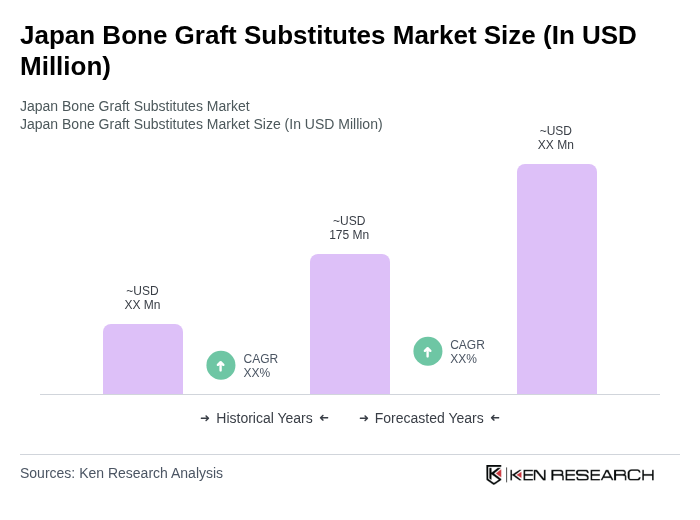
- The Japan Bone Graft Substitutes Market is valued at USD 175 million, based on a five-year historical analysis. This growth is primarily driven by the increasing prevalence of orthopedic and dental surgeries, alongside advancements in surgical techniques and materials. The rising geriatric population, higher incidence of osteoporosis and bone defects, and the growing demand for minimally invasive procedures further contribute to the market's expansion.
- Key regions dominating the market include Tokyo, Osaka, and Nagoya. These cities are home to advanced healthcare infrastructure, a high concentration of medical professionals, and leading research institutions. The presence of major hospitals and specialized clinics in these urban centers facilitates the adoption of innovative bone graft substitutes, enhancing their market position.
- The Regenerative Medicine Act, 2014 issued by the Ministry of Health, Labour and Welfare (MHLW) regulates bone graft substitutes classified as regenerative medical products. This requires manufacturers to submit clinical trial data demonstrating safety and efficacy, with approval pathways including conditional or time-limited marketing authorization for products meeting specific risk-based criteria and performance standards.
Japan Bone Graft Substitutes Market Segmentation
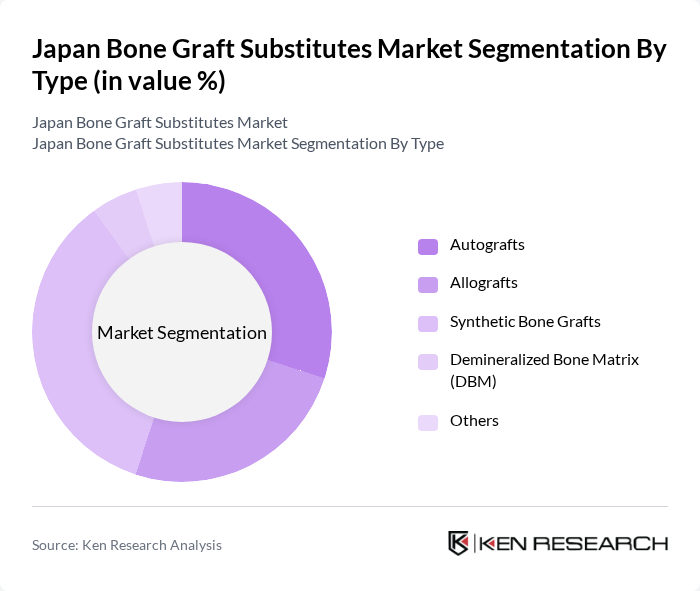
By Type:The market is segmented into various types of bone graft substitutes, including autografts, allografts, synthetic bone grafts, demineralized bone matrix (DBM), and others. Among these, synthetic bone grafts are gaining significant traction due to their biocompatibility and ease of use in various surgical applications. Autografts, while considered the gold standard, are limited by donor site morbidity, leading to a growing preference for synthetic alternatives. The increasing focus on research and development in synthetic materials is expected to further enhance their market presence.
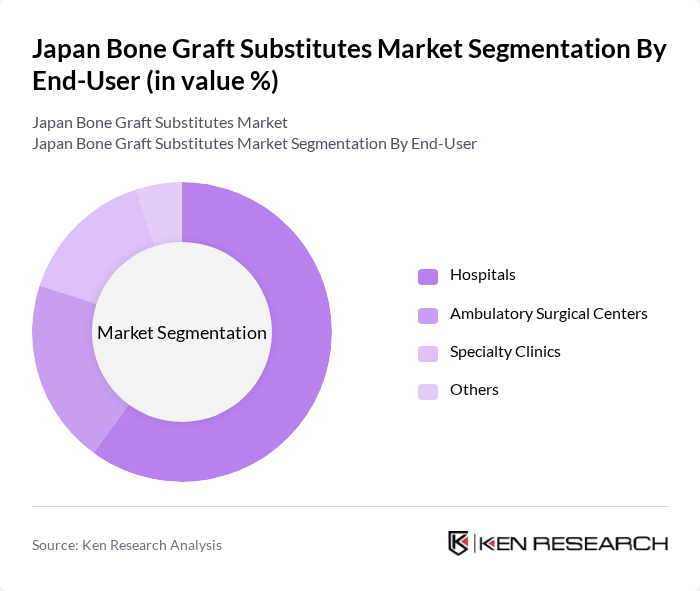
By End-User:The end-user segmentation includes hospitals, ambulatory surgical centers, specialty clinics, and others. Hospitals are the leading end-users, primarily due to their comprehensive surgical facilities and access to advanced medical technologies. The increasing number of orthopedic and dental surgeries performed in hospitals drives the demand for bone graft substitutes. Ambulatory surgical centers are also witnessing growth as they offer cost-effective and efficient surgical options, further contributing to the market dynamics.
Japan Bone Graft Substitutes Market Competitive Landscape
The Japan Bone Graft Substitutes Market is characterized by a dynamic mix of regional and international players. Leading participants such as Medtronic, DePuy Synthes, Stryker Corporation, Zimmer Biomet, Integra LifeSciences, Osstem Implant, Acelity, Geistlich Pharma, BoneSupport, Medbone, Bioventus, AlloSource, RTI Surgical, Orthofix, Xtant Medical contribute to innovation, geographic expansion, and service delivery in this space.
Japan Bone Graft Substitutes Market Industry Analysis
Growth Drivers
- Increasing Prevalence of Orthopedic Surgeries:The demand for bone graft substitutes in Japan is significantly driven by the rising number of orthopedic surgeries, which reached approximately 1.3 million procedures in future. This figure is projected to increase as the population ages and the incidence of conditions such as osteoarthritis and fractures rises. The Japanese Ministry of Health reported that orthopedic surgeries account for nearly 30% of all surgical procedures, highlighting the critical need for effective bone grafting solutions.
- Rising Geriatric Population:Japan has one of the highest proportions of elderly individuals globally, with over 29% of its population aged 65 and older in future. This demographic shift is expected to lead to a higher incidence of bone-related disorders, necessitating more orthopedic interventions. The World Bank estimates that in future, the elderly population will exceed 37 million, further driving the demand for bone graft substitutes to support surgical procedures in this age group.
- Advancements in Bone Grafting Technologies:Technological innovations in bone grafting, such as the development of synthetic materials and bioactive scaffolds, are enhancing the effectiveness of these substitutes. In future, investments in R&D for orthopedic solutions in Japan reached approximately $600 million, reflecting a commitment to improving surgical outcomes. These advancements are expected to increase the adoption of bone graft substitutes, as they offer better integration and healing properties compared to traditional methods.
Market Challenges
- High Cost of Bone Graft Substitutes:The financial burden associated with bone graft substitutes poses a significant challenge in Japan. The average cost of these substitutes can range from ¥55,000 to ¥210,000 per procedure, which may limit accessibility for some patients. As healthcare costs continue to rise, hospitals and clinics may face budget constraints, impacting the availability and adoption of advanced bone grafting solutions in surgical practices.
- Regulatory Hurdles and Approval Processes:The regulatory landscape for medical devices in Japan is stringent, with the Pharmaceuticals and Medical Devices Agency (PMDA) enforcing rigorous approval processes. The average time for product approval can extend up to four years, delaying the introduction of innovative bone graft substitutes to the market. This prolonged timeline can hinder manufacturers' ability to respond swiftly to market demands and technological advancements.
Japan Bone Graft Substitutes Market Future Outlook
The future of the bone graft substitutes market in Japan appears promising, driven by ongoing technological advancements and an increasing focus on personalized medicine. As healthcare providers continue to adopt minimally invasive surgical techniques, the demand for innovative bone grafting solutions is expected to rise. Additionally, the integration of 3D printing technology is likely to revolutionize the production of customized grafts, enhancing patient outcomes and operational efficiency in surgical settings.
Market Opportunities
- Expansion of Healthcare Infrastructure:The Japanese government is investing heavily in healthcare infrastructure, with a budget allocation of ¥1.6 trillion in future. This investment is expected to enhance surgical facilities and increase the availability of advanced medical technologies, creating a favorable environment for the growth of bone graft substitutes.
- Increasing Investment in R&D:With R&D spending in the medical sector projected to reach ¥650 billion in future, there is a significant opportunity for innovation in bone graft substitutes. This investment will likely lead to the development of more effective and affordable solutions, catering to the evolving needs of the aging population and enhancing surgical outcomes.
Scope of the Report
| Segment | Sub-Segments |
|---|---|
| By Type | Autografts Allografts Synthetic Bone Grafts Demineralized Bone Matrix (DBM) Others |
| By End-User | Hospitals Ambulatory Surgical Centers Specialty Clinics Others |
| By Application | Orthopedic Surgery Dental Surgery Spine Surgery Others |
| By Material | Natural Materials Synthetic Materials Composite Materials Others |
| By Distribution Channel | Direct Sales Distributors Online Sales Others |
| By Region | Kanto Kansai Chubu Others |
| By Patient Demographics | Age Group Gender Health Status Others |
Key Target Audience
Investors and Venture Capitalist Firms
Government and Regulatory Bodies (e.g., Ministry of Health, Labour and Welfare)
Manufacturers and Producers
Distributors and Retailers
Healthcare Providers and Hospitals
Medical Device Regulatory Authorities (e.g., Pharmaceuticals and Medical Devices Agency)
Industry Associations (e.g., Japan Medical Device Industry Association)
Insurance Companies and Payers
Players Mentioned in the Report:
Medtronic
DePuy Synthes
Stryker Corporation
Zimmer Biomet
Integra LifeSciences
Osstem Implant
Acelity
Geistlich Pharma
BoneSupport
Medbone
Bioventus
AlloSource
RTI Surgical
Orthofix
Xtant Medical
Table of Contents
Market Assessment Phase
1. Executive Summary and Approach
2. Japan Bone Graft Substitutes Market Overview
2.1 Key Insights and Strategic Recommendations
2.2 Japan Bone Graft Substitutes Market Overview
2.3 Definition and Scope
2.4 Evolution of Market Ecosystem
2.5 Timeline of Key Regulatory Milestones
2.6 Value Chain & Stakeholder Mapping
2.7 Business Cycle Analysis
2.8 Policy & Incentive Landscape
3. Japan Bone Graft Substitutes Market Analysis
3.1 Growth Drivers
3.1.1 Increasing prevalence of orthopedic surgeries
3.1.2 Rising geriatric population
3.1.3 Advancements in bone grafting technologies
3.1.4 Growing demand for minimally invasive procedures
3.2 Market Challenges
3.2.1 High cost of bone graft substitutes
3.2.2 Regulatory hurdles and approval processes
3.2.3 Limited awareness among healthcare professionals
3.2.4 Competition from alternative treatments
3.3 Market Opportunities
3.3.1 Expansion of healthcare infrastructure
3.3.2 Increasing investment in R&D
3.3.3 Collaborations with academic institutions
3.3.4 Growth in medical tourism
3.4 Market Trends
3.4.1 Shift towards synthetic bone graft substitutes
3.4.2 Integration of 3D printing technology
3.4.3 Focus on personalized medicine
3.4.4 Rise in outpatient surgical procedures
3.5 Government Regulation
3.5.1 Stricter quality control measures
3.5.2 Enhanced post-market surveillance
3.5.3 Guidelines for clinical trials
3.5.4 Approval processes for new products
4. SWOT Analysis
5. Stakeholder Analysis
6. Porter's Five Forces Analysis
7. Japan Bone Graft Substitutes Market Market Size, 2019-2024
7.1 By Value
7.2 By Volume
7.3 By Average Selling Price
8. Japan Bone Graft Substitutes Market Segmentation
8.1 By Type
8.1.1 Autografts
8.1.2 Allografts
8.1.3 Synthetic Bone Grafts
8.1.4 Demineralized Bone Matrix (DBM)
8.1.5 Others
8.2 By End-User
8.2.1 Hospitals
8.2.2 Ambulatory Surgical Centers
8.2.3 Specialty Clinics
8.2.4 Others
8.3 By Application
8.3.1 Orthopedic Surgery
8.3.2 Dental Surgery
8.3.3 Spine Surgery
8.3.4 Others
8.4 By Material
8.4.1 Natural Materials
8.4.2 Synthetic Materials
8.4.3 Composite Materials
8.4.4 Others
8.5 By Distribution Channel
8.5.1 Direct Sales
8.5.2 Distributors
8.5.3 Online Sales
8.5.4 Others
8.6 By Region
8.6.1 Kanto
8.6.2 Kansai
8.6.3 Chubu
8.6.4 Others
8.7 By Patient Demographics
8.7.1 Age Group
8.7.2 Gender
8.7.3 Health Status
8.7.4 Others
9. Japan Bone Graft Substitutes Market Competitive Analysis
9.1 Market Share of Key Players
9.2 Cross Comparison of Key Players
9.2.1 Company Name
9.2.2 Group Size (Large, Medium, or Small as per industry convention)
9.2.3 Revenue Growth Rate
9.2.4 Market Penetration Rate
9.2.5 Customer Retention Rate
9.2.6 Product Innovation Rate
9.2.7 Distribution Efficiency
9.2.8 Pricing Strategy
9.2.9 Brand Recognition
9.2.10 Customer Satisfaction Score
9.3 SWOT Analysis of Top Players
9.4 Pricing Analysis
9.5 Detailed Profile of Major Companies
9.5.1 Medtronic
9.5.2 DePuy Synthes
9.5.3 Stryker Corporation
9.5.4 Zimmer Biomet
9.5.5 Integra LifeSciences
9.5.6 Osstem Implant
9.5.7 Acelity
9.5.8 Geistlich Pharma
9.5.9 BoneSupport
9.5.10 Medbone
9.5.11 Bioventus
9.5.12 AlloSource
9.5.13 RTI Surgical
9.5.14 Orthofix
9.5.15 Xtant Medical
10. Japan Bone Graft Substitutes Market End-User Analysis
10.1 Procurement Behavior of Key Ministries
10.1.1 Budget Allocation Trends
10.1.2 Decision-Making Processes
10.1.3 Preferred Suppliers
10.1.4 Compliance Requirements
10.2 Corporate Spend on Infrastructure & Energy
10.2.1 Investment Trends
10.2.2 Budget Prioritization
10.2.3 Long-term Contracts
10.2.4 Others
10.3 Pain Point Analysis by End-User Category
10.3.1 Supply Chain Issues
10.3.2 Quality Concerns
10.3.3 Cost Management
10.3.4 Others
10.4 User Readiness for Adoption
10.4.1 Training Needs
10.4.2 Technology Acceptance
10.4.3 Support Requirements
10.4.4 Others
10.5 Post-Deployment ROI and Use Case Expansion
10.5.1 Performance Metrics
10.5.2 Case Studies
10.5.3 Feedback Mechanisms
10.5.4 Others
11. Japan Bone Graft Substitutes Market Future Size, 2025-2030
11.1 By Value
11.2 By Volume
11.3 By Average Selling Price
Go-To-Market Strategy Phase
1. Whitespace Analysis + Business Model Canvas
1.1 Market Gaps Identification
1.2 Business Model Development
2. Marketing and Positioning Recommendations
2.1 Branding Strategies
2.2 Product USPs
3. Distribution Plan
3.1 Urban Retail vs Rural NGO Tie-ups
4. Channel & Pricing Gaps
4.1 Underserved Routes
4.2 Pricing Bands
5. Unmet Demand & Latent Needs
5.1 Category Gaps
5.2 Consumer Segments
6. Customer Relationship
6.1 Loyalty Programs
6.2 After-sales Service
7. Value Proposition
7.1 Sustainability
7.2 Integrated Supply Chains
8. Key Activities
8.1 Regulatory Compliance
8.2 Branding
8.3 Distribution Setup
9. Entry Strategy Evaluation
9.1 Domestic Market Entry Strategy
9.1.1 Product Mix
9.1.2 Pricing Band
9.1.3 Packaging
9.2 Export Entry Strategy
9.2.1 Target Countries
9.2.2 Compliance Roadmap
10. Entry Mode Assessment
10.1 JV
10.2 Greenfield
10.3 M&A
10.4 Distributor Model
11. Capital and Timeline Estimation
11.1 Capital Requirements
11.2 Timelines
12. Control vs Risk Trade-Off
12.1 Ownership vs Partnerships
13. Profitability Outlook
13.1 Breakeven Analysis
13.2 Long-term Sustainability
14. Potential Partner List
14.1 Distributors
14.2 JVs
14.3 Acquisition Targets
15. Execution Roadmap
15.1 Phased Plan for Market Entry
15.1.1 Market Setup
15.1.2 Market Entry
15.1.3 Growth Acceleration
15.1.4 Scale & Stabilize
15.2 Key Activities and Milestones
15.2.1 Milestone Planning
15.2.2 Activity Tracking
Research Methodology
Phase 1: Approach1
Desk Research
- Analysis of industry reports from Japanese medical device associations and healthcare organizations
- Review of published academic articles and clinical studies on bone graft substitutes
- Examination of government publications and regulatory frameworks related to medical devices in Japan
Primary Research
- Interviews with orthopedic surgeons and specialists in bone grafting procedures
- Surveys with hospital procurement managers regarding purchasing trends and preferences
- Field interviews with representatives from bone graft substitute manufacturers and distributors
Validation & Triangulation
- Cross-validation of findings through multiple data sources, including market reports and expert opinions
- Triangulation of data from clinical outcomes, market demand, and regulatory insights
- Sanity checks conducted through expert panel reviews and feedback sessions
Phase 2: Market Size Estimation1
Top-down Assessment
- Estimation of market size based on national healthcare expenditure and orthopedic surgery statistics
- Segmentation of the market by product type, including synthetic and natural bone graft substitutes
- Incorporation of demographic trends and aging population statistics influencing bone graft demand
Bottom-up Modeling
- Collection of sales data from leading manufacturers of bone graft substitutes in Japan
- Estimation of market share based on volume sold and pricing strategies of key players
- Analysis of hospital purchasing patterns and average usage rates of bone graft substitutes
Forecasting & Scenario Analysis
- Multi-factor regression analysis incorporating factors such as technological advancements and healthcare policies
- Scenario modeling based on potential changes in regulatory environments and market entry of new products
- Development of baseline, optimistic, and pessimistic forecasts through 2030
Phase 3: CATI Sample Composition1
| Scope Item/Segment | Sample Size | Target Respondent Profiles |
|---|---|---|
| Orthopedic Surgeons | 100 | Surgeons specializing in bone grafting and orthopedic procedures |
| Hospital Procurement Managers | 80 | Managers responsible for purchasing medical devices and supplies |
| Bone Graft Substitute Manufacturers | 40 | Executives and product managers from leading manufacturers |
| Healthcare Policy Makers | 50 | Officials involved in medical device regulation and healthcare policy |
| Clinical Researchers | 70 | Researchers focused on orthopedic innovations and clinical outcomes |
Frequently Asked Questions
What is the current value of the Japan Bone Graft Substitutes Market?
The Japan Bone Graft Substitutes Market is valued at approximately USD 175 million, reflecting a significant growth driven by the increasing prevalence of orthopedic and dental surgeries, advancements in surgical techniques, and a rising geriatric population.
What factors are driving the growth of the Japan Bone Graft Substitutes Market?
Which regions in Japan dominate the Bone Graft Substitutes Market?
What types of bone graft substitutes are available in Japan?
Other Regional/Country Reports
Malaysia Bone Graft Substitutes Market
Other Adjacent Reports
KSA Osteoporosis Treatment Market
Philippines Tissue Engineering Market Report Size Share Growth Drivers Trends Opportunities & Forecast 2025–2030KSA Spinal Fusion Market
GCC joint replacement market report Size, Share, Growth Drivers, Trends, Opportunities & Forecast 2025–2030South Africa Surgical Instruments Market
Why Buy From Us?

What makes us stand out is that our consultants follow Robust, Refine and Result (RRR) methodology. Robust for clear definitions, approaches and sanity checking, Refine for differentiating respondents' facts and opinions, and Result for presenting data with story.

We have set a benchmark in the industry by offering our clients with syndicated and customized market research reports featuring coverage of entire market as well as meticulous research and analyst insights.

While we don't replace traditional research, we flip the method upside down. Our dual approach of Top Bottom & Bottom Top ensures quality deliverable by not just verifying company fundamentals but also looking at the sector and macroeconomic factors.

With one step in the future, our research team constantly tries to show you the bigger picture. We help with some of the tough questions you may encounter along the way: How is the industry positioned? Best marketing channel? KPI's of competitors? By aligning every element, we help maximize success.

Our report gives you instant access to the answers and sources that other companies might choose to hide. We elaborate each steps of research methodology we have used and showcase you the sample size to earn your trust.

If you need any support, we are here! We pride ourselves on universe strength, data quality, and quick, friendly, and professional service.