About the Report
Base Year 2024Japan Workers Compensation Market Overview
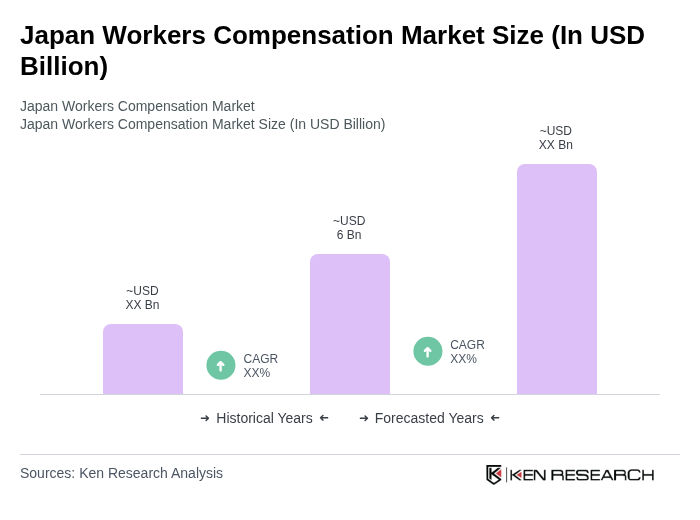
- The Japan Workers Compensation Market is valued at USD 6 billion, based on a five-year historical analysis. This growth is primarily driven by the increasing awareness of workplace safety, rising labor costs, the need for comprehensive employee protection, and the expansion of non-regular workers who require direct insurance coverage. The market has seen a steady rise in claims, prompting employers to invest in better insurance solutions to mitigate risks associated with workplace injuries and illnesses.
- Key cities such as Tokyo, Osaka, and Yokohama dominate the market due to their high concentration of industries and workforce. These urban centers are hubs for manufacturing, technology, and services, leading to a greater demand for workers' compensation insurance. The presence of large corporations and a robust regulatory framework further enhance the market's growth in these regions.
- The Labor Standards Act, 1947 issued by the Ministry of Health, Labour and Welfare, mandates that all employers subscribe to workers' accident compensation insurance through government-designated carriers for all employees, including part-time and temporary workers, covering work-related injuries, illnesses, disabilities, and death with benefits including medical care, cash payments up to 60-91% of average wages, and rehabilitation services without premium caps based on firm size.
Japan Workers Compensation Market Segmentation
By Type:
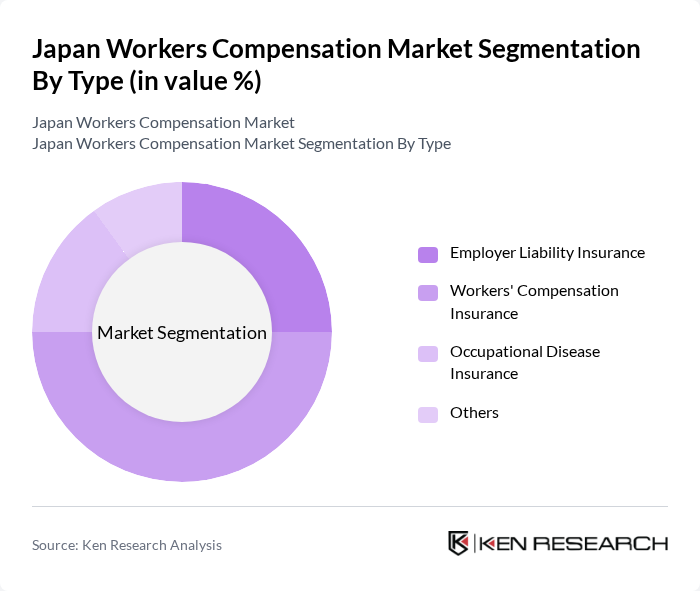
The segmentation by type includes Employer Liability Insurance, Workers' Compensation Insurance, Occupational Disease Insurance, and Others. Among these, Workers' Compensation Insurance is the leading sub-segment, driven by the increasing number of workplace injuries and the legal requirements for employers to provide coverage. This insurance type is essential for protecting employees and ensuring that they receive medical care and compensation for lost wages. The growing awareness of occupational health and safety further propels the demand for this insurance, making it a critical component of the market.
By End-User:
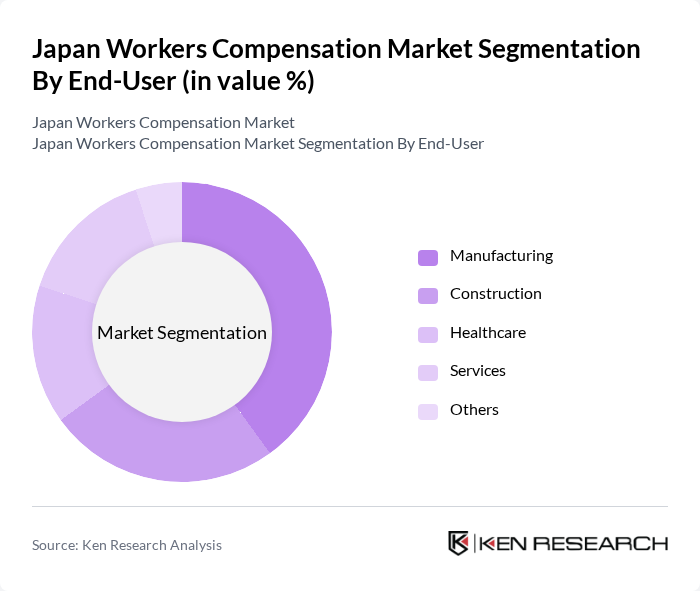
This segmentation includes Manufacturing, Construction, Healthcare, Services, and Others. The Manufacturing sector is the dominant end-user, accounting for a significant portion of the market. This is largely due to the high risk of workplace accidents and injuries associated with manufacturing processes. Companies in this sector are increasingly investing in workers' compensation insurance to protect their workforce and comply with regulatory requirements. The growing emphasis on safety standards and employee welfare in manufacturing further drives the demand for comprehensive insurance solutions.
Japan Workers Compensation Market Competitive Landscape
The Japan Workers Compensation Market is characterized by a dynamic mix of regional and international players. Leading participants such as Tokio Marine & Nichido Fire Insurance Co., Ltd., Sompo Japan Insurance Inc., Mitsui Sumitomo Insurance Co., Ltd., Aioi Nissay Dowa Insurance Co., Ltd., Dai-ichi Life Insurance Company, Limited, Nippon Life Insurance Company, The Japan Mutual Aid Association of Public School Teachers, The Japan Workers' Compensation Insurance Association, Chubb Japan, Zurich Insurance Group, MS&AD Insurance Group Holdings, Inc., AXA Life Insurance Co., Ltd., MetLife Insurance K.K., Liberty Mutual Insurance Japan, Hiscox Japan contribute to innovation, geographic expansion, and service delivery in this space.
Japan Workers Compensation Market Industry Analysis
Growth Drivers
- Increasing Workplace Safety Regulations:Japan's commitment to workplace safety is evident, with the Ministry of Health, Labour and Welfare reporting a 15% increase in safety inspections from 2022 to 2023. This regulatory push aims to reduce workplace accidents, which numbered over 90,000 in recent years. Enhanced regulations are expected to drive demand for workers' compensation insurance, as companies seek to comply and protect their employees, thereby fostering a safer work environment.
- Rising Awareness of Employee Welfare:The Japanese workforce is increasingly prioritizing employee welfare, with 78% of companies in a recent survey by the Japan Institute for Labour Policy and Training indicating a focus on mental health initiatives. This shift is leading to greater investment in workers' compensation programs, as businesses recognize the importance of comprehensive coverage in attracting and retaining talent, ultimately contributing to a more productive workforce.
- Growth in the Industrial Sector:Japan's industrial sector is projected to grow by 3.5% in future, according to the Japan Economic Research Institute. This growth is driven by advancements in manufacturing and technology, leading to increased employment and, consequently, a higher demand for workers' compensation insurance. As industries expand, the need for robust compensation frameworks to protect employees from workplace hazards becomes increasingly critical.
Market Challenges
- High Administrative Costs:The administrative costs associated with managing workers' compensation claims in Japan are significant, averaging around ¥1.2 million per claim as reported by the Japan Workers' Compensation Insurance Association. These costs can deter small businesses from adequately covering their employees, leading to underinsurance and potential legal liabilities, which complicates the overall market landscape.
- Complexity of Regulatory Compliance:Navigating the intricate regulatory landscape poses a challenge for many businesses. In recent years, over 60% of small to medium enterprises reported difficulties in understanding compliance requirements, according to a survey by the Small and Medium Enterprise Agency. This complexity can lead to non-compliance, resulting in penalties and increased scrutiny from regulatory bodies, further straining resources.
Japan Workers Compensation Market Future Outlook
The Japan workers' compensation market is poised for significant transformation, driven by technological advancements and evolving employee expectations. As companies increasingly adopt digital platforms for claims management, efficiency and transparency will improve. Additionally, the focus on mental health and preventive measures will reshape insurance offerings, catering to a workforce that values comprehensive support. These trends indicate a shift towards more adaptive and responsive compensation frameworks, aligning with the changing dynamics of the workplace.
Market Opportunities
- Expansion of Digital Platforms for Claims Management:The integration of digital solutions in claims processing is expected to streamline operations, reducing processing times by up to 30%. This shift not only enhances user experience but also minimizes administrative burdens, allowing insurers to allocate resources more effectively and improve overall service delivery.
- Increasing Demand for Customized Insurance Products:As businesses seek tailored solutions, the demand for customized workers' compensation products is on the rise. In future, it is anticipated that 40% of companies will opt for personalized coverage options, reflecting a growing trend towards flexibility in insurance offerings that meet specific industry needs and employee welfare requirements.
Scope of the Report
| Segment | Sub-Segments |
|---|---|
| By Type | Employer Liability Insurance Workers' Compensation Insurance Occupational Disease Insurance Others |
| By End-User | Manufacturing Construction Healthcare Services Others |
| By Company Size | Small Enterprises Medium Enterprises Large Enterprises Others |
| By Industry Sector | Public Sector Private Sector Non-Profit Organizations Others |
| By Coverage Type | Full Coverage Partial Coverage Customized Coverage Others |
| By Claim Type | Medical Claims Disability Claims Death Claims Others |
| By Policy Duration | Short-term Policies Long-term Policies Others |
Key Target Audience
Investors and Venture Capitalist Firms
Government and Regulatory Bodies (e.g., Ministry of Health, Labour and Welfare)
Insurance Companies
Employers and Business Associations
Healthcare Providers
Legal Firms Specializing in Labor Law
Trade Unions and Worker Advocacy Groups
Risk Management and Safety Consultants
Players Mentioned in the Report:
Tokio Marine & Nichido Fire Insurance Co., Ltd.
Sompo Japan Insurance Inc.
Mitsui Sumitomo Insurance Co., Ltd.
Aioi Nissay Dowa Insurance Co., Ltd.
Dai-ichi Life Insurance Company, Limited
Nippon Life Insurance Company
The Japan Mutual Aid Association of Public School Teachers
The Japan Workers' Compensation Insurance Association
Chubb Japan
Zurich Insurance Group
MS&AD Insurance Group Holdings, Inc.
AXA Life Insurance Co., Ltd.
MetLife Insurance K.K.
Liberty Mutual Insurance Japan
Hiscox Japan
Table of Contents
Market Assessment Phase
1. Executive Summary and Approach
2. Japan Workers Compensation Market Overview
2.1 Key Insights and Strategic Recommendations
2.2 Japan Workers Compensation Market Overview
2.3 Definition and Scope
2.4 Evolution of Market Ecosystem
2.5 Timeline of Key Regulatory Milestones
2.6 Value Chain & Stakeholder Mapping
2.7 Business Cycle Analysis
2.8 Policy & Incentive Landscape
3. Japan Workers Compensation Market Analysis
3.1 Growth Drivers
3.1.1 Increasing workplace safety regulations
3.1.2 Rising awareness of employee welfare
3.1.3 Growth in the industrial sector
3.1.4 Technological advancements in claims processing
3.2 Market Challenges
3.2.1 High administrative costs
3.2.2 Complexity of regulatory compliance
3.2.3 Limited awareness among small businesses
3.2.4 Fraudulent claims
3.3 Market Opportunities
3.3.1 Expansion of digital platforms for claims management
3.3.2 Increasing demand for customized insurance products
3.3.3 Collaboration with health tech companies
3.3.4 Growth in remote work leading to new coverage needs
3.4 Market Trends
3.4.1 Shift towards preventive measures in workplace safety
3.4.2 Integration of AI in claims processing
3.4.3 Rise of telemedicine in worker health management
3.4.4 Increased focus on mental health coverage
3.5 Government Regulation
3.5.1 Mandatory insurance coverage for all employees
3.5.2 Regular audits of compensation claims
3.5.3 Penalties for non-compliance with safety standards
3.5.4 Incentives for companies implementing safety programs
4. SWOT Analysis
5. Stakeholder Analysis
6. Porter's Five Forces Analysis
7. Japan Workers Compensation Market Market Size, 2019-2024
7.1 By Value
7.2 By Volume
7.3 By Average Selling Price
8. Japan Workers Compensation Market Segmentation
8.1 By Type
8.1.1 Employer Liability Insurance
8.1.2 Workers' Compensation Insurance
8.1.3 Occupational Disease Insurance
8.1.4 Others
8.2 By End-User
8.2.1 Manufacturing
8.2.2 Construction
8.2.3 Healthcare
8.2.4 Services
8.2.5 Others
8.3 By Company Size
8.3.1 Small Enterprises
8.3.2 Medium Enterprises
8.3.3 Large Enterprises
8.3.4 Others
8.4 By Industry Sector
8.4.1 Public Sector
8.4.2 Private Sector
8.4.3 Non-Profit Organizations
8.4.4 Others
8.5 By Coverage Type
8.5.1 Full Coverage
8.5.2 Partial Coverage
8.5.3 Customized Coverage
8.5.4 Others
8.6 By Claim Type
8.6.1 Medical Claims
8.6.2 Disability Claims
8.6.3 Death Claims
8.6.4 Others
8.7 By Policy Duration
8.7.1 Short-term Policies
8.7.2 Long-term Policies
8.7.3 Others
9. Japan Workers Compensation Market Competitive Analysis
9.1 Market Share of Key Players
9.2 Cross Comparison of Key Players
9.2.1 Company Name.
9.2.2 Group Size (Large, Medium, or Small as per industry convention).
9.2.3 Claims Processing Efficiency
9.2.4 Customer Satisfaction Rate
9.2.5 Market Penetration Rate
9.2.6 Pricing Strategy
9.2.7 Policy Renewal Rate
9.2.8 Loss Ratio
9.2.9 Compliance Rate with Regulations
9.2.10 Employee Training Programs
9.3 SWOT Analysis of Top Players
9.4 Pricing Analysis
9.5 Detailed Profile of Major Companies
9.5.1 Tokio Marine & Nichido Fire Insurance Co., Ltd.
9.5.2 Sompo Japan Insurance Inc.
9.5.3 Mitsui Sumitomo Insurance Co., Ltd.
9.5.4 Aioi Nissay Dowa Insurance Co., Ltd.
9.5.5 Dai-ichi Life Insurance Company, Limited
9.5.6 Nippon Life Insurance Company
9.5.7 The Japan Mutual Aid Association of Public School Teachers
9.5.8 The Japan Workers' Compensation Insurance Association
9.5.9 Chubb Japan
9.5.10 Zurich Insurance Group
9.5.11 MS&AD Insurance Group Holdings, Inc.
9.5.12 AXA Life Insurance Co., Ltd.
9.5.13 MetLife Insurance K.K.
9.5.14 Liberty Mutual Insurance Japan
9.5.15 Hiscox Japan
10. Japan Workers Compensation Market End-User Analysis
10.1 Procurement Behavior of Key Ministries
10.1.1 Ministry of Health, Labour and Welfare
10.1.2 Ministry of Economy, Trade and Industry
10.1.3 Ministry of Education, Culture, Sports, Science and Technology
10.1.4 Others
10.2 Corporate Spend on Infrastructure & Energy
10.2.1 Investment in Safety Equipment
10.2.2 Training Programs for Employees
10.2.3 Health and Wellness Initiatives
10.2.4 Others
10.3 Pain Point Analysis by End-User Category
10.3.1 Manufacturing Sector
10.3.2 Construction Sector
10.3.3 Healthcare Sector
10.3.4 Others
10.4 User Readiness for Adoption
10.4.1 Awareness of Workers Compensation Policies
10.4.2 Training and Support Availability
10.4.3 Financial Readiness
10.4.4 Others
10.5 Post-Deployment ROI and Use Case Expansion
10.5.1 Measurement of Claims Processing Efficiency
10.5.2 Employee Satisfaction Metrics
10.5.3 Cost Savings from Reduced Claims
10.5.4 Others
11. Japan Workers Compensation Market Future Size, 2025-2030
11.1 By Value
11.2 By Volume
11.3 By Average Selling Price
Go-To-Market Strategy Phase
1. Whitespace Analysis + Business Model Canvas
1.1 Market Gaps Identification
1.2 Business Model Development
2. Marketing and Positioning Recommendations
2.1 Branding Strategies
2.2 Product USPs
3. Distribution Plan
3.1 Urban Retail vs Rural NGO Tie-ups
4. Channel & Pricing Gaps
4.1 Underserved Routes
4.2 Pricing Bands
5. Unmet Demand & Latent Needs
5.1 Category Gaps
5.2 Consumer Segments
6. Customer Relationship
6.1 Loyalty Programs
6.2 After-sales Service
7. Value Proposition
7.1 Sustainability
7.2 Integrated Supply Chains
8. Key Activities
8.1 Regulatory Compliance
8.2 Branding
8.3 Distribution Setup
9. Entry Strategy Evaluation
9.1 Domestic Market Entry Strategy
9.1.1 Product Mix
9.1.2 Pricing Band
9.1.3 Packaging
9.2 Export Entry Strategy
9.2.1 Target Countries
9.2.2 Compliance Roadmap
10. Entry Mode Assessment
10.1 JV
10.2 Greenfield
10.3 M&A
10.4 Distributor Model
11. Capital and Timeline Estimation
11.1 Capital Requirements
11.2 Timelines
12. Control vs Risk Trade-Off
12.1 Ownership vs Partnerships
13. Profitability Outlook
13.1 Breakeven Analysis
13.2 Long-term Sustainability
14. Potential Partner List
14.1 Distributors
14.2 JVs
14.3 Acquisition Targets
15. Execution Roadmap
15.1 Phased Plan for Market Entry
15.1.1 Market Setup
15.1.2 Market Entry
15.1.3 Growth Acceleration
15.1.4 Scale & Stabilize
15.2 Key Activities and Milestones
15.2.1 Milestone Planning
Research Methodology
Phase 1: Approach1
Desk Research
- Analysis of government publications and reports on workers' compensation regulations in Japan
- Review of industry reports from labor organizations and insurance associations
- Examination of academic journals and white papers focusing on occupational health and safety trends
Primary Research
- Interviews with HR managers and safety officers in various industries
- Surveys conducted with employees to gather insights on their experiences with workers' compensation
- Focus groups with legal experts specializing in labor law and workers' compensation claims
Validation & Triangulation
- Cross-validation of findings through comparison with historical claims data from insurance providers
- Triangulation of insights from primary interviews with secondary data trends
- Sanity checks through expert panel discussions involving industry veterans
Phase 2: Market Size Estimation1
Top-down Assessment
- Estimation of total compensation payouts based on national labor statistics
- Segmentation of the market by industry sectors and types of claims
- Incorporation of demographic trends affecting workforce participation and injury rates
Bottom-up Modeling
- Collection of data on average claim sizes from major insurance companies
- Estimation of the number of claims filed annually across different sectors
- Calculation of total market size based on claim frequency and average payout
Forecasting & Scenario Analysis
- Multi-variable analysis considering economic growth, workforce changes, and regulatory impacts
- Scenario modeling based on potential shifts in labor laws and workplace safety standards
- Development of baseline, optimistic, and pessimistic forecasts through 2030
Phase 3: CATI Sample Composition1
| Scope Item/Segment | Sample Size | Target Respondent Profiles |
|---|---|---|
| Manufacturing Sector Workers' Compensation | 120 | HR Managers, Safety Compliance Officers |
| Construction Industry Claims Analysis | 100 | Site Managers, Safety Inspectors |
| Healthcare Sector Compensation Insights | 80 | Nursing Supervisors, Risk Management Directors |
| Service Industry Employee Feedback | 70 | Customer Service Managers, Employee Relations Specialists |
| Legal Perspectives on Workers' Compensation | 60 | Labor Law Attorneys, Claims Adjusters |
Frequently Asked Questions
What is the current value of the Japan Workers Compensation Market?
The Japan Workers Compensation Market is valued at approximately USD 6 billion, reflecting a steady growth driven by increased workplace safety awareness, rising labor costs, and the need for comprehensive employee protection, particularly for non-regular workers.
What are the main types of workers' compensation insurance in Japan?
Which sectors are the largest users of workers' compensation insurance in Japan?
What regulatory framework governs workers' compensation in Japan?
Other Regional/Country Reports
Other Adjacent Reports
Thailand Property and Casualty Insurance Market
Middle East Health Insurance MarketMexico Liability Insurance Market
Oman Group Level Disability Insurance Market Report Size Share Growth Drivers Trends Opportunities & Forecast 2025–2030Japan Occupational Health Services Market
South Korea Workplace Safety Equipment Market
Malaysia Employee Benefits Market
Mexico Risk Management Services Market
South Korea Human Resources Management Market
Qatar Claims Management Software Market
Why Buy From Us?

What makes us stand out is that our consultants follow Robust, Refine and Result (RRR) methodology. Robust for clear definitions, approaches and sanity checking, Refine for differentiating respondents' facts and opinions, and Result for presenting data with story.

We have set a benchmark in the industry by offering our clients with syndicated and customized market research reports featuring coverage of entire market as well as meticulous research and analyst insights.

While we don't replace traditional research, we flip the method upside down. Our dual approach of Top Bottom & Bottom Top ensures quality deliverable by not just verifying company fundamentals but also looking at the sector and macroeconomic factors.

With one step in the future, our research team constantly tries to show you the bigger picture. We help with some of the tough questions you may encounter along the way: How is the industry positioned? Best marketing channel? KPI's of competitors? By aligning every element, we help maximize success.

Our report gives you instant access to the answers and sources that other companies might choose to hide. We elaborate each steps of research methodology we have used and showcase you the sample size to earn your trust.

If you need any support, we are here! We pride ourselves on universe strength, data quality, and quick, friendly, and professional service.