About the Report
Base Year 2024Australia Workers Compensation Market Overview
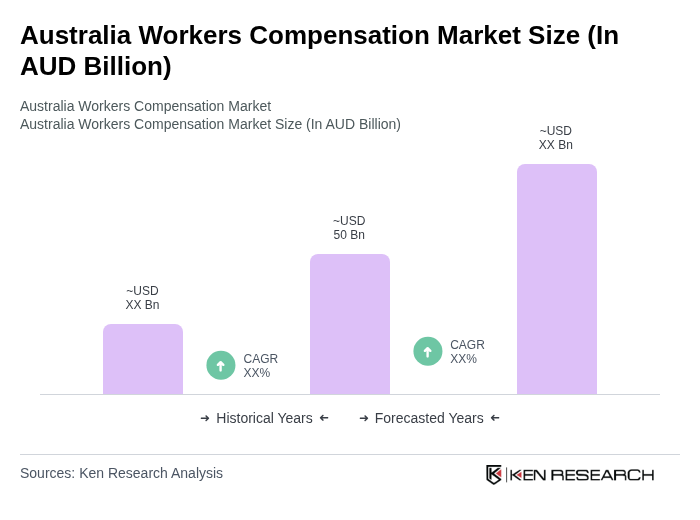
- The Australia Workers Compensation Market is valued at approximately AUD 50 billion, based on a five-year historical analysis. This growth is primarily driven by increasing workplace safety regulations, rising employment rates, growing awareness of employee welfare, escalating psychological injury claims, and rising large-value claims. The market has seen a significant uptick in claims due to the evolving nature of work environments, the need for comprehensive coverage for workers, and legislative reforms addressing mental health injuries.
- Key players in this market include New South Wales, Victoria, and Queensland. These regions dominate due to their large workforce populations, diverse industries, and robust regulatory frameworks that mandate workers' compensation insurance. The concentration of businesses and the presence of major industries in these states further enhance their market significance.
- The Workers Compensation Act 1987, issued by the State Insurance Regulatory Authority (SIRA) in New South Wales, mandates employers to secure insurance covering weekly payments, medical expenses, and rehabilitation for injured workers, with compliance enforced through licensing and premium thresholds based on industry wage rates. This regulation emphasizes the importance of comprehensive coverage and has led to increased investments in safety measures and rehabilitation programs across various sectors.
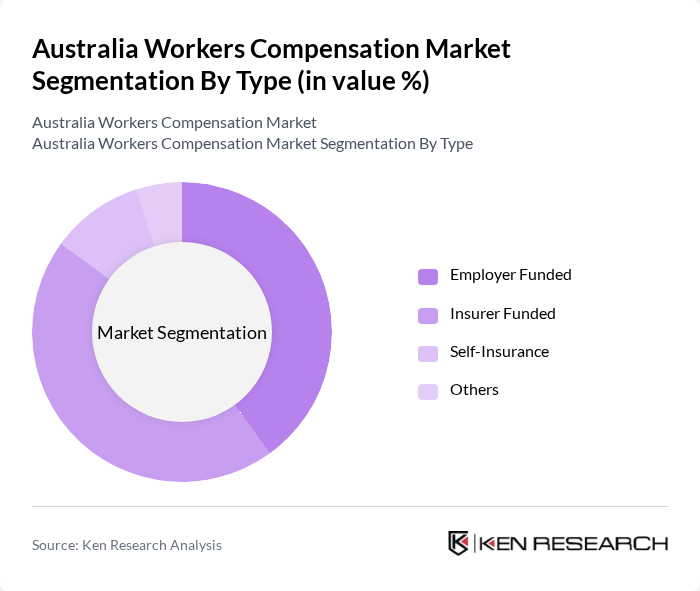
Australia Workers Compensation Market Segmentation
By Type:The market can be segmented into Employer Funded, Insurer Funded, Self-Insurance, and Others. Each of these subsegments plays a crucial role in how workers' compensation is managed and financed across different industries.
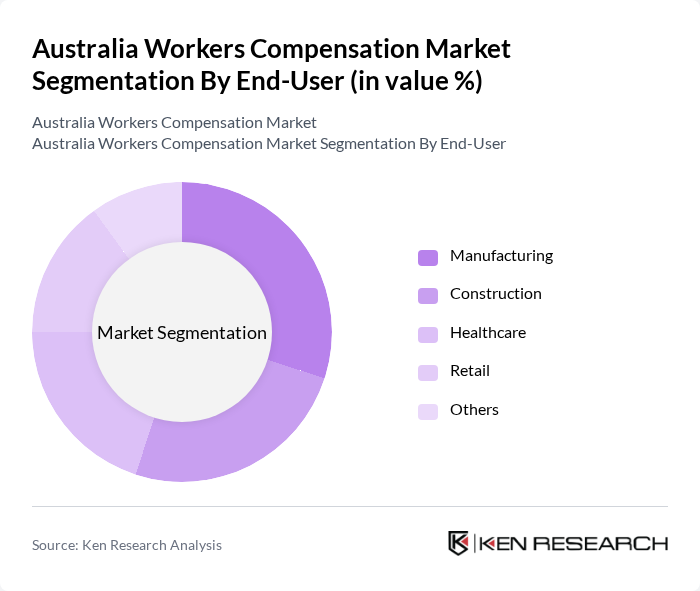
By End-User:The end-user segmentation includes Manufacturing, Construction, Healthcare, Retail, and Others. Each sector has unique requirements and challenges regarding workers' compensation, influencing the overall market dynamics.
Australia Workers Compensation Market Competitive Landscape
The Australia Workers Compensation Market is characterized by a dynamic mix of regional and international players. Leading participants such as Allianz Australia, QBE Insurance, Suncorp Group, CGU Insurance, Employers Mutual, WorkCover Queensland, icare NSW, GIO Insurance, Zurich Australia, AAMI, HBF Health, RAC Insurance, Chubb Insurance, Liberty Mutual, Bupa Australia contribute to innovation, geographic expansion, and service delivery in this space.
Australia Workers Compensation Market Industry Analysis
Growth Drivers
- Increasing Workplace Safety Regulations:The Australian government has implemented stringent workplace safety regulations, resulting in a 15% reduction in workplace injuries from recent years. The Safe Work Australia report indicates that compliance with these regulations has led to a decrease in compensation claims, with the total number of claims falling to 90,000 in the near future. This regulatory environment fosters a culture of safety, encouraging businesses to invest in risk management and employee training, ultimately driving the workers' compensation market.
- Rising Employment Rates:Australia’s employment rate reached 67.5% in the near future, with over 14 million people employed, according to the Australian Bureau of Statistics. This increase in employment directly correlates with a higher number of workers covered under compensation schemes. As more individuals enter the workforce, the demand for comprehensive workers' compensation insurance rises, creating a robust market environment. The growth in employment also reflects economic stability, further supporting the expansion of this sector.
- Technological Advancements in Claims Processing:The integration of technology in claims processing has streamlined operations, reducing processing times by 25% since recent years. Companies are increasingly adopting digital platforms for claims management, which enhances efficiency and customer satisfaction. According to industry reports, 70% of claims are now processed electronically, leading to lower administrative costs and improved accuracy. This technological shift not only benefits insurers but also encourages businesses to engage more actively in the workers' compensation market.
Market Challenges
- High Administrative Costs:Administrative costs in the workers' compensation sector have surged, accounting for approximately 22% of total claims costs in the near future. This increase is attributed to the complexity of claims processing and the need for compliance with various regulations. Insurers face challenges in managing these costs while maintaining profitability, which can lead to higher premiums for businesses. The financial burden of these administrative expenses can deter small businesses from obtaining necessary coverage.
- Fraudulent Claims:Fraudulent claims pose a significant challenge, with estimates suggesting that up to 12% of all claims in Australia are fraudulent. This results in an annual loss of approximately AUD 1.2 billion for insurers. The prevalence of fraud not only increases costs for legitimate claimants but also strains the resources of insurance companies, leading to stricter scrutiny and potentially higher premiums. Addressing this issue is crucial for maintaining the integrity of the workers' compensation system.
Australia Workers Compensation Market Future Outlook
The future of the Australia workers' compensation market appears promising, driven by ongoing regulatory enhancements and technological innovations. As businesses increasingly prioritize employee safety and well-being, the demand for tailored insurance products is expected to rise. Additionally, the integration of artificial intelligence in claims processing will likely improve efficiency and reduce costs. These trends indicate a shift towards a more proactive approach in managing workplace risks, ultimately benefiting both employers and employees in the long term.
Market Opportunities
- Expansion of Digital Platforms for Claims Management:The growing adoption of digital platforms presents a significant opportunity for insurers to enhance claims management processes. By investing in user-friendly interfaces and mobile applications, companies can improve customer engagement and streamline claims submissions, potentially increasing market share and customer loyalty.
- Increased Focus on Mental Health Coverage:As awareness of mental health issues rises, there is a growing demand for comprehensive mental health coverage within workers' compensation policies. Insurers that develop tailored products addressing mental health can tap into this emerging market, providing essential support for employees and differentiating themselves from competitors.
Scope of the Report
| Segment | Sub-Segments |
|---|---|
| By Type | Employer Funded Insurer Funded Self-Insurance Others |
| By End-User | Manufacturing Construction Healthcare Retail Others |
| By Industry Size | Small Enterprises Medium Enterprises Large Enterprises Others |
| By Claim Type | Medical Claims Income Replacement Claims Rehabilitation Claims Others |
| By Coverage Type | Full Coverage Limited Coverage Others |
| By Policy Duration | Short-Term Policies Long-Term Policies Others |
| By Geographic Distribution | New South Wales Victoria Queensland Others |
Key Target Audience
Investors and Venture Capitalist Firms
Government and Regulatory Bodies (e.g., Safe Work Australia, Comcare)
Insurance Companies and Underwriters
Employers and Business Owners
Trade Unions and Worker Advocacy Groups
Healthcare Providers and Rehabilitation Services
Legal Firms Specializing in Workers Compensation
Risk Management and Safety Consultants
Players Mentioned in the Report:
Allianz Australia
QBE Insurance
Suncorp Group
CGU Insurance
Employers Mutual
WorkCover Queensland
icare NSW
GIO Insurance
Zurich Australia
AAMI
HBF Health
RAC Insurance
Chubb Insurance
Liberty Mutual
Bupa Australia
Table of Contents
Market Assessment Phase
1. Executive Summary and Approach
2. Australia Workers Compensation Market Overview
2.1 Key Insights and Strategic Recommendations
2.2 Australia Workers Compensation Market Overview
2.3 Definition and Scope
2.4 Evolution of Market Ecosystem
2.5 Timeline of Key Regulatory Milestones
2.6 Value Chain & Stakeholder Mapping
2.7 Business Cycle Analysis
2.8 Policy & Incentive Landscape
3. Australia Workers Compensation Market Analysis
3.1 Growth Drivers
3.1.1 Increasing Workplace Safety Regulations
3.1.2 Rising Employment Rates
3.1.3 Technological Advancements in Claims Processing
3.1.4 Growing Awareness of Employee Well-being
3.2 Market Challenges
3.2.1 High Administrative Costs
3.2.2 Fraudulent Claims
3.2.3 Variability in State Regulations
3.2.4 Limited Awareness Among Small Businesses
3.3 Market Opportunities
3.3.1 Expansion of Digital Platforms for Claims Management
3.3.2 Increased Focus on Mental Health Coverage
3.3.3 Development of Tailored Insurance Products
3.3.4 Partnerships with Health and Safety Organizations
3.4 Market Trends
3.4.1 Shift Towards Preventive Measures
3.4.2 Integration of AI in Claims Processing
3.4.3 Rise of Flexible Work Arrangements
3.4.4 Emphasis on Data Analytics for Risk Assessment
3.5 Government Regulation
3.5.1 National Workers Compensation Framework
3.5.2 State-Specific Legislation Variations
3.5.3 Compliance Requirements for Employers
3.5.4 Reporting and Transparency Mandates
4. SWOT Analysis
5. Stakeholder Analysis
6. Porter's Five Forces Analysis
7. Australia Workers Compensation Market Market Size, 2019-2024
7.1 By Value
7.2 By Volume
7.3 By Average Selling Price
8. Australia Workers Compensation Market Segmentation
8.1 By Type
8.1.1 Employer Funded
8.1.2 Insurer Funded
8.1.3 Self-Insurance
8.1.4 Others
8.2 By End-User
8.2.1 Manufacturing
8.2.2 Construction
8.2.3 Healthcare
8.2.4 Retail
8.2.5 Others
8.3 By Industry Size
8.3.1 Small Enterprises
8.3.2 Medium Enterprises
8.3.3 Large Enterprises
8.3.4 Others
8.4 By Claim Type
8.4.1 Medical Claims
8.4.2 Income Replacement Claims
8.4.3 Rehabilitation Claims
8.4.4 Others
8.5 By Coverage Type
8.5.1 Full Coverage
8.5.2 Limited Coverage
8.5.3 Others
8.6 By Policy Duration
8.6.1 Short-Term Policies
8.6.2 Long-Term Policies
8.6.3 Others
8.7 By Geographic Distribution
8.7.1 New South Wales
8.7.2 Victoria
8.7.3 Queensland
8.7.4 Others
9. Australia Workers Compensation Market Competitive Analysis
9.1 Market Share of Key Players
9.2 Cross Comparison of Key Players
9.2.1 Company Name
9.2.2 Group Size (Large, Medium, or Small as per industry convention)
9.2.3 Claims Processing Efficiency
9.2.4 Customer Satisfaction Rate
9.2.5 Market Penetration Rate
9.2.6 Pricing Strategy
9.2.7 Loss Ratio
9.2.8 Policy Renewal Rate
9.2.9 Average Claim Settlement Time
9.2.10 Compliance Rate with Regulations
9.3 SWOT Analysis of Top Players
9.4 Pricing Analysis
9.5 Detailed Profile of Major Companies
9.5.1 Allianz Australia
9.5.2 QBE Insurance
9.5.3 Suncorp Group
9.5.4 CGU Insurance
9.5.5 Employers Mutual
9.5.6 WorkCover Queensland
9.5.7 icare NSW
9.5.8 GIO Insurance
9.5.9 Zurich Australia
9.5.10 AAMI
9.5.11 HBF Health
9.5.12 RAC Insurance
9.5.13 Chubb Insurance
9.5.14 Liberty Mutual
9.5.15 Bupa Australia
10. Australia Workers Compensation Market End-User Analysis
10.1 Procurement Behavior of Key Ministries
10.1.1 Ministry of Employment
10.1.2 Ministry of Health
10.1.3 Ministry of Finance
10.1.4 Others
10.2 Corporate Spend on Infrastructure & Energy
10.2.1 Investment in Safety Equipment
10.2.2 Training and Development Expenditure
10.2.3 Health and Wellness Programs
10.2.4 Others
10.3 Pain Point Analysis by End-User Category
10.3.1 Small Businesses
10.3.2 Large Corporations
10.3.3 Government Entities
10.3.4 Others
10.4 User Readiness for Adoption
10.4.1 Awareness of Workers Compensation Benefits
10.4.2 Training on Claims Process
10.4.3 Technology Adoption for Claims Management
10.4.4 Others
10.5 Post-Deployment ROI and Use Case Expansion
10.5.1 Cost Savings from Reduced Claims
10.5.2 Improved Employee Retention Rates
10.5.3 Enhanced Workplace Safety Metrics
10.5.4 Others
11. Australia Workers Compensation Market Future Size, 2025-2030
11.1 By Value
11.2 By Volume
11.3 By Average Selling Price
Go-To-Market Strategy Phase
1. Whitespace Analysis + Business Model Canvas
1.1 Market Gaps Identification
1.2 Business Model Development
2. Marketing and Positioning Recommendations
2.1 Branding Strategies
2.2 Product USPs
3. Distribution Plan
3.1 Urban Retail Strategies
3.2 Rural NGO Tie-ups
4. Channel & Pricing Gaps
4.1 Underserved Routes
4.2 Pricing Bands
5. Unmet Demand & Latent Needs
5.1 Category Gaps
5.2 Consumer Segments
6. Customer Relationship
6.1 Loyalty Programs
6.2 After-sales Service
7. Value Proposition
7.1 Sustainability
7.2 Integrated Supply Chains
8. Key Activities
8.1 Regulatory Compliance
8.2 Branding
8.3 Distribution Setup
9. Entry Strategy Evaluation
9.1 Domestic Market Entry Strategy
9.1.1 Product Mix
9.1.2 Pricing Band
9.1.3 Packaging
9.2 Export Entry Strategy
9.2.1 Target Countries
9.2.2 Compliance Roadmap
10. Entry Mode Assessment
10.1 JV
10.2 Greenfield
10.3 M&A
10.4 Distributor Model
11. Capital and Timeline Estimation
11.1 Capital Requirements
11.2 Timelines
12. Control vs Risk Trade-Off
12.1 Ownership vs Partnerships
13. Profitability Outlook
13.1 Breakeven Analysis
13.2 Long-term Sustainability
14. Potential Partner List
14.1 Distributors
14.2 JVs
14.3 Acquisition Targets
15. Execution Roadmap
15.1 Phased Plan for Market Entry
15.1.1 Market Setup
15.1.2 Market Entry
15.1.3 Growth Acceleration
15.1.4 Scale & Stabilize
15.2 Key Activities and Milestones
15.2.1 Milestone Tracking
15.2.2 Activity Scheduling
Research Methodology
Phase 1: Approach1
Desk Research
- Analysis of government reports and statistics on workers' compensation claims and expenditures
- Review of industry publications and white papers from insurance and risk management organizations
- Examination of historical data on workplace injuries and compensation trends from Safe Work Australia
Primary Research
- Interviews with claims adjusters and underwriters from leading workers' compensation insurers
- Surveys with HR managers and safety officers across various industries
- Focus groups with injured workers to understand their experiences and perceptions of the compensation process
Validation & Triangulation
- Cross-validation of findings through comparison with industry benchmarks and historical data
- Triangulation of insights from primary interviews with secondary data sources
- Sanity checks conducted through expert panel reviews comprising industry veterans and academic researchers
Phase 2: Market Size Estimation1
Top-down Assessment
- Estimation of total workers' compensation market size based on national employment statistics and injury rates
- Segmentation of the market by industry sectors, including construction, healthcare, and manufacturing
- Incorporation of legislative changes and their impact on compensation costs and claims frequency
Bottom-up Modeling
- Collection of data on average claim costs and frequency from major insurers
- Analysis of premium rates and loss ratios across different sectors
- Estimation of total claims volume based on firm-level data and industry averages
Forecasting & Scenario Analysis
- Multi-factor regression analysis incorporating economic indicators, employment trends, and safety regulations
- Scenario modeling based on potential changes in legislation and workplace safety initiatives
- Development of baseline, optimistic, and pessimistic forecasts through 2030
Phase 3: CATI Sample Composition1
| Scope Item/Segment | Sample Size | Target Respondent Profiles |
|---|---|---|
| Construction Industry Claims | 120 | Safety Managers, Project Supervisors |
| Healthcare Sector Compensation | 100 | HR Directors, Risk Management Officers |
| Manufacturing Sector Injuries | 110 | Operations Managers, Safety Compliance Officers |
| Retail Sector Workers' Compensation | 90 | Store Managers, HR Representatives |
| Transport and Logistics Claims | 80 | Fleet Managers, Safety Coordinators |
Frequently Asked Questions
What is the current value of the Australia Workers Compensation Market?
The Australia Workers Compensation Market is valued at approximately AUD 50 billion, driven by factors such as increasing workplace safety regulations, rising employment rates, and growing awareness of employee welfare. This market has experienced significant growth over the past five years.
What are the key drivers of growth in the Australia Workers Compensation Market?
Which regions dominate the Australia Workers Compensation Market?
What does the Workers Compensation Act 1987 mandate?
Other Regional/Country Reports
Other Adjacent Reports
UAE Liability Insurance Market
Germany Occupational Health and Safety Market
Bahrain Risk Management Services Market
Qatar Insurtech Market Size, Share, Growth Drivers & Forecast 2025–2030Kuwait Employee Benefits Market
Saudi Arabia Mental Health Services Market Size, Share, Growth Drivers, Trends, Opportunities & Forecast 2025–2030Indonesia Rehabilitation Services Market
Brazil Claims Management Software Market
Why Buy From Us?

What makes us stand out is that our consultants follow Robust, Refine and Result (RRR) methodology. Robust for clear definitions, approaches and sanity checking, Refine for differentiating respondents' facts and opinions, and Result for presenting data with story.

We have set a benchmark in the industry by offering our clients with syndicated and customized market research reports featuring coverage of entire market as well as meticulous research and analyst insights.

While we don't replace traditional research, we flip the method upside down. Our dual approach of Top Bottom & Bottom Top ensures quality deliverable by not just verifying company fundamentals but also looking at the sector and macroeconomic factors.

With one step in the future, our research team constantly tries to show you the bigger picture. We help with some of the tough questions you may encounter along the way: How is the industry positioned? Best marketing channel? KPI's of competitors? By aligning every element, we help maximize success.

Our report gives you instant access to the answers and sources that other companies might choose to hide. We elaborate each steps of research methodology we have used and showcase you the sample size to earn your trust.

If you need any support, we are here! We pride ourselves on universe strength, data quality, and quick, friendly, and professional service.