About the Report
Base Year 2024Kuwait Workers Compensation Market Overview
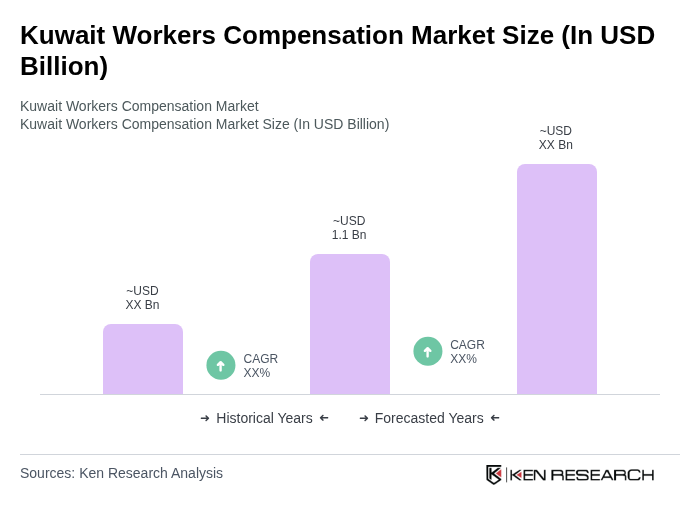
- The Kuwait Workers Compensation Market is valued at USD 1.1 billion, based on a five-year historical analysis. This growth is primarily driven by the increasing number of expatriate workers and the government's commitment to enhancing labor rights and safety regulations. The rising awareness of employee welfare and the need for comprehensive insurance coverage have further propelled the market's expansion.
- Kuwait City is the dominant hub in the Workers Compensation Market due to its status as the capital and the center of economic activities. The concentration of industries, including oil and gas, construction, and services, contributes significantly to the demand for workers' compensation insurance. Additionally, the presence of numerous multinational corporations in the region enhances the market's growth potential.
- The Ministerial Resolution No. 67 of 2022 issued by the Ministry of Social Affairs and Labour mandates employers to provide compensation for workplace injuries and occupational diseases, covering medical treatment, temporary and permanent disability, and death benefits. Employers must secure insurance coverage or demonstrate financial capacity to pay claims exceeding certain thresholds, with compliance enforced through inspections and penalties for non-adherence, which has led to an increase in the uptake of workers' compensation policies across various sectors.
Kuwait Workers Compensation Market Segmentation
By Benefit Type:
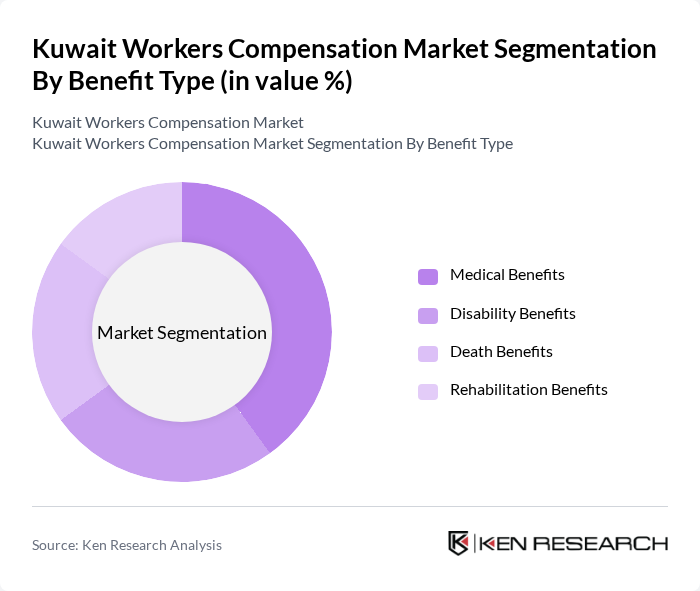
The benefit type segment is dominated by Medical Benefits, which account for a significant portion of the market. This is largely due to the high incidence of workplace injuries in sectors such as construction and manufacturing, where medical expenses can be substantial. Employers are increasingly recognizing the importance of providing comprehensive medical coverage to ensure employee well-being and to comply with regulatory requirements. The rising healthcare costs and the need for timely medical intervention further drive the demand for medical benefits in workers' compensation policies.
By End-User:
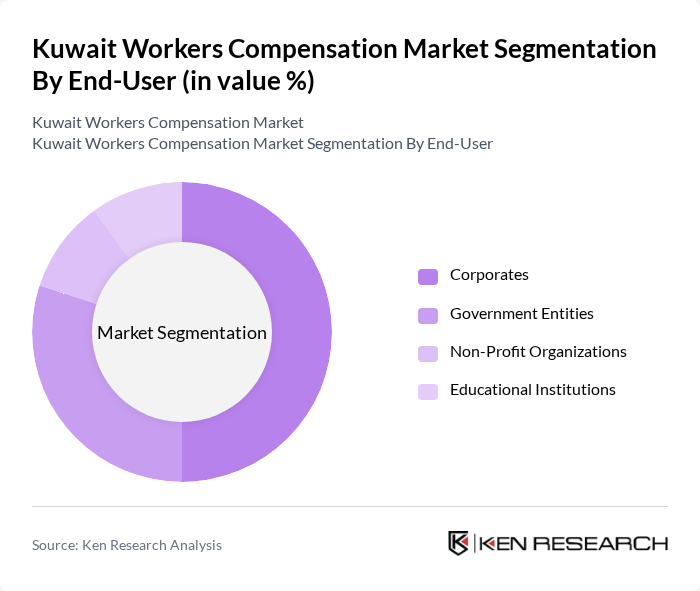
Corporates are the leading end-user segment in the workers' compensation market, accounting for half of the total market share. This dominance is attributed to the large number of employees in the private sector, particularly in industries such as oil and gas, construction, and services. Corporates are increasingly investing in comprehensive workers' compensation plans to mitigate risks associated with workplace injuries and to enhance employee satisfaction. The regulatory environment also compels businesses to secure adequate coverage for their workforce, further solidifying the corporates' position in the market.
Kuwait Workers Compensation Market Competitive Landscape
The Kuwait Workers Compensation Market is characterized by a dynamic mix of regional and international players. Leading participants such as Gulf Insurance Group, Kuwait Insurance Company, National Life & General Insurance Company, National Insurance Company, Warba Insurance Company, Takaful International, Al-Masraf Insurance Company, Al-Ahlia Insurance Company, Kuwait Reinsurance Company, Al Qudra Insurance, United Insurance Company, Al Sagr Cooperative Insurance Company, Al Koot Insurance, Al-Madina for Finance and Investment, Al-Ahli Bank of Kuwait contribute to innovation, geographic expansion, and service delivery in this space.
Kuwait Workers Compensation Market Industry Analysis
Growth Drivers
- Increasing Workforce Participation:The workforce participation rate in Kuwait reached approximately 75% in future, driven by economic reforms and a push for gender equality in the workplace. This increase translates to a larger pool of employees eligible for workers' compensation, thereby expanding the market. The government’s initiatives to enhance job opportunities, particularly for women, are expected to further boost participation rates, leading to a higher demand for comprehensive insurance coverage.
- Rising Awareness of Employee Rights:In recent years, there has been a notable increase in awareness regarding employee rights in Kuwait, with over 65% of workers now informed about their entitlements to compensation. This shift is attributed to educational campaigns and advocacy by labor organizations. As employees become more knowledgeable about their rights, the demand for workers' compensation insurance is expected to rise, compelling employers to comply with legal requirements and provide adequate coverage.
- Government Mandates for Insurance Coverage:The Kuwaiti government has implemented mandatory insurance coverage laws, requiring all employers to provide workers' compensation insurance. As of future, it is estimated that over 92% of businesses are compliant with these regulations. This legal framework not only protects employees but also drives the growth of the insurance market, as companies seek to fulfill their obligations and mitigate potential liabilities associated with workplace injuries.
Market Challenges
- High Premium Costs:One of the significant challenges facing the workers' compensation market in Kuwait is the high premium costs associated with insurance coverage. In future, the average premium for workers' compensation insurance was reported to be around KWD 1,300 per policy, which can be a substantial financial burden for small and medium-sized enterprises. This cost can deter businesses from obtaining necessary coverage, potentially leaving employees unprotected in case of workplace incidents.
- Regulatory Compliance Complexities:Navigating the regulatory landscape for workers' compensation in Kuwait can be complex, with numerous compliance requirements that vary by industry. In future, over 45% of employers reported difficulties in understanding and adhering to these regulations. This complexity can lead to unintentional non-compliance, resulting in penalties and increased scrutiny from regulatory bodies, which can further complicate the operational landscape for businesses.
Kuwait Workers Compensation Market Future Outlook
The future of the Kuwait workers' compensation market appears promising, driven by ongoing economic diversification and a commitment to enhancing employee welfare. As the government continues to enforce mandatory insurance coverage, businesses will increasingly recognize the importance of compliance. Additionally, the integration of technology in claims processing is expected to streamline operations, making it easier for employers to manage their insurance needs while improving employee satisfaction and safety standards across various sectors.
Market Opportunities
- Digital Transformation in Claims Processing:The adoption of digital tools for claims processing presents a significant opportunity for the workers' compensation market. In future, it is anticipated that 55% of claims will be processed digitally, reducing administrative burdens and enhancing efficiency. This shift can lead to faster claim resolutions, improved customer satisfaction, and lower operational costs for insurers.
- Development of Tailored Insurance Products:There is a growing demand for customized insurance products that cater to specific industries and workforce needs. In future, insurers that develop tailored solutions can capture a larger market share, as businesses seek coverage that aligns with their unique risk profiles. This trend will likely drive innovation and competition within the market, benefiting both employers and employees.
Scope of the Report
| Segment | Sub-Segments |
|---|---|
| By Benefit Type | Medical Benefits Disability Benefits Death Benefits Rehabilitation Benefits |
| By End-User | Corporates Government Entities Non-Profit Organizations Educational Institutions |
| By Industry | Construction Manufacturing Oil & Gas Healthcare Services |
| By Coverage Type | Income Replacement Medical Expense Coverage Survivor Benefits Others |
| By Claim Type | Injury Claims Occupational Disease Claims Fatal Claims Others |
| By Policy Duration | Short-Term Policies Long-Term Policies Others |
| By Distribution Channel | Direct Sales Brokers Online Platforms Others |
Key Target Audience
Investors and Venture Capitalist Firms
Government and Regulatory Bodies (e.g., Ministry of Social Affairs and Labor, Public Authority for Manpower)
Insurance Companies
Employers and Business Owners
Trade Unions and Labor Organizations
Healthcare Providers and Medical Institutions
Legal Firms Specializing in Labor Law
Risk Management and Safety Consultants
Players Mentioned in the Report:
Gulf Insurance Group
Kuwait Insurance Company
National Life & General Insurance Company
National Insurance Company
Warba Insurance Company
Takaful International
Al-Masraf Insurance Company
Al-Ahlia Insurance Company
Kuwait Reinsurance Company
Al Qudra Insurance
United Insurance Company
Al Sagr Cooperative Insurance Company
Al Koot Insurance
Al-Madina for Finance and Investment
Al-Ahli Bank of Kuwait
Table of Contents
Market Assessment Phase
1. Executive Summary and Approach
2. Kuwait Workers Compensation Market Overview
2.1 Key Insights and Strategic Recommendations
2.2 Kuwait Workers Compensation Market Overview
2.3 Definition and Scope
2.4 Evolution of Market Ecosystem
2.5 Timeline of Key Regulatory Milestones
2.6 Value Chain & Stakeholder Mapping
2.7 Business Cycle Analysis
2.8 Policy & Incentive Landscape
3. Kuwait Workers Compensation Market Analysis
3.1 Growth Drivers
3.1.1 Increasing workforce participation
3.1.2 Rising awareness of employee rights
3.1.3 Government mandates for insurance coverage
3.1.4 Economic diversification initiatives
3.2 Market Challenges
3.2.1 High premium costs
3.2.2 Limited awareness among employers
3.2.3 Regulatory compliance complexities
3.2.4 Fraudulent claims
3.3 Market Opportunities
3.3.1 Digital transformation in claims processing
3.3.2 Expansion of coverage options
3.3.3 Partnerships with healthcare providers
3.3.4 Development of tailored insurance products
3.4 Market Trends
3.4.1 Shift towards preventive care
3.4.2 Integration of technology in claims management
3.4.3 Increased focus on mental health coverage
3.4.4 Customization of policies for different sectors
3.5 Government Regulation
3.5.1 Mandatory insurance coverage laws
3.5.2 Regulations on claim processing timelines
3.5.3 Guidelines for workplace safety standards
3.5.4 Compliance requirements for insurers
4. SWOT Analysis
5. Stakeholder Analysis
6. Porter's Five Forces Analysis
7. Kuwait Workers Compensation Market Market Size, 2019-2024
7.1 By Value
7.2 By Volume
7.3 By Average Selling Price
8. Kuwait Workers Compensation Market Segmentation
8.1 By Benefit Type
8.1.1 Medical Benefits
8.1.2 Disability Benefits
8.1.3 Death Benefits
8.1.4 Rehabilitation Benefits
8.2 By End-User
8.2.1 Corporates
8.2.2 Government Entities
8.2.3 Non-Profit Organizations
8.2.4 Educational Institutions
8.3 By Industry
8.3.1 Construction
8.3.2 Manufacturing
8.3.3 Oil & Gas
8.3.4 Healthcare
8.3.5 Services
8.4 By Coverage Type
8.4.1 Income Replacement
8.4.2 Medical Expense Coverage
8.4.3 Survivor Benefits
8.4.4 Others
8.5 By Claim Type
8.5.1 Injury Claims
8.5.2 Occupational Disease Claims
8.5.3 Fatal Claims
8.5.4 Others
8.6 By Policy Duration
8.6.1 Short-Term Policies
8.6.2 Long-Term Policies
8.6.3 Others
8.7 By Distribution Channel
8.7.1 Direct Sales
8.7.2 Brokers
8.7.3 Online Platforms
8.7.4 Others
9. Kuwait Workers Compensation Market Competitive Analysis
9.1 Market Share of Key Players
9.2 Cross Comparison of Key Players
9.2.1 Company Name
9.2.2 Group Size (Large, Medium, or Small as per industry convention)
9.2.3 Gross Written Premium (GWP) Growth Rate (% YoY)
9.2.4 Incurred Loss Ratio (%)
9.2.5 Combined Ratio (%)
9.2.6 Market Share (%)
9.2.7 Return on Equity (ROE %)
9.2.8 Claims Settlement Ratio (%)
9.2.9 Policy Renewal Rate (%)
9.2.10 Solvency Ratio
9.3 SWOT Analysis of Top Players
9.4 Pricing Analysis
9.5 Detailed Profile of Major Companies
9.5.1 Gulf Insurance Group
9.5.2 Kuwait Insurance Company
9.5.3 National Life & General Insurance Company
9.5.4 National Insurance Company
9.5.5 Warba Insurance Company
9.5.6 Takaful International
9.5.7 Al-Masraf Insurance Company
9.5.8 Al-Ahlia Insurance Company
9.5.9 Kuwait Reinsurance Company
9.5.10 Al Qudra Insurance
9.5.11 United Insurance Company
9.5.12 Al Sagr Cooperative Insurance Company
9.5.13 Al Koot Insurance
9.5.14 Al-Madina for Finance and Investment
9.5.15 Al-Ahli Bank of Kuwait
10. Kuwait Workers Compensation Market End-User Analysis
10.1 Procurement Behavior of Key Ministries
10.1.1 Ministry of Health
10.1.2 Ministry of Social Affairs
10.1.3 Ministry of Labor
10.1.4 Others
10.2 Corporate Spend on Infrastructure & Energy
10.2.1 Investment in Safety Programs
10.2.2 Budget Allocation for Insurance
10.2.3 Expenditure on Employee Training
10.2.4 Others
10.3 Pain Point Analysis by End-User Category
10.3.1 Employers
10.3.2 Employees
10.3.3 Insurers
10.3.4 Others
10.4 User Readiness for Adoption
10.4.1 Awareness Levels
10.4.2 Training Needs
10.4.3 Technology Adoption
10.4.4 Others
10.5 Post-Deployment ROI and Use Case Expansion
10.5.1 Cost Savings from Reduced Claims
10.5.2 Improved Employee Retention
10.5.3 Enhanced Productivity
10.5.4 Others
11. Kuwait Workers Compensation Market Future Size, 2025-2030
11.1 By Value
11.2 By Volume
11.3 By Average Selling Price
Go-To-Market Strategy Phase
1. Whitespace Analysis + Business Model Canvas
1.1 Market Gaps Identification
2. Marketing and Positioning Recommendations
2.1 Branding Strategies
2.2 Product USPs
3. Distribution Plan
3.1 Urban Retail vs Rural NGO Tie-ups
4. Channel & Pricing Gaps
4.1 Underserved Routes
4.2 Pricing Bands
5. Unmet Demand & Latent Needs
5.1 Category Gaps
5.2 Consumer Segments
6. Customer Relationship
6.1 Loyalty Programs
6.2 After-Sales Service
7. Value Proposition
7.1 Sustainability
7.2 Integrated Supply Chains
8. Key Activities
8.1 Regulatory Compliance
8.2 Branding
8.3 Distribution Setup
9. Entry Strategy Evaluation
9.1 Domestic Market Entry Strategy
9.1.1 Product Mix
9.1.2 Pricing Band
9.1.3 Packaging
9.2 Export Entry Strategy
9.2.1 Target Countries
9.2.2 Compliance Roadmap
10. Entry Mode Assessment
10.1 JV
10.2 Greenfield
10.3 M&A
10.4 Distributor Model
11. Capital and Timeline Estimation
11.1 Capital Requirements
11.2 Timelines
12. Control vs Risk Trade-Off
12.1 Ownership vs Partnerships
13. Profitability Outlook
13.1 Breakeven Analysis
13.2 Long-Term Sustainability
14. Potential Partner List
14.1 Distributors
14.2 JVs
14.3 Acquisition Targets
15. Execution Roadmap
15.1 Phased Plan for Market Entry
15.1.1 Market Setup
15.1.2 Market Entry
15.1.3 Growth Acceleration
15.1.4 Scale & Stabilize
15.2 Key Activities and Milestones
15.2.1 Activity Timeline
15.2.2 Milestone Tracking
Research Methodology
Phase 1: Approach1
Desk Research
- Analysis of government reports and labor statistics from the Ministry of Social Affairs and Labor in Kuwait
- Review of existing literature on workers' compensation frameworks and policies in the Gulf Cooperation Council (GCC) region
- Examination of industry publications and white papers from insurance and legal firms specializing in labor laws
Primary Research
- Interviews with HR managers and compliance officers from major Kuwaiti corporations
- Surveys conducted with insurance providers and brokers specializing in workers' compensation
- Focus group discussions with labor unions and employee advocacy groups to gather insights on worker experiences
Validation & Triangulation
- Cross-validation of findings through comparison with regional compensation models and practices
- Triangulation of data from government sources, industry reports, and expert interviews
- Sanity checks through feedback from a panel of legal and insurance experts in the Kuwaiti market
Phase 2: Market Size Estimation1
Top-down Assessment
- Estimation of total compensation payouts based on national employment statistics and average claim sizes
- Segmentation of the market by industry sectors such as construction, healthcare, and services
- Incorporation of projected growth rates in employment and changes in regulatory frameworks
Bottom-up Modeling
- Collection of data on claims frequency and severity from major insurance providers operating in Kuwait
- Estimation of administrative costs associated with claims processing and management
- Calculation of total market size based on aggregated data from individual firms and sectors
Forecasting & Scenario Analysis
- Development of predictive models using historical claims data and employment trends
- Scenario analysis based on potential changes in labor laws and economic conditions
- Creation of multiple forecasts (baseline, optimistic, and pessimistic) through 2030
Phase 3: CATI Sample Composition1
| Scope Item/Segment | Sample Size | Target Respondent Profiles |
|---|---|---|
| Construction Industry Workers' Compensation | 120 | Site Managers, Safety Officers |
| Healthcare Sector Claims Management | 100 | HR Managers, Risk Management Directors |
| Service Industry Employee Experiences | 90 | Employee Relations Specialists, Union Representatives |
| Insurance Provider Insights | 110 | Claims Adjusters, Underwriters |
| Legal Perspectives on Workers' Rights | 80 | Labor Lawyers, Compliance Officers |
Frequently Asked Questions
What is the current value of the Kuwait Workers Compensation Market?
The Kuwait Workers Compensation Market is valued at approximately USD 1.1 billion, reflecting growth driven by an increasing number of expatriate workers and the government's commitment to enhancing labor rights and safety regulations.
What factors are driving the growth of the Kuwait Workers Compensation Market?
Which city is the primary hub for the Kuwait Workers Compensation Market?
What are the main benefits covered under Kuwait's Workers Compensation policies?
Other Regional/Country Reports
Other Adjacent Reports
Mexico Property and Casualty Insurance Market
Germany Reinsurance MarketSingapore Occupational Health Services Market
Qatar Employee Benefits Market
Brazil Risk Management Services Market
UAE Commercial Insurance Market
Malaysia Human Resources Services Market
Why Buy From Us?

What makes us stand out is that our consultants follow Robust, Refine and Result (RRR) methodology. Robust for clear definitions, approaches and sanity checking, Refine for differentiating respondents' facts and opinions, and Result for presenting data with story.

We have set a benchmark in the industry by offering our clients with syndicated and customized market research reports featuring coverage of entire market as well as meticulous research and analyst insights.

While we don't replace traditional research, we flip the method upside down. Our dual approach of Top Bottom & Bottom Top ensures quality deliverable by not just verifying company fundamentals but also looking at the sector and macroeconomic factors.

With one step in the future, our research team constantly tries to show you the bigger picture. We help with some of the tough questions you may encounter along the way: How is the industry positioned? Best marketing channel? KPI's of competitors? By aligning every element, we help maximize success.

Our report gives you instant access to the answers and sources that other companies might choose to hide. We elaborate each steps of research methodology we have used and showcase you the sample size to earn your trust.

If you need any support, we are here! We pride ourselves on universe strength, data quality, and quick, friendly, and professional service.