About the Report
Base Year 2024New Zealand Workers Compensation Market Overview
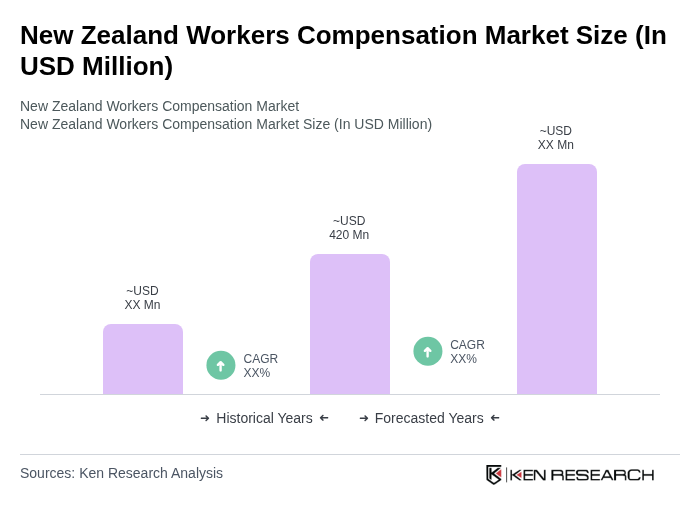
- The New Zealand Workers Compensation Market is valued at USD 420 million, based on a five-year historical analysis. This growth is primarily driven by increasing awareness of workplace safety, regulatory changes, and the rising number of claims related to workplace injuries and illnesses. The market has seen a steady increase in demand for comprehensive coverage options, reflecting the evolving needs of both employers and employees, with industry data indicating a 30% increase in the rate of injured workers accessing weekly compensation since 2014.
- Key players in this market include Auckland, Wellington, and Christchurch, which dominate due to their significant industrial activities and population density. These cities have a higher concentration of businesses and workers, leading to a greater demand for workers' compensation services. Additionally, the presence of major insurance companies in these urban centers facilitates better service delivery and innovation in coverage options.
- The Health and Safety at Work Act 2015, issued by the New Zealand Department of Labour, mandates that employers ensure the health and safety of their workers through comprehensive risk management frameworks. This regulation emphasizes the need for effective risk management and injury prevention strategies, thereby increasing the demand for workers' compensation insurance as businesses seek to comply with legal requirements and protect their workforce. The legislation establishes specific compliance requirements for workplace hazard identification, risk assessment, and implementation of control measures to prevent workplace injuries and illnesses.
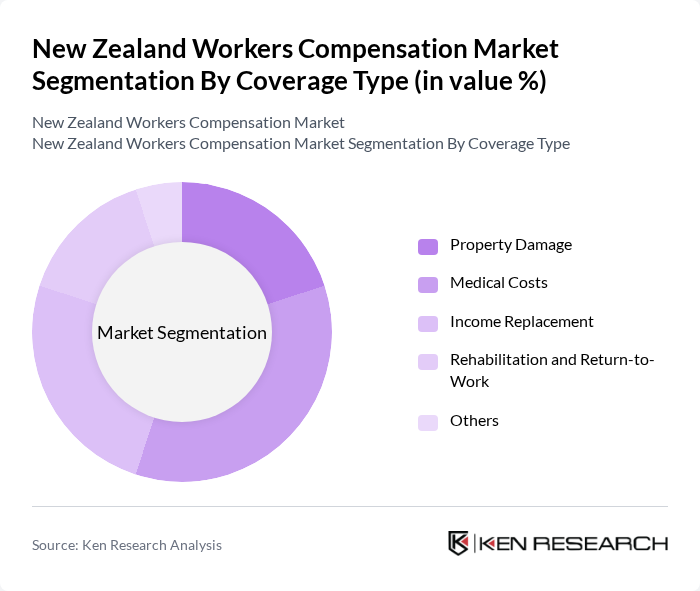
New Zealand Workers Compensation Market Segmentation
By Coverage Type:The coverage types in the market include Property Damage, Medical Costs, Income Replacement, Rehabilitation and Return-to-Work, and Others. Among these, Medical Costs is the leading sub-segment, driven by the increasing healthcare expenses associated with workplace injuries. Employers are increasingly recognizing the importance of providing comprehensive medical coverage to ensure employee well-being and reduce long-term costs associated with workplace injuries.
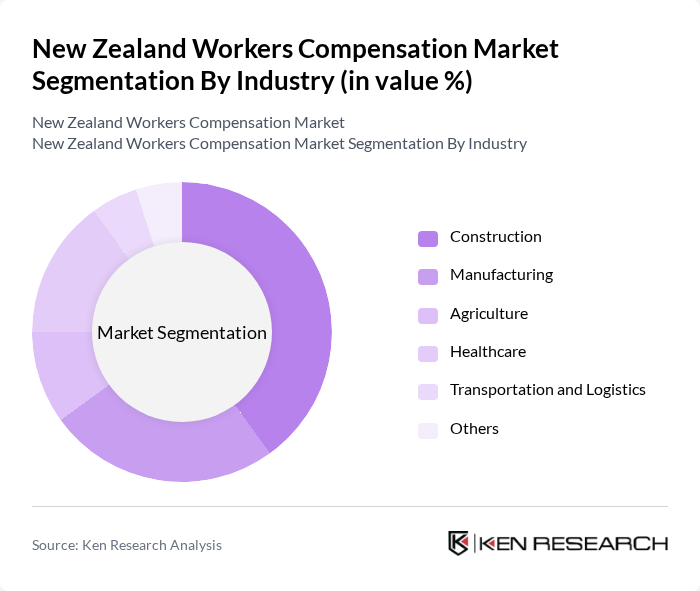
By Industry:The industries covered in the market include Construction, Manufacturing, Agriculture, Healthcare, Transportation and Logistics, and Others. The Construction industry is the dominant segment, primarily due to the high risk of workplace injuries associated with construction activities. As a result, there is a significant demand for workers' compensation insurance to cover potential injuries and ensure compliance with safety regulations.
New Zealand Workers Compensation Market Competitive Landscape
The New Zealand Workers Compensation Market is characterized by a dynamic mix of regional and international players. Leading participants such as Accident Compensation Corporation (ACC), IAG New Zealand, Vero Insurance, QBE Insurance, AIG New Zealand, Tower Insurance, Southern Cross Health Society, NZI Insurance, AMI Insurance, State Insurance, FMG Insurance, Cigna New Zealand, nib New Zealand, Allianz New Zealand, Westpac New Zealand contribute to innovation, geographic expansion, and service delivery in this space.
New Zealand Workers Compensation Market Industry Analysis
Growth Drivers
- Increasing Workplace Safety Regulations:New Zealand's commitment to workplace safety is evident in the Health and Safety at Work Act, which mandates that businesses implement safety measures. In future, the number of workplace injuries reported was approximately 48,000, prompting stricter regulations. The government allocated NZD 1.6 billion for safety initiatives, reflecting a growing emphasis on compliance and risk management, which directly drives the demand for workers' compensation insurance.
- Rising Awareness of Employee Welfare:The focus on employee welfare has surged, with 80% of New Zealand businesses recognizing the importance of mental health support in the workplace. This shift has led to increased investments in wellness programs, with companies spending an average of NZD 1,300 per employee annually on health initiatives. As organizations prioritize employee well-being, the demand for comprehensive workers' compensation coverage is expected to rise, enhancing market growth.
- Growth in the Labor Market:New Zealand's labor market is projected to grow by 3% in future, driven by sectors such as healthcare and technology. This growth translates to an increase in the workforce, which is expected to reach 2.9 million by the end of future. As more employees enter the market, the need for workers' compensation insurance will expand, providing a significant boost to the industry and ensuring adequate coverage for a diverse workforce.
Market Challenges
- High Administrative Costs:The administrative costs associated with managing workers' compensation claims in New Zealand are substantial, averaging NZD 1,200 per claim. These costs can deter small businesses from obtaining necessary coverage, as they may struggle to absorb these expenses. Additionally, the complexity of claims processing can lead to inefficiencies, further straining resources and impacting overall market growth.
- Complexity of Regulatory Compliance:Navigating the regulatory landscape in New Zealand can be challenging for businesses, particularly small enterprises. Compliance with the Accident Compensation Corporation (ACC) regulations requires significant time and resources, with an estimated 35% of businesses reporting difficulties in understanding their obligations. This complexity can lead to non-compliance risks, ultimately hindering the growth of the workers' compensation market as businesses may opt for minimal coverage.
New Zealand Workers Compensation Market Future Outlook
The New Zealand workers' compensation market is poised for significant evolution, driven by technological advancements and a heightened focus on employee wellness. As businesses increasingly adopt digital platforms for claims management, efficiency will improve, reducing administrative burdens. Furthermore, the integration of mental health support into compensation frameworks will likely become standard practice, reflecting societal shifts towards holistic employee care. These trends indicate a dynamic market landscape that prioritizes both safety and employee well-being, fostering a more resilient workforce.
Market Opportunities
- Expansion of Digital Platforms for Claims Management:The rise of digital solutions in claims processing presents a significant opportunity for the workers' compensation market. In future, it is estimated that 65% of claims will be processed digitally, streamlining operations and enhancing customer experience. This shift can lead to reduced processing times and lower administrative costs, benefiting both insurers and policyholders.
- Increased Focus on Mental Health Support:As awareness of mental health issues grows, there is a unique opportunity to develop specialized insurance products that address these needs. The market for mental health-related coverage is expected to expand, with businesses increasingly willing to invest in comprehensive support systems. This trend can enhance employee satisfaction and retention, ultimately driving demand for tailored workers' compensation solutions.
Scope of the Report
| Segment | Sub-Segments |
|---|---|
| By Coverage Type | Property Damage Medical Costs Income Replacement Rehabilitation and Return-to-Work Others |
| By Industry | Construction Manufacturing Agriculture Healthcare Transportation and Logistics Others |
| By Claim Type | Physical Injury Claims Occupational Disease Claims Mental Health Claims Fatal Claims Others |
| By Employer Size | Micro & Small Businesses Mid-Market Enterprises Large Corporations Public Sector |
| By Distribution Channel | Accident Compensation Corporation (ACC) Brokers and Agents Direct Insurance Others |
| By Geographic Distribution | North Island South Island |
Key Target Audience
Investors and Venture Capitalist Firms
Government and Regulatory Bodies (e.g., WorkSafe New Zealand, Accident Compensation Corporation)
Employers and Business Owners
Insurance Providers and Underwriters
Healthcare Providers and Medical Practitioners
Trade Unions and Worker Advocacy Groups
Legal Professionals and Law Firms
Risk Management and Safety Consultants
Players Mentioned in the Report:
Accident Compensation Corporation (ACC)
IAG New Zealand
Vero Insurance
QBE Insurance
AIG New Zealand
Tower Insurance
Southern Cross Health Society
NZI Insurance
AMI Insurance
State Insurance
FMG Insurance
Cigna New Zealand
nib New Zealand
Allianz New Zealand
Westpac New Zealand
Table of Contents
Market Assessment Phase
1. Executive Summary and Approach
2. New Zealand Workers Compensation Market Overview
2.1 Key Insights and Strategic Recommendations
2.2 New Zealand Workers Compensation Market Overview
2.3 Definition and Scope
2.4 Evolution of Market Ecosystem
2.5 Timeline of Key Regulatory Milestones
2.6 Value Chain & Stakeholder Mapping
2.7 Business Cycle Analysis
2.8 Policy & Incentive Landscape
3. New Zealand Workers Compensation Market Analysis
3.1 Growth Drivers
3.1.1 Increasing workplace safety regulations
3.1.2 Rising awareness of employee welfare
3.1.3 Growth in the labor market
3.1.4 Technological advancements in claims processing
3.2 Market Challenges
3.2.1 High administrative costs
3.2.2 Complexity of regulatory compliance
3.2.3 Fraudulent claims
3.2.4 Limited awareness among small businesses
3.3 Market Opportunities
3.3.1 Expansion of digital platforms for claims management
3.3.2 Increased focus on mental health support
3.3.3 Development of customized insurance products
3.3.4 Partnerships with health service providers
3.4 Market Trends
3.4.1 Shift towards preventive measures in workplace safety
3.4.2 Integration of AI in claims processing
3.4.3 Growing emphasis on employee wellness programs
3.4.4 Rise of remote work and its implications on coverage
3.5 Government Regulation
3.5.1 Health and Safety at Work Act
3.5.2 Accident Compensation Corporation (ACC) regulations
3.5.3 Employment Relations Act
3.5.4 Privacy Act compliance in claims handling
4. SWOT Analysis
5. Stakeholder Analysis
6. Porter's Five Forces Analysis
7. New Zealand Workers Compensation Market Market Size, 2019-2024
7.1 By Value
7.2 By Volume
7.3 By Average Selling Price
8. New Zealand Workers Compensation Market Segmentation
8.1 By Coverage Type
8.1.1 Property Damage
8.1.2 Medical Costs
8.1.3 Income Replacement
8.1.4 Rehabilitation and Return-to-Work
8.1.5 Others
8.2 By Industry
8.2.1 Construction
8.2.2 Manufacturing
8.2.3 Agriculture
8.2.4 Healthcare
8.2.5 Transportation and Logistics
8.2.6 Others
8.3 By Claim Type
8.3.1 Physical Injury Claims
8.3.2 Occupational Disease Claims
8.3.3 Mental Health Claims
8.3.4 Fatal Claims
8.3.5 Others
8.4 By Employer Size
8.4.1 Micro & Small Businesses
8.4.2 Mid-Market Enterprises
8.4.3 Large Corporations
8.4.4 Public Sector
8.5 By Distribution Channel
8.5.1 Accident Compensation Corporation (ACC)
8.5.2 Brokers and Agents
8.5.3 Direct Insurance
8.5.4 Others
8.6 By Geographic Distribution
8.6.1 North Island
8.6.2 South Island
9. New Zealand Workers Compensation Market Competitive Analysis
9.1 Market Share of Key Players
9.2 Cross Comparison of Key Players
9.2.1 Company Name
9.2.2 Market Share (%)
9.2.3 Gross Written Premiums Growth Rate (CAGR)
9.2.4 Claims Ratio (%)
9.2.5 Combined Ratio (%)
9.2.6 Return on Equity (ROE %)
9.2.7 Customer Satisfaction (NPS Score)
9.2.8 Average Claim Settlement Time (Days)
9.2.9 Digital Claims Processing Adoption (%)
9.2.10 Regulatory Compliance Score
9.3 SWOT Analysis of Top Players
9.4 Pricing Analysis
9.5 Detailed Profile of Major Companies
9.5.1 Accident Compensation Corporation (ACC)
9.5.2 IAG New Zealand
9.5.3 Vero Insurance
9.5.4 QBE Insurance
9.5.5 AIG New Zealand
9.5.6 Tower Insurance
9.5.7 Southern Cross Health Society
9.5.8 NZI Insurance
9.5.9 AMI Insurance
9.5.10 State Insurance
9.5.11 FMG Insurance
9.5.12 Cigna New Zealand
9.5.13 nib New Zealand
9.5.14 Allianz New Zealand
9.5.15 Westpac New Zealand
10. New Zealand Workers Compensation Market End-User Analysis
10.1 Procurement Behavior of Key Ministries
10.1.1 Ministry of Business, Innovation and Employment
10.1.2 Ministry of Health
10.1.3 Ministry of Education
10.1.4 Others
10.2 Corporate Spend on Infrastructure & Energy
10.2.1 Corporate investment trends
10.2.2 Budget allocation for safety programs
10.2.3 Spending on employee training
10.2.4 Others
10.3 Pain Point Analysis by End-User Category
10.3.1 Small businesses
10.3.2 Large corporations
10.3.3 Government agencies
10.3.4 Others
10.4 User Readiness for Adoption
10.4.1 Awareness of compensation schemes
10.4.2 Training and support availability
10.4.3 Technology adoption levels
10.4.4 Others
10.5 Post-Deployment ROI and Use Case Expansion
10.5.1 Evaluation of ROI metrics
10.5.2 Case studies of successful implementations
10.5.3 Opportunities for scaling
10.5.4 Others
11. New Zealand Workers Compensation Market Future Size, 2025-2030
11.1 By Value
11.2 By Volume
11.3 By Average Selling Price
Go-To-Market Strategy Phase
1. Whitespace Analysis + Business Model Canvas
1.1 Market gaps identification
1.2 Business model development
2. Marketing and Positioning Recommendations
2.1 Branding strategies
2.2 Product USPs
3. Distribution Plan
3.1 Urban retail vs rural NGO tie-ups
4. Channel & Pricing Gaps
4.1 Underserved routes
4.2 Pricing bands
5. Unmet Demand & Latent Needs
5.1 Category gaps
5.2 Consumer segments
6. Customer Relationship
6.1 Loyalty programs
6.2 After-sales service
7. Value Proposition
7.1 Sustainability
7.2 Integrated supply chains
8. Key Activities
8.1 Regulatory compliance
8.2 Branding
8.3 Distribution setup
9. Entry Strategy Evaluation
9.1 Domestic Market Entry Strategy
9.1.1 Product mix
9.1.2 Pricing band
9.1.3 Packaging
9.2 Export Entry Strategy
9.2.1 Target countries
9.2.2 Compliance roadmap
10. Entry Mode Assessment
10.1 JV
10.2 Greenfield
10.3 M&A
10.4 Distributor Model
11. Capital and Timeline Estimation
11.1 Capital requirements
11.2 Timelines
12. Control vs Risk Trade-Off
12.1 Ownership vs Partnerships
13. Profitability Outlook
13.1 Breakeven analysis
13.2 Long-term sustainability
14. Potential Partner List
14.1 Distributors
14.2 JVs
14.3 Acquisition targets
15. Execution Roadmap
15.1 Phased Plan for Market Entry
15.1.1 Market Setup
15.1.2 Market Entry
15.1.3 Growth Acceleration
15.1.4 Scale & Stabilize
15.2 Key Activities and Milestones
15.2.1 Milestone tracking
15.2.2 Activity scheduling
Research Methodology
Phase 1: Approach1
Desk Research
- Analysis of government publications and reports on workers' compensation regulations in New Zealand
- Review of industry reports from insurance and risk management associations
- Examination of academic journals and case studies related to workplace safety and compensation trends
Primary Research
- Interviews with key stakeholders in the workers' compensation sector, including insurers and employers
- Surveys targeting HR managers and safety officers across various industries
- Focus groups with injured workers to gather insights on their experiences and perceptions
Validation & Triangulation
- Cross-validation of findings through comparison with historical claims data and industry benchmarks
- Triangulation of qualitative insights from interviews with quantitative data from surveys
- Sanity checks conducted through expert panel reviews comprising industry veterans and regulatory officials
Phase 2: Market Size Estimation1
Top-down Assessment
- Estimation of total workers' compensation market size based on national employment statistics and injury rates
- Segmentation of the market by industry sectors, including construction, healthcare, and manufacturing
- Incorporation of trends in workplace safety regulations and their impact on compensation costs
Bottom-up Modeling
- Collection of premium data from leading workers' compensation insurers to establish baseline costs
- Analysis of claims data to determine average claim sizes and frequency across different sectors
- Estimation of administrative costs associated with claims processing and management
Forecasting & Scenario Analysis
- Multi-factor regression analysis incorporating economic indicators, employment growth, and safety initiatives
- Scenario modeling based on potential changes in legislation and their effects on claims and premiums
- Development of baseline, optimistic, and pessimistic forecasts for the next five years
Phase 3: CATI Sample Composition1
| Scope Item/Segment | Sample Size | Target Respondent Profiles |
|---|---|---|
| Construction Industry Workers | 100 | Site Managers, Safety Officers |
| Healthcare Sector Employees | 80 | Nurses, Hospital Administrators |
| Manufacturing Workers | 90 | Production Supervisors, HR Managers |
| Retail Sector Employees | 70 | Store Managers, Customer Service Representatives |
| Transport and Logistics Workers | 60 | Logistics Coordinators, Fleet Managers |
Frequently Asked Questions
What is the current value of the New Zealand Workers Compensation Market?
The New Zealand Workers Compensation Market is valued at approximately USD 420 million, reflecting a steady growth driven by increased awareness of workplace safety, regulatory changes, and a rise in claims related to workplace injuries and illnesses.
What are the main drivers of growth in the New Zealand Workers Compensation Market?
Which cities dominate the New Zealand Workers Compensation Market?
What types of coverage are available in the New Zealand Workers Compensation Market?
Other Regional/Country Reports
Other Adjacent Reports
UAE Liability Insurance Market
UAE Occupational Health and Safety Market
Philippines Risk Management Services Market
UAE Employee Benefits Market
Philippines Rehabilitation Services Market
Saudi Arabia Mental Health Services Market Size, Share, Growth Drivers, Trends, Opportunities & Forecast 2025–2030Qatar Claims Management Software Market
Singapore Workplace Wellness Market
Oman Commercial Insurance Market
Why Buy From Us?

What makes us stand out is that our consultants follow Robust, Refine and Result (RRR) methodology. Robust for clear definitions, approaches and sanity checking, Refine for differentiating respondents' facts and opinions, and Result for presenting data with story.

We have set a benchmark in the industry by offering our clients with syndicated and customized market research reports featuring coverage of entire market as well as meticulous research and analyst insights.

While we don't replace traditional research, we flip the method upside down. Our dual approach of Top Bottom & Bottom Top ensures quality deliverable by not just verifying company fundamentals but also looking at the sector and macroeconomic factors.

With one step in the future, our research team constantly tries to show you the bigger picture. We help with some of the tough questions you may encounter along the way: How is the industry positioned? Best marketing channel? KPI's of competitors? By aligning every element, we help maximize success.

Our report gives you instant access to the answers and sources that other companies might choose to hide. We elaborate each steps of research methodology we have used and showcase you the sample size to earn your trust.

If you need any support, we are here! We pride ourselves on universe strength, data quality, and quick, friendly, and professional service.