About the Report
Base Year 2025KSA Digital WealthTech Platforms Market Overview
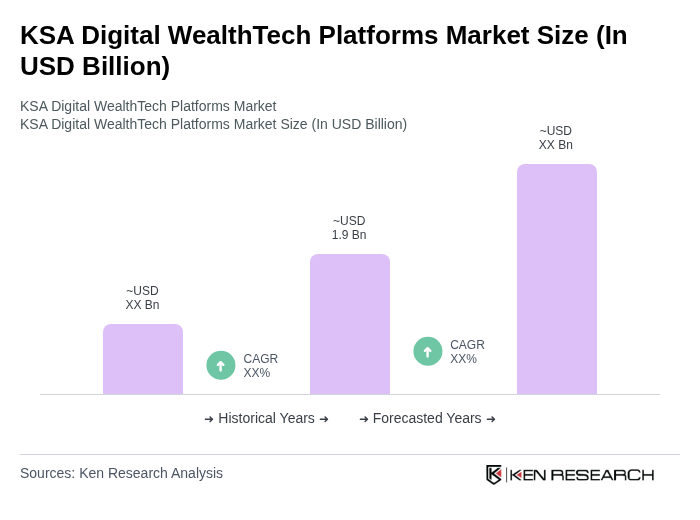
- The KSA Digital WealthTech Platforms Market is valued at approximately USD 1.9 billion, based on a five-year historical analysis of fintech wealthtech and robo-advisory activities in Saudi Arabia. This growth is primarily driven by the increasing adoption of digital financial services, expanding fintech penetration across payments, wealth management and robo-advisory, a surge in smartphone and internet usage, and rising awareness of investment opportunities among retail and mass affluent segments. The market is also supported by government initiatives under Vision 2030 to promote financial technology, digital transformation, and innovation in the financial sector, including targeted support for fintech licensing and regulatory sandboxes.
- Key cities such as Riyadh, Jeddah, and Dammam dominate the KSA Digital WealthTech Platforms Market due to their economic significance, advanced financial infrastructure, and concentration of financial institutions. Riyadh, as the capital and central financial hub, serves as the core market for fintech and wealthtech, supported by major banks, asset managers, and dedicated digital transformation programs. Jeddah’s strategic role as a commercial and trade center strengthens its demand for digital investment and wealth solutions, while the eastern region around Dammam, with its proximity to oil and gas and industrial activity, contributes to the growth of wealth management and investment services for corporates and high-net-worth individuals.
- In 2023, the Saudi Central Bank (SAMA) continued to expand the regulatory framework for digital financial services and fintech, building on prior initiatives such as the SAMA Regulatory Sandbox and dedicated fintech licensing regimes for payment, financing and wealth management activities. Key binding instruments shaping the digital wealth and investment environment include the Rules for Digital-Only Banks issued by the Saudi Central Bank in 2020, which set capital, governance, risk management and technology requirements for purely digital institutions servicing retail and investment customers.These frameworks, together with SAMA’s Fintech Saudi program and sandbox guidelines, provide structured licensing, consumer protection, cybersecurity and operational standards that support innovation in digital wealth management and related fintech solutions.
KSA Digital WealthTech Platforms Market Segmentation
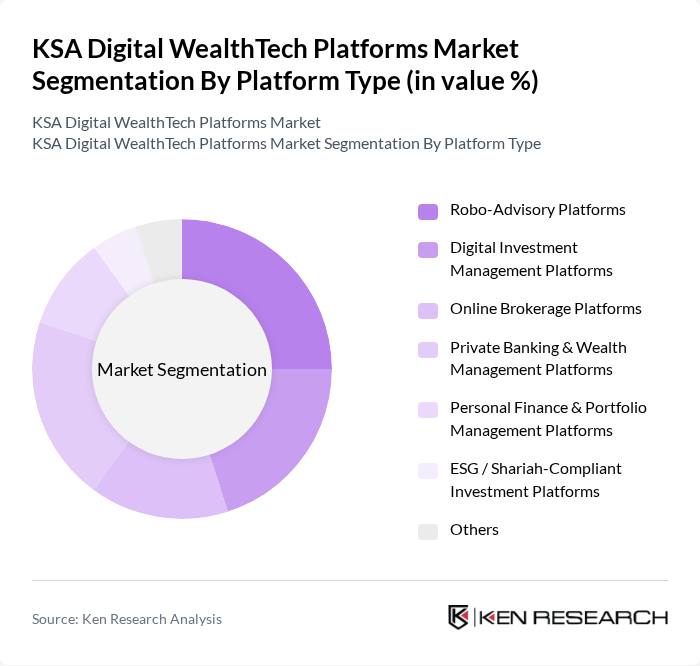
By Platform Type:The KSA Digital WealthTech Platforms Market can be segmented into various platform types, including Robo-Advisory Platforms, Digital Investment Management Platforms, Online Brokerage Platforms, Private Banking & Wealth Management Platforms, Personal Finance & Portfolio Management Platforms, ESG / Shariah-Compliant Investment Platforms, and Others. This segmentation aligns with broader wealth management and wealthtech service categories observed in the KSA market, where discretionary portfolio management, advisory mandates, brokerage and execution, private banking solutions, and digital robo-advisory are the primary service lines delivered through both traditional and digital channels. Each of these segments caters to different consumer needs and preferences, reflecting the diverse landscape of digital wealth management solutions ranging from automated investment advice to full-service private banking and Shariah-compliant investment offerings.
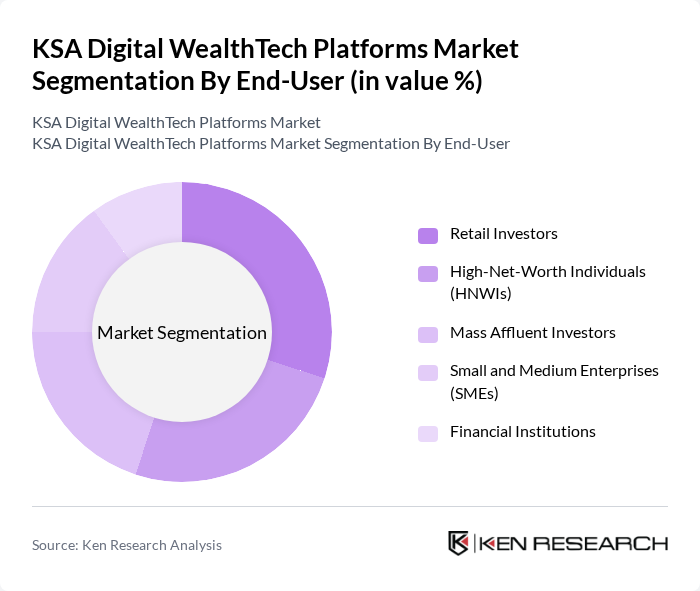
By End-User:The market can also be segmented based on end-users, which include Retail Investors, High-Net-Worth Individuals (HNWIs), Mass Affluent Investors, Small and Medium Enterprises (SMEs), and Financial Institutions. This structure is consistent with the KSA wealth management market, where discretionary portfolio mandates and advisory services are widely used by HNWIs and institutional clients, while digital robo-advisory and online investment platforms are increasingly adopted by retail and mass affluent investors. SMEs and financial institutions typically engage with digital wealthtech platforms for treasury, investment, and portfolio solutions that complement their banking and capital markets activities.
KSA Digital WealthTech Platforms Market Competitive Landscape
The KSA Digital WealthTech Platforms Market is characterized by a dynamic mix of regional and international players. Leading participants such as Al Rajhi Bank, stc pay, NCB Capital, Riyad Bank, Alinma Investment, Samba Financial Group, Alawwal Invest, Abu Dhabi Islamic Bank, Saudi Investment Bank, QNB Alahli, Fawry, EFG Hermes, Mena Capital, SEDCO Capital, Alkhabeer Capital contribute to innovation, geographic expansion, and service delivery in this space, alongside other specialist wealthtech providers and fintech platforms highlighted in recent KSA wealthtech and fintech market studies.
KSA Digital WealthTech Platforms Market Industry Analysis
Growth Drivers
- Increasing Smartphone Penetration:As of in future, Saudi Arabia boasts a smartphone penetration rate of approximately92%, with over33 millionusers. This widespread access to mobile technology facilitates the adoption of digital wealth management solutions. The World Bank reports that mobile internet subscriptions in the country have surged by 15% annually, indicating a robust infrastructure for digital finance. This trend is crucial for WealthTech platforms, as it enables seamless access to financial services and enhances user engagement.
- Rising Demand for Personalized Financial Services:The demand for tailored financial solutions in Saudi Arabia is on the rise, with65%of consumers expressing a preference for personalized services. According to a recent survey by the Saudi Arabian Monetary Authority, 40% of respondents are willing to switch providers for better customization. This shift is driven by a younger demographic, with70%of users aged 18-34 seeking personalized investment advice, creating a significant opportunity for WealthTech platforms to innovate and cater to these preferences.
- Growth of the Fintech Ecosystem:The Saudi fintech ecosystem is rapidly expanding, with over50 licensed fintech companiesoperating in the region as of in future. The government’s Vision 2030 initiative aims to increase the fintech sector's contribution to GDP by 5% by in future. This growth is supported by investments exceeding$1 billionin fintech startups in the last two years, fostering innovation and competition. Such an environment encourages the development of advanced WealthTech solutions, enhancing service offerings and customer satisfaction.
Market Challenges
- Regulatory Compliance Complexities:Navigating the regulatory landscape in Saudi Arabia poses significant challenges for WealthTech platforms. The Financial Sector Development Program outlines stringent compliance requirements, including licensing and reporting obligations. As of in future, over60%of fintech startups report difficulties in meeting these regulations, which can hinder their operational efficiency. This complexity can deter new entrants and stifle innovation, impacting the overall growth of the WealthTech market.
- Cybersecurity Threats:The increasing digitization of financial services has heightened cybersecurity risks in Saudi Arabia. In future, the country experienced a30%rise in cyberattacks targeting financial institutions, according to the National Cybersecurity Authority. WealthTech platforms are particularly vulnerable due to the sensitive nature of financial data. As a result,75%of companies in the sector are investing heavily in cybersecurity measures, which can divert resources from innovation and growth initiatives, posing a significant challenge.
KSA Digital WealthTech Platforms Market Future Outlook
The future of the KSA Digital WealthTech market appears promising, driven by technological advancements and evolving consumer preferences. The integration of artificial intelligence and machine learning is expected to enhance service personalization, while the growing emphasis on sustainable investing will attract environmentally conscious investors. Additionally, partnerships with traditional financial institutions will likely facilitate broader market access, enabling WealthTech platforms to expand their reach and improve service offerings, ultimately fostering a more inclusive financial ecosystem.
Market Opportunities
- Expansion into Underserved Demographics:There is a significant opportunity for WealthTech platforms to target underserved demographics, particularly women and rural populations. Currently, only30%of women in Saudi Arabia engage in investment activities. By developing tailored financial products and educational resources, platforms can tap into this market, potentially increasing their user base and driving financial inclusion.
- Integration of AI and Machine Learning:The adoption of AI and machine learning technologies presents a transformative opportunity for WealthTech platforms. By leveraging these technologies, platforms can enhance customer experience through personalized recommendations and predictive analytics. As of in future, a growing share of financial services firms in Saudi Arabia are investing in AI, indicating a strong trend towards automation and improved decision-making capabilities, which can significantly boost operational efficiency.
Scope of the Report
| Segment | Sub-Segments |
|---|---|
| By Platform Type | Robo-Advisory Platforms Digital Investment Management Platforms Online Brokerage Platforms Private Banking & Wealth Management Platforms Personal Finance & Portfolio Management Platforms ESG / Shariah-Compliant Investment Platforms Others |
| By End-User | Retail Investors High-Net-Worth Individuals (HNWIs) Mass Affluent Investors Small and Medium Enterprises (SMEs) Financial Institutions |
| By Region | Central Region Western Region Eastern Region Southern Region |
| By Deployment Mode | Cloud-Based On-Premise Hybrid |
| By Application | Investment Management Portfolio Tracking & Analytics Financial Planning Risk Profiling & Rebalancing Others |
| By Revenue Model | Subscription-Based Transaction-Based Assets Under Management (AUM)-Based Fees Freemium / SaaS Others |
| By Service Type | Advisory Services Execution Services Custody & Clearing Services Analytics & Reporting Services Others |
Key Target Audience
Investors and Venture Capitalist Firms
Government and Regulatory Bodies (e.g., Saudi Arabian Monetary Authority, Capital Market Authority)
Financial Institutions
Wealth Management Firms
Insurance Companies
Fintech Startups
Technology Providers
Industry Associations
Players Mentioned in the Report:
Al Rajhi Bank
STC Pay
NCB Capital
Riyad Bank
Alinma Investment
Samba Financial Group
Alawwal Invest
Abu Dhabi Islamic Bank
Saudi Investment Bank
QNB Alahli
Table of Contents
Market Assessment Phase
1. Executive Summary and Approach
2. KSA Digital WealthTech Platforms Market Overview
2.1 Key Insights and Strategic Recommendations
2.2 KSA Digital WealthTech Platforms Market Overview
2.3 Definition and Scope
2.4 Evolution of Market Ecosystem
2.5 Timeline of Key Regulatory Milestones
2.6 Value Chain & Stakeholder Mapping
2.7 Business Cycle Analysis
2.8 Policy & Incentive Landscape
3. KSA Digital WealthTech Platforms Market Analysis
3.1 Growth Drivers
3.1.1 Increasing smartphone penetration
3.1.2 Rising demand for personalized financial services
3.1.3 Growth of the fintech ecosystem
3.1.4 Government initiatives promoting digital finance
3.2 Market Challenges
3.2.1 Regulatory compliance complexities
3.2.2 Cybersecurity threats
3.2.3 Limited financial literacy among consumers
3.2.4 Intense competition among platforms
3.3 Market Opportunities
3.3.1 Expansion into underserved demographics
3.3.2 Integration of AI and machine learning
3.3.3 Partnerships with traditional financial institutions
3.3.4 Development of sustainable investment products
3.4 Market Trends
3.4.1 Shift towards robo-advisory services
3.4.2 Increased focus on ESG (Environmental, Social, Governance) investing
3.4.3 Adoption of blockchain technology
3.4.4 Growth of subscription-based financial services
3.5 Government Regulation
3.5.1 Licensing requirements for digital platforms
3.5.2 Data protection regulations
3.5.3 Anti-money laundering (AML) laws
3.5.4 Consumer protection regulations
4. SWOT Analysis
5. Stakeholder Analysis
6. Porter's Five Forces Analysis
7. KSA Digital WealthTech Platforms Market Size, 2019-2024
7.1 By Value
7.2 By Volume
7.3 By Average Selling Price
8. KSA Digital WealthTech Platforms Market Segmentation
8.1 By Platform Type
8.1.1 Robo-Advisory Platforms
8.1.2 Digital Investment Management Platforms
8.1.3 Online Brokerage Platforms
8.1.4 Private Banking & Wealth Management Platforms
8.1.5 Personal Finance & Portfolio Management Platforms
8.1.6 ESG / Shariah-Compliant Investment Platforms
8.1.7 Others
8.2 By End-User
8.2.1 Retail Investors
8.2.2 High-Net-Worth Individuals (HNWIs)
8.2.3 Mass Affluent Investors
8.2.4 Small and Medium Enterprises (SMEs)
8.2.5 Financial Institutions
8.3 By Region
8.3.1 Central Region
8.3.2 Western Region
8.3.3 Eastern Region
8.3.4 Southern Region
8.4 By Deployment Mode
8.4.1 Cloud-Based
8.4.2 On-Premise
8.4.3 Hybrid
8.5 By Application
8.5.1 Investment Management
8.5.2 Portfolio Tracking & Analytics
8.5.3 Financial Planning
8.5.4 Risk Profiling & Rebalancing
8.5.5 Others
8.6 By Revenue Model
8.6.1 Subscription-Based
8.6.2 Transaction-Based
8.6.3 Assets Under Management (AUM)-Based Fees
8.6.4 Freemium / SaaS
8.6.5 Others
8.7 By Service Type
8.7.1 Advisory Services
8.7.2 Execution Services
8.7.3 Custody & Clearing Services
8.7.4 Analytics & Reporting Services
8.7.5 Others
9. KSA Digital WealthTech Platforms Market Competitive Analysis
9.1 Market Share of Key Players
9.2 Cross Comparison of Key Players
9.2.1 Company Name
9.2.2 Assets Under Management (AUM)
9.2.3 Monthly Active Users (MAU)
9.2.4 Annual Revenue
9.2.5 Average Revenue Per User (ARPU)
9.2.6 Customer Acquisition Cost (CAC)
9.2.7 Customer Retention Rate
9.2.8 Net Promoter Score (NPS)
9.2.9 Churn Rate
9.2.10 Revenue Growth Rate
9.3 SWOT Analysis of Top Players
9.4 Pricing Analysis
9.5 Detailed Profile of Major Companies
9.5.1 Al Rajhi Bank
9.5.2 stc pay
9.5.3 NCB Capital
9.5.4 Riyad Bank
9.5.5 Alinma Investment
9.5.6 Samba Financial Group
9.5.7 Alawwal Invest
9.5.8 Abu Dhabi Islamic Bank
9.5.9 Saudi Investment Bank
9.5.10 QNB Alahli
9.5.11 Fawry
9.5.12 EFG Hermes
9.5.13 Mena Capital
9.5.14 SEDCO Capital
9.5.15 Alkhabeer Capital
10. KSA Digital WealthTech Platforms Market End-User Analysis
10.1 Procurement Behavior of Key Ministries
10.1.1 Budget Allocation Trends
10.1.2 Decision-Making Processes
10.1.3 Preferred Platforms
10.1.4 Evaluation Criteria
10.2 Corporate Spend on Infrastructure & Energy
10.2.1 Investment Priorities
10.2.2 Spending Patterns
10.2.3 Key Drivers of Expenditure
10.3 Pain Point Analysis by End-User Category
10.3.1 Individual Investors
10.3.2 SMEs
10.3.3 Corporates
10.4 User Readiness for Adoption
10.4.1 Awareness Levels
10.4.2 Technology Adoption Rates
10.4.3 Training Needs
10.5 Post-Deployment ROI and Use Case Expansion
10.5.1 ROI Measurement Techniques
10.5.2 Use Case Success Stories
10.5.3 Future Expansion Plans
11. KSA Digital WealthTech Platforms Market Future Size, 2025-2030
11.1 By Value
11.2 By Volume
11.3 By Average Selling Price
Go-To-Market Strategy Phase
1. Whitespace Analysis + Business Model Canvas
1.1 Market Gaps Identification
1.2 Business Model Development
2. Marketing and Positioning Recommendations
2.1 Branding Strategies
2.2 Product USPs
3. Distribution Plan
3.1 Urban Retail Strategies
3.2 Rural NGO Tie-ups
4. Channel & Pricing Gaps
4.1 Underserved Routes
4.2 Pricing Bands
5. Unmet Demand & Latent Needs
5.1 Category Gaps
5.2 Consumer Segments
6. Customer Relationship
6.1 Loyalty Programs
6.2 After-sales Service
7. Value Proposition
7.1 Sustainability Initiatives
7.2 Integrated Supply Chains
8. Key Activities
8.1 Regulatory Compliance
8.2 Branding Efforts
8.3 Distribution Setup
9. Entry Strategy Evaluation
9.1 Domestic Market Entry Strategy
9.1.1 Product Mix
9.1.2 Pricing Band
9.1.3 Packaging
9.2 Export Entry Strategy
9.2.1 Target Countries
9.2.2 Compliance Roadmap
10. Entry Mode Assessment
10.1 Joint Ventures
10.2 Greenfield Investments
10.3 Mergers & Acquisitions
10.4 Distributor Model
11. Capital and Timeline Estimation
11.1 Capital Requirements
11.2 Timelines
12. Control vs Risk Trade-Off
12.1 Ownership vs Partnerships
13. Profitability Outlook
13.1 Breakeven Analysis
13.2 Long-term Sustainability
14. Potential Partner List
14.1 Distributors
14.2 Joint Ventures
14.3 Acquisition Targets
15. Execution Roadmap
15.1 Phased Plan for Market Entry
15.1.1 Market Setup
15.1.2 Market Entry
15.1.3 Growth Acceleration
15.1.4 Scale & Stabilize
15.2 Key Activities and Milestones
15.2.1 Milestone Tracking
15.2.2 Activity Scheduling
Research Methodology
Phase 1: Approach1
Desk Research
- Analysis of market reports from financial institutions and industry associations
- Review of regulatory frameworks and guidelines from the Saudi Arabian Monetary Authority (SAMA)
- Examination of digital adoption trends and consumer behavior studies in the KSA
Primary Research
- Interviews with executives from leading Digital WealthTech firms in KSA
- Surveys targeting financial advisors and wealth management professionals
- Focus groups with end-users to understand preferences and pain points
Validation & Triangulation
- Cross-validation of findings with secondary data from financial reports and market analyses
- Triangulation of insights from primary interviews with industry experts and stakeholders
- Sanity checks through expert panel discussions and feedback sessions
Phase 2: Market Size Estimation1
Top-down Assessment
- Estimation of total addressable market (TAM) based on national wealth management statistics
- Segmentation by service offerings such as robo-advisory, investment platforms, and financial planning tools
- Incorporation of macroeconomic indicators and demographic trends influencing wealth management
Bottom-up Modeling
- Data collection from key players regarding user acquisition rates and average revenue per user (ARPU)
- Estimation of market penetration rates for various Digital WealthTech services
- Analysis of transaction volumes and fee structures across different platforms
Forecasting & Scenario Analysis
- Multi-variable forecasting models incorporating economic growth, digital adoption rates, and regulatory changes
- Scenario planning based on potential market disruptions and technological advancements
- Development of baseline, optimistic, and pessimistic growth projections through 2030
Phase 3: CATI Sample Composition1
| Scope Item/Segment | Sample Size | Target Respondent Profiles |
|---|---|---|
| Robo-Advisory Services | 100 | Wealth Managers, Financial Advisors |
| Investment Platforms | 80 | Investment Analysts, Portfolio Managers |
| Financial Planning Tools | 70 | Financial Planners, Tax Advisors |
| Consumer Insights on WealthTech | 90 | End-users, Retail Investors |
| Regulatory Impact Assessment | 60 | Compliance Officers, Regulatory Affairs Specialists |
Frequently Asked Questions
What is the current value of the KSA Digital WealthTech Platforms Market?
The KSA Digital WealthTech Platforms Market is valued at approximately USD 1.9 billion, reflecting significant growth driven by the adoption of digital financial services and increasing awareness of investment opportunities among retail and affluent segments.
What factors are driving the growth of the KSA Digital WealthTech Platforms Market?
Which cities are key players in the KSA Digital WealthTech Platforms Market?
How is the Saudi government supporting the Digital WealthTech sector?
Other Regional/Country Reports
Indonesia Digital WealthTech Platforms Market
Other Adjacent Reports
Thailand Digital Investment Management Market
Oman Online Brokerage Market
Japan Private Banking Market Size, Share & Forecast, By Client Segment, Service Type & Distribution Channel, 2026-2031India Wealth Management Market Size, Share & Forecast, By Product Type, Customer Segment & Distribution Channel, 2025-2032Qatar robo advisory market report size, share, growth drivers, trends, opportunities & forecast 2025–2030Japan Financial Planning Market
UAE Investment Management Market
Indonesia Portfolio Management Market
Germany Financial Technology Market
Mexico Fintech Services Market
Why Buy From Us?

What makes us stand out is that our consultants follow Robust, Refine and Result (RRR) methodology. Robust for clear definitions, approaches and sanity checking, Refine for differentiating respondents' facts and opinions, and Result for presenting data with story.

We have set a benchmark in the industry by offering our clients with syndicated and customized market research reports featuring coverage of entire market as well as meticulous research and analyst insights.

While we don't replace traditional research, we flip the method upside down. Our dual approach of Top Bottom & Bottom Top ensures quality deliverable by not just verifying company fundamentals but also looking at the sector and macroeconomic factors.

With one step in the future, our research team constantly tries to show you the bigger picture. We help with some of the tough questions you may encounter along the way: How is the industry positioned? Best marketing channel? KPI's of competitors? By aligning every element, we help maximize success.

Our report gives you instant access to the answers and sources that other companies might choose to hide. We elaborate each steps of research methodology we have used and showcase you the sample size to earn your trust.

If you need any support, we are here! We pride ourselves on universe strength, data quality, and quick, friendly, and professional service.