Kuwait Americas Seeds Market Report Size Share Growth Drivers Trends Opportunities & Forecast 2025–2030

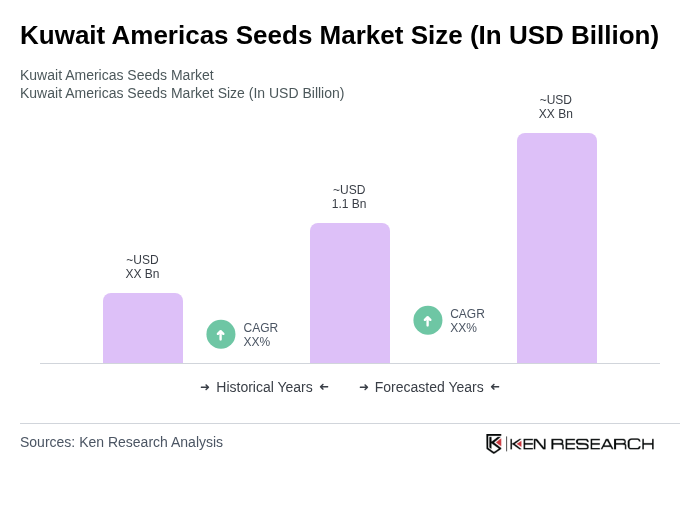
The Kuwait Americas Seeds Market, valued at USD 1.1 billion, grows with demand for high-yield, GM, and hybrid seeds, focusing on cereals, oilseeds, and sustainable practices.

Region:Middle East

Author(s):Shubham

Product Code:KRAD2650

Pages:94

Published On:January 2026
About the Report

Base Year 2024

Kuwait Americas Seeds Market Overview

  • The Kuwait Americas Seeds Market is valued at USD 1.1 billion, based on a five-year historical analysis, in line with the strong growth of the global seeds market and the high regional concentration of seed demand in North and Latin America alongside increasing investment in seed markets across the Middle East. This growth is primarily driven by increasing agricultural productivity, the adoption of advanced seed technologies (including treated and trait-enhanced seeds), and rising demand for food security and self-sufficiency programs in key importing countries. The market has seen a notable shift towards hybrid and traited seeds (including herbicide-tolerant and insect-resistant varieties), supported by precision agriculture, which enables higher yields, better stand establishment, and improved resistance to pests and diseases.
  • Key players in this market include the United States and Brazil, which dominate regional and global seed trade due to their advanced agricultural practices, extensive research and development in seed technology, and favorable climatic conditions for large-scale crop production. The United States accounts for more than four-fifths of the North American seeds market and has seed production value above USD 1.7 billion for major crops such as corn, soybeans, and cotton, reflecting its leading role in seed innovation and exports. Brazil’s seed market is estimated at roughly USD 8.6 billion for major field crops, underpinned by large soybean and maize areas and strong adoption of genetically modified and hybrid seeds, making it a cornerstone supplier for Latin America and export destinations in the Middle East, including Kuwait.
  • In Kuwait, the regulatory framework for seeds and planting material, including genetically engineered products, is primarily governed through sanitary and phytosanitary, biosafety, and food safety instruments rather than a single seed-specific statute. Imports, distribution, and use of genetically modified seeds and derived products operate under the Gulf Standardization Organization’s GSO 2141/2011 “Requirements for Foods and Food Ingredients Obtained from Biotechnology”, which is implemented in Kuwait through the Public Authority for Food and Nutrition and the Ministry of Health to ensure mandatory safety assessment, labeling, and traceability for biotechnology-derived products placed on the market. These measures aim to support food security and agricultural modernization while requiring that imported seed and grain consignments comply with biosafety, quality, and documentation requirements set by Kuwaiti authorities and the wider Gulf regulatory framework.
Kuwait Americas Seeds Market Size

Kuwait Americas Seeds Market Segmentation

By Seed Type:The seed type segmentation includes various categories such as Genetically Modified (GM) Seeds, Conventional (Non-GM) Seeds, Hybrid Seeds, Open-Pollinated/Heirloom Seeds, and Others. In the broader Americas region, hybrid and traited (including GM) seeds represent the largest share of commercial seed value in major row crops such as corn, soybean, and cotton, as they provide higher yields, uniformity, and improved resistance to pests, diseases, and herbicides. Adoption of these seeds is strongly supported by precision farming, seed-applied technologies, and farm consolidation, as farmers seek to maximize productivity per hectare. Conventional (non-GM) and open-pollinated seeds retain importance in segments such as vegetables, certain cereals, and niche or organic production systems, particularly where certification, consumer preferences, or export-market requirements favor non-GM origins.
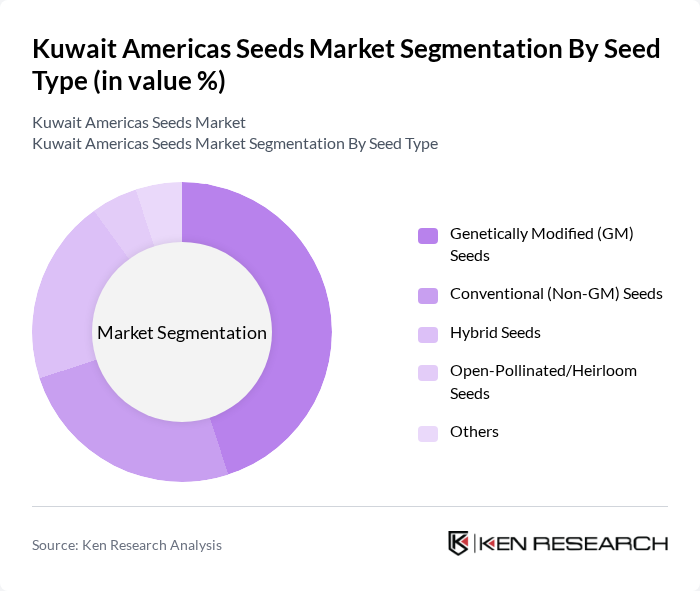
Kuwait Americas Seeds Market segmentation by Seed Type.

By Crop Type:The crop type segmentation encompasses Cereals & Grains, Oilseeds & Pulses, Fruits & Vegetables, Fodder & Forage Crops, and Others. Across the Americas, cereals and grains (notably corn, wheat, and barley) constitute the largest share of commercial seed demand because of their critical role in food, feed, and industrial uses, and the widespread penetration of hybrid and GM technologies in these crops. Oilseeds and pulses, including soybean and canola, form another major segment, supported by strong export demand, the growth of plant-based protein and edible oils, and continued expansion of biotech traits. Fruits and vegetables account for a growing share of seed value, driven by rising health-conscious consumption, increasing horticulture investments, and higher-priced hybrid and specialty vegetable seeds in both open-field and protected cultivation systems. Fodder and forage crops remain essential for the livestock and dairy sectors, where improved varieties support better feed quality and resilience under variable climatic conditions.
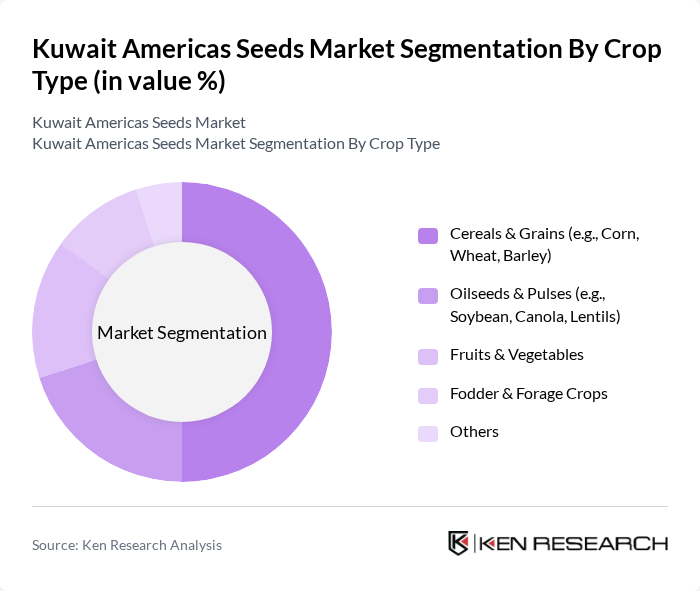
Kuwait Americas Seeds Market segmentation by Crop Type.

Kuwait Americas Seeds Market Competitive Landscape

The Kuwait Americas Seeds Market is characterized by a dynamic mix of regional and international players. Leading participants such as Corteva Agriscience, Bayer CropScience, Syngenta Group, BASF SE, Groupe Limagrain (Vilmorin & Cie), KWS SAAT SE & Co. KGaA, Sakata Seed Corporation, Rijk Zwaan Zaadteelt en Zaadhandel B.V., East-West Seed, Seminis Vegetable Seeds (Bayer), Bejo Zaden B.V., Takii & Co., Ltd., Seed Co Limited, AgReliant Genetics, LLC, Regional & Local Players in Kuwait and Americas contribute to innovation, geographic expansion, and service delivery in this space.

Corteva Agriscience

2019

Indianapolis, USA

Bayer CropScience

2002

Monheim am Rhein, Germany

Syngenta Group

2020

Basel, Switzerland

BASF SE

1865

Ludwigshafen, Germany

Groupe Limagrain (Vilmorin & Cie)

1965

Saint-Beauzire, France

Company

Establishment Year

Headquarters

Group Size (Large, Medium, or Small as per industry convention)

Annual Revenue (USD Million) from Seeds Business

3-Year CAGR in Seed Revenues (%)

EBITDA Margin from Seeds Segment (%)

Market Share in Kuwait & Americas Seeds Market (%)

R&D Intensity (R&D Spend as % of Seed Revenue)

Kuwait Americas Seeds Market Industry Analysis

Growth Drivers

  • Increasing Demand for High-Yield Seeds:The demand for high-yield seeds in Kuwait is driven by the need to enhance agricultural productivity. In the future, the agricultural sector is projected to contribute approximately $3 billion to the national GDP, with high-yield seeds playing a crucial role. Farmers are increasingly adopting these seeds to meet the growing food requirements of a population expected to reach 5 million, thus ensuring food security and sustainability.
  • Adoption of Sustainable Agricultural Practices:Kuwait's commitment to sustainable agriculture is evident in its initiatives to reduce water usage and improve soil health. The government has allocated $200 million for sustainable farming projects in the future, promoting the use of drought-resistant seed varieties. This shift not only addresses environmental concerns but also aligns with global trends towards sustainability, making it a significant growth driver in the seed market.
  • Technological Advancements in Seed Development:The Kuwait Americas Seeds Market is witnessing rapid technological advancements, particularly in biotechnology and genetic engineering. In the future, investments in seed technology are expected to exceed $300 million, focusing on developing seeds that are resilient to climate change. These innovations are crucial for enhancing crop yields and ensuring food security, thereby driving market growth significantly.

Market Challenges

  • Regulatory Hurdles in Seed Approval:The seed approval process in Kuwait is often lengthy and complex, posing significant challenges for seed producers. In the future, it is estimated that the average time for seed approval could extend to 12 months, which delays market entry for new seed varieties. This regulatory bottleneck can hinder innovation and limit the availability of advanced seed options for farmers, impacting overall market growth.
  • Competition from Local Seed Producers:Local seed producers in Kuwait are increasingly competitive, often offering lower-priced alternatives to imported seeds. In the future, local production is expected to account for 50% of the seed market, driven by government support and subsidies. This competition can challenge foreign seed companies, making it essential for them to differentiate their products through quality and innovation to maintain market share.

Kuwait Americas Seeds Market Future Outlook

The future of the Kuwait Americas Seeds Market appears promising, driven by increasing investments in agricultural technology and a growing emphasis on sustainable practices. As the population continues to rise, the demand for high-quality seeds will likely escalate, prompting further innovations. Additionally, collaborations between private companies and research institutions are expected to enhance seed development, ensuring that the market adapts to changing agricultural needs and environmental challenges effectively.

Market Opportunities

  • Expansion of Export Markets for Seeds:Kuwait's strategic location offers significant opportunities for expanding seed exports to neighboring regions. In the future, the government aims to increase seed exports by 30%, tapping into markets in the Gulf Cooperation Council (GCC) and North Africa. This expansion can enhance revenue for local producers and position Kuwait as a key player in the regional seed market.
  • Development of Organic Seed Varieties:With the rising consumer preference for organic produce, there is a growing opportunity for developing organic seed varieties. In the future, the organic food market in Kuwait is projected to reach $150 million, creating demand for organic seeds. This trend presents a lucrative opportunity for seed companies to innovate and cater to health-conscious consumers, driving market growth.

Scope of the Report

SegmentSub-Segments
By Seed Type

Genetically Modified (GM) Seeds

Conventional (Non-GM) Seeds

Hybrid Seeds

Open-Pollinated/Heirloom Seeds

Others

By Crop Type

Cereals & Grains (e.g., Corn, Wheat, Barley)

Oilseeds & Pulses (e.g., Soybean, Canola, Lentils)

Fruits & Vegetables

Fodder & Forage Crops

Others

By Trait

Herbicide-Tolerant

Insect-Resistant

Drought/Stress-Tolerant

High-Yielding/Quality-Enhanced

Others

By Seed Treatment

Treated Seeds

Non-Treated Seeds

By Distribution Channel

Direct Sales (B2B/B2F)

Distributors & Dealers

Cooperatives & Aggregators

Online & Digital Platforms

Others

By Application/End-User

Commercial Farms

Smallholder Farmers

Research & Breeding Institutions

Government & Development Programs

Others

By Region

North America

Latin America

GCC Countries (incl. Kuwait)

Rest of Middle East & Africa

Key Target Audience

Investors and Venture Capitalist Firms

Government and Regulatory Bodies (e.g., Kuwait Ministry of Agriculture and Fisheries)

Manufacturers and Producers

Distributors and Retailers

Agricultural Cooperatives

Seed Certification Agencies (e.g., Kuwait Seed Testing Laboratory)

Importers and Exporters of Agricultural Products

Agri-tech Companies

Players Mentioned in the Report:

Corteva Agriscience

Bayer CropScience

Syngenta Group

BASF SE

Groupe Limagrain (Vilmorin & Cie)

KWS SAAT SE & Co. KGaA

Sakata Seed Corporation

Rijk Zwaan Zaadteelt en Zaadhandel B.V.

East-West Seed

Seminis Vegetable Seeds (Bayer)

Bejo Zaden B.V.

Takii & Co., Ltd.

Seed Co Limited

AgReliant Genetics, LLC

Regional & Local Players in Kuwait and Americas

Table of Contents

Market Assessment Phase

1. Executive Summary and Approach


2. Kuwait Americas Seeds Market Overview

2.1 Key Insights and Strategic Recommendations

2.2 Kuwait Americas Seeds Market Overview

2.3 Definition and Scope

2.4 Evolution of Market Ecosystem

2.5 Timeline of Key Regulatory Milestones

2.6 Value Chain & Stakeholder Mapping

2.7 Business Cycle Analysis

2.8 Policy & Incentive Landscape


3. Kuwait Americas Seeds Market Analysis

3.1 Growth Drivers

3.1.1 Increasing demand for high-yield seeds
3.1.2 Adoption of sustainable agricultural practices
3.1.3 Government initiatives to boost agricultural productivity
3.1.4 Technological advancements in seed development

3.2 Market Challenges

3.2.1 Regulatory hurdles in seed approval
3.2.2 Competition from local seed producers
3.2.3 Climate change impacts on agriculture
3.2.4 Limited awareness of advanced seed varieties

3.3 Market Opportunities

3.3.1 Expansion of export markets for seeds
3.3.2 Collaborations with agricultural research institutions
3.3.3 Development of organic seed varieties
3.3.4 Investment in seed technology innovations

3.4 Market Trends

3.4.1 Shift towards genetically modified seeds
3.4.2 Increasing focus on seed quality and certification
3.4.3 Rise in precision agriculture practices
3.4.4 Growing consumer preference for organic produce

3.5 Government Regulation

3.5.1 Seed quality control regulations
3.5.2 Import/export restrictions on seeds
3.5.3 Subsidies for seed production
3.5.4 Environmental regulations affecting seed development

4. SWOT Analysis


5. Stakeholder Analysis


6. Porter's Five Forces Analysis


7. Kuwait Americas Seeds Market Market Size, 2019-2024

7.1 By Value

7.2 By Volume

7.3 By Average Selling Price


8. Kuwait Americas Seeds Market Segmentation

8.1 By Seed Type

8.1.1 Genetically Modified (GM) Seeds
8.1.2 Conventional (Non-GM) Seeds
8.1.3 Hybrid Seeds
8.1.4 Open-Pollinated/Heirloom Seeds
8.1.5 Others

8.2 By Crop Type

8.2.1 Cereals & Grains (e.g., Corn, Wheat, Barley)
8.2.2 Oilseeds & Pulses (e.g., Soybean, Canola, Lentils)
8.2.3 Fruits & Vegetables
8.2.4 Fodder & Forage Crops
8.2.5 Others

8.3 By Trait

8.3.1 Herbicide-Tolerant
8.3.2 Insect-Resistant
8.3.3 Drought/Stress-Tolerant
8.3.4 High-Yielding/Quality-Enhanced
8.3.5 Others

8.4 By Seed Treatment

8.4.1 Treated Seeds
8.4.2 Non-Treated Seeds

8.5 By Distribution Channel

8.5.1 Direct Sales (B2B/B2F)
8.5.2 Distributors & Dealers
8.5.3 Cooperatives & Aggregators
8.5.4 Online & Digital Platforms
8.5.5 Others

8.6 By Application/End-User

8.6.1 Commercial Farms
8.6.2 Smallholder Farmers
8.6.3 Research & Breeding Institutions
8.6.4 Government & Development Programs
8.6.5 Others

8.7 By Region

8.7.1 North America
8.7.2 Latin America
8.7.3 GCC Countries (incl. Kuwait)
8.7.4 Rest of Middle East & Africa

9. Kuwait Americas Seeds Market Competitive Analysis

9.1 Market Share of Key Players

9.2 Cross Comparison of Key Players

9.2.1 Company Name
9.2.2 Group Size (Large, Medium, or Small as per industry convention)
9.2.3 Annual Revenue (USD Million) from Seeds Business
9.2.4 3-Year CAGR in Seed Revenues (%)
9.2.5 EBITDA Margin from Seeds Segment (%)
9.2.6 Market Share in Kuwait & Americas Seeds Market (%)
9.2.7 R&D Intensity (R&D Spend as % of Seed Revenue)
9.2.8 Capex Intensity (Capex as % of Seed Revenue)
9.2.9 Average Realized Price per Unit (USD/ton or USD/packet)
9.2.10 Distribution Reach (Number of Active Dealers/Channels)
9.2.11 Customer Retention Rate (%)
9.2.12 New Product Launches per Year (Last 3 Years)
9.2.13 Share of Value-Added/Trait-Enhanced Seeds in Portfolio (%)

9.3 SWOT Analysis of Top Players

9.4 Pricing Analysis

9.5 Detailed Profile of Major Companies

9.5.1 Corteva Agriscience
9.5.2 Bayer CropScience
9.5.3 Syngenta Group
9.5.4 BASF SE
9.5.5 Groupe Limagrain (Vilmorin & Cie)
9.5.6 KWS SAAT SE & Co. KGaA
9.5.7 Sakata Seed Corporation
9.5.8 Rijk Zwaan Zaadteelt en Zaadhandel B.V.
9.5.9 East-West Seed
9.5.10 Seminis Vegetable Seeds (Bayer)
9.5.11 Bejo Zaden B.V.
9.5.12 Takii & Co., Ltd.
9.5.13 Seed Co Limited
9.5.14 AgReliant Genetics, LLC
9.5.15 Regional & Local Players in Kuwait and Americas

10. Kuwait Americas Seeds Market End-User Analysis

10.1 Procurement Behavior of Key Ministries

10.1.1 Ministry of Agriculture
10.1.2 Ministry of Commerce
10.1.3 Ministry of Environment
10.1.4 Others

10.2 Corporate Spend on Infrastructure & Energy

10.2.1 Investment in Agricultural Technology
10.2.2 Funding for Research and Development
10.2.3 Expenditure on Seed Quality Improvement
10.2.4 Others

10.3 Pain Point Analysis by End-User Category

10.3.1 Farmers' Access to Quality Seeds
10.3.2 Pricing Concerns for Seed Purchases
10.3.3 Availability of Technical Support
10.3.4 Others

10.4 User Readiness for Adoption

10.4.1 Awareness of New Seed Varieties
10.4.2 Training and Support Needs
10.4.3 Financial Readiness for Investment
10.4.4 Others

10.5 Post-Deployment ROI and Use Case Expansion

10.5.1 Yield Improvement Metrics
10.5.2 Cost Savings Analysis
10.5.3 Market Expansion Opportunities
10.5.4 Others

11. Kuwait Americas Seeds Market Future Size, 2025-2030

11.1 By Value

11.2 By Volume

11.3 By Average Selling Price


Go-To-Market Strategy Phase

1. Whitespace Analysis + Business Model Canvas

1.1 Market Gaps Identification

1.2 Business Model Development


2. Marketing and Positioning Recommendations

2.1 Branding Strategies

2.2 Product USPs


3. Distribution Plan

3.1 Urban Retail vs Rural NGO Tie-ups


4. Channel & Pricing Gaps

4.1 Underserved Routes

4.2 Pricing Bands


5. Unmet Demand & Latent Needs

5.1 Category Gaps

5.2 Consumer Segments


6. Customer Relationship

6.1 Loyalty Programs

6.2 After-sales Service


7. Value Proposition

7.1 Sustainability

7.2 Integrated Supply Chains


8. Key Activities

8.1 Regulatory Compliance

8.2 Branding

8.3 Distribution Setup


9. Entry Strategy Evaluation

9.1 Domestic Market Entry Strategy

9.1.1 Product Mix
9.1.2 Pricing Band
9.1.3 Packaging

9.2 Export Entry Strategy

9.2.1 Target Countries
9.2.2 Compliance Roadmap

10. Entry Mode Assessment

10.1 JV

10.2 Greenfield

10.3 M&A

10.4 Distributor Model


11. Capital and Timeline Estimation

11.1 Capital Requirements

11.2 Timelines


12. Control vs Risk Trade-Off

12.1 Ownership vs Partnerships


13. Profitability Outlook

13.1 Breakeven Analysis

13.2 Long-term Sustainability


14. Potential Partner List

14.1 Distributors

14.2 JVs

14.3 Acquisition Targets


15. Execution Roadmap

15.1 Phased Plan for Market Entry

15.1.1 Market Setup
15.1.2 Market Entry
15.1.3 Growth Acceleration
15.1.4 Scale & Stabilize

15.2 Key Activities and Milestones

15.2.1 Milestone Planning

Research Methodology

ApproachModellingSample

Phase 1: Approach1

Desk Research

  • Analysis of agricultural production statistics from the Kuwait Ministry of Agriculture and Fisheries
  • Review of market reports and publications from international agricultural organizations
  • Examination of trade data and import/export statistics from the Kuwait Customs Authority

Primary Research

  • Interviews with key stakeholders in the seed distribution network, including wholesalers and retailers
  • Surveys conducted with local farmers to understand seed preferences and purchasing behavior
  • Field visits to agricultural exhibitions and trade shows to gather insights on market trends

Validation & Triangulation

  • Cross-validation of findings through multiple data sources, including government reports and industry publications
  • Triangulation of qualitative insights from interviews with quantitative data from surveys
  • Sanity checks through expert panel reviews involving agronomists and market analysts

Phase 2: Market Size Estimation1

Top-down Assessment

  • Estimation of total market size based on national agricultural expenditure and seed consumption rates
  • Segmentation of the market by seed type, including vegetable, fruit, and cereal seeds
  • Incorporation of government agricultural initiatives and subsidies affecting seed usage

Bottom-up Modeling

  • Collection of sales data from major seed distributors and retailers in Kuwait
  • Estimation of average seed prices and volume sold across different seed categories
  • Analysis of farmer purchasing patterns to derive demand forecasts for various seed types

Forecasting & Scenario Analysis

  • Multi-factor regression analysis incorporating factors such as population growth and dietary changes
  • Scenario modeling based on potential changes in agricultural policy and climate conditions
  • Development of baseline, optimistic, and pessimistic market projections through 2030

Phase 3: CATI Sample Composition1

Scope Item/SegmentSample SizeTarget Respondent Profiles
Vegetable Seed Distribution110Seed Distributors, Retailers
Cereal Seed Usage90Farmers, Agricultural Cooperatives
Fruit Seed Market Insights75Horticulturists, Agricultural Consultants
Organic Seed Adoption60Organic Farmers, Sustainability Advocates
Seed Technology Innovations95Research Scientists, Agritech Entrepreneurs

Frequently Asked Questions

What is the current value of the Kuwait Americas Seeds Market?

The Kuwait Americas Seeds Market is valued at approximately USD 1.1 billion, reflecting strong growth driven by increasing agricultural productivity and demand for advanced seed technologies, particularly in North and Latin America.

What factors are driving growth in the Kuwait Americas Seeds Market?

Which types of seeds dominate the Kuwait Americas Seeds Market?

What are the main challenges faced by the Kuwait Americas Seeds Market?

Why Buy From Us?

Refine Robust Result (RRR) Framework

What makes us stand out is that our consultants follow Robust, Refine and Result (RRR) methodology. Robust for clear definitions, approaches and sanity checking, Refine for differentiating respondents' facts and opinions, and Result for presenting data with story.

Our Reach Is Unmatched

We have set a benchmark in the industry by offering our clients with syndicated and customized market research reports featuring coverage of entire market as well as meticulous research and analyst insights.

Shifting the Research Paradigm

While we don't replace traditional research, we flip the method upside down. Our dual approach of Top Bottom & Bottom Top ensures quality deliverable by not just verifying company fundamentals but also looking at the sector and macroeconomic factors.

More Insights-Better Decisions

With one step in the future, our research team constantly tries to show you the bigger picture. We help with some of the tough questions you may encounter along the way: How is the industry positioned? Best marketing channel? KPI's of competitors? By aligning every element, we help maximize success.

Transparency and Trust

Our report gives you instant access to the answers and sources that other companies might choose to hide. We elaborate each steps of research methodology we have used and showcase you the sample size to earn your trust.

Round the Clock Support

If you need any support, we are here! We pride ourselves on universe strength, data quality, and quick, friendly, and professional service.

Why Clients Choose Us?

400000+
Reports in repository
150+
Consulting projects a year
100+
Analysts
8000+
Client Queries in 2022








