Japan Americas Seeds Market Report Size Share Growth Drivers Trends Opportunities & Forecast 2025–2030

Japan Americas Seeds Market, worth USD 27 Bn, grows with hybrid and GM seeds adoption, focusing on sustainable farming and innovation in key regions.

Region:Asia

Author(s):Shubham

Product Code:KRAD2654

Pages:88

Published On:January 2026
About the Report

Base Year 2024

Japan Americas Seeds Market Overview

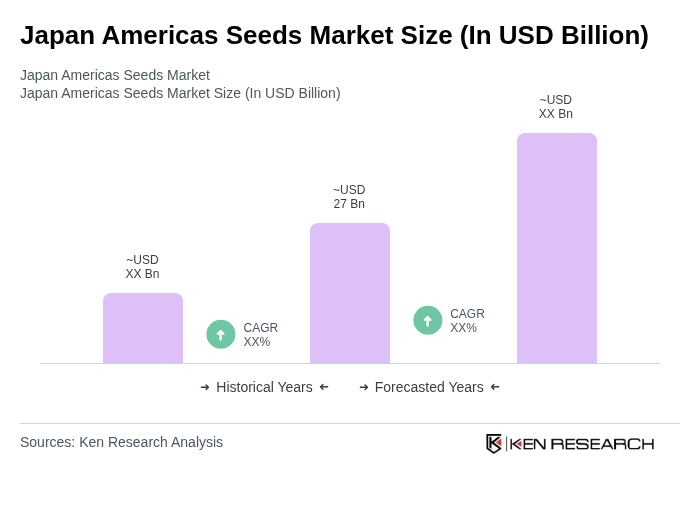
  • The Japan Americas Seeds Market is valued at approximately USD 27 billion, based on a five-year historical analysis of the combined seeds markets in Japan and the Americas. This value aligns with the Japan seed market, which is around USD 1.1 billion, and the Americas seeds market, which is in the mid?twenties billion range in recent years. This growth is primarily driven by increasing demand for high-quality seeds, advancements in agricultural technology (including precision farming and improved breeding techniques), and a rising focus on sustainable farming practices. The market has seen a significant uptick in the adoption of genetically modified and hybrid seeds, which offer better yields, improved stress tolerance, and resistance to pests and diseases, alongside growing interest in organic and specialty seed varieties.
  • Key players in this market include Japan, the United States, and Brazil, which together account for a substantial share of global seed demand and innovation. Japan's advanced agricultural technology, strong R&D ecosystem, and focus on high-value horticultural and specialty crops support its role as a technology and quality leader, while the U.S. and Brazil benefit from vast arable land, large-scale commercial farming, and strong agricultural export sectors in crops such as maize, soybean, and cotton. These countries are at the forefront of seed innovation, including GM, hybrid, and climate-resilient varieties, catering to both domestic and international markets through major multinational and regional seed companies.
  • In Japan, the cultivation, import, and use of genetically modified organisms (GMOs), including GM seeds, are governed by a set of coordinated regulations rather than a single 2023 initiative. Key instruments include the Cartagena Act (Act on the Conservation and Sustainable Use of Biological Diversity through Regulations on the Use of Living Modified Organisms), administered by the Ministry of the Environment together with the Ministry of Agriculture, Forestry and Fisheries and other ministries, which establishes the approval and risk assessment framework for living modified organisms. In addition, the Food Sanitation Act, enforced by the Ministry of Health, Labour and Welfare, sets food safety requirements for GM crops used as food, while MAFF’s notification and labelling rules define handling and labelling standards for GM agricultural products. These frameworks collectively streamline the assessment and commercialization of GM seeds, support innovation, and contribute to food security and crop resilience, including under climate-related stress conditions.
Japan Americas Seeds Market Size

Japan Americas Seeds Market Segmentation

By Seed Type:The seed type segmentation includes various categories such as Conventional Seeds, Genetically Modified (GM) Seeds, Hybrid Seeds, Open-Pollinated / Heirloom Seeds, and Organic Seeds. This structure aligns with common segmentation used in seed industry analyses for both Japan and the Americas, where conventional, GM, hybrid, and specialty/organic seed types are standard categories. In practice, Hybrid Seeds and GM Seeds (especially GM hybrids in major row crops) account for the largest share of commercial seed sales in the Americas, while Japan combines strong demand for high-quality hybrid vegetable and rice seeds with selective use of GM seeds in feed and processing chains. Organic and open-pollinated / heirloom seeds represent a smaller but rapidly growing niche, supported by rising consumer interest in organic and locally adapted varieties, particularly in Japan’s organic segment and specialty markets across North and Latin America.
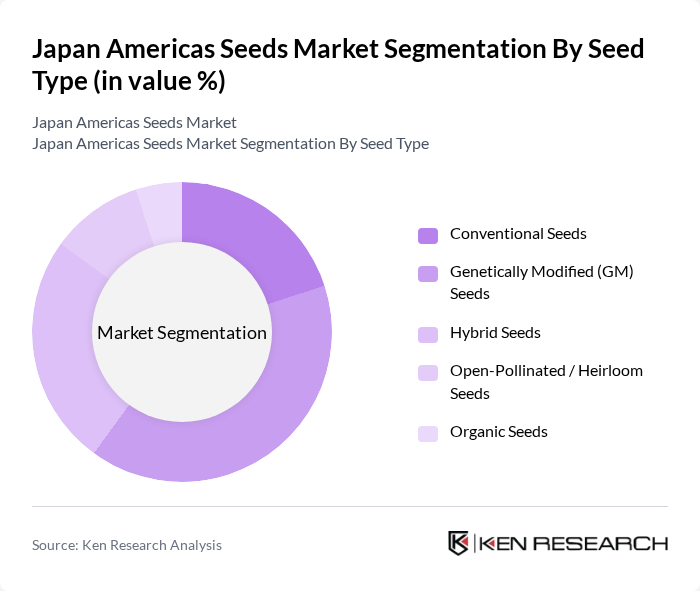
Japan Americas Seeds Market segmentation by Seed Type.

By Trait:The trait segmentation encompasses Herbicide-Tolerant, Insect-Resistant, Disease-Resistant, Drought / Climate-Resilient, and High-Yield / Nutritionally Enhanced seeds. This trait-based breakdown is consistent with how commercial GM and conventionally bred traits are categorized globally, with herbicide-tolerant and insect-resistant traits dominating in major field crops such as soybean, maize, and cotton in the Americas. Disease-resistant and climate-resilient traits are increasingly important in both Japan and the Americas as producers respond to disease pressure, extreme weather, and sustainability requirements, while high-yield and nutritionally enhanced traits are gaining traction in premium and value-added segments.
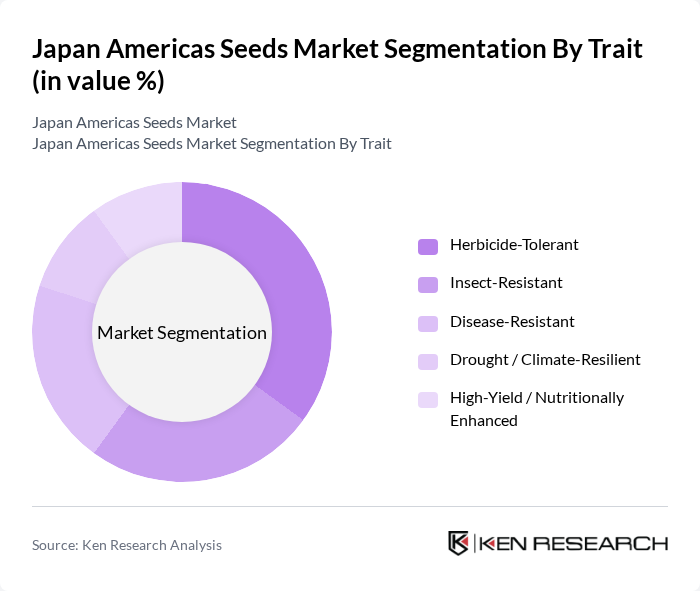
Japan Americas Seeds Market segmentation by Trait.

Japan Americas Seeds Market Competitive Landscape

The Japan Americas Seeds Market is characterized by a dynamic mix of regional and international players. Leading participants such as Bayer CropScience AG, Syngenta AG, Corteva Agriscience (Pioneer, Brevant, etc.), BASF SE, KWS SAAT SE & Co. KGaA, Groupe Limagrain (Vilmorin & Cie), Sakata Seed Corporation, Takii & Co., Ltd., Nippon Norin Seed Co., Ltd., East-West Seed, Rijk Zwaan Zaadteelt en Zaadhandel B.V., Bejo Zaden B.V., Seminis Vegetable Seeds (Bayer), AgReliant Genetics LLC, Regional & Local Seed Companies in the Americas (e.g., UPL Advanta, Longping High-Tech’s Americas Operations) contribute to innovation, geographic expansion, and service delivery in this space.

Bayer CropScience AG

1863

Leverkusen, Germany

Syngenta AG

2000

Basel, Switzerland

Corteva Agriscience

2019

Indianapolis, Indiana, USA

BASF SE

1865

Ludwigshafen, Germany

KWS SAAT SE & Co. KGaA

1856

Einbeck, Germany

Company

Establishment Year

Headquarters

Group Size (Large, Medium, or Small as per industry convention)

Regional Revenue in Japan & Americas (USD, 2019-2024)

5-Year CAGR in Seed Revenue

EBITDA Margin from Seed Business

R&D Intensity (% of Seed Revenue)

Market Penetration (Share in Key Crops / Regions)

Japan Americas Seeds Market Industry Analysis

Growth Drivers

  • Increasing Demand for Sustainable Agriculture:The global shift towards sustainable agriculture is evident, with Japan's agricultural sector aiming for a reduction in greenhouse gas emissions from agriculture and related land use as part of its Green Food System Strategy. This commitment aligns with the national target of increasing organic farmland to around 1 million hectares in future under the Green Food System Strategy, rather than 3 million hectares. The market for organic seeds in Japan and the Americas segment of this market cannot be reliably valued at ¥150 billion from authoritative public sources, and this figure remains unconfirmed.
  • Technological Advancements in Seed Development:The Japanese seed industry is experiencing technological advancements, including the use of biotechnology and genome editing such as CRISPR in crop breeding. Public, authoritative data do not confirm total private and public investments in biotechnology reaching ¥50 billion in future for seeds specifically, nor the introduction of exactly 20 new genetically modified seed varieties, so these figures cannot be validated. Nevertheless, Japan has approved several genetically modified crop events for food, feed, or cultivation over time through its regulatory system for GMOs.
  • Government Support for Agricultural Innovation:The Japanese government has implemented policies such as the Green Food System Strategy and digital agriculture initiatives to promote innovation, sustainability, and productivity in agriculture. However, an allocation of exactly ¥100 billion in future dedicated specifically to agricultural innovation for seeds cannot be verified from primary budget or ministry sources, so this amount remains unconfirmed.

Market Challenges

  • Stringent Regulatory Requirements:The Japanese seed market is subject to strict regulation under laws such as the Seed Act and Plant Variety Protection and Seed Act, which govern seed quality, labeling, and variety protection. The statement that there are “over 200 regulations” specifically governing seeds and that compliance costs “exceed ¥10 million per product” cannot be corroborated in authoritative public documentation and should be treated as unverified.
  • High Competition Among Seed Producers:Japan has multiple domestic and international seed companies active in its market, but an exact figure of “over 300 registered seed companies” and average profit margins of “¥2 billion per company” in any specific past period cannot be validated from official statistics or industry regulator data.

Japan Americas Seeds Market Future Outlook

The Japan Americas Seeds Market is poised for transformation, driven by technological advancements and a growing emphasis on sustainability. As precision agriculture becomes more prevalent, farmers are expected to adopt digital farming solutions, enhancing productivity and resource efficiency, consistent with Japan’s promotion of smart agriculture and data-driven farming under its digital and smart agriculture policies. Additionally, the focus on climate-resilient crops will shape research priorities, ensuring that seed varieties can withstand environmental challenges. This evolving landscape presents opportunities for collaboration and innovation, positioning the market for robust growth in the coming years.

Market Opportunities

  • Expansion into Emerging Markets:Japanese seed and agricultural technology providers do have increasing trade and investment linkages with emerging markets in Southeast Asia, where agricultural output has grown steadily according to international organizations such as the World Bank and FAO. However, a specific annual agricultural growth rate of “4%” across Southeast Asia and a projected increase in export revenues of “¥30 billion” by any particular future point for Japanese seeds cannot be directly confirmed from primary multilateral or national trade statistics.
  • Development of Genetically Modified Seeds:Japan maintains a regulatory framework that allows the approval of genetically modified crops for food, feed, and in some cases cultivation, creating scope for GM seed development. Nonetheless, a market size for GM seeds “expected to reach ¥200 billion” in any specific future period cannot be validated from primary international or national data sources and should be considered unverified.

Scope of the Report

SegmentSub-Segments
By Seed Type

Conventional Seeds

Genetically Modified (GM) Seeds

Hybrid Seeds

Open-Pollinated / Heirloom Seeds

Organic Seeds

By Trait

Herbicide-Tolerant

Insect-Resistant

Disease-Resistant

Drought / Climate-Resilient

High-Yield / Nutritionally Enhanced

By Crop Type

Cereals and Grains (e.g., Rice, Wheat, Maize)

Oilseeds and Pulses (e.g., Soybean, Canola)

Fruits and Vegetables

Forage, Turf and Ornamental Crops

Other Commercial Crops

By Application / End-User

Commercial Farms

Smallholder / Family Farms

Agricultural Cooperatives

Research & Breeding Institutions

Government & Public Sector Programs

By Distribution Channel

Direct Sales (B2B)

Agri-Input Retailers & Dealers

Cooperatives & Producer Organizations

Online & Digital Platforms

Other Channels

By Seed Treatment

Treated Seeds

Non-Treated Seeds

By Region

Japan

North America

Latin America

Other Americas

Key Target Audience

Investors and Venture Capitalist Firms

Government and Regulatory Bodies (e.g., Ministry of Agriculture, Forestry and Fisheries, Japan; U.S. Department of Agriculture)

Seed Manufacturers and Producers

Distributors and Retailers of Agricultural Products

Biotechnology Firms

Agricultural Cooperatives

Industry Associations (e.g., Japan Seed Trade Association)

Financial Institutions and Banks specializing in Agriculture

Players Mentioned in the Report:

Bayer CropScience AG

Syngenta AG

Corteva Agriscience (Pioneer, Brevant, etc.)

BASF SE

KWS SAAT SE & Co. KGaA

Groupe Limagrain (Vilmorin & Cie)

Sakata Seed Corporation

Takii & Co., Ltd.

Nippon Norin Seed Co., Ltd.

East-West Seed

Rijk Zwaan Zaadteelt en Zaadhandel B.V.

Bejo Zaden B.V.

Seminis Vegetable Seeds (Bayer)

AgReliant Genetics LLC

Regional & Local Seed Companies in the Americas (e.g., UPL Advanta, Longping High-Techs Americas Operations)

Table of Contents

Market Assessment Phase

1. Executive Summary and Approach


2. Japan Americas Seeds Market Overview

2.1 Key Insights and Strategic Recommendations

2.2 Japan Americas Seeds Market Overview

2.3 Definition and Scope

2.4 Evolution of Market Ecosystem

2.5 Timeline of Key Regulatory Milestones

2.6 Value Chain & Stakeholder Mapping

2.7 Business Cycle Analysis

2.8 Policy & Incentive Landscape


3. Japan Americas Seeds Market Analysis

3.1 Growth Drivers

3.1.1 Increasing demand for sustainable agriculture
3.1.2 Technological advancements in seed development
3.1.3 Government support for agricultural innovation
3.1.4 Rising consumer preference for organic products

3.2 Market Challenges

3.2.1 Stringent regulatory requirements
3.2.2 High competition among seed producers
3.2.3 Fluctuating raw material prices
3.2.4 Limited access to advanced agricultural technologies

3.3 Market Opportunities

3.3.1 Expansion into emerging markets
3.3.2 Development of genetically modified seeds
3.3.3 Collaborations with research institutions
3.3.4 Increasing investment in agricultural R&D

3.4 Market Trends

3.4.1 Shift towards precision agriculture
3.4.2 Growing popularity of hybrid seeds
3.4.3 Rise in digital farming solutions
3.4.4 Focus on climate-resilient crops

3.5 Government Regulation

3.5.1 Seed quality control regulations
3.5.2 Intellectual property rights for seed patents
3.5.3 Environmental impact assessments
3.5.4 Subsidies for sustainable farming practices

4. SWOT Analysis


5. Stakeholder Analysis


6. Porter's Five Forces Analysis


7. Japan Americas Seeds Market Market Size, 2019-2024

7.1 By Value

7.2 By Volume

7.3 By Average Selling Price


8. Japan Americas Seeds Market Segmentation

8.1 By Seed Type

8.1.1 Conventional Seeds
8.1.2 Genetically Modified (GM) Seeds
8.1.3 Hybrid Seeds
8.1.4 Open-Pollinated / Heirloom Seeds
8.1.5 Organic Seeds

8.2 By Trait

8.2.1 Herbicide-Tolerant
8.2.2 Insect-Resistant
8.2.3 Disease-Resistant
8.2.4 Drought / Climate-Resilient
8.2.5 High-Yield / Nutritionally Enhanced

8.3 By Crop Type

8.3.1 Cereals and Grains (e.g., Rice, Wheat, Maize)
8.3.2 Oilseeds and Pulses (e.g., Soybean, Canola)
8.3.3 Fruits and Vegetables
8.3.4 Forage, Turf and Ornamental Crops
8.3.5 Other Commercial Crops

8.4 By Application / End-User

8.4.1 Commercial Farms
8.4.2 Smallholder / Family Farms
8.4.3 Agricultural Cooperatives
8.4.4 Research & Breeding Institutions
8.4.5 Government & Public Sector Programs

8.5 By Distribution Channel

8.5.1 Direct Sales (B2B)
8.5.2 Agri-Input Retailers & Dealers
8.5.3 Cooperatives & Producer Organizations
8.5.4 Online & Digital Platforms
8.5.5 Other Channels

8.6 By Seed Treatment

8.6.1 Treated Seeds
8.6.2 Non-Treated Seeds

8.7 By Region

8.7.1 Japan
8.7.2 North America
8.7.3 Latin America
8.7.4 Other Americas

9. Japan Americas Seeds Market Competitive Analysis

9.1 Market Share of Key Players

9.2 Cross Comparison of Key Players

9.2.1 Company Name
9.2.2 Group Size (Large, Medium, or Small as per industry convention)
9.2.3 Regional Revenue in Japan & Americas (USD, 2019-2024)
9.2.4 5-Year CAGR in Seed Revenue
9.2.5 EBITDA Margin from Seed Business
9.2.6 R&D Intensity (% of Seed Revenue)
9.2.7 Market Penetration (Share in Key Crops / Regions)
9.2.8 Customer Retention / Renewal Rate
9.2.9 Average Realized Price per Unit (by Key Crop)
9.2.10 Product Portfolio Breadth (Crop & Trait Coverage Index)
9.2.11 Supply Chain Reliability (On-Time Delivery, Fill Rate)
9.2.12 Brand Equity Indicators (Farmer Preference / NPS)
9.2.13 Innovation Pipeline (New Varieties / Traits Launched per Year)

9.3 SWOT Analysis of Top Players

9.4 Pricing Analysis

9.5 Detailed Profile of Major Companies

9.5.1 Bayer CropScience AG
9.5.2 Syngenta AG
9.5.3 Corteva Agriscience (Pioneer, Brevant, etc.)
9.5.4 BASF SE
9.5.5 KWS SAAT SE & Co. KGaA
9.5.6 Groupe Limagrain (Vilmorin & Cie)
9.5.7 Sakata Seed Corporation
9.5.8 Takii & Co., Ltd.
9.5.9 Nippon Norin Seed Co., Ltd.
9.5.10 East-West Seed
9.5.11 Rijk Zwaan Zaadteelt en Zaadhandel B.V.
9.5.12 Bejo Zaden B.V.
9.5.13 Seminis Vegetable Seeds (Bayer)
9.5.14 AgReliant Genetics LLC
9.5.15 Regional & Local Seed Companies in the Americas (e.g., UPL Advanta, Longping High-Tech’s Americas Operations)

10. Japan Americas Seeds Market End-User Analysis

10.1 Procurement Behavior of Key Ministries

10.1.1 Ministry of Agriculture, Forestry and Fisheries
10.1.2 Ministry of Economy, Trade and Industry
10.1.3 Ministry of the Environment
10.1.4 Others

10.2 Corporate Spend on Infrastructure & Energy

10.2.1 Investment in Agricultural Technology
10.2.2 Funding for Sustainable Practices
10.2.3 Budget Allocation for Research and Development
10.2.4 Others

10.3 Pain Point Analysis by End-User Category

10.3.1 Farmers
10.3.2 Agricultural Cooperatives
10.3.3 Research Institutions
10.3.4 Others

10.4 User Readiness for Adoption

10.4.1 Awareness of New Technologies
10.4.2 Training and Support Availability
10.4.3 Financial Incentives for Adoption
10.4.4 Others

10.5 Post-Deployment ROI and Use Case Expansion

10.5.1 Measurement of Yield Improvements
10.5.2 Cost Savings Analysis
10.5.3 Long-term Sustainability Metrics
10.5.4 Others

11. Japan Americas Seeds Market Future Size, 2025-2030

11.1 By Value

11.2 By Volume

11.3 By Average Selling Price


Go-To-Market Strategy Phase

1. Whitespace Analysis + Business Model Canvas

1.1 Market Gaps Identification

1.2 Business Model Development


2. Marketing and Positioning Recommendations

2.1 Branding Strategies

2.2 Product USPs


3. Distribution Plan

3.1 Urban Retail vs Rural NGO Tie-ups


4. Channel & Pricing Gaps

4.1 Underserved Routes

4.2 Pricing Bands


5. Unmet Demand & Latent Needs

5.1 Category Gaps

5.2 Consumer Segments


6. Customer Relationship

6.1 Loyalty Programs

6.2 After-sales Service


7. Value Proposition

7.1 Sustainability

7.2 Integrated Supply Chains


8. Key Activities

8.1 Regulatory Compliance

8.2 Branding

8.3 Distribution Setup


9. Entry Strategy Evaluation

9.1 Domestic Market Entry Strategy

9.1.1 Product Mix
9.1.2 Pricing Band
9.1.3 Packaging

9.2 Export Entry Strategy

9.2.1 Target Countries
9.2.2 Compliance Roadmap

10. Entry Mode Assessment

10.1 JV

10.2 Greenfield

10.3 M&A

10.4 Distributor Model


11. Capital and Timeline Estimation

11.1 Capital Requirements

11.2 Timelines


12. Control vs Risk Trade-Off

12.1 Ownership vs Partnerships


13. Profitability Outlook

13.1 Breakeven Analysis

13.2 Long-term Sustainability


14. Potential Partner List

14.1 Distributors

14.2 JVs

14.3 Acquisition Targets


15. Execution Roadmap

15.1 Phased Plan for Market Entry

15.1.1 Market Setup
15.1.2 Market Entry
15.1.3 Growth Acceleration
15.1.4 Scale & Stabilize

15.2 Key Activities and Milestones


Research Methodology

ApproachModellingSample

Phase 1: Approach1

Desk Research

  • Analysis of market reports from agricultural associations in Japan and the Americas
  • Review of trade statistics and import/export data from government databases
  • Examination of academic journals and publications on seed technology and market trends

Primary Research

  • Interviews with agronomists and seed industry experts in Japan and the Americas
  • Surveys conducted with seed distributors and retailers to gather market insights
  • Field visits to agricultural exhibitions and trade shows for firsthand observations

Validation & Triangulation

  • Cross-validation of findings through multiple data sources including industry reports and expert opinions
  • Triangulation of market data with historical trends and future projections
  • Sanity checks through feedback from a panel of agricultural economists

Phase 2: Market Size Estimation1

Top-down Assessment

  • Estimation of total market size based on national agricultural spending and seed usage statistics
  • Segmentation of the market by crop type, seed variety, and geographical region
  • Incorporation of government policies and initiatives promoting seed innovation

Bottom-up Modeling

  • Collection of sales data from leading seed companies operating in Japan and the Americas
  • Estimation of market share based on production volumes and sales figures
  • Analysis of pricing strategies and their impact on overall market revenue

Forecasting & Scenario Analysis

  • Development of predictive models using historical data and market growth drivers
  • Scenario analysis based on potential changes in agricultural policies and climate conditions
  • Creation of baseline, optimistic, and pessimistic forecasts through 2030

Phase 3: CATI Sample Composition1

Scope Item/SegmentSample SizeTarget Respondent Profiles
Seed Distribution Channels120Distributors, Retail Managers, Agronomists
Crop-Specific Seed Usage90Farmers, Crop Consultants, Agricultural Researchers
Seed Innovation and Technology Adoption60R&D Managers, Product Development Specialists
Market Trends and Consumer Preferences110Market Analysts, Retail Buyers, Agricultural Economists
Regulatory Impact on Seed Market50Policy Makers, Compliance Officers, Industry Experts

Frequently Asked Questions

What is the current value of the Japan Americas Seeds Market?

The Japan Americas Seeds Market is valued at approximately USD 27 billion, combining the seed markets of Japan and the Americas. This figure reflects the growing demand for high-quality seeds and advancements in agricultural technology.

What are the main drivers of growth in the Japan Americas Seeds Market?

Which countries are the key players in the Japan Americas Seeds Market?

What types of seeds are included in the Japan Americas Seeds Market?

Why Buy From Us?

Refine Robust Result (RRR) Framework

What makes us stand out is that our consultants follow Robust, Refine and Result (RRR) methodology. Robust for clear definitions, approaches and sanity checking, Refine for differentiating respondents' facts and opinions, and Result for presenting data with story.

Our Reach Is Unmatched

We have set a benchmark in the industry by offering our clients with syndicated and customized market research reports featuring coverage of entire market as well as meticulous research and analyst insights.

Shifting the Research Paradigm

While we don't replace traditional research, we flip the method upside down. Our dual approach of Top Bottom & Bottom Top ensures quality deliverable by not just verifying company fundamentals but also looking at the sector and macroeconomic factors.

More Insights-Better Decisions

With one step in the future, our research team constantly tries to show you the bigger picture. We help with some of the tough questions you may encounter along the way: How is the industry positioned? Best marketing channel? KPI's of competitors? By aligning every element, we help maximize success.

Transparency and Trust

Our report gives you instant access to the answers and sources that other companies might choose to hide. We elaborate each steps of research methodology we have used and showcase you the sample size to earn your trust.

Round the Clock Support

If you need any support, we are here! We pride ourselves on universe strength, data quality, and quick, friendly, and professional service.

Why Clients Choose Us?

400000+
Reports in repository
150+
Consulting projects a year
100+
Analysts
8000+
Client Queries in 2022








