Kuwait Blood Collection Market Report Size, Share, Growth Drivers, Trends, Opportunities & Forecast 2025–2030

The Kuwait blood collection market, valued at USD 30 million, grows due to rising transfusions, technological innovations, and expanding healthcare infrastructure.

Region:Middle East

Author(s):Rebecca

Product Code:KRAD7433

Pages:95

Published On:December 2025

About the Report

Base Year 2024

Kuwait Blood Collection Market Overview

  • The Kuwait Blood Collection Market is valued at USD 30 million, based on a five-year historical analysis. This growth is primarily driven by the increasing demand for blood transfusions, advancements in blood collection technologies, rising awareness regarding blood donation, and the expansion of diagnostic laboratories and blood banks. The healthcare sector's expansion and the government's initiatives to enhance blood donation campaigns have also significantly contributed to the market's growth.
  • Kuwait City is the dominant region in the blood collection market due to its advanced healthcare infrastructure and high population density. Other notable areas include Hawalli and Al Ahmadi, where healthcare facilities are rapidly expanding. The concentration of hospitals and diagnostic centers in these regions facilitates a higher demand for blood collection products and services.
  • The Ministerial Resolution No. 606 of 2012 issued by the Ministry of Health mandates that all blood collection facilities adhere to stringent safety and quality standards, including licensing requirements for blood banks, compliance with Good Manufacturing Practices for blood products, and regular inspections to ensure pathogen testing and traceability. This regulation aims to ensure the safety of blood products and enhance the overall efficiency of blood collection processes, thereby improving public trust in blood donation and transfusion services.
Kuwait Blood Collection Market Size

Kuwait Blood Collection Market Segmentation

By Product Type:The product type segmentation includes various essential items used in blood collection. The leading sub-segment is vacuum blood collection tubes, which are widely used due to their efficiency and safety in sample collection. Needles and syringes also hold a significant share, driven by their necessity in both clinical and home settings. The demand for blood collection bags and culture bottles is growing, particularly in hospitals and research facilities.
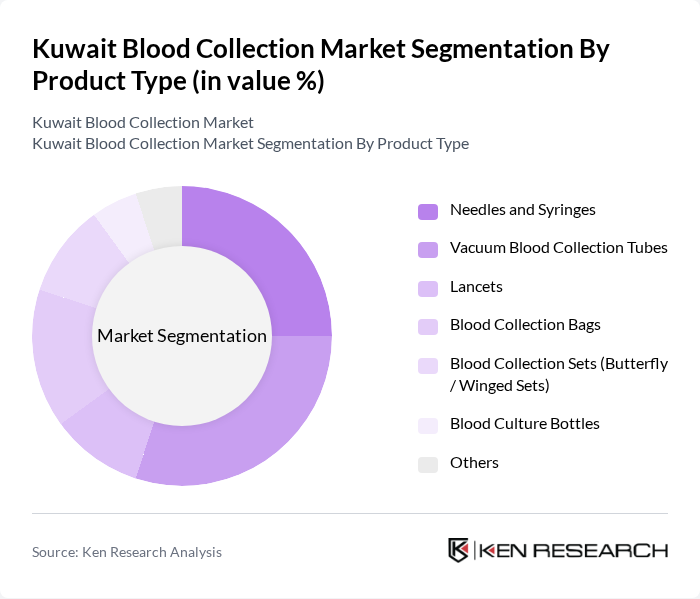
Kuwait Blood Collection Market segmentation by Product Type.

By Application:The application segmentation highlights the various uses of blood collection products. Clinical diagnostics is the leading application, driven by the increasing number of diagnostic tests performed in hospitals and laboratories. Blood donation and transfusion services are also significant, supported by government initiatives to encourage voluntary blood donations. Research and development applications are growing, particularly in academic and clinical research settings.
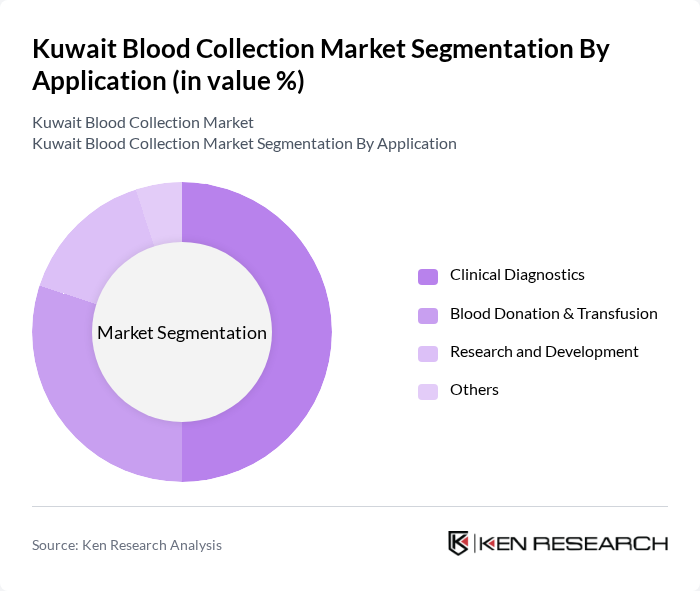
Kuwait Blood Collection Market segmentation by Application.

Kuwait Blood Collection Market Competitive Landscape

The Kuwait Blood Collection Market is characterized by a dynamic mix of regional and international players. Leading participants such as Becton, Dickinson and Company (BD), Terumo Corporation, Greiner Bio-One International GmbH, SARSTEDT AG & Co. KG, Medtronic plc, Nipro Corporation, Fresenius Kabi AG, Kawas Consulting & Medical Supplies Co. W.L.L., Al-Ghanim Healthcare (Alghanim Healthcare), Advanced Technology Company K.S.C. (ATC), Kuwait Central Blood Bank (Ministry of Health), Jaber Al-Ahmad Hospital, Mubarak Al-Kabeer Hospital, Al-Amiri Hospital, Kuwait Red Crescent Society contribute to innovation, geographic expansion, and service delivery in this space.

Becton, Dickinson and Company (BD)

1897

Franklin Lakes, New Jersey, USA

Terumo Corporation

1921

Tokyo, Japan

Greiner Bio-One International GmbH

1868

Frickenhausen, Germany

SARSTEDT AG & Co. KG

1961

Nümbrecht, Germany

Medtronic plc

1949

Dublin, Ireland

Company

Establishment Year

Headquarters

Group Size (Global, Regional, or Local Player)

Revenue from Blood Collection Products in Kuwait (USD Million)

Revenue Growth Rate in Kuwait (% YoY)

Market Share in Kuwait Blood Collection Market (%)

Product Portfolio Breadth (Number of Blood Collection SKUs)

Installed Base of Blood Collection Systems (Number of Sites in Kuwait)

Kuwait Blood Collection Market Industry Analysis

Growth Drivers

  • Increasing Demand for Blood Transfusions:The demand for blood transfusions in Kuwait has surged, with approximately 60,000 units required annually. This increase is driven by a growing population and rising incidences of chronic diseases, such as diabetes and cancer, which necessitate regular blood transfusions. According to the Ministry of Health, the number of transfusions has risen by 20% over the past three years, highlighting the urgent need for efficient blood collection systems to meet this demand.
  • Advancements in Blood Collection Technology:Technological innovations in blood collection, such as automated blood collection systems, have improved efficiency and safety. In future, Kuwait is expected to invest around $6 million in upgrading existing blood collection technologies. These advancements not only enhance the speed of collection but also ensure better donor safety, which is crucial for increasing donor participation and maintaining a stable blood supply.
  • Government Initiatives to Promote Blood Donation:The Kuwaiti government has launched several initiatives to encourage blood donation, including awareness campaigns and community events. In future, over 25,000 new donors are projected to register due to these efforts. The government allocated approximately $1.5 million for these campaigns, aiming to increase the annual blood donation rate by 15% in future, thereby ensuring a more robust blood supply for healthcare facilities.

Market Challenges

  • Limited Public Awareness about Blood Donation:Despite government efforts, public awareness regarding the importance of blood donation remains low. A survey indicated that only 35% of the population understands the critical need for regular blood donations. This lack of awareness contributes to a shortfall in voluntary donations, which is essential for maintaining adequate blood supplies in hospitals and clinics across Kuwait.
  • Shortage of Trained Professionals:The blood collection sector in Kuwait faces a significant challenge due to a shortage of trained healthcare professionals. Currently, there are only 180 certified blood collection specialists in the country, which is insufficient to meet the growing demand. The Ministry of Health has reported that this shortage could lead to delays in blood collection and processing, ultimately affecting patient care and safety.

Kuwait Blood Collection Market Future Outlook

The future of the Kuwait blood collection market appears promising, driven by ongoing technological advancements and increased government support. As healthcare expenditure is projected to rise by 6% in future, investments in blood collection infrastructure and training programs are expected to enhance operational efficiency. Additionally, the integration of digital platforms for donor engagement will likely improve donor retention and participation rates, ensuring a more stable blood supply for the healthcare system.

Market Opportunities

  • Expansion of Blood Banks and Collection Centers:There is a significant opportunity for expanding blood banks and collection centers across Kuwait. With only 12 major blood banks currently operational, the government plans to establish 6 new centers in future, which could increase accessibility and convenience for donors, ultimately boosting donation rates.
  • Collaboration with NGOs for Awareness Campaigns:Collaborating with non-governmental organizations (NGOs) presents a valuable opportunity to enhance public awareness about blood donation. By leveraging the outreach capabilities of NGOs, the government can effectively educate communities, potentially increasing donor participation by 20% in future, thereby addressing the critical need for blood supply.

Scope of the Report

SegmentSub-Segments
By Product Type

Needles and Syringes

Vacuum Blood Collection Tubes

Lancets

Blood Collection Bags

Blood Collection Sets (Butterfly / Winged Sets)

Blood Culture Bottles

Others

By Application

Clinical Diagnostics

Blood Donation & Transfusion

Research and Development

Others

By Collection Method

Venous Blood Collection

Capillary Blood Collection

Automated Blood Collection

Manual Blood Collection

By End-User

Hospitals and Clinics

Diagnostic Laboratories

Blood Banks

Research and Academic Institutes

Others

By Material

Glass-Based Devices

Plastic / PET-Based Devices

Others

By Distribution Channel

Direct Sales (Tenders & Contracts)

Distributors / Dealers

Online Procurement Platforms

Others

By Region

Capital Governorate (Al Asimah)

Hawalli Governorate

Al Ahmadi Governorate

Farwaniya Governorate

Al Jahra Governorate

Mubarak Al-Kabeer Governorate

Key Target Audience

Investors and Venture Capitalist Firms

Government and Regulatory Bodies (e.g., Ministry of Health, Kuwait Blood Transfusion Services)

Manufacturers and Producers of Blood Collection Equipment

Distributors and Retailers of Medical Supplies

Healthcare Providers and Hospitals

Blood Donation Organizations and NGOs

Pharmaceutical Companies

Health Insurance Companies

Players Mentioned in the Report:

Becton, Dickinson and Company (BD)

Terumo Corporation

Greiner Bio-One International GmbH

SARSTEDT AG & Co. KG

Medtronic plc

Nipro Corporation

Fresenius Kabi AG

Kawas Consulting & Medical Supplies Co. W.L.L.

Al-Ghanim Healthcare (Alghanim Healthcare)

Advanced Technology Company K.S.C. (ATC)

Kuwait Central Blood Bank (Ministry of Health)

Jaber Al-Ahmad Hospital

Mubarak Al-Kabeer Hospital

Al-Amiri Hospital

Kuwait Red Crescent Society

Table of Contents

Market Assessment Phase

1. Executive Summary and Approach


2. Kuwait Blood Collection Market Overview

2.1 Key Insights and Strategic Recommendations

2.2 Kuwait Blood Collection Market Overview

2.3 Definition and Scope

2.4 Evolution of Market Ecosystem

2.5 Timeline of Key Regulatory Milestones

2.6 Value Chain & Stakeholder Mapping

2.7 Business Cycle Analysis

2.8 Policy & Incentive Landscape


3. Kuwait Blood Collection Market Analysis

3.1 Growth Drivers

3.1.1 Increasing demand for blood transfusions
3.1.2 Advancements in blood collection technology
3.1.3 Rising awareness about blood donation
3.1.4 Government initiatives to promote blood donation

3.2 Market Challenges

3.2.1 Limited public awareness about blood donation
3.2.2 Regulatory hurdles in blood collection processes
3.2.3 Shortage of trained professionals
3.2.4 Infrastructure limitations in remote areas

3.3 Market Opportunities

3.3.1 Expansion of blood banks and collection centers
3.3.2 Collaboration with NGOs for awareness campaigns
3.3.3 Technological innovations in blood collection
3.3.4 Increasing healthcare expenditure by the government

3.4 Market Trends

3.4.1 Growing adoption of automated blood collection systems
3.4.2 Rise in mobile blood donation units
3.4.3 Integration of digital platforms for donor engagement
3.4.4 Focus on safety and quality in blood collection

3.5 Government Regulation

3.5.1 Compliance with health and safety standards
3.5.2 Licensing requirements for blood collection centers
3.5.3 Regulations on blood donor eligibility
3.5.4 Guidelines for blood storage and transportation

4. SWOT Analysis


5. Stakeholder Analysis


6. Porter's Five Forces Analysis


7. Kuwait Blood Collection Market Market Size, 2019-2024

7.1 By Value

7.2 By Volume

7.3 By Average Selling Price


8. Kuwait Blood Collection Market Segmentation

8.1 By Product Type

8.1.1 Needles and Syringes
8.1.2 Vacuum Blood Collection Tubes
8.1.3 Lancets
8.1.4 Blood Collection Bags
8.1.5 Blood Collection Sets (Butterfly / Winged Sets)
8.1.6 Blood Culture Bottles
8.1.7 Others

8.2 By Application

8.2.1 Clinical Diagnostics
8.2.2 Blood Donation & Transfusion
8.2.3 Research and Development
8.2.4 Others

8.3 By Collection Method

8.3.1 Venous Blood Collection
8.3.2 Capillary Blood Collection
8.3.3 Automated Blood Collection
8.3.4 Manual Blood Collection

8.4 By End-User

8.4.1 Hospitals and Clinics
8.4.2 Diagnostic Laboratories
8.4.3 Blood Banks
8.4.4 Research and Academic Institutes
8.4.5 Others

8.5 By Material

8.5.1 Glass-Based Devices
8.5.2 Plastic / PET-Based Devices
8.5.3 Others

8.6 By Distribution Channel

8.6.1 Direct Sales (Tenders & Contracts)
8.6.2 Distributors / Dealers
8.6.3 Online Procurement Platforms
8.6.4 Others

8.7 By Region

8.7.1 Capital Governorate (Al Asimah)
8.7.2 Hawalli Governorate
8.7.3 Al Ahmadi Governorate
8.7.4 Farwaniya Governorate
8.7.5 Al Jahra Governorate
8.7.6 Mubarak Al-Kabeer Governorate

9. Kuwait Blood Collection Market Competitive Analysis

9.1 Market Share of Key Players

9.2 Cross Comparison of Key Players

9.2.1 Company Name
9.2.2 Group Size (Global, Regional, or Local Player)
9.2.3 Revenue from Blood Collection Products in Kuwait (USD Million)
9.2.4 Revenue Growth Rate in Kuwait (% YoY)
9.2.5 Market Share in Kuwait Blood Collection Market (%)
9.2.6 Product Portfolio Breadth (Number of Blood Collection SKUs)
9.2.7 Installed Base of Blood Collection Systems (Number of Sites in Kuwait)
9.2.8 Distribution Network Coverage (Number of Hospitals/Labs/Blood Banks Served)
9.2.9 Average Selling Price Positioning (Premium / Mid / Economy)
9.2.10 R&D and Innovation Intensity (R&D Spend as % of Global Revenue)
9.2.11 Regulatory & Quality Certifications Relevant to Kuwait (e.g., CE, FDA, SFDA, local approvals)
9.2.12 Key Kuwait Contracts and Tenders Won (Last 3–5 Years)

9.3 SWOT Analysis of Top Players

9.4 Pricing Analysis

9.5 Detailed Profile of Major Companies

9.5.1 Becton, Dickinson and Company (BD)
9.5.2 Terumo Corporation
9.5.3 Greiner Bio-One International GmbH
9.5.4 SARSTEDT AG & Co. KG
9.5.5 Medtronic plc
9.5.6 Nipro Corporation
9.5.7 Fresenius Kabi AG
9.5.8 Kawas Consulting & Medical Supplies Co. W.L.L.
9.5.9 Al-Ghanim Healthcare (Alghanim Healthcare)
9.5.10 Advanced Technology Company K.S.C. (ATC)
9.5.11 Kuwait Central Blood Bank (Ministry of Health)
9.5.12 Jaber Al-Ahmad Hospital
9.5.13 Mubarak Al-Kabeer Hospital
9.5.14 Al-Amiri Hospital
9.5.15 Kuwait Red Crescent Society

10. Kuwait Blood Collection Market End-User Analysis

10.1 Procurement Behavior of Key Ministries

10.1.1 Ministry of Health
10.1.2 Ministry of Education
10.1.3 Ministry of Interior
10.1.4 Others

10.2 Corporate Spend on Infrastructure & Energy

10.2.1 Investment in Blood Collection Facilities
10.2.2 Funding for Awareness Campaigns
10.2.3 Budget Allocation for Technology Upgrades
10.2.4 Others

10.3 Pain Point Analysis by End-User Category

10.3.1 Hospitals
10.3.2 Blood Banks
10.3.3 Research Institutions
10.3.4 Others

10.4 User Readiness for Adoption

10.4.1 Training Needs
10.4.2 Infrastructure Readiness
10.4.3 Technology Acceptance
10.4.4 Others

10.5 Post-Deployment ROI and Use Case Expansion

10.5.1 Evaluation of Blood Collection Efficiency
10.5.2 Impact on Patient Outcomes
10.5.3 Cost Savings Analysis
10.5.4 Others

11. Kuwait Blood Collection Market Future Size, 2025-2030

11.1 By Value

11.2 By Volume

11.3 By Average Selling Price


Go-To-Market Strategy Phase

1. Whitespace Analysis + Business Model Canvas

1.1 Market Gaps Identification

1.2 Business Model Development


2. Marketing and Positioning Recommendations

2.1 Branding Strategies

2.2 Product USPs


3. Distribution Plan

3.1 Urban Retail vs Rural NGO Tie-ups


4. Channel & Pricing Gaps

4.1 Underserved Routes

4.2 Pricing Bands


5. Unmet Demand & Latent Needs

5.1 Category Gaps

5.2 Consumer Segments


6. Customer Relationship

6.1 Loyalty Programs

6.2 After-sales Service


7. Value Proposition

7.1 Sustainability

7.2 Integrated Supply Chains


8. Key Activities

8.1 Regulatory Compliance

8.2 Branding

8.3 Distribution Setup


9. Entry Strategy Evaluation

9.1 Domestic Market Entry Strategy

9.1.1 Product Mix
9.1.2 Pricing Band
9.1.3 Packaging

9.2 Export Entry Strategy

9.2.1 Target Countries
9.2.2 Compliance Roadmap

10. Entry Mode Assessment

10.1 JV

10.2 Greenfield

10.3 M&A

10.4 Distributor Model


11. Capital and Timeline Estimation

11.1 Capital Requirements

11.2 Timelines


12. Control vs Risk Trade-Off

12.1 Ownership vs Partnerships


13. Profitability Outlook

13.1 Breakeven Analysis

13.2 Long-term Sustainability


14. Potential Partner List

14.1 Distributors

14.2 JVs

14.3 Acquisition Targets


15. Execution Roadmap

15.1 Phased Plan for Market Entry

15.1.1 Market Setup
15.1.2 Market Entry
15.1.3 Growth Acceleration
15.1.4 Scale & Stabilize

15.2 Key Activities and Milestones

15.2.1 Activity Planning
15.2.2 Milestone Tracking

Research Methodology

ApproachModellingSample

Phase 1: Approach1

Desk Research

  • Analysis of government health statistics and blood donation reports from the Ministry of Health, Kuwait
  • Review of industry publications and white papers on blood collection trends and technologies
  • Examination of demographic data and health surveys to understand donor profiles and behaviors

Primary Research

  • Interviews with healthcare professionals and blood bank managers to gather insights on operational challenges
  • Surveys with blood donors to assess motivations and barriers to donation
  • Focus groups with community leaders to explore awareness and education initiatives regarding blood donation

Validation & Triangulation

  • Cross-validation of findings through comparison with international blood collection standards and practices
  • Triangulation of data from healthcare providers, NGOs, and government sources
  • Sanity checks through expert panel reviews involving hematologists and public health officials

Phase 2: Market Size Estimation1

Top-down Assessment

  • Estimation of total blood collection volume based on national health expenditure and population statistics
  • Segmentation of the market by blood type, collection method, and end-user (hospitals, clinics, etc.)
  • Incorporation of trends in transfusion practices and advancements in blood collection technology

Bottom-up Modeling

  • Collection of data from blood banks on average units collected per drive and annual collection rates
  • Operational cost analysis based on equipment, staffing, and logistics for blood collection
  • Volume x cost calculations to derive revenue estimates for blood collection services

Forecasting & Scenario Analysis

  • Multi-factor regression analysis incorporating population growth, health awareness campaigns, and disease prevalence
  • Scenario modeling based on potential changes in regulations and healthcare funding
  • Baseline, optimistic, and pessimistic projections for blood collection growth through 2030

Phase 3: CATI Sample Composition1

Scope Item/SegmentSample SizeTarget Respondent Profiles
Hospital Blood Collection Practices100Blood Bank Managers, Hospital Administrators
Community Blood Donation Drives80Event Coordinators, Community Health Workers
Public Awareness Campaigns60Public Health Officials, NGO Representatives
Donor Experience Feedback120Regular Blood Donors, First-time Donors
Technological Innovations in Blood Collection70Medical Device Manufacturers, Healthcare Innovators

Frequently Asked Questions

What is the current value of the Kuwait Blood Collection Market?

The Kuwait Blood Collection Market is valued at approximately USD 30 million, reflecting a five-year historical analysis. This growth is attributed to increased demand for blood transfusions, advancements in collection technologies, and government initiatives promoting blood donation.

What factors are driving the growth of the Kuwait Blood Collection Market?

Which regions in Kuwait dominate the blood collection market?

What regulations govern blood collection in Kuwait?

Other Regional/Country Reports

KSA blood collection market size, share, growth drivers, trends, opportunities & forecast 2025–2030

Indonesia Blood Collection Market

Malaysia Blood Collection Market

APAC Blood Collection Market

SEA Blood Collection Market

Vietnam Blood Collection Market

Other Adjacent Reports

Malaysia Blood Transfusion Market

KSA Diagnostic Testing Market

KSA Blood Banking Market

Indonesia Hematology Market

Poland Medical Devices MarketVietnam laboratory equipment market report size, share, growth drivers, trends, opportunities & forecast 2025–2030

South Africa Healthcare Supplies Market

KSA Phlebotomy Services Market

Saudi Arabia biotechnology market Size, Share, Growth Drivers, Trends, Opportunities & Forecast 2025–2030

South Korea Regenerative Medicine Market

Why Buy From Us?

Refine Robust Result (RRR) Framework

What makes us stand out is that our consultants follow Robust, Refine and Result (RRR) methodology. Robust for clear definitions, approaches and sanity checking, Refine for differentiating respondents' facts and opinions, and Result for presenting data with story.

Our Reach Is Unmatched

We have set a benchmark in the industry by offering our clients with syndicated and customized market research reports featuring coverage of entire market as well as meticulous research and analyst insights.

Shifting the Research Paradigm

While we don't replace traditional research, we flip the method upside down. Our dual approach of Top Bottom & Bottom Top ensures quality deliverable by not just verifying company fundamentals but also looking at the sector and macroeconomic factors.

More Insights-Better Decisions

With one step in the future, our research team constantly tries to show you the bigger picture. We help with some of the tough questions you may encounter along the way: How is the industry positioned? Best marketing channel? KPI's of competitors? By aligning every element, we help maximize success.

Transparency and Trust

Our report gives you instant access to the answers and sources that other companies might choose to hide. We elaborate each steps of research methodology we have used and showcase you the sample size to earn your trust.

Round the Clock Support

If you need any support, we are here! We pride ourselves on universe strength, data quality, and quick, friendly, and professional service.

Why Clients Choose Us?

400000+
Reports in repository
150+
Consulting projects a year
100+
Analysts
8000+
Client Queries in 2022








