About the Report
Base Year 2024Listen to the audio summary
Kuwait Crop Protection Chemicals Market Overview
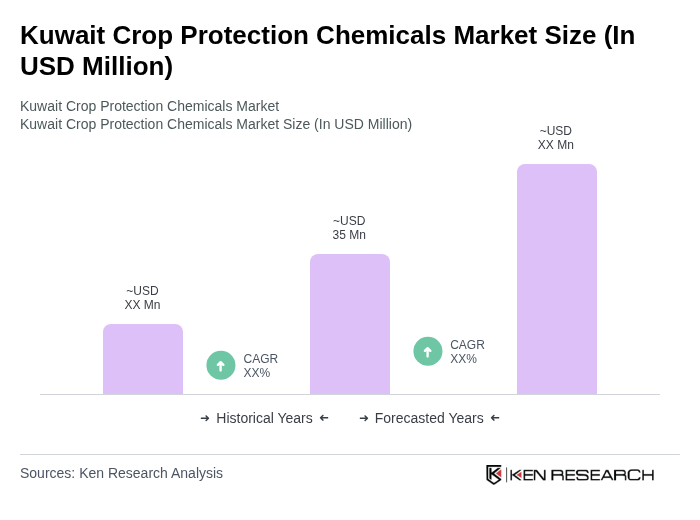
- The Kuwait Crop Protection Chemicals Market is valued at USD 35 million, based on a five-year historical analysis and Kuwait’s share within the Middle East agrochemicals market and regional crop protection imports. This growth is primarily driven by the increasing demand for agricultural productivity under arid climatic conditions and the need for effective pest and weed management solutions in irrigated and greenhouse production systems. The rise in population and urbanization, together with the country’s food security strategy and expansion of protected cultivation, has led to a greater focus on yield stability and quality, prompting farmers and agribusiness operators to adopt advanced crop protection measures such as integrated pest management, drip?compatible formulations, and more targeted herbicide applications.
- Kuwait's market is influenced by key governorates such as Al Jahra, Al Ahmadi, and Farwaniya, where agricultural production, greenhouses, and open?field farms are concentrated, while Kuwait City functions as the main hub for importation, warehousing, and distribution of crop protection products. The concentration of agricultural support services, dealer networks, and government-backed agricultural projects around these areas facilitates the growth of the crop protection chemicals market, making them pivotal in meeting local needs for cereals, fodder, vegetables, and dates, as well as landscaping and amenity uses.
- In 2023, the Kuwaiti government strengthened regulations aimed at promoting sustainable agricultural practices and safe pesticide use through the implementation of the Ministerial Decree No. 71 of 2013 on the Regulation of Pesticides, issued by the Public Authority for Agriculture Affairs and Fish Resources (PAAF), which governs the registration, import, trade, and application of agricultural pesticides in Kuwait. This framework includes detailed guidelines for the safe use of crop protection chemicals, requirements for registration and labeling in line with Gulf and FAO standards, and provisions that enable the Ministry of Health and PAAF to mandate training and awareness programs for farmers, agronomists, and distributors to ensure compliance with safety, residue, and environmental protection norms.
Kuwait Crop Protection Chemicals Market Segmentation
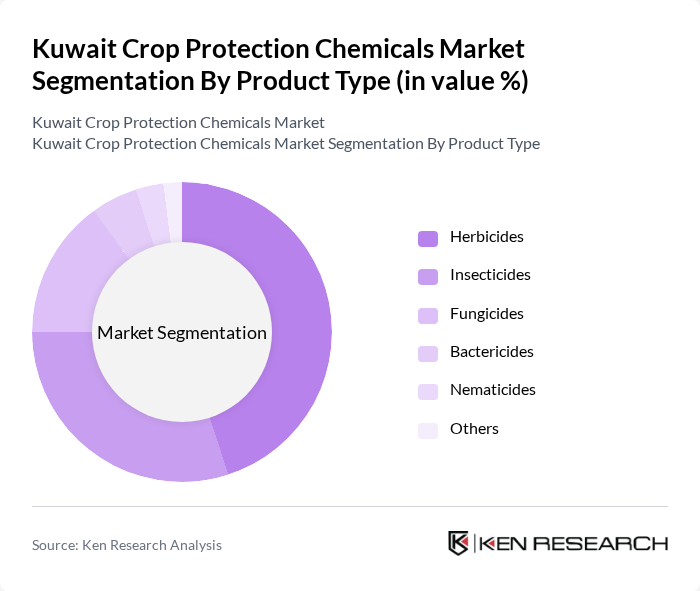
By Product Type:The product type segmentation includes various categories such as herbicides, insecticides, fungicides, bactericides, nematicides, and others. This structure is consistent with global and regional crop protection classification, where herbicides, insecticides, and fungicides form the core product groups. Among these, herbicides are the most widely used worldwide and in arid-field systems due to their effectiveness in controlling unwanted vegetation, which is crucial for crop yield and water-use efficiency. The increasing adoption of herbicides in Kuwait is driven by the need for efficient weed management in fodder crops, cereals, and large greenhouse complexes, where labor savings and consistent performance are important. Insecticides also hold a significant share, as they are essential for protecting vegetables, fruits, and date palms from key pests whose incidence is exacerbated by high temperatures and changing climatic conditions. The demand for fungicides is growing as well, particularly in fruit and vegetable cultivation and greenhouse production, where moisture and intensive cultivation can increase the prevalence of fungal and oomycete diseases that severely impact yield and quality.
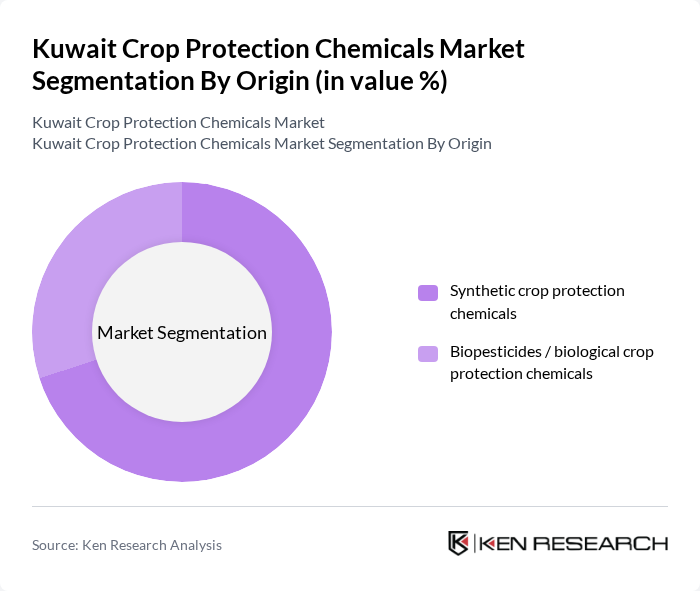
By Origin:The origin segmentation includes synthetic crop protection chemicals and biopesticides. This is aligned with standard international segmentation of crop protection markets into synthetic and biological/biopesticide categories. Synthetic chemicals currently dominate both the global and Middle East crop protection markets due to their broad-spectrum efficacy, ease of use, and established distribution networks, and farmers in Kuwait often prefer these options for their immediate and predictable results in pest and weed control. However, there is a growing trend towards biopesticides and other biological solutions, driven by increasing awareness of environmental sustainability, food safety requirements, and the rise of high?value greenhouse crops and export?oriented production where residue management is critical. This shift is encouraging manufacturers and distributors active in the Gulf region to expand their biological portfolios, including microbial and botanical products, which are perceived as safer alternatives and are often compatible with integrated pest management programs.
Kuwait Crop Protection Chemicals Market Competitive Landscape
The Kuwait Crop Protection Chemicals Market is characterized by a dynamic mix of regional and international players. Leading participants such as BASF SE, Syngenta AG, Bayer AG (Crop Science Division), Corteva Agriscience, FMC Corporation, ADAMA Agricultural Solutions Ltd., Nufarm Limited, UPL Limited, Sumitomo Chemical Co., Ltd., Arysta LifeScience Corporation (now part of UPL), Cheminova A/S (now part of FMC), Isagro S.p.A., Albaugh, LLC, Belchim Crop Protection, BioWorks, Inc. contribute to innovation, geographic expansion, and service delivery in this space.
Kuwait Crop Protection Chemicals Market Industry Analysis
Growth Drivers
- Increasing Agricultural Productivity:The agricultural sector in Kuwait is projected to grow significantly, with a focus on enhancing productivity. In the near future, the government aims to increase crop yields by 15%, supported by investments of approximately two hundred million dollars in modern farming techniques. This growth is driven by the need to ensure food security, as Kuwait imports over 90% of its food. Enhanced productivity directly correlates with the rising demand for crop protection chemicals, which are essential for maintaining crop health and maximizing yields.
- Rising Demand for Organic Farming:The organic farming sector in Kuwait is experiencing a notable surge, with a reported increase of 20% in organic produce sales recently. This trend is supported by consumer preferences shifting towards healthier food options, leading to a projected market value of fifty million dollars for organic products in the near future. As organic farming practices require specific crop protection solutions, this demand is driving innovation and growth in the crop protection chemicals market, particularly for biopesticides and eco-friendly alternatives.
- Government Initiatives for Sustainable Agriculture:The Kuwaiti government has launched several initiatives aimed at promoting sustainable agricultural practices, with a budget allocation of one hundred fifty million dollars for the near future. These initiatives include subsidies for eco-friendly crop protection products and training programs for farmers. The focus on sustainability is expected to increase the adoption of integrated pest management (IPM) strategies, which will further boost the demand for advanced crop protection chemicals that align with environmental regulations and sustainability goals.
Market Challenges
- Stringent Regulatory Requirements:The crop protection chemicals market in Kuwait faces significant challenges due to stringent regulatory frameworks. In the near future, the Ministry of Agriculture is expected to implement new regulations that require comprehensive safety assessments for all chemical products. This could lead to increased compliance costs, estimated at around ten million dollars for manufacturers, potentially hindering market entry for new products and slowing down innovation in the sector.
- Environmental Concerns Regarding Chemical Usage:Growing environmental awareness among consumers and advocacy groups poses a challenge for the crop protection chemicals market. In the near future, it is anticipated that public campaigns against harmful pesticides will intensify, leading to a potential decline in sales of conventional chemical products. This shift could result in a market contraction of approximately thirty million dollars, as farmers seek safer, more sustainable alternatives to meet both regulatory and consumer demands.
Kuwait Crop Protection Chemicals Market Future Outlook
The future of the Kuwait crop protection chemicals market appears promising, driven by technological advancements and a shift towards sustainable practices. As farmers increasingly adopt integrated pest management and precision agriculture techniques, the demand for innovative crop protection solutions is expected to rise. Additionally, the government's commitment to enhancing agricultural productivity and sustainability will likely foster a conducive environment for market growth, encouraging investments in research and development to meet evolving consumer preferences and regulatory standards.
Market Opportunities
- Expansion of Export Markets:Kuwait's strategic location offers significant opportunities for exporting crop protection chemicals to neighboring countries. With an estimated export potential of one hundred million dollars in the near future, local manufacturers can leverage regional trade agreements to enhance their market presence and diversify their revenue streams, capitalizing on the growing demand for agricultural inputs in the Gulf Cooperation Council (GCC) region.
- Development of Biopesticides:The increasing consumer preference for organic and eco-friendly products presents a lucrative opportunity for the development of biopesticides. With a projected market value of twenty-five million dollars in the near future, biopesticides are gaining traction as sustainable alternatives to traditional chemicals. Investment in R&D for biopesticides can position Kuwaiti companies as leaders in this emerging segment, catering to both local and international markets.
Scope of the Report
| Segment | Sub-Segments |
|---|---|
| By Product Type | Herbicides Insecticides Fungicides Bactericides Nematicides Others |
| By Origin | Synthetic crop protection chemicals Biopesticides / biological crop protection chemicals |
| By Crop Type | Cereals and grains Fruits and vegetables Oilseeds and pulses Other crops (forage, ornamental, etc.) |
| By Mode of Application | Foliar spray Soil treatment Seed treatment Other application methods |
| By Formulation | Liquid formulations Dry / solid formulations Others |
| By Distribution Channel | Direct sales to large farms and institutions Agro-dealers and retail outlets Online and digital platforms Distributors and importers Others |
| By Region | Northern Kuwait Southern Kuwait Central Kuwait Others |
Key Target Audience
Investors and Venture Capitalist Firms
Government and Regulatory Bodies (e.g., Kuwait Ministry of Agriculture and Water Resources)
Manufacturers and Producers
Distributors and Retailers
Pesticide and Agrochemical Importers
Environmental Protection Agencies (e.g., Kuwait Environment Public Authority)
Industry Associations (e.g., Kuwait Agricultural Association)
Financial Institutions
Players Mentioned in the Report:
BASF SE
Syngenta AG
Bayer AG (Crop Science Division)
Corteva Agriscience
FMC Corporation
ADAMA Agricultural Solutions Ltd.
Nufarm Limited
UPL Limited
Sumitomo Chemical Co., Ltd.
Arysta LifeScience Corporation (now part of UPL)
Cheminova A/S (now part of FMC)
Isagro S.p.A.
Albaugh, LLC
Belchim Crop Protection
BioWorks, Inc.
Table of Contents
Market Assessment Phase
1. Executive Summary and Approach
2. Kuwait Crop Protection Chemicals Market Overview
2.1 Key Insights and Strategic Recommendations
2.2 Kuwait Crop Protection Chemicals Market Overview
2.3 Definition and Scope
2.4 Evolution of Market Ecosystem
2.5 Timeline of Key Regulatory Milestones
2.6 Value Chain & Stakeholder Mapping
2.7 Business Cycle Analysis
2.8 Policy & Incentive Landscape
3. Kuwait Crop Protection Chemicals Market Analysis
3.1 Growth Drivers
3.1.1 Increasing agricultural productivity
3.1.2 Rising demand for organic farming
3.1.3 Government initiatives for sustainable agriculture
3.1.4 Technological advancements in crop protection
3.2 Market Challenges
3.2.1 Stringent regulatory requirements
3.2.2 Environmental concerns regarding chemical usage
3.2.3 High cost of advanced crop protection products
3.2.4 Limited awareness among farmers
3.3 Market Opportunities
3.3.1 Expansion of export markets
3.3.2 Development of biopesticides
3.3.3 Increasing investment in agricultural R&D
3.3.4 Collaborations with local farmers for product testing
3.4 Market Trends
3.4.1 Shift towards integrated pest management
3.4.2 Growing popularity of precision agriculture
3.4.3 Rise in demand for eco-friendly products
3.4.4 Increased focus on supply chain transparency
3.5 Government Regulation
3.5.1 Registration and approval processes for chemicals
3.5.2 Compliance with international safety standards
3.5.3 Restrictions on certain harmful substances
3.5.4 Incentives for sustainable agricultural practices
4. SWOT Analysis
5. Stakeholder Analysis
6. Porter's Five Forces Analysis
7. Kuwait Crop Protection Chemicals Market Market Size, 2019-2024
7.1 By Value
7.2 By Volume
7.3 By Average Selling Price
8. Kuwait Crop Protection Chemicals Market Segmentation
8.1 By Product Type
8.1.1 Herbicides
8.1.2 Insecticides
8.1.3 Fungicides
8.1.4 Bactericides
8.1.5 Nematicides
8.1.6 Others
8.2 By Origin
8.2.1 Synthetic crop protection chemicals
8.2.2 Biopesticides / biological crop protection chemicals
8.3 By Crop Type
8.3.1 Cereals and grains
8.3.2 Fruits and vegetables
8.3.3 Oilseeds and pulses
8.3.4 Other crops (forage, ornamental, etc.)
8.4 By Mode of Application
8.4.1 Foliar spray
8.4.2 Soil treatment
8.4.3 Seed treatment
8.4.4 Other application methods
8.5 By Formulation
8.5.1 Liquid formulations
8.5.2 Dry / solid formulations
8.5.3 Others
8.6 By Distribution Channel
8.6.1 Direct sales to large farms and institutions
8.6.2 Agro-dealers and retail outlets
8.6.3 Online and digital platforms
8.6.4 Distributors and importers
8.6.5 Others
8.7 By Region
8.7.1 Northern Kuwait
8.7.2 Southern Kuwait
8.7.3 Central Kuwait
8.7.4 Others
9. Kuwait Crop Protection Chemicals Market Competitive Analysis
9.1 Market Share of Key Players
9.2 Cross Comparison of Key Players
9.2.1 Company name
9.2.2 Group size (large, medium, or small as per industry convention)
9.2.3 Kuwait crop protection chemicals revenue (USD million)
9.2.4 Kuwait crop protection chemicals revenue CAGR, 2019–2024 (%)
9.2.5 Kuwait market share by value (%)
9.2.6 Kuwait market share by volume (%)
9.2.7 Share of biological products in portfolio (%)
9.2.8 R&D intensity (R&D spend as % of revenue)
9.2.9 Product portfolio breadth (number of registered SKUs in Kuwait)
9.2.10 Average realized price per litre/kg (USD)
9.2.11 Distribution coverage (number of active distributors / dealers)
9.2.12 Key end?user focus (smallholder vs commercial farms mix)
9.2.13 Registration pipeline (number of products under registration)
9.2.14 Local partnership / JV presence (Yes/No; type)
9.2.15 Compliance / stewardship score (training, disposal, safety programs)
9.3 SWOT Analysis of Top Players
9.4 Pricing Analysis
9.5 Detailed Profile of Major Companies
9.5.1 BASF SE
9.5.2 Syngenta AG
9.5.3 Bayer AG (Crop Science Division)
9.5.4 Corteva Agriscience
9.5.5 FMC Corporation
9.5.6 ADAMA Agricultural Solutions Ltd.
9.5.7 Nufarm Limited
9.5.8 UPL Limited
9.5.9 Sumitomo Chemical Co., Ltd.
9.5.10 Arysta LifeScience Corporation (now part of UPL)
9.5.11 Cheminova A/S (now part of FMC)
9.5.12 Isagro S.p.A.
9.5.13 Albaugh, LLC
9.5.14 Belchim Crop Protection
9.5.15 BioWorks, Inc.
10. Kuwait Crop Protection Chemicals Market End-User Analysis
10.1 Procurement Behavior of Key Ministries
10.1.1 Ministry of Agriculture
10.1.2 Ministry of Environment
10.1.3 Ministry of Commerce and Industry
10.1.4 Others
10.2 Corporate Spend on Infrastructure & Energy
10.2.1 Investment in agricultural infrastructure
10.2.2 Funding for research and development
10.2.3 Expenditure on sustainable practices
10.2.4 Others
10.3 Pain Point Analysis by End-User Category
10.3.1 Farmers
10.3.2 Agricultural cooperatives
10.3.3 Distributors
10.3.4 Others
10.4 User Readiness for Adoption
10.4.1 Awareness of crop protection solutions
10.4.2 Training and support needs
10.4.3 Financial readiness
10.4.4 Others
10.5 Post-Deployment ROI and Use Case Expansion
10.5.1 Measurement of effectiveness
10.5.2 Feedback mechanisms
10.5.3 Opportunities for scaling
10.5.4 Others
11. Kuwait Crop Protection Chemicals Market Future Size, 2025-2030
11.1 By Value
11.2 By Volume
11.3 By Average Selling Price
Go-To-Market Strategy Phase
1. Whitespace Analysis + Business Model Canvas
1.1 Market Gaps Identification
1.2 Value Proposition Development
1.3 Revenue Streams
1.4 Key Resources
1.5 Key Activities
1.6 Key Partnerships
1.7 Customer Segments
2. Marketing and Positioning Recommendations
2.1 Branding strategies
2.2 Product USPs
3. Distribution Plan
3.1 Urban retail vs rural NGO tie-ups
4. Channel & Pricing Gaps
4.1 Underserved routes
4.2 Pricing bands
5. Unmet Demand & Latent Needs
5.1 Category gaps
5.2 Consumer segments
6. Customer Relationship
6.1 Loyalty programs
6.2 After-sales service
7. Value Proposition
7.1 Sustainability
7.2 Integrated supply chains
8. Key Activities
8.1 Regulatory compliance
8.2 Branding
8.3 Distribution setup
9. Entry Strategy Evaluation
9.1 Domestic Market Entry Strategy
9.1.1 Product mix
9.1.2 Pricing band
9.1.3 Packaging
9.2 Export Entry Strategy
9.2.1 Target countries
9.2.2 Compliance roadmap
10. Entry Mode Assessment
10.1 JV
10.2 Greenfield
10.3 M&A
10.4 Distributor Model
11. Capital and Timeline Estimation
11.1 Capital requirements
11.2 Timelines
12. Control vs Risk Trade-Off
12.1 Ownership vs Partnerships
13. Profitability Outlook
13.1 Breakeven analysis
13.2 Long-term sustainability
14. Potential Partner List
14.1 Distributors
14.2 JVs
14.3 Acquisition targets
15. Execution Roadmap
15.1 Phased Plan for Market Entry
15.1.1 Market Setup
15.1.2 Market Entry
15.1.3 Growth Acceleration
15.1.4 Scale & Stabilize
15.2 Key Activities and Milestones
15.2.1 Milestone 1
15.2.2 Milestone 2
Research Methodology
Phase 1: Approach1
Desk Research
- Analysis of agricultural production statistics from the Kuwait Ministry of Agriculture and Water Resources
- Review of market reports and publications from regional agricultural organizations
- Examination of trade data and import/export statistics from the Kuwait Customs Authority
Primary Research
- Interviews with key stakeholders in the crop protection chemicals sector, including manufacturers and distributors
- Surveys conducted with agricultural extension officers and agronomists in Kuwait
- Field visits to farms to gather insights on the usage and effectiveness of crop protection products
Validation & Triangulation
- Cross-validation of findings through multiple data sources, including government reports and industry publications
- Triangulation of qualitative insights from interviews with quantitative data from surveys
- Sanity checks through expert panel discussions with agribusiness consultants
Phase 2: Market Size Estimation1
Top-down Assessment
- Estimation of total market size based on national agricultural output and crop protection expenditure ratios
- Segmentation of the market by product type, including herbicides, insecticides, and fungicides
- Incorporation of government agricultural policies and initiatives promoting sustainable farming practices
Bottom-up Modeling
- Collection of sales data from leading crop protection chemical companies operating in Kuwait
- Estimation of market share based on product distribution channels and regional sales performance
- Volume and pricing analysis based on historical sales trends and projected growth rates
Forecasting & Scenario Analysis
- Development of forecasting models using historical data and projected agricultural growth rates
- Scenario analysis based on potential changes in regulatory frameworks and environmental policies
- Creation of baseline, optimistic, and pessimistic market growth scenarios through 2030
Phase 3: CATI Sample Composition1
| Scope Item/Segment | Sample Size | Target Respondent Profiles |
|---|---|---|
| Chemical Manufacturers | 60 | Product Managers, Sales Directors |
| Agricultural Distributors | 60 | Distribution Managers, Supply Chain Coordinators |
| Farmers and Growers | 120 | Crop Producers, Farm Owners |
| Regulatory Bodies | 40 | Policy Makers, Environmental Officers |
| Agricultural Consultants | 50 | Agronomists, Crop Advisors |
Frequently Asked Questions
What is the current value of the Kuwait Crop Protection Chemicals Market?
The Kuwait Crop Protection Chemicals Market is valued at approximately USD 35 million, reflecting a historical analysis of the market and its share within the broader Middle East agrochemicals sector.
What factors are driving growth in the Kuwait Crop Protection Chemicals Market?
Which governorates in Kuwait are key to the crop protection chemicals market?
What are the main product types in the Kuwait Crop Protection Chemicals Market?
Other Regional/Country Reports
Other Adjacent Reports
Japan Agricultural Fertilizers Market
Indonesia Seeds and Planting Materials Market
Thailand Irrigation Systems MarketJapan Greenhouse Technology Market
Asia Pacific Biostimulants Market Size, Share & Forecast, By Product Type, Crop Type & Application, 2025-2032Global Plant Growth Regulators Market Outlook to 2030North America Precision Agriculture Market Outlook to 2030: Size, Share, Growth and TrendsKuwait Agricultural Biotechnology Market Size, Share, Growth Drivers, Trends, Opportunities & Forecast 2025–2030Germany Organic Farming Products Market
UAE Agrochemical Distribution Market
Why Buy From Us?

What makes us stand out is that our consultants follow Robust, Refine and Result (RRR) methodology. Robust for clear definitions, approaches and sanity checking, Refine for differentiating respondents' facts and opinions, and Result for presenting data with story.

We have set a benchmark in the industry by offering our clients with syndicated and customized market research reports featuring coverage of entire market as well as meticulous research and analyst insights.

While we don't replace traditional research, we flip the method upside down. Our dual approach of Top Bottom & Bottom Top ensures quality deliverable by not just verifying company fundamentals but also looking at the sector and macroeconomic factors.

With one step in the future, our research team constantly tries to show you the bigger picture. We help with some of the tough questions you may encounter along the way: How is the industry positioned? Best marketing channel? KPI's of competitors? By aligning every element, we help maximize success.

Our report gives you instant access to the answers and sources that other companies might choose to hide. We elaborate each steps of research methodology we have used and showcase you the sample size to earn your trust.

If you need any support, we are here! We pride ourselves on universe strength, data quality, and quick, friendly, and professional service.