About the Report
Base Year 2024Listen to the audio summary
Netherlands Floriculture Market Overview
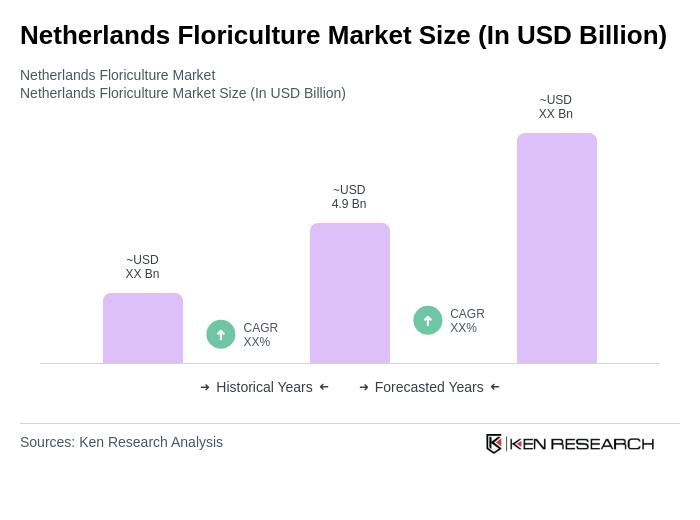
- The Netherlands Floriculture Market is valued at USD 4.9 billion, based on a five-year historical analysis. This growth is primarily driven by the increasing demand for ornamental plants, cut flowers, and potted plants, fueled by consumer preferences for home gardening, floral arrangements, and the expansion of e-commerce and specialty retail channels. The market is also supported by the country's strong export capabilities, making it a global leader in floriculture .
- Key players in this market include Aalsmeer, Naaldwijk, and Rijnsburg, which are prominent flower auction centers. The dominance of these cities is attributed to their strategic locations, advanced logistics, and established networks that facilitate efficient distribution and trade of floral products both domestically and internationally .
- The Dutch government has introduced regulations and incentives to promote sustainable floriculture practices, encouraging the adoption of eco-friendly cultivation methods and resource-efficient technologies. These initiatives are expected to enhance the environmental sustainability of the industry and improve the overall quality of floral products .
Netherlands Floriculture Market Segmentation
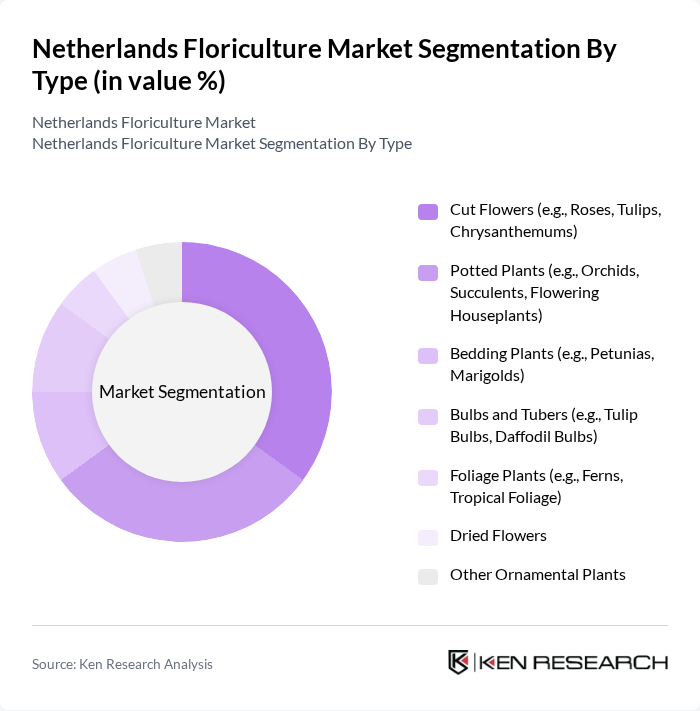
By Type:The floriculture market can be segmented into various types, including cut flowers, potted plants, bedding plants, bulbs and tubers, foliage plants, dried flowers, and other ornamental plants. Each of these subsegments caters to different consumer preferences and market demands. Cut flowers, such as roses, tulips, and chrysanthemums, and potted plants, including orchids and succulents, are particularly popular due to their aesthetic appeal, versatility, and suitability for both domestic and export markets. Bedding plants and bulbs are also significant, especially in seasonal and landscaping applications. Foliage plants and dried flowers are gaining traction as consumers seek low-maintenance and sustainable decorative options .
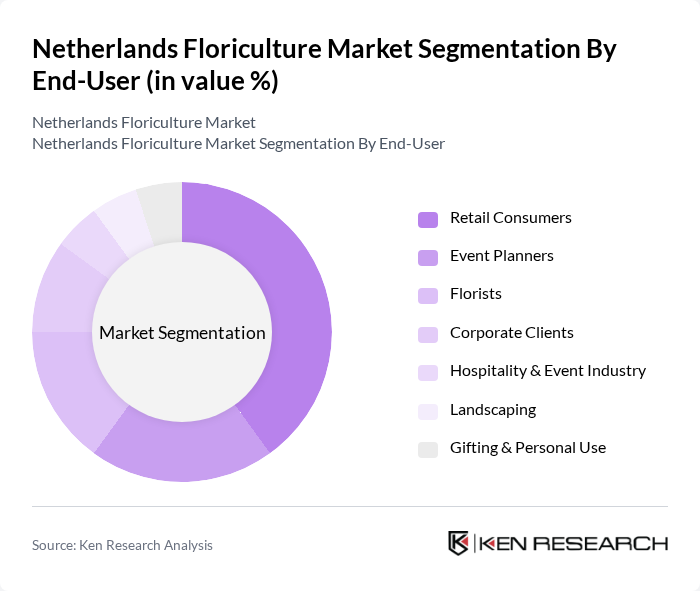
By End-User:The end-user segmentation includes retail consumers, event planners, florists, corporate clients, the hospitality and event industry, landscaping services, and gifting and personal use. Each segment has unique requirements and purchasing behaviors. Florists and retail consumers are the largest contributors to market demand, driven by frequent purchases for occasions, home decoration, and gifting. Event planners and the hospitality sector increasingly seek customized floral solutions, while landscaping and corporate clients focus on long-term contracts and sustainable plant selections .
Netherlands Floriculture Market Competitive Landscape
The Netherlands Floriculture Market is characterized by a dynamic mix of regional and international players. Leading participants such as Royal FloraHolland, Dümmen Orange, Dutch Flower Group, Florensis, Anthura, Van der Ende Group, HilverdaFlorist, KP Holland, Kwekerij J. van der Kooij, Greenhouse Holland, Hortech, Kwekerij De Vries, Kwekerij De Lier, Kwekerij Van der Meer, Kwekerij Van der Wal, Kwekerij Van der Zanden contribute to innovation, geographic expansion, and service delivery in this space.
Netherlands Floriculture Market Industry Analysis
Growth Drivers
- Increasing Consumer Demand for Sustainable Products:The Netherlands has seen a significant rise in consumer preference for sustainable floriculture products, with sales of organic flowers increasing by 15% annually. In future, the organic flower market reached €150 million, driven by eco-conscious consumers. This trend aligns with the European Union's Green Deal, which aims to make Europe climate-neutral by 2050, further boosting demand for sustainable practices in floriculture.
- Growth in Online Flower Sales:The online flower sales segment in the Netherlands has expanded rapidly, with a reported increase of 20% in future, reaching €300 million. This growth is attributed to changing consumer behaviors, particularly among younger demographics who prefer the convenience of e-commerce. The COVID-19 pandemic accelerated this trend, leading to a permanent shift in purchasing habits, with online platforms now accounting for 40% of total flower sales in the country.
- Expansion of Export Markets:The Netherlands remains a global leader in flower exports, with a reported export value of €6.5 billion in future. Key markets include Germany, the United Kingdom, and France, which collectively account for over 60% of total exports. The country's strategic location and advanced logistics infrastructure facilitate this growth, allowing Dutch floriculture businesses to tap into emerging markets in Asia and the Middle East, further enhancing their global footprint.
Market Challenges
- Fluctuating Raw Material Prices:The floriculture industry in the Netherlands faces challenges due to volatile raw material prices, particularly for essential inputs like soil and fertilizers. In future, the price of peat increased by 30%, impacting production costs significantly. This fluctuation can lead to reduced profit margins for growers, forcing them to either absorb costs or pass them onto consumers, which may affect demand negatively.
- Climate Change Impacts on Production:Climate change poses a significant threat to the floriculture sector, with unpredictable weather patterns affecting crop yields. In future, extreme weather events led to a 10% reduction in flower production in key growing regions. This unpredictability not only disrupts supply chains but also increases operational costs for growers, who must invest in adaptive technologies and practices to mitigate these risks.
Netherlands Floriculture Market Future Outlook
The future of the Netherlands floriculture market appears promising, driven by increasing consumer awareness of sustainability and the growing trend of online shopping. As the market adapts to these changes, innovations in technology and cultivation practices will likely enhance productivity and efficiency. Additionally, the expansion of export markets, particularly in Asia, presents significant growth potential. The industry is expected to continue evolving, focusing on eco-friendly practices and digital transformation to meet consumer demands effectively.
Market Opportunities
- Rise in Eco-Friendly Packaging Solutions:The demand for eco-friendly packaging is on the rise, with the market for sustainable packaging solutions projected to reach €1 billion in future. This shift presents an opportunity for floriculture businesses to differentiate themselves by adopting biodegradable and recyclable materials, appealing to environmentally conscious consumers and enhancing brand loyalty.
- Development of Niche Flower Varieties:There is a growing interest in niche flower varieties, with sales of unique and exotic flowers increasing by 25% in future. This trend offers floriculture businesses the chance to cater to specialized markets, such as luxury events and bespoke floral arrangements, thereby increasing their market share and profitability through diversification.
Scope of the Report
| Segment | Sub-Segments |
|---|---|
| By Type | Cut Flowers Potted Plants Bedding Plants Bulbs and Tubers Foliage Plants Dried Flowers Other Ornamental Plants |
| By End-User | Retail Consumers Event Planners Florists Corporate Clients Hospitality & Event Industry Landscaping Gifting & Personal Use |
| By Sales Channel | Flower Auctions Wholesalers Retailers Direct Sales to Florists and Event Planners Specialty Stores Franchises Florists and Kiosks Supermarkets/Hypermarkets Independent Small Stores |
| By Distribution Mode | Direct Sales Third-Party Logistics E-commerce Platforms |
| By Price Range | Budget Mid-Range Premium |
| By Occasion | Weddings Funerals Corporate Events Holidays |
| By Seasonality | Spring Summer Autumn Winter |
Key Target Audience
Investors and Venture Capitalist Firms
Government and Regulatory Bodies (e.g., Netherlands Ministry of Agriculture, Nature and Food Quality)
Manufacturers and Producers
Distributors and Retailers
Floriculture Exporters
Technology Providers
Industry Associations (e.g., Royal FloraHolland)
Financial Institutions
Players Mentioned in the Report:
Royal FloraHolland
Dummen Orange
Dutch Flower Group
Florensis
Anthura
Van der Ende Group
HilverdaFlorist
KP Holland
Kwekerij J. van der Kooij
Greenhouse Holland
Hortech
Kwekerij De Vries
Kwekerij De Lier
Kwekerij Van der Meer
Kwekerij Van der Wal
Kwekerij Van der Zanden
Table of Contents
Market Assessment Phase
1. Executive Summary and Approach
2. Netherlands Floriculture Market Overview
2.1 Key Insights and Strategic Recommendations
2.2 Netherlands Floriculture Market Overview
2.3 Definition and Scope
2.4 Evolution of Market Ecosystem
2.5 Timeline of Key Regulatory Milestones
2.6 Value Chain & Stakeholder Mapping
2.7 Business Cycle Analysis
2.8 Policy & Incentive Landscape
3. Netherlands Floriculture Market Analysis
3.1 Growth Drivers
3.1.1 Increasing consumer demand for sustainable products
3.1.2 Growth in online flower sales
3.1.3 Expansion of export markets
3.1.4 Technological advancements in cultivation
3.2 Market Challenges
3.2.1 Fluctuating raw material prices
3.2.2 Climate change impacts on production
3.2.3 Competition from international markets
3.2.4 Regulatory compliance costs
3.3 Market Opportunities
3.3.1 Rise in eco-friendly packaging solutions
3.3.2 Development of niche flower varieties
3.3.3 Collaborations with local artisans
3.3.4 Growth in event and wedding floristry
3.4 Market Trends
3.4.1 Increasing popularity of subscription flower services
3.4.2 Shift towards locally sourced flowers
3.4.3 Use of AI in supply chain management
3.4.4 Focus on floral design education and workshops
3.5 Government Regulation
3.5.1 Regulations on pesticide use
3.5.2 Import/export restrictions on certain species
3.5.3 Environmental sustainability mandates
3.5.4 Labor laws affecting seasonal workers
4. SWOT Analysis
5. Stakeholder Analysis
6. Porter's Five Forces Analysis
7. Netherlands Floriculture Market Market Size, 2019-2024
7.1 By Value
7.2 By Volume
7.3 By Average Selling Price
8. Netherlands Floriculture Market Segmentation
8.1 By Type
8.1.1 Cut Flowers (e.g., Roses, Tulips, Chrysanthemums)
8.1.2 Potted Plants (e.g., Orchids, Succulents, Flowering Houseplants)
8.1.3 Bedding Plants (e.g., Petunias, Marigolds)
8.1.4 Bulbs and Tubers (e.g., Tulip Bulbs, Daffodil Bulbs)
8.1.5 Foliage Plants (e.g., Ferns, Tropical Foliage)
8.1.6 Dried Flowers
8.1.7 Other Ornamental Plants
8.2 By End-User
8.2.1 Retail Consumers
8.2.2 Event Planners
8.2.3 Florists
8.2.4 Corporate Clients
8.2.5 Hospitality & Event Industry
8.2.6 Landscaping
8.2.7 Gifting & Personal Use
8.3 By Sales Channel
8.3.1 Flower Auctions (e.g., Royal FloraHolland)
8.3.2 Wholesalers
8.3.3 Retailers (Brick-and-Mortar Stores, Online Platforms)
8.3.4 Direct Sales to Florists and Event Planners
8.3.5 Specialty Stores
8.3.6 Franchises
8.3.7 Florists and Kiosks
8.3.8 Supermarkets/Hypermarkets
8.3.9 Independent Small Stores
8.4 By Distribution Mode
8.4.1 Direct Sales
8.4.2 Third-Party Logistics
8.4.3 E-commerce Platforms
8.5 By Price Range
8.5.1 Budget
8.5.2 Mid-Range
8.5.3 Premium
8.6 By Occasion
8.6.1 Weddings
8.6.2 Funerals
8.6.3 Corporate Events
8.6.4 Holidays
8.7 By Seasonality
8.7.1 Spring
8.7.2 Summer
8.7.3 Autumn
8.7.4 Winter
9. Netherlands Floriculture Market Competitive Analysis
9.1 Market Share of Key Players
9.2 Cross Comparison of Key Players
9.2.1 Company Name
9.2.2 Group Size (Large, Medium, or Small as per industry convention)
9.2.3 Revenue Growth Rate (YoY %)
9.2.4 Market Penetration Rate (Domestic & Export %)
9.2.5 Customer Retention Rate (%)
9.2.6 Average Order Value (€)
9.2.7 Pricing Strategy (Premium, Value, Volume)
9.2.8 Distribution Efficiency (Order Fulfillment Time, % On-Time Delivery)
9.2.9 Product Diversification Index (Number of SKUs, Category Breadth)
9.2.10 Brand Recognition Score (Survey/Market Share %)
9.2.11 Sustainability Certification Coverage (% of Products Eco-Certified)
9.2.12 Innovation Index (Patents, New Varieties Introduced)
9.3 SWOT Analysis of Top Players
9.4 Pricing Analysis
9.5 Detailed Profile of Major Companies
9.5.1 Royal FloraHolland
9.5.2 Dümmen Orange
9.5.3 Dutch Flower Group
9.5.4 Florensis
9.5.5 Anthura
9.5.6 Van der Ende Group
9.5.7 HilverdaFlorist
9.5.8 KP Holland
9.5.9 Kwekerij J. van der Kooij
9.5.10 Greenhouse Holland
9.5.11 Hortech
9.5.12 Kwekerij De Vries
9.5.13 Kwekerij De Lier
9.5.14 Kwekerij Van der Meer
9.5.15 Kwekerij Van der Wal
9.5.16 Kwekerij Van der Zanden
10. Netherlands Floriculture Market End-User Analysis
10.1 Procurement Behavior of Key Ministries
10.1.1 Budget Allocation for Floriculture
10.1.2 Supplier Selection Criteria
10.1.3 Contracting Processes
10.1.4 Sustainability Considerations
10.2 Corporate Spend on Infrastructure & Energy
10.2.1 Investment in Greenhouses
10.2.2 Energy Efficiency Initiatives
10.2.3 Technology Upgrades
10.3 Pain Point Analysis by End-User Category
10.3.1 Supply Chain Disruptions
10.3.2 Quality Control Issues
10.3.3 Pricing Volatility
10.4 User Readiness for Adoption
10.4.1 Awareness of Sustainable Practices
10.4.2 Training and Support Needs
10.5 Post-Deployment ROI and Use Case Expansion
10.5.1 Measurement of Success Metrics
10.5.2 Opportunities for Upselling
11. Netherlands Floriculture Market Future Size, 2025-2030
11.1 By Value
11.2 By Volume
11.3 By Average Selling Price
Go-To-Market Strategy Phase
1. Whitespace Analysis + Business Model Canvas
1.1 Market Gaps Identification
1.2 Value Proposition Development
1.3 Revenue Streams Analysis
1.4 Cost Structure Evaluation
1.5 Key Partnerships Exploration
1.6 Customer Segmentation
1.7 Channels of Distribution
2. Marketing and Positioning Recommendations
2.1 Branding Strategies
2.2 Product USPs
3. Distribution Plan
3.1 Urban Retail vs Rural NGO Tie-ups
4. Channel & Pricing Gaps
4.1 Underserved Routes
4.2 Pricing Bands
5. Unmet Demand & Latent Needs
5.1 Category Gaps
5.2 Consumer Segments
6. Customer Relationship
6.1 Loyalty Programs
6.2 After-sales Service
7. Value Proposition
7.1 Sustainability
7.2 Integrated Supply Chains
8. Key Activities
8.1 Regulatory Compliance
8.2 Branding
8.3 Distribution Setup
9. Entry Strategy Evaluation
9.1 Domestic Market Entry Strategy
9.1.1 Product Mix
9.1.2 Pricing Band
9.1.3 Packaging
9.2 Export Entry Strategy
9.2.1 Target Countries
9.2.2 Compliance Roadmap
10. Entry Mode Assessment
10.1 JV
10.2 Greenfield
10.3 M&A
10.4 Distributor Model
11. Capital and Timeline Estimation
11.1 Capital Requirements
11.2 Timelines
12. Control vs Risk Trade-Off
12.1 Ownership vs Partnerships
13. Profitability Outlook
13.1 Breakeven Analysis
13.2 Long-term Sustainability
14. Potential Partner List
14.1 Distributors
14.2 JVs
14.3 Acquisition Targets
15. Execution Roadmap
15.1 Phased Plan for Market Entry
15.1.1 Market Setup
15.1.2 Market Entry
15.1.3 Growth Acceleration
15.1.4 Scale & Stabilize
15.2 Key Activities and Milestones
15.2.1 Activity Planning
15.2.2 Milestone Tracking
Research Methodology
Phase 1: Approach1
Desk Research
- Analysis of industry reports from Dutch horticultural associations and trade organizations
- Review of government publications on floriculture regulations and export statistics
- Examination of academic journals focusing on sustainable practices in the floriculture sector
Primary Research
- Interviews with key stakeholders including growers, wholesalers, and retailers in the floriculture market
- Surveys targeting floriculture supply chain experts to gather insights on market trends
- Field visits to nurseries and flower auctions to observe operational practices and market dynamics
Validation & Triangulation
- Cross-validation of data through multiple sources including trade publications and expert opinions
- Triangulation of findings from desk research and primary interviews to ensure consistency
- Sanity checks conducted through expert panel discussions to validate assumptions and projections
Phase 2: Market Size Estimation1
Top-down Assessment
- Estimation of market size based on national floriculture sales data and export figures
- Segmentation of the market by product type, including cut flowers, potted plants, and bulbs
- Incorporation of trends in consumer preferences and sustainability initiatives impacting market growth
Bottom-up Modeling
- Collection of sales volume data from leading floriculture companies operating in the Netherlands
- Analysis of pricing strategies and cost structures within the floriculture supply chain
- Estimation of market potential based on production capacity and distribution channels
Forecasting & Scenario Analysis
- Utilization of time series analysis to project future market growth based on historical data
- Scenario modeling considering factors such as climate change impacts and consumer behavior shifts
- Development of best-case, worst-case, and most-likely scenarios for market evolution through 2030
Phase 3: CATI Sample Composition1
| Scope Item/Segment | Sample Size | Target Respondent Profiles |
|---|---|---|
| Cut Flower Producers | 100 | Farm Owners, Production Managers |
| Potted Plant Retailers | 60 | Store Managers, Merchandising Directors |
| Floriculture Exporters | 50 | Export Managers, Logistics Coordinators |
| Floriculture Wholesalers | 40 | Sales Directors, Supply Chain Managers |
| Floriculture Industry Experts | 40 | Market Analysts, Academic Researchers |
Frequently Asked Questions
What is the current value of the Netherlands Floriculture Market?
The Netherlands Floriculture Market is valued at approximately USD 4.9 billion, reflecting a robust growth driven by increasing consumer demand for ornamental plants, cut flowers, and potted plants, alongside the expansion of e-commerce and specialty retail channels.
What types of products are included in the Netherlands Floriculture Market?
Who are the key players in the Netherlands Floriculture Market?
What are the main growth drivers for the Netherlands Floriculture Market?
Other Regional/Country Reports
Indonesia Floriculture Market
Why Buy From Us?

What makes us stand out is that our consultants follow Robust, Refine and Result (RRR) methodology. Robust for clear definitions, approaches and sanity checking, Refine for differentiating respondents' facts and opinions, and Result for presenting data with story.

We have set a benchmark in the industry by offering our clients with syndicated and customized market research reports featuring coverage of entire market as well as meticulous research and analyst insights.

While we don't replace traditional research, we flip the method upside down. Our dual approach of Top Bottom & Bottom Top ensures quality deliverable by not just verifying company fundamentals but also looking at the sector and macroeconomic factors.

With one step in the future, our research team constantly tries to show you the bigger picture. We help with some of the tough questions you may encounter along the way: How is the industry positioned? Best marketing channel? KPI's of competitors? By aligning every element, we help maximize success.

Our report gives you instant access to the answers and sources that other companies might choose to hide. We elaborate each steps of research methodology we have used and showcase you the sample size to earn your trust.

If you need any support, we are here! We pride ourselves on universe strength, data quality, and quick, friendly, and professional service.