Kuwait Vegan Tuna Market Report Size, Share, Growth Drivers, Trends, Opportunities & Forecast 2025–2030

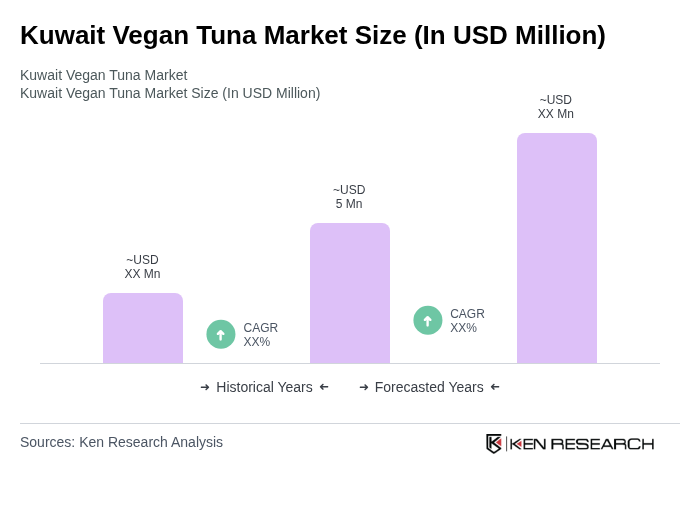
Kuwait Vegan Tuna Market, valued at USD 5 million, grows due to rising health awareness, plant-based diet shifts, and sustainable options, with soy-based and canned forms leading segments.

Region:Middle East

Author(s):Dev

Product Code:KRAD3223

Pages:80

Published On:November 2025
About the Report

Base Year 2024

Kuwait Vegan Tuna Market Overview

  • The Kuwait Vegan Tuna market is valued at USD 5 million, based on a five-year historical analysis. This estimate is derived from the Middle East & Africa vegan tuna market size, which is around USD 35 million, with Kuwait representing a notable but smaller share within the region. Growth is primarily driven by increasing demand forplant-based protein sources, rising health consciousness among consumers, and a shift towards sustainable food options. The market is further supported by the growing number of vegan, vegetarian, and flexitarian consumers in the region who seek alternatives to traditional seafood products.
  • Kuwait City is the dominant hub for the Vegan Tuna market, attributed to its large urban population and heightened awareness of health and environmental issues. The city’s diverse culinary scene and the presence of health-focused retailers and supermarkets have contributed to the popularity and accessibility of vegan products, positioning Kuwait City as a key market driver.
  • In 2023, the Kuwaiti government issued the “Food Safety and Plant-Based Product Promotion Guidelines, 2023” through the Public Authority for Food and Nutrition. This regulation provides incentives for local food manufacturers to diversify their offerings with plant-based alternatives, including vegan seafood products. The guidelines establish labeling standards, require product registration, and offer tax incentives for companies producing plant-based foods, thereby supporting the growth of the Vegan Tuna market in Kuwait.
Kuwait Vegan Tuna Market Size

Kuwait Vegan Tuna Market Segmentation

By Protein Source:The Vegan Tuna market can be segmented based on the protein source used in the products. The primary subsegments includeSoy-Based Vegan Tuna, Wheat-Based Vegan Tuna, Pea Protein-Based Vegan Tuna, and Other Plant-Based Sources. Among these,Soy-Based Vegan Tunais the leading subsegment, accounting for the largest share due to its high protein content, versatility, and consumer familiarity. The increasing adoption of plant-based diets and the perception of soy as a healthy, sustainable alternative have further propelled demand for soy-based vegan tuna products.
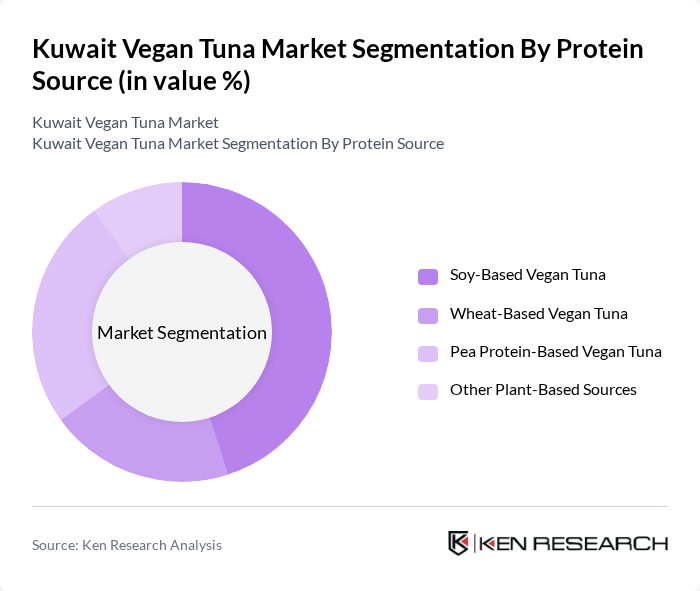
Kuwait Vegan Tuna Market segmentation by Protein Source.

By Product Form:The market can also be segmented based on the product form, which includesCanned Vegan Tuna, Frozen Vegan Tuna, Ready-to-Eat Vegan Tuna (Ambient), and Other Formats.Canned Vegan Tunais the most popular product form, driven by consumer demand for convenience and longer shelf life. The growing trend of meal prepping and the need for quick, healthy meal solutions among urban consumers have also increased demand for ready-to-eat and frozen vegan tuna products.
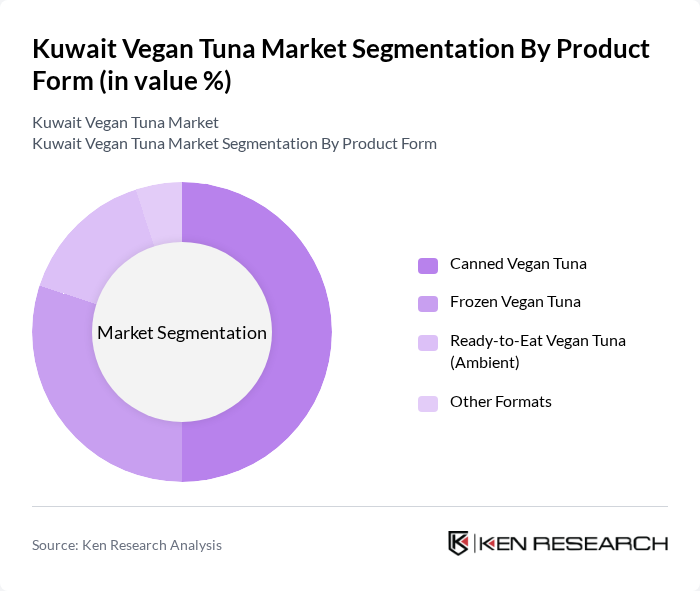
Kuwait Vegan Tuna Market segmentation by Product Form.

Kuwait Vegan Tuna Market Competitive Landscape

The Kuwait Vegan Tuna Market is characterized by a dynamic mix of regional and international players. Leading participants such as Good Catch Foods, Loma Linda (Atlantic Natural Foods), Sophie’s Kitchen, Vegan ZeaStar, Ocean's Halo, TUNO, Nestlé S.A. (Garden Gourmet), Gardein (Conagra Brands), Vantastic Foods, New Wave Foods, Prime Roots, Avant Meats, Worthington Foods, Ocean Hugger Foods, The Plant Based Seafood Co. contribute to innovation, geographic expansion, and service delivery in this space.

Good Catch Foods

2016

Newtown, Pennsylvania, USA

Loma Linda (Atlantic Natural Foods)

1890

Nashville, North Carolina, USA

Sophie’s Kitchen

2011

Walnut Creek, California, USA

Vegan ZeaStar

2019

Amsterdam, Netherlands

Ocean's Halo

2012

San Francisco, California, USA

Company

Establishment Year

Headquarters

Group Size (Large, Medium, Small)

Revenue from Vegan Tuna (USD, Kuwait/MENA)

Market Share in Kuwait Vegan Tuna Segment (%)

Year-on-Year Revenue Growth (%)

Distribution Network Breadth (No. of Outlets/Channels)

Product Portfolio Breadth (No. of SKUs/Variants)

Kuwait Vegan Tuna Market Industry Analysis

Growth Drivers

  • Increasing Health Consciousness:The health consciousness among Kuwaiti consumers is rising, with 70% of the population actively seeking healthier food options. The World Health Organization reported that over 70% of adults in Kuwait are overweight or obese, prompting a shift towards plant-based diets. This trend is supported by a growing awareness of the health benefits associated with vegan diets, including lower cholesterol levels and reduced risk of chronic diseases, driving demand for vegan tuna products.
  • Rising Demand for Plant-Based Proteins:The demand for plant-based proteins in Kuwait is projected to reach 20,000 tons, reflecting a significant shift in dietary preferences. The Kuwait Food and Nutrition Center indicates that plant-based diets can reduce the risk of heart disease, further fueling interest. This trend is bolstered by the increasing availability of vegan products in supermarkets, with a 50% increase in plant-based product offerings in the last year, enhancing market growth.
  • Environmental Sustainability Trends:Kuwait's commitment to sustainability is evident, with the government aiming to reduce carbon emissions by 30%. This initiative has led to a growing preference for environmentally friendly products, including vegan alternatives. A survey by the Kuwait Institute for Scientific Research found that 80% of consumers are willing to pay more for sustainable products, indicating a strong market for vegan tuna that aligns with these environmental values.

Market Challenges

  • Limited Consumer Awareness:Despite the growth potential, consumer awareness of vegan tuna remains low, with only 40% of the population familiar with plant-based seafood alternatives. The Kuwait Consumer Protection Agency reports that many consumers still associate tuna primarily with traditional fish products. This lack of awareness poses a significant barrier to market penetration, as education and marketing efforts are essential to inform consumers about the benefits and availability of vegan options.
  • High Production Costs:The production costs for vegan tuna are currently estimated to be 30% higher than traditional tuna due to the sourcing of high-quality plant-based ingredients and advanced processing technologies. The Ministry of Commerce and Industry in Kuwait highlights that these costs can limit competitive pricing, making it challenging for vegan products to gain market share against established seafood brands. This financial barrier necessitates strategic pricing and cost management to enhance market viability.

Kuwait Vegan Tuna Market Future Outlook

The future of the Kuwait vegan tuna market appears promising, driven by increasing health awareness and a shift towards sustainable eating habits. As consumer preferences evolve, the market is likely to see a rise in innovative product offerings that cater to diverse dietary needs. Additionally, the expansion of distribution channels, particularly through online platforms, will facilitate greater accessibility. Collaborations with health-focused brands will further enhance market visibility, positioning vegan tuna as a viable alternative in the seafood sector.

Market Opportunities

  • Expansion of Distribution Channels:The growth of e-commerce in Kuwait, with online grocery sales projected to reach $300 million, presents a significant opportunity for vegan tuna brands. By leveraging online platforms, companies can reach a broader audience, enhancing product availability and convenience for consumers seeking plant-based options.
  • Product Innovation and Diversification:There is a growing opportunity for product innovation in the vegan tuna segment, with potential for new flavors and formats. The Kuwait Food and Nutrition Center indicates that introducing diverse product lines can attract a wider consumer base, particularly among younger demographics who are more open to trying new food experiences.

Scope of the Report

SegmentSub-Segments
By Protein Source

Soy-Based Vegan Tuna

Wheat-Based Vegan Tuna

Pea Protein-Based Vegan Tuna

Other Plant-Based Sources

By Product Form

Canned Vegan Tuna

Frozen Vegan Tuna

Ready-to-Eat Vegan Tuna (Ambient)

Other Formats

By End-User

Retail Consumers

Foodservice (Restaurants, Cafes, Catering)

Institutional (Hotels, Hospitals, Schools)

Others

By Distribution Channel

Supermarkets and Hypermarkets

Online Retail

Health Food Stores

Specialty Stores

Others

By Packaging Type

Glass Packaging

Plastic Packaging

Metal Packaging

Sustainable Packaging

Others

By Flavor Profile

Classic Flavor

Spicy Flavor

Herb-Infused Flavor

Mediterranean Flavor

Others

By Price Range

Premium Segment

Mid-Range Segment

Budget Segment

Others

By Consumer Demographics

Age Group (18-25, 26-35, 36-50, 51+)

Income Level (Low, Middle, High)

Lifestyle Preferences (Health-Conscious, Eco-Friendly, Flexitarian)

Others

Key Target Audience

Investors and Venture Capitalist Firms

Government and Regulatory Bodies (e.g., Kuwait Food and Drug Administration)

Manufacturers and Producers of Plant-Based Foods

Distributors and Retailers of Vegan Products

Food Service Providers and Restaurants

Health and Wellness Organizations

Environmental NGOs and Advocacy Groups

Financial Institutions and Banks

Players Mentioned in the Report:

Good Catch Foods

Loma Linda (Atlantic Natural Foods)

Sophies Kitchen

Vegan ZeaStar

Ocean's Halo

TUNO

Nestle S.A. (Garden Gourmet)

Gardein (Conagra Brands)

Vantastic Foods

New Wave Foods

Prime Roots

Avant Meats

Worthington Foods

Ocean Hugger Foods

The Plant Based Seafood Co.

Table of Contents

Market Assessment Phase

1. Executive Summary and Approach


2. Kuwait Vegan Tuna Market Overview

2.1 Key Insights and Strategic Recommendations

2.2 Kuwait Vegan Tuna Market Overview

2.3 Definition and Scope

2.4 Evolution of Market Ecosystem

2.5 Timeline of Key Regulatory Milestones

2.6 Value Chain & Stakeholder Mapping

2.7 Business Cycle Analysis

2.8 Policy & Incentive Landscape


3. Kuwait Vegan Tuna Market Analysis

3.1 Growth Drivers

3.1.1 Increasing Health Consciousness
3.1.2 Rising Demand for Plant-Based Proteins
3.1.3 Environmental Sustainability Trends
3.1.4 Government Support for Vegan Products

3.2 Market Challenges

3.2.1 Limited Consumer Awareness
3.2.2 High Production Costs
3.2.3 Competition from Traditional Tuna Products
3.2.4 Regulatory Hurdles

3.3 Market Opportunities

3.3.1 Expansion of Distribution Channels
3.3.2 Product Innovation and Diversification
3.3.3 Collaborations with Health Food Brands
3.3.4 Export Potential to Neighboring Markets

3.4 Market Trends

3.4.1 Growth of Online Retail Platforms
3.4.2 Increasing Popularity of Veganism
3.4.3 Focus on Clean Label Products
3.4.4 Rise of Sustainable Packaging Solutions

3.5 Government Regulation

3.5.1 Food Safety Standards
3.5.2 Labeling Requirements for Vegan Products
3.5.3 Import Regulations for Plant-Based Foods
3.5.4 Subsidies for Vegan Product Development

4. SWOT Analysis


5. Stakeholder Analysis


6. Porter's Five Forces Analysis


7. Kuwait Vegan Tuna Market Market Size, 2019-2024

7.1 By Value

7.2 By Volume

7.3 By Average Selling Price


8. Kuwait Vegan Tuna Market Segmentation

8.1 By Protein Source

8.1.1 Soy-Based Vegan Tuna
8.1.2 Wheat-Based Vegan Tuna
8.1.3 Pea Protein-Based Vegan Tuna
8.1.4 Other Plant-Based Sources

8.2 By Product Form

8.2.1 Canned Vegan Tuna
8.2.2 Frozen Vegan Tuna
8.2.3 Ready-to-Eat Vegan Tuna (Ambient)
8.2.4 Other Formats

8.3 By End-User

8.3.1 Retail Consumers
8.3.2 Foodservice (Restaurants, Cafes, Catering)
8.3.3 Institutional (Hotels, Hospitals, Schools)
8.3.4 Others

8.4 By Distribution Channel

8.4.1 Supermarkets and Hypermarkets
8.4.2 Online Retail
8.4.3 Health Food Stores
8.4.4 Specialty Stores
8.4.5 Others

8.5 By Packaging Type

8.5.1 Glass Packaging
8.5.2 Plastic Packaging
8.5.3 Metal Packaging
8.5.4 Sustainable Packaging
8.5.5 Others

8.6 By Flavor Profile

8.6.1 Classic Flavor
8.6.2 Spicy Flavor
8.6.3 Herb-Infused Flavor
8.6.4 Mediterranean Flavor
8.6.5 Others

8.7 By Price Range

8.7.1 Premium Segment
8.7.2 Mid-Range Segment
8.7.3 Budget Segment
8.7.4 Others

8.8 By Consumer Demographics

8.8.1 Age Group (18-25, 26-35, 36-50, 51+)
8.8.2 Income Level (Low, Middle, High)
8.8.3 Lifestyle Preferences (Health-Conscious, Eco-Friendly, Flexitarian)
8.8.4 Others

9. Kuwait Vegan Tuna Market Competitive Analysis

9.1 Market Share of Key Players

9.2 KPIs for Cross Comparison of Key Players

9.2.1 Company Name
9.2.2 Group Size (Large, Medium, Small)
9.2.3 Revenue from Vegan Tuna (USD, Kuwait/MENA)
9.2.4 Market Share in Kuwait Vegan Tuna Segment (%)
9.2.5 Year-on-Year Revenue Growth (%)
9.2.6 Distribution Network Breadth (No. of Outlets/Channels)
9.2.7 Product Portfolio Breadth (No. of SKUs/Variants)
9.2.8 Average Retail Price (KWD/unit)
9.2.9 Brand Awareness Score (Survey-based, %)
9.2.10 Customer Satisfaction Index (Survey-based, 1-10)
9.2.11 Supply Chain Lead Time (Days)
9.2.12 Regulatory Compliance (Certifications Held)

9.3 SWOT Analysis of Top Players

9.4 Pricing Analysis

9.5 Detailed Profile of Major Companies

9.5.1 Good Catch Foods
9.5.2 Loma Linda (Atlantic Natural Foods)
9.5.3 Sophie’s Kitchen
9.5.4 Vegan ZeaStar
9.5.5 Ocean's Halo
9.5.6 TUNO
9.5.7 Nestlé S.A. (Garden Gourmet)
9.5.8 Gardein (Conagra Brands)
9.5.9 Vantastic Foods
9.5.10 New Wave Foods
9.5.11 Prime Roots
9.5.12 Avant Meats
9.5.13 Worthington Foods
9.5.14 Ocean Hugger Foods
9.5.15 The Plant Based Seafood Co.

10. Kuwait Vegan Tuna Market End-User Analysis

10.1 Procurement Behavior of Key Ministries

10.1.1 Ministry of Health
10.1.2 Ministry of Commerce and Industry
10.1.3 Ministry of Environment
10.1.4 Others

10.2 Corporate Spend on Infrastructure & Energy

10.2.1 Investment in Sustainable Practices
10.2.2 Budget Allocation for Vegan Products
10.2.3 Partnerships with Vegan Brands
10.2.4 Others

10.3 Pain Point Analysis by End-User Category

10.3.1 Price Sensitivity
10.3.2 Quality Concerns
10.3.3 Availability Issues
10.3.4 Others

10.4 User Readiness for Adoption

10.4.1 Awareness Levels
10.4.2 Willingness to Pay
10.4.3 Accessibility of Products
10.4.4 Others

10.5 Post-Deployment ROI and Use Case Expansion

10.5.1 Cost Savings Analysis
10.5.2 Performance Metrics
10.5.3 Customer Feedback Integration
10.5.4 Others

11. Kuwait Vegan Tuna Market Future Size, 2025-2030

11.1 By Value

11.2 By Volume

11.3 By Average Selling Price


Go-To-Market Strategy Phase

1. Whitespace Analysis + Business Model Canvas

1.1 Market Gaps Identification

1.2 Business Model Framework


2. Marketing and Positioning Recommendations

2.1 Branding Strategies

2.2 Product USPs


3. Distribution Plan

3.1 Urban Retail vs Rural NGO Tie-ups


4. Channel & Pricing Gaps

4.1 Underserved Routes

4.2 Pricing Bands


5. Unmet Demand & Latent Needs

5.1 Category Gaps

5.2 Consumer Segments


6. Customer Relationship

6.1 Loyalty Programs

6.2 After-sales Service


7. Value Proposition

7.1 Sustainability

7.2 Integrated Supply Chains


8. Key Activities

8.1 Regulatory Compliance

8.2 Branding

8.3 Distribution Setup


9. Entry Strategy Evaluation

9.1 Domestic Market Entry Strategy

9.1.1 Product Mix
9.1.2 Pricing Band
9.1.3 Packaging

9.2 Export Entry Strategy

9.2.1 Target Countries
9.2.2 Compliance Roadmap

10. Entry Mode Assessment

10.1 JV

10.2 Greenfield

10.3 M&A

10.4 Distributor Model


11. Capital and Timeline Estimation

11.1 Capital Requirements

11.2 Timelines


12. Control vs Risk Trade-Off

12.1 Ownership vs Partnerships


13. Profitability Outlook

13.1 Breakeven Analysis

13.2 Long-term Sustainability


14. Potential Partner List

14.1 Distributors

14.2 JVs

14.3 Acquisition Targets


15. Execution Roadmap

15.1 Phased Plan for Market Entry

15.1.1 Market Setup
15.1.2 Market Entry
15.1.3 Growth Acceleration
15.1.4 Scale & Stabilize

15.2 Key Activities and Milestones

15.2.1 Milestone Planning
15.2.2 Activity Tracking

Research Methodology

ApproachModellingSample

Phase 1: Approach1

Desk Research

  • Analysis of market reports from local and international vegan food organizations
  • Review of government publications on food safety regulations and import policies
  • Examination of consumer behavior studies focusing on plant-based diets in Kuwait

Primary Research

  • Interviews with key stakeholders in the food distribution sector, including wholesalers and retailers
  • Surveys targeting consumers to gauge awareness and acceptance of vegan tuna products
  • Focus group discussions with health and nutrition experts to understand market trends

Validation & Triangulation

  • Cross-validation of findings through multiple data sources, including sales data and consumer feedback
  • Triangulation of insights from industry experts and market analysts
  • Sanity checks through expert panel reviews to ensure data reliability

Phase 2: Market Size Estimation1

Top-down Assessment

  • Estimation of market size based on national food consumption statistics and trends in plant-based diets
  • Analysis of import data for vegan products to understand market penetration
  • Incorporation of demographic data to assess potential consumer base growth

Bottom-up Modeling

  • Volume estimates derived from sales data of existing vegan products in the market
  • Cost analysis based on pricing strategies of leading vegan food brands
  • Calculation of market potential based on consumer purchasing patterns and frequency

Forecasting & Scenario Analysis

  • Multi-factor regression analysis considering factors like health trends and environmental awareness
  • Scenario modeling based on potential regulatory changes and market entry of new products
  • Development of baseline, optimistic, and pessimistic forecasts through 2030

Phase 3: CATI Sample Composition1

Scope Item/SegmentSample SizeTarget Respondent Profiles
Consumer Awareness of Vegan Tuna120Health-conscious Consumers, Vegan Diet Adopters
Retailer Insights on Vegan Product Demand60Store Managers, Product Buyers
Food Service Industry Perspectives50Restaurant Owners, Menu Planners
Nutritionist Opinions on Vegan Tuna40Registered Dietitians, Nutrition Consultants
Market Trends from Food Distributors45Supply Chain Managers, Distribution Executives

Frequently Asked Questions

What is the current value of the Kuwait Vegan Tuna market?

The Kuwait Vegan Tuna market is valued at approximately USD 5 million, based on a five-year historical analysis. This figure reflects Kuwait's share of the broader Middle East & Africa vegan tuna market, which is around USD 35 million.

What factors are driving the growth of the Vegan Tuna market in Kuwait?

Which city in Kuwait is the primary hub for Vegan Tuna products?

What recent government initiatives support the Vegan Tuna market in Kuwait?

Other Regional/Country Reports

Indonesia Vegan Tuna Market

Malaysia Vegan Tuna Market

KSA Vegan Tuna Market

APAC Vegan Tuna Market

SEA Vegan Tuna Market

Vietnam Vegan Tuna Market

Why Buy From Us?

Refine Robust Result (RRR) Framework

What makes us stand out is that our consultants follow Robust, Refine and Result (RRR) methodology. Robust for clear definitions, approaches and sanity checking, Refine for differentiating respondents' facts and opinions, and Result for presenting data with story.

Our Reach Is Unmatched

We have set a benchmark in the industry by offering our clients with syndicated and customized market research reports featuring coverage of entire market as well as meticulous research and analyst insights.

Shifting the Research Paradigm

While we don't replace traditional research, we flip the method upside down. Our dual approach of Top Bottom & Bottom Top ensures quality deliverable by not just verifying company fundamentals but also looking at the sector and macroeconomic factors.

More Insights-Better Decisions

With one step in the future, our research team constantly tries to show you the bigger picture. We help with some of the tough questions you may encounter along the way: How is the industry positioned? Best marketing channel? KPI's of competitors? By aligning every element, we help maximize success.

Transparency and Trust

Our report gives you instant access to the answers and sources that other companies might choose to hide. We elaborate each steps of research methodology we have used and showcase you the sample size to earn your trust.

Round the Clock Support

If you need any support, we are here! We pride ourselves on universe strength, data quality, and quick, friendly, and professional service.

Why Clients Choose Us?

400000+
Reports in repository
150+
Consulting projects a year
100+
Analysts
8000+
Client Queries in 2022








