Region:Central and South America
Author(s):Dev
Product Code:KRAA0418
Pages:86
Published On:August 2025
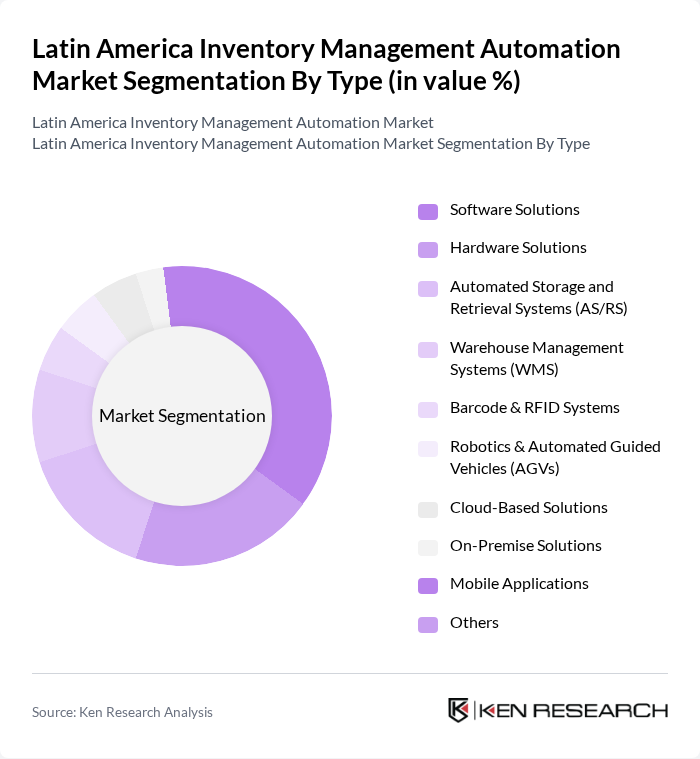
By Type:The market is segmented into Software Solutions, Hardware Solutions, Automated Storage and Retrieval Systems (AS/RS), Warehouse Management Systems (WMS), Barcode & RFID Systems, Robotics & Automated Guided Vehicles (AGVs), Cloud-Based Solutions, On-Premise Solutions, Mobile Applications, and Others. Software Solutions lead the market due to their ability to integrate seamlessly with existing enterprise systems, provide real-time data analytics, and support advanced decision-making. Hardware Solutions, including robotics and AS/RS, are also experiencing robust growth as companies seek to automate physical inventory handling and optimize warehouse layouts .
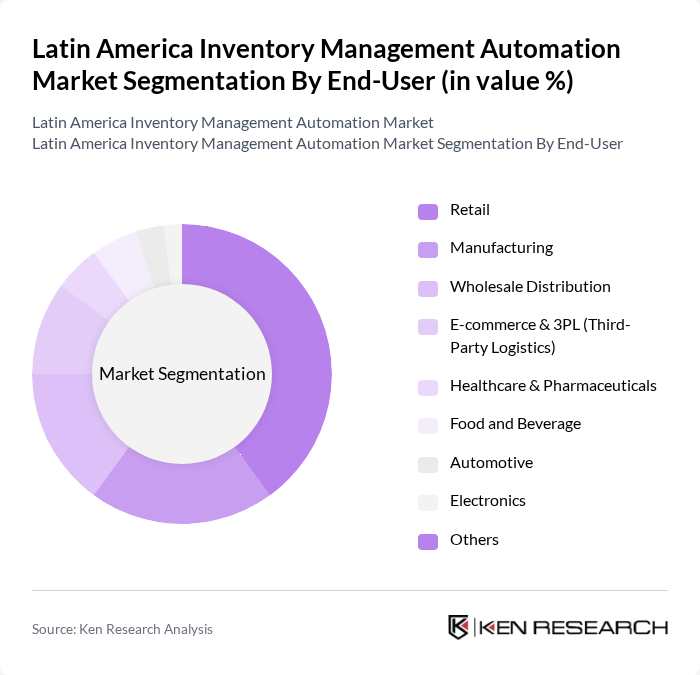
By End-User:The end-user segmentation includes Retail, Manufacturing, Wholesale Distribution, E-commerce & 3PL (Third-Party Logistics), Healthcare & Pharmaceuticals, Food and Beverage, Automotive, Electronics, and Others. The Retail sector is the largest end-user, driven by the rapid growth of e-commerce, omnichannel fulfillment, and the need for efficient, real-time inventory management to meet dynamic consumer demands. Manufacturing and wholesale distribution are also significant segments, leveraging automation to optimize supply chains and reduce lead times .
The Latin America Inventory Management Automation Market is characterized by a dynamic mix of regional and international players. Leading participants such as SAP SE, Oracle Corporation, Manhattan Associates, Infor, Blue Yonder (formerly JDA Software), Zebra Technologies, KNAPP AG, SSI SCHAEFER, Swisslog (KUKA Group), Dematic (KION Group), MHS Global, Vanderlande Industries, TOTVS (Brazil), Consinco (Brazil), Tecsys contribute to innovation, geographic expansion, and service delivery in this space.
As the Latin American inventory management automation market evolves, several trends are expected to shape its future. The integration of artificial intelligence and machine learning will enhance predictive analytics, enabling businesses to optimize inventory levels and reduce waste. Additionally, the increasing focus on sustainability will drive the adoption of green practices in inventory management, as companies seek to minimize their environmental impact while improving operational efficiency and customer satisfaction.
| Segment | Sub-Segments |
|---|---|
| By Type | Software Solutions Hardware Solutions Automated Storage and Retrieval Systems (AS/RS) Warehouse Management Systems (WMS) Barcode & RFID Systems Robotics & Automated Guided Vehicles (AGVs) Cloud-Based Solutions On-Premise Solutions Mobile Applications Others |
| By End-User | Retail Manufacturing Wholesale Distribution E-commerce & 3PL (Third-Party Logistics) Healthcare & Pharmaceuticals Food and Beverage Automotive Electronics Others |
| By Industry Vertical | Automotive Electronics Pharmaceuticals Consumer Goods Food Retail & Grocery Aerospace Others |
| By Deployment Mode | On-Premise Cloud-Based Hybrid Others |
| By Region | Brazil Mexico Argentina Chile Colombia Peru Others |
| By Customer Size | Large Enterprises Medium Enterprises Small Enterprises Others |
| By Service Type | Consulting Services Implementation Services Support and Maintenance Services Training & Integration Services Others |
| Scope Item/Segment | Sample Size | Target Respondent Profiles |
|---|---|---|
| Retail Inventory Automation | 100 | Supply Chain Managers, IT Directors |
| Manufacturing Process Optimization | 80 | Operations Managers, Production Supervisors |
| E-commerce Fulfillment Strategies | 90 | Logistics Coordinators, Warehouse Managers |
| Technology Adoption in SMEs | 60 | Business Owners, IT Managers |
| Impact of Automation on Supply Chain Efficiency | 50 | Consultants, Industry Analysts |
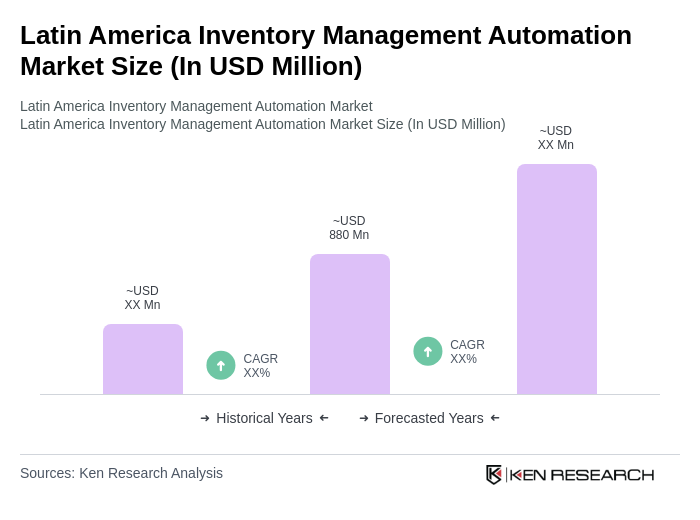
The Latin America Inventory Management Automation Market is valued at approximately USD 880 million, driven by the increasing demand for operational efficiency, e-commerce growth, and real-time inventory tracking solutions.

What makes us stand out is that our consultants follow Robust, Refine and Result (RRR) methodology. Robust for clear definitions, approaches and sanity checking, Refine for differentiating respondents' facts and opinions, and Result for presenting data with story.

We have set a benchmark in the industry by offering our clients with syndicated and customized market research reports featuring coverage of entire market as well as meticulous research and analyst insights.

While we don't replace traditional research, we flip the method upside down. Our dual approach of Top Bottom & Bottom Top ensures quality deliverable by not just verifying company fundamentals but also looking at the sector and macroeconomic factors.

With one step in the future, our research team constantly tries to show you the bigger picture. We help with some of the tough questions you may encounter along the way: How is the industry positioned? Best marketing channel? KPI's of competitors? By aligning every element, we help maximize success.

Our report gives you instant access to the answers and sources that other companies might choose to hide. We elaborate each steps of research methodology we have used and showcase you the sample size to earn your trust.

If you need any support, we are here! We pride ourselves on universe strength, data quality, and quick, friendly, and professional service.













