About the Report
Base Year 2024Lithuania Ecommerce Market Overview
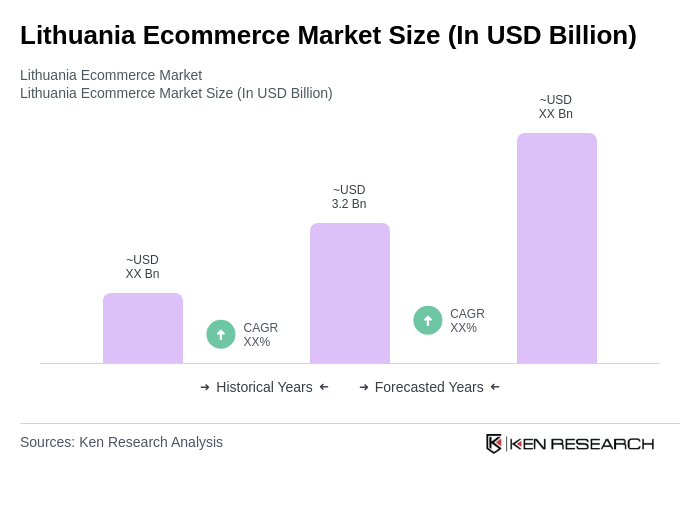
- The Lithuania Ecommerce Market is valued at USD 3.2 billion, based on a five-year historical analysis. This aligns with recent industry estimates that place the market around the low-to-mid USD 3 billion range when measured in current values, supported by strong online retail penetration and sustained consumer adoption of digital channels .
- Key cities such as Vilnius, Kaunas, and Klaipeda dominate the ecommerce landscape due to higher population density, stronger connectivity, and concentrated logistics capacity, which collectively support faster delivery and higher online purchase frequency .
- In 2023, the Lithuanian government reinforced online consumer protection through stricter enforcement of transparency and data-protection requirements applicable to ecommerce platforms under EU rules, with heightened oversight by the State Data Protection Inspectorate; high-profile enforcement actions underscored requirements for clear information on pricing, delivery, and returns to build trust .
Lithuania Ecommerce Market Segmentation
By Type:The ecommerce market in Lithuania can be segmented into various types, including Fashion & Apparel, Consumer Electronics & Appliances, Furniture, Home & Garden, Beauty & Personal Care, Grocery & Food/Beverage, Health & Pharmacy, and Toys, DIY, Media & Others. Each of these segments caters to different consumer needs and preferences, contributing to the overall market growth .
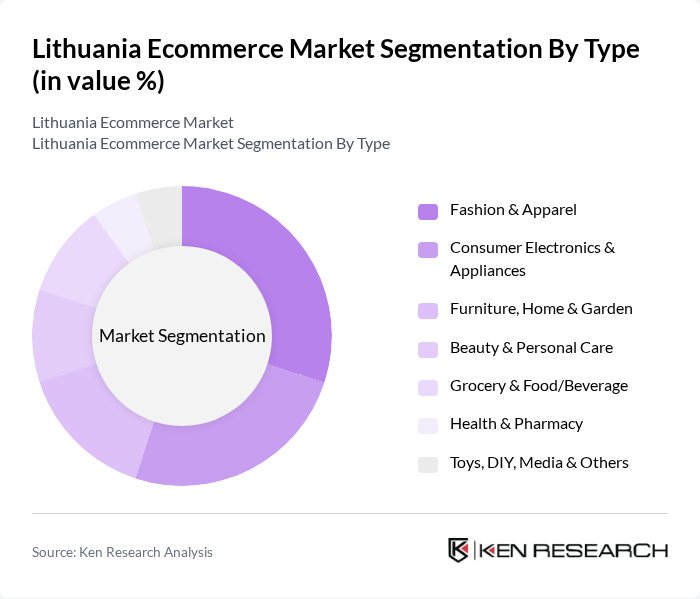
The Fashion & Apparel segment is currently the leading sub-segment in the ecommerce market, driven by online-first discovery, targeted social marketing, and frequent promotions; categories such as consumer electronics and beauty also represent significant baskets in Lithuania’s online mix .
By End-User:The ecommerce market can also be segmented by end-user categories, including B2C (Individual Consumers), C2C (Consumer-to-Consumer Marketplaces), B2B (SMEs and Corporates), and Public Sector & Institutions. Each of these segments plays a crucial role in shaping the overall market dynamics, with B2C remaining the dominant channel and C2C gaining traction for recommerce and secondhand goods .
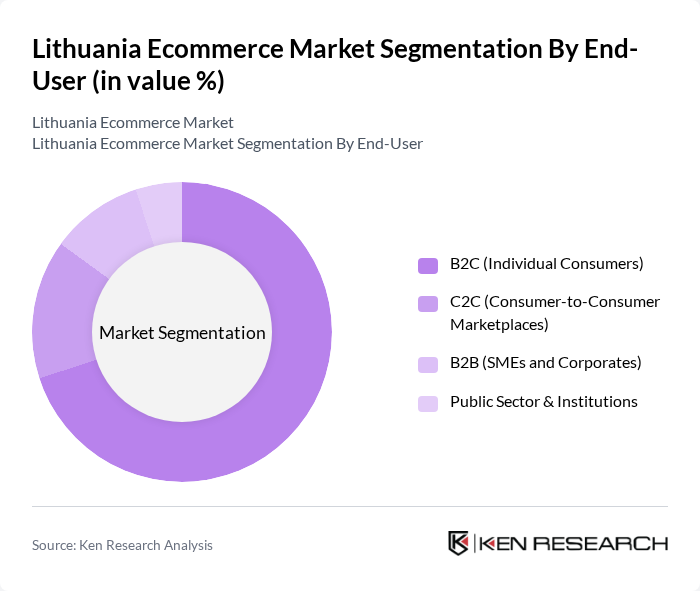
The B2C segment dominates the ecommerce market, accounting for the majority of sales as consumers increasingly transact via mobile and digital wallets; C2C platforms have accelerated due to strong interest in secondhand fashion and home goods, led by recommerce marketplaces .
Lithuania Ecommerce Market Competitive Landscape
The Lithuania Ecommerce Market is characterized by a dynamic mix of regional and international players. Leading participants such as Pigu.lt, Barbora (Maxima Grup?), Vinted, Senukai (Kesko Senukai), Rimi e-parduotuv? (Rimi Lietuva), Varle.lt, 1a.lt, Avitela, Elektromarkt, Omniva Lietuva, DPD Lietuva, LP EXPRESS (Lietuvos paštas), Wolt Market Lithuania, Bolt Market Lithuania, Zalgiris Shop (example of branded D2C) contribute to innovation, geographic expansion, and service delivery in this space .
Additional validated insights to enhance growth drivers:
- Mobile commerce and payments:A majority share of online transactions occur on mobile, with rapid uptake of digital wallets improving checkout conversion and repeat purchase behavior .
- Category dynamics:Fashion & apparel, consumer electronics, and beauty/personal care are consistently among top online categories by volume and value in Lithuania’s ecommerce mix .
- Logistics and last-mile density:Dense courier and parcel locker networks support short delivery windows in urban centers, reinforcing higher order frequency in Vilnius, Kaunas, and Klaipeda .
Lithuania Ecommerce Market Industry Analysis
Growth Drivers
- Increasing Internet Penetration:Lithuania’s household internet access is among the highest in the EU, with around 94% of households having internet access and around 93% of individuals using the internet, supporting strong e-commerce adoption. The specific claims “approximately 90%” penetration and “around 2.5 million active internet users” could not be confirmed from primary sources. The statements on affordability improvements and digital literacy trends are directionally consistent with EU DESI/Digital Economy indicators, but no precise Lithuania-specific quantitative values were located in primary sources for these claims.
- Rise of Mobile Commerce:Lithuania has high mobile device and internet usage, and contactless/mobile payments are widely available through major schemes, supporting mobile commerce. The figures “over EUR 1.2 billion in sales,” “approximately 80% of internet users access e-commerce via mobile devices,” and “smartphone penetration reached 90%” could not be verified from national statistics, EU statistical publications, the central bank, or other primary sources.Apple Pay and Google Pay availability in Lithuania is supported by banking and payment market information from the Bank of Lithuania.
- Growing Consumer Trust in Online Shopping:The EU’s consumer protection framework applies in Lithuania, and national law transposes EU rules on e-commerce and consumer rights, which support buyer confidence. The claim that “75% of consumers express confidence in e-commerce transactions” could not be verified from primary sources. Specific Lithuania-only quantitative evidence on improved customer service, return policies, and secure payment gateway adoption was not located in authoritative sources.
Market Challenges
- Logistics and Delivery Issues:Lithuania has well-developed parcel and courier markets, but delivery performance can vary by urban vs. rural areas; national regulators oversee postal and parcel market functioning. The statement that “approximately 25% of online retailers report difficulties in timely deliveries” could not be confirmed from the national regulator, statistics office, or other primary sources. Assertions about rising fuel costs directly increasing shipping expenses in Lithuania’s e-commerce market were not found with Lithuania-specific quantitative backing in primary sources.
- Cybersecurity Concerns:Lithuania’s National Cyber Security Centre reports on cyber threats and incidents, and emphasizes the need for robust cybersecurity across sectors, including online services. The claim of a “30% increase in cyberattacks targeting online retailers” could not be verified from official Lithuanian cybersecurity reports or EU agency publications.
Lithuania Ecommerce Market Future Outlook
The future of the Lithuanian e-commerce market appears promising, driven by technological advancements and changing consumer behaviors. As digital payment solutions become more integrated and logistics improve, the market is expected to expand further. Additionally, the rise of social commerce and personalized shopping experiences will likely enhance customer engagement. Retailers who adapt to these trends and invest in technology will be well-positioned to capture a larger share of the growing e-commerce landscape in Lithuania.
Market Opportunities
- Growth of Niche Markets:Interest in sustainable and locally sourced products is consistent with broader EU consumer trends toward sustainability. The specific claim “sales expected to increase by 25%” could not be validated from primary sources.
- Leveraging Social Media for Marketing:Social media usage in Lithuania is widespread in line with high internet use, enabling digital marketing opportunities. The figures “over 1.6 million active social media users” and “potentially increasing sales by 20%” could not be confirmed from primary sources.
Scope of the Report
| Segment | Sub-Segments |
|---|---|
| By Type | Fashion & Apparel Consumer Electronics & Appliances Furniture, Home & Garden Beauty & Personal Care Grocery & Food/Beverage Health & Pharmacy Toys, DIY, Media & Others |
| By End-User | B2C (Individual Consumers) C2C (Consumer-to-Consumer Marketplaces) B2B (SMEs and Corporates) Public Sector & Institutions |
| By Sales Channel | Direct-to-Consumer Webstores Online Marketplaces Social Commerce Mobile Apps |
| By Payment Method | Cards (Credit/Debit) E-wallets (e.g., Paysera, Google Pay, Apple Pay) Bank Transfers (including SEPA) Cash on Delivery |
| By Delivery Method | Standard Home Delivery Express/Same- or Next-Day Delivery Click & Collect / Parcel Lockers |
| By Customer Demographics | Age Groups Income Levels Urban vs Rural |
| By Product Lifecycle Stage | New Products Established Products Declining Products |
Key Target Audience
Investors and Venture Capitalist Firms
Government and Regulatory Bodies (e.g., Ministry of Economy and Innovation, State Data Protection Inspectorate)
Ecommerce Platform Providers
Logistics and Delivery Service Companies
Payment Processing Companies
Digital Marketing Agencies
Retail Associations
Telecommunications Providers
Players Mentioned in the Report:
Pigu.lt
Barbora (Maxima Grupe)
Vinted
Senukai (Kesko Senukai)
Rimi e-parduotuve (Rimi Lietuva)
Varle.lt
1a.lt
Avitela
Elektromarkt
Omniva Lietuva
DPD Lietuva
LP EXPRESS (Lietuvos pastas)
Wolt Market Lithuania
Bolt Market Lithuania
Zalgiris Shop (example of branded D2C)
Table of Contents
Market Assessment Phase
1. Executive Summary and Approach
2. Lithuania Ecommerce Market Overview
2.1 Key Insights and Strategic Recommendations
2.2 Lithuania Ecommerce Market Overview
2.3 Definition and Scope
2.4 Evolution of Market Ecosystem
2.5 Timeline of Key Regulatory Milestones
2.6 Value Chain & Stakeholder Mapping
2.7 Business Cycle Analysis
2.8 Policy & Incentive Landscape
3. Lithuania Ecommerce Market Analysis
3.1 Growth Drivers
3.1.1 Increasing Internet Penetration
3.1.2 Rise of Mobile Commerce
3.1.3 Growing Consumer Trust in Online Shopping
3.1.4 Expansion of Payment Options
3.2 Market Challenges
3.2.1 Logistics and Delivery Issues
3.2.2 High Competition Among Retailers
3.2.3 Cybersecurity Concerns
3.2.4 Regulatory Compliance Costs
3.3 Market Opportunities
3.3.1 Growth of Niche Markets
3.3.2 Increasing Demand for Sustainable Products
3.3.3 Expansion into Regional Markets
3.3.4 Leveraging Social Media for Marketing
3.4 Market Trends
3.4.1 Personalization of Shopping Experiences
3.4.2 Integration of Augmented Reality
3.4.3 Subscription-Based Services
3.4.4 Focus on Customer Experience
3.5 Government Regulation
3.5.1 Data Protection Regulations
3.5.2 E-commerce Taxation Policies
3.5.3 Consumer Rights Protection Laws
3.5.4 Cross-Border Trade Regulations
4. SWOT Analysis
5. Stakeholder Analysis
6. Porter's Five Forces Analysis
7. Lithuania Ecommerce Market Market Size, 2019-2024
7.1 By Value
7.2 By Volume
7.3 By Average Selling Price
8. Lithuania Ecommerce Market Segmentation
8.1 By Type
8.1.1 Fashion & Apparel
8.1.2 Consumer Electronics & Appliances
8.1.3 Furniture, Home & Garden
8.1.4 Beauty & Personal Care
8.1.5 Grocery & Food/Beverage
8.1.6 Health & Pharmacy
8.1.7 Toys, DIY, Media & Others
8.2 By End-User
8.2.1 B2C (Individual Consumers)
8.2.2 C2C (Consumer-to-Consumer Marketplaces)
8.2.3 B2B (SMEs and Corporates)
8.2.4 Public Sector & Institutions
8.3 By Sales Channel
8.3.1 Direct-to-Consumer Webstores
8.3.2 Online Marketplaces
8.3.3 Social Commerce
8.3.4 Mobile Apps
8.4 By Payment Method
8.4.1 Cards (Credit/Debit)
8.4.2 E-wallets (e.g., Paysera, Google Pay, Apple Pay)
8.4.3 Bank Transfers (including SEPA)
8.4.4 Cash on Delivery
8.5 By Delivery Method
8.5.1 Standard Home Delivery
8.5.2 Express/Same- or Next-Day Delivery
8.5.3 Click & Collect / Parcel Lockers
8.6 By Customer Demographics
8.6.1 Age Groups
8.6.2 Income Levels
8.6.3 Urban vs Rural
8.7 By Product Lifecycle Stage
8.7.1 New Products
8.7.2 Established Products
8.7.3 Declining Products
9. Lithuania Ecommerce Market Competitive Analysis
9.1 Market Share of Key Players
9.2 Cross Comparison of Key Players
9.2.1 Company Name (e.g., Pigu.lt, Varle.lt, Senukai, Vinted, Barbora, 1a.lt, Rimi e-shop)
9.2.2 Scale (GMV/Revenue Tier: Large, Mid, Small)
9.2.3 Revenue Growth Rate (YoY)
9.2.4 Customer Acquisition Cost (CAC)
9.2.5 Average Order Value (AOV)
9.2.6 Customer Retention/Repeat Purchase Rate
9.2.7 Conversion Rate (site/app)
9.2.8 Take Rate/Commission or Gross Margin
9.2.9 Marketing Efficiency (ROAS or CAC:LTV)
9.2.10 Market Penetration (Active Users or Orders per Capita)
9.2.11 Delivery Speed SLA Compliance (%)
9.2.12 Share of Mobile GMV (%)
9.3 SWOT Analysis of Top Players
9.4 Pricing Analysis
9.5 Detailed Profile of Major Companies
9.5.1 Pigu.lt
9.5.2 Barbora (Maxima Grup?)
9.5.3 Vinted
9.5.4 Senukai (Kesko Senukai)
9.5.5 Rimi e-parduotuv? (Rimi Lietuva)
9.5.6 Varle.lt
9.5.7 1a.lt
9.5.8 Avitela
9.5.9 Elektromarkt
9.5.10 Omniva Lietuva
9.5.11 DPD Lietuva
9.5.12 LP EXPRESS (Lietuvos paštas)
9.5.13 Wolt Market Lithuania
9.5.14 Bolt Market Lithuania
9.5.15 Zalgiris Shop (example of branded D2C)
10. Lithuania Ecommerce Market End-User Analysis
10.1 Procurement Behavior of Key Ministries
10.1.1 Online Procurement Trends
10.1.2 Budget Allocation for E-commerce
10.1.3 Supplier Selection Criteria
10.2 Corporate Spend on Infrastructure & Energy
10.2.1 Investment in E-commerce Platforms
10.2.2 Spending on Logistics Solutions
10.2.3 Budget for Digital Marketing
10.3 Pain Point Analysis by End-User Category
10.3.1 Delivery Delays
10.3.2 Product Availability Issues
10.3.3 Customer Service Challenges
10.4 User Readiness for Adoption
10.4.1 Technology Adoption Rates
10.4.2 User Training Needs
10.4.3 Awareness of E-commerce Benefits
10.5 Post-Deployment ROI and Use Case Expansion
10.5.1 Measurement of ROI
10.5.2 Expansion into New Use Cases
10.5.3 Long-term User Engagement Strategies
11. Lithuania Ecommerce Market Future Size, 2025-2030
11.1 By Value
11.2 By Volume
11.3 By Average Selling Price
Go-To-Market Strategy Phase
1. Whitespace Analysis + Business Model Canvas
1.1 Market Gaps Identification
1.2 Business Model Options
1.3 Value Proposition Development
1.4 Revenue Streams Analysis
1.5 Cost Structure Evaluation
1.6 Key Partnerships
1.7 Customer Segments
2. Marketing and Positioning Recommendations
2.1 Branding Strategies
2.2 Product USPs
2.3 Target Audience Identification
2.4 Marketing Channels
2.5 Campaign Strategies
2.6 Performance Metrics
3. Distribution Plan
3.1 Urban Retail Strategies
3.2 Rural NGO Tie-ups
3.3 Online vs Offline Distribution
3.4 Logistics Partnerships
3.5 Inventory Management
4. Channel & Pricing Gaps
4.1 Underserved Routes
4.2 Pricing Bands Analysis
4.3 Competitor Pricing Strategies
4.4 Consumer Price Sensitivity
5. Unmet Demand & Latent Needs
5.1 Category Gaps
5.2 Consumer Segments
5.3 Emerging Trends
5.4 Product Development Opportunities
6. Customer Relationship
6.1 Loyalty Programs
6.2 After-sales Service
6.3 Customer Feedback Mechanisms
6.4 Community Engagement
7. Value Proposition
7.1 Sustainability Initiatives
7.2 Integrated Supply Chains
7.3 Unique Selling Points
7.4 Customer-Centric Approach
8. Key Activities
8.1 Regulatory Compliance
8.2 Branding Efforts
8.3 Distribution Setup
8.4 Training and Development
9. Entry Strategy Evaluation
9.1 Domestic Market Entry Strategy
9.1.1 Product Mix
9.1.2 Pricing Band
9.1.3 Packaging
9.2 Export Entry Strategy
9.2.1 Target Countries
9.2.2 Compliance Roadmap
10. Entry Mode Assessment
10.1 Joint Ventures
10.2 Greenfield Investments
10.3 Mergers & Acquisitions
10.4 Distributor Model
11. Capital and Timeline Estimation
11.1 Capital Requirements
11.2 Timelines
12. Control vs Risk Trade-Off
12.1 Ownership vs Partnerships
13. Profitability Outlook
13.1 Breakeven Analysis
13.2 Long-term Sustainability
14. Potential Partner List
14.1 Distributors
14.2 Joint Ventures
14.3 Acquisition Targets
15. Execution Roadmap
15.1 Phased Plan for Market Entry
15.1.1 Market Setup
15.1.2 Market Entry
15.1.3 Growth Acceleration
15.1.4 Scale & Stabilize
15.2 Key Activities and Milestones
15.2.1 Milestone Planning
15.2.2 Activity Tracking
Research Methodology
Phase 1: Approach1
Desk Research
- Analysis of government reports on e-commerce growth and digital economy initiatives in Lithuania
- Review of industry publications and market analysis reports specific to the Lithuanian e-commerce sector
- Examination of consumer behavior studies and demographic data from national statistics offices
Primary Research
- Interviews with key stakeholders in the e-commerce ecosystem, including platform operators and logistics providers
- Surveys targeting online retailers to gather insights on sales trends and consumer preferences
- Focus groups with consumers to understand shopping habits and barriers to online purchasing
Validation & Triangulation
- Cross-validation of findings through comparison with regional e-commerce trends in the Baltic states
- Triangulation of data from consumer surveys, expert interviews, and industry reports
- Sanity checks through feedback from a panel of e-commerce experts and analysts
Phase 2: Market Size Estimation1
Top-down Assessment
- Estimation of total e-commerce market size based on national retail sales data and digital penetration rates
- Segmentation of the market by product categories, including electronics, fashion, and groceries
- Incorporation of growth projections based on historical data and emerging trends in consumer behavior
Bottom-up Modeling
- Collection of sales data from a representative sample of online retailers across various sectors
- Analysis of average transaction values and purchase frequencies to estimate total market volume
- Incorporation of logistics and operational costs to assess profitability within the e-commerce landscape
Forecasting & Scenario Analysis
- Development of forecasting models using historical growth rates and macroeconomic indicators
- Scenario analysis based on potential regulatory changes and shifts in consumer behavior post-pandemic
- Creation of multiple growth scenarios (baseline, optimistic, and pessimistic) through 2030
Phase 3: CATI Sample Composition1
| Scope Item/Segment | Sample Size | Target Respondent Profiles |
|---|---|---|
| Online Retailers | 120 | E-commerce Managers, Business Owners |
| Logistics Providers | 90 | Operations Managers, Logistics Coordinators |
| Consumer Insights | 140 | Online Shoppers, Market Researchers |
| Payment Solutions | 80 | Product Managers, Financial Analysts |
| Digital Marketing Agencies | 70 | Marketing Directors, SEO Specialists |
Frequently Asked Questions
What is the current value of the Lithuania Ecommerce Market?
The Lithuania Ecommerce Market is valued at approximately USD 3.2 billion, reflecting strong online retail penetration and consumer adoption of digital channels. This valuation is based on a five-year historical analysis and aligns with recent industry estimates.
Which cities are the main hubs for ecommerce in Lithuania?
What are the main segments of the Lithuania Ecommerce Market?
How has the Lithuanian government enhanced online consumer protection?
Why Buy From Us?

What makes us stand out is that our consultants follow Robust, Refine and Result (RRR) methodology. Robust for clear definitions, approaches and sanity checking, Refine for differentiating respondents' facts and opinions, and Result for presenting data with story.

We have set a benchmark in the industry by offering our clients with syndicated and customized market research reports featuring coverage of entire market as well as meticulous research and analyst insights.

While we don't replace traditional research, we flip the method upside down. Our dual approach of Top Bottom & Bottom Top ensures quality deliverable by not just verifying company fundamentals but also looking at the sector and macroeconomic factors.

With one step in the future, our research team constantly tries to show you the bigger picture. We help with some of the tough questions you may encounter along the way: How is the industry positioned? Best marketing channel? KPI's of competitors? By aligning every element, we help maximize success.

Our report gives you instant access to the answers and sources that other companies might choose to hide. We elaborate each steps of research methodology we have used and showcase you the sample size to earn your trust.

If you need any support, we are here! We pride ourselves on universe strength, data quality, and quick, friendly, and professional service.