Malaysia Poultry Meat Processing Equipment Market Size Share Growth Drivers Trends Opportunities & Forecast 2025–2030

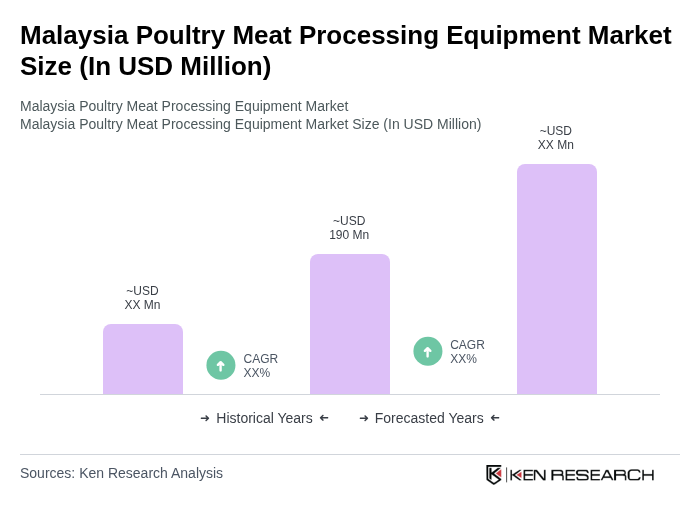
The Malaysia poultry meat processing equipment market, worth USD 190 million, grows due to rising poultry demand, automation, and strict regulations.

Region:Asia

Author(s):Rebecca

Product Code:KRAE4234

Pages:84

Published On:March 2026
About the Report

Base Year 2024

Malaysia Poultry Meat Processing Equipment Market Overview

  • The Malaysia Poultry Meat Processing Equipment Market is valued at USD 190 million, based on a five-year historical analysis. This growth is primarily driven by the increasing demand for poultry products, advancements in processing technologies, the rising focus on food safety and quality standards, and the expansion of automation to reduce contamination and enhance productivity. The market has seen a significant uptick in investments aimed at modernizing processing facilities to enhance efficiency and meet consumer expectations.
  • Key cities such as Kuala Lumpur, Penang, and Johor Bahru dominate the market due to their strategic locations, robust infrastructure, and proximity to major poultry production hubs. These cities serve as critical centers for distribution and processing, facilitating easier access to both domestic and international markets, thereby driving the growth of the poultry meat processing equipment sector.
  • The Food Safety and Quality Act, 2009 issued by the Ministry of Health Malaysia, mandates stringent regulations on poultry processing standards, including licensing requirements for food premises, adherence to hygiene and sanitation protocols, and compliance with microbial contamination thresholds. This legislation aims to ensure that all poultry products meet safety and quality benchmarks, thereby enhancing consumer confidence and promoting public health. Compliance with these regulations is crucial for industry players to maintain their market position and avoid penalties.
Malaysia Poultry Meat Processing Equipment Market Size

Malaysia Poultry Meat Processing Equipment Market Segmentation

By Equipment Type:The equipment type segmentation includes various categories essential for poultry processing, such as Killing & Defeathering Equipment, Evisceration Equipment, Cut-up Machines, Deboning & Skinning Equipment, Marinating & Tumbling Equipment, Cooling and Freezing Equipment, and Others. The dominant sub-segment is Killing & Defeathering Equipment, which is crucial for the initial stages of processing. This segment is driven by the need for efficiency and hygiene in poultry processing. Evisceration Equipment follows closely, as it is vital for ensuring the quality of the meat. The demand for automation in these processes is also increasing, leading to a rise in the adoption of advanced technologies.
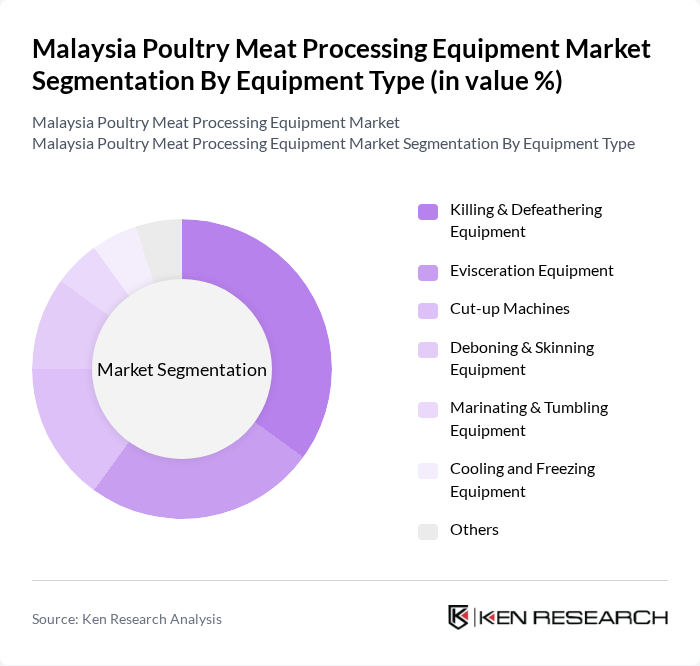
Malaysia Poultry Meat Processing Equipment Market segmentation by Equipment Type.

By Poultry Type:The poultry type segmentation includes Chicken Meat, Turkey Meat, Duck Meat, and Others. Chicken Meat is the leading sub-segment, accounting for a significant portion of the market due to its popularity and high consumption rates in Malaysia. The increasing health consciousness among consumers has also led to a rise in demand for processed chicken products. Turkey Meat and Duck Meat are growing segments, but they still lag behind chicken in terms of market share.
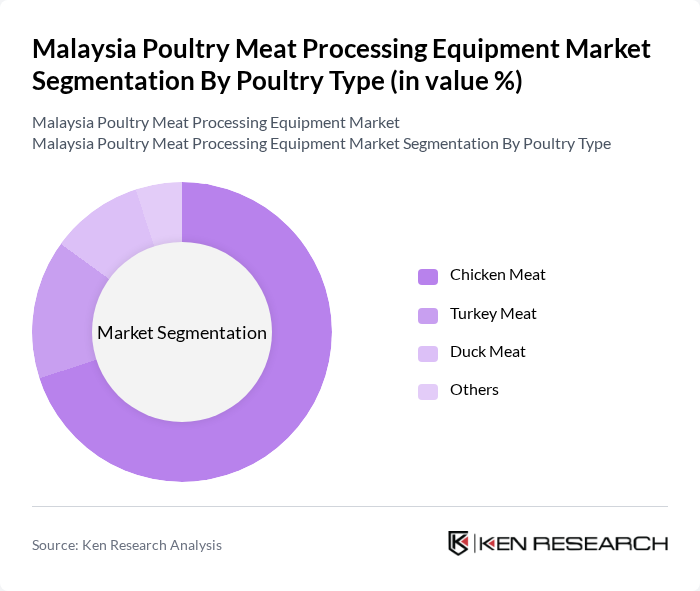
Malaysia Poultry Meat Processing Equipment Market segmentation by Poultry Type.

Malaysia Poultry Meat Processing Equipment Market Competitive Landscape

The Malaysia Poultry Meat Processing Equipment Market is characterized by a dynamic mix of regional and international players. Leading participants such as Marel, JBT Corporation, GEA Group, Tetra Pak, Bühler Group, Prime Equipment Group Inc., BAADER, Avidan Technologies, A.M.A. Group, A.C.M. Group, A.S.A. Group, A.B.C. Group, A.D.E. Group, A.F.G. Group, A.H.I. Group contribute to innovation, geographic expansion, and service delivery in this space.

Marel

1983

Boxmeer, Netherlands

JBT Corporation

1884

Chicago, USA

GEA Group

1881

Düsseldorf, Germany

Tetra Pak

1951

Lund, Sweden

Bühler Group

1860

Uzwil, Switzerland

Company

Establishment Year

Headquarters

Market Share (%)

Revenue (USD Million)

Year-over-Year Growth Rate (%)

Geographic Presence

Product Portfolio Breadth

Technology Leadership Index

Malaysia Poultry Meat Processing Equipment Market Industry Analysis

Growth Drivers

  • Increasing Demand for Poultry Meat:The demand for poultry meat in Malaysia is projected to reach 1.8 million metric tons in future, driven by a growing population and rising disposable incomes. The World Bank estimates that Malaysia's GDP per capita will increase to approximately $13,000 in future, leading to higher meat consumption. Additionally, poultry remains a preferred protein source due to its affordability and versatility, further fueling the need for advanced processing equipment to meet this demand.
  • Technological Advancements in Processing Equipment:The poultry processing equipment market is witnessing significant technological innovations, with investments in automation and IoT integration. In future, the Malaysian government is expected to allocate RM 600 million towards enhancing food processing technologies. This investment aims to improve efficiency and reduce labor costs, enabling processors to meet the increasing demand for high-quality poultry products while maintaining competitive pricing in the market.
  • Government Support for the Poultry Industry:The Malaysian government has implemented various initiatives to support the poultry sector, including subsidies and grants. In future, the government plans to provide RM 250 million in subsidies to poultry farmers and processors to enhance production capabilities. This support is crucial for modernizing processing facilities and ensuring compliance with food safety standards, ultimately contributing to the growth of the poultry meat processing equipment market.

Market Challenges

  • Fluctuating Raw Material Prices:The poultry processing industry faces challenges due to volatile raw material prices, particularly feed costs. In future, the price of corn and soybean meal, essential components of poultry feed, is expected to rise by 12% due to global supply chain disruptions. This fluctuation can significantly impact profit margins for processors, making it difficult to maintain stable pricing for poultry products in the market.
  • Stringent Regulatory Requirements:Compliance with food safety and environmental regulations poses a significant challenge for poultry processors in Malaysia. The government has introduced stricter regulations, including the Food Safety and Quality Act, which mandates rigorous inspections and certifications. In future, the cost of compliance is projected to increase by 18%, placing additional financial burdens on processors and potentially hindering market growth.

Malaysia Poultry Meat Processing Equipment Market Future Outlook

The future of the Malaysia poultry meat processing equipment market appears promising, driven by technological advancements and increasing consumer demand for high-quality products. As processors adopt automation and IoT technologies, operational efficiencies are expected to improve significantly. Additionally, the growing trend towards organic and sustainably sourced poultry products will likely create new market segments, encouraging further investment in innovative processing solutions to meet evolving consumer preferences and regulatory standards.

Market Opportunities

  • Expansion of Export Markets:Malaysia's poultry industry has the potential to expand its export markets significantly. In future, the government aims to increase poultry exports by 25%, targeting countries in Southeast Asia and the Middle East. This expansion will create opportunities for processing equipment manufacturers to develop specialized machinery that meets international standards, enhancing competitiveness in the global market.
  • Investment in Sustainable Practices:There is a growing emphasis on sustainability within the poultry industry, with consumers increasingly favoring eco-friendly products. In future, investments in sustainable processing practices are expected to rise by 35%, driven by consumer demand for organic poultry. This trend presents opportunities for equipment manufacturers to innovate and provide solutions that align with sustainable production methods, enhancing market appeal.

Scope of the Report

SegmentSub-Segments
By Equipment Type

Killing & Defeathering Equipment

Evisceration Equipment

Cut-up Machines

Deboning & Skinning Equipment

Marinating & Tumbling Equipment

Cooling and Freezing Equipment

Others

By Poultry Type

Chicken Meat

Turkey Meat

Duck Meat

Others

By Product Type

Fresh Processed

Raw Cooked

Pre-Cooked

Raw Fermented Sausages

Cured

Dried

Others

By Automation Type

Automatic

Semi-Automatic

Manual

By Distribution Channel

Online

Offline

By Region

Central Region

Northern Region

Southern Region

Eastern Region

Key Target Audience

Investors and Venture Capitalist Firms

Government and Regulatory Bodies (e.g., Ministry of Agriculture and Food Security, Department of Veterinary Services)

Poultry Meat Processing Equipment Manufacturers

Food Processing Companies

Distributors and Wholesalers of Poultry Equipment

Industry Associations (e.g., Malaysian Poultry Industry Association)

Food Safety and Quality Assurance Agencies

Financial Institutions and Banks

Players Mentioned in the Report:

Marel

JBT Corporation

GEA Group

Tetra Pak

Buhler Group

Prime Equipment Group Inc.

BAADER

Avidan Technologies

A.M.A. Group

A.C.M. Group

A.S.A. Group

A.B.C. Group

A.D.E. Group

A.F.G. Group

A.H.I. Group

Table of Contents

Market Assessment Phase

1. Executive Summary and Approach


2. Malaysia Poultry Meat Processing Equipment Market Overview

2.1 Key Insights and Strategic Recommendations

2.2 Malaysia Poultry Meat Processing Equipment Market Overview

2.3 Definition and Scope

2.4 Evolution of Market Ecosystem

2.5 Timeline of Key Regulatory Milestones

2.6 Value Chain & Stakeholder Mapping

2.7 Business Cycle Analysis

2.8 Policy & Incentive Landscape


3. Malaysia Poultry Meat Processing Equipment Market Analysis

3.1 Growth Drivers

3.1.1 Increasing demand for poultry meat
3.1.2 Technological advancements in processing equipment
3.1.3 Government support for the poultry industry
3.1.4 Rising health consciousness among consumers

3.2 Market Challenges

3.2.1 Fluctuating raw material prices
3.2.2 Stringent regulatory requirements
3.2.3 Competition from alternative protein sources
3.2.4 Supply chain disruptions

3.3 Market Opportunities

3.3.1 Expansion of export markets
3.3.2 Adoption of automation in processing
3.3.3 Development of organic poultry products
3.3.4 Investment in sustainable practices

3.4 Market Trends

3.4.1 Shift towards plant-based alternatives
3.4.2 Increasing focus on food safety and quality
3.4.3 Growth of e-commerce in poultry sales
3.4.4 Integration of IoT in processing equipment

3.5 Government Regulation

3.5.1 Food safety standards compliance
3.5.2 Environmental regulations on waste management
3.5.3 Import/export regulations for poultry products
3.5.4 Subsidies for poultry farmers and processors

4. SWOT Analysis


5. Stakeholder Analysis


6. Porter's Five Forces Analysis


7. Malaysia Poultry Meat Processing Equipment Market Size, 2019-2024

7.1 By Value

7.2 By Volume

7.3 By Average Selling Price


8. Malaysia Poultry Meat Processing Equipment Market Segmentation

8.1 By Equipment Type

8.1.1 Killing & Defeathering Equipment
8.1.2 Evisceration Equipment
8.1.3 Cut-up Machines
8.1.4 Deboning & Skinning Equipment
8.1.5 Marinating & Tumbling Equipment
8.1.6 Cooling and Freezing Equipment
8.1.7 Others

8.2 By Poultry Type

8.2.1 Chicken Meat
8.2.2 Turkey Meat
8.2.3 Duck Meat
8.2.4 Others

8.3 By Product Type

8.3.1 Fresh Processed
8.3.2 Raw Cooked
8.3.3 Pre-Cooked
8.3.4 Raw Fermented Sausages
8.3.5 Cured
8.3.6 Dried
8.3.7 Others

8.4 By Automation Type

8.4.1 Automatic
8.4.2 Semi-Automatic
8.4.3 Manual

8.5 By Distribution Channel

8.5.1 Online
8.5.2 Offline

8.6 By Region

8.6.1 Central Region
8.6.2 Northern Region
8.6.3 Southern Region
8.6.4 Eastern Region

9. Malaysia Poultry Meat Processing Equipment Market Competitive Analysis

9.1 Market Share of Key Players

9.2 Cross Comparison of Key Players

9.2.1 Company Name
9.2.2 Market Share (%)
9.2.3 Revenue (USD Million)
9.2.4 Year-over-Year Growth Rate (%)
9.2.5 Geographic Presence
9.2.6 Product Portfolio Breadth
9.2.7 Technology Leadership Index
9.2.8 Customer Satisfaction Score
9.2.9 R&D Investment as % of Revenue
9.2.10 Equipment Uptime/Reliability Rating

9.3 SWOT Analysis of Top Players

9.4 Pricing Analysis

9.5 Detailed Profile of Major Companies

9.5.1 Marel
9.5.2 JBT Corporation
9.5.3 GEA Group
9.5.4 Tetra Pak
9.5.5 Bühler Group
9.5.6 Prime Equipment Group Inc.
9.5.7 BAADER
9.5.8 Avidan Technologies
9.5.9 A.M.A. Group
9.5.10 A.C.M. Group
9.5.11 A.S.A. Group
9.5.12 A.B.C. Group
9.5.13 A.D.E. Group
9.5.14 A.F.G. Group
9.5.15 A.H.I. Group

10. Malaysia Poultry Meat Processing Equipment Market End-User Analysis

10.1 Procurement Behavior of Key Ministries

10.1.1 Budget Allocation Trends
10.1.2 Procurement Processes
10.1.3 Supplier Selection Criteria
10.1.4 Contract Management Practices

10.2 Corporate Spend on Infrastructure & Energy

10.2.1 Investment Trends in Processing Facilities
10.2.2 Energy Consumption Patterns
10.2.3 Infrastructure Development Initiatives
10.2.4 Cost Management Strategies

10.3 Pain Point Analysis by End-User Category

10.3.1 Equipment Reliability Issues
10.3.2 Maintenance Challenges
10.3.3 Compliance with Regulations
10.3.4 Cost Constraints

10.4 User Readiness for Adoption

10.4.1 Training and Skill Development Needs
10.4.2 Technology Adoption Barriers
10.4.3 Change Management Strategies
10.4.4 User Feedback Mechanisms

10.5 Post-Deployment ROI and Use Case Expansion

10.5.1 Performance Metrics Tracking
10.5.2 Case Studies of Successful Implementations
10.5.3 Scalability of Solutions
10.5.4 Future Investment Plans

11. Malaysia Poultry Meat Processing Equipment Market Future Size, 2025-2030

11.1 By Value

11.2 By Volume

11.3 By Average Selling Price


Go-To-Market Strategy Phase

12. Whitespace Analysis + Business Model Canvas

12.1 Market Gaps Identification

12.2 Value Proposition Development

12.3 Revenue Streams Analysis

12.4 Cost Structure Evaluation

12.5 Key Partnerships Exploration

12.6 Customer Segmentation

12.7 Channels of Distribution


13. Marketing and Positioning Recommendations

13.1 Branding Strategies

13.2 Product USPs

13.3 Target Market Identification

13.4 Communication Strategies

13.5 Digital Marketing Approaches


14. Distribution Plan

14.1 Urban Retail Strategies

14.2 Rural NGO Tie-ups

14.3 Logistics and Supply Chain Management

14.4 Distribution Channel Optimization


15. Channel & Pricing Gaps

15.1 Underserved Routes

15.2 Pricing Bands Analysis

15.3 Competitor Pricing Strategies

15.4 Customer Willingness to Pay


16. Unmet Demand & Latent Needs

16.1 Category Gaps Identification

16.2 Consumer Segments Analysis

16.3 Product Development Opportunities

16.4 Market Entry Strategies


17. Customer Relationship

17.1 Loyalty Programs

17.2 After-sales Service Enhancements

17.3 Customer Feedback Mechanisms

17.4 Relationship Management Strategies


18. Value Proposition

18.1 Sustainability Initiatives

18.2 Integrated Supply Chains

18.3 Customer-Centric Innovations

18.4 Competitive Differentiation


19. Key Activities

19.1 Regulatory Compliance

19.2 Branding Initiatives

19.3 Distribution Setup

19.4 Market Research Activities


20. Entry Strategy Evaluation

20.1 Domestic Market Entry Strategy

20.1.1 Product Mix Considerations
20.1.2 Pricing Band Strategies
20.1.3 Packaging Innovations

20.2 Export Entry Strategy

20.2.1 Target Countries Analysis
20.2.2 Compliance Roadmap Development

21. Entry Mode Assessment

21.1 Joint Ventures

21.2 Greenfield Investments

21.3 Mergers & Acquisitions

21.4 Distributor Model Evaluation


22. Capital and Timeline Estimation

22.1 Capital Requirements Analysis

22.2 Timelines for Market Entry


23. Control vs Risk Trade-Off

23.1 Ownership vs Partnerships

23.2 Risk Management Strategies


24. Profitability Outlook

24.1 Breakeven Analysis

24.2 Long-term Sustainability Strategies


25. Potential Partner List

25.1 Distributors

25.2 Joint Ventures

25.3 Acquisition Targets


26. Execution Roadmap

26.1 Phased Plan for Market Entry

26.1.1 Market Setup
26.1.2 Market Entry
26.1.3 Growth Acceleration
26.1.4 Scale & Stabilize

26.2 Key Activities and Milestones

26.2.1 Milestone Planning
26.2.2 Activity Tracking

27. Disclaimer


Research Methodology

ApproachModellingSample

Phase 1: Approach1

Desk Research

  • Industry reports from Malaysian agricultural and food processing associations
  • Government publications on poultry production and meat processing regulations
  • Market analysis from trade journals focusing on food technology and equipment

Primary Research

  • Interviews with key stakeholders in poultry processing plants
  • Surveys targeting equipment manufacturers and suppliers in Malaysia
  • Field visits to processing facilities to observe equipment usage and needs

Validation & Triangulation

  • Cross-validation of data from multiple industry sources and expert opinions
  • Triangulation of market size estimates using production and consumption data
  • Sanity checks through feedback from industry experts and consultants

Phase 2: Market Size Estimation1

Top-down Assessment

  • Analysis of national poultry production statistics and growth trends
  • Segmentation of the market by equipment type and processing capacity
  • Incorporation of government initiatives promoting poultry industry growth

Bottom-up Modeling

  • Estimation of equipment demand based on production volume and processing needs
  • Cost analysis of equipment procurement and maintenance across different scales
  • Volume x cost calculations for various processing technologies

Forecasting & Scenario Analysis

  • Multi-factor regression analysis considering consumer demand and export potential
  • Scenario modeling based on regulatory changes and technological advancements
  • Baseline, optimistic, and pessimistic forecasts through 2030

Phase 3: CATI Sample Composition1

Scope Item/SegmentSample SizeTarget Respondent Profiles
Poultry Processing Equipment Manufacturers45Product Managers, Sales Directors
Poultry Processing Plant Operators80Operations Managers, Plant Supervisors
Food Safety and Quality Assurance Professionals60Quality Control Managers, Compliance Officers
Supply Chain and Logistics Managers70Logistics Coordinators, Procurement Managers
Industry Experts and Consultants50Market Analysts, Industry Advisors

Frequently Asked Questions

What is the current value of the Malaysia Poultry Meat Processing Equipment Market?

The Malaysia Poultry Meat Processing Equipment Market is valued at approximately USD 190 million, reflecting a significant growth driven by increasing demand for poultry products and advancements in processing technologies.

What are the key factors driving growth in the Malaysia Poultry Meat Processing Equipment Market?

Which cities are the main hubs for poultry meat processing in Malaysia?

What types of equipment are included in the Malaysia Poultry Meat Processing Equipment Market?

Why Buy From Us?

Refine Robust Result (RRR) Framework

What makes us stand out is that our consultants follow Robust, Refine and Result (RRR) methodology. Robust for clear definitions, approaches and sanity checking, Refine for differentiating respondents' facts and opinions, and Result for presenting data with story.

Our Reach Is Unmatched

We have set a benchmark in the industry by offering our clients with syndicated and customized market research reports featuring coverage of entire market as well as meticulous research and analyst insights.

Shifting the Research Paradigm

While we don't replace traditional research, we flip the method upside down. Our dual approach of Top Bottom & Bottom Top ensures quality deliverable by not just verifying company fundamentals but also looking at the sector and macroeconomic factors.

More Insights-Better Decisions

With one step in the future, our research team constantly tries to show you the bigger picture. We help with some of the tough questions you may encounter along the way: How is the industry positioned? Best marketing channel? KPI's of competitors? By aligning every element, we help maximize success.

Transparency and Trust

Our report gives you instant access to the answers and sources that other companies might choose to hide. We elaborate each steps of research methodology we have used and showcase you the sample size to earn your trust.

Round the Clock Support

If you need any support, we are here! We pride ourselves on universe strength, data quality, and quick, friendly, and professional service.

Why Clients Choose Us?

400000+
Reports in repository
150+
Consulting projects a year
100+
Analysts
8000+
Client Queries in 2022








