About the Report
Base Year 2024Mexico Commercial Real Estate Market Overview
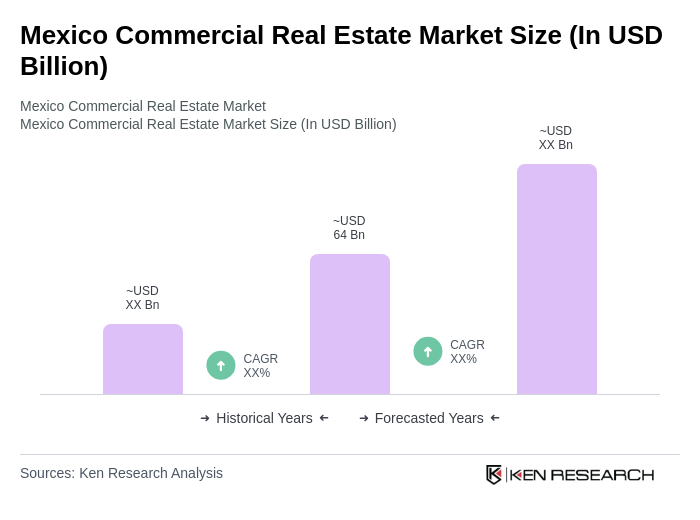
- The Mexico Commercial Real Estate Market is valued at approximately USD 64 billion, based on a five-year historical analysis. This growth is primarily driven by urbanization, increased foreign direct investment, and a surge in demand for logistics and industrial spaces, particularly due to nearshoring trends, e-commerce expansion, and supply chain optimization. Additional growth drivers include the adoption of ESG standards, digitalization of real estate processes, and the development of new industrial corridors in states such as Nuevo León and Querétaro .
- Key cities dominating the market include Mexico City, Monterrey, and Guadalajara. Mexico City serves as the economic hub with a high concentration of corporate offices and retail spaces, while Monterrey is recognized for its industrial and logistics facilities due to its strategic location and robust infrastructure. Guadalajara is emerging as a technology and innovation center, attracting investments in mixed-use and tech-driven developments. Intermediate cities such as Querétaro, Mérida, and León are also gaining prominence due to improved connectivity and urban development .
- In 2023, the Mexican government updated the "Ley de Ingresos," aiming to streamline property taxes and enhance transparency in real estate transactions. This regulatory adjustment is designed to attract additional foreign investment by simplifying the tax structure and ensuring a more predictable investment environment .
Mexico Commercial Real Estate Market Segmentation
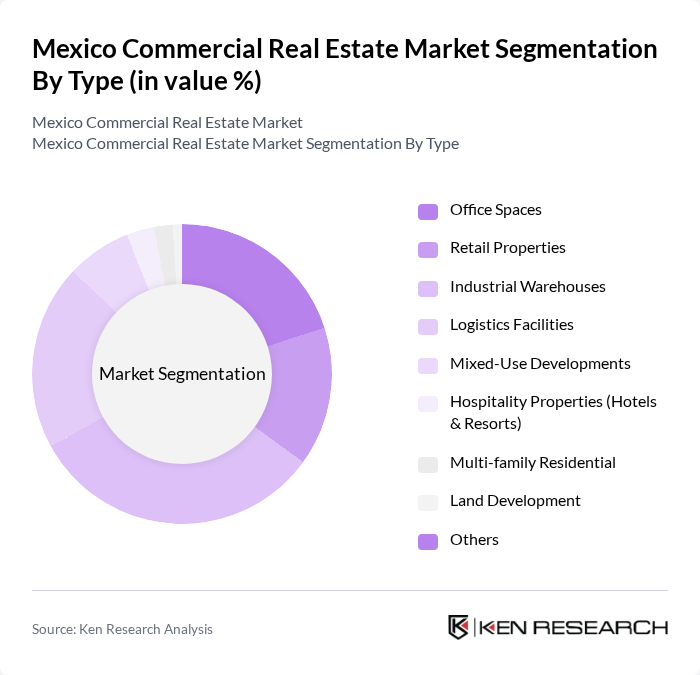
By Type:The commercial real estate market in Mexico is segmented into office spaces, retail properties, industrial warehouses, logistics facilities, mixed-use developments, hospitality properties, multi-family residential, land development, and others. Industrial warehouses and logistics facilities have seen the fastest growth, driven by nearshoring and e-commerce. Office spaces are adapting to new workplace models emphasizing flexibility and sustainability, while retail properties are shifting toward mixed-use and experiential formats. Mixed-use developments and hospitality properties are also expanding, reflecting evolving consumer and business demands .
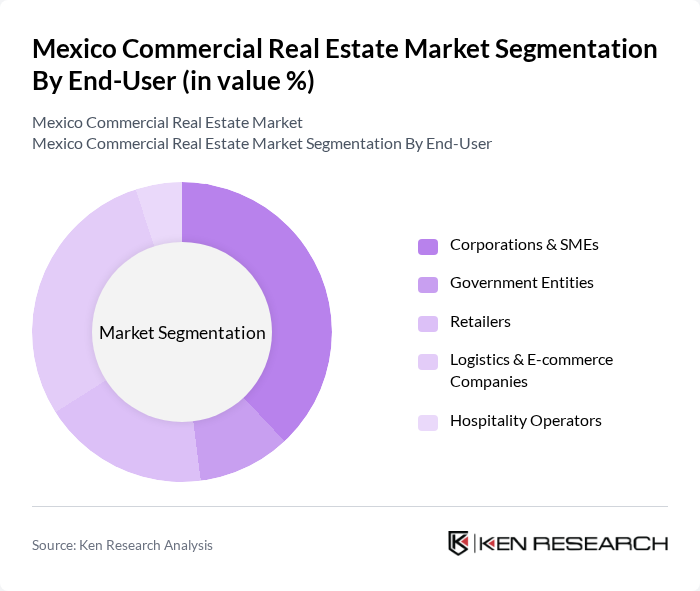
By End-User:The end-user segmentation of the commercial real estate market includes corporations and SMEs, government entities, retailers, logistics and e-commerce companies, and hospitality operators. Corporations and SMEs remain the largest end-user group, with logistics and e-commerce companies rapidly increasing their share due to the rise in nearshoring and digital retail. Retailers and hospitality operators continue to adapt to shifting consumer preferences and tourism trends .
Mexico Commercial Real Estate Market Competitive Landscape
The Mexico Commercial Real Estate Market is characterized by a dynamic mix of regional and international players. Leading participants such as Fibra Uno (FUNO), Prologis México, Vesta, Grupo Sordo Madaleno, Grupo Danhos, JLL México, CBRE México, Cushman & Wakefield México, Colliers México, Inmuebles24, Grupo Lar México, Desarrolladora Homex, Grupo Gigante, Grupo Acosta Verde, Hines México, Savills México, Flat.mx, Grupo Posadas contribute to innovation, geographic expansion, and service delivery in this space.
Mexico Commercial Real Estate Market Industry Analysis
Growth Drivers
- Urbanization and Population Growth:Mexico's urban population is projected to reach 81% by future, up from 83% in 2020, according to the World Bank. This rapid urbanization drives demand for commercial real estate, particularly in metropolitan areas like Mexico City and Guadalajara. The population is expected to grow by approximately 1 million annually, leading to increased demand for office spaces, retail outlets, and logistics facilities, thereby stimulating investment in the commercial real estate sector.
- Foreign Direct Investment (FDI) Inflows:In future, Mexico attracted $36 billion in FDI, with the commercial real estate sector receiving a significant portion. The government’s pro-business policies and trade agreements, such as the USMCA, enhance Mexico's attractiveness to foreign investors. This influx of capital is expected to continue, supporting the development of new commercial properties and the revitalization of existing ones, particularly in high-demand urban areas, thus bolstering the market.
- Infrastructure Development Initiatives:The Mexican government has committed over $10 billion to infrastructure projects in future, focusing on transportation and logistics. Major initiatives include the expansion of highways and the development of new airports, which facilitate better connectivity for commercial real estate. Improved infrastructure not only enhances accessibility but also increases property values, making the commercial real estate market more attractive to investors and developers alike.
Market Challenges
- Economic Volatility:Mexico's economy is projected to grow by only 2.5% in future, according to the IMF, reflecting ongoing challenges such as inflation and global economic uncertainties. This volatility can deter investment in commercial real estate, as potential investors may hesitate to commit capital in an unpredictable environment. Economic fluctuations can also impact rental rates and occupancy levels, posing risks to property owners and developers.
- Regulatory Uncertainty:The commercial real estate sector faces significant regulatory challenges, including complex zoning laws and land use regulations. In future, over 40% of developers reported delays due to regulatory hurdles, according to industry surveys. This uncertainty can lead to increased costs and project timelines, discouraging investment and complicating the development process, ultimately affecting the overall market growth.
Mexico Commercial Real Estate Market Future Outlook
The Mexico commercial real estate market is poised for a transformative period driven by urbanization, technological advancements, and evolving consumer preferences. As remote work continues to influence office space demand, flexible leasing options are likely to gain traction. Additionally, the focus on sustainability will drive investments in green buildings, aligning with global trends. The integration of smart technologies in property management will enhance operational efficiency, making the market more attractive to investors and tenants alike, fostering a dynamic growth environment.
Market Opportunities
- Growth in Co-working Spaces:The demand for co-working spaces is expected to rise significantly, with an estimated 20% increase in occupancy rates by future. This trend is driven by startups and remote workers seeking flexible office solutions. Investors can capitalize on this opportunity by developing co-working facilities in urban centers, catering to the evolving needs of modern businesses and freelancers.
- Demand for Sustainable Buildings:With a growing emphasis on environmental sustainability, the market for green buildings is projected to expand. By future, it is estimated that 30% of new commercial developments will incorporate sustainable practices. This shift presents opportunities for developers to invest in eco-friendly projects, attracting environmentally conscious tenants and benefiting from potential tax incentives and lower operational costs.
Scope of the Report
| Segment | Sub-Segments |
|---|---|
| By Type | Office Spaces Retail Properties Industrial Warehouses Logistics Facilities Mixed-Use Developments Hospitality Properties (Hotels & Resorts) Multi-family Residential Land Development Others |
| By End-User | Corporations & SMEs Government Entities Retailers Logistics & E-commerce Companies Hospitality Operators |
| By Investment Source | Domestic Institutional Investors Foreign Direct Investment (FDI) Real Estate Investment Trusts (REITs / FIBRAs) Public-Private Partnerships (PPP) Government Schemes |
| By Property Class | Class A Class B Class C |
| By Location | Mexico City Metropolitan Area Monterrey Metropolitan Area Guadalajara Metropolitan Area Bajío Region Border States (e.g., Tijuana, Ciudad Juárez) Other Urban Areas Suburban Areas Rural Areas |
| By Lease Type | Long-term Leases Short-term Leases Flexible/Co-working Leases |
| By Development Stage | Pre-Construction Under Construction Completed |
Key Target Audience
Investors and Venture Capitalist Firms
Government and Regulatory Bodies (e.g., Secretaría de Desarrollo Agrario, Territorial y Urbano, Comisión Nacional de Vivienda)
Real Estate Developers
Property Management Companies
Construction Firms
Financial Institutions
Real Estate Investment Trusts (REITs)
Commercial Brokers and Agents
Players Mentioned in the Report:
Fibra Uno (FUNO)
Prologis Mexico
Vesta
Grupo Sordo Madaleno
Grupo Danhos
JLL Mexico
CBRE Mexico
Cushman & Wakefield Mexico
Colliers Mexico
Inmuebles24
Grupo Lar Mexico
Desarrolladora Homex
Grupo Gigante
Grupo Acosta Verde
Hines Mexico
Savills Mexico
Flat.mx
Grupo Posadas
Table of Contents
Market Assessment Phase
1. Executive Summary and Approach
2. Mexico Commercial Real Estate Market Overview
2.1 Key Insights and Strategic Recommendations
2.2 Mexico Commercial Real Estate Market Overview
2.3 Definition and Scope
2.4 Evolution of Market Ecosystem
2.5 Timeline of Key Regulatory Milestones
2.6 Value Chain & Stakeholder Mapping
2.7 Business Cycle Analysis
2.8 Policy & Incentive Landscape
3. Mexico Commercial Real Estate Market Analysis
3.1 Growth Drivers
3.1.1 Urbanization and Population Growth
3.1.2 Foreign Direct Investment (FDI) Inflows
3.1.3 Infrastructure Development Initiatives
3.1.4 E-commerce Growth and Logistics Demand
3.2 Market Challenges
3.2.1 Economic Volatility
3.2.2 Regulatory Uncertainty
3.2.3 Limited Access to Financing
3.2.4 Environmental Concerns and Compliance
3.3 Market Opportunities
3.3.1 Growth in Co-working Spaces
3.3.2 Demand for Sustainable Buildings
3.3.3 Expansion of Retail and Mixed-Use Developments
3.3.4 Technological Integration in Property Management
3.4 Market Trends
3.4.1 Rise of Remote Work and Its Impact on Office Space
3.4.2 Increasing Focus on Smart Buildings
3.4.3 Shift Towards Flexible Leasing Options
3.4.4 Growth of Real Estate Investment Trusts (REITs)
3.5 Government Regulation
3.5.1 Zoning Laws and Land Use Regulations
3.5.2 Tax Incentives for Real Estate Development
3.5.3 Environmental Regulations
3.5.4 Foreign Ownership Restrictions
4. SWOT Analysis
5. Stakeholder Analysis
6. Porter's Five Forces Analysis
7. Mexico Commercial Real Estate Market Market Size, 2019-2024
7.1 By Value
7.2 By Volume
7.3 By Average Selling Price
8. Mexico Commercial Real Estate Market Segmentation
8.1 By Type
8.1.1 Office Spaces
8.1.2 Retail Properties
8.1.3 Industrial Warehouses
8.1.4 Logistics Facilities
8.1.5 Mixed-Use Developments
8.1.6 Hospitality Properties (Hotels & Resorts)
8.1.7 Multi-family Residential
8.1.8 Land Development
8.1.9 Others
8.2 By End-User
8.2.1 Corporations & SMEs
8.2.2 Government Entities
8.2.3 Retailers
8.2.4 Logistics & E-commerce Companies
8.2.5 Hospitality Operators
8.3 By Investment Source
8.3.1 Domestic Institutional Investors
8.3.2 Foreign Direct Investment (FDI)
8.3.3 Real Estate Investment Trusts (REITs / FIBRAs)
8.3.4 Public-Private Partnerships (PPP)
8.3.5 Government Schemes
8.4 By Property Class
8.4.1 Class A
8.4.2 Class B
8.4.3 Class C
8.5 By Location
8.5.1 Mexico City Metropolitan Area
8.5.2 Monterrey Metropolitan Area
8.5.3 Guadalajara Metropolitan Area
8.5.4 Bajío Region
8.5.5 Border States (e.g., Tijuana, Ciudad Juárez)
8.5.6 Other Urban Areas
8.5.7 Suburban Areas
8.5.8 Rural Areas
8.6 By Lease Type
8.6.1 Long-term Leases
8.6.2 Short-term Leases
8.6.3 Flexible/Co-working Leases
8.7 By Development Stage
8.7.1 Pre-Construction
8.7.2 Under Construction
8.7.3 Completed
9. Mexico Commercial Real Estate Market Competitive Analysis
9.1 Market Share of Key Players
9.2 Cross Comparison of Key Players
9.2.1 Company Name
9.2.2 Group Size (Large, Medium, or Small as per industry convention)
9.2.3 Total Revenue (USD)
9.2.4 Revenue Growth Rate (%)
9.2.5 Market Penetration Rate (%)
9.2.6 Gross Leasable Area (GLA, m²)
9.2.7 Occupancy Rate (%)
9.2.8 Average Lease Duration (years)
9.2.9 Net Operating Income (NOI, USD)
9.2.10 Return on Investment (ROI, %)
9.2.11 Debt-to-Equity Ratio
9.2.12 Asset Diversification (by property type/region)
9.2.13 ESG/Sustainability Ratings
9.3 SWOT Analysis of Top Players
9.4 Pricing Analysis
9.5 Detailed Profile of Major Companies
9.5.1 Fibra Uno (FUNO)
9.5.2 Prologis México
9.5.3 Vesta
9.5.4 Grupo Sordo Madaleno
9.5.5 Grupo Danhos
9.5.6 JLL México
9.5.7 CBRE México
9.5.8 Cushman & Wakefield México
9.5.9 Colliers México
9.5.10 Inmuebles24
9.5.11 Grupo Lar México
9.5.12 Desarrolladora Homex
9.5.13 Grupo Gigante
9.5.14 Grupo Acosta Verde
9.5.15 Hines México
9.5.16 Savills México
9.5.17 Flat.mx
9.5.18 Grupo Posadas
10. Mexico Commercial Real Estate Market End-User Analysis
10.1 Procurement Behavior of Key Ministries
10.1.1 Ministry of Finance
10.1.2 Ministry of Urban Development
10.1.3 Ministry of Environment
10.2 Corporate Spend on Infrastructure & Energy
10.2.1 Corporate Investments in Real Estate
10.2.2 Infrastructure Development Budgets
10.2.3 Energy Efficiency Initiatives
10.3 Pain Point Analysis by End-User Category
10.3.1 Cost of Leasing
10.3.2 Availability of Suitable Properties
10.3.3 Regulatory Compliance Issues
10.4 User Readiness for Adoption
10.4.1 Awareness of Market Trends
10.4.2 Financial Preparedness
10.4.3 Technological Adoption
10.5 Post-Deployment ROI and Use Case Expansion
10.5.1 Measurement of ROI
10.5.2 Expansion into New Markets
10.5.3 Long-term Sustainability Plans
11. Mexico Commercial Real Estate Market Future Size, 2025-2030
11.1 By Value
11.2 By Volume
11.3 By Average Selling Price
Go-To-Market Strategy Phase
1. Whitespace Analysis + Business Model Canvas
1.1 Market Gaps Identification
1.2 Business Model Development
2. Marketing and Positioning Recommendations
2.1 Branding Strategies
2.2 Product USPs
3. Distribution Plan
3.1 Urban Retail vs Rural NGO Tie-ups
4. Channel & Pricing Gaps
4.1 Underserved Routes
4.2 Pricing Bands
5. Unmet Demand & Latent Needs
5.1 Category Gaps
5.2 Consumer Segments
6. Customer Relationship
6.1 Loyalty Programs
6.2 After-sales Service
7. Value Proposition
7.1 Sustainability
7.2 Integrated Supply Chains
8. Key Activities
8.1 Regulatory Compliance
8.2 Branding
8.3 Distribution Setup
9. Entry Strategy Evaluation
9.1 Domestic Market Entry Strategy
9.1.1 Product Mix
9.1.2 Pricing Band
9.1.3 Packaging
9.2 Export Entry Strategy
9.2.1 Target Countries
9.2.2 Compliance Roadmap
10. Entry Mode Assessment
10.1 Joint Ventures
10.2 Greenfield Investments
10.3 Mergers & Acquisitions
10.4 Distributor Model
11. Capital and Timeline Estimation
11.1 Capital Requirements
11.2 Timelines
12. Control vs Risk Trade-Off
12.1 Ownership vs Partnerships
13. Profitability Outlook
13.1 Breakeven Analysis
13.2 Long-term Sustainability
14. Potential Partner List
14.1 Distributors
14.2 Joint Ventures
14.3 Acquisition Targets
15. Execution Roadmap
15.1 Phased Plan for Market Entry
15.1.1 Market Setup
15.1.2 Market Entry
15.1.3 Growth Acceleration
15.1.4 Scale & Stabilize
15.2 Key Activities and Milestones
15.2.1 Activity Planning
15.2.2 Milestone Tracking
Research Methodology
Phase 1: Approach1
Desk Research
- Analysis of commercial real estate reports from government agencies and industry associations
- Review of market trends and forecasts from real estate consultancy firms
- Examination of economic indicators and demographic data relevant to real estate investment
Primary Research
- Interviews with real estate developers and property managers in key urban areas
- Surveys with commercial tenants to understand leasing preferences and market conditions
- Focus groups with real estate investors to gauge sentiment and investment strategies
Validation & Triangulation
- Cross-validation of findings with multiple data sources, including government statistics and private reports
- Triangulation of qualitative insights from interviews with quantitative data from surveys
- Sanity checks through expert panel reviews comprising industry veterans and analysts
Phase 2: Market Size Estimation1
Top-down Assessment
- Estimation of total market size based on national GDP contribution from the real estate sector
- Segmentation of the market by property type, including office, retail, and industrial spaces
- Incorporation of regional growth rates and urbanization trends affecting demand
Bottom-up Modeling
- Collection of data on rental rates and occupancy levels from major cities
- Analysis of transaction volumes and values from recent commercial real estate deals
- Estimation of future growth based on pipeline projects and planned developments
Forecasting & Scenario Analysis
- Multi-factor regression analysis incorporating economic growth, interest rates, and foreign investment
- Scenario modeling based on potential regulatory changes and market disruptions
- Development of baseline, optimistic, and pessimistic forecasts through 2030
Phase 3: CATI Sample Composition1
| Scope Item/Segment | Sample Size | Target Respondent Profiles |
|---|---|---|
| Office Space Leasing | 100 | Property Managers, Corporate Real Estate Executives |
| Retail Market Trends | 80 | Retail Store Owners, Leasing Agents |
| Industrial Property Demand | 60 | Logistics Managers, Industrial Developers |
| Investment Sentiment Analysis | 90 | Real Estate Investors, Financial Analysts |
| Urban Development Projects | 50 | City Planners, Urban Developers |
Frequently Asked Questions
What is the current value of the Mexico Commercial Real Estate Market?
The Mexico Commercial Real Estate Market is valued at approximately USD 64 billion, driven by urbanization, foreign direct investment, and increased demand for logistics and industrial spaces, particularly due to trends like nearshoring and e-commerce expansion.
Which cities are the key players in the Mexico Commercial Real Estate Market?
What are the main growth drivers of the Mexico Commercial Real Estate Market?
What challenges does the Mexico Commercial Real Estate Market face?
Why Buy From Us?

What makes us stand out is that our consultants follow Robust, Refine and Result (RRR) methodology. Robust for clear definitions, approaches and sanity checking, Refine for differentiating respondents' facts and opinions, and Result for presenting data with story.

We have set a benchmark in the industry by offering our clients with syndicated and customized market research reports featuring coverage of entire market as well as meticulous research and analyst insights.

While we don't replace traditional research, we flip the method upside down. Our dual approach of Top Bottom & Bottom Top ensures quality deliverable by not just verifying company fundamentals but also looking at the sector and macroeconomic factors.

With one step in the future, our research team constantly tries to show you the bigger picture. We help with some of the tough questions you may encounter along the way: How is the industry positioned? Best marketing channel? KPI's of competitors? By aligning every element, we help maximize success.

Our report gives you instant access to the answers and sources that other companies might choose to hide. We elaborate each steps of research methodology we have used and showcase you the sample size to earn your trust.

If you need any support, we are here! We pride ourselves on universe strength, data quality, and quick, friendly, and professional service.