About the Report
Base Year 2024Middle East Biomaterial Wound Dressing Market Overview
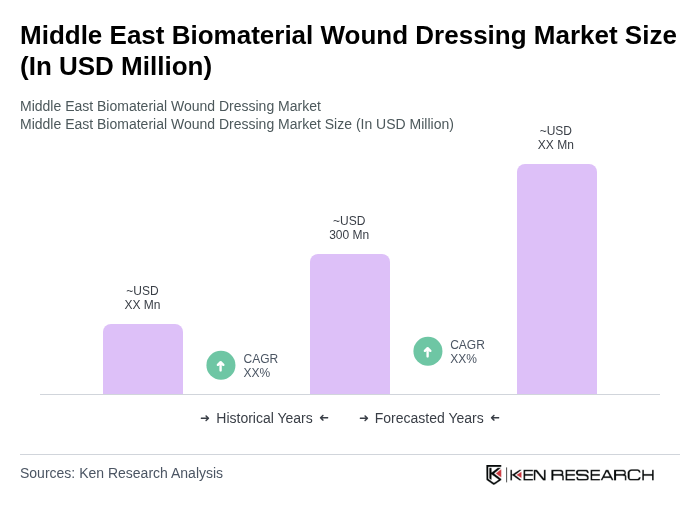
- The Middle East Biomaterial Wound Dressing Market is valued at USD 300 million, based on a five-year historical analysis of the Middle East and Africa biomaterial wound dressing market, which generated around USD 299.7 million in revenue in 2024. This growth is primarily driven by the increasing prevalence of chronic wounds such as diabetic foot ulcers and pressure ulcers, particularly in Gulf countries with high diabetes incidence, rising healthcare expenditure, and advancements in advanced and bioactive wound care technologies. The demand for innovative and effective wound dressings is further fueled by growing awareness of infection control, increased surgical volumes, and the need for faster healing and reduced hospital stays in both public and private healthcare facilities.
- Key players in this market include Saudi Arabia, the United Arab Emirates, and Turkey. These countries dominate the market due to their robust healthcare infrastructure, higher per capita healthcare spending, and significant investments in medical technology and specialized wound care services. Additionally, the increasing number of accredited hospitals, expansion of private healthcare groups, and a growing population with a high burden of lifestyle-related chronic diseases contribute to their market leadership in the adoption of advanced biomaterial wound dressings.
- In 2023, the Saudi Arabian government implemented a new regulation mandating the use of advanced biomaterial wound dressings in public healthcare facilities. This regulation aims to improve patient outcomes and reduce healthcare costs associated with wound management. The initiative is part of a broader strategy to enhance healthcare quality and accessibility across the region.
Middle East Biomaterial Wound Dressing Market Segmentation
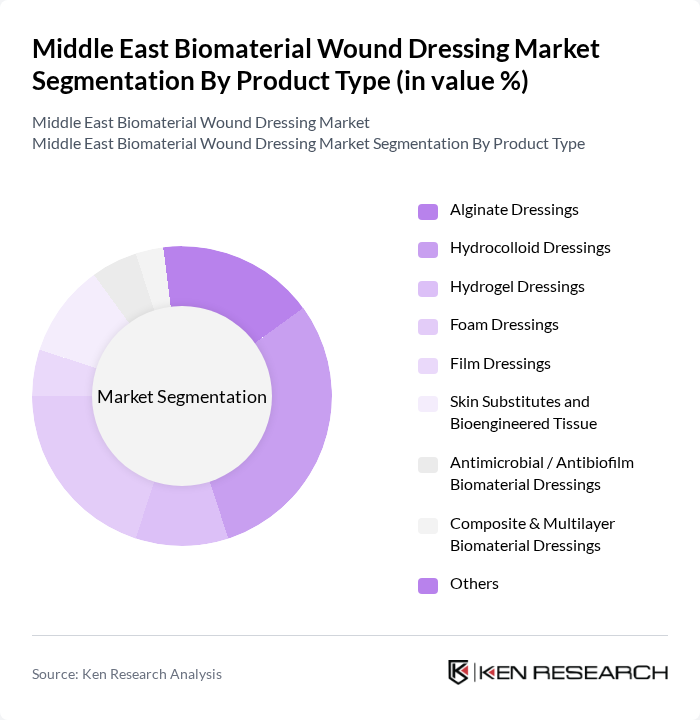
By Product Type:The product type segmentation includes various categories of wound dressings, each designed to cater to specific wound care needs. The subsegments are Alginate Dressings, Hydrocolloid Dressings, Hydrogel Dressings, Foam Dressings, Film Dressings, Skin Substitutes and Bioengineered Tissue, Antimicrobial / Antibiofilm Biomaterial Dressings, Composite & Multilayer Biomaterial Dressings, and Others. Advanced biomaterial dressings such as foam, alginate, antimicrobial, and bioengineered tissue products are increasingly preferred for chronic and surgical wounds because they maintain a moist environment, absorb exudate, and support tissue regeneration. Among these, foam and other advanced moist wound dressings collectively hold a significant share globally, while hydrocolloid and hydrogel dressings continue to be widely used for moderate exudating wounds and in outpatient and homecare settings.
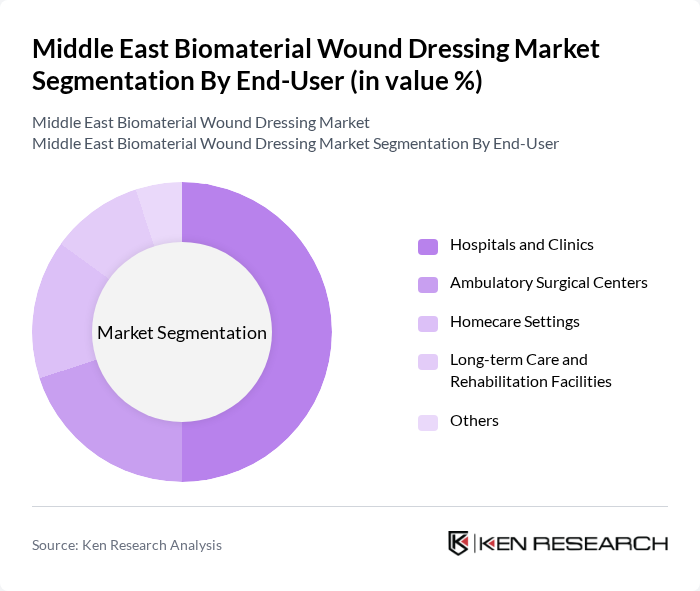
By End-User:The end-user segmentation encompasses various healthcare settings where biomaterial wound dressings are utilized. This includes Hospitals and Clinics, Ambulatory Surgical Centers, Homecare Settings, Long-term Care and Rehabilitation Facilities, and Others. Hospitals and Clinics dominate this segment due to the high volume of surgical procedures, trauma cases, and complex chronic wound management that require advanced and specialized dressings. The increasing number of surgeries, expansion of outpatient surgical and day-care units, and the growing focus on enhanced recovery protocols and patient-centered care are driving the demand for effective biomaterial wound dressings across both inpatient and ambulatory care settings.
Middle East Biomaterial Wound Dressing Market Competitive Landscape
The Middle East Biomaterial Wound Dressing Market is characterized by a dynamic mix of regional and international players. Leading participants such as Smith & Nephew plc, Mölnlycke Health Care AB, 3M Health Care (3M Company), ConvaTec Group plc, Coloplast A/S, B. Braun Melsungen AG, Paul Hartmann AG, Medline Industries, LP, Ethicon, Inc. (Johnson & Johnson MedTech), Medtronic plc, Organogenesis Holdings Inc., Integra LifeSciences Corporation, Hollister Incorporated, DeRoyal Industries, Inc., Regional & Local Players (e.g., Gulf Medical Co. Ltd., Tamer Group, Nahdi Medical Company) contribute to innovation, geographic expansion, and service delivery in this space.
Middle East Biomaterial Wound Dressing Market Industry Analysis
Growth Drivers
- Increasing Prevalence of Chronic Wounds:The Middle East is witnessing a significant rise in chronic wounds, with an estimated 2.6 million people affected annually. Conditions such as diabetes and vascular diseases contribute to this increase, with diabetes prevalence projected to reach 12.2% in future, according to the International Diabetes Federation. This growing patient population necessitates advanced wound care solutions, driving demand for biomaterial wound dressings that promote faster healing and reduce complications.
- Rising Awareness of Advanced Wound Care Products:Awareness of advanced wound care products is increasing, with healthcare professionals and patients recognizing the benefits of biomaterials. A survey by the Middle East Healthcare Federation indicated that 70% of healthcare providers are now prioritizing advanced wound care solutions. This shift is supported by educational initiatives and training programs, which aim to enhance knowledge about the effectiveness of biomaterial dressings in managing complex wounds, thus boosting market growth.
- Technological Advancements in Biomaterials:The biomaterials sector is experiencing rapid technological advancements, with innovations such as nanotechnology and smart dressings gaining traction. The market for smart wound dressings is expected to reach $1.3 billion in future, as reported by Research and Markets. These technologies enhance healing processes and provide real-time monitoring, making them attractive options for healthcare providers. Such advancements are pivotal in driving the adoption of biomaterial wound dressings across the region.
Market Challenges
- High Cost of Advanced Wound Dressings:The high cost associated with advanced biomaterial wound dressings poses a significant challenge in the Middle East. Prices for these products can range from $22 to $110 per dressing, making them less accessible for patients, especially in lower-income regions. According to the World Bank, healthcare expenditure in the Middle East averages around $1,200 per capita, limiting the affordability of advanced wound care solutions for many patients.
- Limited Access to Healthcare Facilities in Rural Areas:Access to healthcare facilities remains a challenge in rural areas of the Middle East, where approximately 32% of the population resides. The World Health Organization reports that only 62% of rural health facilities are adequately equipped to provide advanced wound care. This limited access hampers the timely treatment of chronic wounds, thereby restricting the market growth for biomaterial wound dressings in these underserved regions.
Middle East Biomaterial Wound Dressing Market Future Outlook
The future of the Middle East biomaterial wound dressing market appears promising, driven by ongoing advancements in healthcare infrastructure and increasing investments in research and development. As the region's healthcare systems evolve, there will be a greater emphasis on integrating innovative wound care solutions. Additionally, the growing geriatric population will further fuel demand for effective wound management products, creating a favorable environment for market expansion and innovation in the coming years.
Market Opportunities
- Expansion of Healthcare Infrastructure:The ongoing expansion of healthcare infrastructure in the Middle East presents significant opportunities for the biomaterial wound dressing market. Governments are investing heavily in healthcare facilities, with an estimated $55 billion allocated for healthcare development in future. This investment will enhance access to advanced wound care products, driving market growth and improving patient outcomes.
- Increasing Demand for Personalized Medicine:The rising demand for personalized medicine is creating new opportunities in the biomaterial wound dressing market. As healthcare shifts towards tailored treatment approaches, the need for customized wound care solutions is growing. The global personalized medicine market is projected to reach $2.6 trillion in future, indicating a substantial opportunity for biomaterial manufacturers to develop specialized products that cater to individual patient needs.
Scope of the Report
| Segment | Sub-Segments |
|---|---|
| By Product Type | Alginate Dressings Hydrocolloid Dressings Hydrogel Dressings Foam Dressings Film Dressings Skin Substitutes and Bioengineered Tissue Antimicrobial / Antibiofilm Biomaterial Dressings Composite & Multilayer Biomaterial Dressings Others |
| By End-User | Hospitals and Clinics Ambulatory Surgical Centers Homecare Settings Long-term Care and Rehabilitation Facilities Others |
| By Distribution Channel | Direct Tenders to Hospitals and Ministries Distributors and Medical Device Wholesalers Retail and Hospital Pharmacies E-commerce and Online B2B Platforms Others |
| By Material | Natural Biomaterials (e.g., alginate, collagen, chitosan) Synthetic Polymeric Biomaterials Hybrid and Composite Biomaterials Others |
| By Application / Wound Type | Surgical Wounds Traumatic Wounds and Lacerations Chronic Wounds (Diabetic Foot, Venous & Pressure Ulcers) Burns Donor Sites and Skin Grafts Others |
| By Country | Saudi Arabia United Arab Emirates Turkey Israel Egypt South Africa (trade hub for MEA supply) Rest of Middle East & North Africa |
| By Price Range | Economy Mid-range Premium Value-based / Bundled Offering |
Key Target Audience
Investors and Venture Capitalist Firms
Government and Regulatory Bodies (e.g., Ministry of Health, Food and Drug Administration)
Manufacturers and Producers
Distributors and Retailers
Healthcare Providers and Hospitals
Pharmaceutical Companies
Medical Device Companies
Insurance Companies and Payers
Players Mentioned in the Report:
Smith & Nephew plc
Molnlycke Health Care AB
3M Health Care (3M Company)
ConvaTec Group plc
Coloplast A/S
B. Braun Melsungen AG
Paul Hartmann AG
Medline Industries, LP
Ethicon, Inc. (Johnson & Johnson MedTech)
Medtronic plc
Organogenesis Holdings Inc.
Integra LifeSciences Corporation
Hollister Incorporated
DeRoyal Industries, Inc.
Regional & Local Players (e.g., Gulf Medical Co. Ltd., Tamer Group, Nahdi Medical Company)
Table of Contents
Market Assessment Phase
1. Executive Summary and Approach
2. Middle East Biomaterial Wound Dressing Market Overview
2.1 Key Insights and Strategic Recommendations
2.2 Middle East Biomaterial Wound Dressing Market Overview
2.3 Definition and Scope
2.4 Evolution of Market Ecosystem
2.5 Timeline of Key Regulatory Milestones
2.6 Value Chain & Stakeholder Mapping
2.7 Business Cycle Analysis
2.8 Policy & Incentive Landscape
3. Middle East Biomaterial Wound Dressing Market Analysis
3.1 Growth Drivers
3.1.1 Increasing prevalence of chronic wounds
3.1.2 Rising awareness of advanced wound care products
3.1.3 Technological advancements in biomaterials
3.1.4 Supportive government initiatives for healthcare
3.2 Market Challenges
3.2.1 High cost of advanced wound dressings
3.2.2 Limited access to healthcare facilities in rural areas
3.2.3 Regulatory hurdles in product approval
3.2.4 Competition from traditional wound care products
3.3 Market Opportunities
3.3.1 Expansion of healthcare infrastructure
3.3.2 Growing geriatric population
3.3.3 Increasing demand for personalized medicine
3.3.4 Rising investment in R&D for wound care solutions
3.4 Market Trends
3.4.1 Shift towards bioactive and biodegradable materials
3.4.2 Integration of digital health technologies
3.4.3 Focus on patient-centric wound care solutions
3.4.4 Emergence of telemedicine in wound management
3.5 Government Regulation
3.5.1 Stricter quality control measures
3.5.2 Enhanced approval processes for new products
3.5.3 Incentives for local manufacturing of wound dressings
3.5.4 Guidelines for the use of biomaterials in healthcare
4. SWOT Analysis
5. Stakeholder Analysis
6. Porter's Five Forces Analysis
7. Middle East Biomaterial Wound Dressing Market Market Size, 2019-2024
7.1 By Value
7.2 By Volume
7.3 By Average Selling Price
8. Middle East Biomaterial Wound Dressing Market Segmentation
8.1 By Product Type
8.1.1 Alginate Dressings
8.1.2 Hydrocolloid Dressings
8.1.3 Hydrogel Dressings
8.1.4 Foam Dressings
8.1.5 Film Dressings
8.1.6 Skin Substitutes and Bioengineered Tissue
8.1.7 Antimicrobial / Antibiofilm Biomaterial Dressings
8.1.8 Composite & Multilayer Biomaterial Dressings
8.1.9 Others
8.2 By End-User
8.2.1 Hospitals and Clinics
8.2.2 Ambulatory Surgical Centers
8.2.3 Homecare Settings
8.2.4 Long-term Care and Rehabilitation Facilities
8.2.5 Others
8.3 By Distribution Channel
8.3.1 Direct Tenders to Hospitals and Ministries
8.3.2 Distributors and Medical Device Wholesalers
8.3.3 Retail and Hospital Pharmacies
8.3.4 E-commerce and Online B2B Platforms
8.3.5 Others
8.4 By Material
8.4.1 Natural Biomaterials (e.g., alginate, collagen, chitosan)
8.4.2 Synthetic Polymeric Biomaterials
8.4.3 Hybrid and Composite Biomaterials
8.4.4 Others
8.5 By Application / Wound Type
8.5.1 Surgical Wounds
8.5.2 Traumatic Wounds and Lacerations
8.5.3 Chronic Wounds (Diabetic Foot, Venous & Pressure Ulcers)
8.5.4 Burns
8.5.5 Donor Sites and Skin Grafts
8.5.6 Others
8.6 By Country
8.6.1 Saudi Arabia
8.6.2 United Arab Emirates
8.6.3 Turkey
8.6.4 Israel
8.6.5 Egypt
8.6.6 South Africa (trade hub for MEA supply)
8.6.7 Rest of Middle East & North Africa
8.7 By Price Range
8.7.1 Economy
8.7.2 Mid-range
8.7.3 Premium
8.7.4 Value-based / Bundled Offering
9. Middle East Biomaterial Wound Dressing Market Competitive Analysis
9.1 Market Share of Key Players
9.2 Cross Comparison of Key Players
9.2.1 Company Name
9.2.2 Group Size (Global Multinational / Regional Player / Local Player)
9.2.3 Global Biomaterial Wound Dressing Revenue (USD, Latest FY)
9.2.4 Middle East Biomaterial Wound Dressing Revenue (USD, Latest FY)
9.2.5 3-year CAGR in Middle East Biomaterial Wound Dressing Sales
9.2.6 Middle East Market Share (%) in Biomaterial Wound Dressings
9.2.7 Product Portfolio Breadth (No. of Biomaterial Dressing SKUs)
9.2.8 R&D Intensity (% of Revenue Spent on Wound-care R&D)
9.2.9 Regulatory & Market Access Footprint (No. of ME Countries with Registration)
9.2.10 Distribution Coverage (No. of Distributors / Key Accounts in ME)
9.2.11 Average Selling Price Positioning (Economy / Mid-range / Premium)
9.2.12 Gross Margin on Biomaterial Wound Dressing Portfolio (%)
9.2.13 Key Hospital / Government Tender Wins in ME (Last 3 Years)
9.2.14 Clinical Evidence Strength (No. of Trials / Publications in MEA)
9.2.15 Digital & Training Support (No. of CME / Training Programs Conducted in ME)
9.3 SWOT Analysis of Top Players
9.4 Pricing Analysis
9.5 Detailed Profile of Major Companies
9.5.1 Smith & Nephew plc
9.5.2 Mölnlycke Health Care AB
9.5.3 3M Health Care (3M Company)
9.5.4 ConvaTec Group plc
9.5.5 Coloplast A/S
9.5.6 B. Braun Melsungen AG
9.5.7 Paul Hartmann AG
9.5.8 Medline Industries, LP
9.5.9 Ethicon, Inc. (Johnson & Johnson MedTech)
9.5.10 Medtronic plc
9.5.11 Organogenesis Holdings Inc.
9.5.12 Integra LifeSciences Corporation
9.5.13 Hollister Incorporated
9.5.14 DeRoyal Industries, Inc.
9.5.15 Regional & Local Players (e.g., Gulf Medical Co. Ltd., Tamer Group, Nahdi Medical Company)
10. Middle East Biomaterial Wound Dressing Market End-User Analysis
10.1 Procurement Behavior of Key Ministries
10.1.1 Government healthcare procurement policies
10.1.2 Budget allocation for wound care products
10.1.3 Evaluation criteria for suppliers
10.1.4 Contracting processes and timelines
10.2 Corporate Spend on Infrastructure & Energy
10.2.1 Investment in healthcare infrastructure
10.2.2 Spending on advanced medical technologies
10.2.3 Budgeting for training and development
10.2.4 Allocation for research and development
10.3 Pain Point Analysis by End-User Category
10.3.1 Challenges faced by hospitals
10.3.2 Issues in home healthcare
10.3.3 Needs of long-term care facilities
10.3.4 Concerns of outpatient clinics
10.4 User Readiness for Adoption
10.4.1 Awareness of biomaterial benefits
10.4.2 Training requirements for healthcare staff
10.4.3 Infrastructure readiness for new products
10.4.4 Financial readiness for procurement
10.5 Post-Deployment ROI and Use Case Expansion
10.5.1 Measurement of cost savings
10.5.2 Evaluation of patient outcomes
10.5.3 Opportunities for product expansion
10.5.4 Feedback mechanisms for continuous improvement
11. Middle East Biomaterial Wound Dressing Market Future Size, 2025-2030
11.1 By Value
11.2 By Volume
11.3 By Average Selling Price
Go-To-Market Strategy Phase
1. Whitespace Analysis + Business Model Canvas
1.1 Market gaps and opportunities
1.2 Business model components
2. Marketing and Positioning Recommendations
2.1 Branding strategies
2.2 Product USPs
3. Distribution Plan
3.1 Urban retail vs rural NGO tie-ups
4. Channel & Pricing Gaps
4.1 Underserved routes
4.2 Pricing bands
5. Unmet Demand & Latent Needs
5.1 Category gaps
5.2 Consumer segments
6. Customer Relationship
6.1 Loyalty programs
6.2 After-sales service
7. Value Proposition
7.1 Sustainability
7.2 Integrated supply chains
8. Key Activities
8.1 Regulatory compliance
8.2 Branding
8.3 Distribution setup
9. Entry Strategy Evaluation
9.1 Domestic Market Entry Strategy
9.1.1 Product mix
9.1.2 Pricing band
9.1.3 Packaging
9.2 Export Entry Strategy
9.2.1 Target countries
9.2.2 Compliance roadmap
10. Entry Mode Assessment
10.1 JV
10.2 Greenfield
10.3 M&A
10.4 Distributor Model
11. Capital and Timeline Estimation
11.1 Capital requirements
11.2 Timelines
12. Control vs Risk Trade-Off
12.1 Ownership vs Partnerships
13. Profitability Outlook
13.1 Breakeven analysis
13.2 Long-term sustainability
14. Potential Partner List
14.1 Distributors
14.2 JVs
14.3 Acquisition targets
15. Execution Roadmap
15.1 Phased Plan for Market Entry
15.1.1 Market Setup
15.1.2 Market Entry
15.1.3 Growth Acceleration
15.1.4 Scale & Stabilize
15.2 Key Activities and Milestones
15.2.1 Activity timelines
15.2.2 Milestone tracking
Research Methodology
Phase 1: Approach1
Desk Research
- Analysis of market reports from industry associations and healthcare organizations
- Review of academic journals and publications on biomaterials and wound care
- Examination of government health statistics and demographic data relevant to wound care
Primary Research
- Interviews with healthcare professionals, including surgeons and wound care specialists
- Surveys targeting procurement managers in hospitals and clinics
- Focus groups with patients and caregivers to understand user experiences and preferences
Validation & Triangulation
- Cross-validation of findings through multiple expert interviews and stakeholder feedback
- Triangulation of data from market reports, primary research, and industry trends
- Sanity checks through consultations with academic experts in biomaterials
Phase 2: Market Size Estimation1
Top-down Assessment
- Estimation of total healthcare expenditure in the Middle East and its allocation to wound care
- Analysis of the prevalence of chronic wounds and surgical procedures requiring dressings
- Incorporation of regional healthcare policies and funding for wound care initiatives
Bottom-up Modeling
- Collection of sales data from leading biomaterial manufacturers and distributors
- Estimation of average selling prices for various types of wound dressings
- Volume estimates based on hospital and clinic usage patterns across the region
Forecasting & Scenario Analysis
- Multi-variable forecasting using trends in healthcare spending and population demographics
- Scenario analysis based on potential regulatory changes and technological advancements
- Development of baseline, optimistic, and pessimistic market growth projections through 2030
Phase 3: CATI Sample Composition1
| Scope Item/Segment | Sample Size | Target Respondent Profiles |
|---|---|---|
| Hospital Procurement Departments | 100 | Procurement Managers, Supply Chain Coordinators |
| Wound Care Clinics | 80 | Wound Care Specialists, Clinic Managers |
| Pharmaceutical Distributors | 70 | Sales Managers, Product Line Directors |
| Patient Advocacy Groups | 50 | Patient Representatives, Healthcare Advocates |
| Research Institutions | 60 | Biomedical Researchers, Academic Professors |
Frequently Asked Questions
What is the current value of the Middle East Biomaterial Wound Dressing Market?
The Middle East Biomaterial Wound Dressing Market is valued at approximately USD 300 million, based on a five-year historical analysis. This market is projected to generate around USD 299.7 million in revenue in 2024, reflecting significant growth driven by various factors.
What are the main drivers of growth in the Middle East Biomaterial Wound Dressing Market?
Which countries dominate the Middle East Biomaterial Wound Dressing Market?
What types of products are included in the Middle East Biomaterial Wound Dressing Market?
Other Regional/Country Reports
Indonesia Biomaterial Wound Dressing Market
Malaysia Biomaterial Wound Dressing Market
KSA Biomaterial Wound Dressing Market
APAC Biomaterial Wound Dressing Market
SEA Biomaterial Wound Dressing Market
Vietnam Biomaterial Wound Dressing Market
Other Adjacent Reports
Brazil Wound Care Devices Market
Gcc Surgical Dressings Market Report Size, Share, Growth Drivers, Trends, Opportunities & Forecast 2025–2030Philippines Tissue Engineering Market Report Size Share Growth Drivers Trends Opportunities & Forecast 2025–2030Qatar Regenerative Medicine Market Report Size Share Growth Drivers Trends Opportunities & Forecast 2025–2030UAE medical adhesives market Size, Share, Growth Drivers, Trends, Opportunities & Forecast 2025–2030Thailand Infection Control Products Market
Oman Diabetic Foot Ulcer Treatment Market Report Size Share Growth Drivers Trends Opportunities & Forecast 2025–2030Egypt Pressure Ulcer Prevention Market
Saudi Arabia Home Healthcare Services Market Outlook to 2030Saudi Arabia Biomaterials Market Report Size Share Growth Drivers Trends Opportunities & Forecast 2025–2030Why Buy From Us?

What makes us stand out is that our consultants follow Robust, Refine and Result (RRR) methodology. Robust for clear definitions, approaches and sanity checking, Refine for differentiating respondents' facts and opinions, and Result for presenting data with story.

We have set a benchmark in the industry by offering our clients with syndicated and customized market research reports featuring coverage of entire market as well as meticulous research and analyst insights.

While we don't replace traditional research, we flip the method upside down. Our dual approach of Top Bottom & Bottom Top ensures quality deliverable by not just verifying company fundamentals but also looking at the sector and macroeconomic factors.

With one step in the future, our research team constantly tries to show you the bigger picture. We help with some of the tough questions you may encounter along the way: How is the industry positioned? Best marketing channel? KPI's of competitors? By aligning every element, we help maximize success.

Our report gives you instant access to the answers and sources that other companies might choose to hide. We elaborate each steps of research methodology we have used and showcase you the sample size to earn your trust.

If you need any support, we are here! We pride ourselves on universe strength, data quality, and quick, friendly, and professional service.