About the Report
Base Year 2024Middle East Fast Food Market Overview
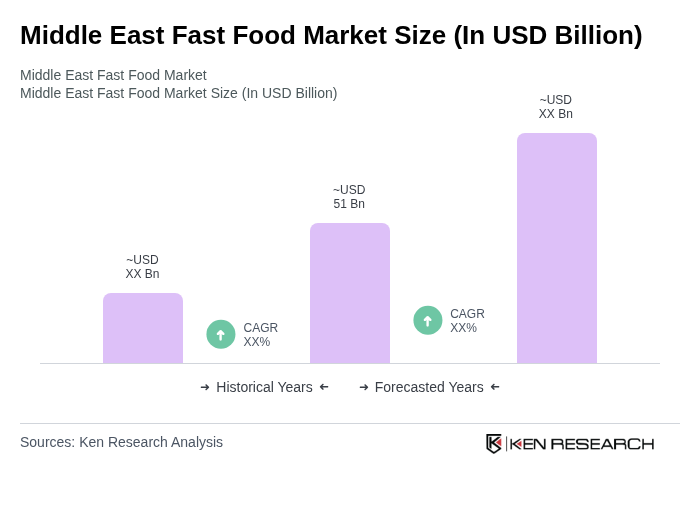
- The Middle East Fast Food Market is valued at approximately USD 51 billion, based on a five?year historical analysis. This growth is driven by rapid urbanization, a large and youthful population, rising disposable incomes, and continued lifestyle shifts toward convenient, on?the?go meals. The market has also benefited from strong tourism flows, a wider presence of international brands, and growing demand for diverse offerings that span both global and locally inspired menus.
- Key players in this market include Saudi Arabia, the United Arab Emirates, and Turkey, alongside other sizable markets such as Israel and Iran within broader Middle East coverage. These countries lead due to relatively high income levels, a significant expatriate and tourist base, dense urban centers, and well?developed modern retail and mall infrastructure that favors organized fast?food formats. Their major cities have become hubs for both international quick?service chains and strong regional brands, reinforcing fast food’s role in everyday and social dining occasions.
- In 2023, Saudi Arabia continued tightening regulations around food service hygiene and safety, including measures affecting fast food operators through the Saudi Food and Drug Authority and municipal health controls. These policies emphasize stricter compliance with food safety management systems, clearer nutritional information, and improved inspection regimes, with the aim of safeguarding public health and supporting more informed, health?conscious choices.
Middle East Fast Food Market Segmentation
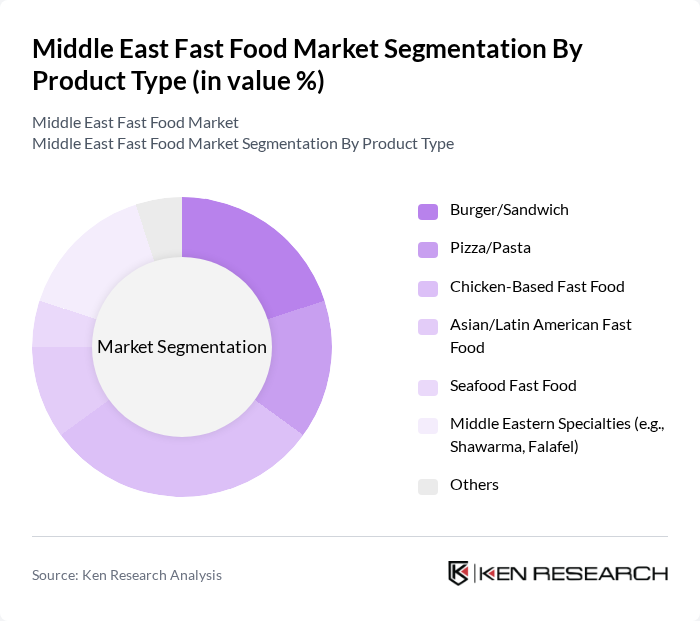
By Product Type:The product type segmentation includes various categories such as Burger/Sandwich, Pizza/Pasta, Chicken-Based Fast Food, Asian/Latin American Fast Food, Seafood Fast Food, Middle Eastern Specialties (e.g., Shawarma, Falafel), and Others. Industry sources commonly break the Middle East fast food market into similar categories, with chicken, burger/sandwich, pizza/pasta and regional specialties recognized as major product clusters. Chicken-based fast food holds a particularly strong position in the region, reflecting consumer preference for poultry over red meat on both price and perceived health grounds and the popularity of fried and grilled chicken concepts.
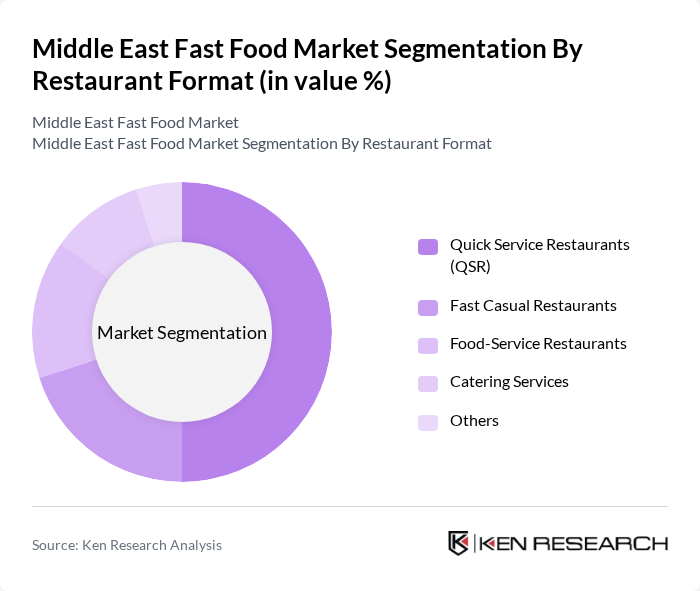
By Restaurant Format:This segmentation includes Quick Service Restaurants (QSR), Fast Casual Restaurants, Food-Service Restaurants, Catering Services, and Others. The Quick Service Restaurants (QSR) segment is leading the market, driven by the increasing demand for fast, affordable meals. The convenience of QSRs, coupled with their ability to cater to a busy lifestyle, has made them the preferred choice for consumers seeking quick dining options.
Middle East Fast Food Market Competitive Landscape
The Middle East Fast Food Market is characterized by a dynamic mix of regional and international players. Leading participants such as McDonald's, KFC, Burger King, Subway, Domino's Pizza, Hardee's (CKE Restaurants), Papa Johns, Pizza Hut, Tim Hortons, Shake Shack, Five Guys, Al Baik, Zaatar w Zeit, Herfy Food Services, Jollibee contribute to innovation, geographic expansion, and service delivery in this space.
Middle East Fast Food Market Industry Analysis
Growth Drivers
- Increasing Urbanization:The Middle East is experiencing rapid urbanization, with urban populations projected to reach 85% in the future, up from 80% in 2020. This shift is driving demand for fast food, as urban dwellers seek convenient dining options. Cities like Dubai and Riyadh are expanding, with over 1.8 million new residents expected in urban areas in the future. This demographic change is crucial for fast food chains aiming to capture a larger market share in densely populated regions.
- Rising Disposable Incomes:The average disposable income in the Middle East is projected to increase by 5% annually, reaching approximately $23,000 per capita in the future. This rise in income allows consumers to spend more on dining out, particularly in the fast food sector. Countries like the UAE and Saudi Arabia are leading this trend, with significant increases in consumer spending on food services, which is expected to exceed $35 billion collectively in the future.
- Expansion of Delivery Services:The fast food delivery market in the Middle East is anticipated to grow significantly, with an estimated value of $7 billion in the future. The proliferation of mobile apps and online ordering platforms has made fast food more accessible. Companies like Talabat and Zomato are expanding their services, with delivery orders expected to account for 35% of total fast food sales in urban areas, reflecting changing consumer habits towards convenience.
Market Challenges
- Intense Competition:The fast food market in the Middle East is characterized by fierce competition, with over 250 international and local brands vying for market share. Major players like McDonald's and KFC face challenges from emerging local chains that offer unique menu items. This competitive landscape is expected to intensify, with new entrants projected to increase by 20% in the future, making it crucial for established brands to innovate and differentiate their offerings.
- Health Concerns Related to Fast Food:Growing health awareness among consumers poses a significant challenge for the fast food industry. Reports indicate that 65% of the population in the Middle East is concerned about obesity and related health issues. As a result, fast food chains are pressured to reformulate their menus to include healthier options. Failure to adapt could lead to a decline in sales, as consumers increasingly prioritize health-conscious choices in their dining decisions.
Middle East Fast Food Market Future Outlook
The Middle East fast food market is poised for transformation, driven by evolving consumer preferences and technological advancements. As health-conscious dining becomes more prevalent, fast food chains will need to innovate their menus to include nutritious options. Additionally, the integration of technology in ordering and delivery processes will enhance customer experiences. With urbanization continuing to rise, the market will likely see increased demand for convenient dining solutions, positioning fast food as a staple in the region's culinary landscape.
Market Opportunities
- Growth of Health-Conscious Options:There is a significant opportunity for fast food chains to introduce health-focused menu items. With 45% of consumers actively seeking healthier alternatives, brands that adapt to this trend can capture a larger market share. This shift could lead to increased sales, as health-conscious consumers are willing to pay a premium for nutritious options.
- Expansion into Untapped Markets:Emerging markets within the Middle East, such as Iraq and Yemen, present substantial growth opportunities. With a combined population of over 35 million and increasing urbanization, fast food chains can establish a foothold in these regions. Targeting these markets could result in significant revenue growth, as consumer demand for fast food continues to rise in previously underserved areas.
Scope of the Report
| Segment | Sub-Segments |
|---|---|
| By Product Type | Burger/Sandwich Pizza/Pasta Chicken-Based Fast Food Asian/Latin American Fast Food Seafood Fast Food Middle Eastern Specialties (e.g., Shawarma, Falafel) Others |
| By Restaurant Format | Quick Service Restaurants (QSR) Fast Casual Restaurants Food-Service Restaurants Catering Services Others |
| By Country | Saudi Arabia United Arab Emirates Turkey Qatar Kuwait Others (Bahrain, Oman, Jordan, etc.) |
| By Service Type | Dine-In Takeaway Delivery (Aggregator and Direct) Drive-Thru Others |
| By Price Positioning | Premium Mid-Range Budget Value Meals/Combo Offers Others |
| By Consumer Demographics | By Age Group By Income Level By Lifestyle/Working Professionals Others |
| By Health Orientation | Health-Conscious/Better-for-You Options Indulgence-Oriented Consumers Others |
Key Target Audience
Investors and Venture Capitalist Firms
Government and Regulatory Bodies (e.g., Ministry of Health, Ministry of Commerce)
Manufacturers and Producers
Distributors and Retailers
Food Safety Authorities (e.g., Food and Drug Administration of
Industry Associations (e.g., Middle East Food and Beverage Association)
Franchise Operators and Developers
Logistics and Supply Chain Companies
Players Mentioned in the Report:
McDonald's
KFC
Burger King
Subway
Domino's Pizza
Hardee's (CKE Restaurants)
Papa Johns
Pizza Hut
Tim Hortons
Shake Shack
Five Guys
Al Baik
Zaatar w Zeit
Herfy Food Services
Jollibee
Table of Contents
Market Assessment Phase
1. Executive Summary and Approach
2. Middle East Fast Food Market Overview
2.1 Key Insights and Strategic Recommendations
2.2 Middle East Fast Food Market Overview
2.3 Definition and Scope
2.4 Evolution of Market Ecosystem
2.5 Timeline of Key Regulatory Milestones
2.6 Value Chain & Stakeholder Mapping
2.7 Business Cycle Analysis
2.8 Policy & Incentive Landscape
3. Middle East Fast Food Market Analysis
3.1 Growth Drivers
3.1.1 Increasing Urbanization
3.1.2 Rising Disposable Incomes
3.1.3 Changing Consumer Preferences
3.1.4 Expansion of Delivery Services
3.2 Market Challenges
3.2.1 Intense Competition
3.2.2 Regulatory Compliance Issues
3.2.3 Health Concerns Related to Fast Food
3.2.4 Supply Chain Disruptions
3.3 Market Opportunities
3.3.1 Growth of Health-Conscious Options
3.3.2 Expansion into Untapped Markets
3.3.3 Technological Innovations in Ordering
3.3.4 Partnerships with Local Brands
3.4 Market Trends
3.4.1 Rise of Plant-Based Menus
3.4.2 Increased Focus on Sustainability
3.4.3 Digital Transformation in Marketing
3.4.4 Customization of Menu Offerings
3.5 Government Regulation
3.5.1 Food Safety Standards
3.5.2 Labor Laws and Employment Regulations
3.5.3 Health and Nutrition Labeling
3.5.4 Environmental Regulations
4. SWOT Analysis
5. Stakeholder Analysis
6. Porter's Five Forces Analysis
7. Middle East Fast Food Market Market Size, 2019-2024
7.1 By Value
7.2 By Volume
7.3 By Average Selling Price
8. Middle East Fast Food Market Segmentation
8.1 By Product Type
8.1.1 Burger/Sandwich
8.1.2 Pizza/Pasta
8.1.3 Chicken-Based Fast Food
8.1.4 Asian/Latin American Fast Food
8.1.5 Seafood Fast Food
8.1.6 Middle Eastern Specialties (e.g., Shawarma, Falafel)
8.1.7 Others
8.2 By Restaurant Format
8.2.1 Quick Service Restaurants (QSR)
8.2.2 Fast Casual Restaurants
8.2.3 Food-Service Restaurants
8.2.4 Catering Services
8.2.5 Others
8.3 By Country
8.3.1 Saudi Arabia
8.3.2 United Arab Emirates
8.3.3 Turkey
8.3.4 Qatar
8.3.5 Kuwait
8.3.6 Others (Bahrain, Oman, Jordan, etc.)
8.4 By Service Type
8.4.1 Dine-In
8.4.2 Takeaway
8.4.3 Delivery (Aggregator and Direct)
8.4.4 Drive-Thru
8.4.5 Others
8.5 By Price Positioning
8.5.1 Premium
8.5.2 Mid-Range
8.5.3 Budget
8.5.4 Value Meals/Combo Offers
8.5.5 Others
8.6 By Consumer Demographics
8.6.1 By Age Group
8.6.2 By Income Level
8.6.3 By Lifestyle/Working Professionals
8.6.4 Others
8.7 By Health Orientation
8.7.1 Health-Conscious/Better-for-You Options
8.7.2 Indulgence-Oriented Consumers
8.7.3 Others
9. Middle East Fast Food Market Competitive Analysis
9.1 Market Share of Key Players
9.2 Cross Comparison of Key Players
9.2.1 Company Name
9.2.2 Scale of Operations in Middle East (Number of Outlets)
9.2.3 Middle East Revenue and Revenue Growth Rate
9.2.4 Same-Store Sales Growth (SSSG)
9.2.5 Average Order Value (AOV)
9.2.6 Market Share in Key Countries (e.g., Saudi Arabia, UAE)
9.2.7 Delivery and Digital Sales Mix (% of Total Sales)
9.2.8 Menu Localization and Halal Compliance Index
9.2.9 Operational Metrics (Average Service Time, Order Accuracy)
9.2.10 Brand Equity Indicators (Brand Awareness, NPS, Loyalty Enrollment)
9.3 SWOT Analysis of Top Players
9.4 Pricing Analysis
9.5 Detailed Profile of Major Companies
9.5.1 McDonald's
9.5.2 KFC
9.5.3 Burger King
9.5.4 Subway
9.5.5 Domino's Pizza
9.5.6 Hardee's (CKE Restaurants)
9.5.7 Papa Johns
9.5.8 Pizza Hut
9.5.9 Tim Hortons
9.5.10 Shake Shack
9.5.11 Five Guys
9.5.12 Al Baik
9.5.13 Zaatar w Zeit
9.5.14 Herfy Food Services
9.5.15 Jollibee
10. Middle East Fast Food Market End-User Analysis
10.1 Procurement Behavior of Key Ministries
10.1.1 Government Contracts
10.1.2 Bulk Purchasing Trends
10.1.3 Compliance with Local Sourcing
10.1.4 Others
10.2 Corporate Spend on Infrastructure & Energy
10.2.1 Investment in Fast Food Outlets
10.2.2 Spending on Marketing and Promotions
10.2.3 Budget Allocation for Sustainability Initiatives
10.2.4 Others
10.3 Pain Point Analysis by End-User Category
10.3.1 Quality of Food
10.3.2 Service Speed
10.3.3 Menu Variety
10.3.4 Pricing Concerns
10.3.5 Others
10.4 User Readiness for Adoption
10.4.1 Awareness of Fast Food Options
10.4.2 Acceptance of New Menu Items
10.4.3 Technology Adoption for Ordering
10.4.4 Others
10.5 Post-Deployment ROI and Use Case Expansion
10.5.1 Customer Feedback Mechanisms
10.5.2 Repeat Purchase Rates
10.5.3 Expansion into New Locations
10.5.4 Others
11. Middle East Fast Food Market Future Size, 2025-2030
11.1 By Value
11.2 By Volume
11.3 By Average Selling Price
Go-To-Market Strategy Phase
1. Whitespace Analysis + Business Model Canvas
1.1 Market Gaps Identification
1.2 Business Model Development
2. Marketing and Positioning Recommendations
2.1 Branding Strategies
2.2 Product USPs
3. Distribution Plan
3.1 Urban Retail Strategies
3.2 Rural NGO Tie-Ups
4. Channel & Pricing Gaps
4.1 Underserved Routes
4.2 Pricing Bands Analysis
5. Unmet Demand & Latent Needs
5.1 Category Gaps
5.2 Consumer Segments
6. Customer Relationship
6.1 Loyalty Programs
6.2 After-Sales Service
7. Value Proposition
7.1 Sustainability Initiatives
7.2 Integrated Supply Chains
8. Key Activities
8.1 Regulatory Compliance
8.2 Branding Efforts
8.3 Distribution Setup
9. Entry Strategy Evaluation
9.1 Domestic Market Entry Strategy
9.1.1 Product Mix Considerations
9.1.2 Pricing Band Strategy
9.1.3 Packaging Innovations
9.2 Export Entry Strategy
9.2.1 Target Countries Identification
9.2.2 Compliance Roadmap Development
10. Entry Mode Assessment
10.1 Joint Ventures
10.2 Greenfield Investments
10.3 Mergers & Acquisitions
10.4 Distributor Model Evaluation
11. Capital and Timeline Estimation
11.1 Capital Requirements Analysis
11.2 Timelines for Market Entry
12. Control vs Risk Trade-Off
12.1 Ownership vs Partnerships
13. Profitability Outlook
13.1 Breakeven Analysis
13.2 Long-Term Sustainability
14. Potential Partner List
14.1 Distributors
14.2 Joint Ventures
14.3 Acquisition Targets
15. Execution Roadmap
15.1 Phased Plan for Market Entry
15.1.1 Market Setup
15.1.2 Market Entry
15.1.3 Growth Acceleration
15.1.4 Scale & Stabilize
15.2 Key Activities and Milestones
15.2.1 Milestone Planning
15.2.2 Activity Tracking
Research Methodology
Phase 1: Approach1
Desk Research
- Analysis of market reports from industry associations and government publications
- Review of consumer behavior studies and demographic data from national statistics agencies
- Examination of online food delivery trends and fast food consumption patterns in the Middle East
Primary Research
- Interviews with executives from leading fast food chains operating in the region
- Surveys targeting consumers to understand preferences and spending habits
- Focus groups with food industry experts and nutritionists to gauge market trends
Validation & Triangulation
- Cross-validation of findings with multiple data sources, including sales data and consumer surveys
- Triangulation of insights from primary interviews with secondary research findings
- Sanity checks through expert panel discussions to ensure data reliability
Phase 2: Market Size Estimation1
Top-down Assessment
- Estimation of total market size based on GDP contribution from the food service sector
- Segmentation of the market by country, cuisine type, and service model (dine-in, takeout, delivery)
- Incorporation of growth rates from historical data and projected economic indicators
Bottom-up Modeling
- Collection of sales data from major fast food chains and local outlets
- Estimation of average transaction values and customer footfall across different regions
- Volume x price analysis to derive revenue estimates for various fast food segments
Forecasting & Scenario Analysis
- Utilization of time series analysis to project future market growth based on past trends
- Scenario modeling based on potential economic shifts, consumer preferences, and health trends
- Development of best-case, worst-case, and most-likely scenarios through 2030
Phase 3: CATI Sample Composition1
| Scope Item/Segment | Sample Size | Target Respondent Profiles |
|---|---|---|
| Consumer Fast Food Preferences | 120 | Regular Fast Food Consumers, Age 18-45 |
| Market Trends in Delivery Services | 90 | Delivery Service Managers, Restaurant Owners |
| Health Conscious Eating Habits | 70 | Nutritionists, Health Food Advocates |
| Impact of Social Media on Fast Food Choices | 100 | Social Media Influencers, Marketing Professionals |
| Regional Fast Food Market Dynamics | 80 | Local Franchise Owners, Market Analysts |
Frequently Asked Questions
What is the current value of the Middle East Fast Food Market?
The Middle East Fast Food Market is valued at approximately USD 51 billion, driven by factors such as urbanization, a youthful population, rising disposable incomes, and a shift towards convenient meal options.
Which countries are the key players in the Middle East Fast Food Market?
What are the main product types in the Middle East Fast Food Market?
How is the Middle East Fast Food Market segmented by restaurant format?
Other Regional/Country Reports
Indonesia Fast Food Market
Other Adjacent Reports
South Korea Food Delivery Services Market
Vietnam Quick Service Restaurant Technology Market
Singapore Beverage Dispensing Equipment Market
Indonesia Healthy Fast Food Alternatives Market
Singapore Food Packaging Solutions Market
Egypt Restaurant Franchise Market
KSA Online Food Ordering Platforms Market
Thailand Snack Food Production Market
Saudi Arabia Catering Services Market Size, Share & Forecast, By Service Type, End-Use Industry & Delivery Model, 2026–2032Belgium Cloud Kitchen Operations Market
Why Buy From Us?

What makes us stand out is that our consultants follow Robust, Refine and Result (RRR) methodology. Robust for clear definitions, approaches and sanity checking, Refine for differentiating respondents' facts and opinions, and Result for presenting data with story.

We have set a benchmark in the industry by offering our clients with syndicated and customized market research reports featuring coverage of entire market as well as meticulous research and analyst insights.

While we don't replace traditional research, we flip the method upside down. Our dual approach of Top Bottom & Bottom Top ensures quality deliverable by not just verifying company fundamentals but also looking at the sector and macroeconomic factors.

With one step in the future, our research team constantly tries to show you the bigger picture. We help with some of the tough questions you may encounter along the way: How is the industry positioned? Best marketing channel? KPI's of competitors? By aligning every element, we help maximize success.

Our report gives you instant access to the answers and sources that other companies might choose to hide. We elaborate each steps of research methodology we have used and showcase you the sample size to earn your trust.

If you need any support, we are here! We pride ourselves on universe strength, data quality, and quick, friendly, and professional service.