About the Report
Base Year 2024Middle East Home Improvement Market Overview
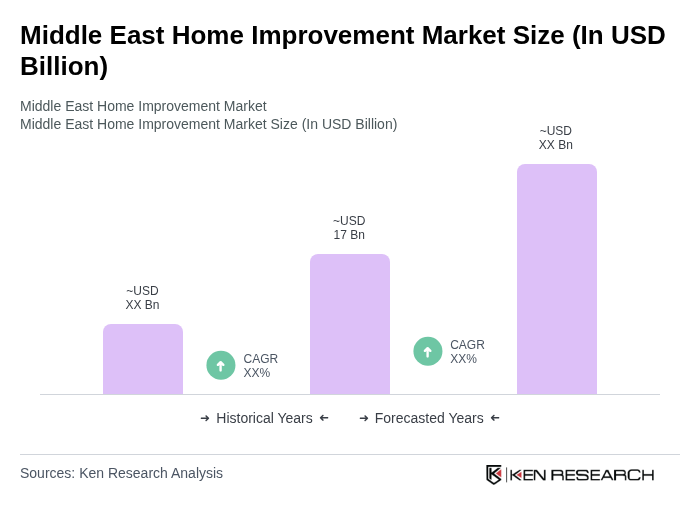
- The Middle East Home Improvement Market is valued at USD 17 billion, based on a five-year historical analysis and triangulation with related indicators such as residential construction, interior design services, and home furnishing demand in the region. This growth is primarily driven by increasing urbanization, rising disposable incomes, robust residential construction pipelines, and a growing trend towards home renovation and improvement projects among consumers in GCC markets and key economies such as Saudi Arabia, the United Arab Emirates, and Qatar. The market has seen a surge in demand for both DIY and professional services as homeowners seek to enhance their living spaces, improve energy performance, and modernize interiors, supported by strong demand for furnishings, fixtures, and finishing materials.
- Key players in this market include Saudi Arabia and the United Arab Emirates, which dominate due to their robust construction sectors, sustained government-backed housing and infrastructure programs, and high levels of expatriate populations driving demand for rental and owned residential units. These countries have seen significant investments in infrastructure and residential projects, including large-scale master-planned communities and urban development initiatives, leading to a heightened demand for home improvement products and services, particularly in interior fit-outs, finishes, and remodeling.
- In 2023, the UAE government implemented a new regulation aimed at promoting sustainable building practices in home renovations. This regulation mandates that all new home improvement projects must adhere to energy efficiency standards, encouraging the use of eco-friendly materials and technologies. The initiative is part of a broader strategy to reduce carbon emissions and promote sustainable living in urban areas, in line with instruments such as the UAE Energy Efficiency Standardization and Labelling Program issued by the Emirates Authority for Standardization and Metrology (ESMA) and the updated UAE Building Codes, which set minimum performance requirements for building envelopes, HVAC systems, and lighting in residential projects.
Middle East Home Improvement Market Segmentation
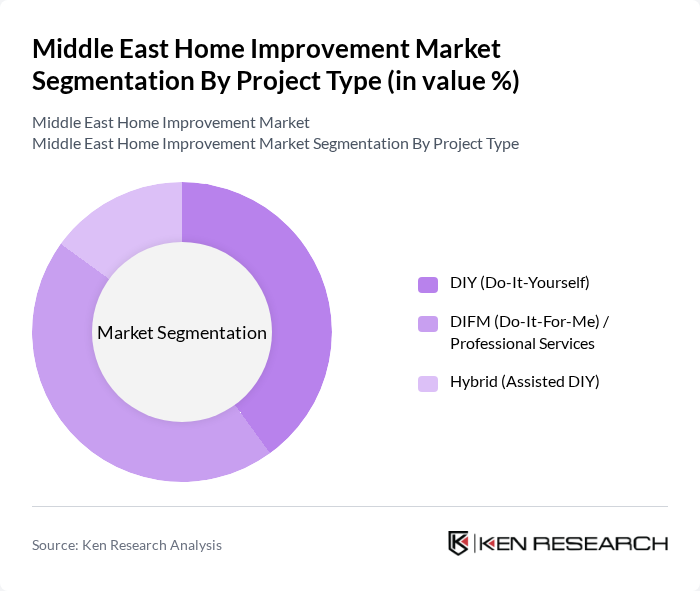
By Project Type:The project type segmentation includes DIY (Do-It-Yourself), DIFM (Do-It-For-Me) / Professional Services, and Hybrid (Assisted DIY). The DIY segment has gained popularity as consumers increasingly engage in home improvement projects themselves, driven by the availability of online resources, e-commerce platforms, and user-friendly tools and kits, particularly for décor, painting, and minor refurbishment tasks. The DIFM segment remains strong due to the demand for professional services, particularly in complex renovations, plumbing, electrical works, and structural modifications where specialist contractors and interior designers are preferred. The Hybrid segment caters to those who prefer a mix of both approaches, where homeowners purchase materials and design guidance but rely on professionals for installation or technical aspects, a pattern increasingly visible in larger GCC cities with rising awareness of design quality and time constraints among working professionals.
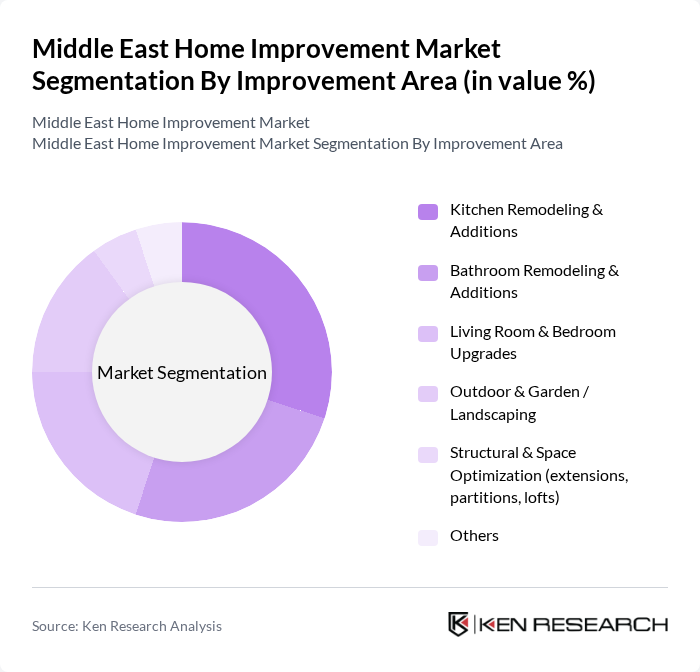
By Improvement Area:The improvement area segmentation includes Kitchen Remodeling & Additions, Bathroom Remodeling & Additions, Living Room & Bedroom Upgrades, Outdoor & Garden / Landscaping, Structural & Space Optimization (extensions, partitions, lofts), and Others. Kitchen and bathroom remodels are particularly popular due to their potential to increase property value and their alignment with regional preferences for high-spec finishes, premium fittings, and integrated storage, mirroring global trends where these areas command a significant share of home improvement spending. Outdoor improvements are also gaining traction as homeowners invest in landscaping, pergolas, terraces, and outdoor living spaces to adapt to mixed-use villa and townhouse communities and to enhance quality of life, especially in markets like the UAE and Saudi Arabia where larger plots and community amenities support such investments.
Middle East Home Improvement Market Competitive Landscape
The Middle East Home Improvement Market is characterized by a dynamic mix of regional and international players. Leading participants such as Al-Futtaim Group (IKEA, ACE, Homeworks), Landmark Group (Home Centre, Home Box), Lulu Group International (Home & Electricals Divisions), Danube Group (Danube Home), Alghanim Industries (Xcite by Alghanim, Home Retail), Saudi Automotive Services Co. (SASCO – Retail Formats with Home Products), SACO (Saudi Company for Hardware), Al-Jazeera Paints, National Paints Factories Co., Saudi Ceramics Company, Ras Al Khaimah Ceramics (RAK Ceramics), Jotun Middle East, Al-Muhaidib Group (Building Materials & Home Improvement Investments), Al-Hokair Group (Retail & Lifestyle Concepts), and other emerging regional e-commerce and omni-channel players contribute to innovation, geographic expansion, and service delivery in this space.
Middle East Home Improvement Market Industry Analysis
Growth Drivers
- Increasing Urbanization:The Middle East is experiencing rapid urbanization, with urban populations projected to reach 85% in future, up from 78% in the recent past. This shift drives demand for home improvement as urban dwellers seek to enhance living spaces. Cities like Dubai and Riyadh are expanding, leading to increased construction and renovation activities. The World Bank estimates that urbanization contributes approximately $1.8 trillion to the region's GDP, further fueling investments in home improvement projects.
- Rising Disposable Incomes:The average disposable income in the Middle East is expected to rise to $22,000 per capita in future, up from $17,500 in the recent past. This increase allows consumers to allocate more funds towards home improvement projects. As families invest in their homes, spending on renovations and upgrades is anticipated to grow significantly. The IMF reports that higher disposable incomes correlate with a 35% increase in home improvement expenditures, indicating a robust market potential.
- Expansion of E-commerce Platforms:E-commerce in the Middle East is projected to reach $30 billion in future, growing from $20 billion in the recent past. This expansion facilitates easier access to home improvement products and services. Consumers increasingly prefer online shopping for convenience and variety, leading to a surge in DIY projects. According to industry reports, online sales of home improvement goods are expected to account for 30% of total sales, significantly impacting market dynamics and consumer behavior.
Market Challenges
- Economic Fluctuations:The Middle East faces economic volatility, with GDP growth projected at 3% in future, down from 3.5% in the recent past. Fluctuating oil prices and geopolitical tensions contribute to this instability, affecting consumer confidence and spending on home improvement. As disposable incomes fluctuate, consumers may prioritize essential expenditures over renovations, leading to a potential slowdown in market growth. The World Bank highlights that economic uncertainty can reduce home improvement investments by up to 15%.
- Supply Chain Disruptions:The home improvement sector is grappling with supply chain challenges, exacerbated by global disruptions. In future, delays in material shipments are expected to increase by 25%, impacting project timelines and costs. The ongoing effects of the COVID-19 pandemic and geopolitical tensions have strained logistics, leading to shortages of essential materials. Industry reports indicate that these disruptions can increase project costs by 12-18%, hindering market growth and consumer satisfaction.
Middle East Home Improvement Market Future Outlook
The Middle East home improvement market is poised for significant transformation, driven by technological advancements and evolving consumer preferences. As sustainability becomes a priority, companies are expected to innovate with eco-friendly products and solutions. Additionally, the integration of smart home technologies will enhance consumer engagement and drive demand. With government initiatives supporting renovation projects, the market is likely to witness increased investments, fostering a dynamic environment for growth and innovation in the coming years.
Market Opportunities
- Sustainable Home Improvement Solutions:The demand for sustainable products is rising, with a projected market value of $6 billion in future. Consumers are increasingly seeking eco-friendly materials and energy-efficient solutions, presenting a lucrative opportunity for businesses to innovate and capture this growing segment. Companies that prioritize sustainability can enhance brand loyalty and attract environmentally conscious consumers.
- Smart Home Technologies:The smart home market in the Middle East is expected to reach $12 billion in future, driven by consumer interest in automation and energy efficiency. This trend presents opportunities for home improvement companies to integrate smart technologies into their offerings, enhancing convenience and security for homeowners. As technology adoption increases, businesses can leverage this trend to differentiate themselves in a competitive market.
Scope of the Report
| Segment | Sub-Segments |
|---|---|
| By Project Type | DIY (Do-It-Yourself) DIFM (Do-It-For-Me) / Professional Services Hybrid (Assisted DIY) |
| By Improvement Area | Kitchen Remodeling & Additions Bathroom Remodeling & Additions Living Room & Bedroom Upgrades Outdoor & Garden / Landscaping Structural & Space Optimization (extensions, partitions, lofts) Others |
| By Product Category | Building & Remodeling Materials (flooring, tiles, fixtures) Home Décor & Furnishings Tools, Hardware & DIY Supplies Outdoor Living Products Smart Home & Energy-Efficient Solutions Others |
| By Application | Interior Improvement Exterior & Facade Improvement Maintenance, Repair & Replacement (MRR) New Installation Others |
| By End-User | Residential (Villas, Apartments, Compounds) Commercial (Retail, Hospitality, Offices) Institutional (Education, Healthcare, Government) Others |
| By Distribution Channel | Home Improvement & DIY Stores Specialty Stores (tiles, paint, sanitary ware, lighting) Hypermarkets & General Merchandise Retailers Online / E-commerce Platforms Direct Sales & Contractors Others |
| By Country | Saudi Arabia United Arab Emirates Qatar Kuwait Oman Bahrain Rest of Middle East |
Key Target Audience
Investors and Venture Capitalist Firms
Government and Regulatory Bodies (e.g., Ministry of Housing, Urban Planning Authorities)
Manufacturers and Producers
Distributors and Retailers
Construction and Contracting Companies
Real Estate Developers
Home Improvement Service Providers
Financial Institutions
Players Mentioned in the Report:
Al-Futtaim Group (IKEA, ACE, Homeworks)
Landmark Group (Home Centre, Home Box)
Lulu Group International (Home & Electricals Divisions)
Danube Group (Danube Home)
Alghanim Industries (XIKEA Kuwait, Home Retail)
Saudi Automotive Services Co. (SASCO Retail Formats with Home Products)
SACO (Saudi Company for Hardware)
Al-Jazeera Paints
National Paints Factories Co.
Saudi Ceramics Company
Ras Al Khaimah Ceramics (RAK Ceramics)
Jotun Middle East
Al-Muhaidib Group (Building Materials & Home Improvement Investments)
Al-Hokair Group (Retail & Lifestyle Concepts)
Other Emerging Regional E-commerce & Omni-channel Players
Table of Contents
Market Assessment Phase
1. Executive Summary and Approach
2. Middle East Home Improvement Market Overview
2.1 Key Insights and Strategic Recommendations
2.2 Middle East Home Improvement Market Overview
2.3 Definition and Scope
2.4 Evolution of Market Ecosystem
2.5 Timeline of Key Regulatory Milestones
2.6 Value Chain & Stakeholder Mapping
2.7 Business Cycle Analysis
2.8 Policy & Incentive Landscape
3. Middle East Home Improvement Market Analysis
3.1 Growth Drivers
3.1.1 Increasing Urbanization
3.1.2 Rising Disposable Incomes
3.1.3 Growing Interest in DIY Projects
3.1.4 Expansion of E-commerce Platforms
3.2 Market Challenges
3.2.1 Economic Fluctuations
3.2.2 Supply Chain Disruptions
3.2.3 Regulatory Compliance Issues
3.2.4 Competition from Low-Cost Alternatives
3.3 Market Opportunities
3.3.1 Sustainable Home Improvement Solutions
3.3.2 Smart Home Technologies
3.3.3 Government Incentives for Renovation
3.3.4 Expansion into Emerging Markets
3.4 Market Trends
3.4.1 Increased Focus on Sustainability
3.4.2 Integration of Technology in Home Improvement
3.4.3 Customization and Personalization of Products
3.4.4 Growth of Online Retail Channels
3.5 Government Regulation
3.5.1 Building Codes and Standards
3.5.2 Environmental Regulations
3.5.3 Import Tariffs on Home Improvement Goods
3.5.4 Safety Regulations for Construction Materials
4. SWOT Analysis
5. Stakeholder Analysis
6. Porter's Five Forces Analysis
7. Middle East Home Improvement Market Market Size, 2019-2024
7.1 By Value
7.2 By Volume
7.3 By Average Selling Price
8. Middle East Home Improvement Market Segmentation
8.1 By Project Type
8.1.1 DIY (Do-It-Yourself)
8.1.2 DIFM (Do-It-For-Me) / Professional Services
8.1.3 Hybrid (Assisted DIY)
8.2 By Improvement Area
8.2.1 Kitchen Remodeling & Additions
8.2.2 Bathroom Remodeling & Additions
8.2.3 Living Room & Bedroom Upgrades
8.2.4 Outdoor & Garden / Landscaping
8.2.5 Structural & Space Optimization (extensions, partitions, lofts)
8.2.6 Others
8.3 By Product Category
8.3.1 Building & Remodeling Materials (flooring, tiles, fixtures)
8.3.2 Home Décor & Furnishings
8.3.3 Tools, Hardware & DIY Supplies
8.3.4 Outdoor Living Products
8.3.5 Smart Home & Energy-Efficient Solutions
8.3.6 Others
8.4 By Application
8.4.1 Interior Improvement
8.4.2 Exterior & Facade Improvement
8.4.3 Maintenance, Repair & Replacement (MRR)
8.4.4 New Installation
8.4.5 Others
8.5 By End-User
8.5.1 Residential (Villas, Apartments, Compounds)
8.5.2 Commercial (Retail, Hospitality, Offices)
8.5.3 Institutional (Education, Healthcare, Government)
8.5.4 Others
8.6 By Distribution Channel
8.6.1 Home Improvement & DIY Stores
8.6.2 Specialty Stores (tiles, paint, sanitary ware, lighting)
8.6.3 Hypermarkets & General Merchandise Retailers
8.6.4 Online / E-commerce Platforms
8.6.5 Direct Sales & Contractors
8.6.6 Others
8.7 By Country
8.7.1 Saudi Arabia
8.7.2 United Arab Emirates
8.7.3 Qatar
8.7.4 Kuwait
8.7.5 Oman
8.7.6 Bahrain
8.7.7 Rest of Middle East
9. Middle East Home Improvement Market Competitive Analysis
9.1 Market Share of Key Players
9.2 Cross Comparison of Key Players
9.2.1 Company Name
9.2.2 Group Size (Large, Medium, or Small as per industry convention)
9.2.3 Regional Revenue (USD, Latest FY)
9.2.4 3-Year Revenue CAGR in Middle East (%)
9.2.5 EBITDA Margin (%)
9.2.6 Capex Intensity (% of Revenue)
9.2.7 Middle East Market Share (%)
9.2.8 Store / Outlet Count in Middle East
9.2.9 Online Sales Share (% of Revenue)
9.2.10 Average Ticket Size (USD per Transaction)
9.2.11 Same-Store Sales Growth (Like-for-like, %)
9.2.12 Customer Retention / Repeat Purchase Rate (%)
9.3 SWOT Analysis of Top Players
9.4 Pricing Analysis
9.5 Detailed Profile of Major Companies
9.5.1 Al-Futtaim Group (IKEA, ACE, Homeworks)
9.5.2 Landmark Group (Home Centre, Home Box)
9.5.3 Lulu Group International (Home & Electricals Divisions)
9.5.4 Danube Group (Danube Home)
9.5.5 Alghanim Industries (XIKEA Kuwait, Home Retail)
9.5.6 Saudi Automotive Services Co. (SASCO – Retail Formats with Home Products)
9.5.7 SACO (Saudi Company for Hardware)
9.5.8 Al-Jazeera Paints
9.5.9 National Paints Factories Co.
9.5.10 Saudi Ceramics Company
9.5.11 Ras Al Khaimah Ceramics (RAK Ceramics)
9.5.12 Jotun Middle East
9.5.13 Al-Muhaidib Group (Building Materials & Home Improvement Investments)
9.5.14 Al-Hokair Group (Retail & Lifestyle Concepts)
9.5.15 Other Emerging Regional E-commerce & Omni-channel Players
10. Middle East Home Improvement Market End-User Analysis
10.1 Procurement Behavior of Key Ministries
10.1.1 Ministry of Housing
10.1.2 Ministry of Municipal and Rural Affairs
10.1.3 Ministry of Commerce
10.1.4 Others
10.2 Corporate Spend on Infrastructure & Energy
10.2.1 Corporate Investment Trends
10.2.2 Budget Allocation for Renovation
10.2.3 Spending on Sustainable Solutions
10.2.4 Others
10.3 Pain Point Analysis by End-User Category
10.3.1 Homeowners
10.3.2 Contractors
10.3.3 Retailers
10.3.4 Others
10.4 User Readiness for Adoption
10.4.1 Awareness of New Products
10.4.2 Willingness to Invest
10.4.3 Adoption of Technology
10.4.4 Others
10.5 Post-Deployment ROI and Use Case Expansion
10.5.1 Measurement of ROI
10.5.2 Case Studies of Successful Implementations
10.5.3 Future Expansion Plans
10.5.4 Others
11. Middle East Home Improvement Market Future Size, 2025-2030
11.1 By Value
11.2 By Volume
11.3 By Average Selling Price
Go-To-Market Strategy Phase
1. Whitespace Analysis + Business Model Canvas
1.1 Market Gaps Identification
1.2 Business Model Development
2. Marketing and Positioning Recommendations
2.1 Branding Strategies
2.2 Product USPs
3. Distribution Plan
3.1 Urban Retail Strategies
3.2 Rural NGO Tie-ups
4. Channel & Pricing Gaps
4.1 Underserved Routes
4.2 Pricing Bands
5. Unmet Demand & Latent Needs
5.1 Category Gaps
5.2 Consumer Segments
6. Customer Relationship
6.1 Loyalty Programs
6.2 After-sales Service
7. Value Proposition
7.1 Sustainability Initiatives
7.2 Integrated Supply Chains
8. Key Activities
8.1 Regulatory Compliance
8.2 Branding Efforts
8.3 Distribution Setup
9. Entry Strategy Evaluation
9.1 Domestic Market Entry Strategy
9.1.1 Product Mix
9.1.2 Pricing Band
9.1.3 Packaging
9.2 Export Entry Strategy
9.2.1 Target Countries
9.2.2 Compliance Roadmap
10. Entry Mode Assessment
10.1 JV
10.2 Greenfield
10.3 M&A
10.4 Distributor Model
11. Capital and Timeline Estimation
11.1 Capital Requirements
11.2 Timelines
12. Control vs Risk Trade-Off
12.1 Ownership vs Partnerships
13. Profitability Outlook
13.1 Breakeven Analysis
13.2 Long-term Sustainability
14. Potential Partner List
14.1 Distributors
14.2 JVs
14.3 Acquisition Targets
15. Execution Roadmap
15.1 Phased Plan for Market Entry
15.1.1 Market Setup
15.1.2 Market Entry
15.1.3 Growth Acceleration
15.1.4 Scale & Stabilize
15.2 Key Activities and Milestones
15.2.1 Milestone Planning
15.2.2 Activity Tracking
Research Methodology
Phase 1: Approach1
Desk Research
- Analysis of market reports from industry associations and government publications
- Review of demographic and economic data from national statistics agencies
- Examination of online consumer behavior studies and home improvement trends
Primary Research
- Interviews with home improvement retailers and distributors across the Middle East
- Surveys targeting homeowners and DIY enthusiasts to gauge spending habits
- Focus groups with contractors and builders to understand market needs
Validation & Triangulation
- Cross-validation of findings with multiple data sources, including trade publications
- Triangulation of consumer insights with sales data from major retailers
- Sanity checks through expert panels comprising industry veterans and analysts
Phase 2: Market Size Estimation1
Top-down Assessment
- Estimation of total market size based on national home improvement expenditure data
- Segmentation by product categories such as tools, materials, and furnishings
- Incorporation of growth rates from regional economic forecasts
Bottom-up Modeling
- Collection of sales data from leading home improvement retailers in the region
- Estimation of average transaction values and purchase frequencies
- Volume x price analysis for key product segments to derive market size
Forecasting & Scenario Analysis
- Multi-variable forecasting using economic indicators and consumer confidence metrics
- Scenario modeling based on potential regulatory changes and market disruptions
- Development of baseline, optimistic, and pessimistic growth scenarios through 2030
Phase 3: CATI Sample Composition1
| Scope Item/Segment | Sample Size | Target Respondent Profiles |
|---|---|---|
| Retail Home Improvement Sales | 150 | Store Managers, Sales Executives |
| DIY Consumer Insights | 140 | Homeowners, DIY Enthusiasts |
| Contractor and Builder Feedback | 100 | General Contractors, Subcontractors |
| Market Trends in Home Renovation | 80 | Interior Designers, Architects |
| Online Home Improvement Purchases | 120 | E-commerce Managers, Digital Marketing Specialists |
Frequently Asked Questions
What is the current value of the Middle East Home Improvement Market?
The Middle East Home Improvement Market is valued at approximately USD 17 billion, driven by factors such as urbanization, rising disposable incomes, and a robust residential construction pipeline across key economies like Saudi Arabia and the UAE.
What are the main drivers of growth in the Middle East Home Improvement Market?
Which countries dominate the Middle East Home Improvement Market?
What types of home improvement projects are popular in the Middle East?
Other Regional/Country Reports
Other Adjacent Reports
Philippines Home Furnishings Market
Middle East Building Materials Market Report Size Share Growth Drivers Trends Opportunities & Forecast 2025–2030United States Paints and Coatings Market Outlook to 2030: Size, Share, Growth and TrendsVietnam Ceramics and Tiles Market
Qatar Smart Home Technology MarketGermany Sustainable Building Materials Market
Thailand Landscaping and Outdoor Design Market
Mexico Kitchen and Bathroom Fixtures MarketWhy Buy From Us?

What makes us stand out is that our consultants follow Robust, Refine and Result (RRR) methodology. Robust for clear definitions, approaches and sanity checking, Refine for differentiating respondents' facts and opinions, and Result for presenting data with story.

We have set a benchmark in the industry by offering our clients with syndicated and customized market research reports featuring coverage of entire market as well as meticulous research and analyst insights.

While we don't replace traditional research, we flip the method upside down. Our dual approach of Top Bottom & Bottom Top ensures quality deliverable by not just verifying company fundamentals but also looking at the sector and macroeconomic factors.

With one step in the future, our research team constantly tries to show you the bigger picture. We help with some of the tough questions you may encounter along the way: How is the industry positioned? Best marketing channel? KPI's of competitors? By aligning every element, we help maximize success.

Our report gives you instant access to the answers and sources that other companies might choose to hide. We elaborate each steps of research methodology we have used and showcase you the sample size to earn your trust.

If you need any support, we are here! We pride ourselves on universe strength, data quality, and quick, friendly, and professional service.