Region:Middle East
Author(s):Dev
Product Code:KRAC5040
Pages:94
Published On:January 2026
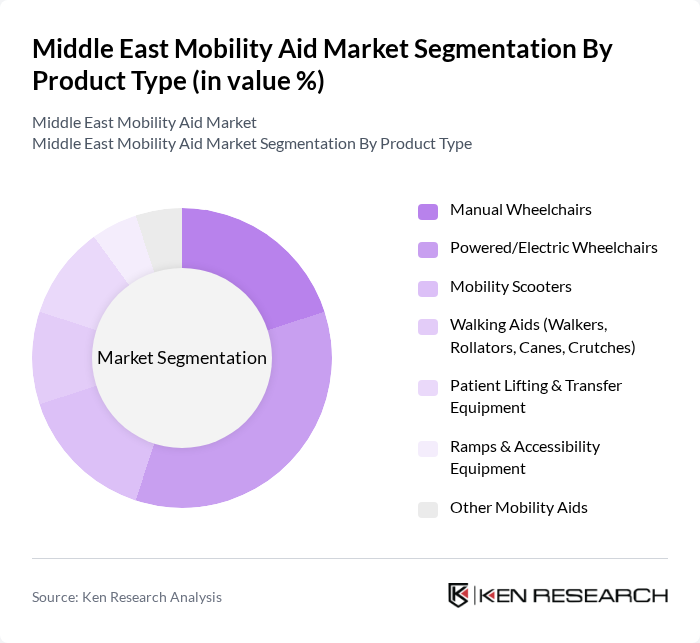
By Product Type:The product type segmentation includes various mobility aids that cater to different user needs. The subsegments are Manual Wheelchairs, Powered/Electric Wheelchairs, Mobility Scooters, Walking Aids (Walkers, Rollators, Canes, Crutches), Patient Lifting & Transfer Equipment, Ramps & Accessibility Equipment, and Other Mobility Aids. Among these, powered/electric wheelchairs are gaining traction due to their advanced features and ease of use, particularly among the elderly and individuals with severe mobility impairments.
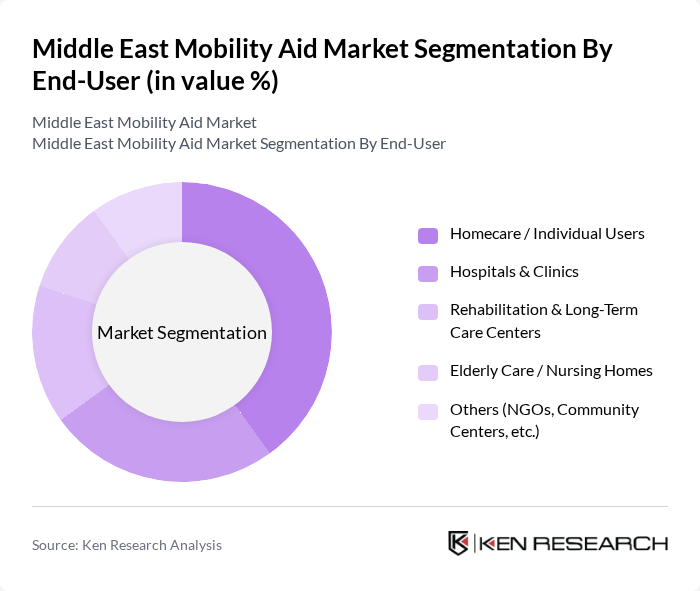
By End-User:The end-user segmentation encompasses various sectors utilizing mobility aids, including Homecare / Individual Users, Hospitals & Clinics, Rehabilitation & Long-Term Care Centers, Elderly Care / Nursing Homes, and Others (NGOs, Community Centers, etc.). The homecare segment is particularly prominent, driven by the increasing preference for at-home care solutions among the elderly population, which is leading to a higher demand for mobility aids tailored for individual use.
The Middle East Mobility Aid Market is characterized by a dynamic mix of regional and international players. Leading participants such as Sunrise Medical, Invacare Corporation, Ottobock, Pride Mobility Products Corp., Permobil AB, Drive Medical Design & Manufacturing, Medline Industries LP, Karman Healthcare, Meyra Group, Handicare Group, GF Health Products, Inc., Carex Health Brands, Local & Regional Players (e.g., Shonaquip, regional Ta??mac?l?k & medical distributors) contribute to innovation, geographic expansion, and service delivery in this space.
The Middle East mobility aid market is poised for transformative growth, driven by technological advancements and increasing consumer awareness. The integration of smart technologies, such as IoT and AI, is expected to enhance the functionality of mobility aids, making them more appealing to users. Additionally, as governments continue to invest in healthcare infrastructure, accessibility initiatives will likely expand, fostering a more inclusive environment. This combination of innovation and supportive policies will create a robust market landscape, encouraging further investment and development in mobility solutions.
| Segment | Sub-Segments |
|---|---|
| By Product Type | Manual Wheelchairs Powered/Electric Wheelchairs Mobility Scooters Walking Aids (Walkers, Rollators, Canes, Crutches) Patient Lifting & Transfer Equipment Ramps & Accessibility Equipment Other Mobility Aids |
| By End-User | Homecare / Individual Users Hospitals & Clinics Rehabilitation & Long-Term Care Centers Elderly Care / Nursing Homes Others (NGOs, Community Centers, etc.) |
| By User Profile | Pediatric Adult Geriatric Others |
| By Distribution Channel | Hospital & Clinic Pharmacies Specialized Medical Equipment Retailers Online Channels (E-commerce & Manufacturer Portals) Government & Institutional Procurement Others |
| By Country/Region | GCC Countries (Saudi Arabia, UAE, Qatar, Kuwait, Oman, Bahrain) Levant (Jordan, Lebanon, Iraq, Others) North Africa (Egypt, Morocco, Algeria, Others) Rest of Middle East |
| By Technology | Non-Smart / Conventional Devices Smart / Connected Mobility Aids Assistive Robotics & Advanced Solutions Others |
| By Price Band | Economy Mid-Range Premium Ultra-Premium / Customized |
| Scope Item/Segment | Sample Size | Target Respondent Profiles |
|---|---|---|
| Healthcare Providers | 120 | Physiotherapists, Occupational Therapists |
| Mobility Aid Retailers | 90 | Store Managers, Sales Representatives |
| End-Users of Mobility Aids | 130 | Individuals with Disabilities, Caregivers |
| Government Health Officials | 60 | Policy Makers, Program Coordinators |
| Non-Profit Organizations | 50 | Advocacy Leaders, Program Managers |
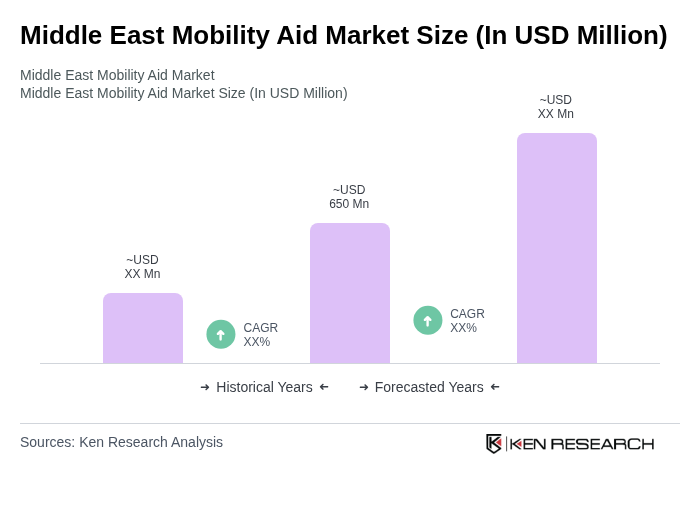
The Middle East Mobility Aid Market is valued at approximately USD 650 million, driven by factors such as an increasing aging population, rising prevalence of disabilities, and improved healthcare infrastructure across the region.

What makes us stand out is that our consultants follow Robust, Refine and Result (RRR) methodology. Robust for clear definitions, approaches and sanity checking, Refine for differentiating respondents' facts and opinions, and Result for presenting data with story.

We have set a benchmark in the industry by offering our clients with syndicated and customized market research reports featuring coverage of entire market as well as meticulous research and analyst insights.

While we don't replace traditional research, we flip the method upside down. Our dual approach of Top Bottom & Bottom Top ensures quality deliverable by not just verifying company fundamentals but also looking at the sector and macroeconomic factors.

With one step in the future, our research team constantly tries to show you the bigger picture. We help with some of the tough questions you may encounter along the way: How is the industry positioned? Best marketing channel? KPI's of competitors? By aligning every element, we help maximize success.

Our report gives you instant access to the answers and sources that other companies might choose to hide. We elaborate each steps of research methodology we have used and showcase you the sample size to earn your trust.

If you need any support, we are here! We pride ourselves on universe strength, data quality, and quick, friendly, and professional service.













