Region:Middle East
Author(s):Dev
Product Code:KRAD1652
Pages:92
Published On:November 2025
By Type:The market is segmented into hardware firewalls, software firewalls, cloud-based firewalls, virtual firewalls, hybrid firewalls, and others. Hardware firewalls currently lead the market, favored for their robust security features and reliability in protecting enterprise network perimeters .
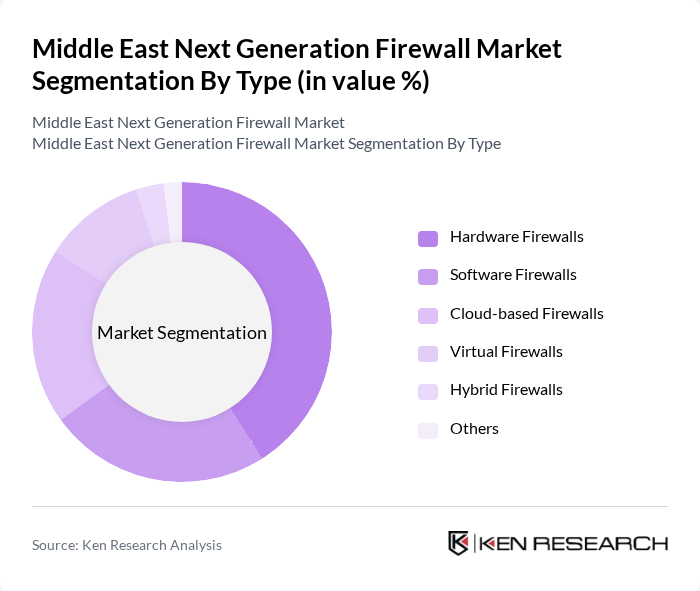
Hardware firewalls dominate the market due to their high-performance security capabilities and physical deployment in enterprise networks, offering enhanced protection against external threats. The increasing complexity of cyberattacks and the need for reliable, scalable security solutions have led organizations to prioritize investments in hardware firewalls .
By End-User:The market is segmented by end-users, including BFSI (Banking, Financial Services, and Insurance), healthcare, retail, IT & telecommunications, government, energy & utilities, manufacturing, education, and others. The BFSI sector is the largest end-user, driven by stringent regulatory requirements and the need for robust security measures to protect sensitive financial data .
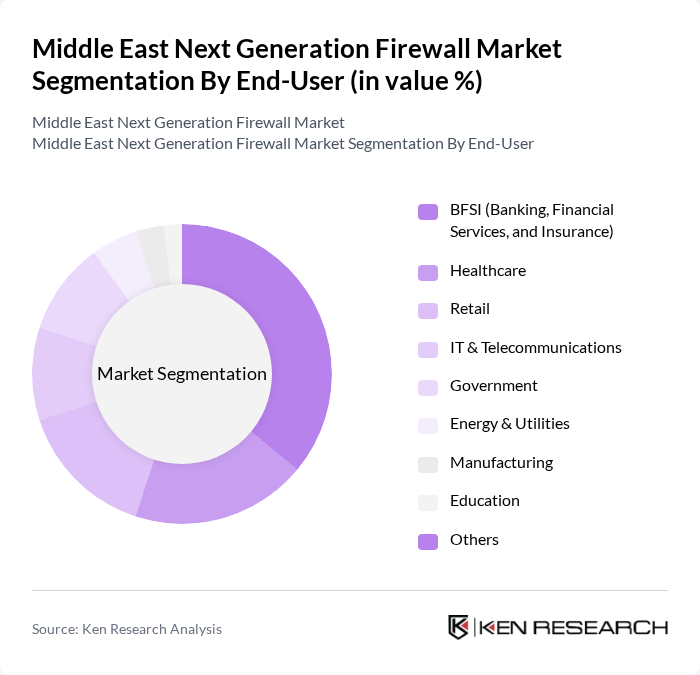
The BFSI sector leads due to the critical need for data protection and compliance with financial regulations. The rising number of cyberattacks targeting financial institutions has prompted significant investment in next-generation firewalls. The healthcare sector is also experiencing rapid growth as organizations seek to protect sensitive patient data and comply with evolving data protection standards .
The Middle East Next Generation Firewall Market is characterized by a dynamic mix of regional and international players. Leading participants such as Palo Alto Networks, Fortinet, Check Point Software Technologies, Cisco Systems, Juniper Networks, Barracuda Networks, SonicWall, Huawei Technologies, Trend Micro, Forcepoint, WatchGuard Technologies, Zscaler, Sophos, Hillstone Networks, and GajShield Infotech contribute to innovation, geographic expansion, and service delivery in this space .
The future of the Middle East next-generation firewall market appears promising, driven by the increasing sophistication of cyber threats and the growing emphasis on digital transformation. Organizations are expected to prioritize investments in advanced security solutions, particularly those that incorporate artificial intelligence and machine learning. Additionally, the shift towards remote work and cloud-based services will further accelerate the demand for robust cybersecurity measures, ensuring that next-generation firewalls remain a critical component of organizational security strategies.
| Segment | Sub-Segments |
|---|---|
| By Type | Hardware Firewalls Software Firewalls Cloud-based Firewalls Virtual Firewalls Hybrid Firewalls Others |
| By End-User | BFSI (Banking, Financial Services, and Insurance) Healthcare Retail IT & Telecommunications Government Energy & Utilities Manufacturing Education Others |
| By Deployment Mode | On-Premises Cloud Hybrid Others |
| By Region | GCC Countries (Saudi Arabia, UAE, Qatar, Kuwait, Oman, Bahrain) Levant Region (Jordan, Lebanon, Iraq, Syria, Palestine) North Africa (Egypt, Morocco, Algeria, Tunisia, Libya) Rest of Middle East |
| By Industry Vertical | Government Education Energy and Utilities Manufacturing Healthcare Retail IT & Telecommunications BFSI Others |
| By Security Features | Intrusion Prevention System (IPS) Application Control VPN Support Anti-Malware Protection Sandboxing URL Filtering Others |
| By Pricing Model | Subscription-based One-time License Fee Pay-as-you-go Others |
| Scope Item/Segment | Sample Size | Target Respondent Profiles |
|---|---|---|
| Enterprise Cybersecurity Strategies | 60 | IT Security Managers, Chief Information Officers |
| Government Cybersecurity Initiatives | 50 | Policy Makers, Cybersecurity Advisors |
| SME Adoption of NGFW Solutions | 40 | IT Managers, Business Owners |
| Telecommunications Sector Security Measures | 45 | Network Security Engineers, Operations Managers |
| Healthcare Cybersecurity Compliance | 40 | Compliance Officers, IT Directors |
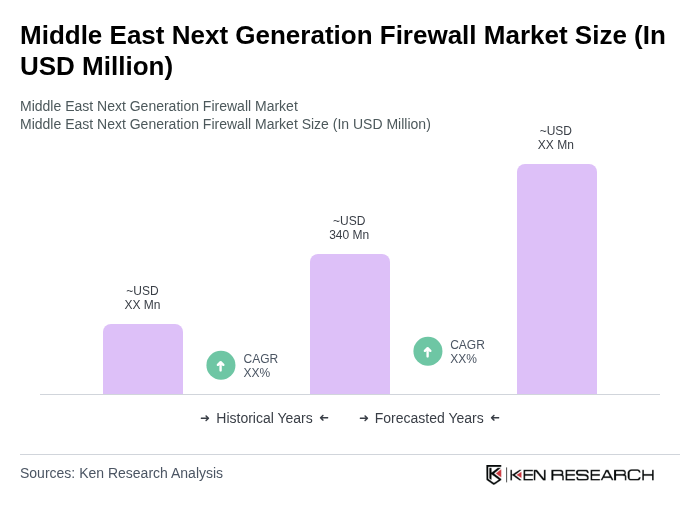
The Middle East Next Generation Firewall Market is valued at approximately USD 340 million, driven by increasing cyber threats, digital transformation initiatives, and the adoption of cloud services across various sectors.

What makes us stand out is that our consultants follow Robust, Refine and Result (RRR) methodology. Robust for clear definitions, approaches and sanity checking, Refine for differentiating respondents' facts and opinions, and Result for presenting data with story.

We have set a benchmark in the industry by offering our clients with syndicated and customized market research reports featuring coverage of entire market as well as meticulous research and analyst insights.

While we don't replace traditional research, we flip the method upside down. Our dual approach of Top Bottom & Bottom Top ensures quality deliverable by not just verifying company fundamentals but also looking at the sector and macroeconomic factors.

With one step in the future, our research team constantly tries to show you the bigger picture. We help with some of the tough questions you may encounter along the way: How is the industry positioned? Best marketing channel? KPI's of competitors? By aligning every element, we help maximize success.

Our report gives you instant access to the answers and sources that other companies might choose to hide. We elaborate each steps of research methodology we have used and showcase you the sample size to earn your trust.

If you need any support, we are here! We pride ourselves on universe strength, data quality, and quick, friendly, and professional service.













