Middle East Noninvasive Prenatal Testing Market Report Size Share Growth Drivers Trends Opportunities & Forecast 2025–2030

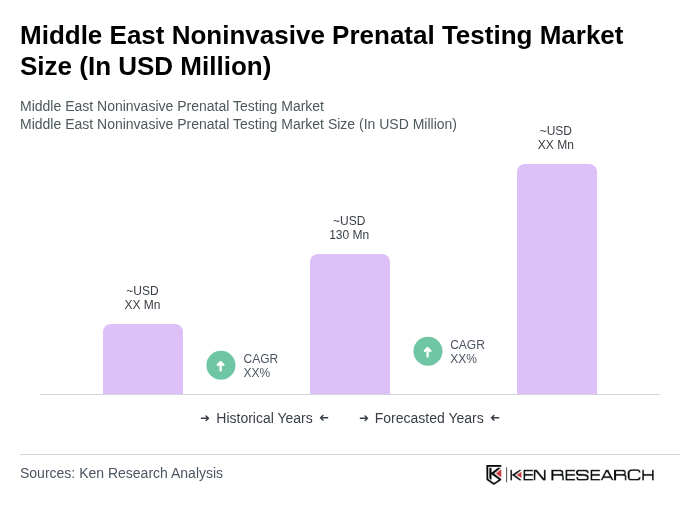
Middle East Noninvasive Prenatal Testing Market, worth USD 130 million, grows with rising prenatal health awareness and innovations in cell-free DNA testing.

Region:Middle East

Author(s):Dev

Product Code:KRAB2348

Pages:87

Published On:January 2026
About the Report

Base Year 2024

Middle East Noninvasive Prenatal Testing Market Overview

  • The Middle East Noninvasive Prenatal Testing Market is valued at USD 130 million, based on a five-year historical analysis. This growth is primarily driven by increasing awareness of prenatal health, advancements in next-generation sequencing and cell-free DNA analysis technologies, and rising disposable incomes among expectant parents in key Gulf Cooperation Council (GCC) countries. The demand for noninvasive prenatal testing (NIPT) has surged as it offers a safer alternative to invasive procedures such as amniocentesis and chorionic villus sampling, while enabling early detection of common chromosomal aneuploidies and selected microdeletions.
  • Key country-level growth drivers in this market include Saudi Arabia, the United Arab Emirates, and Qatar, which together account for a significant share of regional testing volumes due to their advanced healthcare infrastructure and strong adoption of private specialty laboratories. These countries benefit from high rates of medical tourism, national strategies emphasizing maternal and child health, and an expanding base of tertiary-care hospitals offering integrated prenatal genetics services. The presence of leading diagnostic laboratories, combined with a relatively young but steadily growing population of expectant mothers and higher prevalence of chromosomal abnormalities linked to consanguineous marriages, further contributes to their market leadership.
  • In the United Arab Emirates, regulatory oversight of prenatal and genetic testing is anchored in instruments such as the Federal Law No. 7 of 2019 on Medically Assisted Reproduction and the Ministerial Resolution on Clinical Genetics and Genomic Services issued by the UAE Ministry of Health and Prevention, which require licensed facilities to implement validated test methods, internal and external quality assurance programs, and appropriate pre? and post?test counseling for prenatal genetic investigations, including NIPT. These provisions aim to ensure the accuracy and reliability of prenatal test results, mandate the use of accredited laboratories, and strengthen patient safety and trust in prenatal healthcare services across public and private providers.
Middle East Noninvasive Prenatal Testing Market Size

Middle East Noninvasive Prenatal Testing Market Segmentation

By Test Type:The market is segmented into various test types, including Cell-free DNA-based NIPT, Comprehensive NIPT panels, Targeted NIPT panels, and Others. Cell-free DNA-based NIPT is the most widely adopted technology platform in the region, supported by strong clinical evidence for trisomy 21, 18, and 13 screening and its favorable safety profile. Comprehensive NIPT panels, which extend analysis to sex chromosome aneuploidies and selected microdeletion or monogenic disease panels, are gaining traction among high-risk and self?pay populations who seek broader genomic information and are increasingly offered through partnerships between regional laboratories and global test developers. Targeted NIPT panels remain relevant for payers and providers focused on cost?effective screening for a limited set of high?prevalence conditions, while the Others category includes emerging approaches such as combined NIPT plus carrier screening workflows and reflex testing algorithms.
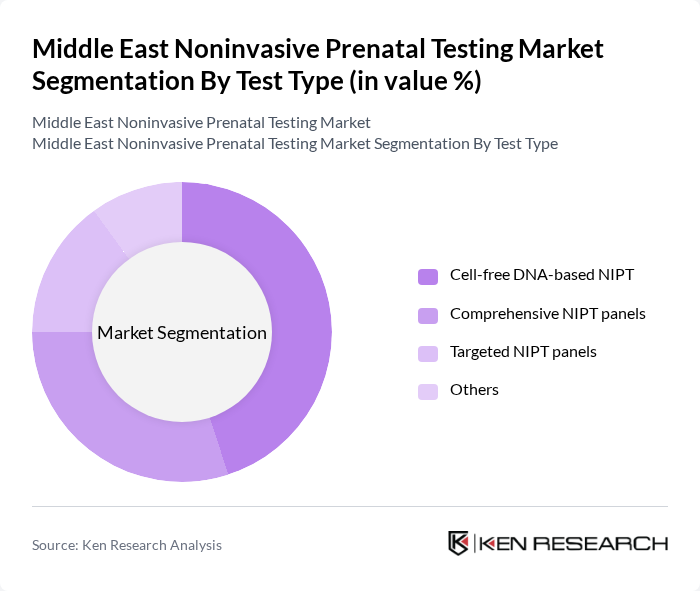
Middle East Noninvasive Prenatal Testing Market segmentation by Test Type.

By Gestational Age:The market is categorized based on gestational age into three segments: 0–12 weeks, 13–24 weeks, and 25–36 weeks. In practice, most NIPT is ordered from around 10 weeks of gestation onward, and the 13–24 weeks segment currently accounts for the largest share of regional revenue, reflecting common clinical workflows in which women are referred for NIPT following first?trimester ultrasound or biochemical screening. However, the 0–12 weeks segment is the fastest growing, as earlier prenatal visits, rising awareness of early fetal anomaly detection, and the availability of validated NIPT protocols from 10 weeks support a shift toward earlier screening and more timely pregnancy decision?making. The 25–36 weeks segment remains comparatively smaller and is largely associated with late presenters, repeat testing in specific clinical scenarios, and complex high?risk pregnancies managed in tertiary centers.
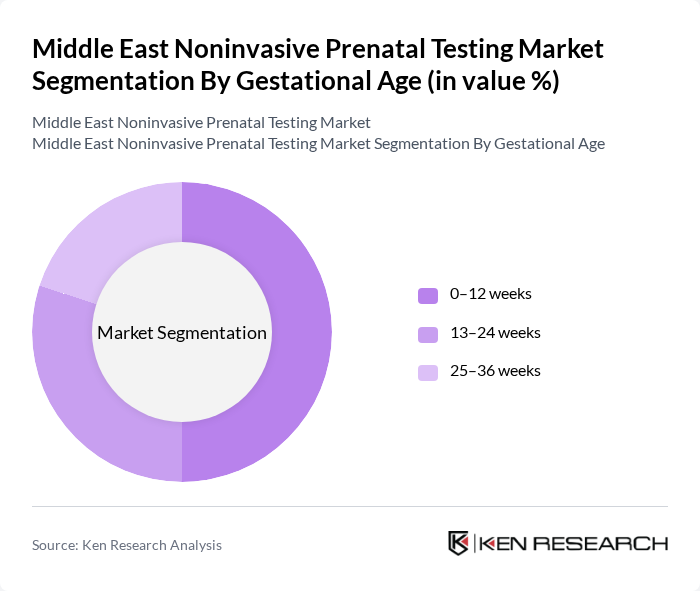
Middle East Noninvasive Prenatal Testing Market segmentation by Gestational Age.

Middle East Noninvasive Prenatal Testing Market Competitive Landscape

The Middle East Noninvasive Prenatal Testing Market is characterized by a dynamic mix of regional and international players. Leading participants such as Illumina, Inc., Natera, Inc., Roche Diagnostics (Roche Holding AG), Laboratory Corporation of America Holdings (Labcorp), Quest Diagnostics Incorporated, PerkinElmer, Inc., Eurofins Scientific SE, Myriad Genetics, Inc., BGI Genomics Co., Ltd., MedGenome Inc., Centogene N.V., Qiagen N.V., CooperSurgical, Inc., Regional hospital laboratories (selected examples), Emerging Middle East-based NIPT providers contribute to innovation, geographic expansion, and service delivery in this space.

Illumina, Inc.

1998

San Diego, California, USA

Natera, Inc.

2004

Austin, Texas, USA

Roche Diagnostics

1896

Basel, Switzerland

Laboratory Corporation of America Holdings

1971

Burlington, North Carolina, USA

Quest Diagnostics Incorporated

1967

Secaucus, New Jersey, USA

Company

Establishment Year

Headquarters

Regional NIPT revenue (USD million)

3-year CAGR in regional NIPT revenue

Number of NIPT tests performed annually (Middle East)

Installed NIPT capacity (tests per year)

Average selling price per test (USD)

Gross margin on NIPT portfolio (%)

Middle East Noninvasive Prenatal Testing Market Industry Analysis

Growth Drivers

  • Increasing Awareness of Prenatal Health:The Middle East has seen a significant rise in prenatal health awareness, with over 70% of expectant mothers now seeking prenatal care, according to the World Health Organization. This shift is driven by educational campaigns and increased access to healthcare services. In future, the region is projected to allocate approximately $1.6 billion towards maternal health initiatives, further enhancing awareness and encouraging the adoption of noninvasive prenatal testing (NIPT) as a standard practice.
  • Rising Demand for Early Diagnosis:The demand for early diagnosis of genetic disorders is surging, with an estimated 16% increase in NIPT utilization in the last year alone. This trend is fueled by the growing number of high-risk pregnancies, which accounted for 26% of all pregnancies in the region in the recent past. As healthcare providers emphasize early detection, the market for NIPT is expected to expand, supported by a projected 11% increase in healthcare spending in future, reaching $220 billion across the Middle East.
  • Technological Advancements in Testing Methods:Technological innovations in NIPT are enhancing accuracy and efficiency, with new testing methods reducing false-positive rates to below 1%. The introduction of next-generation sequencing (NGS) has revolutionized prenatal testing, making it more accessible. In future, the investment in NIPT technology is expected to exceed $350 million, driven by partnerships between tech firms and healthcare providers, ensuring that advanced testing methods are widely available across the region.

Market Challenges

  • High Cost of Testing Procedures:The cost of NIPT remains a significant barrier, with average testing prices ranging from $1,100 to $2,700, making it unaffordable for many families. In future, it is estimated that only 32% of the population can access these tests without financial strain. This economic disparity limits the market's growth potential, particularly in lower-income areas where healthcare budgets are constrained, impacting overall prenatal health outcomes.
  • Limited Access in Rural Areas:Access to NIPT is severely restricted in rural regions, where healthcare infrastructure is often inadequate. Approximately 42% of the population in these areas lacks access to specialized prenatal care services. In future, government initiatives are expected to address this issue, but logistical challenges remain, with only 22% of rural healthcare facilities equipped to offer NIPT. This gap in service delivery poses a significant challenge to market penetration.

Middle East Noninvasive Prenatal Testing Market Future Outlook

The future of the Middle East noninvasive prenatal testing market appears promising, driven by ongoing advancements in technology and increasing healthcare investments. As the region's healthcare expenditure is projected to reach $220 billion in future, the focus on maternal health will likely intensify. Additionally, the integration of telemedicine and digital health solutions is expected to enhance access to prenatal care, particularly in underserved areas, fostering a more inclusive healthcare environment for expectant mothers.

Market Opportunities

  • Expansion of Healthcare Infrastructure:The ongoing expansion of healthcare infrastructure in the Middle East presents a significant opportunity for NIPT providers. With over $12 billion allocated for healthcare facility upgrades in future, new clinics and hospitals will increasingly offer advanced prenatal testing services, improving accessibility and driving market growth.
  • Introduction of Cost-Effective Testing Solutions:The development of cost-effective NIPT solutions is crucial for market expansion. In future, several companies are expected to launch affordable testing options, targeting the 72% of the population currently unable to afford existing tests. This innovation could significantly increase market penetration and improve prenatal health outcomes across diverse socioeconomic groups.

Scope of the Report

SegmentSub-Segments
By Test Type

Cell-free DNA-based NIPT

Comprehensive NIPT panels

Targeted NIPT panels

Others

By Gestational Age

–12 weeks

–24 weeks

–36 weeks

By Condition Screened

Trisomy 21 (Down syndrome)

Trisomy 18 and Trisomy 13

Sex chromosome aneuploidies

Microdeletions and other genetic disorders

By Technology Platform

Next-generation sequencing (NGS)

PCR-based methods

Microarray-based methods

Others

By End User

Hospitals and maternity centers

Diagnostic and reference laboratories

Specialized fertility and women’s health clinics

Others

By Country

Saudi Arabia

United Arab Emirates

Qatar

Kuwait

Oman

Rest of Middle East

Key Target Audience

Investors and Venture Capitalist Firms

Government and Regulatory Bodies (e.g., Ministry of Health, Health Authority Abu Dhabi)

Manufacturers and Producers of Noninvasive Prenatal Testing Kits

Distributors and Retailers of Medical Devices

Healthcare Providers and Hospitals

Technology Providers for Genetic Testing

Industry Associations (e.g., Middle East Fertility Society)

Financial Institutions and Investment Banks

Players Mentioned in the Report:

Illumina, Inc.

Natera, Inc.

Roche Diagnostics (Roche Holding AG)

Laboratory Corporation of America Holdings (Labcorp)

Quest Diagnostics Incorporated

PerkinElmer, Inc.

Eurofins Scientific SE

Myriad Genetics, Inc.

BGI Genomics Co., Ltd.

MedGenome Inc.

Centogene N.V.

Qiagen N.V.

CooperSurgical, Inc.

Regional hospital laboratories (selected examples)

Emerging Middle East-based NIPT providers

Table of Contents

Market Assessment Phase

1. Executive Summary and Approach


2. Middle East Noninvasive Prenatal Testing Market Overview

2.1 Key Insights and Strategic Recommendations

2.2 Middle East Noninvasive Prenatal Testing Market Overview

2.3 Definition and Scope

2.4 Evolution of Market Ecosystem

2.5 Timeline of Key Regulatory Milestones

2.6 Value Chain & Stakeholder Mapping

2.7 Business Cycle Analysis

2.8 Policy & Incentive Landscape


3. Middle East Noninvasive Prenatal Testing Market Analysis

3.1 Growth Drivers

3.1.1 Increasing awareness of prenatal health
3.1.2 Rising demand for early diagnosis
3.1.3 Technological advancements in testing methods
3.1.4 Government initiatives promoting maternal health

3.2 Market Challenges

3.2.1 High cost of testing procedures
3.2.2 Limited access in rural areas
3.2.3 Regulatory hurdles
3.2.4 Cultural sensitivities regarding prenatal testing

3.3 Market Opportunities

3.3.1 Expansion of healthcare infrastructure
3.3.2 Collaborations with local healthcare providers
3.3.3 Introduction of cost-effective testing solutions
3.3.4 Growing interest in genetic counseling services

3.4 Market Trends

3.4.1 Shift towards personalized medicine
3.4.2 Increasing use of telemedicine for consultations
3.4.3 Rising popularity of home-based testing kits
3.4.4 Focus on non-invasive techniques

3.5 Government Regulation

3.5.1 Guidelines for prenatal testing procedures
3.5.2 Licensing requirements for testing facilities
3.5.3 Data protection regulations for patient information
3.5.4 Quality control standards for testing kits

4. SWOT Analysis


5. Stakeholder Analysis


6. Porter's Five Forces Analysis


7. Middle East Noninvasive Prenatal Testing Market Market Size, 2019-2024

7.1 By Value

7.2 By Volume

7.3 By Average Selling Price


8. Middle East Noninvasive Prenatal Testing Market Segmentation

8.1 By Test Type

8.1.1 Cell-free DNA-based NIPT
8.1.2 Comprehensive NIPT panels
8.1.3 Targeted NIPT panels
8.1.4 Others

8.2 By Gestational Age

8.2.1 0–12 weeks
8.2.2 13–24 weeks
8.2.3 25–36 weeks

8.3 By Condition Screened

8.3.1 Trisomy 21 (Down syndrome)
8.3.2 Trisomy 18 and Trisomy 13
8.3.3 Sex chromosome aneuploidies
8.3.4 Microdeletions and other genetic disorders

8.4 By Technology Platform

8.4.1 Next-generation sequencing (NGS)
8.4.2 PCR-based methods
8.4.3 Microarray-based methods
8.4.4 Others

8.5 By End User

8.5.1 Hospitals and maternity centers
8.5.2 Diagnostic and reference laboratories
8.5.3 Specialized fertility and women’s health clinics
8.5.4 Others

8.6 By Country

8.6.1 Saudi Arabia
8.6.2 United Arab Emirates
8.6.3 Qatar
8.6.4 Kuwait
8.6.5 Oman
8.6.6 Rest of Middle East

9. Middle East Noninvasive Prenatal Testing Market Competitive Analysis

9.1 Market Share of Key Players

9.2 Cross Comparison of Key Players

9.2.1 Company name
9.2.2 Regional NIPT revenue (USD million)
9.2.3 3-year CAGR in regional NIPT revenue
9.2.4 Number of NIPT tests performed annually (Middle East)
9.2.5 Installed NIPT capacity (tests per year)
9.2.6 Average selling price per test (USD)
9.2.7 Gross margin on NIPT portfolio (%)
9.2.8 Market share by volume (%)
9.2.9 Market share by value (%)
9.2.10 Test menu breadth (number of indications covered)
9.2.11 Turnaround time (average days per test)
9.2.12 Share of tests from digital/online referrals (%)
9.2.13 R&D spend on prenatal genomics (% of revenue)
9.2.14 Number of payer/reimbursement contracts in region
9.2.15 Number of key hospital and clinic partnerships
9.2.16 Regulatory and accreditation status (e.g., CAP/ISO)

9.3 SWOT Analysis of Top Players

9.4 Pricing Analysis

9.5 Detailed Profile of Major Companies

9.5.1 Illumina, Inc.
9.5.2 Natera, Inc.
9.5.3 Roche Diagnostics (Roche Holding AG)
9.5.4 Laboratory Corporation of America Holdings (Labcorp)
9.5.5 Quest Diagnostics Incorporated
9.5.6 PerkinElmer, Inc.
9.5.7 Eurofins Scientific SE
9.5.8 Myriad Genetics, Inc.
9.5.9 BGI Genomics Co., Ltd.
9.5.10 MedGenome Inc.
9.5.11 Centogene N.V.
9.5.12 Qiagen N.V.
9.5.13 CooperSurgical, Inc.
9.5.14 Regional hospital laboratories (selected examples)
9.5.15 Emerging Middle East-based NIPT providers

10. Middle East Noninvasive Prenatal Testing Market End-User Analysis

10.1 Procurement Behavior of Key Ministries

10.1.1 Budget allocation for prenatal health
10.1.2 Decision-making processes
10.1.3 Preferred suppliers and vendors
10.1.4 Evaluation criteria for testing services

10.2 Corporate Spend on Infrastructure & Energy

10.2.1 Investment in healthcare facilities
10.2.2 Funding for prenatal testing programs
10.2.3 Partnerships with private sector
10.2.4 Allocation for research and development

10.3 Pain Point Analysis by End-User Category

10.3.1 Access to quality testing services
10.3.2 Affordability of testing options
10.3.3 Awareness of available services
10.3.4 Cultural barriers to testing

10.4 User Readiness for Adoption

10.4.1 Familiarity with noninvasive testing
10.4.2 Willingness to pay for services
10.4.3 Trust in healthcare providers
10.4.4 Availability of educational resources

10.5 Post-Deployment ROI and Use Case Expansion

10.5.1 Measurement of testing outcomes
10.5.2 Feedback from healthcare providers
10.5.3 Expansion into new markets
10.5.4 Long-term benefits for maternal health

11. Middle East Noninvasive Prenatal Testing Market Future Size, 2025-2030

11.1 By Value

11.2 By Volume

11.3 By Average Selling Price


Go-To-Market Strategy Phase

1. Whitespace Analysis + Business Model Canvas

1.1 Market gaps and opportunities

1.2 Value proposition development

1.3 Revenue model identification

1.4 Key partnerships and alliances

1.5 Customer segmentation

1.6 Cost structure analysis

1.7 Competitive landscape overview


2. Marketing and Positioning Recommendations

2.1 Branding strategies

2.2 Product USPs

2.3 Target audience identification

2.4 Communication channels

2.5 Promotional tactics

2.6 Market positioning

2.7 Performance metrics


3. Distribution Plan

3.1 Urban retail strategies

3.2 Rural NGO tie-ups

3.3 Online distribution channels

3.4 Partnerships with healthcare providers

3.5 Logistics and supply chain management

3.6 Inventory management

3.7 Distribution efficiency


4. Channel & Pricing Gaps

4.1 Underserved routes

4.2 Pricing bands analysis

4.3 Competitor pricing strategies

4.4 Customer willingness to pay

4.5 Value-based pricing models

4.6 Discount strategies

4.7 Price elasticity of demand


5. Unmet Demand & Latent Needs

5.1 Category gaps

5.2 Consumer segments analysis

5.3 Emerging trends

5.4 Customer feedback mechanisms

5.5 Market research insights

5.6 Product development opportunities

5.7 Service enhancement suggestions


6. Customer Relationship

6.1 Loyalty programs

6.2 After-sales service

6.3 Customer engagement strategies

6.4 Feedback collection methods

6.5 Relationship management tools

6.6 Community building initiatives

6.7 Customer education programs


7. Value Proposition

7.1 Sustainability initiatives

7.2 Integrated supply chains

7.3 Unique selling points

7.4 Customer-centric approach

7.5 Long-term benefits

7.6 Competitive advantages

7.7 Market differentiation strategies


8. Key Activities

8.1 Regulatory compliance

8.2 Branding efforts

8.3 Distribution setup

8.4 Training and development

8.5 Marketing campaigns

8.6 Performance monitoring

8.7 Stakeholder engagement


9. Entry Strategy Evaluation

9.1 Domestic Market Entry Strategy

9.1.1 Product mix considerations
9.1.2 Pricing band analysis
9.1.3 Packaging strategies

9.2 Export Entry Strategy

9.2.1 Target countries identification
9.2.2 Compliance roadmap development

10. Entry Mode Assessment

10.1 Joint Ventures

10.2 Greenfield investments

10.3 Mergers & Acquisitions

10.4 Distributor Model


11. Capital and Timeline Estimation

11.1 Capital requirements

11.2 Timelines for market entry


12. Control vs Risk Trade-Off

12.1 Ownership considerations

12.2 Partnerships evaluation


13. Profitability Outlook

13.1 Breakeven analysis

13.2 Long-term sustainability strategies


14. Potential Partner List

14.1 Distributors

14.2 Joint Ventures

14.3 Acquisition targets


15. Execution Roadmap

15.1 Phased Plan for Market Entry

15.1.1 Market Setup
15.1.2 Market Entry
15.1.3 Growth Acceleration
15.1.4 Scale & Stabilize

15.2 Key Activities and Milestones

15.2.1 Activity timelines
15.2.2 Milestone tracking

Research Methodology

ApproachModellingSample

Phase 1: Approach1

Desk Research

  • Analysis of market reports from healthcare organizations and industry associations in the Middle East
  • Review of academic journals and publications focusing on noninvasive prenatal testing (NIPT) technologies
  • Examination of demographic and health statistics from government health ministries and international health organizations

Primary Research

  • Interviews with obstetricians and gynecologists specializing in prenatal care
  • Surveys with laboratory managers and technicians involved in NIPT services
  • Focus groups with expectant parents to understand awareness and acceptance of NIPT

Validation & Triangulation

  • Cross-validation of findings through multiple expert interviews and stakeholder feedback
  • Triangulation of data from healthcare providers, laboratories, and patient surveys
  • Sanity checks through comparison with historical market trends and growth rates

Phase 2: Market Size Estimation1

Top-down Assessment

  • Estimation of the total addressable market based on national birth rates and prenatal testing uptake
  • Segmentation of the market by country, testing type, and healthcare provider
  • Incorporation of regional healthcare policies and funding for prenatal testing initiatives

Bottom-up Modeling

  • Collection of data on the number of NIPT tests conducted by leading laboratories in the region
  • Estimation of average pricing for NIPT services across different healthcare settings
  • Calculation of market size based on volume of tests and average revenue per test

Forecasting & Scenario Analysis

  • Development of growth projections based on trends in maternal age and genetic testing awareness
  • Scenario analysis considering potential regulatory changes and technological advancements
  • Baseline, optimistic, and pessimistic forecasts through 2030 based on varying adoption rates

Phase 3: CATI Sample Composition1

Scope Item/SegmentSample SizeTarget Respondent Profiles
Obstetricians and Gynecologists120Healthcare Providers, Specialists in Prenatal Care
Laboratory Managers90Technical Directors, Laboratory Technicians
Expectant Parents140First-time Parents, Couples Considering NIPT
Healthcare Policy Makers60Government Officials, Health Program Directors
Genetic Counselors60Genetic Counselors, Patient Educators

Frequently Asked Questions

What is the current value of the Middle East Noninvasive Prenatal Testing Market?

The Middle East Noninvasive Prenatal Testing Market is valued at approximately USD 130 million, reflecting a significant growth trend driven by advancements in technology and increased awareness of prenatal health among expectant parents in the region.

What factors are driving the growth of the Noninvasive Prenatal Testing Market in the Middle East?

Which countries are leading in the Noninvasive Prenatal Testing Market in the Middle East?

What are the main types of tests available in the Noninvasive Prenatal Testing Market?

Why Buy From Us?

Refine Robust Result (RRR) Framework

What makes us stand out is that our consultants follow Robust, Refine and Result (RRR) methodology. Robust for clear definitions, approaches and sanity checking, Refine for differentiating respondents' facts and opinions, and Result for presenting data with story.

Our Reach Is Unmatched

We have set a benchmark in the industry by offering our clients with syndicated and customized market research reports featuring coverage of entire market as well as meticulous research and analyst insights.

Shifting the Research Paradigm

While we don't replace traditional research, we flip the method upside down. Our dual approach of Top Bottom & Bottom Top ensures quality deliverable by not just verifying company fundamentals but also looking at the sector and macroeconomic factors.

More Insights-Better Decisions

With one step in the future, our research team constantly tries to show you the bigger picture. We help with some of the tough questions you may encounter along the way: How is the industry positioned? Best marketing channel? KPI's of competitors? By aligning every element, we help maximize success.

Transparency and Trust

Our report gives you instant access to the answers and sources that other companies might choose to hide. We elaborate each steps of research methodology we have used and showcase you the sample size to earn your trust.

Round the Clock Support

If you need any support, we are here! We pride ourselves on universe strength, data quality, and quick, friendly, and professional service.

Why Clients Choose Us?

400000+
Reports in repository
150+
Consulting projects a year
100+
Analysts
8000+
Client Queries in 2022








