Middle East Residential Ductwork Design Software Market Report Size Share Growth Drivers Trends Opportunities & Forecast 2025–2030

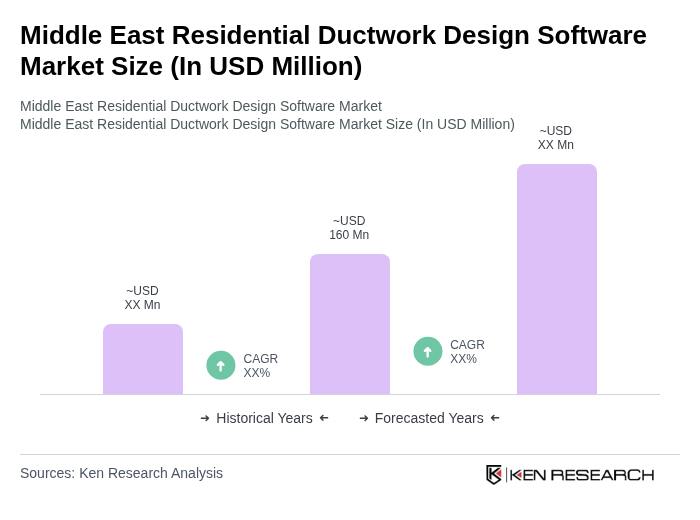
Middle East Residential Ductwork Design Software Market at USD 160 Mn, fueled by HVAC efficiency trends, BIM tools, and regulations like UAE Energy Standards for optimized duct systems.

Region:Middle East

Author(s):Shubham

Product Code:KRAD2535

Pages:83

Published On:January 2026
About the Report

Base Year 2024

Middle East Residential Ductwork Design Software Market Overview

  • The Middle East Residential Ductwork Design Software Market is valued at USD 160 million, based on a five-year historical analysis and aligned with the wider growth in HVAC systems and smart HVAC technologies in the region. This growth is primarily driven by the increasing demand for energy-efficient HVAC systems and the rising trend of smart home and smart HVAC technologies, which require precise duct sizing, load calculation, and airflow optimization. The market is also supported by the expansion of residential construction projects and large-scale community developments across the region, where developers and consultants increasingly adopt BIM-based and CFD-supported ductwork design tools to improve energy performance, indoor air quality, and lifecycle costs.
  • Key countries in this market include the UAE, Saudi Arabia, and Qatar, which together account for the majority of HVAC and building technology spending in the Gulf. The UAE leads due to its rapid urbanization, high-rise residential developments, and significant investments in infrastructure and smart city projects that embed digital design and building information modeling in standard practice. Saudi Arabia benefits from its Vision 2030 initiative, which emphasizes modernization, energy efficiency, and green building in large residential and mixed-use programs, increasing demand for advanced HVAC and duct design tools at planning and execution stages. Qatar’s hosting of major international events has accelerated residential and hospitality construction, where adherence to energy codes and indoor comfort requirements further drives the use of specialized ductwork design and coordination software.
  • In 2023, the UAE government strengthened building energy performance requirements, including more stringent provisions for HVAC efficiency and duct system performance under the UAE Energy Efficiency Standard and Labeling regulations issued by the Emirates Authority for Standardization and Metrology (ESMA) and the UAE Energy Conservation Building Codes, which align with Estidama and other local green building frameworks. These instruments mandate higher minimum energy performance standards for HVAC equipment, encourage tight and well-insulated ductwork, and support compliance with green building certifications, thereby increasing the demand for advanced residential ductwork design software capable of detailed load calculations, leakage control, and integration with BIM workflows to meet these codes.
Middle East Residential Ductwork Design Software Market Size

Middle East Residential Ductwork Design Software Market Segmentation

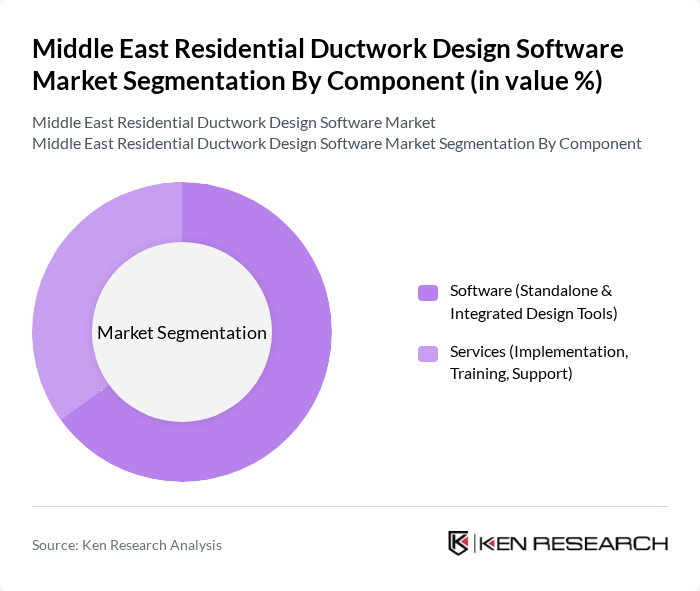
By Component:The components of the market include software and services. The software segment is further divided into standalone and integrated design tools, including BIM plug-ins, CAD-based duct sizing modules, and CFD-assisted airflow optimization tools used by consultants and contractors. The services segment encompasses implementation, customization, training, and ongoing technical support associated with these solutions. The software segment is currently dominating the market due to the increasing adoption of advanced design tools that enhance efficiency and accuracy in ductwork design, reduce rework on-site, and support compliance documentation for regional green building and energy-efficiency requirements.
Middle East Residential Ductwork Design Software Market segmentation by Component.

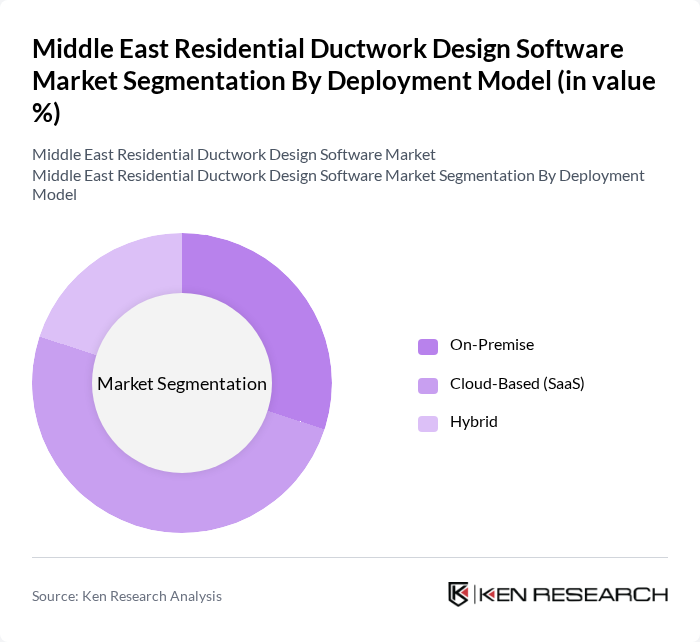
By Deployment Model:The deployment models include on-premise, cloud-based (SaaS), and hybrid solutions. The cloud-based model is gaining traction due to its flexibility, subscription-based pricing, and the ability for distributed design teams across multiple countries and job sites to collaborate in real time. Cloud-based solutions also integrate more easily with other project management, BIM, and facility management platforms, which is increasingly valued in large residential and mixed-use developments. This segment is expected to lead the market as more engineering firms, contractors, and developers in the Middle East transition to SaaS-based HVAC and duct design platforms for better scalability, automatic updates, and remote access.
Middle East Residential Ductwork Design Software Market segmentation by Deployment Model.

Middle East Residential Ductwork Design Software Market Competitive Landscape

The Middle East Residential Ductwork Design Software Market is characterized by a dynamic mix of regional and international players. Leading participants such as Autodesk, Inc., Trimble Inc., Carrier Global Corporation, Daikin Industries, Ltd., Honeywell International Inc., Mitsubishi Electric Corporation, Johnson Controls International plc, Siemens AG, Rheem Manufacturing Company, Lennox International Inc., Fujitsu General Limited, Panasonic Holdings Corporation, Schneider Electric SE, Trane Technologies plc, Belimo Holding AG contribute to innovation, geographic expansion, and service delivery in this space.

Autodesk, Inc.

1982

San Francisco, California, USA

Trimble Inc.

1978

Westminster, Colorado, USA

Carrier Global Corporation

1915

Palm Beach Gardens, Florida, USA

Daikin Industries, Ltd.

1924

Osaka, Japan

Honeywell International Inc.

1906

Charlotte, North Carolina, USA

Company

Establishment Year

Headquarters

Revenue (Global and Middle East, Latest Fiscal Year)

3-Year Revenue CAGR (Software Segment)

EBITDA Margin (%)

R&D Spend as % of Revenue

Annual Recurring Revenue (ARR) from Software

Customer Retention / Net Revenue Retention Rate

Middle East Residential Ductwork Design Software Market Industry Analysis

Growth Drivers

  • Increasing Demand for Energy-Efficient HVAC Systems:The Middle East is experiencing a surge in demand for energy-efficient HVAC systems, driven by rising energy costs and environmental concerns. In future, the region's energy consumption is projected to reach 1,300 terawatt-hours, with residential buildings accounting for approximately 60% of this total. This shift towards energy efficiency is prompting homeowners to invest in advanced ductwork design software that optimizes HVAC performance, thereby reducing energy consumption and costs.
  • Technological Advancements in Ductwork Design:The ductwork design software market is benefiting from rapid technological advancements, including the integration of AI and machine learning. In future, the global AI market is expected to reach $1.5 trillion, influencing the Middle East's software solutions. These technologies enhance design accuracy and efficiency, allowing for better airflow management and reduced installation times, which are critical for meeting the growing demand for sophisticated HVAC systems in residential settings.
  • Government Initiatives Promoting Sustainable Building Practices:Governments across the Middle East are implementing initiatives to promote sustainable building practices, including stricter energy efficiency regulations. For instance, the UAE's Energy Strategy 2050 aims to increase the contribution of clean energy to 60% by 2050. This regulatory environment is encouraging the adoption of advanced ductwork design software, as builders and architects seek compliant solutions that align with national sustainability goals and enhance building performance.

Market Challenges

  • High Initial Investment Costs:One of the significant challenges facing the Middle East residential ductwork design software market is the high initial investment costs associated with advanced software solutions. In future, the average cost of implementing comprehensive ductwork design software can exceed $60,000, which may deter smaller firms from adopting these technologies. This financial barrier limits market penetration and slows the transition from traditional design methods to more efficient software-driven approaches.
  • Lack of Skilled Professionals in Ductwork Design:The shortage of skilled professionals in ductwork design poses a considerable challenge to the market. According to the World Bank, the Middle East faces a skills gap, with an estimated 25% of construction professionals lacking adequate training in modern design software. This deficiency hampers the effective utilization of advanced ductwork design tools, leading to suboptimal design outcomes and increased project delays, ultimately affecting market growth.

Middle East Residential Ductwork Design Software Market Future Outlook

The future of the Middle East residential ductwork design software market appears promising, driven by ongoing technological innovations and increasing regulatory support for energy efficiency. As smart home technologies gain traction, the integration of IoT devices with ductwork design software will enhance system performance and user experience. Additionally, the growing emphasis on indoor air quality will further propel demand for advanced design solutions, ensuring that the market remains dynamic and responsive to evolving consumer needs and regulatory frameworks.

Market Opportunities

  • Expansion of Smart Home Technologies:The rise of smart home technologies presents a significant opportunity for ductwork design software providers. In future, the smart home market in the Middle East is projected to reach $6 billion, creating demand for integrated solutions that optimize HVAC systems. This trend encourages software developers to innovate and offer products that seamlessly connect with smart home ecosystems, enhancing user convenience and energy efficiency.
  • Integration of AI in Design Software:The integration of AI into ductwork design software offers substantial market opportunities. By future, AI-driven design tools are expected to improve design accuracy and efficiency, reducing project timelines by up to 25%. This capability not only attracts more users but also positions software providers as leaders in a competitive market, driving further adoption and innovation in ductwork design solutions.

Scope of the Report

SegmentSub-Segments
By Component

Software (Standalone & Integrated Design Tools)

Services (Implementation, Training, Support)

By Deployment Model

On-Premise

Cloud-Based (SaaS)

Hybrid

By Functionality

Duct Sizing & Layout Optimization

Load Calculation & Energy Analysis

BIM-Integrated Duct Design

D Modeling & Simulation

Compliance & Code-Checking Tools

By End-User

HVAC Contractors & Installers

MEP Engineering Firms

Architectural & Design Studios

Real Estate Developers

Others (Consultants, Facility Managers)

By Organization Size

Small & Medium Enterprises (SMEs)

Large Enterprises

By Pricing Model

Subscription (Monthly/Annual)

Perpetual License

Usage-Based / Pay-Per-Project

By Country

UAE

Saudi Arabia

Qatar

Kuwait

Rest of Middle East

Key Target Audience

Investors and Venture Capitalist Firms

Government and Regulatory Bodies (e.g., Ministry of Housing, Ministry of Energy)

Manufacturers and Producers of Ductwork Systems

Distributors and Retailers of HVAC Equipment

Building Contractors and Construction Firms

Technology Providers for HVAC Software Solutions

Industry Associations (e.g., Middle East HVAC Association)

Financial Institutions and Banks

Players Mentioned in the Report:

Autodesk, Inc.

Trimble Inc.

Carrier Global Corporation

Daikin Industries, Ltd.

Honeywell International Inc.

Mitsubishi Electric Corporation

Johnson Controls International plc

Siemens AG

Rheem Manufacturing Company

Lennox International Inc.

Fujitsu General Limited

Panasonic Holdings Corporation

Schneider Electric SE

Trane Technologies plc

Belimo Holding AG

Table of Contents

Market Assessment Phase

1. Executive Summary and Approach


2. Middle East Residential Ductwork Design Software Market Overview

2.1 Key Insights and Strategic Recommendations

2.2 Middle East Residential Ductwork Design Software Market Overview

2.3 Definition and Scope

2.4 Evolution of Market Ecosystem

2.5 Timeline of Key Regulatory Milestones

2.6 Value Chain & Stakeholder Mapping

2.7 Business Cycle Analysis

2.8 Policy & Incentive Landscape


3. Middle East Residential Ductwork Design Software Market Analysis

3.1 Growth Drivers

3.1.1 Increasing demand for energy-efficient HVAC systems
3.1.3 Technological advancements in ductwork design
3.1.4 Government initiatives promoting sustainable building practices

3.2 Market Challenges

3.2.1 High initial investment costs
3.2.2 Lack of skilled professionals in ductwork design
3.2.3 Regulatory compliance complexities
3.2.4 Competition from traditional design methods

3.3 Market Opportunities

3.3.1 Expansion of smart home technologies
3.3.2 Integration of AI in design software
3.3.3 Growing awareness of indoor air quality
3.3.4 Partnerships with construction firms for bundled services

3.4 Market Trends

3.4.1 Shift towards cloud-based design solutions
3.4.2 Increasing use of 3D modeling in ductwork design
3.4.3 Adoption of BIM (Building Information Modeling) technologies
3.4.4 Focus on customization and user-friendly interfaces

3.5 Government Regulation

3.5.1 Energy efficiency standards for residential buildings
3.5.2 Building codes mandating ductwork specifications
3.5.3 Incentives for using sustainable materials
3.5.4 Regulations on indoor air quality and ventilation

4. SWOT Analysis


5. Stakeholder Analysis


6. Porter's Five Forces Analysis


7. Middle East Residential Ductwork Design Software Market Size, 2019-2024

7.1 By Value

7.2 By Volume

7.3 By Average Selling Price


8. Middle East Residential Ductwork Design Software Market Segmentation

8.1 By Component

8.1.1 Software (Standalone & Integrated Design Tools)
8.1.2 Services (Implementation, Training, Support)

8.2 By Deployment Model

8.2.1 On-Premise
8.2.2 Cloud-Based (SaaS)
8.2.3 Hybrid

8.3 By Functionality

8.3.1 Duct Sizing & Layout Optimization
8.3.2 Load Calculation & Energy Analysis
8.3.3 BIM-Integrated Duct Design
8.3.4 3D Modeling & Simulation
8.3.5 Compliance & Code-Checking Tools

8.4 By End-User

8.4.1 HVAC Contractors & Installers
8.4.2 MEP Engineering Firms
8.4.3 Architectural & Design Studios
8.4.4 Real Estate Developers
8.4.5 Others (Consultants, Facility Managers)

8.5 By Organization Size

8.5.1 Small & Medium Enterprises (SMEs)
8.5.2 Large Enterprises

8.6 By Pricing Model

8.6.1 Subscription (Monthly/Annual)
8.6.2 Perpetual License
8.6.3 Usage-Based / Pay-Per-Project

8.7 By Country

8.7.1 UAE
8.7.2 Saudi Arabia
8.7.3 Qatar
8.7.4 Kuwait
8.7.5 Rest of Middle East

9. Middle East Residential Ductwork Design Software Market Competitive Analysis

9.1 Market Share of Key Players

9.2 Cross Comparison of Key Players

9.2.1 Company Name
9.2.2 Revenue (Global and Middle East, Latest Fiscal Year)
9.2.3 3-Year Revenue CAGR (Software Segment)
9.2.4 EBITDA Margin (%)
9.2.5 R&D Spend as % of Revenue
9.2.6 Annual Recurring Revenue (ARR) from Software
9.2.7 Customer Retention / Net Revenue Retention Rate
9.2.8 Number of Active Middle East Deployments / Clients
9.2.9 Average Contract Value (ACV) / Deal Size
9.2.10 Payback Period / Time-to-ROI for Clients
9.2.11 Market Share in Middle East Residential Segment (%)
9.2.12 Product Release Frequency / Update Cycle

9.3 SWOT Analysis of Top Players

9.4 Pricing Analysis

9.5 Detailed Profile of Major Companies

9.5.1 Autodesk, Inc.
9.5.2 Trimble Inc.
9.5.3 Carrier Global Corporation
9.5.4 Daikin Industries, Ltd.
9.5.5 Honeywell International Inc.
9.5.6 Mitsubishi Electric Corporation
9.5.7 Johnson Controls International plc
9.5.8 Siemens AG
9.5.9 Rheem Manufacturing Company
9.5.10 Lennox International Inc.
9.5.11 Fujitsu General Limited
9.5.12 Panasonic Holdings Corporation
9.5.13 Schneider Electric SE
9.5.14 Trane Technologies plc
9.5.15 Belimo Holding AG

10. Middle East Residential Ductwork Design Software Market End-User Analysis

10.1 Procurement Behavior of Key Ministries

10.1.1 Key Decision-Making Processes
10.1.2 Budget Allocation Trends
10.1.3 Preferred Procurement Channels
10.1.4 Contracting Practices

10.2 Corporate Spend on Infrastructure & Energy

10.2.1 Investment Trends in Residential Projects
10.2.2 Budgeting for Ductwork Design Software
10.2.3 Cost-Benefit Analysis Practices
10.2.4 Long-term Financial Commitments

10.3 Pain Point Analysis by End-User Category

10.3.1 Common Challenges Faced by Homeowners
10.3.2 Issues Encountered by Contractors
10.3.3 Architect and Engineer Concerns
10.3.4 Others

10.4 User Readiness for Adoption

10.4.1 Awareness of Software Benefits
10.4.2 Training and Support Needs
10.4.3 Technology Adoption Barriers
10.4.4 Others

10.5 Post-Deployment ROI and Use Case Expansion

10.5.1 Measurement of ROI Metrics
10.5.2 Case Studies of Successful Implementations
10.5.3 Future Use Case Opportunities
10.5.4 Others

11. Middle East Residential Ductwork Design Software Market Future Size, 2025-2030

11.1 By Value

11.2 By Volume

11.3 By Average Selling Price


Go-To-Market Strategy Phase

1. Whitespace Analysis + Business Model Canvas

1.1 Market Gaps Identification

1.2 Business Model Framework


2. Marketing and Positioning Recommendations

2.1 Branding Strategies

2.2 Product USPs


3. Distribution Plan

3.1 Urban Retail Strategies

3.2 Rural NGO Tie-Ups


4. Channel & Pricing Gaps

4.1 Underserved Routes

4.2 Pricing Bands


5. Unmet Demand & Latent Needs

5.1 Category Gaps

5.2 Consumer Segments


6. Customer Relationship

6.1 Loyalty Programs

6.2 After-Sales Service


7. Value Proposition

7.1 Sustainability Initiatives

7.2 Integrated Supply Chains


8. Key Activities

8.1 Regulatory Compliance

8.2 Branding Efforts

8.3 Distribution Setup


9. Entry Strategy Evaluation

9.1 Domestic Market Entry Strategy

9.1.1 Product Mix Considerations
9.1.2 Pricing Band Strategies
9.1.3 Packaging Approaches

9.2 Export Entry Strategy

9.2.1 Target Countries
9.2.2 Compliance Roadmap

10. Entry Mode Assessment

10.1 Joint Ventures

10.2 Greenfield Investments

10.3 Mergers & Acquisitions

10.4 Distributor Model


11. Capital and Timeline Estimation

11.1 Capital Requirements

11.2 Timelines for Implementation


12. Control vs Risk Trade-Off

12.1 Ownership Considerations

12.2 Partnerships Evaluation


13. Profitability Outlook

13.1 Breakeven Analysis

13.2 Long-Term Sustainability


14. Potential Partner List

14.1 Distributors

14.2 Joint Ventures

14.3 Acquisition Targets


15. Execution Roadmap

15.1 Phased Plan for Market Entry

15.1.1 Market Setup
15.1.2 Market Entry
15.1.3 Growth Acceleration
15.1.4 Scale & Stabilize

15.2 Key Activities and Milestones

15.2.1 Milestone Planning
15.2.2 Activity Tracking

Research Methodology

ApproachModellingSample

Phase 1: Approach1

Desk Research

  • Industry reports from regional HVAC associations and building standards organizations
  • Market analysis publications focusing on ductwork design software trends in the Middle East
  • Government publications on construction and building regulations affecting ductwork design

Primary Research

  • Interviews with HVAC engineers and designers specializing in residential projects
  • Surveys with software developers and vendors in the ductwork design space
  • Field interviews with contractors and builders involved in residential construction

Validation & Triangulation

  • Cross-validation of findings through multiple expert interviews and industry reports
  • Triangulation of data from software sales figures and user feedback
  • Sanity checks through expert panel reviews and consensus-building sessions

Phase 2: Market Size Estimation1

Top-down Assessment

  • Analysis of overall residential construction spending in the Middle East
  • Estimation of ductwork design software adoption rates among residential builders
  • Incorporation of regional growth trends in smart home technologies and energy efficiency

Bottom-up Modeling

  • Volume estimates based on the number of residential units constructed annually
  • Cost analysis of ductwork design software based on pricing models from leading vendors
  • Calculation of market size using unit sales multiplied by average software pricing

Forecasting & Scenario Analysis

  • Multi-factor regression analysis incorporating economic indicators and housing market trends
  • Scenario modeling based on potential regulatory changes and technological advancements
  • Baseline, optimistic, and pessimistic forecasts through 2030 based on market dynamics

Phase 3: CATI Sample Composition1

Scope Item/SegmentSample SizeTarget Respondent Profiles
Residential Ductwork Design Software Users140HVAC Engineers, Software Users
Contractors in Residential Construction100Project Managers, Site Supervisors
Software Developers in HVAC Sector80Product Managers, Technical Leads
Building Regulatory Authorities50Regulatory Officers, Compliance Managers
Energy Efficiency Consultants70Sustainability Experts, Energy Auditors

Frequently Asked Questions

What is the current value of the Middle East Residential Ductwork Design Software Market?

The Middle East Residential Ductwork Design Software Market is valued at approximately USD 160 million, reflecting the growth in HVAC systems and smart technologies in the region, driven by the demand for energy-efficient solutions and advanced design tools.

Which countries are leading in the Middle East Residential Ductwork Design Software Market?

What factors are driving the growth of the ductwork design software market in the Middle East?

What are the main components of the Middle East Residential Ductwork Design Software Market?

Other Adjacent Reports

Philippines HVAC Software Market

Indonesia Building Information Modeling Software Market

Qatar Smart Home Technology Market

Germany Energy Management Software Market

Qatar Residential Construction Software Market

Mexico Air Duct Systems Market

KSA Computational Fluid Dynamics Software Market

Philippines Green Building Technologies Market

Vietnam iot integration market report Size, Share, Growth Drivers, Trends, Opportunities & Forecast 2025–2030Saudi Arabia Building Automation Systems Market Size, Share, Trends & Forecast 2025–2030

Why Buy From Us?

Refine Robust Result (RRR) Framework

What makes us stand out is that our consultants follow Robust, Refine and Result (RRR) methodology. Robust for clear definitions, approaches and sanity checking, Refine for differentiating respondents' facts and opinions, and Result for presenting data with story.

Our Reach Is Unmatched

We have set a benchmark in the industry by offering our clients with syndicated and customized market research reports featuring coverage of entire market as well as meticulous research and analyst insights.

Shifting the Research Paradigm

While we don't replace traditional research, we flip the method upside down. Our dual approach of Top Bottom & Bottom Top ensures quality deliverable by not just verifying company fundamentals but also looking at the sector and macroeconomic factors.

More Insights-Better Decisions

With one step in the future, our research team constantly tries to show you the bigger picture. We help with some of the tough questions you may encounter along the way: How is the industry positioned? Best marketing channel? KPI's of competitors? By aligning every element, we help maximize success.

Transparency and Trust

Our report gives you instant access to the answers and sources that other companies might choose to hide. We elaborate each steps of research methodology we have used and showcase you the sample size to earn your trust.

Round the Clock Support

If you need any support, we are here! We pride ourselves on universe strength, data quality, and quick, friendly, and professional service.

Why Clients Choose Us?

400000+
Reports in repository
150+
Consulting projects a year
100+
Analysts
8000+
Client Queries in 2022








