About the Report
Base Year 2024Listen to the audio summary
Middle East Weight Management Market Overview
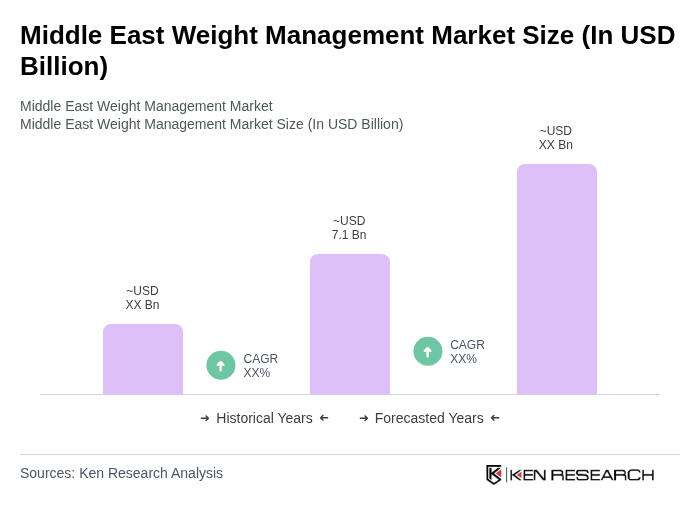
- The Middle East Weight Management Market is valued at USD 7.1 billion, based on a five-year historical analysis. This growth is primarily driven by rising obesity rates, increasing health awareness, and a growing demand for weight management solutions among the population. The market has seen a surge in interest due to lifestyle changes, urbanization, and the influence of social media on health and fitness trends. Recent trends include the adoption of digital health platforms, increased focus on personalized nutrition, and the integration of wearable technology for fitness tracking .
- Key players in this market include the GCC countries, particularly Saudi Arabia and the UAE, which dominate due to their high disposable incomes and a strong focus on health and wellness. Additionally, the Levant region, including Jordan and Lebanon, is also significant due to increasing health awareness and government initiatives promoting healthy lifestyles .
- In 2023, the UAE government implemented the "National Nutrition Strategy 2022–2030" issued by the Ministry of Health and Prevention. This binding instrument aims to reduce obesity rates by promoting healthy eating and physical activity. The strategy includes public health campaigns, regulatory measures on food labeling, and partnerships with private sectors to enhance access to weight management programs and services, reflecting a commitment to improving public health outcomes .
Middle East Weight Management Market Segmentation
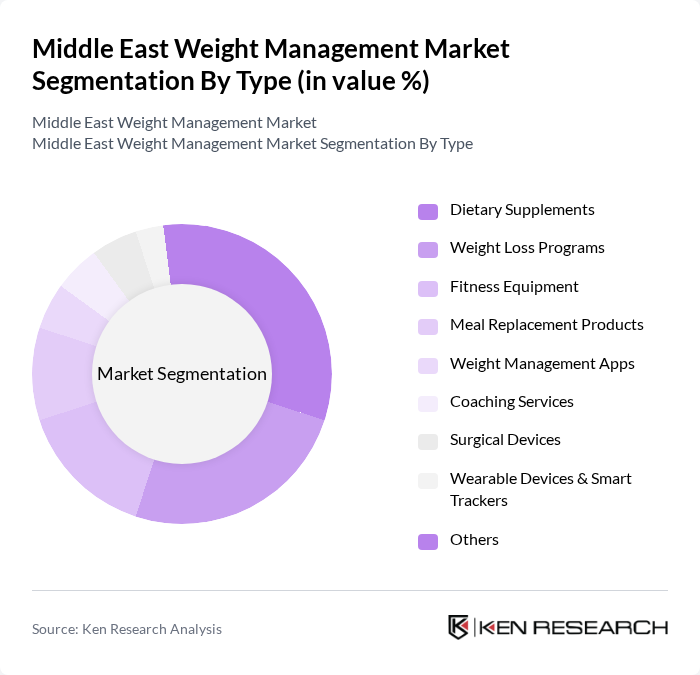
By Type:The segmentation by type includes various subsegments such as Dietary Supplements, Weight Loss Programs, Fitness Equipment, Meal Replacement Products, Weight Management Apps, Coaching Services, Surgical Devices, Wearable Devices & Smart Trackers, and Others. Among these, Dietary Supplements and Weight Loss Programs are particularly prominent due to their widespread acceptance and effectiveness in aiding weight management. The market is also witnessing rapid growth in the adoption of wearable devices and smart trackers, driven by increasing consumer interest in digital health monitoring and personalized fitness solutions .
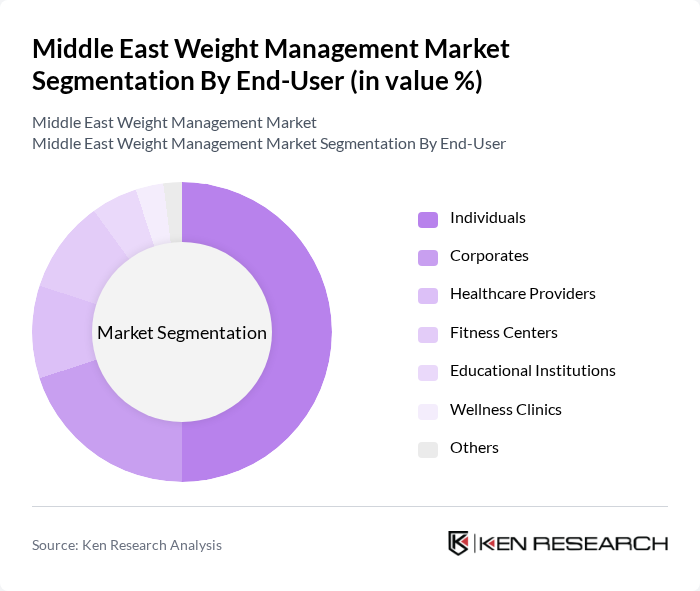
By End-User:The end-user segmentation includes Individuals, Corporates, Healthcare Providers, Fitness Centers, Educational Institutions, Wellness Clinics, and Others. Individuals represent the largest segment, driven by the increasing awareness of health and fitness among the general population, while Corporates are also significant due to employee wellness programs. Healthcare providers and wellness clinics are expanding their offerings to include integrated weight management services, reflecting a broader shift toward preventive healthcare .
Middle East Weight Management Market Competitive Landscape
The Middle East Weight Management Market is characterized by a dynamic mix of regional and international players. Leading participants such as Herbalife Nutrition Ltd., WW International, Inc. (formerly Weight Watchers), Atkins Nutritionals, Inc., Nestlé Health Science (Optifast Middle East), VLCC Health Care Ltd., Dr. Nutrition (UAE), Fitness First Middle East, Gold's Gym Middle East, Bodyline Clinics (UAE, KSA), NutriCentre (Saudi Arabia), Lifesum, MyFitnessPal, Noom, Inc., Fitbit, Inc., Under Armour, Inc. contribute to innovation, geographic expansion, and service delivery in this space.
Middle East Weight Management Market Industry Analysis
Growth Drivers
- Increasing Prevalence of Obesity:The Middle East has seen a significant rise in obesity rates, with the World Health Organization reporting that approximately35%of adults in the region are classified as obese. This alarming statistic correlates with a surge in obesity-related health issues, such as diabetes and cardiovascular diseases, which are projected to affect over22 million individualsin future. This growing health crisis drives demand for effective weight management solutions, creating a robust market environment.
- Rising Health Consciousness:A notable shift towards health consciousness among consumers in the Middle East is evident, with a recent survey indicating that62%of individuals are actively seeking weight management solutions. This trend is fueled by increased access to information about health and wellness, leading to a greater emphasis on preventive healthcare. As a result, the demand for weight management products and services is expected to rise, further propelling market growth.
- Growth in Fitness and Wellness Industry:The fitness and wellness industry in the Middle East is projected to reachUSD 30 billionin future, reflecting a growing interest in physical fitness and healthy living. This expansion is accompanied by an increase in gym memberships, wellness programs, and fitness-related products. The rising number of fitness centers and wellness retreats is expected to enhance the availability of weight management solutions, catering to the evolving needs of health-conscious consumers.
Market Challenges
- Cultural Attitudes Towards Weight:Cultural perceptions of body image in the Middle East can pose significant challenges to weight management initiatives. Many societies prioritize traditional body types, which may discourage individuals from seeking weight loss solutions. This cultural barrier can hinder the effectiveness of marketing strategies and limit the adoption of weight management programs, impacting overall market growth and consumer engagement.
- Limited Access to Professional Services:Access to professional weight management services remains a challenge in many Middle Eastern countries. According to the World Bank, only32%of the population has access to qualified healthcare professionals specializing in weight management. This limited availability can lead to inadequate support for individuals seeking to lose weight, ultimately affecting the success rates of weight management programs and products in the region.
Middle East Weight Management Market Future Outlook
The Middle East weight management market is poised for significant transformation, driven by technological advancements and evolving consumer preferences. As digital health platforms gain traction, more individuals will have access to personalized weight management solutions. Additionally, the integration of artificial intelligence in health applications is expected to enhance user experience and effectiveness. These trends indicate a shift towards more tailored and accessible weight management options, fostering a healthier population and a more dynamic market landscape.
Market Opportunities
- Expansion of Digital Health Platforms:The rise of digital health platforms presents a significant opportunity for the weight management market. With over55%of the population using smartphones, the demand for mobile applications that offer personalized weight management solutions is increasing. This trend can enhance user engagement and provide tailored support, ultimately driving market growth.
- Collaborations with Healthcare Providers:Collaborating with healthcare providers can create new avenues for weight management solutions. By integrating services with hospitals and clinics, companies can enhance credibility and reach a broader audience. This partnership approach is expected to improve patient outcomes and increase the adoption of weight management programs, benefiting both consumers and providers.
Scope of the Report
| Segment | Sub-Segments |
|---|---|
| By Type | Dietary Supplements Weight Loss Programs Fitness Equipment Meal Replacement Products Weight Management Apps Coaching Services Surgical Devices Wearable Devices & Smart Trackers Others |
| By End-User | Individuals Corporates Healthcare Providers Fitness Centers Educational Institutions Wellness Clinics Others |
| By Demographics | Age Group (Children, Adults, Seniors) Gender (Male, Female) Income Level (Low, Middle, High) Urban vs. Rural Others |
| By Region | GCC Countries (Saudi Arabia, UAE, Qatar, Kuwait, Oman, Bahrain) Levant Region (Jordan, Lebanon, Syria, Palestine, Iraq) North Africa (Egypt, Morocco, Algeria, Tunisia) Others |
| By Distribution Channel | Online Retail Supermarkets/Hypermarkets Pharmacies Health Stores Direct Sales Fitness Centers & Clinics Others |
| By Product Formulation | Natural Products Synthetic Products Organic Products Herbal Products Others |
| By Service Type | In-Person Services Virtual Services Hybrid Services Others |
Key Target Audience
Investors and Venture Capitalist Firms
Government and Regulatory Bodies (e.g., Ministry of Health, Food and Drug Authority)
Manufacturers and Producers of Weight Management Products
Distributors and Retailers of Health and Wellness Products
Health Insurance Companies
Fitness and Wellness Centers
Pharmaceutical Companies
Health Technology Startups
Players Mentioned in the Report:
Herbalife Nutrition Ltd.
WW International, Inc. (formerly Weight Watchers)
Atkins Nutritionals, Inc.
Nestle Health Science (Optifast Middle East)
VLCC Health Care Ltd.
Dr. Nutrition (UAE)
Fitness First Middle East
Gold's Gym Middle East
Bodyline Clinics (UAE, KSA)
NutriCentre (Saudi Arabia)
Lifesum
MyFitnessPal
Noom, Inc.
Fitbit, Inc.
Under Armour, Inc.
Table of Contents
Market Assessment Phase
1. Executive Summary and Approach
2. Middle East Weight Management Market Overview
2.1 Key Insights and Strategic Recommendations
2.2 Middle East Weight Management Market Overview
2.3 Definition and Scope
2.4 Evolution of Market Ecosystem
2.5 Timeline of Key Regulatory Milestones
2.6 Value Chain & Stakeholder Mapping
2.7 Business Cycle Analysis
2.8 Policy & Incentive Landscape
3. Middle East Weight Management Market Analysis
3.1 Growth Drivers
3.1.1 Increasing prevalence of obesity and related health issues
3.1.2 Rising health consciousness among consumers
3.1.3 Growth in fitness and wellness industry
3.1.4 Technological advancements in weight management solutions
3.2 Market Challenges
3.2.1 Cultural attitudes towards weight and body image
3.2.2 Limited access to professional weight management services
3.2.3 High costs associated with weight management programs
3.2.4 Regulatory hurdles in product approvals
3.3 Market Opportunities
3.3.1 Expansion of digital health platforms
3.3.2 Increasing demand for personalized weight management solutions
3.3.3 Collaborations with healthcare providers
3.3.4 Growth in e-commerce for weight management products
3.4 Market Trends
3.4.1 Shift towards holistic health and wellness
3.4.2 Integration of AI and machine learning in weight management
3.4.3 Rise of plant-based and organic weight management products
3.4.4 Increased focus on mental health in weight management
3.5 Government Regulation
3.5.1 Implementation of health awareness campaigns
3.5.2 Regulations on advertising weight loss products
3.5.3 Standards for nutritional labeling
3.5.4 Guidelines for weight management programs
4. SWOT Analysis
5. Stakeholder Analysis
6. Porter's Five Forces Analysis
7. Middle East Weight Management Market Market Size, 2019-2024
7.1 By Value
7.2 By Volume
7.3 By Average Selling Price
8. Middle East Weight Management Market Segmentation
8.1 By Type
8.1.1 Dietary Supplements
8.1.2 Weight Loss Programs
8.1.3 Fitness Equipment
8.1.4 Meal Replacement Products
8.1.5 Weight Management Apps
8.1.6 Coaching Services
8.1.7 Surgical Devices
8.1.8 Wearable Devices & Smart Trackers
8.1.9 Others
8.2 By End-User
8.2.1 Individuals
8.2.2 Corporates
8.2.3 Healthcare Providers
8.2.4 Fitness Centers
8.2.5 Educational Institutions
8.2.6 Wellness Clinics
8.2.7 Others
8.3 By Demographics
8.3.1 Age Group (Children, Adults, Seniors)
8.3.2 Gender (Male, Female)
8.3.3 Income Level (Low, Middle, High)
8.3.4 Urban vs. Rural
8.3.5 Others
8.4 By Region
8.4.1 GCC Countries (Saudi Arabia, UAE, Qatar, Kuwait, Oman, Bahrain)
8.4.2 Levant Region (Jordan, Lebanon, Syria, Palestine, Iraq)
8.4.3 North Africa (Egypt, Morocco, Algeria, Tunisia)
8.4.4 Others
8.5 By Distribution Channel
8.5.1 Online Retail
8.5.2 Supermarkets/Hypermarkets
8.5.3 Pharmacies
8.5.4 Health Stores
8.5.5 Direct Sales
8.5.6 Fitness Centers & Clinics
8.5.7 Others
8.6 By Product Formulation
8.6.1 Natural Products
8.6.2 Synthetic Products
8.6.3 Organic Products
8.6.4 Herbal Products
8.6.5 Others
8.7 By Service Type
8.7.1 In-Person Services
8.7.2 Virtual Services
8.7.3 Hybrid Services
8.7.4 Others
9. Middle East Weight Management Market Competitive Analysis
9.1 Market Share of Key Players
9.2 Cross Comparison of Key Players
9.2.1 Company Name
9.2.2 Group Size (Large, Medium, or Small as per industry convention)
9.2.3 Revenue (USD Million)
9.2.4 Market Share (%)
9.2.5 Customer Acquisition Cost (CAC)
9.2.6 Customer Retention Rate (%)
9.2.7 Market Penetration Rate (%)
9.2.8 Average Revenue per User (ARPU)
9.2.9 Pricing Strategy (Premium, Value, Subscription, etc.)
9.2.10 Brand Awareness Index
9.2.11 Product Diversification Index
9.2.12 Customer Satisfaction Score (CSAT/NPS)
9.2.13 Digital Engagement Rate
9.2.14 Regional Presence (No. of Countries in ME)
9.3 SWOT Analysis of Top Players
9.4 Pricing Analysis
9.5 Detailed Profile of Major Companies
9.5.1 Herbalife Nutrition Ltd.
9.5.2 WW International, Inc. (formerly Weight Watchers)
9.5.3 Atkins Nutritionals, Inc.
9.5.4 Nestlé Health Science (Optifast Middle East)
9.5.5 VLCC Health Care Ltd.
9.5.6 Dr. Nutrition (UAE)
9.5.7 Fitness First Middle East
9.5.8 Gold's Gym Middle East
9.5.9 Bodyline Clinics (UAE, KSA)
9.5.10 NutriCentre (Saudi Arabia)
9.5.11 Lifesum
9.5.12 MyFitnessPal
9.5.13 Noom, Inc.
9.5.14 Fitbit, Inc.
9.5.15 Under Armour, Inc.
10. Middle East Weight Management Market End-User Analysis
10.1 Procurement Behavior of Key Ministries
10.1.1 Government health initiatives
10.1.2 Budget allocation for health programs
10.1.3 Collaboration with private sector
10.1.4 Evaluation of service providers
10.2 Corporate Spend on Infrastructure & Energy
10.2.1 Investment in employee wellness programs
10.2.2 Partnerships with fitness centers
10.2.3 Funding for health technology
10.2.4 Others
10.3 Pain Point Analysis by End-User Category
10.3.1 Accessibility to weight management services
10.3.2 Affordability of programs
10.3.3 Effectiveness of weight loss solutions
10.3.4 Others
10.4 User Readiness for Adoption
10.4.1 Awareness of weight management options
10.4.2 Willingness to invest in health
10.4.3 Availability of technology
10.4.4 Others
10.5 Post-Deployment ROI and Use Case Expansion
10.5.1 Measurement of health outcomes
10.5.2 Long-term engagement strategies
10.5.3 Expansion of service offerings
10.5.4 Others
11. Middle East Weight Management Market Future Size, 2025-2030
11.1 By Value
11.2 By Volume
11.3 By Average Selling Price
Go-To-Market Strategy Phase
1. Whitespace Analysis + Business Model Canvas
1.1
2. Marketing and Positioning Recommendations
2.1
3. Distribution Plan
3.1
4. Channel & Pricing Gaps
4.1
5. Unmet Demand & Latent Needs
5.1
6. Customer Relationship
7.1
7. Value Proposition
8.1
8. Key Activities
9.1
9. Entry Strategy Evaluation
9.1 Domestic Market Entry Strategy
10.1.1
9.2 Export Entry Strategy
10.2.1
10. Entry Mode Assessment
11.1
11. Capital and Timeline Estimation
12.1
12. Control vs Risk Trade-Off
13.1
13. Profitability Outlook
14.1
14. Potential Partner List
15.1
15. Execution Roadmap
15.1 Phased Plan for Market Entry
16.1.1
15.2 Key Activities and Milestones
16.2.1
Research Methodology
Phase 1: Approach1
Desk Research
- Analysis of market reports from industry associations and health organizations in the Middle East
- Review of government health initiatives and weight management policies across various countries
- Examination of published academic studies and journals focusing on obesity trends and weight management solutions
Primary Research
- Interviews with healthcare professionals, including dietitians and nutritionists, specializing in weight management
- Surveys conducted with fitness center owners and personal trainers to understand consumer behavior
- Focus groups with individuals undergoing weight management programs to gather qualitative insights
Validation & Triangulation
- Cross-validation of findings through multiple data sources, including health statistics and market trends
- Triangulation of insights from primary interviews with secondary data to ensure consistency
- Sanity checks through expert panel reviews comprising industry veterans and academic researchers
Phase 2: Market Size Estimation1
Top-down Assessment
- Estimation of the overall healthcare expenditure in the Middle East and its allocation to weight management
- Segmentation of the market by service type, including dietary programs, fitness services, and medical interventions
- Incorporation of demographic data to assess the prevalence of obesity and related health issues
Bottom-up Modeling
- Collection of data from leading weight management service providers to establish revenue benchmarks
- Estimation of average spending per consumer on weight management services and products
- Volume x price analysis to derive total market value based on service uptake
Forecasting & Scenario Analysis
- Multi-variable forecasting using trends in obesity rates, healthcare policies, and consumer awareness
- Scenario analysis based on potential economic changes and shifts in consumer preferences towards health
- Development of baseline, optimistic, and pessimistic market projections through 2030
Phase 3: CATI Sample Composition1
| Scope Item/Segment | Sample Size | Target Respondent Profiles |
|---|---|---|
| Dietary Program Providers | 100 | Nutritionists, Program Coordinators |
| Fitness Centers and Gyms | 60 | Gym Owners, Personal Trainers |
| Healthcare Professionals | 50 | Doctors, Dietitians |
| Weight Management Product Retailers | 40 | Retail Managers, Product Developers |
| Consumers Engaged in Weight Management | 90 | Individuals on weight loss programs, Fitness Enthusiasts |
Frequently Asked Questions
What is the current value of the Middle East Weight Management Market?
The Middle East Weight Management Market is valued at approximately USD 7.1 billion, driven by rising obesity rates, health awareness, and demand for weight management solutions. This growth reflects significant lifestyle changes and urbanization in the region.
What factors are driving the growth of the weight management market in the Middle East?
Which countries dominate the Middle East Weight Management Market?
What are the main types of weight management solutions available in the market?
Other Regional/Country Reports
Indonesia Weight Management Market
Malaysia Weight Management Market
KSA Weight Management Market
APAC Weight Management Market
Other Adjacent Reports
Philippines Nutrition Consulting Market
UAE Wellness Programs Market
Japan Obesity Treatment Market
Thailand Health Food Market
Qatar Gym Membership Market
Ksa Telehealth Services Market Report Size, Share, Growth Drivers, Trends, Opportunities & Forecast 2025–2030UAE Netherlands Bariatric Surgery MarketWhy Buy From Us?

What makes us stand out is that our consultants follow Robust, Refine and Result (RRR) methodology. Robust for clear definitions, approaches and sanity checking, Refine for differentiating respondents' facts and opinions, and Result for presenting data with story.

We have set a benchmark in the industry by offering our clients with syndicated and customized market research reports featuring coverage of entire market as well as meticulous research and analyst insights.

While we don't replace traditional research, we flip the method upside down. Our dual approach of Top Bottom & Bottom Top ensures quality deliverable by not just verifying company fundamentals but also looking at the sector and macroeconomic factors.

With one step in the future, our research team constantly tries to show you the bigger picture. We help with some of the tough questions you may encounter along the way: How is the industry positioned? Best marketing channel? KPI's of competitors? By aligning every element, we help maximize success.

Our report gives you instant access to the answers and sources that other companies might choose to hide. We elaborate each steps of research methodology we have used and showcase you the sample size to earn your trust.

If you need any support, we are here! We pride ourselves on universe strength, data quality, and quick, friendly, and professional service.