About the Report
Base Year 2024New Zealand Automotive Adhesives Sealants Market Overview
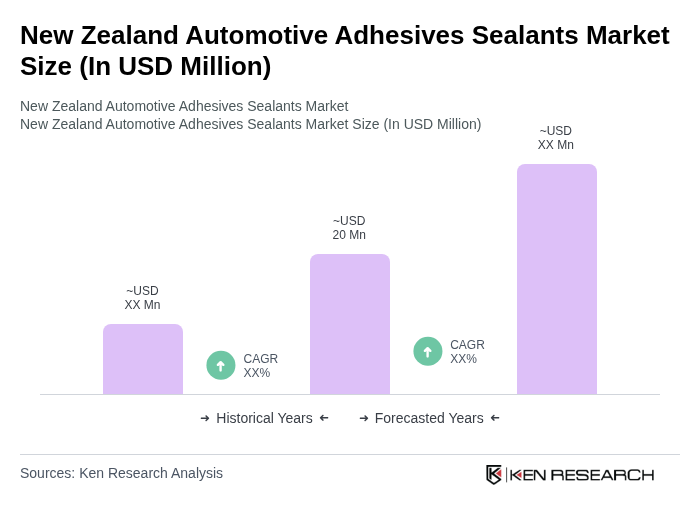
- The New Zealand Automotive Adhesives Sealants Market is valued at USD 20 million, based on a five-year historical analysis and the country’s share in the global automotive adhesives and sealants industry. This growth is primarily driven by the increasing demand for lightweight materials (such as aluminum and composites) in vehicle manufacturing and body-in-white applications, along with rising adoption of electric and hybrid vehicles that require advanced adhesive technologies for battery pack assembly, thermal management, and structural integrity.
- Auckland and Wellington are important demand centers in the New Zealand Automotive Adhesives Sealants Market, driven mainly by their concentration of vehicle importers, distributors, body shops, and automotive repair and refinishing networks rather than large-scale OEM vehicle manufacturing, which is limited in the country.
- New Zealand’s regulatory framework for vehicles and related components is guided by instruments such as the Land Transport Rule: Vehicle Exhaust Emissions 2007 issued by Waka Kotahi NZ Transport Agency, which sets exhaust emission standards for vehicles entering the fleet and encourages adoption of lower-emission technologies. In parallel, environmental and chemical management requirements under the Hazardous Substances and New Organisms Act 1996 and associated EPA controls promote the use of lower-VOC, eco-friendlier formulations in coatings, adhesives, and sealants used in automotive applications.
New Zealand Automotive Adhesives Sealants Market Segmentation
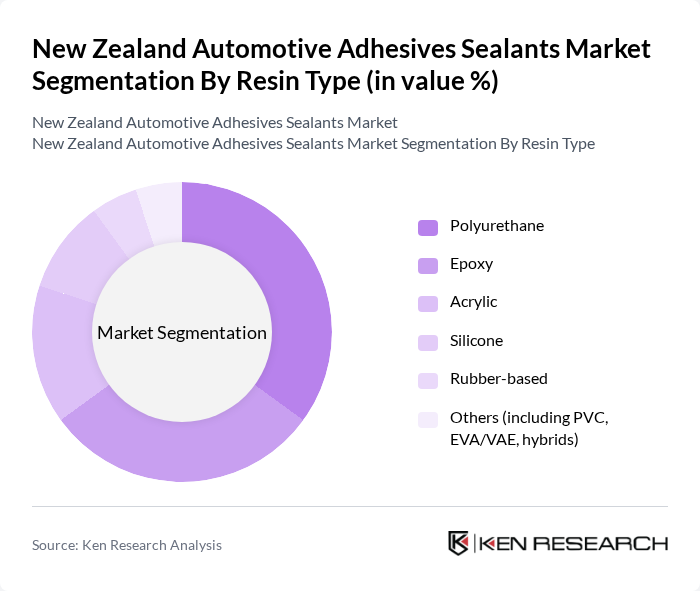
By Resin Type:The resin type segmentation includes various materials used in automotive adhesives and sealants, each offering unique properties suitable for different applications. Polyurethane and epoxy resins are widely used globally in structural bonding, glazing, and body shop repairs due to their excellent bonding strength, durability, and ability to join dissimilar lightweight substrates such as metals and plastics. Acrylic and silicone resins are also gaining traction, particularly in applications requiring fast cure, flexibility, and high weather and UV resistance for exterior trims and sealing. Rubber-based adhesives are favored for their elasticity and vibration damping in interior components and NVH applications, while other materials like PVC and EVA/VAE are used in niche automotive uses such as seam sealing, underbody coatings, and interior laminates.
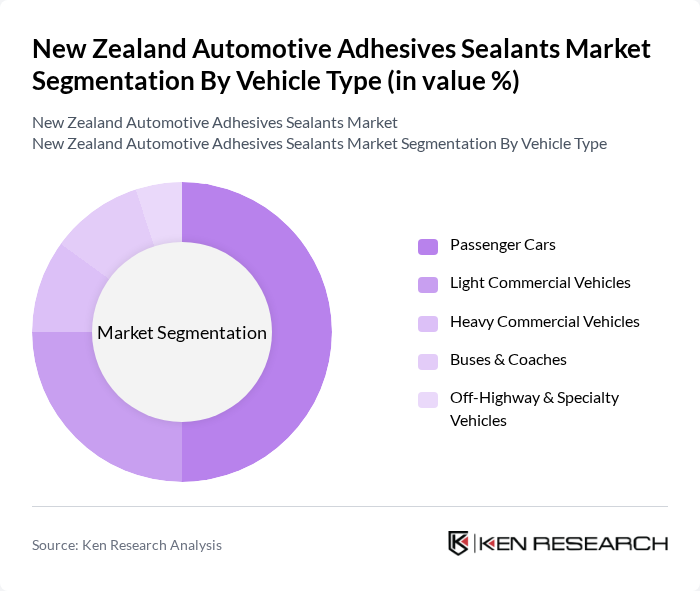
By Vehicle Type:The vehicle type segmentation encompasses various categories of vehicles utilizing automotive adhesives and sealants. Passenger cars dominate demand in New Zealand, reflecting the structure of the national vehicle fleet, where light passenger vehicles account for the majority of registrations and imports. Light commercial vehicles are also significant, supported by growth in e-commerce, last-mile delivery, and small business fleets. Heavy commercial vehicles and buses & coaches are notable segments for structural bonding, windscreen bonding, and body sealing in imported and locally modified vehicles. Off-highway and specialty vehicles represent a smaller but essential market, particularly in agriculture, construction, and forestry, where adhesives and sealants must deliver durability, chemical resistance, and performance in harsh operating environments.
New Zealand Automotive Adhesives Sealants Market Competitive Landscape
The New Zealand Automotive Adhesives Sealants Market is characterized by a dynamic mix of regional and international players. Leading participants such as Henkel AG & Co. KGaA, 3M Company, Sika AG, PPG Industries, Inc., BASF SE, Dow Inc., Huntsman Corporation, Illinois Tool Works Inc. (ITW), Arkema S.A., Bostik SA, RPM International Inc., Momentive Performance Materials Inc., LORD Corporation (Parker LORD), Avery Dennison Corporation, Franklin International contribute to innovation, geographic expansion, and service delivery in this space.
New Zealand Automotive Adhesives Sealants Market Industry Analysis
Growth Drivers
- Increasing Demand for Lightweight Vehicles:The New Zealand automotive sector is witnessing a significant shift towards lightweight vehicles, driven by consumer preferences for fuel efficiency and lower emissions. In future, the average weight of new vehicles is projected to decrease by approximately90 kg, leading to a demand for advanced adhesives that facilitate lightweight construction. This trend is supported by the New Zealand government’s commitment to reducing carbon emissions by25%by 2030, further propelling the need for innovative adhesive solutions.
- Growth in Automotive Production and Sales:The New Zealand automotive industry is expected to produce around210,000vehicles in future, reflecting a6%increase from the previous year. This growth is fueled by rising consumer confidence and an expanding economy, which is projected to grow by3.5%in future according to the World Bank. As production ramps up, the demand for automotive adhesives and sealants will correspondingly increase, particularly for applications in assembly and manufacturing processes.
- Rising Focus on Vehicle Safety and Durability:With an increasing emphasis on vehicle safety, New Zealand's automotive manufacturers are investing heavily in technologies that enhance durability and performance. In future, it is estimated that75%of new vehicles will incorporate advanced adhesive technologies to improve crashworthiness and structural integrity. This trend aligns with the New Zealand Transport Agency's initiatives to enhance road safety, thereby driving the demand for high-performance adhesives in vehicle production.
Market Challenges
- Fluctuating Raw Material Prices:The automotive adhesives market in New Zealand faces significant challenges due to the volatility of raw material prices, particularly petrochemical-based components. In future, the price of key raw materials is expected to rise by12-18%due to global supply chain disruptions and geopolitical tensions. This fluctuation can adversely affect production costs and profit margins for manufacturers, leading to potential price increases for end consumers.
- Stringent Environmental Regulations:New Zealand's commitment to environmental sustainability has led to the implementation of stringent regulations governing the use of volatile organic compounds (VOCs) in automotive adhesives. By future, compliance with these regulations will require manufacturers to invest in reformulating products, which could increase operational costs. The need for eco-friendly alternatives may also limit the availability of traditional adhesive solutions, posing a challenge for market players.
New Zealand Automotive Adhesives Sealants Market Future Outlook
The future of the New Zealand automotive adhesives sealants market appears promising, driven by technological advancements and a growing emphasis on sustainability. As manufacturers increasingly adopt bio-based and eco-friendly adhesive solutions, the market is likely to witness a shift towards innovative formulations that meet regulatory standards. Additionally, the expansion of the electric vehicle segment will create new opportunities for specialized adhesives, enhancing performance and safety in automotive applications. Overall, the market is poised for growth as it adapts to evolving consumer preferences and regulatory landscapes.
Market Opportunities
- Expansion of Electric Vehicle Market:The electric vehicle (EV) market in New Zealand is projected to grow significantly, with sales expected to reach35,000units in future. This growth presents a substantial opportunity for adhesive manufacturers to develop specialized products that cater to the unique requirements of EVs, such as lightweight materials and enhanced thermal management.
- Development of Bio-Based Adhesives:As sustainability becomes a priority, the demand for bio-based adhesives is on the rise. In future, the market for bio-based adhesives in New Zealand is anticipated to grow by25%, driven by consumer preferences for environmentally friendly products. This trend offers manufacturers a chance to innovate and capture a share of the growing eco-conscious market segment.
Scope of the Report
| Segment | Sub-Segments |
|---|---|
| By Resin Type | Polyurethane Epoxy Acrylic Silicone Rubber-based Others (including PVC, EVA/VAE, hybrids) |
| By Vehicle Type | Passenger Cars Light Commercial Vehicles Heavy Commercial Vehicles Buses & Coaches Off-Highway & Specialty Vehicles |
| By Application | Body-in-White & Structural Bonding Interior Trim & Assembly Exterior Trim, Glazing & Body Sealing Powertrain, Under-the-Hood & Thermal Management Electric Vehicle Battery & E-Drive Assembly Aftermarket Repair & Maintenance |
| By Technology | Water-based Solvent-based Hot-melt Reactive (1K & 2K, including heat-cure) UV / Light-cure & Others |
| By Distribution Channel | Direct Sales to OEMs Direct Sales to Tier-1 & Tier-2 Suppliers Industrial Distributors Automotive Aftermarket & Parts Retailers Online / E-commerce |
| By Region | North Island – Major Urban & Industrial Hubs South Island – Manufacturing & Logistics Corridors Other Territories & Remote Fleets |
Key Target Audience
Investors and Venture Capitalist Firms
Government and Regulatory Bodies (e.g., New Zealand Transport Agency, Environmental Protection Authority)
Automotive Manufacturers
Adhesives and Sealants Manufacturers
Automotive Component Suppliers
Logistics and Supply Chain Companies
Industry Associations (e.g., Motor Industry Association of New Zealand)
Financial Institutions
Players Mentioned in the Report:
Henkel AG & Co. KGaA
3M Company
Sika AG
PPG Industries, Inc.
BASF SE
Dow Inc.
Huntsman Corporation
Illinois Tool Works Inc. (ITW)
Arkema S.A.
Bostik SA
RPM International Inc.
Momentive Performance Materials Inc.
LORD Corporation (Parker LORD)
Avery Dennison Corporation
Franklin International
Table of Contents
Market Assessment Phase
1. Executive Summary and Approach
2. New Zealand Automotive Adhesives Sealants Market Overview
2.1 Key Insights and Strategic Recommendations
2.2 New Zealand Automotive Adhesives Sealants Market Overview
2.3 Definition and Scope
2.4 Evolution of Market Ecosystem
2.5 Timeline of Key Regulatory Milestones
2.6 Value Chain & Stakeholder Mapping
2.7 Business Cycle Analysis
2.8 Policy & Incentive Landscape
3. New Zealand Automotive Adhesives Sealants Market Analysis
3.1 Growth Drivers
3.1.1 Increasing demand for lightweight vehicles
3.1.2 Growth in automotive production and sales
3.1.3 Rising focus on vehicle safety and durability
3.1.4 Technological advancements in adhesive formulations
3.2 Market Challenges
3.2.1 Fluctuating raw material prices
3.2.2 Stringent environmental regulations
3.2.3 Competition from alternative bonding solutions
3.2.4 Limited awareness of advanced adhesive technologies
3.3 Market Opportunities
3.3.1 Expansion of electric vehicle market
3.3.2 Increasing investments in automotive R&D
3.3.3 Growing trend of vehicle customization
3.3.4 Development of bio-based adhesives
3.4 Market Trends
3.4.1 Shift towards sustainable and eco-friendly products
3.4.2 Integration of smart technologies in automotive adhesives
3.4.3 Rising demand for high-performance adhesives
3.4.4 Increased focus on supply chain resilience
3.5 Government Regulation
3.5.1 Compliance with environmental standards
3.5.2 Regulations on VOC emissions
3.5.3 Safety standards for automotive components
3.5.4 Incentives for using sustainable materials
4. SWOT Analysis
5. Stakeholder Analysis
6. Porter's Five Forces Analysis
7. New Zealand Automotive Adhesives Sealants Market Size, 2019-2024
7.1 By Value
7.2 By Volume
7.3 By Average Selling Price
8. New Zealand Automotive Adhesives Sealants Market Segmentation
8.1 By Resin Type
8.1.1 Polyurethane
8.1.2 Epoxy
8.1.3 Acrylic
8.1.4 Silicone
8.1.5 Rubber-based
8.1.6 Others (including PVC, EVA/VAE, hybrids)
8.2 By Vehicle Type
8.2.1 Passenger Cars
8.2.2 Light Commercial Vehicles
8.2.3 Heavy Commercial Vehicles
8.2.4 Buses & Coaches
8.2.5 Off-Highway & Specialty Vehicles
8.3 By Application
8.3.1 Body-in-White & Structural Bonding
8.3.2 Interior Trim & Assembly
8.3.3 Exterior Trim, Glazing & Body Sealing
8.3.4 Powertrain, Under-the-Hood & Thermal Management
8.3.5 Electric Vehicle Battery & E-Drive Assembly
8.3.6 Aftermarket Repair & Maintenance
8.4 By Technology
8.4.1 Water-based
8.4.2 Solvent-based
8.4.3 Hot-melt
8.4.4 Reactive (1K & 2K, including heat-cure)
8.4.5 UV / Light-cure & Others
8.5 By Distribution Channel
8.5.1 Direct Sales to OEMs
8.5.2 Direct Sales to Tier-1 & Tier-2 Suppliers
8.5.3 Industrial Distributors
8.5.4 Automotive Aftermarket & Parts Retailers
8.5.5 Online / E-commerce
8.6 By Region
8.6.1 North Island – Major Urban & Industrial Hubs
8.6.2 South Island – Manufacturing & Logistics Corridors
8.6.3 Other Territories & Remote Fleets
9. New Zealand Automotive Adhesives Sealants Market Competitive Analysis
9.1 Market Share of Key Players
9.2 Cross Comparison of Key Players
9.2.1 Company Name
9.2.2 Revenue from New Zealand Automotive Adhesives & Sealants (NZD)
9.2.3 3–5 Year CAGR in Segment Revenue
9.2.4 Market Share in New Zealand Automotive Adhesives & Sealants (%)
9.2.5 EBITDA Margin from Automotive Adhesives & Sealants (%)
9.2.6 R&D Spend on Automotive Adhesives & Sealants (% of Segment Revenue)
9.2.7 Average Selling Price Index vs Market (Volume-weighted)
9.2.8 OEM Account Penetration (Number of NZ / ANZ OEM & Tier Accounts)
9.2.9 Capacity Utilization for Automotive Adhesives & Sealants (%)
9.2.10 Working Capital Cycle – Days Sales Outstanding (DSO)
9.2.11 On-time Delivery Rate to Key Automotive Customers (%)
9.2.12 New Product Launches in Last 3 Years (Count)
9.3 SWOT Analysis of Top Players
9.4 Pricing Analysis
9.5 Detailed Profile of Major Companies
9.5.1 Henkel AG & Co. KGaA
9.5.2 3M Company
9.5.3 Sika AG
9.5.4 PPG Industries, Inc.
9.5.5 BASF SE
9.5.6 Dow Inc.
9.5.7 Huntsman Corporation
9.5.8 Illinois Tool Works Inc. (ITW)
9.5.9 Arkema S.A.
9.5.10 Bostik SA
9.5.11 RPM International Inc.
9.5.12 Momentive Performance Materials Inc.
9.5.13 LORD Corporation (Parker LORD)
9.5.14 Avery Dennison Corporation
9.5.15 Franklin International
10. New Zealand Automotive Adhesives Sealants Market End-User Analysis
10.1 Procurement Behavior of Key Ministries
10.1.1 Government procurement policies
10.1.2 Budget allocation for automotive projects
10.1.3 Evaluation criteria for suppliers
10.1.4 Collaboration with local manufacturers
10.2 Corporate Spend on Infrastructure & Energy
10.2.1 Investment trends in automotive infrastructure
10.2.2 Corporate partnerships for adhesive solutions
10.2.3 Budgeting for sustainability initiatives
10.2.4 Impact of economic conditions on spending
10.3 Pain Point Analysis by End-User Category
10.3.1 Quality assurance challenges
10.3.2 Supply chain disruptions
10.3.3 Cost management issues
10.3.4 Need for innovative solutions
10.4 User Readiness for Adoption
10.4.1 Awareness of adhesive technologies
10.4.2 Training and support requirements
10.4.3 Adoption barriers in the automotive sector
10.4.4 Feedback mechanisms for product improvement
10.5 Post-Deployment ROI and Use Case Expansion
10.5.1 Measurement of adhesive performance
10.5.2 Case studies of successful implementations
10.5.3 Long-term benefits of adhesive solutions
10.5.4 Opportunities for product diversification
11. New Zealand Automotive Adhesives Sealants Market Future Size, 2025-2030
11.1 By Value
11.2 By Volume
11.3 By Average Selling Price
Go-To-Market Strategy Phase
1. Whitespace Analysis + Business Model Canvas
1.1 Market gaps and opportunities
1.2 Business model components
2. Marketing and Positioning Recommendations
2.1 Branding strategies
2.2 Product USPs
3. Distribution Plan
3.1 Urban retail vs rural NGO tie-ups
4. Channel & Pricing Gaps
4.1 Underserved routes
4.2 Pricing bands
5. Unmet Demand & Latent Needs
5.1 Category gaps
5.2 Consumer segments
6. Customer Relationship
6.1 Loyalty programs
6.2 After-sales service
7. Value Proposition
7.1 Sustainability
7.2 Integrated supply chains
8. Key Activities
8.1 Regulatory compliance
8.2 Branding
8.3 Distribution setup
9. Entry Strategy Evaluation
9.1 Domestic Market Entry Strategy
9.1.1 Product mix
9.1.2 Pricing band
9.1.3 Packaging
9.2 Export Entry Strategy
9.2.1 Target countries
9.2.2 Compliance roadmap
10. Entry Mode Assessment
10.1 JV
10.2 Greenfield
10.3 M&A
10.4 Distributor Model
11. Capital and Timeline Estimation
11.1 Capital requirements
11.2 Timelines
12. Control vs Risk Trade-Off
12.1 Ownership vs Partnerships
13. Profitability Outlook
13.1 Breakeven analysis
13.2 Long-term sustainability
14. Potential Partner List
14.1 Distributors
14.2 JVs
14.3 Acquisition targets
15. Execution Roadmap
15.1 Phased Plan for Market Entry
15.1.1 Market Setup
15.1.2 Market Entry
15.1.3 Growth Acceleration
15.1.4 Scale & Stabilize
15.2 Key Activities and Milestones
15.2.1 Milestone tracking
15.2.2 Activity scheduling
Research Methodology
Phase 1: Approach1
Desk Research
- Industry reports from New Zealand's Ministry of Transport and automotive associations
- Market analysis from trade publications focusing on adhesives and sealants
- Statistical data from New Zealand's automotive manufacturing and sales databases
Primary Research
- Interviews with product managers at leading automotive adhesive manufacturers
- Surveys with automotive assembly line supervisors regarding adhesive usage
- Field interviews with automotive engineers specializing in material selection
Validation & Triangulation
- Cross-validation of findings through multiple industry expert interviews
- Triangulation of data from market reports, sales figures, and regulatory insights
- Sanity checks through feedback from a panel of automotive industry experts
Phase 2: Market Size Estimation1
Top-down Assessment
- Analysis of total automotive production figures in New Zealand
- Segmentation of adhesive and sealant usage by vehicle type and application
- Incorporation of trends in electric vehicle production and their adhesive needs
Bottom-up Modeling
- Volume estimates based on adhesive consumption rates per vehicle assembly
- Cost analysis derived from supplier pricing and procurement contracts
- Estimation of market share based on sales data from key manufacturers
Forecasting & Scenario Analysis
- Multi-factor regression analysis incorporating economic growth and automotive trends
- Scenario modeling based on potential shifts in regulatory standards
- Baseline, optimistic, and pessimistic forecasts through 2030
Phase 3: CATI Sample Composition1
| Scope Item/Segment | Sample Size | Target Respondent Profiles |
|---|---|---|
| Automotive Manufacturers | 120 | Production Managers, Quality Assurance Leads |
| Adhesive Suppliers | 90 | Sales Directors, Product Development Managers |
| Automotive Repair Shops | 80 | Shop Owners, Service Managers |
| Regulatory Bodies | 40 | Compliance Officers, Policy Makers |
| Automotive Industry Consultants | 60 | Market Analysts, Strategic Advisors |
Frequently Asked Questions
What is the current value of the New Zealand Automotive Adhesives Sealants Market?
The New Zealand Automotive Adhesives Sealants Market is valued at approximately USD 20 million, reflecting a historical analysis of the market and its share in the global automotive adhesives and sealants industry.
What factors are driving growth in the New Zealand Automotive Adhesives Sealants Market?
Which regions in New Zealand are key demand centers for automotive adhesives and sealants?
What regulatory frameworks influence the New Zealand Automotive Adhesives Sealants Market?
Other Regional/Country Reports
Other Adjacent Reports
Philippines Vehicle Thermal Management Market
South Africa Bio-based Adhesives Market
Philippines Automotive Repair Services Market
Vietnam Polyurethane Resins Market
Middle East EMEA Epoxy Adhesives Market Report Size Share Growth Drivers Trends Opportunities & Forecast 2025–2030Indonesia Vehicle Emission Control Market
Why Buy From Us?

What makes us stand out is that our consultants follow Robust, Refine and Result (RRR) methodology. Robust for clear definitions, approaches and sanity checking, Refine for differentiating respondents' facts and opinions, and Result for presenting data with story.

We have set a benchmark in the industry by offering our clients with syndicated and customized market research reports featuring coverage of entire market as well as meticulous research and analyst insights.

While we don't replace traditional research, we flip the method upside down. Our dual approach of Top Bottom & Bottom Top ensures quality deliverable by not just verifying company fundamentals but also looking at the sector and macroeconomic factors.

With one step in the future, our research team constantly tries to show you the bigger picture. We help with some of the tough questions you may encounter along the way: How is the industry positioned? Best marketing channel? KPI's of competitors? By aligning every element, we help maximize success.

Our report gives you instant access to the answers and sources that other companies might choose to hide. We elaborate each steps of research methodology we have used and showcase you the sample size to earn your trust.

If you need any support, we are here! We pride ourselves on universe strength, data quality, and quick, friendly, and professional service.