About the Report
Base Year 2024North America Beer Market Overview
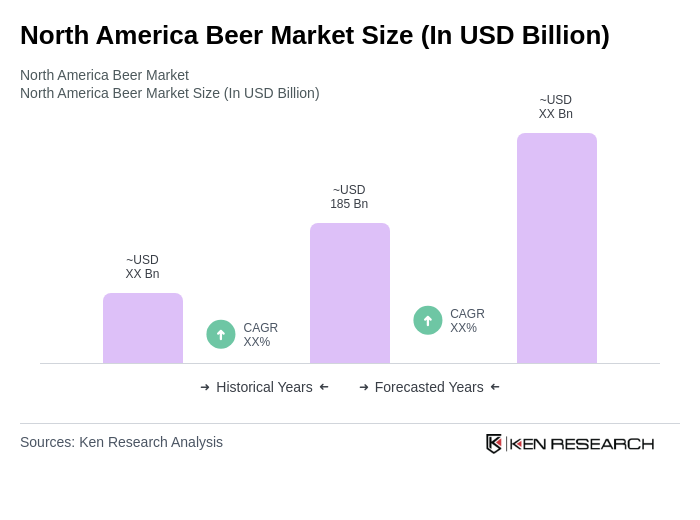
- The North America Beer Market is valued at approximately USD 185 billion, based on a five-year historical analysis. This value is consistent with multiple analyst estimates that place the market in the high-170s to around USD 190 billion range, reflecting recent consolidation, pricing growth, and stable consumption in core markets led by the United States . This growth is primarily driven by increasing consumer preference for craft and premium beers, flavor innovation, and the rise of health-conscious options such as low-calorie, low-alcohol, and non-alcoholic beers, alongside adjacent categories like hard seltzers and flavored malt beverages . Additionally, the market has benefited from robust retail distribution and the continued expansion of online and omnichannel alcohol delivery, which have improved consumer access and assortment .
- The United States, Canada, and Mexico dominate the North America Beer Market due to their rich brewing traditions, diverse consumer preferences, and strong beer culture. The U.S. accounts for the vast majority of regional sales and volume, supported by a large base of macro brands and a mature craft segment; independent industry tracking places the U.S. at over four-fifths of regional share, with Canada as the next largest market . The craft ecosystem, including thousands of breweries, has elevated variety and local relevance across the region .
- In 2023, the U.S. government implemented regulations aimed at reducing alcohol-related harm, including stricter labeling requirements for alcoholic beverages. This regulation mandates that all beer products clearly display alcohol content and health warnings, promoting responsible consumption. The initiative is part of a broader public health strategy to address alcohol misuse and enhance consumer awareness. While federal alcohol labeling is governed by the Alcohol and Tobacco Tax and Trade Bureau (TTB) and the Federal Alcohol Administration Act, recent policy emphasis and consumer health trend reporting continue to highlight alcohol content disclosure and health messaging as priorities for regulators and industry communications .
North America Beer Market Segmentation
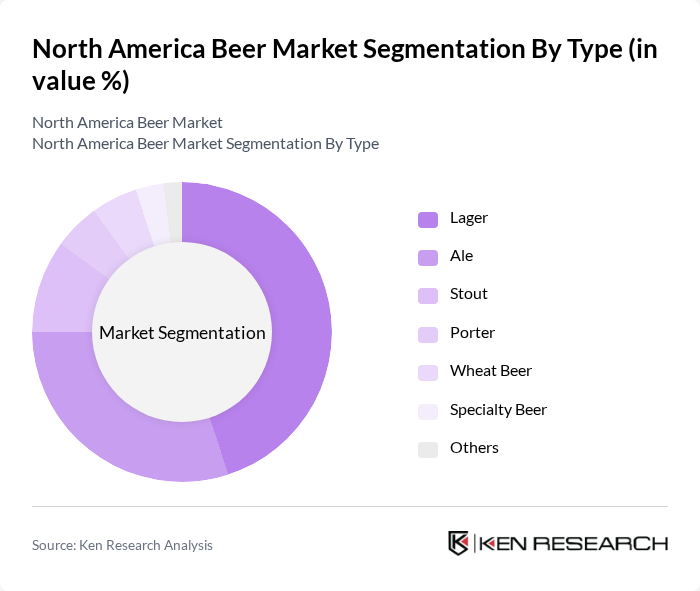
By Type:The beer market can be segmented into various types, including Lager, Ale, Stout, Porter, Wheat Beer, Specialty Beer, and Others. Among these,Lageris the most popular type across North America’s mainstream segment, supported by the scale of leading brands and consumer preference for crisp, sessionable profiles that anchor bar and retail menus .Ale, with its diverse flavor profiles, continues to gain traction within craft-led occasions (IPAs, pale ales, and specialty styles), reinforcing premiumization and variety-seeking behaviors . Specialty and limited-release beers appeal to consumers seeking unique and innovative options, often overlapping with seasonal and small-batch offerings from craft producers .
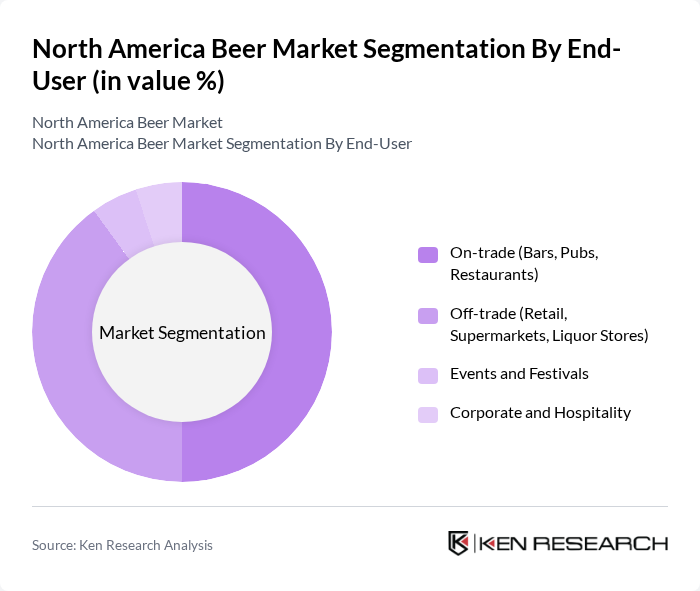
By End-User:The beer market is segmented by end-user categories, including On-trade (Bars, Pubs, Restaurants), Off-trade (Retail, Supermarkets, Liquor Stores), Events and Festivals, and Corporate and Hospitality. TheOn-tradesegment is material to brand building and experiential consumption; however, North America’s beer sales are significantly driven by theOff-tradechannel through supermarkets, liquor stores, and convenience retail, which benefits from broad assortment and price promotions . The On-trade channel remains critical for trial, limited releases, and draft-led experiences, while events and hospitality provide incremental occasion-based demand .
North America Beer Market Competitive Landscape
The North America Beer Market is characterized by a dynamic mix of regional and international players. Leading participants such as Anheuser-Busch InBev (AB InBev), Molson Coors Beverage Company, Constellation Brands, Inc., HEINEKEN USA Inc., Diageo North America, The Boston Beer Company, Sierra Nevada Brewing Co., New Belgium Brewing Company, Dogfish Head Craft Brewery, Lagunitas Brewing Company, Stone Brewing, Pabst Brewing Company, D.G. Yuengling & Son, Inc., Founders Brewing Co., Bell’s Brewery, Inc., Grupo Modelo (AB InBev) – North America, Cervecería Cuauhtémoc Moctezuma–Heineken México, Moosehead Breweries Limited, Labatt Brewing Company (AB InBev Canada), Sleeman Breweries Ltd. (Sapporo Breweries) contribute to innovation, geographic expansion, and service delivery in this space .
North America Beer Market Industry Analysis
Growth Drivers
- Increasing Craft Beer Popularity:The craft beer segment in North America has seen a rise, with over 9,000 craft breweries operating in the U.S. alone as of the most recent Brewers Association count. This growth is fueled by consumer demand for unique flavors and local products, contributing to a 10% increase in craft beer sales, which reached approximately $28 billion. The trend is expected to continue, driven by millennials who prioritize quality and authenticity in their beverage choices.
- Health-Conscious Consumer Trends:A significant shift towards health-conscious consumption is evident, with 30% of consumers actively seeking low-calorie and low-alcohol options. The rise of non-alcoholic and low-alcohol beers, which accounted for $0.5–1.0 billion in sales, reflects this trend. As consumers become more health-aware, breweries are innovating to create products that align with these preferences, thus expanding their market reach and enhancing brand loyalty.
- E-commerce Growth in Alcohol Sales:The e-commerce segment for alcohol sales has surged, with online sales projected to reach $7 billion, up from $4 billion. This growth is driven by the convenience of home delivery and the increasing acceptance of online purchasing among consumers. As more breweries establish direct-to-consumer sales channels, they can tap into a broader audience, enhancing their market presence and profitability.
Market Challenges
- Regulatory Compliance Complexity:The beer industry faces significant regulatory hurdles, with over 1,000 federal, state, and local regulations governing production and distribution. Compliance costs can exceed $100,000 annually for small breweries, impacting their financial viability. Navigating these regulations requires substantial resources, which can deter new entrants and stifle innovation within the market, ultimately limiting growth potential.
- Market Saturation in Key Regions:Key markets, particularly in urban areas, are experiencing saturation, with an average of 10 breweries per 100,000 residents in cities like Portland and San Francisco. This saturation leads to intense competition, making it challenging for new entrants to gain market share. As established brands dominate, smaller breweries may struggle to differentiate themselves, impacting overall market dynamics and profitability.
North America Beer Market Future Outlook
The North America beer market is poised for dynamic evolution, driven by shifting consumer preferences and innovative brewing practices. The increasing demand for craft and premium products, alongside the rise of e-commerce, will likely reshape distribution channels. Additionally, sustainability initiatives are expected to gain traction, influencing production methods. As breweries adapt to these trends, they will enhance their competitive edge, ensuring resilience in a rapidly changing market landscape.
Market Opportunities
- Expansion of Non-Alcoholic Beer Segment:The non-alcoholic beer segment is projected to grow significantly, with sales expected to reach $2 billion. This growth presents an opportunity for breweries to diversify their product offerings and cater to health-conscious consumers, thereby capturing a larger market share and enhancing brand loyalty.
- Growth in Sustainable Brewing Practices:As environmental concerns rise, breweries adopting sustainable practices can differentiate themselves. The market for sustainable beer is anticipated to grow by 15% annually, driven by consumer preference for eco-friendly products. This trend offers breweries a chance to enhance their brand image while appealing to a growing demographic focused on sustainability.
Scope of the Report
| Segment | Sub-Segments |
|---|---|
| By Type | Lager Ale Stout Porter Wheat Beer Specialty Beer Others |
| By End-User | On-trade (Bars, Pubs, Restaurants) Off-trade (Retail, Supermarkets, Liquor Stores) Events and Festivals Corporate and Hospitality |
| By Sales Channel | On-trade Off-trade Online (Direct-to-Consumer, Marketplaces) Specialty Beer Retailers |
| By Packaging Type | Bottles Cans Kegs Growlers/Crowlers |
| By Alcohol Content | Non-alcoholic/Alcohol-free (?0.5% ABV) Low Alcohol (0.5%–3.5% ABV) Regular (3.6%–5.5% ABV) High/Strong (>5.5% ABV) |
| By Region | United States Canada Mexico |
| By Price Range | Premium Mid-Range Economy |
| By Category | Craft Non-craft/Mainstream Imported Non-alcoholic |
Key Target Audience
Investors and Venture Capitalist Firms
Government and Regulatory Bodies (e.g., Alcohol and Tobacco Tax and Trade Bureau, Food and Drug Administration)
Manufacturers and Producers
Distributors and Retailers
Craft Beer Associations
Hospitality and Food Service Operators
Marketing and Advertising Agencies
Financial Institutions
Players Mentioned in the Report:
Anheuser-Busch InBev (AB InBev)
Molson Coors Beverage Company
Constellation Brands, Inc.
HEINEKEN USA Inc.
Diageo North America
The Boston Beer Company
Sierra Nevada Brewing Co.
New Belgium Brewing Company
Dogfish Head Craft Brewery
Lagunitas Brewing Company
Stone Brewing
Pabst Brewing Company
D.G. Yuengling & Son, Inc.
Founders Brewing Co.
Bells Brewery, Inc.
Grupo Modelo (AB InBev) North America
Cerveceria Cuauhtemoc MoctezumaHeineken Mexico
Moosehead Breweries Limited
Labatt Brewing Company (AB InBev Canada)
Sleeman Breweries Ltd. (Sapporo Breweries)
Table of Contents
Market Assessment Phase
1. Executive Summary and Approach
2. North America Beer Market Overview
2.1 Key Insights and Strategic Recommendations
2.2 North America Beer Market Overview
2.3 Definition and Scope
2.4 Evolution of Market Ecosystem
2.5 Timeline of Key Regulatory Milestones
2.6 Value Chain & Stakeholder Mapping
2.7 Business Cycle Analysis
2.8 Policy & Incentive Landscape
3. North America Beer Market Analysis
3.1 Growth Drivers
3.1.1 Increasing Craft Beer Popularity
3.1.2 Health-Conscious Consumer Trends
3.1.3 E-commerce Growth in Alcohol Sales
3.1.4 Innovative Flavors and Brewing Techniques
3.2 Market Challenges
3.2.1 Regulatory Compliance Complexity
3.2.2 Market Saturation in Key Regions
3.2.3 Supply Chain Disruptions
3.2.4 Changing Consumer Preferences
3.3 Market Opportunities
3.3.1 Expansion of Non-Alcoholic Beer Segment
3.3.2 Growth in Sustainable Brewing Practices
3.3.3 Increased Investment in Local Breweries
3.3.4 Collaboration with Food and Beverage Pairings
3.4 Market Trends
3.4.1 Rise of Hard Seltzers and Flavored Beers
3.4.2 Shift Towards Premium and Craft Products
3.4.3 Digital Marketing and Social Media Engagement
3.4.4 Focus on Environmental Sustainability
3.5 Government Regulation
3.5.1 State-Specific Alcohol Distribution Laws
3.5.2 Labeling and Advertising Regulations
3.5.3 Taxation Policies on Alcohol Sales
3.5.4 Health and Safety Standards Compliance
4. SWOT Analysis
5. Stakeholder Analysis
6. Porter's Five Forces Analysis
7. North America Beer Market Market Size, 2019-2024
7.1 By Value
7.2 By Volume
7.3 By Average Selling Price
8. North America Beer Market Segmentation
8.1 By Type
8.1.1 Lager
8.1.2 Ale
8.1.3 Stout
8.1.4 Porter
8.1.5 Wheat Beer
8.1.6 Specialty Beer
8.1.7 Others
8.2 By End-User
8.2.1 On-trade (Bars, Pubs, Restaurants)
8.2.2 Off-trade (Retail, Supermarkets, Liquor Stores)
8.2.3 Events and Festivals
8.2.4 Corporate and Hospitality
8.3 By Sales Channel
8.3.1 On-trade
8.3.2 Off-trade
8.3.3 Online (Direct-to-Consumer, Marketplaces)
8.3.4 Specialty Beer Retailers
8.4 By Packaging Type
8.4.1 Bottles
8.4.2 Cans
8.4.3 Kegs
8.4.4 Growlers/Crowlers
8.5 By Alcohol Content
8.5.1 Non-alcoholic/Alcohol-free (?0.5% ABV)
8.5.2 Low Alcohol (0.5%–3.5% ABV)
8.5.3 Regular (3.6%–5.5% ABV)
8.5.4 High/Strong (>5.5% ABV)
8.6 By Region
8.6.1 United States
8.6.2 Canada
8.6.3 Mexico
8.7 By Price Range
8.7.1 Premium
8.7.2 Mid-Range
8.7.3 Economy
8.8 By Category
8.8.1 Craft
8.8.2 Non-craft/Mainstream
8.8.3 Imported
8.8.4 Non-alcoholic
9. North America Beer Market Competitive Analysis
9.1 Market Share of Key Players
9.2 Cross Comparison of Key Players
9.2.1 Company Name
9.2.2 Group Size (Global, Regional, or Local brewer)
9.2.3 North America Beer Revenue (USD) and YoY Growth
9.2.4 Volume Share in North America (% of beer shipments)
9.2.5 On-trade vs Off-trade Mix (%)
9.2.6 Portfolio Mix (% Lager, Ale, Non-alcoholic, FMB/Hard Seltzer)
9.2.7 Average Realized Price per HL (USD/HL)
9.2.8 Distribution Reach (states/provinces covered, DSD vs 3-tier)
9.2.9 Brand Equity Metrics (Top-3 brands awareness/consideration)
9.2.10 Innovation Rate (% of revenue from launches ?24 months)
9.2.11 Capacity Utilization (%) and Brewery Count in NA
9.2.12 ESG KPIs (Water use ratio hl/hl, renewable energy share %)
9.3 SWOT Analysis of Top Players
9.4 Pricing Analysis
9.5 Detailed Profile of Major Companies
9.5.1 Anheuser-Busch InBev (AB InBev)
9.5.2 Molson Coors Beverage Company
9.5.3 Constellation Brands, Inc.
9.5.4 HEINEKEN USA Inc.
9.5.5 Diageo North America
9.5.6 The Boston Beer Company
9.5.7 Sierra Nevada Brewing Co.
9.5.8 New Belgium Brewing Company
9.5.9 Dogfish Head Craft Brewery
9.5.10 Lagunitas Brewing Company
9.5.11 Stone Brewing
9.5.12 Pabst Brewing Company
9.5.13 D.G. Yuengling & Son, Inc.
9.5.14 Founders Brewing Co.
9.5.15 Bell’s Brewery, Inc.
9.5.16 Grupo Modelo (AB InBev) – North America
9.5.17 Cervecería Cuauhtémoc Moctezuma–Heineken México
9.5.18 Moosehead Breweries Limited
9.5.19 Labatt Brewing Company (AB InBev Canada)
9.5.20 Sleeman Breweries Ltd. (Sapporo Breweries)
10. North America Beer Market End-User Analysis
10.1 Procurement Behavior of Key Ministries
10.1.1 Government Procurement Policies
10.1.2 Budget Allocations for Alcoholic Beverages
10.1.3 Supplier Selection Criteria
10.2 Corporate Spend on Infrastructure & Energy
10.2.1 Investment in Brewery Infrastructure
10.2.2 Energy Efficiency Initiatives
10.2.3 Sustainability Investments
10.3 Pain Point Analysis by End-User Category
10.3.1 Supply Chain Disruptions
10.3.2 Quality Control Issues
10.3.3 Regulatory Compliance Challenges
10.4 User Readiness for Adoption
10.4.1 Awareness of Craft Beer Options
10.4.2 Willingness to Experiment with New Brands
10.4.3 Accessibility of Products
10.5 Post-Deployment ROI and Use Case Expansion
10.5.1 Sales Growth Post-Implementation
10.5.2 Customer Feedback and Satisfaction
10.5.3 Market Expansion Opportunities
11. North America Beer Market Future Size, 2025-2030
11.1 By Value
11.2 By Volume
11.3 By Average Selling Price
Go-To-Market Strategy Phase
1. Whitespace Analysis + Business Model Canvas
1.1 Market Gaps Identification
1.2 Business Model Development
2. Marketing and Positioning Recommendations
2.1 Branding Strategies
2.2 Product USPs
3. Distribution Plan
3.1 Urban Retail Strategies
3.2 Rural NGO Tie-Ups
4. Channel & Pricing Gaps
4.1 Underserved Routes
4.2 Pricing Bands Analysis
5. Unmet Demand & Latent Needs
5.1 Category Gaps
5.2 Consumer Segments
6. Customer Relationship
6.1 Loyalty Programs
6.2 After-Sales Service
7. Value Proposition
7.1 Sustainability Initiatives
7.2 Integrated Supply Chains
8. Key Activities
8.1 Regulatory Compliance
8.2 Branding Efforts
8.3 Distribution Setup
9. Entry Strategy Evaluation
9.1 Domestic Market Entry Strategy
9.1.1 Product Mix Considerations
9.1.2 Pricing Band Strategy
9.1.3 Packaging Innovations
9.2 Export Entry Strategy
9.2.1 Target Countries Identification
9.2.2 Compliance Roadmap Development
10. Entry Mode Assessment
10.1 Joint Ventures
10.2 Greenfield Investments
10.3 Mergers & Acquisitions
10.4 Distributor Model Evaluation
11. Capital and Timeline Estimation
11.1 Capital Requirements Analysis
11.2 Timelines for Market Entry
12. Control vs Risk Trade-Off
12.1 Ownership vs Partnerships
13. Profitability Outlook
13.1 Breakeven Analysis
13.2 Long-Term Sustainability Assessment
14. Potential Partner List
14.1 Distributors
14.2 Joint Ventures
14.3 Acquisition Targets
15. Execution Roadmap
15.1 Phased Plan for Market Entry
15.1.1 Market Setup
15.1.2 Market Entry
15.1.3 Growth Acceleration
15.1.4 Scale & Stabilize
15.2 Key Activities and Milestones
15.2.1 Milestone Planning
15.2.2 Activity Tracking
Research Methodology
Phase 1: Approach1
Desk Research
- Analysis of industry reports from the Brewers Association and other relevant trade organizations
- Review of market trends and consumer behavior studies published by market research firms
- Examination of government publications and statistics related to alcohol consumption and regulations
Primary Research
- Interviews with brewers, distributors, and retailers to gather insights on market dynamics
- Surveys targeting consumers to understand preferences, purchasing habits, and brand loyalty
- Focus groups with craft beer enthusiasts to explore emerging trends and product innovations
Validation & Triangulation
- Cross-validation of findings through comparison with historical sales data and market forecasts
- Triangulation of insights from primary interviews with secondary data sources
- Sanity checks conducted through expert panel reviews comprising industry veterans
Phase 2: Market Size Estimation1
Top-down Assessment
- Estimation of total beer market size based on national consumption statistics and demographic data
- Segmentation of the market by beer type (craft, premium, mass-market) and distribution channel
- Incorporation of trends in health consciousness and craft beer popularity into market projections
Bottom-up Modeling
- Collection of sales data from key breweries and distributors to establish baseline volumes
- Analysis of pricing strategies across different beer segments to estimate revenue potential
- Volume x price calculations to derive market size estimates for each segment
Forecasting & Scenario Analysis
- Multi-factor regression analysis incorporating economic indicators, demographic shifts, and consumer trends
- Scenario modeling based on potential regulatory changes and shifts in consumer preferences
- Development of baseline, optimistic, and pessimistic forecasts through 2030
Phase 3: CATI Sample Composition1
| Scope Item/Segment | Sample Size | Target Respondent Profiles |
|---|---|---|
| Craft Beer Consumers | 140 | Craft Beer Enthusiasts, Regular Consumers |
| Retail Beer Outlets | 90 | Store Managers, Beverage Buyers |
| Distributors and Wholesalers | 80 | Sales Representatives, Distribution Managers |
| Breweries (Small and Large) | 70 | Owners, Head Brewers, Marketing Managers |
| Industry Experts and Analysts | 40 | Market Analysts, Industry Consultants |
Frequently Asked Questions
What is the current value of the North America Beer Market?
The North America Beer Market is valued at approximately USD 185 billion, reflecting a stable consumption pattern and growth driven by craft and premium beer preferences, flavor innovations, and health-conscious options.
Which countries dominate the North America Beer Market?
What are the main types of beer in the North America Beer Market?
How has consumer behavior influenced the North America Beer Market?
Other Regional/Country Reports
Why Buy From Us?

What makes us stand out is that our consultants follow Robust, Refine and Result (RRR) methodology. Robust for clear definitions, approaches and sanity checking, Refine for differentiating respondents' facts and opinions, and Result for presenting data with story.

We have set a benchmark in the industry by offering our clients with syndicated and customized market research reports featuring coverage of entire market as well as meticulous research and analyst insights.

While we don't replace traditional research, we flip the method upside down. Our dual approach of Top Bottom & Bottom Top ensures quality deliverable by not just verifying company fundamentals but also looking at the sector and macroeconomic factors.

With one step in the future, our research team constantly tries to show you the bigger picture. We help with some of the tough questions you may encounter along the way: How is the industry positioned? Best marketing channel? KPI's of competitors? By aligning every element, we help maximize success.

Our report gives you instant access to the answers and sources that other companies might choose to hide. We elaborate each steps of research methodology we have used and showcase you the sample size to earn your trust.

If you need any support, we are here! We pride ourselves on universe strength, data quality, and quick, friendly, and professional service.