








Ken Research Logo

Oman Gaming As A Service Market Report Size, Share, Growth Drivers, Trends, Opportunities & Forecast 2025–2030

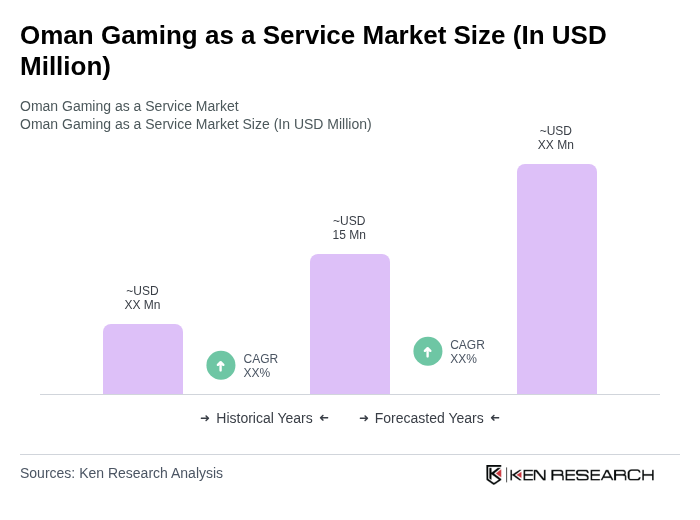
The Oman Gaming as a Service Market, valued at USD 15 million, is growing due to high internet penetration, mobile platforms, and government digital initiatives.

Region:Middle East

Author(s):Rebecca

Product Code:KRAD4922

Pages:99

Published On:December 2025
About the Report

Base Year 2024

Oman Gaming as a Service Market Overview

  • The Oman Gaming as a Service Market is valued at USD 15 million, based on a five-year historical analysis, in line with the broader Oman video game market valuation that is driven by high smartphone penetration, expanding 5G infrastructure, and a young, digitally engaged population. This growth is primarily supported by the increasing penetration of high-speed internet and 5G networks, the rise of mobile gaming, and the growing popularity of eSports and online streaming among the youth. The market is further underpinned by government initiatives under Oman Vision 2040 to promote digital transformation, cloud services, and technology adoption, which enhance the overall online entertainment and gaming ecosystem.
  • Muscat, the capital city, is a dominant player in the Oman Gaming as a Service Market due to its advanced telecom infrastructure, higher broadband penetration, and concentration of data centers and cloud PoPs that support low-latency services. Other cities like Salalah and Sohar are also emerging as significant contributors, driven by a young population eager to engage in gaming and digital entertainment and by expanding mobile broadband and 5G coverage beyond the capital. The presence and local partnerships of international cloud and gaming providers in Oman and the wider Middle East further enhance the market's growth potential by improving content delivery and user experience.
  • In 2023, the Omani government strengthened its digital and online content governance framework aimed at promoting responsible online activity and protecting minors, including gaming. Relevant instruments include the Child Law issued by Royal Decree No. 22/2014 and its implementing regulations, which mandate protection of children from harmful digital content and require safeguards for age-appropriate access, as well as the Cybercrime Law issued by Royal Decree No. 12/2011, which regulates misuse of information systems and online content. Within this framework, service providers operating in Oman are expected to apply age verification mechanisms, content classification and filtering, and mechanisms to prevent exploitation of minors in online environments, supporting a safer ecosystem for gaming and other digital entertainment services.
Oman Gaming as a Service Market Size

Oman Gaming as a Service Market Segmentation

By Service Model:The service model segmentation includes various offerings that cater to different aspects of gaming services. The subsegments are Cloud Gaming / Game Streaming Services, Gaming Platforms-as-a-Service (backend, matchmaking, analytics), Game Hosting & Server Rental Services, Managed eSports & Tournament Services, and White-Label Gaming-as-a-Service Solutions. Among these, Cloud Gaming / Game Streaming Services is currently the leading subsegment, aligned with regional trends where cloud and streaming platforms are among the fastest-growing parts of the gaming value chain, supported by 5G rollouts and GPU deployments. The convenience of accessing games without the need for high-end hardware, combined with increased broadband speeds and device-agnostic access, has made this model particularly appealing to consumers and telecom operators bundling gaming with data plans.
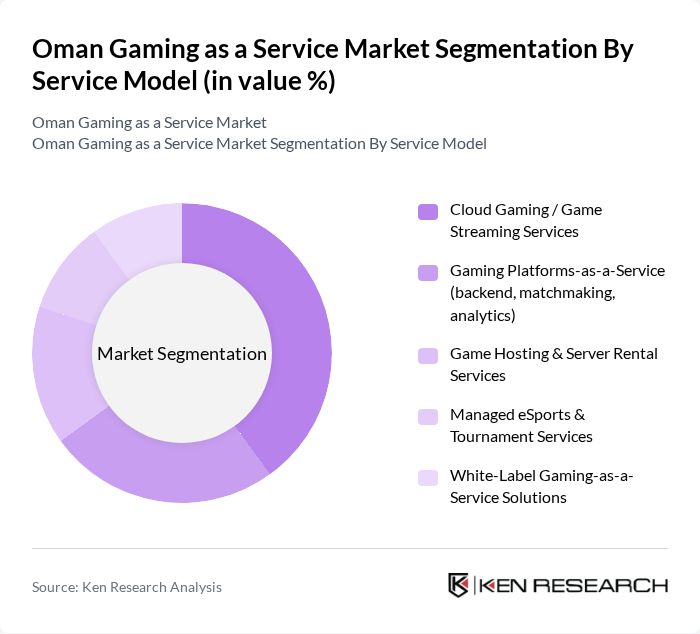
Oman Gaming as a Service Market segmentation by Service Model.

By Platform:This segmentation focuses on the various platforms through which gaming services are delivered. The subsegments include Mobile (Android / iOS), PC & Laptop, Console, Smart TV & Set-Top Box, and Web / Browser-Based. Mobile gaming is the dominant platform, consistent with the Oman video game market where mobile gaming accounts for over half of the market share, supported by widespread smartphone penetration, affordable data, and strong 4G/5G coverage. The convenience of gaming on-the-go, availability of free-to-play and in-app purchase models, and the increasing number of mobile gamers have solidified its position as the leading platform in the market.

Oman Gaming as a Service Market segmentation by Platform.

Oman Gaming as a Service Market Competitive Landscape

The Oman Gaming as a Service Market is characterized by a dynamic mix of regional and international players. Leading participants such as Omantel (Oman Telecommunications Company S.A.O.G.), Ooredoo Oman (Omani Qatari Telecommunications Company), Atyaf Home Entertainment LLC, Akamai Technologies Inc., Amazon Web Services (AWS) Middle East, Microsoft Azure Middle East & Africa, NVIDIA GeForce NOW, Blacknut Cloud Gaming, Tencent Cloud International, Google Cloud (including Google Play Games services), Meta Platforms Inc. (gaming & cloud infrastructure services), Unity Technologies (cloud gaming backend & live services), Epic Games Inc. (Epic Online Services / backend platform), PlayStation Network (Sony Interactive Entertainment), Xbox Cloud Gaming (Microsoft) contribute to innovation, geographic expansion, and service delivery in this space.

Omantel

1980

Muscat, Oman

Ooredoo Oman

2004

Muscat, Oman

Atyaf Home Entertainment LLC

2010

Muscat, Oman

Akamai Technologies Inc.

1998

Cambridge, Massachusetts, USA

Amazon Web Services (AWS)

2006

Seattle, Washington, USA

Company

Establishment Year

Headquarters

Group Size (Large, Medium, or Small as per industry convention)

Oman Gaming-as-a-Service Revenue

Revenue Growth Rate in Oman GaaS

Number of Paying Subscribers / Active Paying Users

Monthly Active Users (MAU) / Daily Active Users (DAU)

Average Revenue Per Paying User (ARPPU)

Oman Gaming as a Service Market Industry Analysis

Growth Drivers

  • Increasing Internet Penetration:As of future, Oman boasts an internet penetration rate of approximately 97%–98%, with around 4.7 million active internet users. This widespread access facilitates online gaming, allowing more individuals to engage with gaming platforms. The government’s investment in digital infrastructure, including fiber-optic networks, has significantly improved connectivity, enabling seamless gaming experiences. Enhanced internet access is crucial for the growth of the gaming sector, as it directly correlates with user engagement and market expansion.
  • Rising Mobile Gaming Popularity:Mobile gaming in Oman is experiencing a surge, with over 70% of gamers preferring mobile platforms. The number of mobile subscriptions reached 6.3 million in future, indicating a strong shift towards mobile gaming. This trend is supported by the increasing availability of affordable smartphones and mobile data plans. As mobile gaming becomes more accessible, it is expected to drive user engagement and revenue growth in the gaming sector, making it a key growth driver for the market.
  • Government Support for Digital Initiatives:The Omani government has allocated approximately $500 million towards digital transformation initiatives in future. This includes support for the gaming industry through favorable regulations and funding for local gaming startups. The government's commitment to fostering a digital economy is evident in its strategic plans, which aim to position Oman as a regional hub for technology and innovation. Such support is vital for attracting investments and encouraging the development of the gaming ecosystem.

Market Challenges

  • Regulatory Uncertainties:The gaming industry in Oman faces significant regulatory challenges, with unclear guidelines affecting operators. As of future, there are no specific laws governing online gaming, leading to confusion among stakeholders. This uncertainty can deter potential investors and limit the growth of local gaming companies. The lack of a clear regulatory framework poses risks for market participants, making it essential for the government to establish comprehensive regulations to foster a stable environment.
  • Limited Payment Gateway Options:In future, Oman has only three major payment gateways that support online gaming transactions, which limits the convenience for users. This lack of diversity in payment options can hinder user acquisition and retention, as gamers often prefer multiple payment methods. Additionally, the absence of internationally recognized payment systems can restrict foreign investments in the local gaming market. Addressing this challenge is crucial for enhancing the overall gaming experience and attracting a broader audience.

Oman Gaming as a Service Market Future Outlook

The future of the Oman gaming market appears promising, driven by technological advancements and increasing consumer interest. As cloud gaming services gain traction, more players are expected to enter the market, enhancing competition and innovation. Additionally, the integration of augmented reality (AR) technologies is likely to create immersive gaming experiences, attracting a diverse audience. With ongoing government support and infrastructure improvements, the market is poised for significant growth, fostering a vibrant gaming ecosystem in Oman.

Market Opportunities

  • Growth of Cloud Gaming Services:The cloud gaming sector is projected to expand rapidly, with an estimated 1.2 million users in Oman by future. This growth presents opportunities for local developers to create innovative gaming solutions that cater to the increasing demand for high-quality gaming experiences without the need for expensive hardware.
  • Development of Local Gaming Studios:With government support and a growing talent pool, the establishment of local gaming studios is becoming more feasible. By future, it is anticipated that at least 10 new studios will emerge, focusing on culturally relevant content, which can enhance user engagement and promote the Omani gaming identity on a global scale.

Scope of the Report

SegmentSub-Segments
By Service Model

Cloud Gaming / Game Streaming Services

Gaming Platforms-as-a-Service (backend, matchmaking, analytics)

Game Hosting & Server Rental Services

Managed eSports & Tournament Services

White-Label Gaming-as-a-Service Solutions

By Platform

Mobile (Android / iOS)

PC & Laptop

Console

Smart TV & Set-Top Box

Web / Browser-Based

By Revenue Model

Subscription (SVoD / Game Pass models)

Free-to-Play with In-Game Purchases

Pay-per-Use / Session-Based Access

Advertising-Supported

Hybrid Models

By End-User Segment

Individual Gamers

Game Publishers & Developers

Telecom Operators & ISPs

Enterprises (corporate engagement & training)

Educational & Training Institutions

By Deployment Type

Public Cloud

Private Cloud

Hybrid Cloud

On-Premise Managed Services

Edge / Local Data Center Deployment

By Content Type / Genre

Action & Adventure

Role-Playing Games (RPG)

Sports & Racing

Strategy & Simulation

Casual, Puzzle & Hyper-Casual

By Distribution & Access Channel

Telecom Bundled Offers

App Stores & Digital Marketplaces

Direct-to-Consumer Platforms

OEM / Device Manufacturer Partnerships

Third-Party Aggregators & Portals

Key Target Audience

Investors and Venture Capitalist Firms

Government and Regulatory Bodies (e.g., Ministry of Culture, Sports and Youth)

Game Developers and Publishers

Telecommunications Companies

Payment Processing Companies

Advertising and Marketing Agencies

Content Creators and Streamers

Gaming Hardware Manufacturers

Players Mentioned in the Report:

Omantel (Oman Telecommunication Company S.A.O.G.)

Ooredoo Oman (Omani Qatari Telecommunications Company)

Atyaf Home Entertainment LLC

Akamai Technologies Inc.

Amazon Web Services (AWS) Middle East

Microsoft Azure Middle East & Africa

NVIDIA GeForce NOW

Blacknut Cloud Gaming

Tencent Cloud International

Google Cloud (including Google Play Games services)

Meta Platforms Inc. (gaming & cloud infrastructure services)

Unity Technologies (cloud gaming backend & live services)

Epic Games Inc. (Epic Online Services / backend platform)

PlayStation Network (Sony Interactive Entertainment)

Xbox Cloud Gaming (Microsoft)

Table of Contents

Market Assessment Phase

1. Executive Summary and Approach


2. Oman Gaming as a Service Market Overview

2.1 Key Insights and Strategic Recommendations

2.2 Oman Gaming as a Service Market Overview

2.3 Definition and Scope

2.4 Evolution of Market Ecosystem

2.5 Timeline of Key Regulatory Milestones

2.6 Value Chain & Stakeholder Mapping

2.7 Business Cycle Analysis

2.8 Policy & Incentive Landscape


3. Oman Gaming as a Service Market Analysis

3.1 Growth Drivers

3.1.1 Increasing Internet Penetration
3.1.2 Rising Mobile Gaming Popularity
3.1.3 Government Support for Digital Initiatives
3.1.4 Expansion of E-sports Events

3.2 Market Challenges

3.2.1 Regulatory Uncertainties
3.2.2 Limited Payment Gateway Options
3.2.3 Cultural Resistance to Gaming
3.2.4 High Competition from Global Players

3.3 Market Opportunities

3.3.1 Growth of Cloud Gaming Services
3.3.2 Development of Local Gaming Studios
3.3.3 Partnerships with Telecom Providers
3.3.4 Investment in Gaming Infrastructure

3.4 Market Trends

3.4.1 Rise of Subscription-Based Gaming Models
3.4.2 Integration of Augmented Reality (AR)
3.4.3 Increased Focus on User Experience
3.4.4 Growth of Social Gaming Platforms

3.5 Government Regulation

3.5.1 Licensing Requirements for Operators
3.5.2 Age Restrictions on Gaming Content
3.5.3 Taxation Policies for Gaming Revenues
3.5.4 Compliance with Data Protection Laws

4. SWOT Analysis


5. Stakeholder Analysis


6. Porter's Five Forces Analysis


7. Oman Gaming as a Service Market Market Size, 2019-2024

7.1 By Value

7.2 By Volume

7.3 By Average Selling Price


8. Oman Gaming as a Service Market Segmentation

8.1 By Service Model

8.1.1 Cloud Gaming / Game Streaming Services
8.1.2 Gaming Platforms-as-a-Service (backend, matchmaking, analytics)
8.1.3 Game Hosting & Server Rental Services
8.1.4 Managed eSports & Tournament Services
8.1.5 White-Label Gaming-as-a-Service Solutions

8.2 By Platform

8.2.1 Mobile (Android / iOS)
8.2.2 PC & Laptop
8.2.3 Console
8.2.4 Smart TV & Set-Top Box
8.2.5 Web / Browser-Based

8.3 By Revenue Model

8.3.1 Subscription (SVoD / Game Pass models)
8.3.2 Free-to-Play with In-Game Purchases
8.3.3 Pay-per-Use / Session-Based Access
8.3.4 Advertising-Supported
8.3.5 Hybrid Models

8.4 By End-User Segment

8.4.1 Individual Gamers
8.4.2 Game Publishers & Developers
8.4.3 Telecom Operators & ISPs
8.4.4 Enterprises (corporate engagement & training)
8.4.5 Educational & Training Institutions

8.5 By Deployment Type

8.5.1 Public Cloud
8.5.2 Private Cloud
8.5.3 Hybrid Cloud
8.5.4 On-Premise Managed Services
8.5.5 Edge / Local Data Center Deployment

8.6 By Content Type / Genre

8.6.1 Action & Adventure
8.6.2 Role-Playing Games (RPG)
8.6.3 Sports & Racing
8.6.4 Strategy & Simulation
8.6.5 Casual, Puzzle & Hyper-Casual

8.7 By Distribution & Access Channel

8.7.1 Telecom Bundled Offers
8.7.2 App Stores & Digital Marketplaces
8.7.3 Direct-to-Consumer Platforms
8.7.4 OEM / Device Manufacturer Partnerships
8.7.5 Third-Party Aggregators & Portals

9. Oman Gaming as a Service Market Competitive Analysis

9.1 Market Share of Key Players

9.2 Cross Comparison of Key Players

9.2.1 Company Name
9.2.2 Group Size (Large, Medium, or Small as per industry convention)
9.2.3 Oman Gaming-as-a-Service Revenue
9.2.4 Revenue Growth Rate in Oman GaaS
9.2.5 Number of Paying Subscribers / Active Paying Users
9.2.6 Monthly Active Users (MAU) / Daily Active Users (DAU)
9.2.7 Average Revenue Per Paying User (ARPPU)
9.2.8 Churn Rate of Subscribers
9.2.9 Average Session Length / Playtime per User
9.2.10 Network Latency / Average Streaming Quality (Oman)
9.2.11 Market Share in Oman GaaS Segment
9.2.12 ARPU from Telecom-Bundled Users vs Direct Users
9.2.13 Content Portfolio Size (Number of Titles Available)
9.2.14 Data Center / Edge Presence in Oman or GCC

9.3 SWOT Analysis of Top Players

9.4 Pricing Analysis

9.5 Detailed Profile of Major Companies

9.5.1 Omantel (Oman Telecommunication Company S.A.O.G.)
9.5.2 Ooredoo Oman (Omani Qatari Telecommunications Company)
9.5.3 Atyaf Home Entertainment LLC
9.5.4 Akamai Technologies Inc.
9.5.5 Amazon Web Services (AWS) Middle East
9.5.6 Microsoft Azure Middle East & Africa
9.5.7 NVIDIA GeForce NOW
9.5.8 Blacknut Cloud Gaming
9.5.9 Tencent Cloud International
9.5.10 Google Cloud (including Google Play Games services)
9.5.11 Meta Platforms Inc. (gaming & cloud infrastructure services)
9.5.12 Unity Technologies (cloud gaming backend & live services)
9.5.13 Epic Games Inc. (Epic Online Services / backend platform)
9.5.14 PlayStation Network (Sony Interactive Entertainment)
9.5.15 Xbox Cloud Gaming (Microsoft)

10. Oman Gaming as a Service Market End-User Analysis

10.1 Procurement Behavior of Key Ministries

10.1.1 Ministry of Culture
10.1.2 Ministry of Education
10.1.3 Ministry of Youth and Sports
10.1.4 Ministry of Commerce

10.2 Corporate Spend on Infrastructure & Energy

10.2.1 Investment in Gaming Infrastructure
10.2.2 Expenditure on Digital Marketing
10.2.3 Budget for E-sports Events
10.2.4 Funding for Local Game Development

10.3 Pain Point Analysis by End-User Category

10.3.1 Gamers
10.3.2 Developers
10.3.3 Investors
10.3.4 Regulatory Bodies

10.4 User Readiness for Adoption

10.4.1 Awareness of Gaming Services
10.4.2 Accessibility of Gaming Platforms
10.4.3 Technical Support Availability
10.4.4 Community Engagement

10.5 Post-Deployment ROI and Use Case Expansion

10.5.1 User Retention Rates
10.5.2 Revenue Growth Post-Deployment
10.5.3 Expansion into New Markets
10.5.4 Feedback and Improvement Cycles

11. Oman Gaming as a Service Market Future Size, 2025-2030

11.1 By Value

11.2 By Volume

11.3 By Average Selling Price


Go-To-Market Strategy Phase

1. Whitespace Analysis + Business Model Canvas

1.1 Market Gaps Identification

1.2 Business Model Development


2. Marketing and Positioning Recommendations

2.1 Branding Strategies

2.2 Product USPs


3. Distribution Plan

3.1 Urban Retail vs Rural NGO Tie-ups


4. Channel & Pricing Gaps

4.1 Underserved Routes

4.2 Pricing Bands


5. Unmet Demand & Latent Needs

5.1 Category Gaps

5.2 Consumer Segments


6. Customer Relationship

6.1 Loyalty Programs

6.2 After-sales Service


7. Value Proposition

7.1 Sustainability

7.2 Integrated Supply Chains


8. Key Activities

8.1 Regulatory Compliance

8.2 Branding

8.3 Distribution Setup


9. Entry Strategy Evaluation

9.1 Domestic Market Entry Strategy

9.1.1 Product Mix
9.1.2 Pricing Band
9.1.3 Packaging

9.2 Export Entry Strategy

9.2.1 Target Countries
9.2.2 Compliance Roadmap

10. Entry Mode Assessment

10.1 JV

10.2 Greenfield

10.3 M&A

10.4 Distributor Model


11. Capital and Timeline Estimation

11.1 Capital Requirements

11.2 Timelines


12. Control vs Risk Trade-Off

12.1 Ownership vs Partnerships


13. Profitability Outlook

13.1 Breakeven Analysis

13.2 Long-term Sustainability


14. Potential Partner List

14.1 Distributors

14.2 JVs

14.3 Acquisition Targets


15. Execution Roadmap

15.1 Phased Plan for Market Entry

15.1.1 Market Setup
15.1.2 Market Entry
15.1.3 Growth Acceleration
15.1.4 Scale & Stabilize

15.2 Key Activities and Milestones

15.2.1 Milestone Planning
15.2.2 Activity Tracking

Research Methodology

ApproachModellingSample

Phase 1: Approach1

Desk Research

  • Analysis of market reports from regional gaming associations and government publications
  • Review of industry white papers and market analysis from gaming consultancy firms
  • Examination of demographic and economic data from the National Centre for Statistics and Information (NCSI) of Oman

Primary Research

  • Interviews with key stakeholders in the gaming industry, including game developers and service providers
  • Surveys targeting gamers to understand preferences and spending habits
  • Focus group discussions with gaming community leaders and influencers in Oman

Validation & Triangulation

  • Cross-validation of findings through multiple data sources, including sales data and user engagement metrics
  • Triangulation of insights from primary interviews with secondary data trends
  • Sanity checks conducted through expert panel reviews comprising industry veterans

Phase 2: Market Size Estimation1

Top-down Assessment

  • Estimation of total addressable market (TAM) based on regional gaming revenue statistics
  • Segmentation of the market by gaming type (mobile, console, PC) and service model (subscription, pay-per-play)
  • Incorporation of growth projections from government initiatives promoting digital entertainment

Bottom-up Modeling

  • Collection of data from local gaming companies regarding user acquisition and retention rates
  • Operational cost analysis based on service pricing models and user engagement
  • Estimation of revenue streams based on average spending per user (ARPU) across different gaming platforms

Forecasting & Scenario Analysis

  • Multi-factor regression analysis incorporating factors such as internet penetration and mobile device usage
  • Scenario modeling based on potential regulatory changes and shifts in consumer behavior
  • Development of baseline, optimistic, and pessimistic forecasts through 2030

Phase 3: CATI Sample Composition1

Scope Item/SegmentSample SizeTarget Respondent Profiles
Mobile Gaming Users150Casual Gamers, Mobile App Developers
Console Gaming Enthusiasts100Console Gamers, Retail Managers
PC Gaming Community90PC Gamers, eSports Organizers
Game Development Studios60Game Designers, Product Managers
Online Gaming Service Providers70Service Managers, Marketing Directors

Frequently Asked Questions

What is the current value of the Oman Gaming as a Service Market?

The Oman Gaming as a Service Market is valued at approximately USD 15 million, reflecting a growing interest in digital gaming driven by high smartphone penetration, expanding 5G infrastructure, and a young, digitally engaged population.

What factors are driving the growth of the Oman Gaming as a Service Market?

Which cities in Oman are significant for the Gaming as a Service Market?

What are the main service models in the Oman Gaming as a Service Market?

Other Regional/Country Reports

Indonesia Gaming As A Service Market

Malaysia Gaming As A Service Market

KSA Gaming As A Service Market

APAC Gaming As A Service Market

SEA Gaming As A Service Market

Vietnam Gaming As A Service Market

Why Buy From Us?

Refine Robust Result (RRR) Framework

What makes us stand out is that our consultants follow Robust, Refine and Result (RRR) methodology. Robust for clear definitions, approaches and sanity checking, Refine for differentiating respondents' facts and opinions, and Result for presenting data with story.

Our Reach Is Unmatched

We have set a benchmark in the industry by offering our clients with syndicated and customized market research reports featuring coverage of entire market as well as meticulous research and analyst insights.

Shifting the Research Paradigm

While we don't replace traditional research, we flip the method upside down. Our dual approach of Top Bottom & Bottom Top ensures quality deliverable by not just verifying company fundamentals but also looking at the sector and macroeconomic factors.

More Insights-Better Decisions

With one step in the future, our research team constantly tries to show you the bigger picture. We help with some of the tough questions you may encounter along the way: How is the industry positioned? Best marketing channel? KPI's of competitors? By aligning every element, we help maximize success.

Transparency and Trust

Our report gives you instant access to the answers and sources that other companies might choose to hide. We elaborate each steps of research methodology we have used and showcase you the sample size to earn your trust.

Round the Clock Support

If you need any support, we are here! We pride ourselves on universe strength, data quality, and quick, friendly, and professional service.

Why Clients Choose Us?

400000+
Reports in repository
150+
Consulting projects a year
100+
Analysts
8000+
Client Queries in 2022