About the Report
Base Year 2024United States Cloud Computing Market Overview
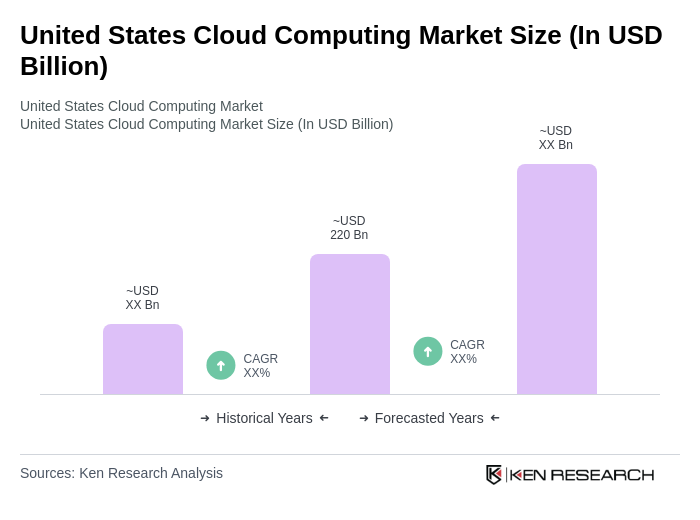
- The United States Cloud Computing Market is valued at USD 220 billion, based on a five-year historical analysis. This reflects validated U.S. cloud computing revenue in the low two-hundred billions range reported for the latest year, with Software as a Service as the largest revenue contributor and strong growth across IaaS and PaaS segments .
- Key players in this market include major technology hubs such as San Francisco, New York City, and Seattle. These hubs dominate due to dense concentrations of cloud and enterprise software firms, availability of venture capital, deep technical talent pools, and the extensive presence of leading providers and ecosystems around them .
- In 2023, the U.S. federal cloud agenda continued under government-wide strategies that direct agencies to adopt secure commercial cloud with standardized authorizations (FedRAMP) to improve efficiency, security, and cost outcomes; these initiatives encourage migration to cloud services while ensuring compliance with federal standards .
United States Cloud Computing Market Segmentation
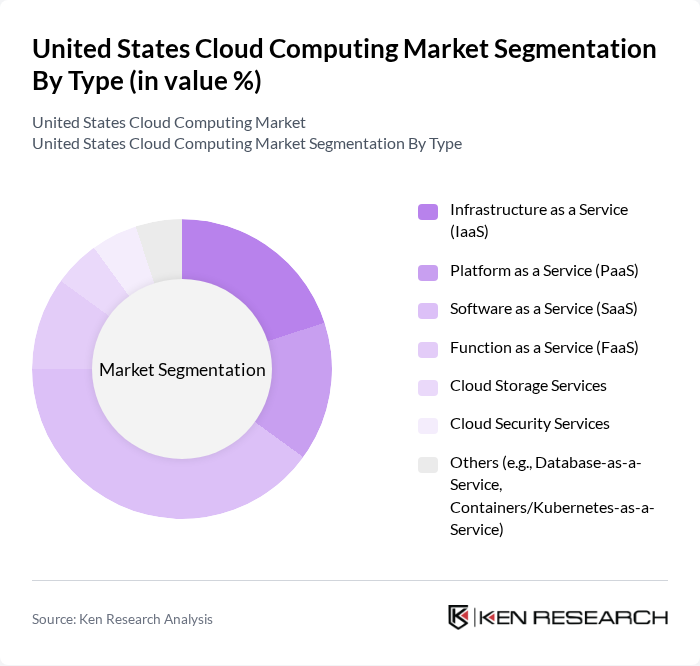
By Type:The cloud computing market can be segmented into various types, including Infrastructure as a Service (IaaS), Platform as a Service (PaaS), Software as a Service (SaaS), Function as a Service (FaaS), Cloud Storage Services, Cloud Security Services, and Others (e.g., Database-as-a-Service, Containers/Kubernetes-as-a-Service). Among these, SaaS has emerged as the dominant segment due to its widespread adoption across businesses of all sizes, driven by the need for cost-effective software solutions and ease of access. The flexibility and scalability offered by SaaS applications have made them particularly appealing to organizations looking to enhance productivity without significant upfront investments .
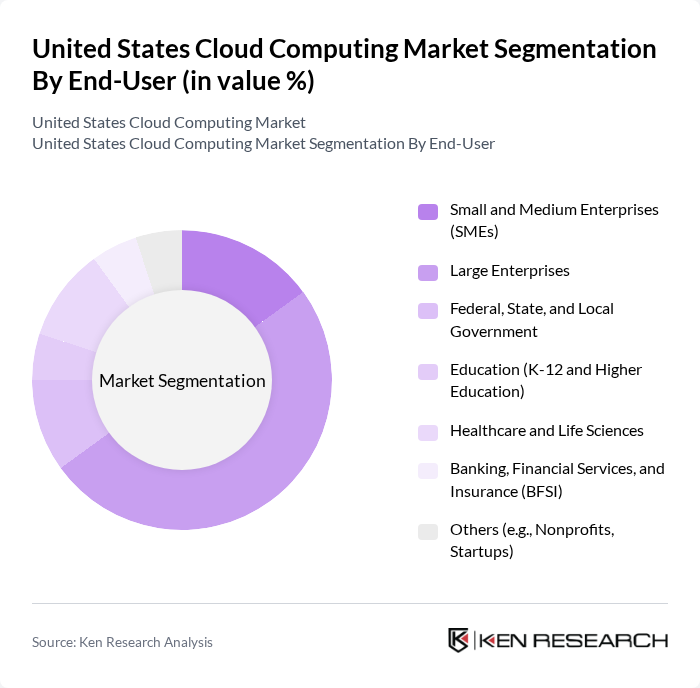
By End-User:The end-user segmentation of the cloud computing market includes Small and Medium Enterprises (SMEs), Large Enterprises, Federal, State, and Local Government, Education (K-12 and Higher Education), Healthcare and Life Sciences, Banking, Financial Services, and Insurance (BFSI), and Others (e.g., Nonprofits, Startups). Large Enterprises are the leading segment, primarily due to their substantial IT budgets and the need for advanced cloud solutions to manage complex operations. The trend towards digital transformation and the increasing reliance on data analytics have further propelled large organizations to adopt cloud services extensively .
United States Cloud Computing Market Competitive Landscape
The United States Cloud Computing Market is characterized by a dynamic mix of regional and international players. Leading participants such as Amazon Web Services, Inc. (AWS), Microsoft Corporation (Azure), Google Cloud (Alphabet Inc.), IBM Cloud, Oracle Cloud Infrastructure (OCI), Salesforce, Inc., VMware by Broadcom, Rackspace Technology, Inc., DigitalOcean Holdings, Inc., Snowflake Inc., ServiceNow, Inc., Cisco Systems, Inc. (Webex, AppDynamics, Observability), Datadog, Inc., Twilio Inc. (Twilio Segment), MongoDB, Inc. contribute to innovation, geographic expansion, and service delivery in this space .
United States Cloud Computing Market Industry Analysis
Growth Drivers
- Increased Demand for Remote Work Solutions:The COVID-19 pandemic accelerated the shift towards remote work, with 70% of U.S. companies adopting remote work policies in future. This transition has driven the demand for cloud-based collaboration tools, which are projected to reach one hundred billion dollars in revenue in future. As organizations seek to enhance productivity and maintain operational continuity, cloud solutions are becoming essential for remote workforce management, contributing significantly to market growth.
- Rising Adoption of AI and Machine Learning:The integration of AI and machine learning into cloud services is transforming business operations. In future, the AI cloud market is expected to exceed fifty billion dollars, driven by enterprises leveraging cloud platforms for data analytics and automation. This trend is supported by a projected thirty percent increase in AI-related cloud service adoption, as companies aim to enhance decision-making and operational efficiency through advanced technologies.
- Cost Efficiency and Scalability of Cloud Solutions:Businesses are increasingly recognizing the cost benefits of cloud computing, with an estimated forty percent reduction in IT costs reported by companies migrating to cloud solutions. The scalability offered by cloud services allows organizations to adjust resources based on demand, which is crucial in a volatile economic environment. By future, the total savings from cloud adoption are projected to reach two hundred billion dollars, further driving market expansion.
Market Challenges
- Data Privacy Concerns:As cloud adoption increases, so do concerns regarding data privacy and security. In future, sixty percent of U.S. businesses reported data breaches, leading to significant financial losses averaging four point twenty-four million dollars per incident. The stringent regulations, such as GDPR and CCPA, impose additional compliance costs, which can deter smaller companies from fully embracing cloud solutions, thus posing a challenge to market growth.
- High Initial Investment Costs:Despite long-term savings, the initial costs associated with cloud migration can be substantial. In future, businesses are expected to invest approximately thirty billion dollars in cloud infrastructure, which can be a barrier for small to medium-sized enterprises. The financial burden of transitioning to cloud services, including training and integration, may hinder widespread adoption, limiting market potential.
United States Cloud Computing Market Future Outlook
The future of the U.S. cloud computing market appears promising, driven by technological advancements and evolving business needs. As organizations increasingly adopt multi-cloud strategies, the demand for integrated solutions will rise. Furthermore, the focus on sustainability in cloud operations is expected to shape investment decisions, with companies prioritizing eco-friendly practices. The integration of IoT with cloud services will also enhance operational efficiencies, creating new avenues for growth and innovation in the sector.
Market Opportunities
- Growth in Edge Computing:The rise of edge computing presents significant opportunities for cloud providers. In future, the edge computing market is projected to reach fifteen billion dollars, driven by the need for real-time data processing and reduced latency. This trend will enable businesses to enhance their operational capabilities, creating a demand for cloud services that support edge infrastructure.
- Increased Investment in Cloud Startups:Venture capital investment in cloud startups is expected to exceed twenty-five billion dollars in future, reflecting a growing interest in innovative cloud solutions. This influx of capital will foster technological advancements and drive competition, leading to the development of new services that cater to diverse business needs, thus expanding the overall market landscape.
Scope of the Report
| Segment | Sub-Segments |
|---|---|
| By Type | Infrastructure as a Service (IaaS) Platform as a Service (PaaS) Software as a Service (SaaS) Function as a Service (FaaS) Cloud Storage Services Cloud Security Services Others (e.g., Database-as-a-Service, Containers/Kubernetes-as-a-Service) |
| By End-User | Small and Medium Enterprises (SMEs) Large Enterprises Federal, State, and Local Government Education (K-12 and Higher Education) Healthcare and Life Sciences Banking, Financial Services, and Insurance (BFSI) Others (e.g., Nonprofits, Startups) |
| By Deployment Model | Public Cloud Private Cloud Hybrid Cloud Multi-Cloud Edge Cloud |
| By Industry Vertical | IT and Telecommunications Retail and E-commerce Manufacturing Media and Entertainment Transportation and Logistics Energy and Utilities Public Sector and Defense Others |
| By Service Model | Managed Services Professional Services Consulting Services Support and Maintenance Services FinOps and Cost Optimization Services |
| By Geographic Presence | Northeast Midwest South West Others (U.S. territories) |
| By Pricing Model | Subscription-Based Pay-As-You-Go (Consumption-Based) Tiered Pricing Reserved/Committed Use Pricing Others (e.g., Spot/Preemptible Instances) |
Key Target Audience
Investors and Venture Capitalist Firms
Government and Regulatory Bodies (e.g., Federal Communications Commission, National Institute of Standards and Technology)
Cloud Service Providers
Telecommunications Companies
Data Center Operators
Cybersecurity Firms
Enterprise IT Departments
Industry Associations (e.g., Cloud Native Computing Foundation, Computing Technology Industry Association)
Players Mentioned in the Report:
Amazon Web Services, Inc. (AWS)
Microsoft Corporation (Azure)
Google Cloud (Alphabet Inc.)
IBM Cloud
Oracle Cloud Infrastructure (OCI)
Salesforce, Inc.
VMware by Broadcom
Rackspace Technology, Inc.
DigitalOcean Holdings, Inc.
Snowflake Inc.
ServiceNow, Inc.
Cisco Systems, Inc. (Webex, AppDynamics, Observability)
Datadog, Inc.
Twilio Inc. (Twilio Segment)
MongoDB, Inc.
Table of Contents
Market Assessment Phase
1. Executive Summary and Approach
2. United States Cloud Computing Market Overview
2.1 Key Insights and Strategic Recommendations
2.2 United States Cloud Computing Market Overview
2.3 Definition and Scope
2.4 Evolution of Market Ecosystem
2.5 Timeline of Key Regulatory Milestones
2.6 Value Chain & Stakeholder Mapping
2.7 Business Cycle Analysis
2.8 Policy & Incentive Landscape
3. United States Cloud Computing Market Analysis
3.1 Growth Drivers
3.1.1 Increased Demand for Remote Work Solutions
3.1.2 Rising Adoption of AI and Machine Learning
3.1.3 Enhanced Data Security and Compliance Needs
3.1.4 Cost Efficiency and Scalability of Cloud Solutions
3.2 Market Challenges
3.2.1 Data Privacy Concerns
3.2.2 High Initial Investment Costs
3.2.3 Complexity of Migration to Cloud
3.2.4 Limited Skilled Workforce
3.3 Market Opportunities
3.3.1 Growth in Edge Computing
3.3.2 Expansion of Hybrid Cloud Solutions
3.3.3 Increased Investment in Cloud Startups
3.3.4 Demand for Cloud-Based Disaster Recovery Solutions
3.4 Market Trends
3.4.1 Shift Towards Multi-Cloud Strategies
3.4.2 Rise of Serverless Computing
3.4.3 Focus on Sustainability in Cloud Operations
3.4.4 Integration of IoT with Cloud Services
3.5 Government Regulation
3.5.1 GDPR Compliance for US Companies
3.5.2 CCPA Implementation
3.5.3 Federal Cloud Computing Strategy
3.5.4 Cybersecurity Frameworks for Cloud Providers
4. SWOT Analysis
5. Stakeholder Analysis
6. Porter's Five Forces Analysis
7. United States Cloud Computing Market Market Size, 2019-2024
7.1 By Value
7.2 By Volume
7.3 By Average Selling Price
8. United States Cloud Computing Market Segmentation
8.1 By Type
8.1.1 Infrastructure as a Service (IaaS)
8.1.2 Platform as a Service (PaaS)
8.1.3 Software as a Service (SaaS)
8.1.4 Function as a Service (FaaS)
8.1.5 Cloud Storage Services
8.1.6 Cloud Security Services
8.1.7 Others (e.g., Database-as-a-Service, Containers/Kubernetes-as-a-Service)
8.2 By End-User
8.2.1 Small and Medium Enterprises (SMEs)
8.2.2 Large Enterprises
8.2.3 Federal, State, and Local Government
8.2.4 Education (K-12 and Higher Education)
8.2.5 Healthcare and Life Sciences
8.2.6 Banking, Financial Services, and Insurance (BFSI)
8.2.7 Others (e.g., Nonprofits, Startups)
8.3 By Deployment Model
8.3.1 Public Cloud
8.3.2 Private Cloud
8.3.3 Hybrid Cloud
8.3.4 Multi-Cloud
8.3.5 Edge Cloud
8.4 By Industry Vertical
8.4.1 IT and Telecommunications
8.4.2 Retail and E-commerce
8.4.3 Manufacturing
8.4.4 Media and Entertainment
8.4.5 Transportation and Logistics
8.4.6 Energy and Utilities
8.4.7 Public Sector and Defense
8.4.8 Others
8.5 By Service Model
8.5.1 Managed Services
8.5.2 Professional Services
8.5.3 Consulting Services
8.5.4 Support and Maintenance Services
8.5.5 FinOps and Cost Optimization Services
8.6 By Geographic Presence
8.6.1 Northeast
8.6.2 Midwest
8.6.3 South
8.6.4 West
8.6.5 Others (U.S. territories)
8.7 By Pricing Model
8.7.1 Subscription-Based
8.7.2 Pay-As-You-Go (Consumption-Based)
8.7.3 Tiered Pricing
8.7.4 Reserved/Committed Use Pricing
8.7.5 Others (e.g., Spot/Preemptible Instances)
9. United States Cloud Computing Market Competitive Analysis
9.1 Market Share of Key Players
9.2 Cross Comparison of Key Players
9.2.1 Company Name
9.2.2 Segment Focus (IaaS, PaaS, SaaS, Multi-cloud services)
9.2.3 U.S. Revenue from Cloud Services (latest fiscal year)
9.2.4 YoY Cloud Revenue Growth (U.S. or North America)
9.2.5 Data Center Footprint (No. of U.S. regions/availability zones)
9.2.6 Customer Acquisition Cost (CAC) Proxy (Sales & marketing as % of revenue)
9.2.7 Net Dollar Retention (NDR) / Expansion Rate
9.2.8 Gross Margin (Cloud or consolidated, if disclosed)
9.2.9 Average Contract Value (ACV) / ARPU (enterprise)
9.2.10 Churn Rate (logo or revenue, if disclosed)
9.2.11 Customer Lifetime Value (CLV) Proxy (ARPU × gross margin × avg. tenure)
9.2.12 Pricing Model (on-demand, reserved/committed, spot; discounts)
9.2.13 SLA and Compliance (SLA uptime %, FedRAMP/DoD IL, HIPAA, SOC 2)
9.2.14 Market Penetration (U.S. enterprise adoption, key vertical wins)
9.2.15 Partner Ecosystem Strength (MSPs, ISVs, marketplace listings)
9.3 SWOT Analysis of Top Players
9.4 Pricing Analysis
9.5 Detailed Profile of Major Companies
9.5.1 Amazon Web Services, Inc. (AWS)
9.5.2 Microsoft Corporation (Azure)
9.5.3 Google Cloud (Alphabet Inc.)
9.5.4 IBM Cloud
9.5.5 Oracle Cloud Infrastructure (OCI)
9.5.6 Salesforce, Inc.
9.5.7 VMware by Broadcom
9.5.8 Rackspace Technology, Inc.
9.5.9 DigitalOcean Holdings, Inc.
9.5.10 Snowflake Inc.
9.5.11 ServiceNow, Inc.
9.5.12 Cisco Systems, Inc. (Webex, AppDynamics, Observability)
9.5.13 Datadog, Inc.
9.5.14 Twilio Inc. (Twilio Segment)
9.5.15 MongoDB, Inc.
10. United States Cloud Computing Market End-User Analysis
10.1 Procurement Behavior of Key Ministries
10.1.1 Federal Government Procurement Trends
10.1.2 State Government Cloud Adoption Rates
10.1.3 Local Government Cloud Initiatives
10.1.4 Budget Allocations for Cloud Services
10.2 Corporate Spend on Infrastructure & Energy
10.2.1 IT Infrastructure Investments
10.2.2 Energy Efficiency Initiatives
10.2.3 Cloud Migration Budgets
10.2.4 Spending on Cybersecurity Solutions
10.3 Pain Point Analysis by End-User Category
10.3.1 Data Security Concerns
10.3.2 Integration Challenges
10.3.3 Cost Management Issues
10.3.4 Compliance and Regulatory Hurdles
10.4 User Readiness for Adoption
10.4.1 Training and Skill Development Needs
10.4.2 Change Management Strategies
10.4.3 Technology Infrastructure Readiness
10.4.4 User Acceptance Testing Feedback
10.5 Post-Deployment ROI and Use Case Expansion
10.5.1 Performance Metrics Tracking
10.5.2 User Satisfaction Surveys
10.5.3 Cost Savings Analysis
10.5.4 Future Use Case Development
11. United States Cloud Computing Market Future Size, 2025-2030
11.1 By Value
11.2 By Volume
11.3 By Average Selling Price
Go-To-Market Strategy Phase
1. Whitespace Analysis + Business Model Canvas
1.1 Market Gaps Identification
1.2 Business Model Framework
2. Marketing and Positioning Recommendations
2.1 Branding Strategies
2.2 Product USPs
3. Distribution Plan
3.1 Urban Retail Strategies
3.2 Rural NGO Tie-Ups
4. Channel & Pricing Gaps
4.1 Underserved Routes
4.2 Pricing Bands Analysis
5. Unmet Demand & Latent Needs
5.1 Category Gaps
5.2 Consumer Segments
6. Customer Relationship
6.1 Loyalty Programs
6.2 After-Sales Service
7. Value Proposition
7.1 Sustainability Initiatives
7.2 Integrated Supply Chains
8. Key Activities
8.1 Regulatory Compliance
8.2 Branding Efforts
8.3 Distribution Setup
9. Entry Strategy Evaluation
9.1 Domestic Market Entry Strategy
9.1.1 Product Mix Considerations
9.1.2 Pricing Band Strategy
9.1.3 Packaging Options
9.2 Export Entry Strategy
9.2.1 Target Countries
9.2.2 Compliance Roadmap
10. Entry Mode Assessment
10.1 Joint Ventures
10.2 Greenfield Investments
10.3 Mergers & Acquisitions
10.4 Distributor Model
11. Capital and Timeline Estimation
11.1 Capital Requirements
11.2 Timelines for Implementation
12. Control vs Risk Trade-Off
12.1 Ownership Considerations
12.2 Partnerships Evaluation
13. Profitability Outlook
13.1 Breakeven Analysis
13.2 Long-Term Sustainability
14. Potential Partner List
14.1 Distributors
14.2 Joint Ventures
14.3 Acquisition Targets
15. Execution Roadmap
15.1 Phased Plan for Market Entry
15.1.1 Market Setup
15.1.2 Market Entry
15.1.3 Growth Acceleration
15.1.4 Scale & Stabilize
15.2 Key Activities and Milestones
15.2.1 Milestone Tracking
15.2.2 Activity Scheduling
Research Methodology
Phase 1: Approach1
Desk Research
- Analysis of industry reports from leading cloud computing associations and market research firms
- Review of government publications and white papers on cloud adoption trends in the U.S.
- Examination of financial reports and press releases from major cloud service providers
Primary Research
- Interviews with IT decision-makers in various sectors, including healthcare, finance, and retail
- Surveys targeting cloud service users to gather insights on satisfaction and usage patterns
- Focus groups with cloud technology experts to discuss emerging trends and challenges
Validation & Triangulation
- Cross-validation of findings through multiple data sources, including market reports and expert opinions
- Triangulation of quantitative data with qualitative insights from interviews and surveys
- Sanity checks conducted through expert panel reviews to ensure data accuracy and relevance
Phase 2: Market Size Estimation1
Top-down Assessment
- Estimation of total addressable market (TAM) based on overall IT spending in the U.S.
- Segmentation of the market by cloud service type (IaaS, PaaS, SaaS) and industry verticals
- Incorporation of growth rates from historical data and projected trends in cloud adoption
Bottom-up Modeling
- Collection of data on cloud service pricing from leading providers to establish a cost framework
- Estimation of user adoption rates based on firm size and industry characteristics
- Volume x pricing model to calculate revenue potential across different cloud service segments
Forecasting & Scenario Analysis
- Multi-factor regression analysis incorporating economic indicators and technology adoption rates
- Scenario planning based on potential regulatory changes and market disruptions
- Development of baseline, optimistic, and pessimistic forecasts through 2030
Phase 3: CATI Sample Composition1
| Scope Item/Segment | Sample Size | Target Respondent Profiles |
|---|---|---|
| Healthcare Cloud Adoption | 120 | IT Managers, Chief Information Officers |
| Financial Services Cloud Solutions | 100 | Risk Management Officers, IT Security Managers |
| Retail Cloud Infrastructure | 110 | Operations Directors, E-commerce Managers |
| Manufacturing Cloud Integration | 90 | Supply Chain Managers, IT Directors |
| Education Sector Cloud Services | 80 | IT Administrators, Educational Technology Coordinators |
Frequently Asked Questions
What is the current value of the United States Cloud Computing Market?
The United States Cloud Computing Market is valued at approximately USD 220 billion, reflecting a robust growth trajectory driven by the increasing adoption of cloud services across various sectors, particularly Software as a Service (SaaS).
Which segments contribute most to the U.S. Cloud Computing Market?
What are the key technology hubs for cloud computing in the U.S.?
How has the U.S. federal government influenced cloud adoption?
Other Regional/Country Reports
Why Buy From Us?

What makes us stand out is that our consultants follow Robust, Refine and Result (RRR) methodology. Robust for clear definitions, approaches and sanity checking, Refine for differentiating respondents' facts and opinions, and Result for presenting data with story.

We have set a benchmark in the industry by offering our clients with syndicated and customized market research reports featuring coverage of entire market as well as meticulous research and analyst insights.

While we don't replace traditional research, we flip the method upside down. Our dual approach of Top Bottom & Bottom Top ensures quality deliverable by not just verifying company fundamentals but also looking at the sector and macroeconomic factors.

With one step in the future, our research team constantly tries to show you the bigger picture. We help with some of the tough questions you may encounter along the way: How is the industry positioned? Best marketing channel? KPI's of competitors? By aligning every element, we help maximize success.

Our report gives you instant access to the answers and sources that other companies might choose to hide. We elaborate each steps of research methodology we have used and showcase you the sample size to earn your trust.

If you need any support, we are here! We pride ourselves on universe strength, data quality, and quick, friendly, and professional service.