Ken Research Logo

Oman Micro Fulfillment Market Report Size, Share, Growth Drivers, Trends, Opportunities & Forecast 2025–2030

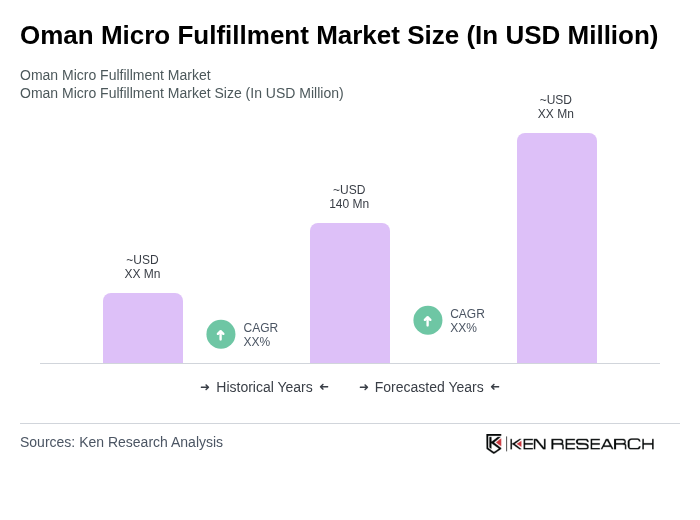
Oman Micro Fulfillment Market, valued at USD 140 million, is growing due to rising e-commerce, fast delivery needs, and government logistics reforms like SOLS 2040.

Region:Middle East

Author(s):Rebecca

Product Code:KRAD5064

Pages:83

Published On:December 2025
About the Report

Base Year 2024

Oman Micro Fulfillment Market Overview

  • The Oman Micro Fulfillment Market is valued at USD 140 million, based on a five-year historical analysis and alignment with the overall logistics and warehousing base in Oman, where the broader logistics and warehousing market is around USD 1.0 billion and the third?party logistics market is slightly above USD 1.0 billion. This growth is primarily driven by the increasing demand for faster delivery services, the rapid rise of e-commerce and omni-channel retail, and the need for efficient, automated supply chain solutions that can support same?day and next?day delivery. The market has seen a gradual shift towards micro fulfillment centers and dark-store models, which allow retailers and logistics providers to position inventory closer to consumers and improve order picking speed and accuracy for online grocery, general retail, and quick commerce orders.
  • Muscat, the capital city, is the dominant player in the Oman Micro Fulfillment Market due to its high population density, concentration of modern retail formats, and role as the main hub for e-commerce, logistics, and warehousing activities in the country. Other notable regions include Al Batinah and Dhofar, where ongoing urbanization, growth of organized retail, and increasing consumer spending are driving demand for warehousing, last?mile logistics, and e-commerce fulfillment solutions. These areas are witnessing a rise in online shopping penetration in line with broader Middle East retail and e-commerce trends, supporting adoption of smaller, strategically located fulfillment nodes to improve delivery times and service coverage.
  • In 2023, the Omani government continued implementing logistics and customs reforms under the National Logistics Strategy (SOLS 2040) to enhance the logistics sector, including warehousing, distribution centers, and urban logistics infrastructure that underpin micro fulfillment models. A key regulatory and policy framework shaping these developments is Royal Decree 29/2012 issuing the Customs Law and its subsequent implementing regulations by the Directorate General of Customs, which set operational rules for bonded warehouses, customs procedures, and the movement and storage of goods for logistics and fulfillment providers. In parallel, Oman Logistics Center (ASYAD) and government-led logistics programs have facilitated investments in warehouse parks, free zones, and technology-enabled logistics platforms, with dedicated funding within broader logistics and infrastructure budgets supporting digitalization, automation, and capacity expansion relevant to micro fulfillment operations.
Oman Micro Fulfillment Market Size

Oman Micro Fulfillment Market Segmentation

By Type:The market is segmented into various types of micro fulfillment centers, including store-based micro fulfillment centers, dark stores, third-party logistics operated centers, and automated modules. Store-based micro fulfillment centers typically operate within or adjacent to supermarkets and hypermarkets, enabling efficient in-store picking or automated picking for online grocery and click-and-collect orders. Dark stores and dedicated micro fulfillment warehouses are optimized for high?throughput online order processing without in?store shoppers, supporting both grocery and general merchandise. Third?party logistics operated centers provide shared, multi-client facilities and technology platforms that allow retailers and brands to outsource e-commerce fulfillment and last?mile preparation. Automated micro fulfillment modules and lockers, often using shuttle, cube storage, or autonomous mobile robot technologies, support rapid picking, consolidation, and contactless pickup in urban locations and transportation hubs.
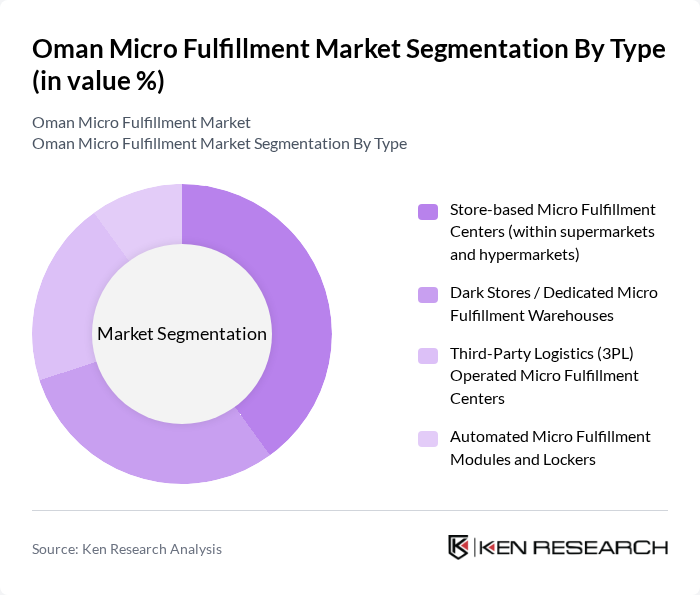
Oman Micro Fulfillment Market segmentation by Type.

By End-User:The end-user segmentation includes grocery and hypermarket retailers, pure-play e-commerce platforms, quick commerce services, pharma distributors, and other retail merchants. Grocery and hypermarket retailers are leading the segment due to the strong shift of consumers toward online grocery and omni-channel shopping, with micro fulfillment used to support click-and-collect, curbside pickup, and home delivery of fresh produce and daily essentials. Pure-play e-commerce and marketplaces rely on micro fulfillment centers and localized warehouses to shorten delivery lead times and improve last?mile efficiency, while quick commerce and food delivery platforms leverage dark stores and small warehouses to enable sub?hour deliveries in dense urban catchments. Pharma and healthcare distributors increasingly explore temperature?controlled micro fulfillment and proximity stocking for prescription medicines and over-the-counter products, and other retail and SME merchants benefit from shared or 3PL-operated micro fulfillment capacity that reduces their capital expenditure and speeds up digital channel enablement.
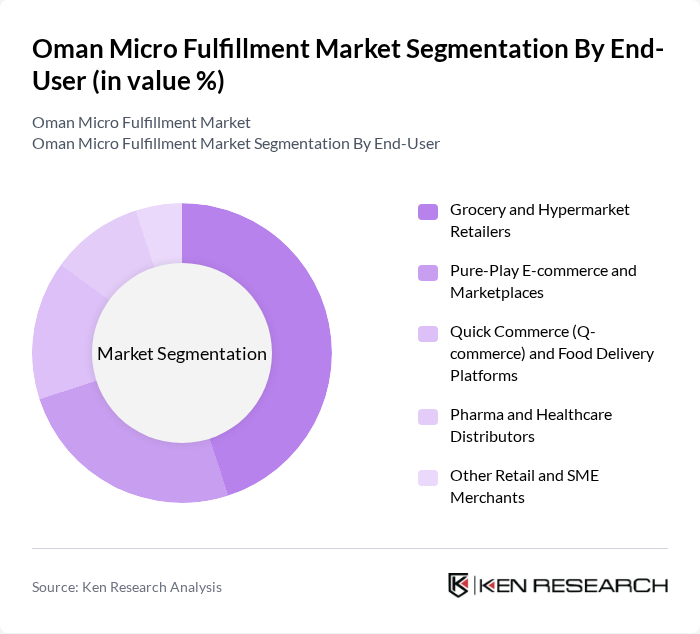
Oman Micro Fulfillment Market segmentation by End-User.

Oman Micro Fulfillment Market Competitive Landscape

The Oman Micro Fulfillment Market is characterized by a dynamic mix of regional and international players. Leading participants such as LuLu Hypermarket Oman, Carrefour Oman (Majid Al Futtaim Retail), Talabat Oman, Asyad Group (Integrated Logistics and Warehousing), Oman Post & Logistics Services, Khimji Ramdas Logistics, Fetchr Oman, Al Nowras Logistics, Oman Air Cargo, Al Madina Logistics Services Company, Aramex Oman, DHL Express Oman, FedEx Express Oman, J&T Express Oman, Akeed (Local Food and Grocery Delivery Platform) contribute to innovation, geographic expansion, and service delivery in this space, leveraging Oman’s growing logistics and warehousing base and the expansion of e-commerce fulfillment across the Middle East.

LuLu Hypermarket Oman

2000

Muscat, Oman

Carrefour Oman (Majid Al Futtaim Retail)

1995

Muscat, Oman

Talabat Oman

2004

Muscat, Oman

Asyad Group

2016

Muscat, Oman

Oman Post & Logistics Services

2005

Muscat, Oman

Company

Establishment Year

Headquarters

Ownership / Player Type (Retailer, 3PL, Parcel Express, Tech Provider)

Installed Micro Fulfillment Capacity (no. of sites and total pallet/bin positions)

Order Processing Throughput (orders per day per site)

On-time Delivery Rate (within promised SLA)

Average Order Cycle Time (from order placement to dispatch)

Last-mile Coverage (share of population / urban areas served)

Oman Micro Fulfillment Market Industry Analysis

Growth Drivers

  • Increasing Demand for Fast Delivery:The demand for fast delivery services in Oman is surging, with the logistics sector projected to grow by 6.5% annually, reaching an estimated value of OMR 1.3 billion by future. This growth is driven by consumer expectations for rapid fulfillment, particularly in urban areas where 70% of the population resides. The rise in online shopping, which saw a 35% increase in future, further fuels this demand, compelling businesses to adopt micro fulfillment strategies.
  • Rise of E-commerce Platforms:E-commerce in Oman is experiencing exponential growth, with online sales expected to reach OMR 600 million in future, up from OMR 400 million in future. This surge is attributed to increased internet penetration, which stands at 99%, and a growing preference for online shopping among consumers. As e-commerce platforms expand their offerings, the need for efficient micro fulfillment solutions becomes critical to meet customer expectations for speed and convenience.
  • Technological Advancements in Logistics:The logistics sector in Oman is embracing technological innovations, with investments in automation and AI projected to exceed OMR 120 million by future. These advancements enhance operational efficiency and reduce delivery times, addressing the growing consumer demand for quick service. Additionally, the integration of smart warehousing solutions is expected to optimize inventory management, further supporting the micro fulfillment model's growth in the region.

Market Challenges

  • High Initial Investment Costs:Establishing micro fulfillment centers in Oman requires significant capital investment, estimated at OMR 1.2 million per facility. This high upfront cost poses a barrier for many small and medium-sized enterprises (SMEs) looking to enter the market. Additionally, the need for advanced technology and infrastructure further exacerbates financial constraints, limiting the ability of businesses to adopt micro fulfillment strategies effectively.
  • Limited Infrastructure in Certain Areas:While urban centers in Oman are well-equipped for micro fulfillment, rural areas face significant infrastructure challenges. Approximately 45% of the population lives in these regions, where logistics capabilities are underdeveloped. This disparity creates difficulties in reaching customers efficiently, hindering the overall growth of the micro fulfillment market and limiting service availability in less accessible locations.

Oman Micro Fulfillment Market Future Outlook

The future of the Oman micro fulfillment market appears promising, driven by ongoing technological advancements and a shift in consumer preferences towards faster delivery options. As e-commerce continues to expand, businesses are likely to invest in innovative logistics solutions to enhance efficiency. Furthermore, the government's focus on improving infrastructure and regulatory frameworks will support the growth of micro fulfillment centers, enabling companies to meet the rising demand for quick and reliable delivery services across the region.

Market Opportunities

  • Expansion of Delivery Services:The growing demand for diverse delivery options presents a significant opportunity for micro fulfillment providers. With the logistics sector projected to grow by 6.5% annually, companies can capitalize on this trend by offering tailored delivery solutions that cater to specific consumer needs, enhancing customer satisfaction and loyalty.
  • Partnerships with Local Retailers:Collaborating with local retailers can create synergies that enhance the micro fulfillment model. By leveraging existing retail networks, fulfillment centers can reduce operational costs and improve service delivery. This strategy not only supports local businesses but also meets the increasing consumer preference for local products, fostering community engagement and economic growth.

Scope of the Report

SegmentSub-Segments
By Type

Store-based Micro Fulfillment Centers (within supermarkets and hypermarkets)

Dark Stores / Dedicated Micro Fulfillment Warehouses

Third-Party Logistics (3PL) Operated Micro Fulfillment Centers

Automated Micro Fulfillment Modules and Lockers

By End-User

Grocery and Hypermarket Retailers

Pure-Play E-commerce and Marketplaces

Quick Commerce (Q-commerce) and Food Delivery Platforms

Pharma and Healthcare Distributors

Other Retail and SME Merchants

By Delivery Method

Same-day and Instant Delivery (within 2–4 hours)

Next-day Delivery

Click & Collect / Curbside Pickup

Scheduled Time-slot Delivery

By Technology Used

Automated Storage and Retrieval Systems (AS/RS) and Shuttle Systems

Robotics, Goods-to-Person and Conveyor Systems

Warehouse Management Systems (WMS) and Order Management Systems (OMS)

IoT, RFID and Real-time Tracking Solutions

By Geographic Coverage

Muscat Governorate

Al Batinah (North and South)

Dhofar (Salalah and surrounding areas)

Interior and Other Governorates

By Service Type

First-party (Retailer-owned) Fulfillment

Third-party Logistics (3PL) and Fulfillment-as-a-Service

Last-mile Delivery and Pick-up Point Services

Value-added Services (kitting, returns handling, cold-chain, etc.)

By Payment Method

Card and Online Payments

Cash on Delivery

Mobile Wallets and Fintech Apps

Corporate and B2B Billing Arrangements

Key Target Audience

Investors and Venture Capitalist Firms

Government and Regulatory Bodies (e.g., Ministry of Commerce, Industry and Investment Promotion)

Manufacturers and Producers

Distributors and Retailers

Logistics and Supply Chain Companies

Technology Providers

Industry Associations (e.g., Oman Chamber of Commerce and Industry)

Financial Institutions

Players Mentioned in the Report:

LuLu Hypermarket Oman

Carrefour Oman (Majid Al Futtaim Retail)

Talabat Oman

Asyad Group (Integrated Logistics and Warehousing)

Oman Post & Logistics Services

Khimji Ramdas Logistics

Fetchr Oman

Al Nowras Logistics

Oman Air Cargo

Al Madina Logistics Services Company

Aramex Oman

DHL Express Oman

FedEx Express Oman

J&T Express Oman

Akeed (Local Food and Grocery Delivery Platform)

Table of Contents

Market Assessment Phase

1. Executive Summary and Approach


2. Oman Micro Fulfillment Market Overview

2.1 Key Insights and Strategic Recommendations

2.2 Oman Micro Fulfillment Market Overview

2.3 Definition and Scope

2.4 Evolution of Market Ecosystem

2.5 Timeline of Key Regulatory Milestones

2.6 Value Chain & Stakeholder Mapping

2.7 Business Cycle Analysis

2.8 Policy & Incentive Landscape


3. Oman Micro Fulfillment Market Analysis

3.1 Growth Drivers

3.1.1 Increasing Demand for Fast Delivery
3.1.2 Rise of E-commerce Platforms
3.1.3 Urbanization and Changing Consumer Behavior
3.1.4 Technological Advancements in Logistics

3.2 Market Challenges

3.2.1 High Initial Investment Costs
3.2.2 Limited Infrastructure in Certain Areas
3.2.3 Regulatory Compliance Issues
3.2.4 Competition from Traditional Fulfillment Models

3.3 Market Opportunities

3.3.1 Expansion of Delivery Services
3.3.2 Partnerships with Local Retailers
3.3.3 Adoption of Automation Technologies
3.3.4 Growth in Consumer Preference for Local Products

3.4 Market Trends

3.4.1 Increased Investment in Smart Warehousing
3.4.2 Integration of AI and Machine Learning
3.4.3 Focus on Sustainability Practices
3.4.4 Emergence of Omni-channel Fulfillment Strategies

3.5 Government Regulation

3.5.1 Import and Export Regulations
3.5.2 Labor Laws Affecting Fulfillment Centers
3.5.3 Environmental Regulations for Warehousing
3.5.4 Tax Incentives for Technology Adoption

4. SWOT Analysis


5. Stakeholder Analysis


6. Porter's Five Forces Analysis


7. Oman Micro Fulfillment Market Market Size, 2019-2024

7.1 By Value

7.2 By Volume

7.3 By Average Selling Price


8. Oman Micro Fulfillment Market Segmentation

8.1 By Type

8.1.1 Store-based Micro Fulfillment Centers (within supermarkets and hypermarkets)
8.1.2 Dark Stores / Dedicated Micro Fulfillment Warehouses
8.1.3 Third-Party Logistics (3PL) Operated Micro Fulfillment Centers
8.1.4 Automated Micro Fulfillment Modules and Lockers

8.2 By End-User

8.2.1 Grocery and Hypermarket Retailers
8.2.2 Pure-Play E-commerce and Marketplaces
8.2.3 Quick Commerce (Q-commerce) and Food Delivery Platforms
8.2.4 Pharma and Healthcare Distributors
8.2.5 Other Retail and SME Merchants

8.3 By Delivery Method

8.3.1 Same-day and Instant Delivery (within 2–4 hours)
8.3.2 Next-day Delivery
8.3.3 Click & Collect / Curbside Pickup
8.3.4 Scheduled Time-slot Delivery

8.4 By Technology Used

8.4.1 Automated Storage and Retrieval Systems (AS/RS) and Shuttle Systems
8.4.2 Robotics, Goods-to-Person and Conveyor Systems
8.4.3 Warehouse Management Systems (WMS) and Order Management Systems (OMS)
8.4.4 IoT, RFID and Real-time Tracking Solutions

8.5 By Geographic Coverage

8.5.1 Muscat Governorate
8.5.2 Al Batinah (North and South)
8.5.3 Dhofar (Salalah and surrounding areas)
8.5.4 Interior and Other Governorates

8.6 By Service Type

8.6.1 First-party (Retailer-owned) Fulfillment
8.6.2 Third-party Logistics (3PL) and Fulfillment-as-a-Service
8.6.3 Last-mile Delivery and Pick-up Point Services
8.6.4 Value-added Services (kitting, returns handling, cold-chain, etc.)

8.7 By Payment Method

8.7.1 Card and Online Payments
8.7.2 Cash on Delivery
8.7.3 Mobile Wallets and Fintech Apps
8.7.4 Corporate and B2B Billing Arrangements

9. Oman Micro Fulfillment Market Competitive Analysis

9.1 Market Share of Key Players

9.2 Cross Comparison of Key Players

9.2.1 Company Name
9.2.2 Ownership / Player Type (Retailer, 3PL, Parcel Express, Tech Provider)
9.2.3 Installed Micro Fulfillment Capacity (no. of sites and total pallet/bin positions)
9.2.4 Order Processing Throughput (orders per day per site)
9.2.5 On-time Delivery Rate (within promised SLA)
9.2.6 Average Order Cycle Time (from order placement to dispatch)
9.2.7 Last-mile Coverage (share of population / urban areas served)
9.2.8 Automation Level (manual, semi-automated, fully automated)
9.2.9 Fulfillment Cost per Order
9.2.10 Revenue from Micro Fulfillment and Related E-commerce Logistics

9.3 SWOT Analysis of Top Players

9.4 Pricing Analysis

9.5 Detailed Profile of Major Companies

9.5.1 LuLu Hypermarket Oman
9.5.2 Carrefour Oman (Majid Al Futtaim Retail)
9.5.3 Talabat Oman
9.5.4 Asyad Group (Integrated Logistics and Warehousing)
9.5.5 Oman Post & Logistics Services
9.5.6 Khimji Ramdas Logistics
9.5.7 Fetchr Oman
9.5.8 Al Nowras Logistics
9.5.9 Oman Air Cargo
9.5.10 Al Madina Logistics Services Company
9.5.11 Aramex Oman
9.5.12 DHL Express Oman
9.5.13 FedEx Express Oman
9.5.14 J&T Express Oman
9.5.15 Akeed (Local Food and Grocery Delivery Platform)

10. Oman Micro Fulfillment Market End-User Analysis

10.1 Procurement Behavior of Key Ministries

10.1.1 Ministry of Commerce and Industry
10.1.2 Ministry of Transport, Communications and Information Technology
10.1.3 Ministry of Health
10.1.4 Ministry of Agriculture, Fisheries and Water Resources

10.2 Corporate Spend on Infrastructure & Energy

10.2.1 Investment in Logistics Infrastructure
10.2.2 Spending on Technology Upgrades
10.2.3 Budget Allocation for Sustainability Initiatives
10.2.4 Others

10.3 Pain Point Analysis by End-User Category

10.3.1 Retail Sector Challenges
10.3.2 E-commerce Sector Challenges
10.3.3 Food and Beverage Sector Challenges
10.3.4 Healthcare Sector Challenges

10.4 User Readiness for Adoption

10.4.1 Awareness of Micro Fulfillment Solutions
10.4.2 Willingness to Invest in Technology
10.4.3 Training and Skill Development Needs
10.4.4 Others

10.5 Post-Deployment ROI and Use Case Expansion

10.5.1 Measurement of ROI
10.5.2 Case Studies of Successful Implementations
10.5.3 Potential for Scaling Operations
10.5.4 Others

11. Oman Micro Fulfillment Market Future Size, 2025-2030

11.1 By Value

11.2 By Volume

11.3 By Average Selling Price


Go-To-Market Strategy Phase

1. Whitespace Analysis + Business Model Canvas

1.1 Market Gaps Identification

1.2 Business Model Development


2. Marketing and Positioning Recommendations

2.1 Branding Strategies

2.2 Product USPs


3. Distribution Plan

3.1 Urban Retail vs Rural NGO Tie-ups


4. Channel & Pricing Gaps

4.1 Underserved Routes

4.2 Pricing Bands


5. Unmet Demand & Latent Needs

5.1 Category Gaps

5.2 Consumer Segments


6. Customer Relationship

6.1 Loyalty Programs

6.2 After-sales Service


7. Value Proposition

7.1 Sustainability

7.2 Integrated Supply Chains


8. Key Activities

8.1 Regulatory Compliance

8.2 Branding

8.3 Distribution Setup


9. Entry Strategy Evaluation

9.1 Domestic Market Entry Strategy

9.1.1 Product Mix
9.1.2 Pricing Band
9.1.3 Packaging

9.2 Export Entry Strategy

9.2.1 Target Countries
9.2.2 Compliance Roadmap

10. Entry Mode Assessment

10.1 JV

10.2 Greenfield

10.3 M&A

10.4 Distributor Model


11. Capital and Timeline Estimation

11.1 Capital Requirements

11.2 Timelines


12. Control vs Risk Trade-Off

12.1 Ownership vs Partnerships


13. Profitability Outlook

13.1 Breakeven Analysis

13.2 Long-term Sustainability


14. Potential Partner List

14.1 Distributors

14.2 JVs

14.3 Acquisition Targets


15. Execution Roadmap

15.1 Phased Plan for Market Entry

15.1.1 Market Setup
15.1.2 Market Entry
15.1.3 Growth Acceleration
15.1.4 Scale & Stabilize

15.2 Key Activities and Milestones

15.2.1 Milestone Planning
15.2.2 Activity Tracking

Research Methodology

ApproachModellingSample

Phase 1: Approach1

Desk Research

  • Analysis of government reports and publications on micro fulfillment trends in Oman
  • Review of industry white papers and market analysis reports from logistics and retail sectors
  • Examination of demographic and economic data from the National Centre for Statistics and Information (NCSI) of Oman

Primary Research

  • Interviews with logistics managers at leading retail chains operating in Oman
  • Surveys with e-commerce platform executives to understand fulfillment strategies
  • Field interviews with technology providers specializing in micro fulfillment solutions

Validation & Triangulation

  • Cross-validation of findings through multiple data sources including trade publications and expert insights
  • Triangulation of market data with consumer behavior studies and logistics performance metrics
  • Sanity checks conducted through expert panel discussions with industry veterans

Phase 2: Market Size Estimation1

Top-down Assessment

  • Estimation of market size based on national e-commerce growth rates and logistics expenditure
  • Segmentation of the market by retail categories and fulfillment methods
  • Incorporation of government initiatives promoting digital transformation in retail

Bottom-up Modeling

  • Collection of operational data from micro fulfillment centers and their throughput rates
  • Cost analysis based on service pricing models from local logistics providers
  • Volume estimates derived from consumer purchasing patterns and return rates

Forecasting & Scenario Analysis

  • Multi-factor regression analysis incorporating economic indicators and consumer trends
  • Scenario modeling based on potential regulatory changes and technological advancements
  • Development of baseline, optimistic, and pessimistic forecasts through 2030

Phase 3: CATI Sample Composition1

Scope Item/SegmentSample SizeTarget Respondent Profiles
Retail Micro Fulfillment Strategies120Logistics Managers, Retail Operations Directors
E-commerce Fulfillment Optimization90eCommerce Managers, Supply Chain Analysts
Technology Adoption in Fulfillment80IT Managers, Technology Solution Providers
Consumer Behavior in Online Shopping100Market Researchers, Consumer Insights Analysts
Logistics Cost Management70Financial Analysts, Procurement Managers

Frequently Asked Questions

What is the current value of the Oman Micro Fulfillment Market?

The Oman Micro Fulfillment Market is valued at approximately USD 140 million, reflecting a significant growth trajectory aligned with the broader logistics and warehousing market in Oman, which is around USD 1.0 billion.

What factors are driving the growth of the Oman Micro Fulfillment Market?

Which regions in Oman are most significant for micro fulfillment?

What types of micro fulfillment centers are present in Oman?

Other Regional/Country Reports

Indonesia Micro Fulfillment Market

Malaysia Micro Fulfillment Market

KSA Micro Fulfillment Market

APAC Micro Fulfillment Market

SEA Micro Fulfillment Market

Vietnam Micro Fulfillment Market

Other Adjacent Reports

Why Buy From Us?

Refine Robust Result (RRR) Framework

What makes us stand out is that our consultants follow Robust, Refine and Result (RRR) methodology. Robust for clear definitions, approaches and sanity checking, Refine for differentiating respondents' facts and opinions, and Result for presenting data with story.

Our Reach Is Unmatched

We have set a benchmark in the industry by offering our clients with syndicated and customized market research reports featuring coverage of entire market as well as meticulous research and analyst insights.

Shifting the Research Paradigm

While we don't replace traditional research, we flip the method upside down. Our dual approach of Top Bottom & Bottom Top ensures quality deliverable by not just verifying company fundamentals but also looking at the sector and macroeconomic factors.

More Insights-Better Decisions

With one step in the future, our research team constantly tries to show you the bigger picture. We help with some of the tough questions you may encounter along the way: How is the industry positioned? Best marketing channel? KPI's of competitors? By aligning every element, we help maximize success.

Transparency and Trust

Our report gives you instant access to the answers and sources that other companies might choose to hide. We elaborate each steps of research methodology we have used and showcase you the sample size to earn your trust.

Round the Clock Support

If you need any support, we are here! We pride ourselves on universe strength, data quality, and quick, friendly, and professional service.

Why Clients Choose Us?

400000+
Reports in repository
150+
Consulting projects a year
100+
Analysts
8000+
Client Queries in 2022








