About the Report
Base Year 2024Vietnam Quick Commerce Market Overview
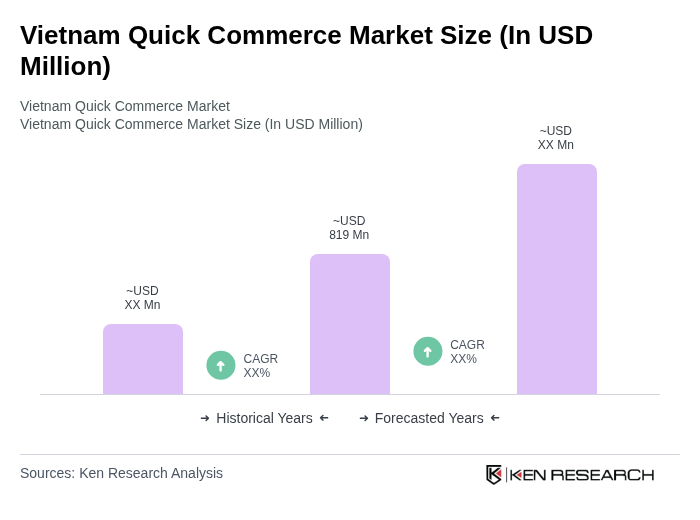
- The Vietnam Quick Commerce Market is valued at USD 819 million, based on a five-year historical analysis. This growth is primarily driven by the increasing demand for fast delivery services, urbanization, and the rise of e-commerce platforms. The convenience of on-demand delivery has led to a surge in consumer adoption, particularly among younger demographics who prioritize speed and efficiency in their shopping experiences. Urban millennials, who are highly digitally fluent, have become the core user base, with a strong preference for instant-purchase models and mobile wallet adoption, further accelerating market expansion .
- Key cities dominating the market include Ho Chi Minh City and Hanoi, which are the largest urban centers in Vietnam. Their dominance is attributed to high population density, a growing middle class, and a robust digital infrastructure that supports quick commerce operations. Additionally, these cities have a vibrant startup ecosystem that fosters innovation in delivery services, including the proliferation of dark stores and AI-powered logistics solutions to optimize last-mile delivery .
- In 2024, the Vietnamese government implemented regulations to enhance the operational framework for quick commerce. This includes a mandate for delivery services to comply with safety and quality standards, ensuring that food and other perishable goods are handled properly during transit. The regulation, issued by the Ministry of Industry and Trade, requires all quick commerce operators to adhere to food safety protocols, temperature control for perishables, and proper labeling, aiming to protect consumer interests and promote sustainable practices within the industry .
Vietnam Quick Commerce Market Segmentation
By Product Category:The product categories in the quick commerce market include a diverse range of offerings that cater to various consumer needs. The segments are Grocery and Staples, Fresh Produce and Dairy, Snacks and Beverages, Personal Care and OTC Pharma, Home and Cleaning Supplies, Electronics and Accessories, Pet Care, Flowers and Gifts, and Other Product Categories. Among these, Grocery and Staples dominate the market due to the essential nature of these products and the increasing trend of online grocery shopping. Snacks and Beverages are also witnessing strong growth, driven by impulse buying and a willingness among urban consumers to pay for immediate convenience .

By End-User:The end-user segmentation in the quick commerce market includes Individual Consumers, Small Businesses, Corporates, and Others. Individual Consumers represent the largest segment, driven by the increasing trend of online shopping and the demand for convenience. Small businesses also contribute significantly as they leverage quick commerce for inventory management and customer service enhancement, particularly in urban areas where rapid delivery is critical for operational efficiency .

Vietnam Quick Commerce Market Competitive Landscape
The Vietnam Quick Commerce Market is characterized by a dynamic mix of regional and international players. Leading participants such as Grab, Gojek (GoFood Vietnam), ShopeeFood (formerly Now.vn), Tiki, Baemin Vietnam, Loship, Chopp, VinID, VinMart (now WinMart), Lotte Mart Vietnam, Circle K Vietnam, CoopMart, Sendo, FPT Retail, Bach Hoa Xanh contribute to innovation, geographic expansion, and service delivery in this space.
Vietnam Quick Commerce Market Industry Analysis
Growth Drivers
- Increasing Urbanization:Vietnam's urban population is projected to reach approximately 39% in future, according to the World Bank. This rapid urbanization drives demand for quick commerce services, as city dwellers seek convenience and speed in their shopping experiences. The concentration of consumers in urban areas facilitates efficient delivery logistics, allowing companies to optimize their operations and meet the growing expectations for fast service. This demographic shift is a significant catalyst for market growth.
- Rising Smartphone Penetration:Smartphone penetration in Vietnam is estimated to be around 73% of the population, with approximately 70 million users engaging in mobile commerce. This surge in smartphone usage enables consumers to access quick commerce platforms easily, fostering a culture of online shopping. The Vietnam Telecommunications Authority reports that mobile internet usage continues to grow annually, further supporting the growth of digital commerce. This trend is crucial for quick commerce, as it enhances customer engagement and service accessibility.
- Demand for Convenience:The Vietnamese consumer market is increasingly prioritizing convenience, with a significant proportion of urban residents indicating a preference for on-demand delivery services. This shift is driven by busy lifestyles and a growing middle class with disposable income. According to a recent industry report, the demand for convenience-driven services is expected to grow by 20% annually, pushing quick commerce providers to innovate and expand their offerings. This consumer behavior is a key driver for the quick commerce sector's expansion in Vietnam.
Market Challenges
- Intense Competition:The quick commerce market in Vietnam is characterized by fierce competition, with over 50 active players vying for market share. Major companies like Grab and GoJek are investing heavily in marketing and technology to attract customers. This competitive landscape leads to price wars, which can erode profit margins. According to industry analysts, the average customer acquisition cost has increased by 30% in the past year, making it challenging for new entrants to establish a foothold in the market.
- Regulatory Hurdles:The Vietnamese government has implemented various regulations affecting the quick commerce sector, including e-commerce laws and consumer protection regulations. Compliance with these regulations can be costly and time-consuming for businesses. For instance, the Ministry of Industry and Trade reported that a significant proportion of e-commerce companies faced challenges in adhering to new regulations in future. These regulatory hurdles can hinder operational efficiency and slow down market entry for new players, impacting overall growth.
Vietnam Quick Commerce Market Future Outlook
The future of Vietnam's quick commerce market appears promising, driven by technological advancements and evolving consumer preferences. As urbanization continues, companies are likely to enhance their delivery networks and invest in innovative solutions to meet consumer demands. Additionally, the integration of AI and automation will streamline operations, improving efficiency. The market is expected to witness a shift towards sustainable practices, with businesses adopting eco-friendly delivery methods to align with consumer values, further shaping the industry's trajectory.
Market Opportunities
- Growth of E-commerce:The e-commerce sector in Vietnam is estimated to be valued at approximately USD 20 billion, according to the Ministry of Industry and Trade and World Bank data. This growth can be leveraged by integrating quick delivery options into existing e-commerce platforms, enhancing customer satisfaction and loyalty. Companies that capitalize on this trend can gain a competitive edge in the rapidly evolving market landscape.
- Partnerships with Local Businesses:Collaborating with local businesses can enhance service offerings and expand market reach. By forming strategic partnerships, quick commerce companies can tap into established customer bases and diversify their product ranges. This approach not only fosters community engagement but also drives mutual growth, as local businesses benefit from increased visibility and sales through quick commerce platforms.
Scope of the Report
| Segment | Sub-Segments |
|---|---|
| By Product Category | Grocery and Staples Fresh Produce and Dairy Snacks and Beverages Personal Care and OTC Pharma Home and Cleaning Supplies Electronics and Accessories Pet Care Flowers and Gifts Other Product Categories |
| By End-User | Individual Consumers Small Businesses Corporates Others |
| By Delivery Time Promise | Less than 10 Minutes –30 Minutes –60 Minutes Scheduled Delivery Others |
| By Payment Method | Cash on Delivery Digital Wallets Credit/Debit Cards Bank Transfers Others |
| By Geographic Coverage | Ho Chi Minh City Hanoi Da Nang Can Tho Hai Phong Bien Hoa Nha Trang Other Urban and Rural Areas |
| By Customer Demographics | Age Groups (Gen Z, Millennials, Gen X, Boomers) Income Levels Lifestyle Segments Others |
| By Service Type | On-Demand Services Subscription Services Hybrid Services Others |
Key Target Audience
Investors and Venture Capitalist Firms
Government and Regulatory Bodies (e.g., Ministry of Industry and Trade, Ministry of Information and Communications)
Logistics and Delivery Service Providers
E-commerce Platforms
Retail Chains and Supermarkets
Local Farmers and Food Producers
Technology Providers and Software Developers
Advertising and Marketing Agencies
Players Mentioned in the Report:
Grab
Gojek (GoFood Vietnam)
ShopeeFood (formerly Now.vn)
Tiki
Baemin Vietnam
Loship
Chopp
VinID
VinMart (now WinMart)
Lotte Mart Vietnam
Circle K Vietnam
CoopMart
Sendo
FPT Retail
Bach Hoa Xanh
Table of Contents
Market Assessment Phase
1. Executive Summary and Approach
2. Vietnam Quick Commerce Market Overview
2.1 Key Insights and Strategic Recommendations
2.2 Vietnam Quick Commerce Market Overview
2.3 Definition and Scope
2.4 Evolution of Market Ecosystem
2.5 Timeline of Key Regulatory Milestones
2.6 Value Chain & Stakeholder Mapping
2.7 Business Cycle Analysis
2.8 Policy & Incentive Landscape
3. Vietnam Quick Commerce Market Analysis
3.1 Growth Drivers
3.1.1 Increasing Urbanization
3.1.2 Rising Smartphone Penetration
3.1.3 Demand for Convenience
3.1.4 Expansion of Delivery Networks
3.2 Market Challenges
3.2.1 Intense Competition
3.2.2 Regulatory Hurdles
3.2.3 Infrastructure Limitations
3.2.4 Consumer Trust Issues
3.3 Market Opportunities
3.3.1 Growth of E-commerce
3.3.2 Partnerships with Local Businesses
3.3.3 Technological Innovations
3.3.4 Expansion into Rural Areas
3.4 Market Trends
3.4.1 Increased Focus on Sustainability
3.4.2 Personalization of Services
3.4.3 Integration of AI and Automation
3.4.4 Rise of Subscription Models
3.5 Government Regulation
3.5.1 E-commerce Law Compliance
3.5.2 Consumer Protection Regulations
3.5.3 Data Privacy Laws
3.5.4 Taxation Policies for Online Sales
4. SWOT Analysis
5. Stakeholder Analysis
6. Porter's Five Forces Analysis
7. Vietnam Quick Commerce Market Market Size, 2019-2024
7.1 By Value
7.2 By Volume
7.3 By Average Selling Price
8. Vietnam Quick Commerce Market Segmentation
8.1 By Product Category
8.1.1 Grocery and Staples
8.1.2 Fresh Produce and Dairy
8.1.3 Snacks and Beverages
8.1.4 Personal Care and OTC Pharma
8.1.5 Home and Cleaning Supplies
8.1.6 Electronics and Accessories
8.1.7 Pet Care
8.1.8 Flowers and Gifts
8.1.9 Other Product Categories
8.2 By End-User
8.2.1 Individual Consumers
8.2.2 Small Businesses
8.2.3 Corporates
8.2.4 Others
8.3 By Delivery Time Promise
8.3.1 Less than 10 Minutes
8.3.2 11–30 Minutes
8.3.3 31–60 Minutes
8.3.4 Scheduled Delivery
8.3.5 Others
8.4 By Payment Method
8.4.1 Cash on Delivery
8.4.2 Digital Wallets
8.4.3 Credit/Debit Cards
8.4.4 Bank Transfers
8.4.5 Others
8.5 By Geographic Coverage
8.5.1 Ho Chi Minh City
8.5.2 Hanoi
8.5.3 Da Nang
8.5.4 Can Tho
8.5.5 Hai Phong
8.5.6 Bien Hoa
8.5.7 Nha Trang
8.5.8 Other Urban and Rural Areas
8.6 By Customer Demographics
8.6.1 Age Groups (Gen Z, Millennials, Gen X, Boomers)
8.6.2 Income Levels
8.6.3 Lifestyle Segments
8.6.4 Others
8.7 By Service Type
8.7.1 On-Demand Services
8.7.2 Subscription Services
8.7.3 Hybrid Services
8.7.4 Others
9. Vietnam Quick Commerce Market Competitive Analysis
9.1 Market Share of Key Players
9.2 KPIs for Cross Comparison of Key Players
9.2.1 Company Name
9.2.2 Market Share (%)
9.2.3 Gross Merchandise Value (GMV)
9.2.4 Number of Active Users
9.2.5 Average Order Value (AOV)
9.2.6 Customer Acquisition Cost (CAC)
9.2.7 Delivery Time Efficiency (Median Delivery Time)
9.2.8 Customer Retention Rate (%)
9.2.9 Order Frequency per User
9.2.10 Revenue Growth Rate (%)
9.2.11 Customer Satisfaction Score (NPS or Equivalent)
9.2.12 Coverage Area (Cities/Provinces Served)
9.2.13 Number of SKUs Offered
9.2.14 Payment Method Diversity
9.2.15 Delivery Success Rate (%)
9.3 SWOT Analysis of Top Players
9.4 Pricing Analysis
9.5 List of Major Companies
9.5.1 Grab
9.5.2 Gojek (GoFood Vietnam)
9.5.3 ShopeeFood (formerly Now.vn)
9.5.4 Tiki
9.5.5 Baemin Vietnam
9.5.6 Loship
9.5.7 Chopp
9.5.8 VinID
9.5.9 VinMart (now WinMart)
9.5.10 Lotte Mart Vietnam
9.5.11 Circle K Vietnam
9.5.12 CoopMart
9.5.13 Sendo
9.5.14 FPT Retail
9.5.15 Bach Hoa Xanh
10. Vietnam Quick Commerce Market End-User Analysis
10.1 Procurement Behavior of Key Ministries
10.1.1 Ministry of Industry and Trade
10.1.2 Ministry of Health
10.1.3 Ministry of Agriculture and Rural Development
10.1.4 Ministry of Finance
10.2 Corporate Spend on Infrastructure & Energy
10.2.1 Investment in Logistics
10.2.2 Technology Upgrades
10.2.3 Marketing Expenditure
10.2.4 Others
10.3 Pain Point Analysis by End-User Category
10.3.1 Delivery Delays
10.3.2 Product Availability
10.3.3 Pricing Transparency
10.3.4 Customer Support Issues
10.4 User Readiness for Adoption
10.4.1 Technology Familiarity
10.4.2 Trust in Online Transactions
10.4.3 Demand for Convenience
10.4.4 Others
10.5 Post-Deployment ROI and Use Case Expansion
10.5.1 Cost Savings
10.5.2 Increased Sales
10.5.3 Customer Feedback Integration
10.5.4 Others
11. Vietnam Quick Commerce Market Future Size, 2025-2030
11.1 By Value
11.2 By Volume
11.3 By Average Selling Price
Go-To-Market Strategy Phase
1. Whitespace Analysis + Business Model Canvas
1.1 Market Gaps Identification
1.2 Business Model Framework
2. Marketing and Positioning Recommendations
2.1 Branding Strategies
2.2 Product USPs
3. Distribution Plan
3.1 Urban Retail vs Rural NGO Tie-ups
4. Channel & Pricing Gaps
4.1 Underserved Routes
4.2 Pricing Bands
5. Unmet Demand & Latent Needs
5.1 Category Gaps
5.2 Consumer Segments
6. Customer Relationship
6.1 Loyalty Programs
6.2 After-sales Service
7. Value Proposition
7.1 Sustainability
7.2 Integrated Supply Chains
8. Key Activities
8.1 Regulatory Compliance
8.2 Branding
8.3 Distribution Setup
9. Entry Strategy Evaluation
9.1 Domestic Market Entry Strategy
9.1.1 Product Mix
9.1.2 Pricing Band
9.1.3 Packaging
9.2 Export Entry Strategy
9.2.1 Target Countries
9.2.2 Compliance Roadmap
10. Entry Mode Assessment
10.1 JV
10.2 Greenfield
10.3 M&A
10.4 Distributor Model
11. Capital and Timeline Estimation
11.1 Capital Requirements
11.2 Timelines
12. Control vs Risk Trade-Off
12.1 Ownership vs Partnerships
13. Profitability Outlook
13.1 Breakeven Analysis
13.2 Long-term Sustainability
14. Potential Partner List
14.1 Distributors
14.2 JVs
14.3 Acquisition Targets
15. Execution Roadmap
15.1 Phased Plan for Market Entry
15.1.1 Market Setup
15.1.2 Market Entry
15.1.3 Growth Acceleration
15.1.4 Scale & Stabilize
15.2 Key Activities and Milestones
15.2.1 Milestone Planning
15.2.2 Activity Tracking
Research Methodology
Phase 1: Approach1
Desk Research
- Analysis of market reports from industry associations and government publications
- Review of academic journals and white papers on quick commerce trends in Vietnam
- Examination of demographic and economic data from the General Statistics Office of Vietnam
Primary Research
- Interviews with key stakeholders in the quick commerce ecosystem, including logistics providers and retailers
- Surveys targeting consumers to understand preferences and purchasing behaviors in quick commerce
- Focus group discussions with urban consumers to gauge perceptions of delivery services
Validation & Triangulation
- Cross-validation of findings through multiple data sources, including sales data and consumer feedback
- Triangulation of insights from primary interviews with secondary data trends
- Sanity checks conducted through expert reviews from industry veterans and market analysts
Phase 2: Market Size Estimation1
Top-down Assessment
- Estimation of total addressable market (TAM) based on urban population density and internet penetration rates
- Segmentation of market size by product categories such as groceries, electronics, and personal care
- Incorporation of growth rates from e-commerce and mobile payment adoption trends
Bottom-up Modeling
- Collection of transaction data from leading quick commerce platforms to establish average order values
- Estimation of delivery frequency and customer retention rates based on survey results
- Calculation of market size using volume of orders multiplied by average revenue per order
Forecasting & Scenario Analysis
- Development of growth scenarios based on economic indicators and consumer behavior shifts
- Scenario modeling to assess impacts of regulatory changes and competitive landscape evolution
- Projections for market growth through 2030, including best-case, worst-case, and most likely scenarios
Phase 3: CATI Sample Composition1
| Scope Item/Segment | Sample Size | Target Respondent Profiles |
|---|---|---|
| Consumer Preferences in Quick Commerce | 120 | Urban Consumers, Age 18-45 |
| Logistics Operations Insights | 60 | Logistics Managers, Operations Managers |
| Retailer Perspectives on Quick Commerce | 50 | Retail Managers, E-commerce Managers |
| Technology Adoption in Delivery Services | 40 | IT Managers, Technology Managers |
| Market Trends and Consumer Behavior | 70 | Market Analysts, Business Development Managers |
Frequently Asked Questions
What is the current value of the Vietnam Quick Commerce Market?
The Vietnam Quick Commerce Market is valued at approximately USD 819 million, driven by increasing demand for fast delivery services, urbanization, and the rise of e-commerce platforms, particularly among younger consumers who prioritize convenience and speed in their shopping experiences.
Which cities are the largest markets for quick commerce in Vietnam?
What are the main product categories in the Vietnam Quick Commerce Market?
Who are the primary end-users of quick commerce services in Vietnam?
Other Regional/Country Reports
Indonesia Quick Commerce Market
KSA Quick Commerce Market
APAC Quick Commerce Market
SEA Quick Commerce Market
Other Adjacent Reports
South Korea Last-Mile Delivery Market
Philippines Food Delivery Market
Germany Grocery Delivery Market
Germany Logistics Technology MarketIndia Supply Chain Management Market Size, Share & Forecast, By Solution Type, Deployment Model & End-Use Industry, 2026-2031South Korea Mobile Payment Market Size, Share & Forecast, By Payment Type, Customer Segment & Distribution Channel, 2025-2032UK Urban Logistics Market Size, Share & Forecast, By Service Type, Mode of Transport & End-Use Industry, 2025–2032Germany Retail Technology Market
Indonesia On-Demand Services Market Outlook to 2021 - Increasing Internet and Smartphone Penetration and the Advent of Superior Technology to Foster Future GrowthWhy Buy From Us?

What makes us stand out is that our consultants follow Robust, Refine and Result (RRR) methodology. Robust for clear definitions, approaches and sanity checking, Refine for differentiating respondents' facts and opinions, and Result for presenting data with story.

We have set a benchmark in the industry by offering our clients with syndicated and customized market research reports featuring coverage of entire market as well as meticulous research and analyst insights.

While we don't replace traditional research, we flip the method upside down. Our dual approach of Top Bottom & Bottom Top ensures quality deliverable by not just verifying company fundamentals but also looking at the sector and macroeconomic factors.

With one step in the future, our research team constantly tries to show you the bigger picture. We help with some of the tough questions you may encounter along the way: How is the industry positioned? Best marketing channel? KPI's of competitors? By aligning every element, we help maximize success.

Our report gives you instant access to the answers and sources that other companies might choose to hide. We elaborate each steps of research methodology we have used and showcase you the sample size to earn your trust.

If you need any support, we are here! We pride ourselves on universe strength, data quality, and quick, friendly, and professional service.