About the Report
Base Year 2024Philippines Automotive Artificial Intelligence Market Overview
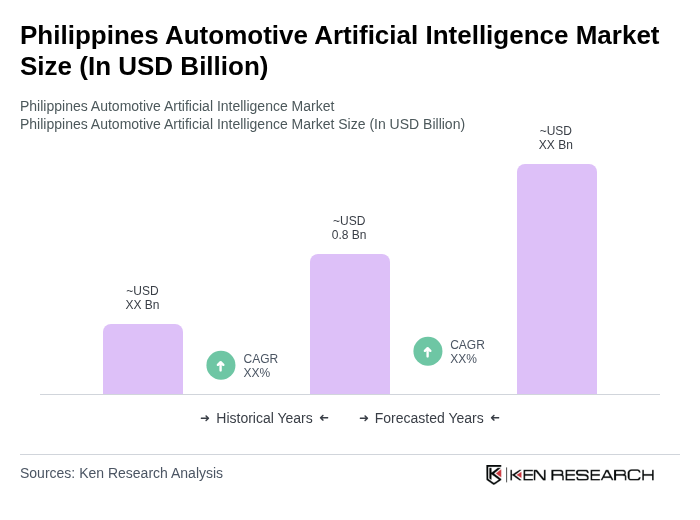
- The Philippines Automotive Artificial Intelligence Market is valued at USD 0.8 billion, based on a five-year historical analysis of the broader Philippines artificial intelligence and global automotive AI markets. This growth is primarily driven by the increasing adoption of AI technologies in vehicle manufacturing and assembly, rising penetration of connected and infotainment features in new vehicles, growing consumer demand for advanced driver assistance and safety systems, and government initiatives promoting digital transformation and Industry 4.0 adoption in manufacturing and mobility.
- Metro Manila, Cebu, and Davao are the dominant cities in the Philippines Automotive Artificial Intelligence Market. Metro Manila leads due to its high population density, concentration of vehicle sales, dealerships, and corporate headquarters of major automakers and technology firms, while Cebu and Davao are emerging hubs for automotive innovation, telematics, shared mobility services, and technology integration supported by growing IT-BPM ecosystems.
- In the automotive and mobility domain, AI adoption is being encouraged under broader innovation and industrial policies such as the Department of Trade and Industry’s National Artificial Intelligence Strategy Roadmap, along with the Comprehensive Automotive Resurgence Strategy (CARS) Program, which aims to enhance local automotive manufacturing competitiveness by incentivizing investments in technology upgrading, automation, and digital solutions. These instruments promote the use of data-driven and AI-enabled systems in production, supply chain, and vehicle platforms, supporting innovation and competitiveness in the domestic automotive market.
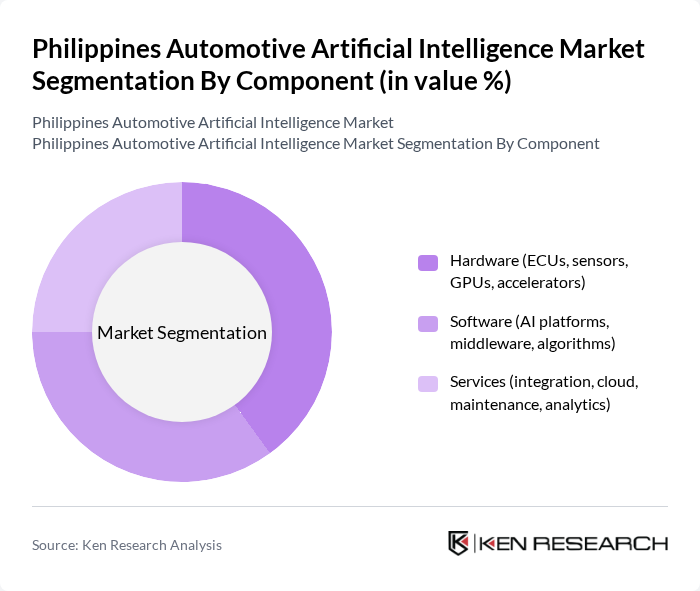
Philippines Automotive Artificial Intelligence Market Segmentation
By Component:The components of the automotive AI market include hardware, software, and services. Hardware encompasses essential elements like ECUs, sensors, GPUs, and accelerators, which are critical for implementing ADAS, perception, connectivity, and powertrain optimization functionalities in vehicles. Software includes AI platforms, middleware, and algorithms for perception, planning, control, personalization, and over-the-air (OTA) updates that enable continuous data processing and decision-making across the vehicle lifecycle. Services cover integration, cloud solutions, connectivity enablement, cybersecurity, maintenance, and analytics, which support the deployment, scaling, and optimization of AI technologies in vehicles and backend mobility platforms.
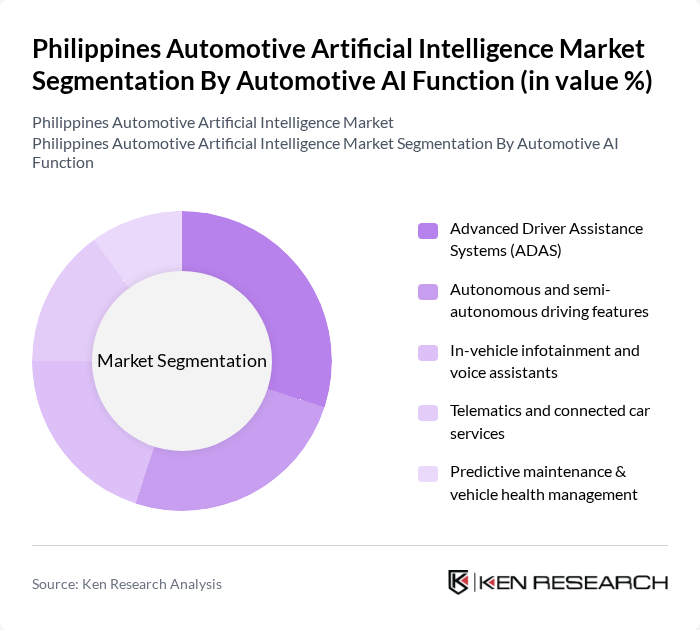
By Automotive AI Function:The automotive AI functions include advanced driver assistance systems (ADAS), autonomous and semi-autonomous driving features, in-vehicle infotainment and voice assistants, telematics and connected car services, and predictive maintenance and vehicle health management. ADAS is crucial for enhancing vehicle safety through functions such as adaptive cruise control, automatic emergency braking, lane-keeping assistance, and driver monitoring systems, which are increasingly featured in new models globally. Infotainment systems and voice assistants improve user experience by enabling navigation, entertainment, and hands-free control integrated with smartphone ecosystems. Telematics and connected car services support fleet management, usage-based insurance, and real-time diagnostics, while predictive maintenance and vehicle health management use AI to anticipate component failures, reduce downtime, and lower total cost of ownership for both private users and fleets.
Philippines Automotive Artificial Intelligence Market Competitive Landscape
The Philippines Automotive Artificial Intelligence Market is characterized by a dynamic mix of regional and international players. Leading participants such as Toyota Motor Philippines Corporation, Mitsubishi Motors Philippines Corporation, Honda Cars Philippines, Inc., Nissan Philippines, Inc., Isuzu Philippines Corporation, Ford Motor Company Philippines, Inc., Suzuki Philippines, Inc., Hyundai Motor Philippines, Inc., Changan Motor Philippines, Inc., BYD Auto Philippines, Inc., Sojitz G Auto Philippines Corporation (Geely Philippines), Mercedes-Benz Philippines (IC Star Automotive Inc.), SMC Asia Car Distributors Corp. (BMW Philippines), Volkswagen Philippines (Ayala Corporation), Kia Philippines (Ayala-owned AC Motors) contribute to innovation, geographic expansion, and service delivery in this space.
Philippines Automotive Artificial Intelligence Market Industry Analysis
Growth Drivers
- Increasing Demand for Smart Vehicles:The Philippines automotive sector is witnessing a surge in demand for smart vehicles, with sales of connected cars projected to reach 150,000 units in future. This growth is driven by consumer interest in advanced features such as navigation, infotainment, and driver assistance systems. The World Bank reports that the country's GDP growth rate is expected to be 6.5% in future, further boosting disposable income and consumer spending on innovative automotive technologies.
- Government Initiatives for Automotive Innovation:The Philippine government has launched several initiatives to promote automotive innovation, including the Comprehensive Automotive Resurgence Strategy (CARS) program, which aims to produce 200,000 vehicles annually in future. This initiative is supported by a budget allocation of PHP 27 billion (approximately USD 500 million) to enhance local manufacturing and attract foreign investments, fostering a conducive environment for AI integration in vehicles.
- Rising Consumer Preference for Enhanced Safety Features:With road safety becoming a priority, the demand for vehicles equipped with advanced safety features is increasing. In future, it is estimated that 70% of new vehicles sold will include AI-driven safety technologies, such as automatic emergency braking and lane-keeping assistance. The Philippine Statistics Authority indicates that traffic-related fatalities have decreased by 15% over the past three years, highlighting the effectiveness of these technologies in improving road safety.
Market Challenges
- High Initial Investment Costs:The integration of AI technologies in the automotive sector requires significant upfront investments, often exceeding PHP 10 million (approximately USD 180,000) per vehicle model. This financial barrier can deter local manufacturers from adopting advanced technologies, especially small and medium enterprises. The Philippine Chamber of Commerce and Industry reports that only 30% of local automotive firms have the capital to invest in AI solutions, limiting overall market growth.
- Limited Infrastructure for AI Integration:The lack of adequate infrastructure for AI integration poses a significant challenge to the automotive sector. As of future, only 40% of urban areas in the Philippines have the necessary digital infrastructure to support connected vehicle technologies. The National Economic and Development Authority (NEDA) emphasizes the need for improved internet connectivity and smart city initiatives to facilitate the deployment of AI-driven automotive solutions, which remains a critical hurdle for market expansion.
Philippines Automotive Artificial Intelligence Market Future Outlook
The future of the Philippines automotive AI market appears promising, driven by technological advancements and increasing consumer awareness. As the government continues to support innovation through funding and policy frameworks, the adoption of AI technologies in vehicles is expected to accelerate. Additionally, the rise of electric vehicles will create new opportunities for AI applications, enhancing vehicle performance and user experience. Collaborations between automotive manufacturers and tech companies will further drive innovation, ensuring a competitive landscape in the coming years.
Market Opportunities
- Expansion of Electric Vehicle Market:The electric vehicle (EV) market in the Philippines is projected to grow significantly, with sales expected to reach 50,000 units in future. This growth presents opportunities for AI technologies to optimize battery management and enhance vehicle performance, making EVs more appealing to consumers and contributing to environmental sustainability.
- Development of AI-Driven Automotive Solutions:There is a growing demand for AI-driven automotive solutions, such as predictive maintenance and personalized in-car experiences. By future, the market for these solutions is anticipated to reach PHP 5 billion (approximately USD 90 million), driven by consumer preferences for enhanced convenience and safety, creating a lucrative opportunity for tech developers and automotive manufacturers.
Scope of the Report
| Segment | Sub-Segments |
|---|---|
| By Component | Hardware (ECUs, sensors, GPUs, accelerators) Software (AI platforms, middleware, algorithms) Services (integration, cloud, maintenance, analytics) |
| By Automotive AI Function | Advanced Driver Assistance Systems (ADAS) Autonomous and semi-autonomous driving features In-vehicle infotainment and voice assistants Telematics and connected car services Predictive maintenance & vehicle health management |
| By Vehicle Type | Passenger cars Light commercial vehicles Heavy commercial vehicles Electric vehicles (BEV, PHEV, HEV) Robo-taxis and shared mobility fleets |
| By End-User / Customer Type | OEMs and local assemblers Tier-1 & Tier-2 automotive suppliers Fleet and logistics operators Mobility-as-a-Service (MaaS) and ride-hailing platforms Government & smart city programs |
| By Technology | Machine learning and deep learning Computer vision Natural language processing Sensor fusion & perception systems Edge and on-board AI computing |
| By Connectivity & Deployment | Embedded / on-board AI systems Cloud-based automotive AI platforms Vehicle-to-vehicle (V2V) and vehicle-to-infrastructure (V2I) Over-the-air (OTA) software & feature updates Hybrid (edge–cloud) deployment models |
| By Use Case Cluster in Philippines | Road safety & collision avoidance solutions Traffic flow optimization & congestion management EV charging, routing & energy management Usage-based insurance & driver behavior analytics Dealership, sales & after-sales AI (chatbots, lead scoring) |
Key Target Audience
Investors and Venture Capitalist Firms
Government and Regulatory Bodies (e.g., Department of Trade and Industry, Department of Transportation)
Automotive Manufacturers and Producers
Automotive Component Suppliers
Technology Providers and AI Developers
Industry Associations (e.g., Chamber of Automotive Manufacturers of the Philippines, Inc.)
Financial Institutions and Banks
Logistics and Supply Chain Companies
Players Mentioned in the Report:
Toyota Motor Philippines Corporation
Mitsubishi Motors Philippines Corporation
Honda Cars Philippines, Inc.
Nissan Philippines, Inc.
Isuzu Philippines Corporation
Ford Motor Company Philippines, Inc.
Suzuki Philippines, Inc.
Hyundai Motor Philippines, Inc.
Changan Motor Philippines, Inc.
BYD Auto Philippines, Inc.
Sojitz G Auto Philippines Corporation (Geely Philippines)
Mercedes-Benz Philippines (IC Star Automotive Inc.)
SMC Asia Car Distributors Corp. (BMW Philippines)
Volkswagen Philippines (Ayala Corporation)
Kia Philippines (Ayala-owned AC Motors)
Table of Contents
Market Assessment Phase
1. Executive Summary and Approach
2. Philippines Automotive Artificial Intelligence Market Overview
2.1 Key Insights and Strategic Recommendations
2.2 Philippines Automotive Artificial Intelligence Market Overview
2.3 Definition and Scope
2.4 Evolution of Market Ecosystem
2.5 Timeline of Key Regulatory Milestones
2.6 Value Chain & Stakeholder Mapping
2.7 Business Cycle Analysis
2.8 Policy & Incentive Landscape
3. Philippines Automotive Artificial Intelligence Market Analysis
3.1 Growth Drivers
3.1.1 Increasing demand for smart vehicles
3.1.2 Government initiatives for automotive innovation
3.1.3 Rising consumer preference for enhanced safety features
3.1.4 Growth in connected vehicle technology
3.2 Market Challenges
3.2.1 High initial investment costs
3.2.2 Limited infrastructure for AI integration
3.2.3 Regulatory hurdles and compliance issues
3.2.4 Shortage of skilled workforce in AI technologies
3.3 Market Opportunities
3.3.1 Expansion of electric vehicle market
3.3.2 Development of AI-driven automotive solutions
3.3.3 Collaborations with tech companies
3.3.4 Increasing investment in R&D for automotive AI
3.4 Market Trends
3.4.1 Adoption of autonomous driving technologies
3.4.2 Integration of AI in vehicle maintenance
3.4.3 Growth of AI-based traffic management systems
3.4.4 Rise of personalized in-car experiences
3.5 Government Regulation
3.5.1 Implementation of AI safety standards
3.5.2 Incentives for electric and AI-integrated vehicles
3.5.3 Data privacy regulations for automotive AI
3.5.4 Environmental regulations impacting automotive AI
4. SWOT Analysis
5. Stakeholder Analysis
6. Porter's Five Forces Analysis
7. Philippines Automotive Artificial Intelligence Market Market Size, 2019-2024
7.1 By Value
7.2 By Volume
7.3 By Average Selling Price
8. Philippines Automotive Artificial Intelligence Market Segmentation
8.1 By Component
8.1.1 Hardware (ECUs, sensors, GPUs, accelerators)
8.1.2 Software (AI platforms, middleware, algorithms)
8.1.3 Services (integration, cloud, maintenance, analytics)
8.2 By Automotive AI Function
8.2.1 Advanced Driver Assistance Systems (ADAS)
8.2.2 Autonomous and semi-autonomous driving features
8.2.3 In-vehicle infotainment and voice assistants
8.2.4 Telematics and connected car services
8.2.5 Predictive maintenance & vehicle health management
8.3 By Vehicle Type
8.3.1 Passenger cars
8.3.2 Light commercial vehicles
8.3.3 Heavy commercial vehicles
8.3.4 Electric vehicles (BEV, PHEV, HEV)
8.3.5 Robo-taxis and shared mobility fleets
8.4 By End-User / Customer Type
8.4.1 OEMs and local assemblers
8.4.2 Tier-1 & Tier-2 automotive suppliers
8.4.3 Fleet and logistics operators
8.4.4 Mobility-as-a-Service (MaaS) and ride-hailing platforms
8.4.5 Government & smart city programs
8.5 By Technology
8.5.1 Machine learning and deep learning
8.5.2 Computer vision
8.5.3 Natural language processing
8.5.4 Sensor fusion & perception systems
8.5.5 Edge and on-board AI computing
8.6 By Connectivity & Deployment
8.6.1 Embedded / on-board AI systems
8.6.2 Cloud-based automotive AI platforms
8.6.3 Vehicle-to-vehicle (V2V) and vehicle-to-infrastructure (V2I)
8.6.4 Over-the-air (OTA) software & feature updates
8.6.5 Hybrid (edge–cloud) deployment models
8.7 By Use Case Cluster in Philippines
8.7.1 Road safety & collision avoidance solutions
8.7.2 Traffic flow optimization & congestion management
8.7.3 EV charging, routing & energy management
8.7.4 Usage-based insurance & driver behavior analytics
8.7.5 Dealership, sales & after-sales AI (chatbots, lead scoring)
9. Philippines Automotive Artificial Intelligence Market Competitive Analysis
9.1 Market Share of Key Players
9.2 Cross Comparison of Key Players
9.2.1 Company name and headquarters (global / local)
9.2.2 Group size (global revenue and employee base)
9.2.3 Philippines automotive AI revenue and 3-year CAGR
9.2.4 Installed base of AI-enabled vehicles in the Philippines
9.2.5 Share of models with ADAS / connected features in local portfolio
9.2.6 R&D intensity (% of revenue spent on AI and software)
9.2.7 Partnership network (telecoms, cloud, local tech/startups)
9.2.8 Time-to-market for new AI features and OTA updates
9.2.9 Average selling price uplift from AI / connectivity packages
9.2.10 Customer experience KPIs (NPS/CSAT for digital & in-car services)
9.3 SWOT Analysis of Top Players
9.4 Pricing Analysis
9.5 Detailed Profile of Major Companies
9.5.1 Toyota Motor Philippines Corporation
9.5.2 Mitsubishi Motors Philippines Corporation
9.5.3 Honda Cars Philippines, Inc.
9.5.4 Nissan Philippines, Inc.
9.5.5 Isuzu Philippines Corporation
9.5.6 Ford Motor Company Philippines, Inc.
9.5.7 Suzuki Philippines, Inc.
9.5.8 Hyundai Motor Philippines, Inc.
9.5.9 Changan Motor Philippines, Inc.
9.5.10 BYD Auto Philippines, Inc.
9.5.11 Sojitz G Auto Philippines Corporation (Geely Philippines)
9.5.12 Mercedes-Benz Philippines (IC Star Automotive Inc.)
9.5.13 SMC Asia Car Distributors Corp. (BMW Philippines)
9.5.14 Volkswagen Philippines (Ayala Corporation)
9.5.15 Kia Philippines (Ayala-owned AC Motors)
10. Philippines Automotive Artificial Intelligence Market End-User Analysis
10.1 Procurement Behavior of Key Ministries
10.1.1 Ministry of Transportation
10.1.2 Department of Trade and Industry
10.1.3 Department of Science and Technology
10.1.4 Local Government Units
10.2 Corporate Spend on Infrastructure & Energy
10.2.1 Investment in Smart Transportation Systems
10.2.2 Budget Allocation for AI Research
10.2.3 Expenditure on Vehicle Safety Enhancements
10.2.4 Funding for Electric Vehicle Infrastructure
10.3 Pain Point Analysis by End-User Category
10.3.1 Automotive Manufacturers
10.3.2 Fleet Operators
10.3.3 Insurance Companies
10.3.4 Government Agencies
10.4 User Readiness for Adoption
10.4.1 Awareness of AI Benefits
10.4.2 Training and Skill Development Needs
10.4.3 Infrastructure Readiness
10.4.4 Financial Readiness
10.5 Post-Deployment ROI and Use Case Expansion
10.5.1 Measurement of AI Impact on Efficiency
10.5.2 Expansion of AI Applications in Operations
10.5.3 Long-term Cost Savings Analysis
10.5.4 User Feedback and Iterative Improvements
11. Philippines Automotive Artificial Intelligence Market Future Size, 2025-2030
11.1 By Value
11.2 By Volume
11.3 By Average Selling Price
Go-To-Market Strategy Phase
1. Whitespace Analysis + Business Model Canvas
1.1 Market Gaps Identification
1.2 Value Proposition Development
1.3 Revenue Streams Analysis
1.4 Cost Structure Evaluation
1.5 Key Partnerships Exploration
1.6 Customer Segmentation
1.7 Channels and Customer Relationships
2. Marketing and Positioning Recommendations
2.1 Branding Strategies
2.2 Product USPs
2.3 Target Market Identification
2.4 Communication Strategies
2.5 Digital Marketing Approaches
2.6 Customer Engagement Tactics
2.7 Performance Metrics
3. Distribution Plan
3.1 Urban Retail Strategies
3.2 Rural NGO Tie-ups
3.3 E-commerce Integration
3.4 Logistics and Supply Chain Management
3.5 Distribution Partnerships
3.6 Inventory Management
3.7 Customer Service Channels
4. Channel & Pricing Gaps
4.1 Underserved Routes
4.2 Pricing Bands Analysis
4.3 Competitor Pricing Strategies
4.4 Customer Price Sensitivity
4.5 Value-based Pricing Models
4.6 Discount and Promotion Strategies
4.7 Pricing Optimization Techniques
5. Unmet Demand & Latent Needs
5.1 Category Gaps Identification
5.2 Consumer Segments Analysis
5.3 Emerging Trends and Needs
5.4 Product Development Opportunities
5.5 Market Entry Strategies
5.6 Customer Feedback Mechanisms
5.7 Innovation Opportunities
6. Customer Relationship
6.1 Loyalty Programs
6.2 After-sales Service
6.3 Customer Feedback Systems
6.4 Community Engagement Initiatives
6.5 Customer Education Programs
6.6 Relationship Management Tools
6.7 Performance Tracking
7. Value Proposition
7.1 Sustainability Initiatives
7.2 Integrated Supply Chains
7.3 Customer-Centric Innovations
7.4 Competitive Differentiation
7.5 Value Delivery Mechanisms
7.6 Brand Positioning Strategies
7.7 Performance Metrics
8. Key Activities
8.1 Regulatory Compliance
8.2 Branding Initiatives
8.3 Distribution Setup
8.4 Marketing Campaigns
8.5 Training and Development
8.6 Performance Monitoring
8.7 Stakeholder Engagement
9. Entry Strategy Evaluation
9.1 Domestic Market Entry Strategy
9.1.1 Product Mix
9.1.2 Pricing Band
9.1.3 Packaging Strategies
9.2 Export Entry Strategy
9.2.1 Target Countries
9.2.2 Compliance Roadmap
10. Entry Mode Assessment
10.1 Joint Ventures
10.2 Greenfield Investments
10.3 Mergers & Acquisitions
10.4 Distributor Model
10.5 Risk Assessment
10.6 Strategic Partnerships
10.7 Market Adaptation Strategies
11. Capital and Timeline Estimation
11.1 Capital Requirements
11.2 Timelines for Implementation
11.3 Financial Projections
11.4 Funding Sources
11.5 Budget Allocation
11.6 Risk Management Plans
11.7 Performance Metrics
12. Control vs Risk Trade-Off
12.1 Ownership vs Partnerships
12.2 Risk Mitigation Strategies
12.3 Control Mechanisms
12.4 Partnership Evaluation
12.5 Long-term Sustainability Plans
12.6 Performance Monitoring
12.7 Strategic Adjustments
13. Profitability Outlook
13.1 Breakeven Analysis
13.2 Long-term Sustainability
13.3 Profit Margin Projections
13.4 Revenue Growth Strategies
13.5 Cost Management Techniques
13.6 Financial Health Indicators
13.7 Performance Metrics
14. Potential Partner List
14.1 Distributors
14.2 Joint Ventures
14.3 Acquisition Targets
14.4 Strategic Alliances
14.5 Technology Partners
14.6 Research Collaborations
14.7 Community Engagement Partner
Research Methodology
Phase 1: Approach1
Desk Research
- Analysis of industry reports from automotive associations in the Philippines
- Review of government publications on AI adoption in the automotive sector
- Examination of academic journals and white papers on AI technologies in automotive applications
Primary Research
- Interviews with key stakeholders in automotive manufacturing and AI technology firms
- Surveys targeting automotive engineers and AI developers in the Philippines
- Focus group discussions with automotive industry experts and analysts
Validation & Triangulation
- Cross-validation of findings through multiple data sources including trade publications and expert opinions
- Triangulation of market trends using historical data and current industry insights
- Sanity checks conducted through expert panel reviews to ensure data reliability
Phase 2: Market Size Estimation1
Top-down Assessment
- Estimation of market size based on national automotive sales and AI integration rates
- Segmentation of the market by vehicle type and AI application (e.g., autonomous driving, predictive maintenance)
- Incorporation of government initiatives promoting AI in the automotive sector
Bottom-up Modeling
- Collection of data from leading automotive manufacturers on AI technology investments
- Estimation of market potential based on unit sales and average AI technology costs
- Volume x cost analysis for various AI applications in automotive processes
Forecasting & Scenario Analysis
- Multi-factor regression analysis considering economic growth, technological advancements, and consumer adoption rates
- Scenario modeling based on regulatory changes and market dynamics affecting AI adoption
- Development of baseline, optimistic, and pessimistic forecasts through 2030
Phase 3: CATI Sample Composition1
| Scope Item/Segment | Sample Size | Target Respondent Profiles |
|---|---|---|
| Automotive Manufacturers | 40 | Production Managers, R&D Directors |
| AI Technology Providers | 40 | Product Managers, Technical Leads |
| Automotive Component Suppliers | 40 | Supply Chain Managers, Quality Assurance Heads |
| Regulatory Bodies | 40 | Policy Makers, Compliance Officers |
| Industry Analysts | 40 | Market Researchers, Economic Analysts |
Frequently Asked Questions
What is the current value of the Philippines Automotive Artificial Intelligence Market?
The Philippines Automotive Artificial Intelligence Market is valued at approximately USD 0.8 billion, reflecting a significant growth trend driven by the adoption of AI technologies in vehicle manufacturing, safety systems, and government initiatives promoting digital transformation.
Which cities are leading in the Philippines Automotive Artificial Intelligence Market?
What are the key drivers of growth in the Philippines Automotive AI Market?
What challenges does the Philippines Automotive AI Market face?
Other Regional/Country Reports
Indonesia Automotive Artificial Intelligence Market
Malaysia Automotive Artificial Intelligence Market
KSA Automotive Artificial Intelligence Market
APAC Automotive Artificial Intelligence Market
SEA Automotive Artificial Intelligence Market
Other Adjacent Reports
Brazil Autonomous Driving Technology Market
UAE Connected Vehicle MarketIndia Advanced Driver Assistance Systems Market Outlook to 2030Germany Vehicle Telematics Market
Bahrain Electric Vehicle Technology Market
Middle East Automotive Software Market Report Size, Share, Growth Drivers, Trends, Opportunities & Forecast 2025–2030North America Automotive Sensors Market Outlook to 2030: Size, Share, Growth and TrendsQatar predictive maintenance market size, share, growth drivers, trends, opportunities & forecast 2025–2030KSA smart mobility market report Size, Share, Growth Drivers, Trends, Opportunities & Forecast 2025–2030Middle East Automotive Cybersecurity (Connected Vehicles) Market Size, Share, Growth Drivers, Trends, Opportunities, Competitive Landscape & Forecast 2025–2030Why Buy From Us?

What makes us stand out is that our consultants follow Robust, Refine and Result (RRR) methodology. Robust for clear definitions, approaches and sanity checking, Refine for differentiating respondents' facts and opinions, and Result for presenting data with story.

We have set a benchmark in the industry by offering our clients with syndicated and customized market research reports featuring coverage of entire market as well as meticulous research and analyst insights.

While we don't replace traditional research, we flip the method upside down. Our dual approach of Top Bottom & Bottom Top ensures quality deliverable by not just verifying company fundamentals but also looking at the sector and macroeconomic factors.

With one step in the future, our research team constantly tries to show you the bigger picture. We help with some of the tough questions you may encounter along the way: How is the industry positioned? Best marketing channel? KPI's of competitors? By aligning every element, we help maximize success.

Our report gives you instant access to the answers and sources that other companies might choose to hide. We elaborate each steps of research methodology we have used and showcase you the sample size to earn your trust.

If you need any support, we are here! We pride ourselves on universe strength, data quality, and quick, friendly, and professional service.