About the Report
Base Year 2024Listen to the audio summary
Philippines Food Truck Services Market Overview
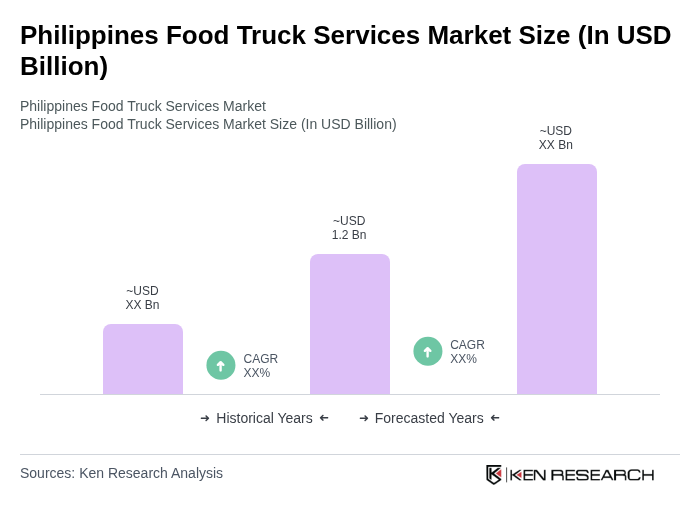
- The Philippines Food Truck Services Market is valued at USD 1.2 billion, based on a five-year historical analysis. This growth is primarily driven by the increasing demand for convenient dining options, urbanization, and a growing food culture that embraces diverse culinary experiences. The rise of social media has also played a significant role in promoting food trucks, making them a popular choice among consumers seeking unique and gourmet food offerings.
- Metro Manila, Cebu, and Davao are the dominant cities in the Philippines Food Truck Services Market. Metro Manila, being the capital, has a high population density and a vibrant food scene, making it an ideal location for food trucks. Cebu and Davao also contribute significantly due to their growing urban centers and increasing tourism, which boosts demand for diverse food options.
- In 2023, the Philippine government implemented the Food Truck Regulation Act, which aims to streamline the licensing process for food truck operators. This regulation requires food trucks to obtain a special permit from local government units, ensuring compliance with health and safety standards. The initiative is designed to promote entrepreneurship while maintaining food safety and quality across the industry.
Philippines Food Truck Services Market Segmentation
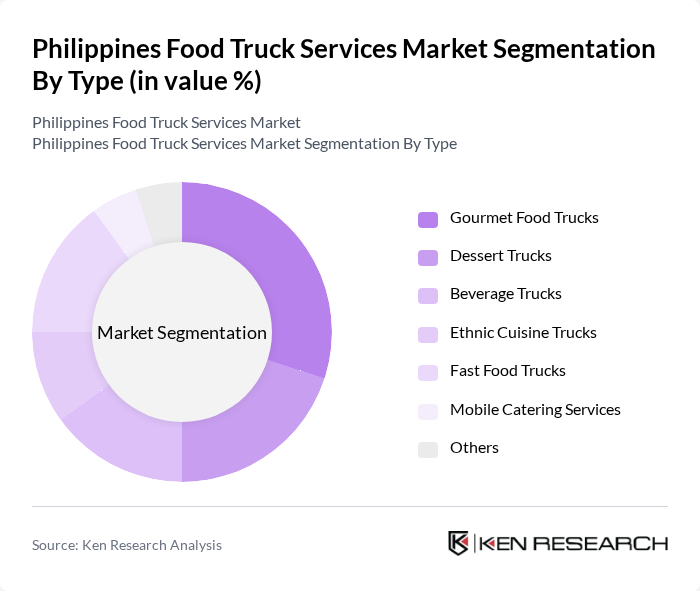
By Type:The food truck services market can be segmented into various types, including gourmet food trucks, dessert trucks, beverage trucks, ethnic cuisine trucks, fast food trucks, mobile catering services, and others. Each type caters to different consumer preferences and occasions, contributing to the overall market dynamics.
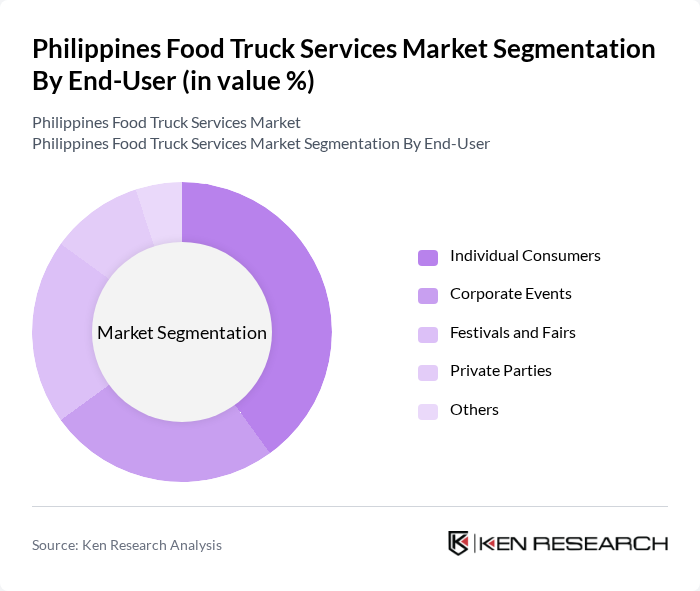
By End-User:The end-user segmentation includes individual consumers, corporate events, festivals and fairs, private parties, and others. Each segment reflects different consumer needs and preferences, influencing the types of food trucks that thrive in the market.
Philippines Food Truck Services Market Competitive Landscape
The Philippines Food Truck Services Market is characterized by a dynamic mix of regional and international players. Leading participants such as The Lost Bread, Elait, The Good Food Truck, Kanto Freestyle Breakfast, The Food Truck Project, Bente Dos, The Rolling Tacos, The Hungry Nomad, The Grilled Cheese Truck, The BBQ Bus, The Sweet Spot, The Vegan Food Truck, The Burger Joint, The Pizza Cart, The Seafood Shack contribute to innovation, geographic expansion, and service delivery in this space.
Philippines Food Truck Services Market Industry Analysis
Growth Drivers
- Increasing Urbanization:The Philippines is experiencing rapid urbanization, with urban areas projected to house 57% of the population in future, up from 54% in 2020. This shift is driving demand for convenient food options, particularly food trucks, which cater to busy urban lifestyles. The urban population is expected to reach approximately 63 million in future, creating a larger customer base for food truck services. This trend is supported by the growing number of urban centers, which are becoming hotspots for food truck operations.
- Rising Demand for Street Food:The street food market in the Philippines is valued at around PHP 120 billion (approximately USD 2.2 billion) in future, reflecting a significant cultural preference for affordable and diverse food options. Food trucks, which offer a variety of street food, are well-positioned to capitalize on this trend. The increasing popularity of food festivals and street food markets further enhances the visibility and accessibility of food trucks, making them a preferred choice for consumers seeking unique culinary experiences.
- Supportive Government Policies:The Philippine government has introduced various initiatives to promote small businesses, including food trucks. In future, the government allocated PHP 2 billion (approximately USD 36 million) to support food entrepreneurs through grants and low-interest loans. Additionally, local government units are streamlining the permitting process for food trucks, reducing bureaucratic hurdles. These supportive measures are encouraging new entrants into the food truck market, fostering innovation and competition within the industry.
Market Challenges
- Regulatory Hurdles:Navigating the regulatory landscape poses significant challenges for food truck operators in the Philippines. Each local government unit has its own set of regulations, leading to inconsistencies in licensing and operational requirements. In future, it is estimated that 32% of food truck businesses face delays in obtaining necessary permits, which can hinder their ability to operate effectively. This fragmented regulatory environment can deter potential entrepreneurs from entering the market.
- High Initial Investment Costs:Starting a food truck business in the Philippines requires substantial initial investment, often exceeding PHP 1.2 million (approximately USD 22,000) for a fully equipped vehicle and necessary permits. This financial barrier can limit access for aspiring entrepreneurs, particularly in a market where many consumers are price-sensitive. Additionally, ongoing operational costs, including fuel, maintenance, and staffing, can further strain the financial viability of new entrants in the food truck sector.
Philippines Food Truck Services Market Future Outlook
The future of the food truck services market in the Philippines appears promising, driven by evolving consumer preferences and urban lifestyle changes. As more Filipinos seek convenient dining options, food trucks are likely to become integral to the culinary landscape. Innovations in menu offerings, such as health-conscious and locally sourced ingredients, will attract a broader customer base. Furthermore, the integration of technology, including mobile payments and online ordering, will enhance customer engagement and streamline operations, positioning food trucks for sustained growth in the coming years.
Market Opportunities
- Expansion into Untapped Regions:There are significant opportunities for food trucks to expand into less saturated markets, particularly in rural areas where street food culture is emerging. By targeting regions with limited dining options, food trucks can establish a loyal customer base and capitalize on the growing demand for diverse food experiences. This expansion can lead to increased revenue and brand recognition in new markets.
- Collaboration with Local Events:Partnering with local festivals, fairs, and community events presents a lucrative opportunity for food trucks. In future, over 1,200 local events are expected to take place across the Philippines, providing food trucks with platforms to showcase their offerings. Such collaborations can enhance visibility, attract new customers, and create a unique dining experience that resonates with local communities, ultimately driving sales and brand loyalty.
Scope of the Report
| Segment | Sub-Segments |
|---|---|
| By Type | Gourmet Food Trucks Dessert Trucks Beverage Trucks Ethnic Cuisine Trucks Fast Food Trucks Mobile Catering Services Others |
| By End-User | Individual Consumers Corporate Events Festivals and Fairs Private Parties Others |
| By Location | Urban Areas Suburban Areas Rural Areas Event Venues Others |
| By Cuisine Type | Filipino Cuisine Asian Cuisine Western Cuisine Fusion Cuisine Others |
| By Service Model | On-Site Catering Pre-Order Services Walk-Up Services Delivery Services Others |
| By Payment Method | Cash Payments Credit/Debit Cards Mobile Payments Online Pre-Payments Others |
| By Marketing Channel | Social Media Marketing Event Sponsorships Local Partnerships Traditional Advertising Others |
Key Target Audience
Investors and Venture Capitalist Firms
Government and Regulatory Bodies (e.g., Department of Trade and Industry, Food and Drug Administration)
Food Truck Operators and Entrepreneurs
Local Government Units (LGUs)
Event Organizers and Planners
Real Estate Developers
Food Suppliers and Ingredient Providers
Marketing and Advertising Agencies
Players Mentioned in the Report:
The Lost Bread
Elait
The Good Food Truck
Kanto Freestyle Breakfast
The Food Truck Project
Bente Dos
The Rolling Tacos
The Hungry Nomad
The Grilled Cheese Truck
The BBQ Bus
The Sweet Spot
The Vegan Food Truck
The Burger Joint
The Pizza Cart
The Seafood Shack
Table of Contents
Market Assessment Phase
1. Executive Summary and Approach
2. Philippines Food Truck Services Market Overview
2.1 Key Insights and Strategic Recommendations
2.2 Philippines Food Truck Services Market Overview
2.3 Definition and Scope
2.4 Evolution of Market Ecosystem
2.5 Timeline of Key Regulatory Milestones
2.6 Value Chain & Stakeholder Mapping
2.7 Business Cycle Analysis
2.8 Policy & Incentive Landscape
3. Philippines Food Truck Services Market Analysis
3.1 Growth Drivers
3.1.1 Increasing Urbanization
3.1.2 Rising Demand for Street Food
3.1.3 Growth of Food Delivery Services
3.1.4 Supportive Government Policies
3.2 Market Challenges
3.2.1 Regulatory Hurdles
3.2.2 High Initial Investment Costs
3.2.3 Competition from Established Restaurants
3.2.4 Limited Access to Prime Locations
3.3 Market Opportunities
3.3.1 Expansion into Untapped Regions
3.3.2 Collaboration with Local Events
3.3.3 Introduction of Unique Food Concepts
3.3.4 Leveraging Social Media for Marketing
3.4 Market Trends
3.4.1 Health-Conscious Menu Options
3.4.2 Eco-Friendly Packaging Solutions
3.4.3 Mobile Payment Integration
3.4.4 Customization of Food Offerings
3.5 Government Regulation
3.5.1 Licensing Requirements
3.5.2 Health and Safety Standards
3.5.3 Zoning Laws
3.5.4 Tax Incentives for Food Businesses
4. SWOT Analysis
5. Stakeholder Analysis
6. Porter's Five Forces Analysis
7. Philippines Food Truck Services Market Market Size, 2019-2024
7.1 By Value
7.2 By Volume
7.3 By Average Selling Price
8. Philippines Food Truck Services Market Segmentation
8.1 By Type
8.1.1 Gourmet Food Trucks
8.1.2 Dessert Trucks
8.1.3 Beverage Trucks
8.1.4 Ethnic Cuisine Trucks
8.1.5 Fast Food Trucks
8.1.6 Mobile Catering Services
8.1.7 Others
8.2 By End-User
8.2.1 Individual Consumers
8.2.2 Corporate Events
8.2.3 Festivals and Fairs
8.2.4 Private Parties
8.2.5 Others
8.3 By Location
8.3.1 Urban Areas
8.3.2 Suburban Areas
8.3.3 Rural Areas
8.3.4 Event Venues
8.3.5 Others
8.4 By Cuisine Type
8.4.1 Filipino Cuisine
8.4.2 Asian Cuisine
8.4.3 Western Cuisine
8.4.4 Fusion Cuisine
8.4.5 Others
8.5 By Service Model
8.5.1 On-Site Catering
8.5.2 Pre-Order Services
8.5.3 Walk-Up Services
8.5.4 Delivery Services
8.5.5 Others
8.6 By Payment Method
8.6.1 Cash Payments
8.6.2 Credit/Debit Cards
8.6.3 Mobile Payments
8.6.4 Online Pre-Payments
8.6.5 Others
8.7 By Marketing Channel
8.7.1 Social Media Marketing
8.7.2 Event Sponsorships
8.7.3 Local Partnerships
8.7.4 Traditional Advertising
8.7.5 Others
9. Philippines Food Truck Services Market Competitive Analysis
9.1 Market Share of Key Players
9.2 Cross Comparison of Key Players
9.2.1 Company Name
9.2.2 Group Size (Large, Medium, or Small as per industry convention)
9.2.3 Revenue Growth Rate
9.2.4 Customer Retention Rate
9.2.5 Average Order Value
9.2.6 Market Penetration Rate
9.2.7 Pricing Strategy
9.2.8 Brand Recognition Score
9.2.9 Customer Satisfaction Index
9.2.10 Operational Efficiency Ratio
9.3 SWOT Analysis of Top Players
9.4 Pricing Analysis
9.5 Detailed Profile of Major Companies
9.5.1 The Lost Bread
9.5.2 Elait
9.5.3 The Good Food Truck
9.5.4 Kanto Freestyle Breakfast
9.5.5 The Food Truck Project
9.5.6 Bente Dos
9.5.7 The Rolling Tacos
9.5.8 The Hungry Nomad
9.5.9 The Grilled Cheese Truck
9.5.10 The BBQ Bus
9.5.11 The Sweet Spot
9.5.12 The Vegan Food Truck
9.5.13 The Burger Joint
9.5.14 The Pizza Cart
9.5.15 The Seafood Shack
10. Philippines Food Truck Services Market End-User Analysis
10.1 Procurement Behavior of Key Ministries
10.1.1 Budget Allocation for Food Services
10.1.2 Preference for Local Vendors
10.1.3 Compliance with Health Standards
10.1.4 Evaluation of Service Quality
10.2 Corporate Spend on Infrastructure & Energy
10.2.1 Investment in Food Truck Infrastructure
10.2.2 Budget for Catering Services
10.2.3 Expenditure on Marketing and Promotions
10.2.4 Spending on Technology Integration
10.3 Pain Point Analysis by End-User Category
10.3.1 Quality of Food
10.3.2 Availability of Diverse Options
10.3.3 Pricing Concerns
10.3.4 Service Speed
10.4 User Readiness for Adoption
10.4.1 Awareness of Food Truck Services
10.4.2 Willingness to Try New Offerings
10.4.3 Acceptance of Mobile Payment Options
10.4.4 Interest in Unique Food Experiences
10.5 Post-Deployment ROI and Use Case Expansion
10.5.1 Measurement of Customer Satisfaction
10.5.2 Analysis of Repeat Business
10.5.3 Evaluation of Brand Loyalty
10.5.4 Opportunities for Menu Expansion
11. Philippines Food Truck Services Market Future Size, 2025-2030
11.1 By Value
11.2 By Volume
11.3 By Average Selling Price
Go-To-Market Strategy Phase
1. Whitespace Analysis + Business Model Canvas
1.1 Identification of Market Gaps
1.2 Business Model Development
1.3 Value Proposition Definition
1.4 Revenue Stream Analysis
1.5 Cost Structure Evaluation
1.6 Key Partnerships Identification
1.7 Customer Segmentation
2. Marketing and Positioning Recommendations
2.1 Branding Strategies
2.2 Product USPs
2.3 Target Audience Identification
2.4 Marketing Channels Selection
2.5 Promotional Campaign Planning
2.6 Customer Engagement Strategies
2.7 Performance Metrics Definition
3. Distribution Plan
3.1 Urban Retail Strategies
3.2 Rural NGO Tie-Ups
3.3 Direct Sales Approaches
3.4 Online Ordering Systems
3.5 Partnerships with Local Businesses
3.6 Logistics and Supply Chain Management
3.7 Distribution Channel Evaluation
4. Channel & Pricing Gaps
4.1 Underserved Routes
4.2 Pricing Bands Analysis
4.3 Competitor Pricing Comparison
4.4 Customer Price Sensitivity Assessment
4.5 Value-Based Pricing Strategies
4.6 Discount and Promotion Strategies
4.7 Pricing Model Evaluation
5. Unmet Demand & Latent Needs
5.1 Category Gaps Identification
5.2 Consumer Segments Analysis
5.3 Emerging Trends Exploration
5.4 Customer Feedback Collection
5.5 Market Research Insights
5.6 Future Demand Projections
5.7 Product Development Opportunities
6. Customer Relationship
6.1 Loyalty Programs Design
6.2 After-Sales Service Strategies
6.3 Customer Feedback Mechanisms
6.4 Community Engagement Initiatives
6.5 Customer Education Programs
6.6 Relationship Management Tools
6.7 Performance Tracking Metrics
7. Value Proposition
7.1 Sustainability Initiatives
7.2 Integrated Supply Chains
7.3 Unique Selling Points
7.4 Customer-Centric Offerings
7.5 Competitive Advantage Analysis
7.6 Brand Storytelling
7.7 Value Communication Strategies
8. Key Activities
8.1 Regulatory Compliance
8.2 Branding Initiatives
8.3 Distribution Setup
8.4 Marketing Campaign Execution
8.5 Customer Engagement Activities
8.6 Performance Monitoring
8.7 Continuous Improvement Processes
9. Entry Strategy Evaluation
9.1 Domestic Market Entry Strategy
9.1.1 Product Mix Considerations
9.1.2 Pricing Band Strategy
9.1.3 Packaging Solutions
9.2 Export Entry Strategy
9.2.1 Target Countries Identification
9.2.2 Compliance Roadmap Development
10. Entry Mode Assessment
10.1 Joint Ventures
10.2 Greenfield Investments
10.3 Mergers & Acquisitions
10.4 Distributor Model Evaluation
10.5 Risk Assessment
10.6 Strategic Fit Analysis
10.7 Long-term Viability Considerations
11. Capital and Timeline Estimation
11.1 Capital Requirements Analysis
11.2 Timelines for Implementation
11.3 Funding Sources Exploration
11.4 Financial Projections
11.5 Budget Allocation Strategies
11.6 Cost-Benefit Analysis
11.7 Risk Mitigation Plans
12. Control vs Risk Trade-Off
12.1 Ownership vs Partnerships
12.2 Risk Management Strategies
12.3 Control Mechanisms
12.4 Partnership Evaluation Criteria
12.5 Long-term Relationship Management
12.6 Exit Strategy Considerations
12.7 Performance Monitoring
13. Profitability Outlook
13.1 Breakeven Analysis
13.2 Long-term Sustainability Strategies
13.3 Profit Margin Optimization
13.4 Revenue Diversification Opportunities
13.5 Cost Control Measures
13.6 Financial Health Monitoring
13.7 Investment Return Projections
14. Potential Partner List
14.1 Distributors Identification
14.2 Joint Ventures Opportunities
14.3 Acquisition Targets
14.4 Strategic Alliances
14.5 Partnership Evaluation Criteria
14.6 Collaboration Models
14.7 Long-term Relationship Management
15. Execution Roadmap
15.1 Phased Plan for Market Entry
15.1.1 Market Setup
15.1.2 Market Entry
15.1.3 Growth Acceleration
15.1.4 Scale & Stabilize
15.2 Key Activities and Milestones
15.2.1 Activity Planning
15.2.2 Milestone Tracking
15.2.3 Performance Evaluation
15.2.4 Continuous Improvement
Research Methodology
Phase 1: Approach1
Desk Research
- Analysis of industry reports from local food and beverage associations
- Review of government publications on food service regulations and permits
- Examination of market trends through online articles and food truck blogs
Primary Research
- Interviews with food truck owners and operators across major cities
- Surveys targeting consumers to understand preferences and spending habits
- Focus groups with food truck enthusiasts to gauge market demand
Validation & Triangulation
- Cross-validation of findings with data from local food festivals and events
- Triangulation of consumer insights with sales data from food truck operators
- Sanity check through expert panel reviews including industry analysts
Phase 2: Market Size Estimation1
Top-down Assessment
- Estimation of total food service market size in the Philippines
- Segmentation of food truck services by cuisine type and geographic location
- Incorporation of growth rates from related sectors such as catering and events
Bottom-up Modeling
- Collection of sales data from a sample of food trucks operating in urban areas
- Operational cost analysis based on food sourcing and labor expenses
- Volume x average transaction value calculations for revenue projections
Forecasting & Scenario Analysis
- Multi-factor regression analysis incorporating tourism growth and urbanization trends
- Scenario planning based on potential regulatory changes affecting food trucks
- Baseline, optimistic, and pessimistic forecasts through 2030
Phase 3: CATI Sample Composition1
| Scope Item/Segment | Sample Size | Target Respondent Profiles |
|---|---|---|
| Urban Food Truck Operators | 100 | Food Truck Owners, Managers |
| Consumer Preferences in Food Trucks | 150 | Food Enthusiasts, Regular Customers |
| Event-Based Food Truck Services | 80 | Event Organizers, Catering Managers |
| Regulatory Impact on Food Trucks | 60 | Local Government Officials, Health Inspectors |
| Market Trends and Innovations | 70 | Industry Analysts, Food Trend Experts |
Frequently Asked Questions
What is the current value of the Philippines Food Truck Services Market?
The Philippines Food Truck Services Market is valued at approximately USD 1.2 billion, reflecting significant growth driven by urbanization, increasing demand for convenient dining options, and a vibrant food culture that embraces diverse culinary experiences.
Which cities dominate the Philippines Food Truck Services Market?
What regulations govern food trucks in the Philippines?
What types of food trucks are popular in the Philippines?
Other Regional/Country Reports
Other Adjacent Reports
Indonesia Street Food Market
Germany Mobile Catering Market
Singapore Food Delivery Services Market
Qatar Quick Service Restaurant Market
Kuwait Event Catering Market
Vietnam Gourmet Food Services Market
Qatar Beverage Services Market
Saudi Arabia Culinary Tourism Market Report Size, Share, Growth Drivers, Trends, Opportunities & Forecast 2025–2030South Korea Food Ingredient Supply Market
South Africa Kitchen Equipment Market
Why Buy From Us?

What makes us stand out is that our consultants follow Robust, Refine and Result (RRR) methodology. Robust for clear definitions, approaches and sanity checking, Refine for differentiating respondents' facts and opinions, and Result for presenting data with story.

We have set a benchmark in the industry by offering our clients with syndicated and customized market research reports featuring coverage of entire market as well as meticulous research and analyst insights.

While we don't replace traditional research, we flip the method upside down. Our dual approach of Top Bottom & Bottom Top ensures quality deliverable by not just verifying company fundamentals but also looking at the sector and macroeconomic factors.

With one step in the future, our research team constantly tries to show you the bigger picture. We help with some of the tough questions you may encounter along the way: How is the industry positioned? Best marketing channel? KPI's of competitors? By aligning every element, we help maximize success.

Our report gives you instant access to the answers and sources that other companies might choose to hide. We elaborate each steps of research methodology we have used and showcase you the sample size to earn your trust.

If you need any support, we are here! We pride ourselves on universe strength, data quality, and quick, friendly, and professional service.