About the Report
Base Year 2024Philippines Online Food Delivery Aggregators Market Overview
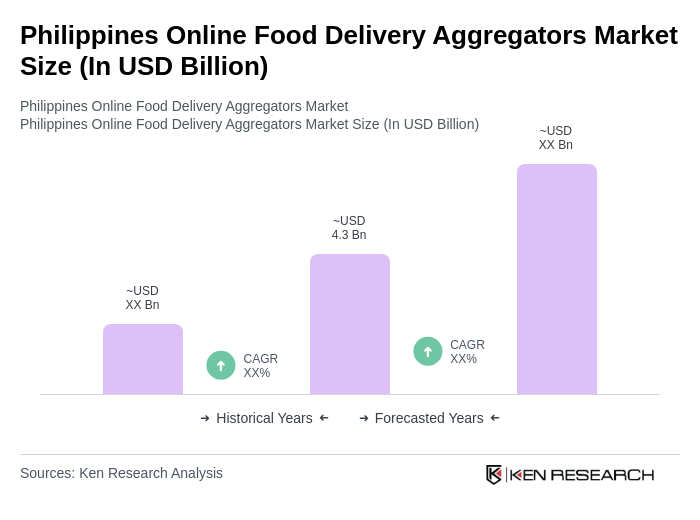
- The Philippines Online Food Delivery Aggregators Market is valued at USD 4.3 billion, based on a five-year historical analysis. This growth is primarily driven by the increasing adoption of smartphones, rapid urbanization, and a pronounced shift in consumer behavior toward convenience and digital solutions for food ordering. The rise in disposable income, the proliferation of digital payment systems, and the growing trend of food delivery services among the younger population have also significantly contributed to the market's expansion. Additionally, the emergence of cloud kitchens and the adoption of sustainable packaging are shaping the market landscape .
- Metro Manila, Cebu, and Davao are the dominant cities in the Philippines Online Food Delivery Aggregators Market. Metro Manila leads due to its high population density, urban lifestyle, and a large number of restaurants and food establishments. Cebu and Davao follow closely, benefiting from their growing urban centers and increasing consumer demand for food delivery services, making them key players in the market .
- The "E-Commerce Philippines 2022 Roadmap," issued by the Department of Trade and Industry, includes operational guidelines for digital platforms, including food delivery aggregators. This instrument mandates compliance with consumer protection standards, data privacy, and fair trade practices. It also encourages platforms to provide insurance coverage and benefits for delivery riders, supporting improved labor conditions and safety in the sector .
Philippines Online Food Delivery Aggregators Market Segmentation
By Platform Type:The market is segmented into mobile applications and websites.Mobile applicationshave gained significant traction due to their user-friendly interfaces and convenience, allowing consumers to order food with just a few taps. Websites, while still relevant, are increasingly being overshadowed by the growing preference for mobile apps, which offer enhanced features such as real-time tracking, personalized recommendations, and seamless integration with digital payment systems. The dominance of mobile platforms is further reinforced by the high smartphone penetration rate in the Philippines .

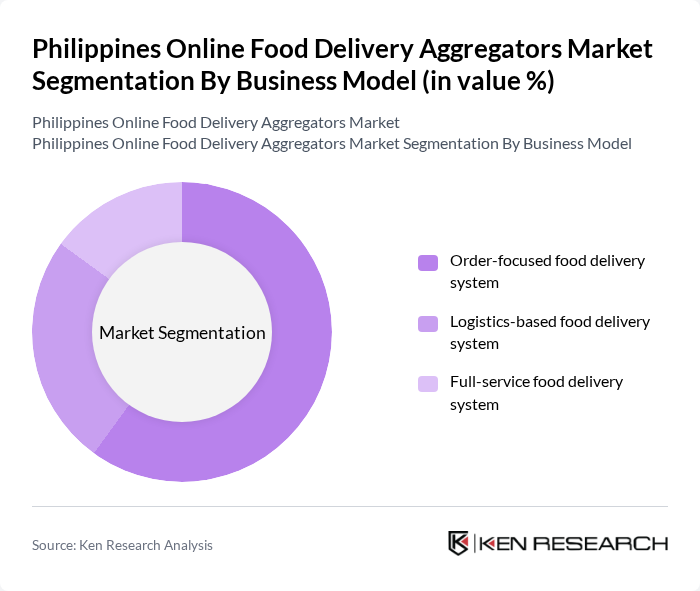
By Business Model:The market is categorized into order-focused food delivery systems, logistics-based food delivery systems, and full-service food delivery systems. Theorder-focused modelis currently leading the market, as it allows consumers to place orders directly from restaurants, providing a streamlined experience. Logistics-based systems are also gaining traction, particularly for their efficiency in managing deliveries and optimizing route planning, while full-service models cater to a niche market that values comprehensive service offerings, including meal preparation and delivery. The rise of cloud kitchens and virtual restaurants is further supporting the growth of logistics-based and order-focused models .
Philippines Online Food Delivery Aggregators Market Competitive Landscape
The Philippines Online Food Delivery Aggregators Market is characterized by a dynamic mix of regional and international players. Leading participants such as GrabFood, Foodpanda (Delivery Hero Philippines, Inc.), LalaFood (ceased operations in 2021), Jollibee Foods Corporation, McDonald's Philippines, Chowking, Mang Inasal, KFC Philippines, Pizza Hut Philippines, Shakey's Pizza, The Coffee Bean & Tea Leaf Philippines, Starbucks Philippines, LAHAT Food, Habit Food Group, GrabExpress, Inc. contribute to innovation, geographic expansion, and service delivery in this space.
Philippines Online Food Delivery Aggregators Market Industry Analysis
Growth Drivers
- Increasing Smartphone Penetration:The Philippines has seen a significant rise in smartphone usage, with overapproximately 84 million smartphone users reported in future, representing asubstantial increase from previous years. This surge facilitates easier access to online food delivery platforms, asover 90% of internet users prefer mobile apps for ordering food. The growing digital literacy among Filipinos further supports this trend, making online food delivery services more accessible and appealing to a broader audience.
- Rising Urbanization and Busy Lifestyles:Urbanization in the Philippines is accelerating, withabout 48% of the population residing in urban areas in future. This shift leads to increased demand for convenient food options, as busy professionals and students seek quick meal solutions. The average Filipino spendsapproximately 7 hours a week commuting, highlighting the need for efficient food delivery services that cater to their fast-paced lifestyles, thus driving market growth.
- Expansion of Restaurant Partnerships:The number of restaurants partnering with online food delivery aggregators hasgrown steadily, with leading platforms reporting thousands of partner establishments nationwide. This expansion allows consumers to access a wider variety of cuisines and dining options, enhancing the appeal of food delivery services. Additionally, many restaurants are now prioritizing online sales, withonline orders accounting for a significant share of revenue for partnered restaurants, further solidifying the market's growth potential.
Market Challenges
- Intense Competition Among Aggregators:The online food delivery market in the Philippines is highly competitive, withseveral major players vying for market share. This intense rivalry leads to aggressive pricing strategies, which can erode profit margins. As a result, many aggregators are forced to invest heavily in marketing and promotions, with expenditures reachingsignificant annual amounts, impacting their overall financial sustainability.
- Delivery Logistics and Operational Costs:The logistics of food delivery pose significant challenges, with operational costsrising due to fuel price increases and labor shortages. Delivery personnel wages have also increased, with theaverage hourly wage for delivery personnel estimated at PHP 55. These rising costs can strain the profitability of food delivery services, making it essential for companies to optimize their logistics and operational efficiency to remain competitive.
Philippines Online Food Delivery Aggregators Market Future Outlook
The future of the Philippines online food delivery market appears promising, driven by technological advancements and evolving consumer preferences. As more Filipinos embrace digital solutions, the integration of AI and data analytics will enhance customer experiences, allowing for personalized services. Additionally, the trend towards healthier eating and sustainable practices will likely shape the offerings of food delivery platforms, encouraging them to adapt and innovate in response to changing consumer demands and preferences.
Market Opportunities
- Expansion into Underserved Regions:There is a significant opportunity for online food delivery services to expand into rural and underserved areas, where access to diverse food options is limited. Withabout 27% of the population living in rural regions, tapping into this market could lead to substantial growth, as demand for convenient food delivery options continues to rise.
- Introduction of Subscription Models:Implementing subscription models could provide a steady revenue stream for food delivery aggregators. With anestimated 20% of consumers expressing interest in subscription services for regular meal deliveries, this approach could enhance customer loyalty and retention, ultimately driving long-term profitability in a competitive market.
Scope of the Report
| Segment | Sub-Segments |
|---|---|
| By Platform Type | Mobile applications Websites |
| By Business Model | Order-focused food delivery system Logistics-based food delivery system Full-service food delivery system |
| By Payment Method | Online payment (credit/debit cards, e-wallets) Cash on delivery |
| By Region | Luzon Visayas Mindanao |
Key Target Audience
Investors and Venture Capitalist Firms
Government and Regulatory Bodies (e.g., Department of Trade and Industry, Food and Drug Administration)
Restaurant Owners and Operators
Logistics and Delivery Service Providers
Payment Processing Companies
Marketing and Advertising Agencies
Food Safety and Quality Assurance Organizations
Telecommunications and Internet Service Providers
Players Mentioned in the Report:
GrabFood
Foodpanda (Delivery Hero Philippines, Inc.)
LalaFood (ceased operations in 2021)
Jollibee Foods Corporation
McDonald's Philippines
Chowking
Mang Inasal
KFC Philippines
Pizza Hut Philippines
Shakey's Pizza
The Coffee Bean & Tea Leaf Philippines
Starbucks Philippines
LAHAT Food
Habit Food Group
GrabExpress, Inc.
Table of Contents
Market Assessment Phase
1. Executive Summary and Approach
2. Philippines Online Food Delivery Aggregators Market Overview
2.1 Key Insights and Strategic Recommendations
2.2 Philippines Online Food Delivery Aggregators Market Overview
2.3 Definition and Scope
2.4 Evolution of Market Ecosystem
2.5 Timeline of Key Regulatory Milestones
2.6 Value Chain & Stakeholder Mapping
2.7 Business Cycle Analysis
2.8 Policy & Incentive Landscape
3. Philippines Online Food Delivery Aggregators Market Analysis
3.1 Growth Drivers
3.1.1 Increasing smartphone penetration
3.1.2 Rising urbanization and busy lifestyles
3.1.3 Expansion of restaurant partnerships
3.1.4 Growth in online payment systems
3.2 Market Challenges
3.2.1 Intense competition among aggregators
3.2.2 Delivery logistics and operational costs
3.2.3 Regulatory compliance issues
3.2.4 Consumer trust and food safety concerns
3.3 Market Opportunities
3.3.1 Expansion into underserved regions
3.3.2 Introduction of subscription models
3.3.3 Partnerships with local food producers
3.3.4 Leveraging data analytics for personalized services
3.4 Market Trends
3.4.1 Growth of cloud kitchens
3.4.2 Increasing demand for healthy food options
3.4.3 Rise of eco-friendly packaging solutions
3.4.4 Integration of AI in customer service
3.5 Government Regulation
3.5.1 Food safety regulations
3.5.2 Labor laws affecting delivery personnel
3.5.3 Taxation policies for online businesses
3.5.4 Data privacy regulations
4. SWOT Analysis
5. Stakeholder Analysis
6. Porter's Five Forces Analysis
7. Philippines Online Food Delivery Aggregators Market Market Size, 2019-2024
7.1 By Value
7.2 By Volume
7.3 By Average Selling Price
8. Philippines Online Food Delivery Aggregators Market Segmentation
8.1 By Platform Type
8.1.1 Mobile applications
8.1.2 Websites
8.2 By Business Model
8.2.1 Order-focused food delivery system
8.2.2 Logistics-based food delivery system
8.2.3 Full-service food delivery system
8.3 By Payment Method
8.3.1 Online payment (credit/debit cards, e-wallets)
8.3.2 Cash on delivery
8.4 By Region
8.4.1 Luzon
8.4.2 Visayas
8.4.3 Mindanao
9. Philippines Online Food Delivery Aggregators Market Competitive Analysis
9.1 Market Share of Key Players
9.2 KPIs for Cross Comparison of Key Players
9.2.1 Company Name
9.2.2 Group Size (Large, Medium, or Small as per industry convention)
9.2.3 Customer Acquisition Cost (CAC)
9.2.4 Average Order Value (AOV)
9.2.5 Delivery Time Efficiency (average delivery time in minutes)
9.2.6 Customer Retention Rate (%)
9.2.7 Pricing Strategy (discounts, delivery fees, subscription pricing)
9.2.8 Market Penetration Rate (% of target market reached)
9.2.9 User Engagement Metrics (monthly active users, app downloads, order frequency)
9.2.10 Revenue Growth Rate (YoY %)
9.3 SWOT Analysis of Top Players
9.4 Pricing Analysis
9.5 Detailed Profile of Major Companies
9.5.1 GrabFood
9.5.2 Foodpanda (Delivery Hero Philippines, Inc.)
9.5.3 LalaFood (ceased operations in 2021)
9.5.4 Jollibee Foods Corporation
9.5.5 McDonald's Philippines
9.5.6 Chowking
9.5.7 Mang Inasal
9.5.8 KFC Philippines
9.5.9 Pizza Hut Philippines
9.5.10 Shakey's Pizza
9.5.11 The Coffee Bean & Tea Leaf Philippines
9.5.12 Starbucks Philippines
9.5.13 LAHAT Food
9.5.14 Habit Food Group
9.5.15 GrabExpress, Inc.
10. Philippines Online Food Delivery Aggregators Market End-User Analysis
10.1 Procurement Behavior of Key Ministries
10.1.1 Food procurement policies
10.1.2 Budget allocation for food services
10.1.3 Supplier selection criteria
10.2 Corporate Spend on Infrastructure & Energy
10.2.1 Investment in delivery infrastructure
10.2.2 Budget for technology integration
10.2.3 Expenditure on marketing and promotions
10.3 Pain Point Analysis by End-User Category
10.3.1 Delivery delays
10.3.2 Quality of food
10.3.3 Customer service issues
10.4 User Readiness for Adoption
10.4.1 Familiarity with online ordering
10.4.2 Access to technology
10.4.3 Willingness to pay for convenience
10.5 Post-Deployment ROI and Use Case Expansion
10.5.1 Measurement of customer satisfaction
10.5.2 Analysis of repeat orders
10.5.3 Expansion into new customer segments
11. Philippines Online Food Delivery Aggregators Market Future Size, 2025-2030
11.1 By Value
11.2 By Volume
11.3 By Average Selling Price
Go-To-Market Strategy Phase
1. Whitespace Analysis + Business Model Canvas
1.1 Market gaps identification
1.2 Value proposition development
1.3 Revenue model exploration
1.4 Customer segment analysis
1.5 Competitive landscape overview
1.6 Key partnerships identification
1.7 Cost structure analysis
2. Marketing and Positioning Recommendations
2.1 Branding strategies
2.2 Product USPs
2.3 Target audience segmentation
2.4 Communication channels
2.5 Promotional tactics
3. Distribution Plan
3.1 Urban retail vs rural NGO tie-ups
3.2 Logistics partnerships
3.3 Delivery network optimization
3.4 Technology integration in distribution
4. Channel & Pricing Gaps
4.1 Underserved routes
4.2 Pricing bands
4.3 Competitor pricing analysis
4.4 Customer willingness to pay
5. Unmet Demand & Latent Needs
5.1 Category gaps
5.2 Consumer segments
5.3 Emerging trends
5.4 Feedback mechanisms
6. Customer Relationship
6.1 Loyalty programs
6.2 After-sales service
6.3 Customer feedback loops
6.4 Community engagement
7. Value Proposition
7.1 Sustainability
7.2 Integrated supply chains
7.3 Unique selling points
7.4 Customer-centric innovations
8. Key Activities
8.1 Regulatory compliance
8.2 Branding
8.3 Distribution setup
8.4 Technology implementation
9. Entry Strategy Evaluation
9.1 Domestic Market Entry Strategy
9.1.1 Product mix
9.1.2 Pricing band
9.1.3 Packaging
9.2 Export Entry Strategy
9.2.1 Target countries
9.2.2 Compliance roadmap
10. Entry Mode Assessment
10.1 JV
10.2 Greenfield
10.3 M&A
10.4 Distributor Model
11. Capital and Timeline Estimation
11.1 Capital requirements
11.2 Timelines
12. Control vs Risk Trade-Off
12.1 Ownership vs Partnerships
13. Profitability Outlook
13.1 Breakeven analysis
13.2 Long-term sustainability
14. Potential Partner List
14.1 Distributors
14.2 JVs
14.3 Acquisition targets
15. Execution Roadmap
15.1 Phased Plan for Market Entry
15.1.1 Market Setup
15.1.2 Market Entry
15.1.3 Growth Acceleration
15.1.4 Scale & Stabilize
15.2 Key Activities and Milestones
15.2.1 Milestone tracking
15.2.2 Performance metrics
15.2.3 Adjustment strategies
Research Methodology
Phase 1: Approach1
Desk Research
- Analysis of industry reports from local market research firms focusing on food delivery trends
- Review of government publications and statistics on e-commerce growth in the Philippines
- Examination of consumer behavior studies related to online food ordering and delivery preferences
Primary Research
- Interviews with key stakeholders in the food delivery ecosystem, including restaurant owners and aggregator executives
- Surveys targeting consumers to understand their preferences, frequency of use, and satisfaction levels
- Focus group discussions with diverse demographic segments to gather qualitative insights on user experiences
Validation & Triangulation
- Cross-validation of findings through comparison with international food delivery market trends
- Triangulation of data from consumer surveys, expert interviews, and secondary research findings
- Sanity checks through expert panel reviews comprising industry veterans and market analysts
Phase 2: Market Size Estimation1
Top-down Assessment
- Estimation of total market size based on national e-commerce revenue and food service industry growth rates
- Segmentation of the market by type of cuisine, delivery model (e.g., direct vs. aggregator), and geographic region
- Incorporation of macroeconomic factors such as GDP growth and urbanization rates influencing food delivery demand
Bottom-up Modeling
- Collection of transaction data from leading food delivery platforms to establish baseline revenue figures
- Estimation of average order value and frequency of orders per consumer segment
- Analysis of operational costs and pricing strategies of food delivery services to assess profitability
Forecasting & Scenario Analysis
- Multi-factor regression analysis incorporating variables such as smartphone penetration and internet accessibility
- Scenario modeling based on potential regulatory changes and shifts in consumer behavior post-pandemic
- Development of baseline, optimistic, and pessimistic forecasts for market growth through 2030
Phase 3: CATI Sample Composition1
| Scope Item/Segment | Sample Size | Target Respondent Profiles |
|---|---|---|
| Consumer Preferences in Food Delivery | 120 | Regular Users, Occasional Users, Non-Users |
| Restaurant Partnerships with Aggregators | 80 | Restaurant Owners, Managers, Franchise Operators |
| Aggregator Business Models | 60 | Business Development Managers, Marketing Directors |
| Delivery Personnel Insights | 50 | Delivery Riders, Logistics Coordinators |
| Impact of Promotions on Consumer Behavior | 70 | Marketing Analysts, Consumer Behavior Researchers |
Frequently Asked Questions
What is the current value of the Philippines Online Food Delivery Aggregators Market?
The Philippines Online Food Delivery Aggregators Market is valued at approximately USD 4.3 billion, reflecting significant growth driven by smartphone adoption, urbanization, and changing consumer preferences towards convenience in food ordering.
Which cities dominate the Philippines Online Food Delivery Aggregators Market?
What are the main drivers of growth in the Philippines Online Food Delivery Market?
What challenges does the Philippines Online Food Delivery Market face?
Other Regional/Country Reports
Indonesia Online Food Delivery Aggregators Market
Malaysia Online Food Delivery Aggregators Market
KSA Online Food Delivery Aggregators Market
APAC Online Food Delivery Aggregators Market
Other Adjacent Reports
Oman Last-Mile Delivery Software Market
Kuwait Cloud Kitchen Operations Market
Mexico Digital Payment Processing Market
Germany Restaurant Management Systems Market
Bahrain Meal Kit Subscription Market
Saudi Arabia Online Grocery Delivery Market Size, Share & Forecast, By Service Type, Delivery Model & Product Category, 2025-2032Vietnam Food Packaging Solutions Market
Vietnam Ride-Hailing Services Market
Australia E-Commerce Logistics Market Size, Share & Forecast, By Service Type, Mode of Transport & Shipment Flow, 2025–2032Germany Consumer Analytics Platforms Market
Why Buy From Us?

What makes us stand out is that our consultants follow Robust, Refine and Result (RRR) methodology. Robust for clear definitions, approaches and sanity checking, Refine for differentiating respondents' facts and opinions, and Result for presenting data with story.

We have set a benchmark in the industry by offering our clients with syndicated and customized market research reports featuring coverage of entire market as well as meticulous research and analyst insights.

While we don't replace traditional research, we flip the method upside down. Our dual approach of Top Bottom & Bottom Top ensures quality deliverable by not just verifying company fundamentals but also looking at the sector and macroeconomic factors.

With one step in the future, our research team constantly tries to show you the bigger picture. We help with some of the tough questions you may encounter along the way: How is the industry positioned? Best marketing channel? KPI's of competitors? By aligning every element, we help maximize success.

Our report gives you instant access to the answers and sources that other companies might choose to hide. We elaborate each steps of research methodology we have used and showcase you the sample size to earn your trust.

If you need any support, we are here! We pride ourselves on universe strength, data quality, and quick, friendly, and professional service.