Ken Research Logo

Philippines Post Consumer Recycled Plastics Automotive Market Report Size, Share, Growth Drivers, Trends, Opportunities & Forecast 2025–2030

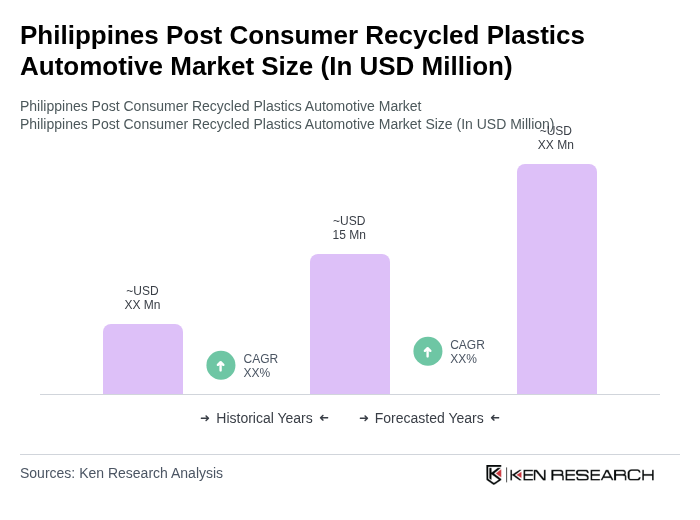
The Philippines Post Consumer Recycled Plastics Automotive Market, valued at USD 15 million, is growing due to recycling initiatives and automotive sustainability trends.

Region:Asia

Author(s):Shubham

Product Code:KRAD5389

Pages:81

Published On:December 2025
About the Report

Base Year 2024

Philippines Post Consumer Recycled Plastics Automotive Market Overview

  • The Philippines Post Consumer Recycled Plastics Automotive Market is valued at USD 15 million, based on a five-year historical analysis and the relative share of automotive applications within the overall recycled and plastics markets in the country. This growth is primarily driven by increasing environmental awareness, government regulations promoting recycling, and the automotive industry's shift towards sustainable and lightweight materials, especially in interior and non-structural components. The rising demand for eco-friendly automotive components has led to a significant uptick in the utilization of post-consumer recycled plastics, particularly polypropylene, PET, and polyethylene grades aligned with OEM sustainability targets.
  • Key regional hubs in this market include Metro Manila, Cavite, and Laguna, which dominate due to their robust automotive manufacturing and assembly presence, concentration of Tier-1 and Tier-2 plastics converters, and proximity to major material recovery and recycling facilities. The concentration of automotive OEMs and Tier-1 suppliers in these regions facilitates a relatively integrated supply chain for recycled plastics, supporting just?in?time deliveries, localization of plastic parts, and collaboration on circularity programs between assemblers and local recyclers.
  • In 2022, the Philippine government enacted Republic Act No. 11898, the Extended Producer Responsibility (EPR) Act of 2022, implemented through the Department of Environment and Natural Resources (DENR) and its Implementing Rules and Regulations (DENR Administrative Order No. 2023?02), which mandates large enterprises to recover and divert specified volumes of plastic packaging waste. This regulation sets recovery and diversion targets, requires registration and EPR program plans, and encourages use of recycled content, thereby indirectly increasing the availability and quality of post-consumer recycled materials that can be used in automotive plastics applications.
Philippines Post Consumer Recycled Plastics Automotive Market Size

Philippines Post Consumer Recycled Plastics Automotive Market Segmentation

By Polymer Type (PCR Plastics):The market is segmented based on various polymer types used in the production of automotive components. The primary subsegments include Polypropylene (rPP), Polyethylene Terephthalate (rPET), Polyethylene (rPE – LDPE/HDPE), Acrylonitrile Butadiene Styrene (rABS) and Other Engineering Plastics, and Others (PVC, PS, PC, Blends). rPP is gaining traction due to its versatility, good impact performance, and cost-effectiveness in interior trims, consoles, and non-structural parts, while rPET is increasingly favored for its sustainability attributes and suitability in fibers, textiles, and some semi-structural applications.
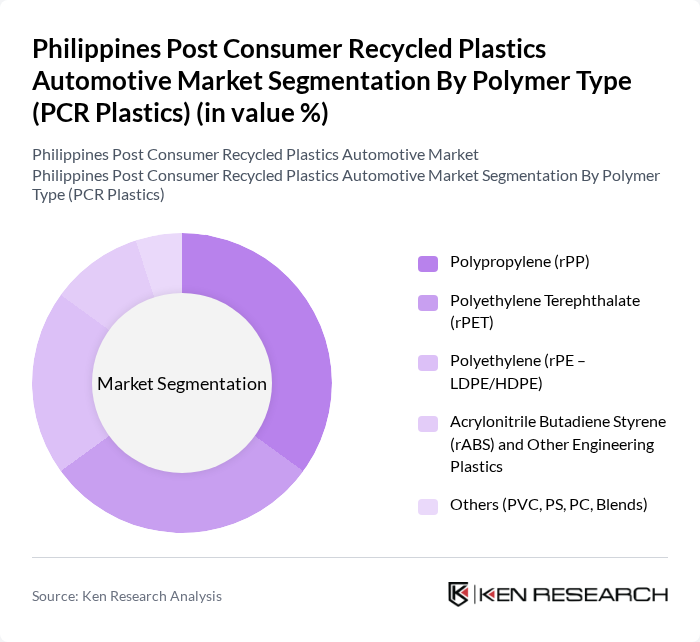
Philippines Post Consumer Recycled Plastics Automotive Market segmentation by Polymer Type (PCR Plastics).

By Automotive Component:This segmentation focuses on the various automotive components that utilize post-consumer recycled plastics. The key subsegments include Interior Components (Trim, Panels, Consoles, Seat Parts), Exterior Components (Bumpers, Grilles, Wheel Arch Liners), Under-the-Hood & Functional Components (Battery Trays, Fluid Reservoirs, Covers), Non-Structural Accessories (Floor Mats, Luggage Trays, Clips & Fasteners), and Others. Interior components are leading the market due to their high demand for lightweight and durable plastics, the feasibility of incorporating higher recycled content without compromising safety-critical performance, and OEM sustainability commitments to increase recycled polymer content per vehicle.
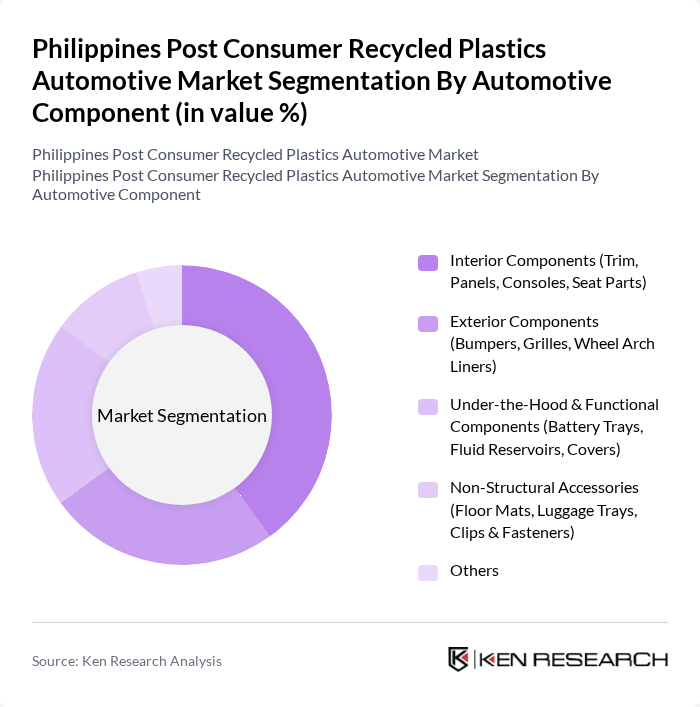
Philippines Post Consumer Recycled Plastics Automotive Market segmentation by Automotive Component.

Philippines Post Consumer Recycled Plastics Automotive Market Competitive Landscape

The Philippines Post Consumer Recycled Plastics Automotive Market is characterized by a dynamic mix of regional and international players. Leading participants such as San Miguel Yamamura Packaging Corporation – Plastic Recycling Division, Manly Plastics Inc., D&L Industries Inc. – Polymer & Colorants Segment, Petroplas Corporation, Polystyrene Packaging Industries Corporation (PPIC), Envirotech Waste Recycling Inc., Genecosco Recycling Corp., Resin Enterprise & Industrial Sales Inc., JG Summit Olefins Corporation – Recycled & Circular Polymers Initiative, Phoenix Petroleum Philippines Inc. – Phoenix Plastics Recycling Unit, First Philippine Industrial Park Locators (Automotive Tier-1 Plastics Converters), Toyota Motor Philippines Corporation – Circular Plastics & Parts Localization, Mitsubishi Motors Philippines Corporation – Use of Recycled Plastics in Local Assembly, Nissan Philippines Inc. – Sustainability and Recycled Content Programs, Isuzu Philippines Corporation – Commercial Vehicle Plastics Recovery Initiatives contribute to innovation, geographic expansion, and service delivery in this space, supported by broader growth in the Philippine plastics industry and rising automotive production and sales.

San Miguel Yamamura Packaging Corporation

1990

Mandaluyong, Philippines

Manly Plastics Inc.

1964

Quezon City, Philippines

D&L Industries Inc.

1963

Quezon City, Philippines

Petroplas Corporation

2000

Pasig City, Philippines

Polystyrene Packaging Industries Corporation (PPIC)

1979

Makati City, Philippines

Company

Establishment Year

Headquarters

Installed Recycling & Compounding Capacity (KT Per Annum, Automotive Share)

Revenue from Automotive Applications and 3-Year CAGR

Domestic Market Coverage (OEM/Tier-1 Accounts, Regional Reach)

Average PCR Content in Supplied Automotive Grades (%)

Certification & Compliance (ISO/TS, IATF 16949, OEM Approvals)

Product & Process Innovation (New Grades, Additives, Circular Partnerships)

Philippines Post Consumer Recycled Plastics Automotive Market Industry Analysis

Growth Drivers

  • Increasing Environmental Awareness:The Philippines has seen a significant rise in environmental consciousness, with 78% of Filipinos expressing concern about plastic waste, according to a recent survey by the Department of Environment and Natural Resources. This awareness drives demand for sustainable automotive materials, as consumers increasingly prefer products that minimize environmental impact. The government’s commitment to reducing plastic pollution aligns with this trend, fostering a market environment conducive to recycled plastics in automotive applications.
  • Government Initiatives for Recycling:The Philippine government has implemented various initiatives to promote recycling, including the Plastic Waste Management Act, which aims to reduce plastic waste by 75% in the near future. This legislation supports the establishment of recycling facilities, with an estimated investment of PHP 1.5 billion allocated for infrastructure development. Such initiatives not only enhance recycling capabilities but also create a favorable regulatory environment for the use of post-consumer recycled plastics in the automotive sector.
  • Rising Demand for Sustainable Materials:The automotive industry in the Philippines is increasingly shifting towards sustainable materials, with a projected increase in the use of recycled plastics by 30% in the near future. This shift is driven by both consumer preferences and corporate sustainability goals, as major automotive manufacturers are committing to using at least 20% recycled materials in their production processes. This trend is supported by the growing availability of high-quality recycled plastics, enhancing their appeal in automotive applications.

Market Challenges

  • Limited Recycling Infrastructure:Despite government efforts, the Philippines still faces significant challenges in recycling infrastructure, with only 20% of plastic waste being recycled as of recent data. The lack of adequate facilities hampers the collection and processing of post-consumer plastics, limiting the supply of recycled materials for the automotive industry. This infrastructure gap poses a critical challenge to meeting the rising demand for sustainable automotive components.
  • High Initial Investment Costs:The establishment of recycling facilities and the adoption of advanced recycling technologies require substantial initial investments, often exceeding PHP 500 million per facility. Many companies, particularly small and medium enterprises, struggle to secure funding for these projects. This financial barrier limits the growth potential of the post-consumer recycled plastics market in the automotive sector, hindering the transition to more sustainable practices.

Philippines Post Consumer Recycled Plastics Automotive Market Future Outlook

The future of the Philippines post-consumer recycled plastics automotive market appears promising, driven by increasing environmental regulations and consumer demand for sustainable products. As the government continues to enhance recycling infrastructure and incentivize the use of recycled materials, the automotive sector is likely to see a significant shift towards eco-friendly practices. Innovations in recycling technologies will further improve the quality and availability of recycled plastics, positioning the industry for sustainable growth in the coming years.

Market Opportunities

  • Expansion of Automotive Manufacturing:The Philippine automotive manufacturing sector is projected to grow by 15% annually, creating a substantial demand for recycled plastics. This growth presents an opportunity for recycling companies to establish partnerships with automotive manufacturers, ensuring a steady supply of sustainable materials that meet industry standards and consumer expectations.
  • Development of New Recycling Technologies:Advancements in recycling technologies, such as chemical recycling, are expected to enhance the efficiency and quality of recycled plastics. By investing in these technologies, companies can improve their product offerings, reduce costs, and meet the increasing demand for high-quality recycled materials in the automotive sector, thus capturing a larger market share.

Scope of the Report

SegmentSub-Segments
By Polymer Type (PCR Plastics)

Polypropylene (rPP)

Polyethylene Terephthalate (rPET)

Polyethylene (rPE – LDPE/HDPE)

Acrylonitrile Butadiene Styrene (rABS) and Other Engineering Plastics

Others (PVC, PS, PC, Blends)

By Automotive Component

Interior Components (Trim, Panels, Consoles, Seat Parts)

Exterior Components (Bumpers, Grilles, Wheel Arch Liners)

Under-the-Hood & Functional Components (Battery Trays, Fluid Reservoirs, Covers)

Non-Structural Accessories (Floor Mats, Luggage Trays, Clips & Fasteners)

Others

By Automotive Vehicle Type

Passenger Cars

Light Commercial Vehicles

Heavy Commercial Vehicles & Buses

Two-Wheelers & Three-Wheelers

Others (Off-Highway, Specialty Vehicles)

By Material Source (Post-Consumer Feedstock)

Beverage Bottles and Containers

Flexible Packaging and Plastic Bags

Household & Consumer Product Packaging

End-of-Life Vehicle Plastics

Others (Industrial & Commercial Post-Consumer Waste)

By Recycling / Processing Technology

Mechanical Recycling (Sorting, Washing, Re-granulation)

Chemical / Advanced Recycling (Depolymerisation, Pyrolysis, Solvolysis)

Compounding & Upcycling (PCR Blends and Masterbatches)

Others

By Sales / Supply Channel

Direct Supply to Automotive OEMs

Supply to Tier-1 / Tier-2 Auto Component Manufacturers

Industrial Distributors & Resin Traders

Others

By Region

Luzon (Including Metro Manila and CALABARZON Automotive Corridor)

Visayas

Mindanao

Others

Key Target Audience

Investors and Venture Capitalist Firms

Government and Regulatory Bodies (e.g., Department of Environment and Natural Resources, Department of Trade and Industry)

Automotive Manufacturers

Plastic Recycling Companies

Automotive Parts Suppliers

Environmental NGOs and Advocacy Groups

Logistics and Supply Chain Companies

Industry Associations (e.g., Chamber of Automotive Manufacturers of the Philippines, Inc.)

Players Mentioned in the Report:

San Miguel Yamamura Packaging Corporation Plastic Recycling Division

Manly Plastics Inc.

D&L Industries Inc. Polymer & Colorants Segment

Petroplas Corporation

Polystyrene Packaging Industries Corporation (PPIC)

Envirotech Waste Recycling Inc.

Genecosco Recycling Corp.

Resin Enterprise & Industrial Sales Inc.

JG Summit Olefins Corporation Recycled & Circular Polymers Initiative

Phoenix Petroleum Philippines Inc. Phoenix Plastics Recycling Unit

First Philippine Industrial Park Locators (Automotive Tier-1 Plastics Converters)

Toyota Motor Philippines Corporation Circular Plastics & Parts Localization

Mitsubishi Motors Philippines Corporation Use of Recycled Plastics in Local Assembly

Nissan Philippines Inc. Sustainability and Recycled Content Programs

Isuzu Philippines Corporation Commercial Vehicle Plastics Recovery Initiatives

Table of Contents

Market Assessment Phase

1. Executive Summary and Approach


2. Philippines Post Consumer Recycled Plastics Automotive Market Overview

2.1 Key Insights and Strategic Recommendations

2.2 Philippines Post Consumer Recycled Plastics Automotive Market Overview

2.3 Definition and Scope

2.4 Evolution of Market Ecosystem

2.5 Timeline of Key Regulatory Milestones

2.6 Value Chain & Stakeholder Mapping

2.7 Business Cycle Analysis

2.8 Policy & Incentive Landscape


3. Philippines Post Consumer Recycled Plastics Automotive Market Analysis

3.1 Growth Drivers

3.1.1 Increasing Environmental Awareness
3.1.2 Government Initiatives for Recycling
3.1.3 Rising Demand for Sustainable Materials
3.1.4 Technological Advancements in Recycling Processes

3.2 Market Challenges

3.2.1 Limited Recycling Infrastructure
3.2.2 High Initial Investment Costs
3.2.3 Fluctuating Raw Material Prices
3.2.4 Regulatory Compliance Issues

3.3 Market Opportunities

3.3.1 Expansion of Automotive Manufacturing
3.3.2 Development of New Recycling Technologies
3.3.3 Partnerships with Automotive Companies
3.3.4 Growing Export Potential

3.4 Market Trends

3.4.1 Shift Towards Circular Economy
3.4.2 Increased Use of Recycled Plastics in Automotive Parts
3.4.3 Consumer Preference for Eco-Friendly Products
3.4.4 Innovations in Material Science

3.5 Government Regulation

3.5.1 Implementation of Plastic Waste Management Act
3.5.2 Incentives for Recycling Facilities
3.5.3 Standards for Recycled Materials in Automotive
3.5.4 Regulations on Plastic Imports

4. SWOT Analysis


5. Stakeholder Analysis


6. Porter's Five Forces Analysis


7. Philippines Post Consumer Recycled Plastics Automotive Market Market Size, 2019-2024

7.1 By Value

7.2 By Volume

7.3 By Average Selling Price


8. Philippines Post Consumer Recycled Plastics Automotive Market Segmentation

8.1 By Polymer Type (PCR Plastics)

8.1.1 Polypropylene (rPP)
8.1.2 Polyethylene Terephthalate (rPET)
8.1.3 Polyethylene (rPE – LDPE/HDPE)
8.1.4 Acrylonitrile Butadiene Styrene (rABS) and Other Engineering Plastics
8.1.5 Others (PVC, PS, PC, Blends)

8.2 By Automotive Component

8.2.1 Interior Components (Trim, Panels, Consoles, Seat Parts)
8.2.2 Exterior Components (Bumpers, Grilles, Wheel Arch Liners)
8.2.3 Under-the-Hood & Functional Components (Battery Trays, Fluid Reservoirs, Covers)
8.2.4 Non-Structural Accessories (Floor Mats, Luggage Trays, Clips & Fasteners)
8.2.5 Others

8.3 By Automotive Vehicle Type

8.3.1 Passenger Cars
8.3.2 Light Commercial Vehicles
8.3.3 Heavy Commercial Vehicles & Buses
8.3.4 Two-Wheelers & Three-Wheelers
8.3.5 Others (Off-Highway, Specialty Vehicles)

8.4 By Material Source (Post-Consumer Feedstock)

8.4.1 Beverage Bottles and Containers
8.4.2 Flexible Packaging and Plastic Bags
8.4.3 Household & Consumer Product Packaging
8.4.4 End-of-Life Vehicle Plastics
8.4.5 Others (Industrial & Commercial Post-Consumer Waste)

8.5 By Recycling / Processing Technology

8.5.1 Mechanical Recycling (Sorting, Washing, Re-granulation)
8.5.2 Chemical / Advanced Recycling (Depolymerisation, Pyrolysis, Solvolysis)
8.5.3 Compounding & Upcycling (PCR Blends and Masterbatches)
8.5.4 Others

8.6 By Sales / Supply Channel

8.6.1 Direct Supply to Automotive OEMs
8.6.2 Supply to Tier-1 / Tier-2 Auto Component Manufacturers
8.6.3 Industrial Distributors & Resin Traders
8.6.4 Others

8.7 By Region

8.7.1 Luzon (Including Metro Manila and CALABARZON Automotive Corridor)
8.7.2 Visayas
8.7.3 Mindanao
8.7.4 Others

9. Philippines Post Consumer Recycled Plastics Automotive Market Competitive Analysis

9.1 Market Share of Key Players

9.2 Cross Comparison of Key Players

9.2.1 Company Specialisation in Automotive-Grade PCR Resins and Compounds
9.2.2 Installed Recycling & Compounding Capacity (KT Per Annum, Automotive Share)
9.2.3 Revenue from Automotive Applications and 3-Year CAGR
9.2.4 Domestic Market Coverage (OEM/Tier-1 Accounts, Regional Reach)
9.2.5 Average PCR Content in Supplied Automotive Grades (%)
9.2.6 Certification & Compliance (ISO/TS, IATF 16949, OEM Approvals)
9.2.7 Product & Process Innovation (New Grades, Additives, Circular Partnerships)
9.2.8 Supply Chain Integration (Collection Network, Sorting, In-house vs Tolling)
9.2.9 Sustainability Performance (CO? Savings, Waste Diverted from Landfill)
9.2.10 Pricing & Contracting Model (Spot vs Long-Term, Premium/Discount to Virgin)

9.3 SWOT Analysis of Top Players

9.4 Pricing Analysis

9.5 Detailed Profile of Major Companies

9.5.1 San Miguel Yamamura Packaging Corporation – Plastic Recycling Division
9.5.2 Manly Plastics Inc.
9.5.3 D&L Industries Inc. – Polymer & Colorants Segment
9.5.4 Petroplas Corporation
9.5.5 Polystyrene Packaging Industries Corporation (PPIC)
9.5.6 Envirotech Waste Recycling Inc.
9.5.7 Genecosco Recycling Corp.
9.5.8 Resin Enterprise & Industrial Sales Inc.
9.5.9 JG Summit Olefins Corporation – Recycled & Circular Polymers Initiative
9.5.10 Phoenix Petroleum Philippines Inc. – Phoenix Plastics Recycling Unit
9.5.11 First Philippine Industrial Park Locators (Automotive Tier-1 Plastics Converters)
9.5.12 Toyota Motor Philippines Corporation – Circular Plastics & Parts Localization
9.5.13 Mitsubishi Motors Philippines Corporation – Use of Recycled Plastics in Local Assembly
9.5.14 Nissan Philippines Inc. – Sustainability and Recycled Content Programs
9.5.15 Isuzu Philippines Corporation – Commercial Vehicle Plastics Recovery Initiatives

10. Philippines Post Consumer Recycled Plastics Automotive Market End-User Analysis

10.1 Procurement Behavior of Key Ministries

10.1.1 Government Contracts for Sustainable Materials
10.1.2 Budget Allocation for Eco-Friendly Projects
10.1.3 Compliance with Environmental Standards
10.1.4 Others

10.2 Corporate Spend on Infrastructure & Energy

10.2.1 Investment in Green Technologies
10.2.2 Budget for Sustainable Sourcing
10.2.3 Others

10.3 Pain Point Analysis by End-User Category

10.3.1 Cost of Recycled Materials
10.3.2 Quality Concerns with Recycled Plastics
10.3.3 Supply Chain Disruptions
10.3.4 Others

10.4 User Readiness for Adoption

10.4.1 Awareness of Benefits of Recycled Plastics
10.4.2 Training and Support Needs
10.4.3 Others

10.5 Post-Deployment ROI and Use Case Expansion

10.5.1 Measurement of Cost Savings
10.5.2 Expansion into New Applications
10.5.3 Others

11. Philippines Post Consumer Recycled Plastics Automotive Market Future Size, 2025-2030

11.1 By Value

11.2 By Volume

11.3 By Average Selling Price


Go-To-Market Strategy Phase

1. Whitespace Analysis + Business Model Canvas

1.1 Market Gaps Identification

1.2 Business Model Development


2. Marketing and Positioning Recommendations

2.1 Branding Strategies

2.2 Product USPs


3. Distribution Plan

3.1 Urban Retail vs Rural NGO Tie-ups


4. Channel & Pricing Gaps

4.1 Underserved Routes

4.2 Pricing Bands


5. Unmet Demand & Latent Needs

5.1 Category Gaps

5.2 Consumer Segments


6. Customer Relationship

6.1 Loyalty Programs

6.2 After-sales Service


7. Value Proposition

7.1 Sustainability

7.2 Integrated Supply Chains


8. Key Activities

8.1 Regulatory Compliance

8.2 Branding

8.3 Distribution Setup


9. Entry Strategy Evaluation

9.1 Domestic Market Entry Strategy

9.1.1 Product Mix
9.1.2 Pricing Band
9.1.3 Packaging

9.2 Export Entry Strategy

9.2.1 Target Countries
9.2.2 Compliance Roadmap

10. Entry Mode Assessment

10.1 JV

10.2 Greenfield

10.3 M&A

10.4 Distributor Model


11. Capital and Timeline Estimation

11.1 Capital Requirements

11.2 Timelines


12. Control vs Risk Trade-Off

12.1 Ownership vs Partnerships


13. Profitability Outlook

13.1 Breakeven Analysis

13.2 Long-term Sustainability


14. Potential Partner List

14.1 Distributors

14.2 JVs

14.3 Acquisition Targets


15. Execution Roadmap

15.1 Phased Plan for Market Entry

15.1.1 Market Setup
15.1.2 Market Entry
15.1.3 Growth Acceleration
15.1.4 Scale & Stabilize

15.2 Key Activities and Milestones

15.2.1 Activity Planning
15.2.2 Milestone Tracking

Research Methodology

ApproachModellingSample

Phase 1: Approach1

Desk Research

  • Analysis of industry reports from government agencies and environmental organizations
  • Review of academic publications on post-consumer recycled plastics in automotive applications
  • Examination of market trends and statistics from trade associations and industry journals

Primary Research

  • Interviews with automotive manufacturers utilizing recycled plastics
  • Surveys with suppliers of recycled plastic materials
  • Focus groups with industry experts and sustainability advocates

Validation & Triangulation

  • Cross-validation of findings through multiple data sources including trade publications and expert opinions
  • Triangulation of market data with insights from regulatory bodies and industry stakeholders
  • Sanity checks through expert panel discussions to ensure data reliability

Phase 2: Market Size Estimation1

Top-down Assessment

  • Estimation of the total automotive market size in the Philippines and its growth rate
  • Analysis of the proportion of recycled plastics used in automotive manufacturing
  • Incorporation of government policies promoting the use of recycled materials in the automotive sector

Bottom-up Modeling

  • Collection of data on production volumes from key automotive manufacturers
  • Cost analysis of recycled plastics versus virgin materials in automotive applications
  • Estimation of market penetration rates for recycled plastics in various automotive components

Forecasting & Scenario Analysis

  • Development of predictive models based on historical growth rates and market trends
  • Scenario analysis considering potential regulatory changes and shifts in consumer preferences
  • Creation of multiple forecasts (baseline, optimistic, and pessimistic) through 2030

Phase 3: CATI Sample Composition1

Scope Item/SegmentSample SizeTarget Respondent Profiles
Automotive Manufacturers120Production Managers, Sustainability Officers
Suppliers of Recycled Plastics90Sales Managers, Product Development Leads
Regulatory Bodies40Policy Makers, Environmental Compliance Officers
Industry Experts and Consultants60Market Analysts, Sustainability Consultants
Consumer Insights80Automotive Enthusiasts, Eco-conscious Consumers

Frequently Asked Questions

What is the current value of the Philippines Post Consumer Recycled Plastics Automotive Market?

The Philippines Post Consumer Recycled Plastics Automotive Market is valued at approximately USD 15 million, reflecting a growing trend towards sustainable materials in the automotive sector driven by environmental awareness and government regulations.

What are the main drivers of growth in this market?

Which regions in the Philippines are key hubs for this market?

What types of recycled plastics are commonly used in automotive applications?

Other Regional/Country Reports

Indonesia Post Consumer Recycled Plastics Automotive Market

Malaysia Post Consumer Recycled Plastics Automotive Market

KSA Post Consumer Recycled Plastics Automotive Market

APAC Post Consumer Recycled Plastics Automotive Market

SEA Post Consumer Recycled Plastics Automotive Market

Vietnam Post Consumer Recycled Plastics Automotive Market

Other Adjacent Reports

Why Buy From Us?

Refine Robust Result (RRR) Framework

What makes us stand out is that our consultants follow Robust, Refine and Result (RRR) methodology. Robust for clear definitions, approaches and sanity checking, Refine for differentiating respondents' facts and opinions, and Result for presenting data with story.

Our Reach Is Unmatched

We have set a benchmark in the industry by offering our clients with syndicated and customized market research reports featuring coverage of entire market as well as meticulous research and analyst insights.

Shifting the Research Paradigm

While we don't replace traditional research, we flip the method upside down. Our dual approach of Top Bottom & Bottom Top ensures quality deliverable by not just verifying company fundamentals but also looking at the sector and macroeconomic factors.

More Insights-Better Decisions

With one step in the future, our research team constantly tries to show you the bigger picture. We help with some of the tough questions you may encounter along the way: How is the industry positioned? Best marketing channel? KPI's of competitors? By aligning every element, we help maximize success.

Transparency and Trust

Our report gives you instant access to the answers and sources that other companies might choose to hide. We elaborate each steps of research methodology we have used and showcase you the sample size to earn your trust.

Round the Clock Support

If you need any support, we are here! We pride ourselves on universe strength, data quality, and quick, friendly, and professional service.

Why Clients Choose Us?

400000+
Reports in repository
150+
Consulting projects a year
100+
Analysts
8000+
Client Queries in 2022








