About the Report
Base Year 2024Philippines Retail Industry Market Overview
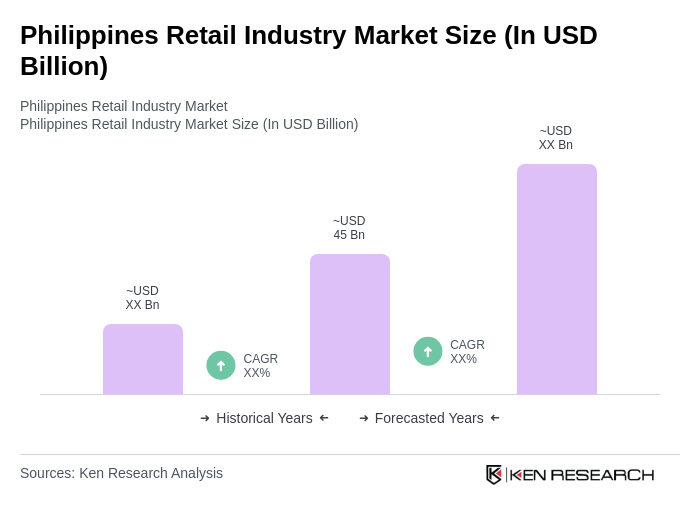
- The Philippines retail industry market is valued at approximately USD 45 billion, based on a five-year historical analysis. This growth is primarily driven by increasing consumer spending and disposable incomes, rapid urbanization, and the expansion of e-commerce and digital payments, underpinned by high smartphone adoption and the scaling of online retail channels. Rising digital adoption, omnichannel investments by major chains, and improved supply chains have further supported market expansion and resilience.
- Metro Manila, Cebu, and Davao are the dominant cities in the Philippines retail market. Metro Manila has a dense population and diverse consumer segments with the country’s largest modern retail footprint, while Cebu and Davao are key regional hubs benefiting from ongoing urbanization and new mall and supermarket expansion by leading chains.
- In 2023, the Philippine government implemented amendments to the Retail Trade Liberalization Act, lowering the minimum paid-up capital requirement for foreign retailers and easing entry. The law reduced capital thresholds, enabling wider foreign participation compared with the prior USD 2.5 million minimum, with implementing rules issued in 2022–2023 to operationalize the reforms.
Philippines Retail Industry Market Segmentation
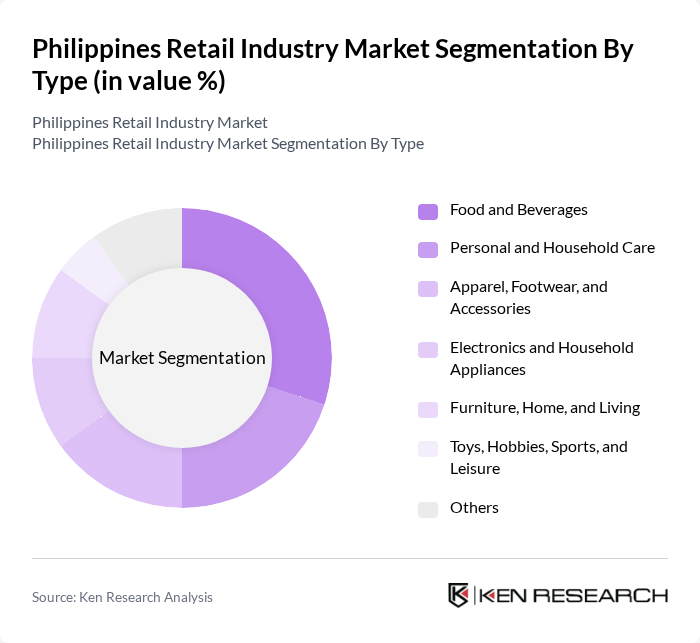
By Type:The retail industry in the Philippines can be segmented into various types, including Food and Beverages, Personal and Household Care, Apparel, Footwear, and Accessories, Electronics and Household Appliances, Furniture, Home, and Living, Toys, Hobbies, Sports, and Leisure, and Others. Each of these segments caters to different consumer needs and preferences, contributing to the overall market dynamics.
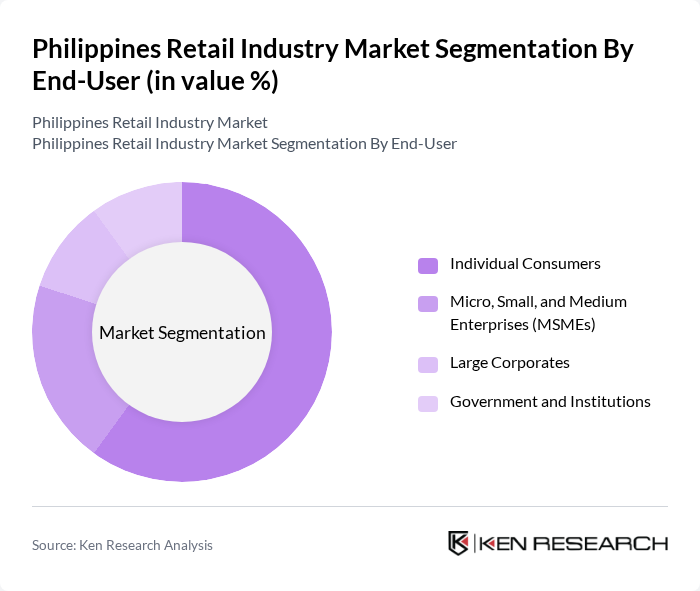
By End-User:The retail market serves various end-users, including Individual Consumers, Micro, Small, and Medium Enterprises (MSMEs), Large Corporates, and Government and Institutions. Each end-user segment has distinct purchasing behaviors and requirements, influencing the overall retail landscape.
Philippines Retail Industry Market Competitive Landscape
The Philippines Retail Industry Market is characterized by a dynamic mix of regional and international players. Leading participants such as SM Retail, Inc., Robinsons Retail Holdings, Inc., Puregold Price Club, Inc., Metro Retail Stores Group, Inc., AllDay Marts, Inc., Gaisano Capital Group, The Landmark Corporation (Landmark Department Store and Supermarket), Rustan Commercial Corporation (Rustan’s and Rustan Supercenters legacy), Philippine Seven Corporation (7?Eleven Philippines), Uncle John’s Convenience Store (formerly Ministop Philippines), Mercury Drug Corporation, Watsons Personal Care Stores (Philippines), Inc., The SM Store, SSI Group, Inc. (Specialty Fashion and Lifestyle Retail), Zalora Philippines contribute to innovation, geographic expansion, and service delivery in this space.
Philippines Retail Industry Market Industry Analysis
Growth Drivers
- Increasing Urbanization:The Philippines is experiencing rapid urbanization, with urban areas projected to house 58% of the population in future, up from 54% in 2020. This shift is driving demand for retail spaces, as urban residents typically have higher disposable incomes. The urban population is expected to reach approximately 63 million in future, creating a larger customer base for retailers. This trend is supported by infrastructure developments, such as the ongoing construction of new malls and commercial centers in urban areas.
- Rising Middle-Class Population:The middle-class population in the Philippines is anticipated to grow to 32 million in future, representing a significant increase from 22 million in 2020. This demographic shift is crucial for the retail sector, as middle-class consumers tend to spend more on discretionary items. The increase in disposable income, projected to rise by 6% annually, will further enhance purchasing power, leading to greater demand for both local and international retail brands, thereby stimulating market growth.
- Growth of E-commerce:E-commerce in the Philippines is projected to reach $15 billion in sales in future, up from $7 billion in 2020. This growth is driven by increased internet penetration, which is expected to hit 85% of the population in future. The rise of mobile commerce, with over 75% of online transactions occurring via smartphones, is also a significant factor. Retailers are increasingly investing in digital platforms to capture this growing market segment, enhancing their overall sales and customer engagement strategies.
Market Challenges
- Intense Competition:The retail landscape in the Philippines is characterized by fierce competition, with over 1,200 registered retail companies vying for market share. Major players like SM Retail and Ayala Malls dominate, but numerous small and medium enterprises (SMEs) are also emerging. This saturation leads to price wars and reduced profit margins, making it challenging for new entrants to establish a foothold. Retailers must innovate and differentiate their offerings to survive in this highly competitive environment.
- Supply Chain Disruptions:The Philippines faces significant supply chain challenges, exacerbated by natural disasters and global disruptions. In future, the country experienced a 17% increase in logistics costs due to rising fuel prices and port congestion. These disruptions can lead to stock shortages and delayed deliveries, negatively impacting customer satisfaction. Retailers must invest in robust supply chain management systems to mitigate these risks and ensure consistent product availability in the market.
Philippines Retail Industry Market Future Outlook
The Philippines retail industry is poised for significant transformation, driven by technological advancements and changing consumer preferences. As e-commerce continues to expand, retailers will increasingly adopt omnichannel strategies to enhance customer experiences. Additionally, the focus on sustainability will shape product offerings, with consumers favoring eco-friendly brands. In future, the integration of artificial intelligence and data analytics will further optimize inventory management and personalized marketing, positioning retailers to better meet evolving consumer demands and preferences.
Market Opportunities
- Digital Transformation:The shift towards digital platforms presents a significant opportunity for retailers to enhance customer engagement. By investing in e-commerce and mobile applications, retailers can tap into the growing online shopping trend, projected to account for 25% of total retail sales in future. This digital focus will enable retailers to reach a broader audience and improve operational efficiency through streamlined processes.
- Expansion into Rural Markets:With 72% of the Philippine population residing in rural areas, there is a substantial opportunity for retailers to expand their reach. By establishing retail outlets in underserved regions, companies can cater to the growing demand for consumer goods. The government’s infrastructure initiatives, including improved road networks, will facilitate access to these markets, allowing retailers to capitalize on this untapped potential.
Scope of the Report
| Segment | Sub-Segments |
|---|---|
| By Type | Food and Beverages Personal and Household Care Apparel, Footwear, and Accessories Electronics and Household Appliances Furniture, Home, and Living Toys, Hobbies, Sports, and Leisure Others |
| By End-User | Individual Consumers Micro, Small, and Medium Enterprises (MSMEs) Large Corporates Government and Institutions |
| By Sales Channel | Supermarkets and Hypermarkets Convenience Stores Department and Specialty Stores Online (E-commerce and Marketplaces) Other Offline Channels |
| By Distribution Mode | Modern Trade Traditional Trade (Sari-sari stores and Wet Markets) Omnichannel and Dark Stores |
| By Price Range | Mass / Value Premium Luxury |
| By Consumer Demographics | Age Group Income Level Gender |
| By Region | Luzon Visayas Mindanao |
Key Target Audience
Investors and Venture Capitalist Firms
Government and Regulatory Bodies (e.g., Department of Trade and Industry, Bureau of Internal Revenue)
Manufacturers and Producers
Distributors and Retailers
Logistics and Supply Chain Companies
Technology Providers
Industry Associations (e.g., Philippine Retailers Association)
Financial Institutions
Players Mentioned in the Report:
SM Retail, Inc.
Robinsons Retail Holdings, Inc.
Puregold Price Club, Inc.
Metro Retail Stores Group, Inc.
AllDay Marts, Inc.
Gaisano Capital Group
The Landmark Corporation (Landmark Department Store and Supermarket)
Rustan Commercial Corporation (Rustans and Rustan Supercenters legacy)
Philippine Seven Corporation (7Eleven Philippines)
Uncle Johns Convenience Store (formerly Ministop Philippines)
Mercury Drug Corporation
Watsons Personal Care Stores (Philippines), Inc.
The SM Store
SSI Group, Inc. (Specialty Fashion and Lifestyle Retail)
Zalora Philippines
Table of Contents
Market Assessment Phase
1. Executive Summary and Approach
2. Philippines Retail Industry Market Overview
2.1 Key Insights and Strategic Recommendations
2.2 Philippines Retail Industry Market Overview
2.3 Definition and Scope
2.4 Evolution of Market Ecosystem
2.5 Timeline of Key Regulatory Milestones
2.6 Value Chain & Stakeholder Mapping
2.7 Business Cycle Analysis
2.8 Policy & Incentive Landscape
3. Philippines Retail Industry Market Analysis
3.1 Growth Drivers
3.1.1 Increasing Urbanization
3.1.2 Rising Middle-Class Population
3.1.3 Growth of E-commerce
3.1.4 Expansion of Retail Formats
3.2 Market Challenges
3.2.1 Intense Competition
3.2.2 Supply Chain Disruptions
3.2.3 Regulatory Compliance Issues
3.2.4 Economic Volatility
3.3 Market Opportunities
3.3.1 Digital Transformation
3.3.2 Sustainable Retail Practices
3.3.3 Expansion into Rural Markets
3.3.4 Partnerships with Local Brands
3.4 Market Trends
3.4.1 Omnichannel Retailing
3.4.2 Personalization of Shopping Experience
3.4.3 Health and Wellness Products
3.4.4 Use of AI and Data Analytics
3.5 Government Regulation
3.5.1 Consumer Protection Laws
3.5.2 Tax Incentives for Retailers
3.5.3 Import Regulations
3.5.4 Labor Laws
4. SWOT Analysis
5. Stakeholder Analysis
6. Porter's Five Forces Analysis
7. Philippines Retail Industry Market Market Size, 2019-2024
7.1 By Value
7.2 By Volume
7.3 By Average Selling Price
8. Philippines Retail Industry Market Segmentation
8.1 By Type
8.1.1 Food and Beverages
8.1.2 Personal and Household Care
8.1.3 Apparel, Footwear, and Accessories
8.1.4 Electronics and Household Appliances
8.1.5 Furniture, Home, and Living
8.1.6 Toys, Hobbies, Sports, and Leisure
8.1.7 Others
8.2 By End-User
8.2.1 Individual Consumers
8.2.2 Micro, Small, and Medium Enterprises (MSMEs)
8.2.3 Large Corporates
8.2.4 Government and Institutions
8.3 By Sales Channel
8.3.1 Supermarkets and Hypermarkets
8.3.2 Convenience Stores
8.3.3 Department and Specialty Stores
8.3.4 Online (E-commerce and Marketplaces)
8.3.5 Other Offline Channels
8.4 By Distribution Mode
8.4.1 Modern Trade
8.4.2 Traditional Trade (Sari-sari stores and Wet Markets)
8.4.3 Omnichannel and Dark Stores
8.5 By Price Range
8.5.1 Mass / Value
8.5.2 Premium
8.5.3 Luxury
8.6 By Consumer Demographics
8.6.1 Age Group
8.6.2 Income Level
8.6.3 Gender
8.7 By Region
8.7.1 Luzon
8.7.2 Visayas
8.7.3 Mindanao
9. Philippines Retail Industry Market Competitive Analysis
9.1 Market Share of Key Players
9.2 Cross Comparison of Key Players
9.2.1 Company Name
9.2.2 Group Size (Large, Medium, or Small as per industry convention)
9.2.3 Total Retail Sales (PHP, latest fiscal year)
9.2.4 Same-Store Sales Growth (SSSG, %)
9.2.5 Store Count and Net Openings (No. of stores, YoY)
9.2.6 Sales per Square Meter (PHP/m²)
9.2.7 Gross Margin (%)
9.2.8 Inventory Turnover (x)
9.2.9 Private Label Mix (% of sales)
9.2.10 Omnichannel Penetration (% of sales from online/OMNI)
9.2.11 Average Basket Size (PHP per transaction)
9.2.12 Loyalty Members (No. of active members)
9.2.13 Geographic Footprint (Regions covered)
9.3 SWOT Analysis of Top Players
9.4 Pricing Analysis
9.5 Detailed Profile of Major Companies
9.5.1 SM Retail, Inc.
9.5.2 Robinsons Retail Holdings, Inc.
9.5.3 Puregold Price Club, Inc.
9.5.4 Metro Retail Stores Group, Inc.
9.5.5 AllDay Marts, Inc.
9.5.6 Gaisano Capital Group
9.5.7 The Landmark Corporation (Landmark Department Store and Supermarket)
9.5.8 Rustan Commercial Corporation (Rustan’s and Rustan Supercenters legacy)
9.5.9 Philippine Seven Corporation (7?Eleven Philippines)
9.5.10 Uncle John’s Convenience Store (formerly Ministop Philippines)
9.5.11 Mercury Drug Corporation
9.5.12 Watsons Personal Care Stores (Philippines), Inc.
9.5.13 The SM Store
9.5.14 SSI Group, Inc. (Specialty Fashion and Lifestyle Retail)
9.5.15 Zalora Philippines
10. Philippines Retail Industry Market End-User Analysis
10.1 Procurement Behavior of Key Ministries
10.1.1 Budget Allocation Trends
10.1.2 Preferred Procurement Channels
10.1.3 Supplier Selection Criteria
10.2 Corporate Spend on Infrastructure & Energy
10.2.1 Investment Priorities
10.2.2 Spending Patterns
10.2.3 Key Infrastructure Projects
10.3 Pain Point Analysis by End-User Category
10.3.1 Supply Chain Inefficiencies
10.3.2 Product Availability Issues
10.3.3 Pricing Concerns
10.4 User Readiness for Adoption
10.4.1 Technology Adoption Rates
10.4.2 Training and Support Needs
10.4.3 Feedback Mechanisms
10.5 Post-Deployment ROI and Use Case Expansion
10.5.1 Performance Metrics
10.5.2 Case Studies of Successful Implementations
10.5.3 Future Use Cases
11. Philippines Retail Industry Market Future Size, 2025-2030
11.1 By Value
11.2 By Volume
11.3 By Average Selling Price
Go-To-Market Strategy Phase
1. Whitespace Analysis + Business Model Canvas
1.1 Market Gaps Identification
1.2 Business Model Framework
2. Marketing and Positioning Recommendations
2.1 Branding Strategies
2.2 Product USPs
3. Distribution Plan
3.1 Urban Retail vs Rural NGO Tie-ups
4. Channel & Pricing Gaps
4.1 Underserved Routes
4.2 Pricing Bands
5. Unmet Demand & Latent Needs
5.1 Category Gaps
5.2 Consumer Segments
6. Customer Relationship
6.1 Loyalty Programs
6.2 After-sales Service
7. Value Proposition
7.1 Sustainability
7.2 Integrated Supply Chains
8. Key Activities
8.1 Regulatory Compliance
8.2 Branding
8.3 Distribution Setup
9. Entry Strategy Evaluation
9.1 Domestic Market Entry Strategy
9.1.1 Product Mix
9.1.2 Pricing Band
9.1.3 Packaging
9.2 Export Entry Strategy
9.2.1 Target Countries
9.2.2 Compliance Roadmap
10. Entry Mode Assessment
10.1 JV
10.2 Greenfield
10.3 M&A
10.4 Distributor Model
11. Capital and Timeline Estimation
11.1 Capital Requirements
11.2 Timelines
12. Control vs Risk Trade-Off
12.1 Ownership vs Partnerships
13. Profitability Outlook
13.1 Breakeven Analysis
13.2 Long-term Sustainability
14. Potential Partner List
14.1 Distributors
14.2 JVs
14.3 Acquisition Targets
15. Execution Roadmap
15.1 Phased Plan for Market Entry
15.1.1 Market Setup
15.1.2 Market Entry
15.1.3 Growth Acceleration
15.1.4 Scale & Stabilize
15.2 Key Activities and Milestones
15.2.1 Milestone Planning
15.2.2 Activity Tracking
Research Methodology
Phase 1: Approach1
Desk Research
- Analysis of government reports and publications from the Philippine Statistics Authority (PSA)
- Review of industry reports from trade associations such as the Philippine Retailers Association (PRA)
- Examination of market trends and consumer behavior studies published by academic institutions
Primary Research
- In-depth interviews with retail executives and store managers across various sectors
- Focus group discussions with consumers to understand shopping preferences and trends
- Surveys targeting retail employees to gather insights on operational challenges and customer interactions
Validation & Triangulation
- Cross-validation of findings through multiple data sources including sales data and consumer surveys
- Triangulation of qualitative insights from interviews with quantitative data from surveys
- Sanity checks conducted through expert reviews from industry veterans and analysts
Phase 2: Market Size Estimation1
Top-down Assessment
- Estimation of total retail market size based on GDP contribution and consumer spending patterns
- Segmentation of the market by retail format (e.g., supermarkets, convenience stores, online retail)
- Incorporation of demographic trends and urbanization rates affecting retail growth
Bottom-up Modeling
- Collection of sales data from leading retail chains to establish baseline revenue figures
- Analysis of foot traffic and conversion rates in physical stores to estimate sales potential
- Estimation of online retail growth based on e-commerce penetration rates and consumer behavior
Forecasting & Scenario Analysis
- Development of growth scenarios based on economic indicators and consumer confidence indices
- Scenario modeling considering potential impacts of regulatory changes and market disruptions
- Projections of market growth through 2030 using historical data and trend analysis
Phase 3: CATI Sample Composition1
| Scope Item/Segment | Sample Size | Target Respondent Profiles |
|---|---|---|
| Supermarket Retail Operations | 150 | Store Managers, Operations Directors |
| Online Retail Consumer Behavior | 120 | eCommerce Managers, Digital Marketing Specialists |
| Convenience Store Insights | 100 | Franchise Owners, Area Managers |
| Consumer Electronics Retail | 80 | Sales Representatives, Product Managers |
| Fashion Retail Trends | 90 | Merchandising Managers, Brand Strategists |
Frequently Asked Questions
What is the current value of the Philippines retail industry market?
The Philippines retail industry market is valued at approximately USD 45 billion, driven by increasing consumer spending, urbanization, and the growth of e-commerce and digital payments, supported by high smartphone adoption and improved supply chains.
Which cities dominate the Philippines retail market?
What recent regulatory changes have impacted foreign retailers in the Philippines?
What are the main segments of the Philippines retail industry?
Why Buy From Us?

What makes us stand out is that our consultants follow Robust, Refine and Result (RRR) methodology. Robust for clear definitions, approaches and sanity checking, Refine for differentiating respondents' facts and opinions, and Result for presenting data with story.

We have set a benchmark in the industry by offering our clients with syndicated and customized market research reports featuring coverage of entire market as well as meticulous research and analyst insights.

While we don't replace traditional research, we flip the method upside down. Our dual approach of Top Bottom & Bottom Top ensures quality deliverable by not just verifying company fundamentals but also looking at the sector and macroeconomic factors.

With one step in the future, our research team constantly tries to show you the bigger picture. We help with some of the tough questions you may encounter along the way: How is the industry positioned? Best marketing channel? KPI's of competitors? By aligning every element, we help maximize success.

Our report gives you instant access to the answers and sources that other companies might choose to hide. We elaborate each steps of research methodology we have used and showcase you the sample size to earn your trust.

If you need any support, we are here! We pride ourselves on universe strength, data quality, and quick, friendly, and professional service.