Qatar Caffeine Supplements Market

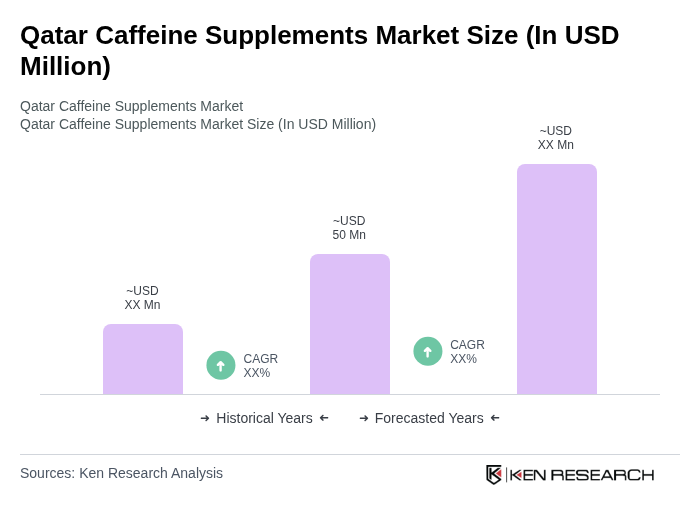
Qatar Caffeine Supplements Market, valued at USD 50 million, is growing due to rising fitness trends and energy needs, dominated by energy drinks and sports applications.

Region:Middle East

Author(s):Geetanshi

Product Code:KRAD4820

Pages:97

Published On:December 2025
About the Report

Base Year 2024

Qatar Caffeine Supplements Market Overview

  • The Qatar Caffeine Supplements Market is valued at USD 50 million, based on a five-year historical analysis and benchmarking against the broader Qatar dietary supplements and caffeine markets. This growth is primarily driven by the increasing demand for energy-boosting products among the youth and working professionals, coupled with a rising trend in fitness and wellness. The market has seen a surge in the popularity of caffeine-based products, particularly energy drinks and pre-workout supplements, as consumers seek quick and effective ways to enhance their performance and productivity.
  • Doha is the dominant city in the Qatar Caffeine Supplements Market, primarily due to its status as the capital and largest city, which houses a significant population of health-conscious consumers and the highest concentration of modern retail, pharmacies, and gyms. Other notable regions include Al Rayyan and Al Wakrah, where the growing number of gyms and fitness centers has contributed to the increased consumption of caffeine supplements. The urban lifestyle, high disposable income, and widespread access to organized retail and e-commerce platforms in these areas further drive market growth.
  • In 2023, the Qatari government implemented regulations to ensure the safety and quality of dietary supplements, including caffeine products, under the framework of the “Regulation of the Registration, Licensing, Import and Circulation of Health Products, Cosmetics and Dietary Supplements” issued by the Ministry of Public Health (MoPH). This regulation mandates that all dietary supplements, including caffeine supplements, must be registered with the Ministry of Public Health and comply with specific labeling, ingredient, and safety standards before being marketed in Qatar. The initiative aims to protect consumers and promote transparency in the market, ensuring that products meet health and safety requirements across import, distribution, and retail channels.
Qatar Caffeine Supplements Market Size

Qatar Caffeine Supplements Market Segmentation

By Product Type:The product type segmentation includes various forms of caffeine supplements that cater to different consumer preferences. The subsegments are Caffeine Capsules/Tablets, Caffeine Energy Drinks, Caffeinated Shots & RTD Functional Beverages, Caffeinated Sports & Pre-Workout Supplements, Caffeinated Gummies, Chewables & Bars, and Others (e.g., pure caffeine powder, drops). Among these, Caffeine Energy Drinks dominate the market due to their convenience and popularity among young adults and athletes seeking quick energy boosts. The trend towards on-the-go consumption and functional beverages has led to a significant increase in the availability and variety of energy drinks and RTD formats, making them a preferred choice for many consumers in both retail and foodservice channels.
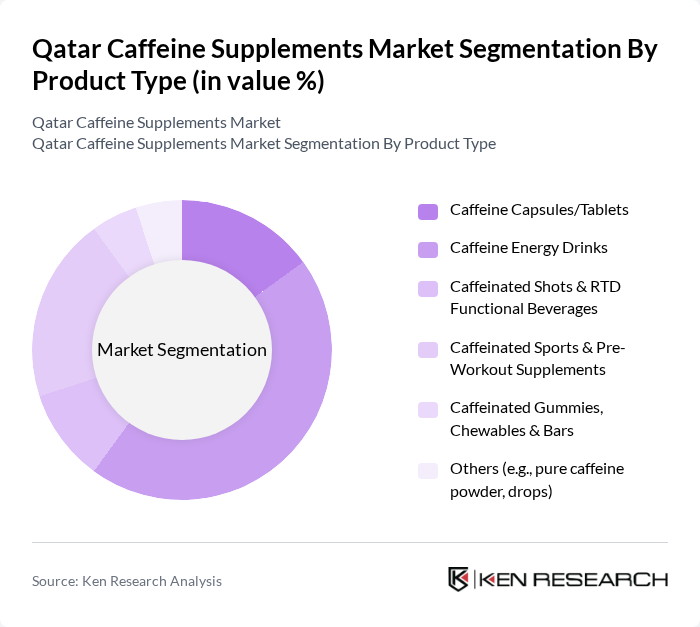
Qatar Caffeine Supplements Market segmentation by Product Type.

By Application:The application segmentation encompasses various uses of caffeine supplements, including Sports & Fitness Performance, Cognitive Enhancement & Study Aid, Weight Management & Thermogenic Support, General Wellness & Lifestyle Energy, and Clinical & OTC Pharmaceutical Use. The Sports & Fitness Performance segment leads the market, driven by the increasing number of fitness enthusiasts and athletes who rely on caffeine for improved endurance, alertness, and training intensity. The growing awareness of health and fitness, expansion of gyms and boutique fitness centers, and wider use of pre-workout and sports nutrition products have led to a surge in demand for caffeine-based products that support physical activity, making this segment particularly robust.
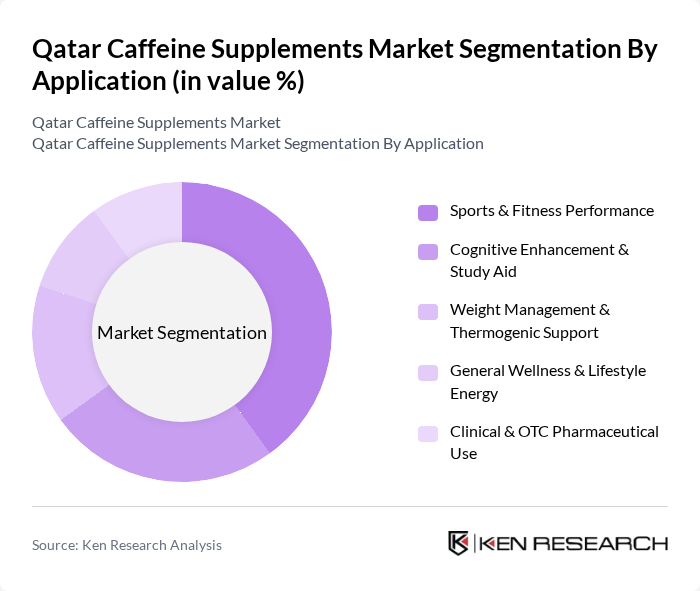
Qatar Caffeine Supplements Market segmentation by Application.

Qatar Caffeine Supplements Market Competitive Landscape

The Qatar Caffeine Supplements Market is characterized by a dynamic mix of regional and international players. Leading participants such as Red Bull GmbH (Qatar Operations), PepsiCo, Inc. – Rockstar & Other Energy Brands (Qatar), Monster Beverage Corporation (Qatar), The Coca?Cola Company – Powerade & Energy Portfolio (Qatar), Qatar Pharma for Pharmaceutical Industries, Qatar National Import & Export Co. (QNIE) – Nutrition & Supplements Distribution, Al Faisal Holding – Consumer & Healthcare Distribution Division, Lifco Qatar LLC – Food, Beverage & Supplement Distribution, Al Meera Consumer Goods Company Q.P.S.C., Carrefour Qatar (Majid Al Futtaim Retail), LuLu Hypermarket Qatar (LuLu Group International), Boots Pharmacy Qatar (Al Jaidah Brothers / Franchise), Al Mansoor Pharmacy Group, MegaMart & Monoprix Qatar (Ali Bin Ali Group), Talabat & Snoonu – Online Grocery & Supplement Delivery Platforms contribute to innovation, geographic expansion, and service delivery in this space.

Red Bull GmbH

1984

Fuschl am See, Austria

PepsiCo, Inc.

1965

Purchase, New York, USA

Monster Beverage Corporation

1935

Corona, California, USA

The Coca-Cola Company

1892

Atlanta, Georgia, USA

Qatar Pharma for Pharmaceutical Industries

2000

Doha, Qatar

Company

Establishment Year

Headquarters

Ownership Type & Group Size (local, regional, global)

Qatar Caffeine Supplements Revenue (US$ Mn)

Revenue Growth Rate in Qatar Caffeine Supplements (%)

Market Share in Qatar Caffeine Supplements (%)

Average Selling Price Positioning (premium, mid, value)

Caffeine Supplements Portfolio Breadth (SKUs in Qatar)

Qatar Caffeine Supplements Market Industry Analysis

Growth Drivers

  • Increasing Health Consciousness:The health and wellness trend in Qatar is driving the caffeine supplements market, with a reported 60% of the population actively seeking healthier lifestyle choices. According to the Qatar National Health Strategy, the government aims to reduce lifestyle-related diseases by 25% in future. This focus on health is leading consumers to seek energy-boosting products that align with their fitness goals, thus increasing demand for caffeine supplements.
  • Rising Demand for Energy-Boosting Products:The energy supplement sector in Qatar is projected to reach QAR 1.2 billion in future, driven by a growing population and increasing work hours. A survey by the Qatar Chamber of Commerce indicates that 45% of consumers use energy supplements to enhance productivity. This trend is particularly prevalent among young professionals and students, who are increasingly turning to caffeine supplements for sustained energy throughout their busy days.
  • Growth in Fitness and Sports Nutrition:The fitness industry in Qatar is expanding rapidly, with over 200 fitness centers reported recently, a 30% increase from previous periods. The Qatar Sports Authority has also invested QAR 500 million in promoting sports and fitness initiatives. This growth is fostering a culture of fitness, leading to increased consumption of caffeine supplements among athletes and fitness enthusiasts seeking performance enhancement and recovery solutions.

Market Challenges

  • Regulatory Compliance Issues:The caffeine supplements market in Qatar faces stringent regulatory compliance challenges, with the Ministry of Public Health enforcing strict food safety standards. Recently, 15% of caffeine products were found non-compliant during inspections, leading to recalls and fines. This regulatory environment can hinder market entry for new brands and complicate operations for existing companies, impacting overall market growth.
  • Price Sensitivity Among Consumers:Price sensitivity is a significant challenge in the Qatari market, where 70% of consumers consider price as a primary factor in purchasing decisions. The average price of caffeine supplements has increased by 10% due to rising import costs and inflation. This price sensitivity can limit the market's growth potential, particularly among lower-income demographics who may opt for cheaper alternatives or forgo supplements altogether.

Qatar Caffeine Supplements Market Future Outlook

The future of the caffeine supplements market in Qatar appears promising, driven by increasing health awareness and a growing fitness culture. As consumers continue to prioritize health and wellness, the demand for innovative and natural caffeine products is expected to rise in future. Additionally, the expansion of e-commerce platforms will facilitate easier access to these products, allowing brands to reach a broader audience. Companies that adapt to these trends will likely thrive in this evolving market landscape.

Market Opportunities

  • Development of Innovative Product Formulations:There is a significant opportunity for brands to create innovative caffeine supplement formulations that cater to specific consumer needs, such as pre-workout energy or cognitive enhancement. The introduction of products with added vitamins and minerals could attract health-conscious consumers, potentially increasing market share and brand loyalty.
  • Collaborations with Fitness Centers and Gyms:Partnering with local gyms and fitness centers presents a lucrative opportunity for caffeine supplement brands. By offering exclusive promotions or samples at these venues, companies can directly reach their target audience, enhancing brand visibility and encouraging trial among fitness enthusiasts who are likely to become repeat customers.

Scope of the Report

SegmentSub-Segments
By Product Type

Caffeine Capsules/Tablets

Caffeine Energy Drinks

Caffeinated Shots & RTD Functional Beverages

Caffeinated Sports & Pre-Workout Supplements

Caffeinated Gummies, Chewables & Bars

Others (e.g., pure caffeine powder, drops)

By Application

Sports & Fitness Performance

Cognitive Enhancement & Study Aid

Weight Management & Thermogenic Support

General Wellness & Lifestyle Energy

Clinical & OTC Pharmaceutical Use

By Distribution Channel

Pharmacies & Drug Stores

Supermarkets/Hypermarkets

Specialty Nutrition & Health Stores

Gyms, Fitness Clubs & Sports Academies

Online Retailers & E?commerce Platforms

Others (convenience stores, petrol stations, vending)

By Caffeine Source

Synthetic Caffeine

Natural Caffeine (coffee bean, tea, guarana, yerba mate)

Blended Formulations

By Form

Solid (tablets, capsules, gummies, bars)

Liquid (RTD drinks, shots, concentrates)

Powder

By Consumer Group

Athletes & Sports Professionals

Fitness Enthusiasts & Gym-Goers

Students & Exam Candidates

Working Professionals & Shift Workers

Others (e.g., gamers, drivers)

By Region

Doha

Al Rayyan

Al Wakrah & Al Wukair

Umm Salal, Al Khor & Others

Key Target Audience

Investors and Venture Capitalist Firms

Government and Regulatory Bodies (e.g., Ministry of Public Health, Qatar Food Safety and Health Authority)

Manufacturers and Producers

Distributors and Retailers

Health and Wellness Organizations

Fitness Centers and Gyms

Pharmaceutical Companies

Sports Nutrition Brands

Players Mentioned in the Report:

Red Bull GmbH (Qatar Operations)

PepsiCo, Inc. Rockstar & Other Energy Brands (Qatar)

Monster Beverage Corporation (Qatar)

The CocaCola Company Powerade & Energy Portfolio (Qatar)

Qatar Pharma for Pharmaceutical Industries

Qatar National Import & Export Co. (QNIE) Nutrition & Supplements Distribution

Al Faisal Holding Consumer & Healthcare Distribution Division

Lifco Qatar LLC Food, Beverage & Supplement Distribution

Al Meera Consumer Goods Company Q.P.S.C.

Carrefour Qatar (Majid Al Futtaim Retail)

LuLu Hypermarket Qatar (LuLu Group International)

Boots Pharmacy Qatar (Al Jaidah Brothers / Franchise)

Al Mansoor Pharmacy Group

MegaMart & Monoprix Qatar (Ali Bin Ali Group)

Talabat & Snoonu Online Grocery & Supplement Delivery Platforms

Table of Contents

Market Assessment Phase

1. Executive Summary and Approach


2. Qatar Caffeine Supplements Market Overview

2.1 Key Insights and Strategic Recommendations

2.2 Qatar Caffeine Supplements Market Overview

2.3 Definition and Scope

2.4 Evolution of Market Ecosystem

2.5 Timeline of Key Regulatory Milestones

2.6 Value Chain & Stakeholder Mapping

2.7 Business Cycle Analysis

2.8 Policy & Incentive Landscape


3. Qatar Caffeine Supplements Market Analysis

3.1 Growth Drivers

3.1.1 Increasing Health Consciousness
3.1.2 Rising Demand for Energy-Boosting Products
3.1.3 Growth in Fitness and Sports Nutrition
3.1.4 Expansion of E-commerce Platforms

3.2 Market Challenges

3.2.1 Regulatory Compliance Issues
3.2.2 Market Saturation
3.2.3 Consumer Awareness and Education
3.2.4 Price Sensitivity Among Consumers

3.3 Market Opportunities

3.3.1 Development of Innovative Product Formulations
3.3.2 Expansion into Untapped Demographics
3.3.3 Collaborations with Fitness Centers and Gyms
3.3.4 Increasing Online Marketing Strategies

3.4 Market Trends

3.4.1 Shift Towards Natural and Organic Ingredients
3.4.2 Growth of Ready-to-Drink Caffeine Products
3.4.3 Rise of Personalized Nutrition
3.4.4 Increasing Popularity of Caffeine Alternatives

3.5 Government Regulation

3.5.1 Food Safety Standards
3.5.2 Labeling Requirements
3.5.3 Import Regulations
3.5.4 Advertising Restrictions

4. SWOT Analysis


5. Stakeholder Analysis


6. Porter's Five Forces Analysis


7. Qatar Caffeine Supplements Market Market Size, 2019-2024

7.1 By Value

7.2 By Volume

7.3 By Average Selling Price


8. Qatar Caffeine Supplements Market Segmentation

8.1 By Product Type

8.1.1 Caffeine Capsules/Tablets
8.1.2 Caffeine Energy Drinks
8.1.3 Caffeinated Shots & RTD Functional Beverages
8.1.4 Caffeinated Sports & Pre-Workout Supplements
8.1.5 Caffeinated Gummies, Chewables & Bars
8.1.6 Others (e.g., pure caffeine powder, drops)

8.2 By Application

8.2.1 Sports & Fitness Performance
8.2.2 Cognitive Enhancement & Study Aid
8.2.3 Weight Management & Thermogenic Support
8.2.4 General Wellness & Lifestyle Energy
8.2.5 Clinical & OTC Pharmaceutical Use

8.3 By Distribution Channel

8.3.1 Pharmacies & Drug Stores
8.3.2 Supermarkets/Hypermarkets
8.3.3 Specialty Nutrition & Health Stores
8.3.4 Gyms, Fitness Clubs & Sports Academies
8.3.5 Online Retailers & E?commerce Platforms
8.3.6 Others (convenience stores, petrol stations, vending)

8.4 By Caffeine Source

8.4.1 Synthetic Caffeine
8.4.2 Natural Caffeine (coffee bean, tea, guarana, yerba mate)
8.4.3 Blended Formulations

8.5 By Form

8.5.1 Solid (tablets, capsules, gummies, bars)
8.5.2 Liquid (RTD drinks, shots, concentrates)
8.5.3 Powder

8.6 By Consumer Group

8.6.1 Athletes & Sports Professionals
8.6.2 Fitness Enthusiasts & Gym-Goers
8.6.3 Students & Exam Candidates
8.6.4 Working Professionals & Shift Workers
8.6.5 Others (e.g., gamers, drivers)

8.7 By Region

8.7.1 Doha
8.7.2 Al Rayyan
8.7.3 Al Wakrah & Al Wukair
8.7.4 Umm Salal, Al Khor & Others

9. Qatar Caffeine Supplements Market Competitive Analysis

9.1 Market Share of Key Players

9.2 Cross Comparison of Key Players

9.2.1 Company Name
9.2.2 Ownership Type & Group Size (local, regional, global)
9.2.3 Qatar Caffeine Supplements Revenue (US$ Mn)
9.2.4 Revenue Growth Rate in Qatar Caffeine Supplements (%)
9.2.5 Market Share in Qatar Caffeine Supplements (%)
9.2.6 Average Selling Price Positioning (premium, mid, value)
9.2.7 Caffeine Supplements Portfolio Breadth (SKUs in Qatar)
9.2.8 Share of Sales by Channel (pharmacy, modern retail, online, others)
9.2.9 Geographic Coverage within Qatar (no. of outlets / cities served)
9.2.10 Marketing & Sponsorship Intensity (sports, fitness, events)
9.2.11 Compliance & Certification Status (MoPH, halal, quality)
9.2.12 Digital Presence & E?commerce Penetration

9.3 SWOT Analysis of Top Players

9.4 Pricing Analysis

9.5 Detailed Profile of Major Companies

9.5.1 Red Bull GmbH (Qatar Operations)
9.5.2 PepsiCo, Inc. – Rockstar & Other Energy Brands (Qatar)
9.5.3 Monster Beverage Corporation (Qatar)
9.5.4 The Coca?Cola Company – Powerade & Energy Portfolio (Qatar)
9.5.5 Qatar Pharma for Pharmaceutical Industries
9.5.6 Qatar National Import & Export Co. (QNIE) – Nutrition & Supplements Distribution
9.5.7 Al Faisal Holding – Consumer & Healthcare Distribution Division
9.5.8 Lifco Qatar LLC – Food, Beverage & Supplement Distribution
9.5.9 Al Meera Consumer Goods Company Q.P.S.C.
9.5.10 Carrefour Qatar (Majid Al Futtaim Retail)
9.5.11 LuLu Hypermarket Qatar (LuLu Group International)
9.5.12 Boots Pharmacy Qatar (Al Jaidah Brothers / Franchise)
9.5.13 Al Mansoor Pharmacy Group
9.5.14 MegaMart & Monoprix Qatar (Ali Bin Ali Group)
9.5.15 Talabat & Snoonu – Online Grocery & Supplement Delivery Platforms

10. Qatar Caffeine Supplements Market End-User Analysis

10.1 Procurement Behavior of Key Ministries

10.1.1 Ministry of Health
10.1.2 Ministry of Education
10.1.3 Ministry of Sports
10.1.4 Others

10.2 Corporate Spend on Infrastructure & Energy

10.2.1 Corporate Wellness Programs
10.2.2 Employee Health Initiatives
10.2.3 Sponsorship of Sports Events
10.2.4 Others

10.3 Pain Point Analysis by End-User Category

10.3.1 Lack of Awareness
10.3.2 Accessibility Issues
10.3.3 Price Sensitivity
10.3.4 Others

10.4 User Readiness for Adoption

10.4.1 Awareness Levels
10.4.2 Willingness to Pay
10.4.3 Availability of Products
10.4.4 Others

10.5 Post-Deployment ROI and Use Case Expansion

10.5.1 Performance Metrics
10.5.2 User Feedback
10.5.3 Market Expansion Opportunities
10.5.4 Others

11. Qatar Caffeine Supplements Market Future Size, 2025-2030

11.1 By Value

11.2 By Volume

11.3 By Average Selling Price


Go-To-Market Strategy Phase

1. Whitespace Analysis + Business Model Canvas

1.1 Market Gaps Identification

1.2 Business Model Development


2. Marketing and Positioning Recommendations

2.1 Branding Strategies

2.2 Product USPs


3. Distribution Plan

3.1 Urban Retail vs Rural NGO Tie-ups


4. Channel & Pricing Gaps

4.1 Underserved Routes

4.2 Pricing Bands


5. Unmet Demand & Latent Needs

5.1 Category Gaps

5.2 Consumer Segments


6. Customer Relationship

6.1 Loyalty Programs

6.2 After-sales Service


7. Value Proposition

7.1 Sustainability

7.2 Integrated Supply Chains


8. Key Activities

8.1 Regulatory Compliance

8.2 Branding

8.3 Distribution Setup


9. Entry Strategy Evaluation

9.1 Domestic Market Entry Strategy

9.1.1 Product Mix
9.1.2 Pricing Band
9.1.3 Packaging

9.2 Export Entry Strategy

9.2.1 Target Countries
9.2.2 Compliance Roadmap

10. Entry Mode Assessment

10.1 JV

10.2 Greenfield

10.3 M&A

10.4 Distributor Model


11. Capital and Timeline Estimation

11.1 Capital Requirements

11.2 Timelines


12. Control vs Risk Trade-Off

12.1 Ownership vs Partnerships


13. Profitability Outlook

13.1 Breakeven Analysis

13.2 Long-term Sustainability


14. Potential Partner List

14.1 Distributors

14.2 JVs

14.3 Acquisition Targets


15. Execution Roadmap

15.1 Phased Plan for Market Entry

15.1.1 Market Setup
15.1.2 Market Entry
15.1.3 Growth Acceleration
15.1.4 Scale & Stabilize

15.2 Key Activities and Milestones

15.2.1 Milestone Planning
15.2.2 Activity Tracking

Research Methodology

ApproachModellingSample

Phase 1: Approach1

Desk Research

  • Analysis of market reports from health and wellness organizations in Qatar
  • Review of academic journals and publications on caffeine consumption trends
  • Examination of government health statistics and dietary guidelines related to caffeine

Primary Research

  • Interviews with nutritionists and dietitians specializing in sports supplements
  • Surveys conducted with fitness trainers and gym owners regarding caffeine supplement usage
  • Focus groups with consumers to understand preferences and purchasing behavior

Validation & Triangulation

  • Cross-validation of findings with industry expert opinions and market trends
  • Triangulation of data from consumer surveys, sales data, and expert interviews
  • Sanity checks through comparison with international caffeine supplement markets

Phase 2: Market Size Estimation1

Top-down Assessment

  • Estimation of total caffeine consumption in Qatar based on population demographics
  • Analysis of market share distribution among different types of caffeine supplements
  • Incorporation of growth rates from related health and wellness sectors

Bottom-up Modeling

  • Collection of sales data from local retailers and online platforms
  • Estimation of average price points for various caffeine supplement products
  • Volume estimates based on consumer purchasing patterns and frequency of use

Forecasting & Scenario Analysis

  • Multi-variable regression analysis incorporating health trends and fitness culture growth
  • Scenario modeling based on potential regulatory changes affecting supplement sales
  • Development of baseline, optimistic, and pessimistic market growth projections through 2030

Phase 3: CATI Sample Composition1

Scope Item/SegmentSample SizeTarget Respondent Profiles
Fitness Enthusiasts120Gym Members, Personal Trainers
Health Professionals80Nutritionists, Dietitians
Retailers of Caffeine Supplements60Store Managers, Product Buyers
Online Consumers100eCommerce Shoppers, Health Product Reviewers
Sports Coaches40Team Coaches, Athletic Trainers

Frequently Asked Questions

What is the current value of the Qatar Caffeine Supplements Market?

The Qatar Caffeine Supplements Market is valued at approximately USD 50 million, reflecting a growing demand for energy-boosting products among the youth and working professionals, driven by trends in fitness and wellness.

Which city dominates the Qatar Caffeine Supplements Market?

What are the main product types in the Qatar Caffeine Supplements Market?

What applications drive the demand for caffeine supplements in Qatar?

Other Regional/Country Reports

Kuwait Caffeine Supplements Market

Indonesia Caffeine Supplements Market

Malaysia Caffeine Supplements Market

KSA Caffeine Supplements Market

APAC Caffeine Supplements Market

SEA Caffeine Supplements Market

Other Adjacent Reports

Middle East Energy Drinks MarketVietnam Sports Nutrition Market Report Size Share Growth Drivers Trends Opportunities & Forecast 2025–2030

Thailand Functional Beverages Market

Saudi Arabia South Korea Dietary Supplements Market Report Size, Share, Growth Drivers, Trends, Opportunities & Forecast 2025–2030

Vietnam Pre-Workout Supplements Market

UAE Weight Management Supplements Market

Oman Cognitive Enhancement Supplements Market

Philippines Wellness and Lifestyle Products Market

GCC Nutraceuticals Market

Brazil Pharmaceutical OTC Products Market

Why Buy From Us?

Refine Robust Result (RRR) Framework

What makes us stand out is that our consultants follow Robust, Refine and Result (RRR) methodology. Robust for clear definitions, approaches and sanity checking, Refine for differentiating respondents' facts and opinions, and Result for presenting data with story.

Our Reach Is Unmatched

We have set a benchmark in the industry by offering our clients with syndicated and customized market research reports featuring coverage of entire market as well as meticulous research and analyst insights.

Shifting the Research Paradigm

While we don't replace traditional research, we flip the method upside down. Our dual approach of Top Bottom & Bottom Top ensures quality deliverable by not just verifying company fundamentals but also looking at the sector and macroeconomic factors.

More Insights-Better Decisions

With one step in the future, our research team constantly tries to show you the bigger picture. We help with some of the tough questions you may encounter along the way: How is the industry positioned? Best marketing channel? KPI's of competitors? By aligning every element, we help maximize success.

Transparency and Trust

Our report gives you instant access to the answers and sources that other companies might choose to hide. We elaborate each steps of research methodology we have used and showcase you the sample size to earn your trust.

Round the Clock Support

If you need any support, we are here! We pride ourselves on universe strength, data quality, and quick, friendly, and professional service.

Why Clients Choose Us?

400000+
Reports in repository
150+
Consulting projects a year
100+
Analysts
8000+
Client Queries in 2022








