About the Report
Base Year 2024Qatar Construction Composites Market Overview
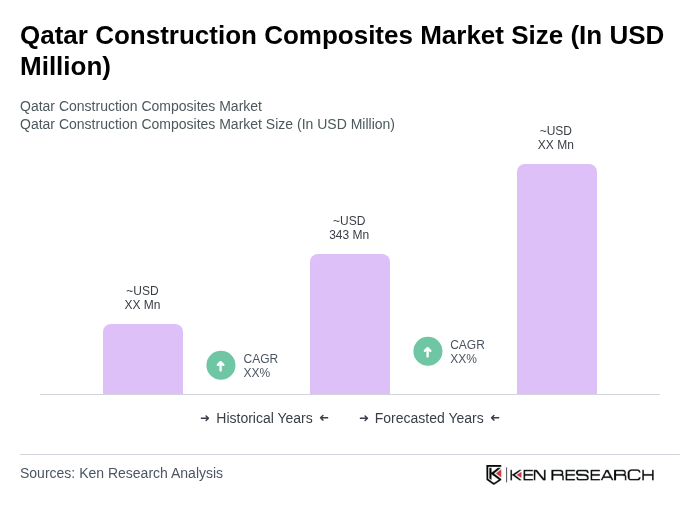
- The Qatar Construction Composites Market is valued at USD 343 million, based on a five-year historical analysis. This growth is primarily driven by the rapid urbanization and infrastructure development initiatives in the region, particularly in preparation for major events like the FIFA World Cup. The increasing demand for lightweight, durable, and sustainable building materials has further propelled the market, as construction companies seek to enhance efficiency and reduce costs.
- Key geographic areas in this market include Doha, Al Rayyan, and Lusail, which dominate due to their strategic importance in Qatar's construction landscape. Doha, as the capital, is the hub for major construction projects, while Al Rayyan and Lusail are experiencing significant urban development and infrastructure investments, making them critical areas for the growth of construction composites.
- The Qatar National Vision 2030 framework establishes sustainability requirements for construction projects, mandating the integration of environmentally responsible materials and practices in infrastructure development. This initiative aims to promote environmental sustainability and reduce the carbon footprint of the construction sector, thereby driving the demand for advanced composites that meet these new standards. Lightweight composites are finding applications in stadiums, bridges, and metro systems as part of Qatar's commitment to sustainable infrastructure development.
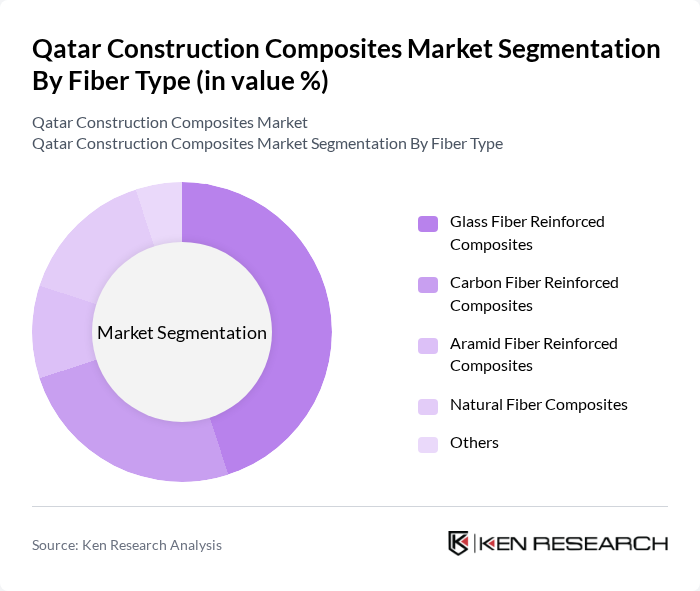
Qatar Construction Composites Market Segmentation
By Fiber Type:The fiber type segmentation includes various materials used in the production of construction composites. The primary subsegments are Glass Fiber Reinforced Composites, Carbon Fiber Reinforced Composites, Aramid Fiber Reinforced Composites, Natural Fiber Composites, and Others. Among these, Glass Fiber Reinforced Composites dominate the market due to their excellent strength-to-weight ratio, corrosion resistance, and cost-effectiveness, making them a preferred choice for various construction applications.
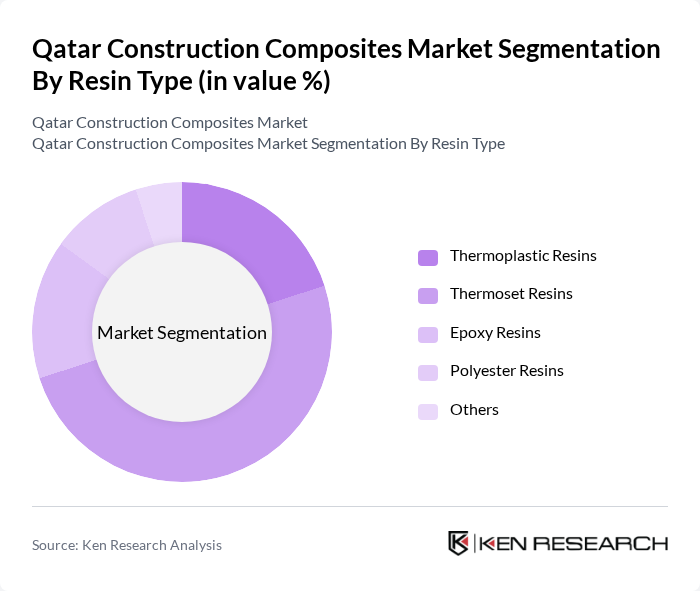
By Resin Type:The resin type segmentation encompasses the various resins used in the manufacturing of construction composites. This includes Thermoplastic Resins, Thermoset Resins, Epoxy Resins, Polyester Resins, and Others. Thermoset Resins are currently leading the market due to their superior mechanical properties and thermal stability, making them ideal for high-performance applications in construction.
Qatar Construction Composites Market Competitive Landscape
The Qatar Construction Composites Market is characterized by a dynamic mix of regional and international players. Leading participants such as QD-SBG Construction, Gulf Contracting Company, HBK Contracting, AlJaber Engineering, Qatar National Cement Company, Doha Cables, Qatar Precast Concrete Company, Qatar Steel Company, Lusail Real Estate Development Company, Ashghal (Public Works Authority), Qatar Petroleum Engineering and Construction Company, Mannai Corporation, Bin Omran Group, Consolidated Contractors Company, Midmac Contracting Company contribute to innovation, geographic expansion, and service delivery in this space.
Qatar Construction Composites Market Industry Analysis
Growth Drivers
- Increasing Demand for Sustainable Building Materials:The Qatar construction sector is witnessing a significant shift towards sustainable building materials, driven by a projected increase in green building projects. In the future, the Qatar Green Building Council aims to certify over 100 new projects, reflecting a commitment to eco-friendly practices. This trend is supported by the Qatar National Vision 2030, which emphasizes sustainability, aiming for a 30% reduction in carbon emissions, thus boosting the demand for composite materials.
- Government Initiatives Promoting Infrastructure Development:The Qatari government has allocated approximately $200 billion for infrastructure projects leading up to the FIFA World Cup and beyond. This investment includes roads, bridges, and public transport systems, which are expected to increase the demand for advanced composite materials. The Qatar National Development Strategy further emphasizes infrastructure enhancement, creating a robust market environment for construction composites in the region.
- Technological Advancements in Composite Materials:Innovations in composite materials are enhancing their performance and applicability in construction. In the future, the introduction of new lightweight composites is expected to reduce construction time by 20%, according to industry reports. Additionally, advancements in manufacturing processes are projected to lower production costs by 15%, making composites more accessible to construction firms, thereby driving their adoption in various projects across Qatar.
Market Challenges
- High Initial Costs of Composite Materials:One of the significant barriers to the widespread adoption of composite materials in Qatar's construction sector is their high initial cost. For instance, the average cost of composite materials can be 30% higher than traditional materials. This price differential poses a challenge for budget-conscious projects, particularly in a competitive market where cost efficiency is paramount, potentially hindering market growth.
- Limited Awareness Among Construction Professionals:Despite the benefits of composite materials, there remains a knowledge gap among construction professionals in Qatar. A recent survey indicated that over 60% of construction managers are unaware of the advantages of composites. This lack of awareness can lead to resistance in adopting new materials, slowing down the transition to more sustainable and efficient building practices in the region.
Qatar Construction Composites Market Future Outlook
The future of the Qatar construction composites market appears promising, driven by increasing investments in sustainable infrastructure and technological innovations. As the government continues to prioritize green building initiatives, the demand for composite materials is expected to rise significantly. Furthermore, the integration of smart technologies in construction processes will likely enhance the efficiency and performance of composite materials, positioning them as a vital component in Qatar's evolving construction landscape.
Market Opportunities
- Expansion of Green Building Initiatives:The growing emphasis on green building practices presents a substantial opportunity for composite materials. With the Qatar Green Building Council's goal to increase certified projects, the demand for eco-friendly composites is expected to rise, potentially increasing market share by 25% in the future.
- Increasing Investment in Smart City Projects:Qatar's commitment to developing smart cities, with an investment of $45 billion in the future, opens new avenues for composite materials. These projects will require innovative materials that enhance sustainability and efficiency, creating a favorable environment for the adoption of advanced composites in urban development.
Scope of the Report
| Segment | Sub-Segments |
|---|---|
| By Fiber Type | Glass Fiber Reinforced Composites Carbon Fiber Reinforced Composites Aramid Fiber Reinforced Composites Natural Fiber Composites Others |
| By Resin Type | Thermoplastic Resins Thermoset Resins Epoxy Resins Polyester Resins Others |
| By Application | Roofing and Cladding Structural Components Insulation Materials Interior Finishing Infrastructure Projects |
| By End-User | Residential Construction Commercial Construction Industrial Construction Infrastructure and Transportation Others |
| By Manufacturing Process | Hand Lay-Up Spray-Up Filament Winding Compression Molding Pultrusion |
| By Distribution Channel | Direct Sales to Contractors Building Material Distributors Specialty Composite Suppliers Online Sales Platforms Others |
| By Region | Doha Al Rayyan Lusail Al Wakrah Others |
Key Target Audience
Investors and Venture Capitalist Firms
Government and Regulatory Bodies (e.g., Ministry of Municipality, Qatar Civil Defence)
Manufacturers and Producers
Distributors and Retailers
Construction Companies and Contractors
Architectural and Engineering Firms
Industry Associations (e.g., Qatar Chamber of Commerce)
Financial Institutions
Players Mentioned in the Report:
QD-SBG Construction
Gulf Contracting Company
HBK Contracting
AlJaber Engineering
Qatar National Cement Company
Doha Cables
Qatar Precast Concrete Company
Qatar Steel Company
Lusail Real Estate Development Company
Ashghal (Public Works Authority)
Qatar Petroleum Engineering and Construction Company
Mannai Corporation
Bin Omran Group
Consolidated Contractors Company
Midmac Contracting Company
Table of Contents
Market Assessment Phase
1. Executive Summary and Approach
2. Qatar Construction Composites Market Overview
2.1 Key Insights and Strategic Recommendations
2.2 Qatar Construction Composites Market Overview
2.3 Definition and Scope
2.4 Evolution of Market Ecosystem
2.5 Timeline of Key Regulatory Milestones
2.6 Value Chain & Stakeholder Mapping
2.7 Business Cycle Analysis
2.8 Policy & Incentive Landscape
3. Qatar Construction Composites Market Analysis
3.1 Growth Drivers
3.1.1 Increasing demand for sustainable building materials
3.1.2 Government initiatives promoting infrastructure development
3.1.3 Technological advancements in composite materials
3.1.4 Rising construction activities in the region
3.2 Market Challenges
3.2.1 High initial costs of composite materials
3.2.2 Limited awareness among construction professionals
3.2.3 Regulatory hurdles in material approvals
3.2.4 Competition from traditional building materials
3.3 Market Opportunities
3.3.1 Expansion of green building initiatives
3.3.2 Increasing investment in smart city projects
3.3.3 Collaboration with technology firms for innovation
3.3.4 Export potential to neighboring regions
3.4 Market Trends
3.4.1 Growing preference for lightweight construction materials
3.4.2 Adoption of Building Information Modeling (BIM)
3.4.3 Shift towards modular construction techniques
3.4.4 Emphasis on lifecycle assessment of materials
3.5 Government Regulation
3.5.1 Standards for composite material performance
3.5.2 Building codes promoting sustainable practices
3.5.3 Incentives for using eco-friendly materials
3.5.4 Regulations on waste management in construction
4. SWOT Analysis
5. Stakeholder Analysis
6. Porter's Five Forces Analysis
7. Qatar Construction Composites Market Market Size, 2019-2024
7.1 By Value
7.2 By Volume
7.3 By Average Selling Price
8. Qatar Construction Composites Market Segmentation
8.1 By Fiber Type
8.1.1 Glass Fiber Reinforced Composites
8.1.2 Carbon Fiber Reinforced Composites
8.1.3 Aramid Fiber Reinforced Composites
8.1.4 Natural Fiber Composites
8.1.5 Others
8.2 By Resin Type
8.2.1 Thermoplastic Resins
8.2.2 Thermoset Resins
8.2.3 Epoxy Resins
8.2.4 Polyester Resins
8.2.5 Others
8.3 By Application
8.3.1 Roofing and Cladding
8.3.2 Structural Components
8.3.3 Insulation Materials
8.3.4 Interior Finishing
8.3.5 Infrastructure Projects
8.4 By End-User
8.4.1 Residential Construction
8.4.2 Commercial Construction
8.4.3 Industrial Construction
8.4.4 Infrastructure and Transportation
8.4.5 Others
8.5 By Manufacturing Process
8.5.1 Hand Lay-Up
8.5.2 Spray-Up
8.5.3 Filament Winding
8.5.4 Compression Molding
8.5.5 Pultrusion
8.6 By Distribution Channel
8.6.1 Direct Sales to Contractors
8.6.2 Building Material Distributors
8.6.3 Specialty Composite Suppliers
8.6.4 Online Sales Platforms
8.6.5 Others
8.7 By Region
8.7.1 Doha
8.7.2 Al Rayyan
8.7.3 Lusail
8.7.4 Al Wakrah
8.7.5 Others
9. Qatar Construction Composites Market Competitive Analysis
9.1 Market Share of Key Players
9.2 Cross Comparison of Key Players
9.2.1 Company Name
9.2.2 Company Size (Large, Medium, or Small)
9.2.3 Annual Revenue (USD Million)
9.2.4 Market Share (%)
9.2.5 Geographic Presence (Domestic/Regional/International)
9.2.6 Product Portfolio Breadth
9.2.7 Year-over-Year Growth Rate (%)
9.2.8 Key Strategic Partnerships
9.2.9 Certifications and Quality Standards
9.2.10 Customer Base Concentration
9.3 SWOT Analysis of Top Players
9.4 Pricing Analysis
9.5 Detailed Profile of Major Companies
9.5.1 QD-SBG Construction
9.5.2 Gulf Contracting Company
9.5.3 HBK Contracting
9.5.4 AlJaber Engineering
9.5.5 Qatar National Cement Company
9.5.6 Doha Cables
9.5.7 Qatar Precast Concrete Company
9.5.8 Qatar Steel Company
9.5.9 Lusail Real Estate Development Company
9.5.10 Ashghal (Public Works Authority)
9.5.11 Qatar Petroleum Engineering and Construction Company
9.5.12 Mannai Corporation
9.5.13 Bin Omran Group
9.5.14 Consolidated Contractors Company
9.5.15 Midmac Contracting Company
10. Qatar Construction Composites Market End-User Analysis
10.1 Procurement Behavior of Key Ministries
10.1.1 Ministry of Municipality and Environment
10.1.2 Ministry of Transport and Communications
10.1.3 Ministry of Energy and Industry
10.1.4 Ministry of Education and Higher Education
10.1.5 Others
10.2 Corporate Spend on Infrastructure & Energy
10.2.1 Major Infrastructure Projects (NEOM-related, Lusail City)
10.2.2 Energy Sector Investments
10.2.3 Public-Private Partnerships
10.2.4 Sustainability Initiatives
10.2.5 Others
10.3 Pain Point Analysis by End-User Category
10.3.1 Residential Sector Challenges
10.3.2 Commercial Sector Challenges
10.3.3 Industrial Sector Challenges
10.3.4 Government Sector Challenges
10.3.5 Others
10.4 User Readiness for Adoption
10.4.1 Awareness Levels
10.4.2 Training and Support Needs
10.4.3 Financial Readiness
10.4.4 Infrastructure Compatibility
10.4.5 Others
10.5 Post-Deployment ROI and Use Case Expansion
10.5.1 Performance Metrics
10.5.2 Cost Savings Analysis
10.5.3 User Feedback Mechanisms
10.5.4 Future Expansion Opportunities
10.5.5 Others
11. Qatar Construction Composites Market Future Size, 2025-2030
11.1 By Value
11.2 By Volume
11.3 By Average Selling Price
Go-To-Market Strategy Phase
1. Whitespace Analysis + Business Model Canvas
1.1 Market Gaps Identification
1.2 Value Proposition Development
1.3 Revenue Streams Analysis
1.4 Cost Structure Evaluation
1.5 Key Partnerships Exploration
1.6 Customer Segmentation
1.7 Channels and Customer Relationships
2. Marketing and Positioning Recommendations
2.1 Branding Strategies
2.2 Product USPs
2.3 Target Market Identification
2.4 Communication Strategies
2.5 Digital Marketing Approaches
3. Distribution Plan
3.1 Urban Retail Strategies
3.2 Rural NGO Tie-Ups
3.3 E-commerce Integration
3.4 Logistics and Supply Chain Management
3.5 Distribution Partnerships
4. Channel & Pricing Gaps
4.1 Underserved Routes
4.2 Pricing Bands Analysis
4.3 Competitor Pricing Strategies
4.4 Customer Willingness to Pay
4.5 Value-Based Pricing Models
5. Unmet Demand & Latent Needs
5.1 Category Gaps Identification
5.2 Consumer Segments Analysis
5.3 Emerging Trends and Preferences
5.4 Product Development Opportunities
5.5 Market Entry Barriers
6. Customer Relationship
6.1 Loyalty Programs
6.2 After-sales Service
6.3 Customer Feedback Mechanisms
6.4 Community Engagement Strategies
6.5 Customer Education Initiatives
7. Value Proposition
7.1 Sustainability Initiatives
7.2 Integrated Supply Chains
7.3 Cost Efficiency
7.4 Quality Assurance
7.5 Innovation and Technology
8. Key Activities
8.1 Regulatory Compliance
8.2 Branding Initiatives
8.3 Distribution Setup
8.4 Training and Development
8.5 Market Research and Analysis
9. Entry Strategy Evaluation
9.1 Domestic Market Entry Strategy
9.1.1 Product Mix
9.1.2 Pricing Band
9.1.3 Packaging Considerations
9.2 Export Entry Strategy
9.2.1 Target Countries
9.2.2 Compliance Roadmap</h5
Research Methodology
Phase 1: Approach1
Desk Research
- Analysis of construction industry reports from Qatar's Ministry of Municipality and Environment
- Review of market studies published by local construction associations and trade bodies
- Examination of economic indicators and construction spending data from Qatar Central Bank
Primary Research
- Interviews with project managers and engineers from leading construction firms in Qatar
- Surveys targeting procurement specialists in the composites sector
- Field interviews with architects and designers involved in composite material selection
Validation & Triangulation
- Cross-validation of findings through multiple data sources including government publications and industry reports
- Triangulation of insights from primary interviews with secondary data trends
- Sanity checks conducted through expert panel discussions with industry veterans
Phase 2: Market Size Estimation1
Top-down Assessment
- Estimation of total construction market size in Qatar and its growth trajectory
- Segmentation of the composites market by application areas such as infrastructure, residential, and commercial
- Incorporation of government initiatives promoting sustainable construction practices
Bottom-up Modeling
- Collection of data on composite material usage from major construction projects
- Estimation of market share based on sales data from leading composite manufacturers
- Volume and pricing analysis to derive revenue estimates for the composites market
Forecasting & Scenario Analysis
- Multi-variable forecasting model incorporating economic growth, urbanization rates, and regulatory changes
- Scenario analysis based on potential shifts in construction material preferences and sustainability trends
- Development of baseline, optimistic, and pessimistic forecasts through 2030
Phase 3: CATI Sample Composition1
| Scope Item/Segment | Sample Size | Target Respondent Profiles |
|---|---|---|
| Infrastructure Projects | 85 | Project Managers, Civil Engineers |
| Residential Construction | 75 | Architects, Developers |
| Commercial Building Projects | 65 | Construction Managers, Procurement Officers |
| Composite Material Suppliers | 55 | Sales Managers, Product Development Heads |
| Sustainability Initiatives in Construction | 45 | Sustainability Consultants, Regulatory Affairs Managers |
Frequently Asked Questions
What is the current value of the Qatar Construction Composites Market?
The Qatar Construction Composites Market is valued at approximately USD 343 million, reflecting significant growth driven by urbanization and infrastructure development, particularly in preparation for major events like the FIFA World Cup.
What factors are driving the growth of the Qatar Construction Composites Market?
Which geographic areas are most significant in the Qatar Construction Composites Market?
What are the main types of fibers used in construction composites in Qatar?
Other Regional/Country Reports
Indonesia Construction Composites Market
Malaysia Construction Composites Market
APAC Construction Composites Market
SEA Construction Composites Market
Vietnam Construction Composites Market
Other Adjacent Reports
Brazil Composite Materials Market
South Korea Fiber Reinforced Plastics Market
Middle East Building Materials Market Size, Share, Trends & Forecast, By Material Type, Application & Distribution Channel, 2026–2031Indonesia Sustainable Construction Market
Oman Infrastructure Development Market
USA Carbon Fiber Market Size, Share & Forecast, By Product Type, End-Use Industry & Application, 2025–2032Philippines Glass Fiber Market
Middle East Aramid Fiber Market Report Size Share Growth Drivers Trends Opportunities & Forecast 2025–2030South Africa Thermoset Resins Market
Ksa Epoxy Resins Market Size, Share, Growth Drivers, Trends, Opportunities & Forecast 2025–2030Why Buy From Us?

What makes us stand out is that our consultants follow Robust, Refine and Result (RRR) methodology. Robust for clear definitions, approaches and sanity checking, Refine for differentiating respondents' facts and opinions, and Result for presenting data with story.

We have set a benchmark in the industry by offering our clients with syndicated and customized market research reports featuring coverage of entire market as well as meticulous research and analyst insights.

While we don't replace traditional research, we flip the method upside down. Our dual approach of Top Bottom & Bottom Top ensures quality deliverable by not just verifying company fundamentals but also looking at the sector and macroeconomic factors.

With one step in the future, our research team constantly tries to show you the bigger picture. We help with some of the tough questions you may encounter along the way: How is the industry positioned? Best marketing channel? KPI's of competitors? By aligning every element, we help maximize success.

Our report gives you instant access to the answers and sources that other companies might choose to hide. We elaborate each steps of research methodology we have used and showcase you the sample size to earn your trust.

If you need any support, we are here! We pride ourselves on universe strength, data quality, and quick, friendly, and professional service.