About the Report
Base Year 2024Qatar Sparkling Coffee Market Overview
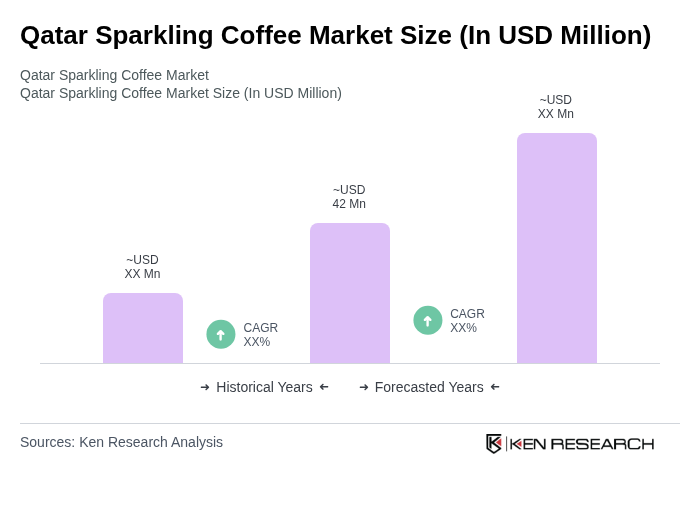
- The Qatar Sparkling Coffee Market is valued at USD 42 million, based on a five-year historical analysis. This growth is primarily driven by the increasing popularity of ready-to-drink beverages, a shift in consumer preferences towards healthier alternatives, and the rising trend of coffee culture among the younger population. The market has seen a surge in demand for innovative flavors and unique blends, contributing to its expansion.
- Key players in this market include Doha, Al Rayyan, and Lusail, which dominate due to their urbanization, high disposable income, and a growing café culture. The concentration of expatriates and a vibrant tourism sector in these cities further enhance the demand for sparkling coffee products, making them pivotal in the market landscape.
- The Qatar Nutrition Labelling and Claims Regulations, 2022 issued by the Ministry of Public Health requires food and beverage manufacturers to declare nutritional information on labels, including sugar content thresholds and health claims standards for products like sparkling coffee. This regulation mandates compliance through clear labelling of calories, sugars, and caffeine levels, with licensing requirements for importers and producers to meet specified nutritional standards.
Qatar Sparkling Coffee Market Segmentation
By Type:
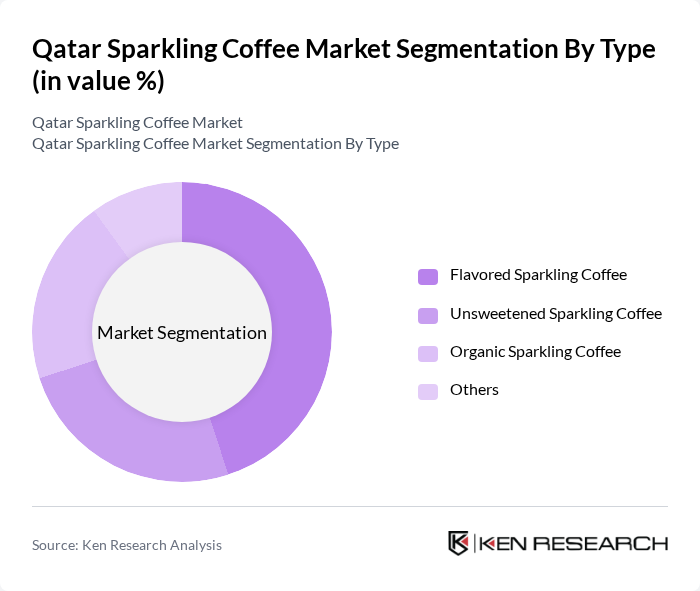
The market is segmented into two main types: Caffeinated Sparkling Coffee and Decaffeinated Sparkling Coffee. Caffeinated Sparkling Coffee is currently the dominant sub-segment, driven by the increasing demand for energy-boosting beverages among young adults and professionals. The unique combination of carbonation and caffeine appeals to consumers looking for refreshing alternatives to traditional coffee. Decaffeinated Sparkling Coffee, while growing, caters to health-conscious individuals seeking to reduce caffeine intake without sacrificing flavor.
By Distribution Channel:
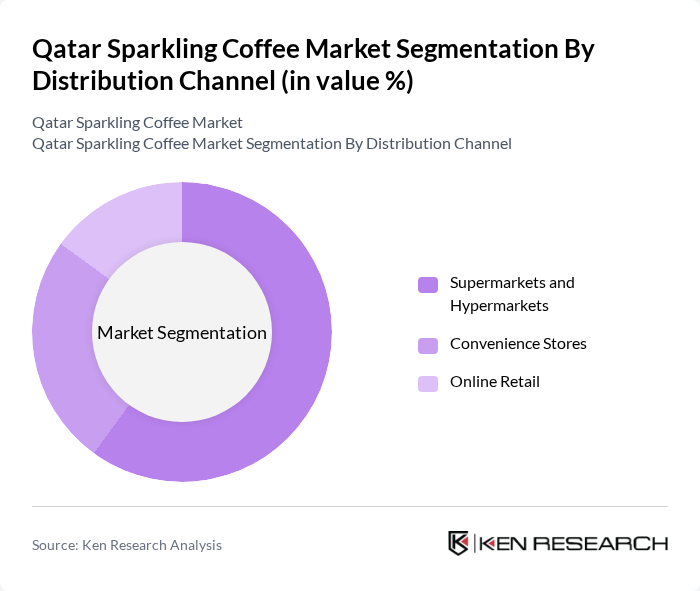
This market is segmented into Supermarkets and Hypermarkets, Convenience Stores, and Online Retail. Supermarkets and Hypermarkets dominate the distribution channel due to their extensive reach and ability to offer a wide variety of products under one roof. Consumers prefer these channels for their convenience and the opportunity to explore different brands and flavors. Online Retail is gaining traction, especially among younger consumers who value the convenience of home delivery and the ability to purchase niche products not available in physical stores.
Qatar Sparkling Coffee Market Competitive Landscape
The Qatar Sparkling Coffee Market is characterized by a dynamic mix of regional and international players. Leading participants such as Starbucks Corporation, Costa Coffee, Lavazza, Illycaffè, Nespresso, Peet's Coffee, Dunkin' Brands, Blue Bottle Coffee, Stumptown Coffee Roasters, Tim Hortons, JDE Peet's, Keurig Dr Pepper, Tchibo, Caribou Coffee, Caffè Nero contribute to innovation, geographic expansion, and service delivery in this space.
Qatar Sparkling Coffee Market Industry Analysis
Growth Drivers
- Increasing Consumer Interest in Innovative Beverages:The Qatar beverage market is witnessing a significant shift towards innovative products, with a reported 35% increase in new beverage launches in the future. This trend is driven by younger consumers, aged 18-34, who are more inclined to experiment with unique flavors and formats. The rise of social media platforms has further amplified this interest, as consumers share their experiences, leading to a growing demand for sparkling coffee as a trendy alternative to traditional beverages.
- Rising Health Consciousness Among Consumers:Health trends are reshaping consumer preferences in Qatar, with a 30% increase in demand for low-calorie and functional beverages reported in the future. Sparkling coffee, often perceived as a healthier alternative due to its lower sugar content and potential antioxidant benefits, aligns well with this trend. The World Health Organization's guidelines on sugar intake have prompted consumers to seek beverages that offer both taste and health benefits, further driving the sparkling coffee market.
- Growth of the Café Culture in Urban Areas:Qatar's urban centers are experiencing a café culture boom, with over 250 new cafés opening in the future alone. This growth is fueled by a rising disposable income, which has increased by 20% in the last year, allowing consumers to indulge in premium beverage experiences. Cafés are increasingly incorporating sparkling coffee into their menus, catering to the demand for unique and refreshing options, thus enhancing market visibility and consumer access.
Market Challenges
- High Competition from Traditional Coffee Beverages:The sparkling coffee market in Qatar faces stiff competition from traditional coffee beverages, which dominate the market with a 65% share. Established brands benefit from strong consumer loyalty and extensive distribution networks. As traditional coffee continues to evolve with new flavors and formats, sparkling coffee must differentiate itself to capture market share, making it challenging for new entrants to gain traction in this competitive landscape.
- Limited Consumer Awareness of Sparkling Coffee:Despite its innovative appeal, sparkling coffee remains relatively unknown among Qatari consumers, with only 25% reporting familiarity with the product in the future. This lack of awareness poses a significant barrier to market growth, as consumers are often hesitant to try unfamiliar beverages. Effective marketing strategies and educational campaigns are essential to increase visibility and encourage trial among potential customers, which is currently a major challenge for the industry.
Qatar Sparkling Coffee Market Future Outlook
The future of the Qatar sparkling coffee market appears promising, driven by evolving consumer preferences and a growing café culture. As health-conscious consumers increasingly seek innovative beverage options, sparkling coffee is well-positioned to capture interest. Additionally, the integration of technology in production and marketing strategies will enhance product visibility and accessibility. With the right focus on consumer education and strategic partnerships, the market can expect to see significant growth in the coming years, fostering a vibrant beverage landscape.
Market Opportunities
- Potential for Product Diversification:There is a significant opportunity for brands to diversify their sparkling coffee offerings by introducing unique flavors and blends. With consumer interest in artisanal products on the rise, brands can leverage this trend to create niche products that cater to specific tastes, potentially increasing market share and consumer loyalty.
- Collaborations with Local Cafés and Restaurants:Partnering with local cafés and restaurants presents a valuable opportunity for sparkling coffee brands to enhance visibility and accessibility. By integrating sparkling coffee into established menus, brands can tap into existing customer bases, driving trial and adoption while benefiting from the growing café culture in urban areas.
Scope of the Report
| Segment | Sub-Segments |
|---|---|
| By Type | Caffeinated Sparkling Coffee Decaffeinated Sparkling Coffee |
| By Distribution Channel | Supermarkets and Hypermarkets Convenience Stores Online Retail |
| By Packaging Type | Cans Bottles Tetra Packs Others |
| By Price Range | Premium Mid-Range Economy |
| By Consumer Demographics | Age Group (18-24, 25-34, 35-44, 45+) Gender Income Level |
Key Target Audience
Investors and Venture Capitalist Firms
Government and Regulatory Bodies (e.g., Ministry of Commerce and Industry, Qatar Food Safety Department)
Manufacturers and Producers
Distributors and Retailers
Hospitality and Food Service Providers
Marketing and Advertising Agencies
Importers and Exporters
Health and Wellness Organizations
Players Mentioned in the Report:
Starbucks Corporation
Costa Coffee
Lavazza
Illycaffe
Nespresso
Peet's Coffee
Dunkin' Brands
Blue Bottle Coffee
Stumptown Coffee Roasters
Tim Hortons
JDE Peet's
Keurig Dr Pepper
Tchibo
Caribou Coffee
Caffe Nero
Table of Contents
Market Assessment Phase
1. Executive Summary and Approach
2. Qatar Sparkling Coffee Market Overview
2.1 Key Insights and Strategic Recommendations
2.2 Qatar Sparkling Coffee Market Overview
2.3 Definition and Scope
2.4 Evolution of Market Ecosystem
2.5 Timeline of Key Regulatory Milestones
2.6 Value Chain & Stakeholder Mapping
2.7 Business Cycle Analysis
2.8 Policy & Incentive Landscape
3. Qatar Sparkling Coffee Market Analysis
3.1 Growth Drivers
3.1.1 Increasing consumer interest in innovative beverages
3.1.2 Rising health consciousness among consumers
3.1.3 Growth of the café culture in urban areas
3.1.4 Expansion of distribution channels
3.2 Market Challenges
3.2.1 High competition from traditional coffee beverages
3.2.2 Limited consumer awareness of sparkling coffee
3.2.3 Regulatory hurdles in beverage production
3.2.4 Fluctuating raw material prices
3.3 Market Opportunities
3.3.1 Potential for product diversification
3.3.2 Collaborations with local cafés and restaurants
3.3.3 Growing demand for ready-to-drink beverages
3.3.4 Expansion into online retail channels
3.4 Market Trends
3.4.1 Increasing popularity of cold brew and sparkling variants
3.4.2 Emergence of sustainable packaging solutions
3.4.3 Rise of artisanal and craft beverage brands
3.4.4 Integration of technology in beverage production
3.5 Government Regulation
3.5.1 Food safety standards and regulations
3.5.2 Labeling requirements for beverage products
3.5.3 Import/export regulations for coffee products
3.5.4 Environmental regulations affecting production
4. SWOT Analysis
5. Stakeholder Analysis
6. Porter's Five Forces Analysis
7. Qatar Sparkling Coffee Market Market Size, 2019-2024
7.1 By Value
7.2 By Volume
7.3 By Average Selling Price
8. Qatar Sparkling Coffee Market Segmentation
8.1 By Type
8.1.1 Caffeinated Sparkling Coffee
8.1.2 Decaffeinated Sparkling Coffee
8.2 By Distribution Channel
8.2.1 Supermarkets and Hypermarkets
8.2.2 Convenience Stores
8.2.3 Online Retail
8.3 By Packaging Type
8.3.1 Cans
8.3.2 Bottles
8.3.3 Tetra Packs
8.3.4 Others
8.4 By Price Range
8.4.1 Premium
8.4.2 Mid-Range
8.4.3 Economy
8.5 By Consumer Demographics
8.5.1 Age Group (18-24, 25-34, 35-44, 45+)
8.5.2 Gender
8.5.3 Income Level
9. Qatar Sparkling Coffee Market Competitive Analysis
9.1 Market Share of Key Players
9.2 Cross Comparison of Key Players
9.2.1 Year-over-Year Revenue Growth Rate (%)
9.2.2 Market Share (% of Total Market Value)
9.2.3 Market Penetration Rate (% of Target Consumers Reached)
9.2.4 Customer Retention Rate (%)
9.2.5 Average Selling Price per Unit (USD)
9.2.6 Product Innovation Index (New SKUs Launched Annually)
9.2.7 Distribution Network Density (Number of Retail Points)
9.2.8 Brand Awareness Score (% of Target Market)
9.2.9 Net Promoter Score (NPS)
9.2.10 Gross Profit Margin (%)
9.3 SWOT Analysis of Top Players
9.4 Pricing Analysis
9.5 Detailed Profile of Major Companies
9.5.1 Starbucks Corporation
9.5.2 Costa Coffee
9.5.3 Lavazza
9.5.4 Illycaffè
9.5.5 Nespresso
9.5.6 Peet's Coffee
9.5.7 Dunkin' Brands
9.5.8 Blue Bottle Coffee
9.5.9 Stumptown Coffee Roasters
9.5.10 Tim Hortons
9.5.11 JDE Peet's
9.5.12 Keurig Dr Pepper
9.5.13 Tchibo
9.5.14 Caribou Coffee
9.5.15 Caffè Nero
10. Qatar Sparkling Coffee Market End-User Analysis
10.1 Procurement Behavior of Key Ministries
10.1.1 Ministry of Health
10.1.2 Ministry of Education
10.1.3 Ministry of Commerce
10.1.4 Others
10.2 Corporate Spend on Infrastructure & Energy
10.2.1 Corporate Cafeterias
10.2.2 Event Management Companies
10.2.3 Hospitality Sector
10.2.4 Others
10.3 Pain Point Analysis by End-User Category
10.3.1 Quality Consistency
10.3.2 Supply Chain Reliability
10.3.3 Pricing Fluctuations
10.3.4 Others
10.4 User Readiness for Adoption
10.4.1 Awareness Levels
10.4.2 Trial Willingness
10.4.3 Feedback Mechanisms
10.4.4 Others
10.5 Post-Deployment ROI and Use Case Expansion
10.5.1 Customer Feedback Analysis
10.5.2 Repeat Purchase Rates
10.5.3 Market Expansion Opportunities
10.5.4 Others
11. Qatar Sparkling Coffee Market Future Size, 2025-2030
11.1 By Value
11.2 By Volume
11.3 By Average Selling Price
Go-To-Market Strategy Phase
1. Whitespace Analysis + Business Model Canvas
1.1 Market Gaps Identification
1.2 Value Proposition Development
1.3 Revenue Streams Analysis
1.4 Cost Structure Evaluation
1.5 Key Partnerships Exploration
1.6 Customer Segmentation
1.7 Channels of Distribution
2. Marketing and Positioning Recommendations
2.1 Branding Strategies
2.2 Product USPs
2.3 Target Audience Engagement
2.4 Digital Marketing Tactics
2.5 Offline Marketing Strategies
2.6 Customer Feedback Integration
2.7 Competitive Positioning
3. Distribution Plan
3.1 Urban Retail Strategies
3.2 Rural NGO Tie-ups
3.3 E-commerce Distribution
3.4 Direct-to-Consumer Channels
3.5 Partnership with Local Distributors
3.6 Logistics and Supply Chain Management
3.7 Inventory Management Solutions
4. Channel & Pricing Gaps
4.1 Underserved Routes
4.2 Pricing Bands Analysis
4.3 Competitor Pricing Strategies
4.4 Consumer Price Sensitivity
4.5 Promotional Pricing Opportunities
4.6 Bundling Strategies
4.7 Seasonal Pricing Adjustments
5. Unmet Demand & Latent Needs
5.1 Category Gaps Identification
5.2 Consumer Segments Analysis
5.3 Product Development Opportunities
5.4 Market Entry Strategies
5.5 Customer Experience Enhancements
5.6 Feedback Loop Creation
5.7 Innovation in Product Offerings
6. Customer Relationship
6.1 Loyalty Programs
6.2 After-sales Service
6.3 Customer Engagement Strategies
6.4 Feedback Mechanisms
6.5 Community Building Initiatives
6.6 Customer Education Programs
6.7 Personalization Strategies
7. Value Proposition
7.1 Sustainability Initiatives
7.2 Integrated Supply Chains
7.3 Quality Assurance Practices
7.4 Unique Selling Points
7.5 Customer-Centric Innovations
7.6 Brand Storytelling
7.7 Market Differentiation Strategies
8. Key Activities
8.1 Regulatory Compliance
8.2 Branding Initiatives
8.3 Distribution Setup
8.4 Marketing Campaigns
8.5 Training and Development
8.6 Performance Monitoring
8.7 Stakeholder Engagement
9. Entry Strategy Evaluation
9.1 Domestic Market Entry Strategy
9.1.1 Product Mix Considerations
9.1.2 Pricing Band Analysis
9.1.3 Packaging Innovations
9.2 Export Entry Strategy
9.2.1 Target Countries Identification
9.2.2 Compliance Roadmap Development
10. Entry Mode Assessment
10.1 Joint Ventures
10.2 Greenfield Investments
10.3 Mergers & Acquisitions
10.4 Distributor Model Evaluation
11. Capital and Timeline Estimation
11.1 Capital Requirements Analysis
11.2 Timelines for Market Entry
12. Control vs Risk Trade-Off
12.1 Ownership vs Partnerships
13. Profitability Outlook
13.1 Breakeven Analysis
13.2 Long-term Sustainability Strategies
14. Potential Partner List
14.1 Distributors
14.2 Joint Ventures
14.3 Acquisition Targets
15. Execution Roadmap
15.1 Phased Plan for Market Entry
15.1.1 Market Setup
15.1.2 Market Entry
15.1.3 Growth Acceleration
15.1.4 Scale & Stabilize
15.2 Key Activities and Milestones
15.2.1 Milestone Planning
15.2.2 Activity Tracking
Research Methodology
Phase 1: Approach1
Desk Research
- Analysis of market reports from local beverage associations and trade publications
- Review of consumer behavior studies and trends in the coffee sector in Qatar
- Examination of import/export data and statistics from Qatar's Ministry of Commerce and Industry
Primary Research
- Interviews with key stakeholders in the coffee supply chain, including importers and distributors
- Surveys targeting coffee shop owners and managers to understand consumer preferences
- Focus groups with consumers to gauge interest in sparkling coffee products
Validation & Triangulation
- Cross-validation of findings with industry reports and expert opinions
- Triangulation of data from consumer surveys and sales data from retailers
- Sanity checks through feedback from industry experts and market analysts
Phase 2: Market Size Estimation1
Top-down Assessment
- Estimation of total beverage market size in Qatar and identification of coffee segment share
- Analysis of demographic trends and their impact on coffee consumption patterns
- Incorporation of tourism and expatriate population growth in consumption forecasts
Bottom-up Modeling
- Collection of sales data from major coffee retailers and cafes in Qatar
- Estimation of average price points for sparkling coffee products
- Volume estimates based on consumer purchase frequency and market penetration rates
Forecasting & Scenario Analysis
- Multi-variable forecasting model incorporating economic indicators and consumer trends
- Scenario analysis based on potential market disruptions and regulatory changes
- Development of baseline, optimistic, and pessimistic growth projections through 2030
Phase 3: CATI Sample Composition1
| Scope Item/Segment | Sample Size | Target Respondent Profiles |
|---|---|---|
| Retail Coffee Outlets | 120 | Café Owners, Baristas, Retail Managers |
| Consumer Preferences | 150 | Regular Coffee Drinkers, Expatriates, Tourists |
| Distribution Channels | 60 | Distributors, Wholesalers, Import Managers |
| Market Trends Analysis | 40 | Market Analysts, Beverage Industry Experts |
| Product Development Insights | 45 | Product Managers, R&D Specialists in Beverage Companies |
Frequently Asked Questions
What is the current value of the Qatar Sparkling Coffee Market?
The Qatar Sparkling Coffee Market is valued at approximately USD 42 million, reflecting a growing trend towards ready-to-drink beverages and innovative coffee options among consumers, particularly the younger demographic.
What are the main drivers of growth in the Qatar Sparkling Coffee Market?
Who are the key players in the Qatar Sparkling Coffee Market?
What types of sparkling coffee are available in Qatar?
Other Regional/Country Reports
Other Adjacent Reports
Malaysia Ready-to-Drink Beverages Market
South Korea Coffee Beverages Market
Belgium Sparkling Beverages Market
Middle East Energy Drinks Market Functional Beverages MarketIndia Non-Alcoholic Beverages Market Outlook to 2030Middle East Specialty Coffee Market Report Size Share Growth Drivers Trends Opportunities & Forecast 2025–2030Kuwait Health and Wellness Beverages Market
KSA carbonated soft drinks market size, share, growth drivers, trends, opportunities & forecast 2025–2030UAE Café Services Market
Why Buy From Us?

What makes us stand out is that our consultants follow Robust, Refine and Result (RRR) methodology. Robust for clear definitions, approaches and sanity checking, Refine for differentiating respondents' facts and opinions, and Result for presenting data with story.

We have set a benchmark in the industry by offering our clients with syndicated and customized market research reports featuring coverage of entire market as well as meticulous research and analyst insights.

While we don't replace traditional research, we flip the method upside down. Our dual approach of Top Bottom & Bottom Top ensures quality deliverable by not just verifying company fundamentals but also looking at the sector and macroeconomic factors.

With one step in the future, our research team constantly tries to show you the bigger picture. We help with some of the tough questions you may encounter along the way: How is the industry positioned? Best marketing channel? KPI's of competitors? By aligning every element, we help maximize success.

Our report gives you instant access to the answers and sources that other companies might choose to hide. We elaborate each steps of research methodology we have used and showcase you the sample size to earn your trust.

If you need any support, we are here! We pride ourselves on universe strength, data quality, and quick, friendly, and professional service.