Qatar Thin Film Photovoltaics PV Market Size Share Growth Drivers Trends Opportunities & Forecast 2025–2030

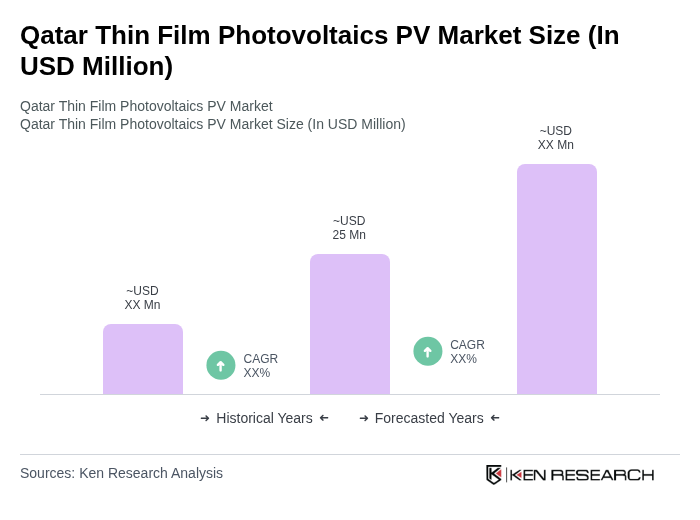
Qatar Thin Film Photovoltaics PV Market, valued at USD 25 million, is growing with government push for 20% renewables by 2030, led by CdTe technology and commercial/industrial adoption.

Region:Middle East

Author(s):Dev

Product Code:KRAA6785

Pages:90

Published On:January 2026
About the Report

Base Year 2024

Qatar Thin Film Photovoltaics PV Market Overview

  • The Qatar Thin Film Photovoltaics PV Market is valued at USD 25 million, based on a five-year historical analysis. This growth is primarily driven by the increasing demand for renewable energy sources, government initiatives promoting solar energy, and advancements in thin film technology that enhance efficiency and reduce costs. The market is witnessing a shift towards sustainable energy solutions, aligning with global trends in environmental conservation.
  • Key players in this market include Qatar Solar Technologies, Siraj Energy, and Nebras Power, which dominate due to their strategic investments in solar infrastructure and favorable climatic conditions for solar energy generation. These companies are also supported by government policies that encourage the adoption of renewable energy technologies, making them pivotal in the growth of the thin film photovoltaics sector.
  • The Qatar National Renewable Energy Strategy 2030, issued by Qatar General Electricity and Water Corporation (Kahramaa) in 2019, mandates utilities to source 20% of power generation capacity from renewables by 2030 through competitive bidding for solar projects exceeding 500 MW, with compliance enforced via power purchase agreements and grid integration standards. This initiative includes significant investments in solar energy projects, particularly in thin film photovoltaics, to enhance energy security and reduce carbon emissions.
Qatar Thin Film Photovoltaics PV Market Size

Qatar Thin Film Photovoltaics PV Market Segmentation

By Type:The thin film photovoltaics market is segmented into various types, including Amorphous Silicon (a-Si), Cadmium Telluride (CdTe), Copper Indium Gallium Selenide (CIGS), Organic Photovoltaics (OPV), and Others. Among these, Cadmium Telluride (CdTe) is currently the leading sub-segment due to its cost-to-performance ratio, energy payback time of less than a year, and ability to withstand high temperature and low light environments, making it suitable for a variety of applications, including building-integrated photovoltaics. The demand for CIGS is also growing, driven by its high efficiency and performance in low-light conditions.
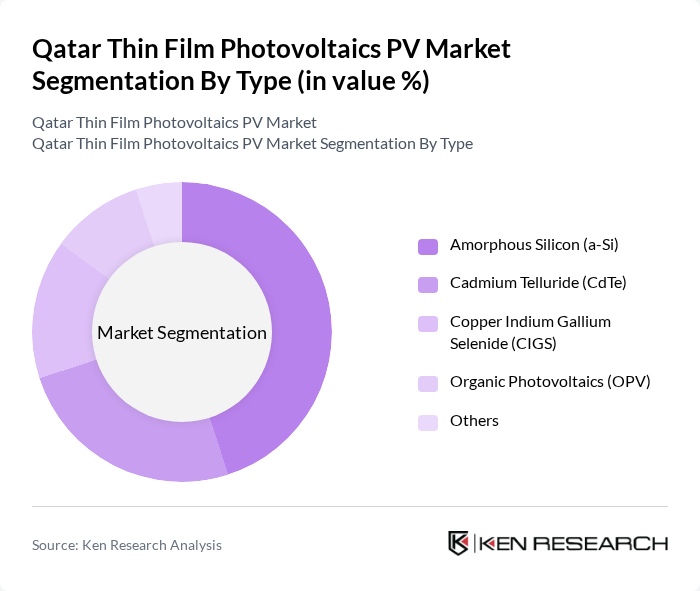
Qatar Thin Film Photovoltaics PV Market segmentation by Type.

By End-User:The end-user segmentation includes Residential, Commercial, Industrial, and Government & Utilities. The Commercial and Industrial segment is currently the dominant sub-segment, driven by increasing demand for sustainable energy solutions to lower energy bills and greenhouse gas emissions along with government incentives for solar installations. The Residential sector is also expanding, as households seek to reduce energy costs and enhance sustainability practices. Industrial applications are growing, particularly in sectors that require large energy inputs, while Government & Utilities are investing heavily in solar projects to meet national energy goals.
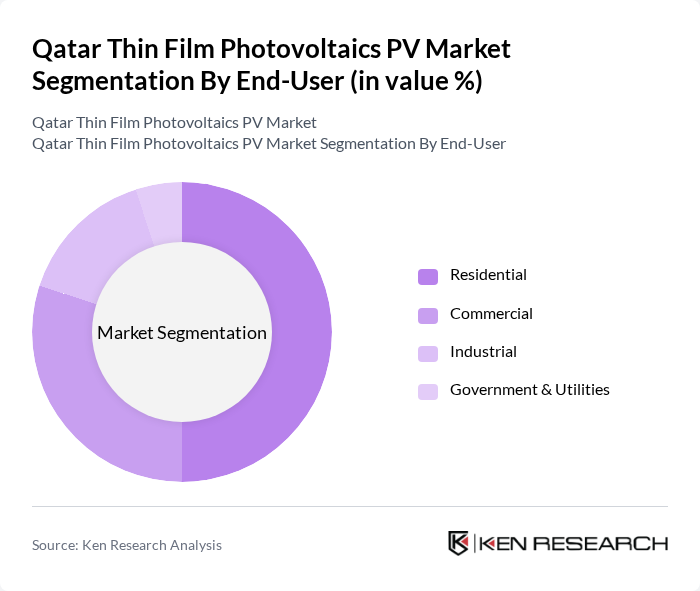
Qatar Thin Film Photovoltaics PV Market segmentation by End-User.

Qatar Thin Film Photovoltaics PV Market Competitive Landscape

The Qatar Thin Film Photovoltaics PV Market is characterized by a dynamic mix of regional and international players. Leading participants such as First Solar, SunPower Corporation, Canadian Solar, JinkoSolar, Trina Solar, Hanwha Q CELLS, Sharp Corporation, REC Group, Solvay, GCL-Poly Energy Holdings, LONGi Green Energy, Yingli Green Energy, Q CELLS, Silevo, Solar Frontier contribute to innovation, geographic expansion, and service delivery in this space.

First Solar

1999

Tempe, Arizona, USA

SunPower Corporation

1985

San Jose, California, USA

Canadian Solar

2001

Guelph, Ontario, Canada

JinkoSolar

2006

Shanghai, China

Trina Solar

1997

Changzhou, Jiangsu, China

Company

Establishment Year

Headquarters

Group Size (Large, Medium, or Small as per industry convention)

Revenue Growth Rate

Market Penetration Rate

Customer Acquisition Cost

Customer Retention Rate

Pricing Strategy

Qatar Thin Film Photovoltaics PV Market Industry Analysis

Growth Drivers

  • Increasing Demand for Renewable Energy:Qatar's energy consumption reached approximately 50 terawatt-hours (TWh) in the recent past, with a significant shift towards renewable sources. The government aims to generate 20% of its energy from renewables in the near future, translating to an increase in demand for thin film photovoltaics (PV). This transition is driven by global climate commitments and local initiatives, positioning thin film technology as a viable solution to meet rising energy needs sustainably.
  • Government Initiatives and Subsidies:The Qatari government has allocated around $1 billion for renewable energy projects, including thin film PV systems. Initiatives such as the Qatar National Vision 2030 emphasize sustainability and energy diversification. Subsidies for solar energy installations have increased, with incentives covering up to 30% of installation costs, making thin film technology more accessible and attractive for both residential and commercial sectors.
  • Technological Advancements in Thin Film Technology:Recent advancements in thin film technology have improved efficiency rates to approximately 15% for certain products, making them competitive with traditional silicon-based panels. Innovations in materials, such as cadmium telluride and organic photovoltaics, have reduced production costs by 20% in the recent past. These developments enhance the appeal of thin film PV systems, particularly in Qatar's arid climate, where lightweight and flexible solutions are advantageous.

Market Challenges

  • High Initial Investment Costs:The upfront costs for thin film PV installations can exceed $1,000 per kilowatt, which poses a significant barrier for widespread adoption. Despite decreasing prices, the initial financial outlay remains a challenge for both consumers and businesses. This high capital requirement can deter potential investors, especially in a market where traditional energy sources are still prevalent and often subsidized.
  • Competition from Traditional Energy Sources:Qatar's energy landscape is heavily dominated by natural gas, which accounted for 99% of the country's electricity generation in the recent past. The low cost of natural gas, approximately $2.50 per million British thermal units (MMBtu), makes it challenging for thin film PV to compete on price. This reliance on fossil fuels creates a significant hurdle for the growth of renewable energy technologies, including thin film photovoltaics.

Qatar Thin Film Photovoltaics PV Market Future Outlook

The future of the thin film photovoltaics market in Qatar appears promising, driven by increasing investments in renewable energy and technological innovations. As the government continues to implement supportive policies and financial incentives, the adoption of thin film technology is expected to rise. Additionally, the growing emphasis on sustainability and energy independence will likely propel further research and development, fostering a more competitive environment for renewable energy solutions in the region.

Market Opportunities

  • Expansion into Commercial and Industrial Sectors:The commercial sector in Qatar is projected to consume over 15 TWh of electricity in future. Targeting this sector with tailored thin film PV solutions can significantly enhance market penetration, as businesses seek to reduce energy costs and improve sustainability profiles.
  • Development of Energy Storage Solutions:The energy storage market in Qatar is expected to grow to $500 million in future. Integrating energy storage with thin film PV systems can enhance reliability and efficiency, making renewable energy more appealing to consumers and businesses, thus creating a synergistic opportunity for growth.

Scope of the Report

SegmentSub-Segments
By Type

Amorphous Silicon (a-Si)

Cadmium Telluride (CdTe)

Copper Indium Gallium Selenide (CIGS)

Organic Photovoltaics (OPV)

Others

By End-User

Residential

Commercial

Industrial

Government & Utilities

By Region

Doha

Al Rayyan

Al Wakrah

Others

By Technology

Photovoltaic

Concentrated Solar Power (CSP)

Others

By Application

Grid-Connected

Off-Grid

Rooftop Installations

Utility-Scale Projects

By Investment Source

Domestic

Foreign Direct Investment (FDI)

Public-Private Partnerships (PPP)

Government Schemes

By Policy Support

Subsidies

Tax Exemptions

Renewable Energy Certificates (RECs)

Others

Key Target Audience

Investors and Venture Capitalist Firms

Government and Regulatory Bodies (e.g., Qatar Ministry of Energy and Industry)

Manufacturers and Producers of Thin Film PV Technology

Energy Utilities and Power Generation Companies

Project Developers and EPC Contractors

Environmental NGOs and Sustainability Organizations

Financial Institutions and Banks

Energy Policy Makers and Planners

Players Mentioned in the Report:

First Solar

SunPower Corporation

Canadian Solar

JinkoSolar

Trina Solar

Hanwha Q CELLS

Sharp Corporation

REC Group

Solvay

GCL-Poly Energy Holdings

LONGi Green Energy

Yingli Green Energy

Q CELLS

Silevo

Solar Frontier

Table of Contents

Market Assessment Phase

1. Executive Summary and Approach


2. Qatar Thin Film Photovoltaics PV Market Overview

2.1 Key Insights and Strategic Recommendations

2.2 Qatar Thin Film Photovoltaics PV Market Overview

2.3 Definition and Scope

2.4 Evolution of Market Ecosystem

2.5 Timeline of Key Regulatory Milestones

2.6 Value Chain & Stakeholder Mapping

2.7 Business Cycle Analysis

2.8 Policy & Incentive Landscape


3. Qatar Thin Film Photovoltaics PV Market Analysis

3.1 Growth Drivers

3.1.1 Increasing demand for renewable energy
3.1.2 Government initiatives and subsidies
3.1.3 Technological advancements in thin film technology
3.1.4 Rising energy prices and energy security concerns

3.2 Market Challenges

3.2.1 High initial investment costs
3.2.2 Competition from traditional energy sources
3.2.3 Limited awareness and understanding of thin film technology
3.2.4 Regulatory hurdles and policy inconsistencies

3.3 Market Opportunities

3.3.1 Expansion into commercial and industrial sectors
3.3.2 Development of energy storage solutions
3.3.3 Partnerships with local and international firms
3.3.4 Increasing focus on sustainability and green building practices

3.4 Market Trends

3.4.1 Growing adoption of smart grid technologies
3.4.2 Integration of IoT in energy management
3.4.3 Shift towards decentralized energy systems
3.4.4 Rise of corporate sustainability initiatives

3.5 Government Regulation

3.5.1 Renewable energy targets and commitments
3.5.2 Feed-in tariffs and power purchase agreements
3.5.3 Environmental impact assessments
3.5.4 Incentives for research and development in renewable technologies

4. SWOT Analysis


5. Stakeholder Analysis


6. Porter's Five Forces Analysis


7. Qatar Thin Film Photovoltaics PV Market Market Size, 2019-2024

7.1 By Value

7.2 By Volume

7.3 By Average Selling Price


8. Qatar Thin Film Photovoltaics PV Market Segmentation

8.1 By Type

8.1.1 Amorphous Silicon (a-Si)
8.1.2 Cadmium Telluride (CdTe)
8.1.3 Copper Indium Gallium Selenide (CIGS)
8.1.4 Organic Photovoltaics (OPV)
8.1.5 Others

8.2 By End-User

8.2.1 Residential
8.2.2 Commercial
8.2.3 Industrial
8.2.4 Government & Utilities

8.3 By Region

8.3.1 Doha
8.3.2 Al Rayyan
8.3.3 Al Wakrah
8.3.4 Others

8.4 By Technology

8.4.1 Photovoltaic
8.4.2 Concentrated Solar Power (CSP)
8.4.3 Others

8.5 By Application

8.5.1 Grid-Connected
8.5.2 Off-Grid
8.5.3 Rooftop Installations
8.5.4 Utility-Scale Projects

8.6 By Investment Source

8.6.1 Domestic
8.6.2 Foreign Direct Investment (FDI)
8.6.3 Public-Private Partnerships (PPP)
8.6.4 Government Schemes

8.7 By Policy Support

8.7.1 Subsidies
8.7.2 Tax Exemptions
8.7.3 Renewable Energy Certificates (RECs)
8.7.4 Others

9. Qatar Thin Film Photovoltaics PV Market Competitive Analysis

9.1 Market Share of Key Players

9.2 Cross Comparison of Key Players

9.2.1 Company Name
9.2.2 Group Size (Large, Medium, or Small as per industry convention)
9.2.3 Revenue Growth Rate
9.2.4 Market Penetration Rate
9.2.5 Customer Acquisition Cost
9.2.6 Customer Retention Rate
9.2.7 Pricing Strategy
9.2.8 Average Project Completion Time
9.2.9 Return on Investment (ROI)
9.2.10 Market Share Percentage

9.3 SWOT Analysis of Top Players

9.4 Pricing Analysis

9.5 Detailed Profile of Major Companies

9.5.1 First Solar
9.5.2 SunPower Corporation
9.5.3 Canadian Solar
9.5.4 JinkoSolar
9.5.5 Trina Solar
9.5.6 Hanwha Q CELLS
9.5.7 Sharp Corporation
9.5.8 REC Group
9.5.9 Solvay
9.5.10 GCL-Poly Energy Holdings
9.5.11 LONGi Green Energy
9.5.12 Yingli Green Energy
9.5.13 Q CELLS
9.5.14 Silevo
9.5.15 Solar Frontier

10. Qatar Thin Film Photovoltaics PV Market End-User Analysis

10.1 Procurement Behavior of Key Ministries

10.1.1 Key procurement policies
10.1.2 Budget allocation for renewable projects
10.1.3 Decision-making processes
10.1.4 Collaboration with private sector

10.2 Corporate Spend on Infrastructure & Energy

10.2.1 Investment trends in renewable energy
10.2.2 Budget priorities for energy projects
10.2.3 Long-term energy contracts
10.2.4 Sustainability initiatives

10.3 Pain Point Analysis by End-User Category

10.3.1 Cost-related challenges
10.3.2 Technical limitations
10.3.3 Regulatory compliance issues
10.3.4 Market volatility concerns

10.4 User Readiness for Adoption

10.4.1 Awareness of thin film technology
10.4.2 Financial readiness
10.4.3 Infrastructure availability
10.4.4 Training and support needs

10.5 Post-Deployment ROI and Use Case Expansion

10.5.1 Performance metrics
10.5.2 Case studies of successful deployments
10.5.3 Scalability of solutions
10.5.4 Future investment potential

11. Qatar Thin Film Photovoltaics PV Market Future Size, 2025-2030

11.1 By Value

11.2 By Volume

11.3 By Average Selling Price


Go-To-Market Strategy Phase

1. Whitespace Analysis + Business Model Canvas

1.1 Market gaps and opportunities

1.2 Business model components


2. Marketing and Positioning Recommendations

2.1 Branding strategies

2.2 Product USPs


3. Distribution Plan

3.1 Urban retail vs rural NGO tie-ups


4. Channel & Pricing Gaps

4.1 Underserved routes

4.2 Pricing bands


5. Unmet Demand & Latent Needs

5.1 Category gaps

5.2 Consumer segments


6. Customer Relationship

6.1 Loyalty programs

6.2 After-sales service


7. Value Proposition

7.1 Sustainability

7.2 Integrated supply chains


8. Key Activities

8.1 Regulatory compliance

8.2 Branding

8.3 Distribution setup


9. Entry Strategy Evaluation

9.1 Domestic Market Entry Strategy

9.1.1 Product mix
9.1.2 Pricing band
9.1.3 Packaging

9.2 Export Entry Strategy

9.2.1 Target countries
9.2.2 Compliance roadmap

10. Entry Mode Assessment

10.1 Joint Ventures

10.2 Greenfield Investments

10.3 Mergers & Acquisitions

10.4 Distributor Model


11. Capital and Timeline Estimation

11.1 Capital requirements

11.2 Timelines


12. Control vs Risk Trade-Off

12.1 Ownership vs Partnerships


13. Profitability Outlook

13.1 Breakeven analysis

13.2 Long-term sustainability


14. Potential Partner List

14.1 Distributors

14.2 Joint Ventures

14.3 Acquisition targets


15. Execution Roadmap

15.1 Phased Plan for Market Entry

15.1.1 Market Setup
15.1.2 Market Entry
15.1.3 Growth Acceleration
15.1.4 Scale & Stabilize

15.2 Key Activities and Milestones

15.2.1 Milestone tracking
15.2.2 Activity scheduling

Research Methodology

ApproachModellingSample

Phase 1: Approach1

Desk Research

  • Analysis of market reports from industry associations and government publications related to thin film photovoltaics in Qatar
  • Review of academic journals and white papers focusing on advancements in thin film technology and its applications
  • Examination of trade statistics and import/export data specific to photovoltaic materials and components

Primary Research

  • Interviews with key stakeholders including manufacturers, suppliers, and installers of thin film photovoltaic systems
  • Surveys conducted with energy policy experts and regulatory bodies in Qatar
  • Field visits to solar energy projects utilizing thin film technology to gather firsthand insights

Validation & Triangulation

  • Cross-validation of findings through comparison with international market trends and local industry reports
  • Triangulation of data from primary interviews, secondary research, and market analytics
  • Sanity checks performed through expert panel discussions to ensure data reliability and accuracy

Phase 2: Market Size Estimation1

Top-down Assessment

  • Estimation of the total addressable market for thin film photovoltaics based on Qatar's renewable energy targets
  • Segmentation of the market by application areas such as residential, commercial, and utility-scale installations
  • Incorporation of government incentives and subsidies for solar energy adoption in the market analysis

Bottom-up Modeling

  • Collection of installation data from leading thin film photovoltaic providers in Qatar
  • Cost analysis based on average pricing of thin film solar panels and installation services
  • Volume estimates derived from projected growth rates in solar energy capacity and demand

Forecasting & Scenario Analysis

  • Development of forecasting models based on historical growth patterns and future energy policies
  • Scenario analysis considering factors such as technological advancements and shifts in consumer preferences
  • Creation of multiple growth scenarios (baseline, optimistic, and pessimistic) through 2030

Phase 3: CATI Sample Composition1

Scope Item/SegmentSample SizeTarget Respondent Profiles
Residential Solar Installations100Homeowners, Solar System Installers
Commercial Solar Projects80Facility Managers, Energy Consultants
Utility-Scale Solar Developments60Project Managers, Energy Policy Makers
Thin Film Technology Providers50Product Managers, R&D Engineers
Government Regulatory Bodies40Regulatory Officials, Energy Analysts

Frequently Asked Questions

What is the current value of the Qatar Thin Film Photovoltaics PV Market?

The Qatar Thin Film Photovoltaics PV Market is valued at approximately USD 25 million, reflecting a growing demand for renewable energy sources and advancements in thin film technology that enhance efficiency and reduce costs.

What are the key drivers of growth in the Qatar Thin Film Photovoltaics PV Market?

Who are the major players in the Qatar Thin Film Photovoltaics PV Market?

What is the Qatar National Renewable Energy Strategy 2030?

Other Adjacent Reports

Germany Solar Photovoltaics Market

KSA Europe Renewable Energy MarketUAE Energy Storage MarketIndia Solar Inverter Market Outlook to 2020

Germany Building-Integrated Photovoltaics Market

Oman Concentrated Solar Power Market

Denmark Wind Energy Market

Brazil Solar Battery Market

India Smart Grid Market Outlook to 2030

UAE Photovoltaic Materials Market

Why Buy From Us?

Refine Robust Result (RRR) Framework

What makes us stand out is that our consultants follow Robust, Refine and Result (RRR) methodology. Robust for clear definitions, approaches and sanity checking, Refine for differentiating respondents' facts and opinions, and Result for presenting data with story.

Our Reach Is Unmatched

We have set a benchmark in the industry by offering our clients with syndicated and customized market research reports featuring coverage of entire market as well as meticulous research and analyst insights.

Shifting the Research Paradigm

While we don't replace traditional research, we flip the method upside down. Our dual approach of Top Bottom & Bottom Top ensures quality deliverable by not just verifying company fundamentals but also looking at the sector and macroeconomic factors.

More Insights-Better Decisions

With one step in the future, our research team constantly tries to show you the bigger picture. We help with some of the tough questions you may encounter along the way: How is the industry positioned? Best marketing channel? KPI's of competitors? By aligning every element, we help maximize success.

Transparency and Trust

Our report gives you instant access to the answers and sources that other companies might choose to hide. We elaborate each steps of research methodology we have used and showcase you the sample size to earn your trust.

Round the Clock Support

If you need any support, we are here! We pride ourselves on universe strength, data quality, and quick, friendly, and professional service.

Why Clients Choose Us?

400000+
Reports in repository
150+
Consulting projects a year
100+
Analysts
8000+
Client Queries in 2022








