Region:Middle East
Author(s):Dev
Product Code:KRAC0975
Pages:81
Published On:December 2025
By Type:
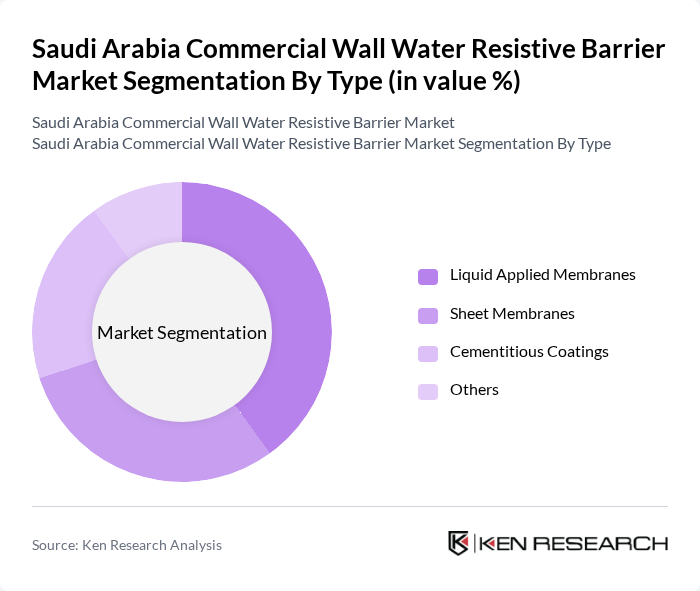
The market is segmented into four main types: Liquid Applied Membranes, Sheet Membranes, Cementitious Coatings, and Others. Among these, Liquid Applied Membranes are gaining traction due to their ease of application and superior performance in moisture protection. This segment is particularly favored in new construction projects where seamless application is crucial. Sheet Membranes, while still significant, are often used in specific applications where durability and long-term performance are prioritized. Cementitious Coatings are also popular for their versatility and effectiveness in various environmental conditions. The "Others" category includes emerging technologies and products that cater to niche markets.
By End-User:
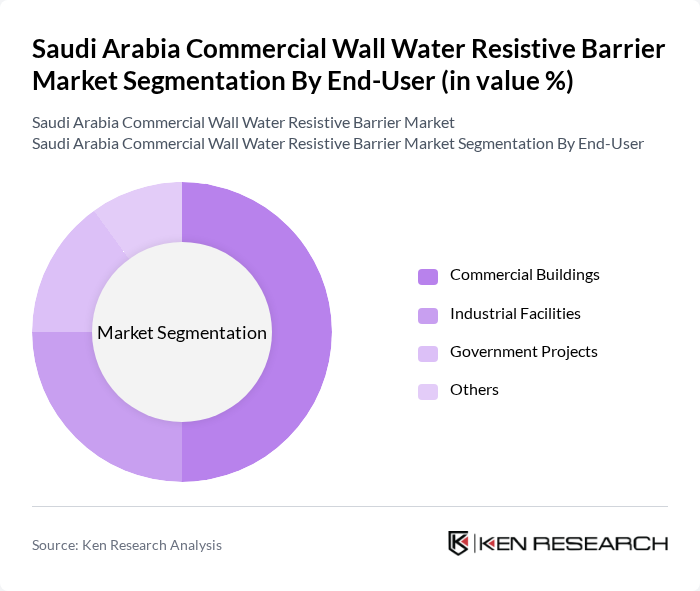
The end-user segmentation includes Commercial Buildings, Industrial Facilities, Government Projects, and Others. Commercial Buildings represent the largest share of the market, driven by the ongoing construction boom in urban areas. The demand for advanced waterproofing solutions in high-rise buildings and shopping complexes is significant. Industrial Facilities also contribute notably, as they require robust moisture protection for operational efficiency. Government Projects are increasingly adopting these barriers to comply with new regulations and standards, while the "Others" category encompasses various smaller sectors.
The Saudi Arabia Commercial Wall Water Resistive Barrier Market is characterized by a dynamic mix of regional and international players. Leading participants such as BASF SE, Sika AG, GCP Applied Technologies, Dow Chemical Company, Saint-Gobain, Tremco Incorporated, Carlisle Companies Incorporated, Mapei S.p.A., Fosroc International Limited, RPM International Inc., Hilti Corporation, Ardex Group, Bostik, W.R. Grace & Co., Koster Bauchemie AG contribute to innovation, geographic expansion, and service delivery in this space.
The future of the Saudi Arabia Commercial Wall Water Resistive Barrier Market appears promising, driven by a focus on innovation in smart and sustainable construction practices. Projects under Vision 2030, such as NEOM, emphasize technology integration and eco-friendly designs, likely increasing demand for advanced water-resistive barrier materials. Additionally, the growing trend of public-private partnerships and digital construction methods will further modernize the sector, enhancing the adoption of prefabricated wall systems that incorporate these barriers.
| Segment | Sub-Segments |
|---|---|
| By Type | Liquid Applied Membranes Sheet Membranes Cementitious Coatings Others |
| By End-User | Commercial Buildings Industrial Facilities Government Projects Others |
| By Application | New Construction Renovation and Retrofitting Infrastructure Projects Others |
| By Material | Polyurethane Bituminous Thermoplastic Others |
| By Region | Central Region Eastern Region Western Region Southern Region |
| By Project Size | Small Scale Projects Medium Scale Projects Large Scale Projects Others |
| By Policy Support | Government Subsidies Tax Incentives Regulatory Support Others |
| Scope Item/Segment | Sample Size | Target Respondent Profiles |
|---|---|---|
| Commercial Building Projects | 150 | Project Managers, Construction Supervisors |
| Architectural Firms | 100 | Lead Architects, Design Engineers |
| Material Suppliers | 80 | Sales Managers, Product Development Heads |
| Regulatory Bodies | 50 | Policy Makers, Environmental Consultants |
| Construction Equipment Rental Services | 70 | Operations Managers, Equipment Procurement Officers |
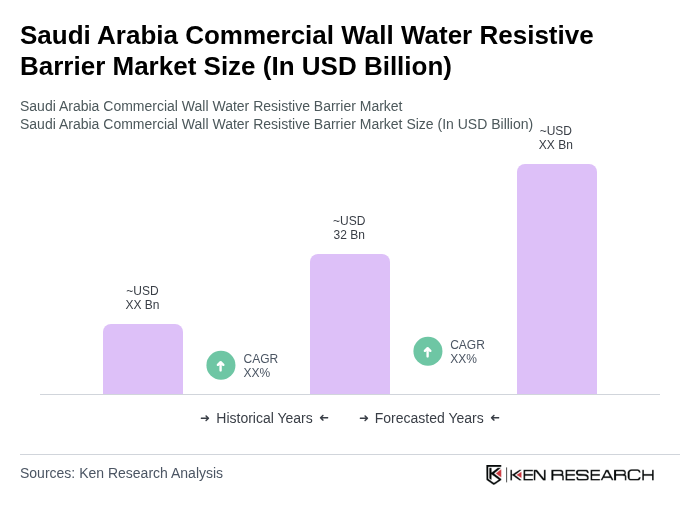
The Saudi Arabia Commercial Wall Water Resistive Barrier Market is valued at approximately USD 32 billion, driven by increasing commercial construction activities, urbanization, and heightened awareness of building envelope performance.

What makes us stand out is that our consultants follow Robust, Refine and Result (RRR) methodology. Robust for clear definitions, approaches and sanity checking, Refine for differentiating respondents' facts and opinions, and Result for presenting data with story.

We have set a benchmark in the industry by offering our clients with syndicated and customized market research reports featuring coverage of entire market as well as meticulous research and analyst insights.

While we don't replace traditional research, we flip the method upside down. Our dual approach of Top Bottom & Bottom Top ensures quality deliverable by not just verifying company fundamentals but also looking at the sector and macroeconomic factors.

With one step in the future, our research team constantly tries to show you the bigger picture. We help with some of the tough questions you may encounter along the way: How is the industry positioned? Best marketing channel? KPI's of competitors? By aligning every element, we help maximize success.

Our report gives you instant access to the answers and sources that other companies might choose to hide. We elaborate each steps of research methodology we have used and showcase you the sample size to earn your trust.

If you need any support, we are here! We pride ourselves on universe strength, data quality, and quick, friendly, and professional service.













