KSA edible offal market report Size, Share, Growth Drivers, Trends, Opportunities & Forecast 2025–2030

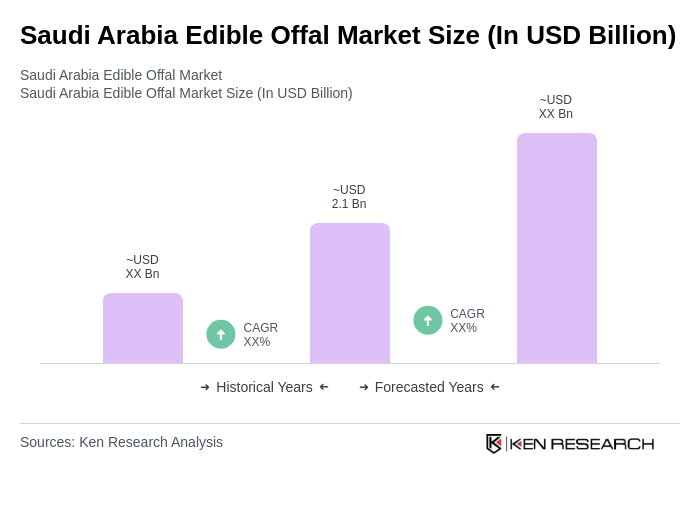
Saudi Arabia edible offal market, valued at USD 2.1 Bn, grows due to cultural preferences, nutritional awareness, and food processing innovations in cities like Riyadh and Jeddah.

Region:Middle East

Author(s):Geetanshi

Product Code:KRAC2466

Pages:91

Published On:October 2025
About the Report

Base Year 2024

Saudi Arabia Edible Offal Market Overview

  • The Saudi Arabia Edible Offal Market is valued at approximately USD 2.1 billion, based on a five-year historical analysis. This growth is primarily driven by increasing consumer demand for diverse protein sources, cultural preferences for offal in traditional dishes, and a growing awareness of the nutritional benefits of offal products. The market is further supported by the rising popularity of nose-to-tail eating, sustainability initiatives, and a focus on reducing food waste, which have all contributed to expanding consumer acceptance and product innovation in the offal segment .
  • Key cities such as Riyadh, Jeddah, and Dammam dominate the market due to their large populations, urbanization, and higher disposable incomes. These cities also have a rich culinary heritage that incorporates offal, making them significant hubs for both retail and food service sectors. The strong presence of modern retail infrastructure and food processing facilities in these urban centers further strengthens their role in driving market growth .
  • The Technical Regulation for Fresh and Frozen Meat and Meat Products (SFDA.FD 995:2021), issued by the Saudi Food and Drug Authority (SFDA), mandates comprehensive safety and quality standards for edible offal products. This regulation requires all processing facilities to undergo mandatory inspections, implement Hazard Analysis and Critical Control Points (HACCP) systems, and obtain certification to ensure compliance with hygiene, labeling, and traceability requirements. These measures are designed to enhance food safety standards and bolster consumer confidence in offal consumption .
Saudi Arabia Edible Offal Market Size

Saudi Arabia Edible Offal Market Segmentation

By Type:The edible offal market can be segmented into various types, including liver, kidneys, heart, tripe, sweetbreads, tongue, lungs, spleen, and others such as brain, tail, feet, and intestines. Among these, liver is the most popular due to its rich flavor and nutritional profile, often used in traditional dishes and gourmet cuisine. Kidneys and heart also see significant demand, particularly in local culinary practices. The increasing trend of nose-to-tail eating and the influence of sustainability-focused consumers are further driving interest in lesser-known offal types, expanding consumer choices and supporting market growth .
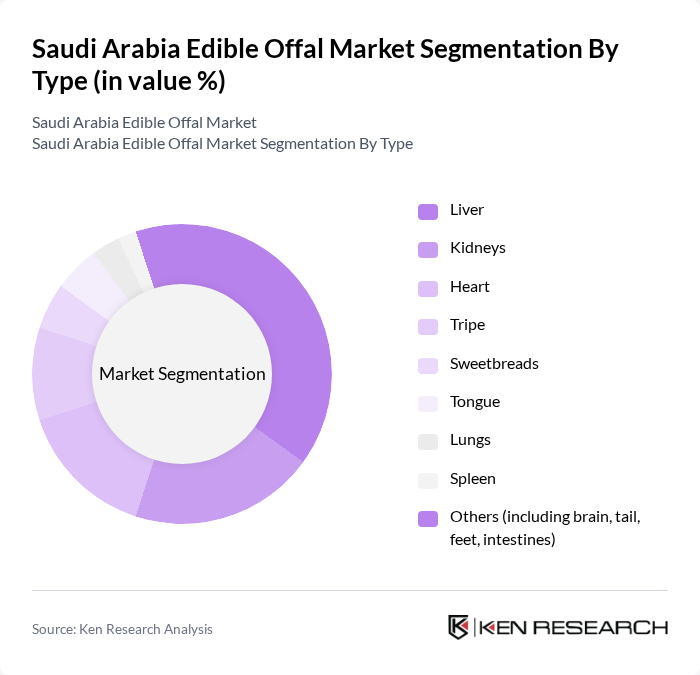
Saudi Arabia Edible Offal Market segmentation by Type.

By Source:The sources of edible offal include cattle, sheep, goat, poultry, camel, and others. Cattle are the primary source due to the high volume of beef production in Saudi Arabia, which also leads to a significant supply of offal. Poultry offal is gaining traction as well, driven by the popularity of chicken dishes in the region. The diverse sources cater to varying consumer preferences and culinary applications, enhancing the overall market appeal. The market also benefits from the integration of offal into both traditional and modern cuisine, reflecting evolving dietary trends .
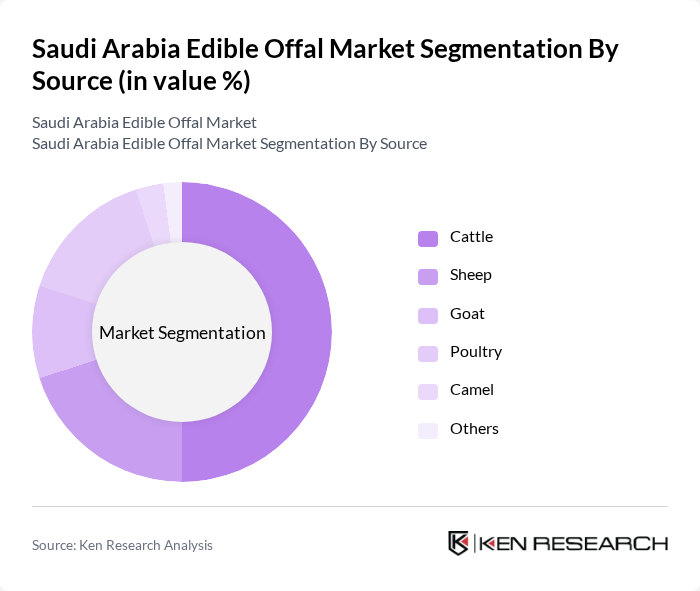
Saudi Arabia Edible Offal Market segmentation by Source.

Saudi Arabia Edible Offal Market Competitive Landscape

The Saudi Arabia Edible Offal Market is characterized by a dynamic mix of regional and international players. Leading participants such as Almarai Company, Al-Watania Poultry, Al-Faisaliah Foods, Al-Jazira Poultry, Al-Muhaidib Group, Al-Othaim Holding, Al-Safi Danone, Al-Baik Food Systems, Al-Rajhi International for Investment, Tanmiah Food Company, Al-Hokair Group, Al-Muhaidib Foods, Al-Salam Foods, Al-Mahmal Group, Almunajem Foods contribute to innovation, geographic expansion, and service delivery in this space.

Almarai Company

1977

Riyadh, Saudi Arabia

Al-Watania Poultry

1977

Qassim, Saudi Arabia

Al-Faisaliah Foods

1971

Riyadh, Saudi Arabia

Al-Jazira Poultry

1981

Riyadh, Saudi Arabia

Al-Muhaidib Group

1946

Riyadh, Saudi Arabia

Company

Establishment Year

Headquarters

Group Size (Large, Medium, or Small as per industry convention)

Annual Offal Processing Volume (Tonnes)

Revenue from Edible Offal Segment (SAR Million)

Market Share in Saudi Arabia Edible Offal (%)

Distribution Network Coverage (Number of Outlets/Regions)

Export Share (if applicable, % of total offal sales)

Saudi Arabia Edible Offal Market Industry Analysis

Growth Drivers

  • Increasing Consumer Demand for Diverse Protein Sources:The Saudi Arabian population is projected to reach 36 million in future, driving a significant demand for protein-rich foods. With a growing awareness of health and nutrition, consumers are increasingly seeking alternative protein sources, including edible offal. The protein consumption per capita in Saudi Arabia is expected to rise to 110 grams daily, indicating a shift towards diverse protein options, including offal, which is often more affordable than traditional meats.
  • Rising Awareness of Nutritional Benefits of Edible Offal:Edible offal is recognized for its high nutritional value, containing essential vitamins and minerals. For instance, liver is rich in Vitamin A, iron, and B vitamins, which are crucial for health. As health consciousness increases, the demand for nutrient-dense foods is expected to grow. The Saudi Ministry of Health has reported a 20% increase in public interest in offal's health benefits, further driving its consumption in various culinary applications.
  • Growth in the Food Processing Industry:The food processing sector in Saudi Arabia is anticipated to grow at a rate of 7% annually, reaching a market value of approximately SAR 120 billion in future. This growth is fostering innovation in product development, including value-added offal products. The increasing number of food processing facilities is expected to enhance the availability and variety of offal products, catering to both local and export markets, thus boosting overall consumption.

Market Challenges

  • Cultural Perceptions and Stigma Associated with Offal Consumption:Despite its nutritional benefits, offal consumption faces cultural stigma in Saudi Arabia, where traditional meat cuts are preferred. A survey by the Saudi Food Authority indicated that 35% of consumers are hesitant to try offal due to cultural beliefs. This perception poses a significant barrier to market growth, as overcoming these cultural challenges requires targeted educational campaigns to promote offal's culinary versatility and health benefits.
  • Regulatory Hurdles in Food Safety and Quality Standards:The edible offal market in Saudi Arabia is subject to stringent food safety regulations, which can complicate processing and distribution. The Saudi Food and Drug Authority (SFDA) has implemented rigorous standards that require compliance from producers. In future, the SFDA is expected to increase inspections by 25%, which may strain smaller producers who lack the resources to meet these regulations, potentially limiting market entry and growth.

Saudi Arabia Edible Offal Market Future Outlook

The future of the Saudi Arabia edible offal market appears promising, driven by increasing consumer interest in diverse protein sources and the growing food processing industry. As culinary trends evolve, offal is likely to gain traction in gourmet cuisine, supported by collaborations with chefs and influencers. Additionally, the rise of online sales platforms will facilitate access to offal products, enhancing consumer engagement and expanding market reach. Overall, the market is poised for gradual growth, reflecting changing dietary preferences and increased awareness of nutritional benefits.

Market Opportunities

  • Development of Value-Added Offal Products:There is a significant opportunity for the development of value-added offal products, such as ready-to-eat meals and gourmet offerings. This innovation can attract health-conscious consumers and those seeking convenience, potentially increasing offal's market share. The food processing sector's growth supports this trend, with an expected investment of SAR 6 billion in product development in future.
  • Export Potential to Neighboring Regions:Saudi Arabia's strategic location offers substantial export potential for edible offal to neighboring countries in the Gulf Cooperation Council (GCC). With a combined population of over 55 million, these markets present a lucrative opportunity. The Saudi government is actively promoting food exports, aiming for a 15% increase in food exports in future, which could significantly benefit the offal sector.

Scope of the Report

SegmentSub-Segments
By Type

Liver

Kidneys

Heart

Tripe

Sweetbreads

Tongue

Lungs

Spleen

Others (including brain, tail, feet, intestines)

By Source

Cattle

Sheep

Goat

Poultry

Camel

Others

By End-User

Retail Consumers

Restaurants

Food Manufacturers

Catering Services

By Distribution Channel

Supermarkets/Hypermarkets

Online Retail

Specialty Butcher Shops

Wholesale/Institutional Sales

Direct Sales

By Packaging Type

Vacuum Sealed

Canned

Fresh/Chilled

Frozen

By Price Range

Economy

Mid-Range

Premium

By Quality

Organic

Conventional

By Form

Fresh/Chilled

Frozen

Processed (canned, brined, sausage, bagged, etc.)

By Region

Central Region

Eastern Region

Western Region

Southern Region

Northern Region

Key Target Audience

Investors and Venture Capitalist Firms

Government and Regulatory Bodies (e.g., Saudi Food and Drug Authority, Ministry of Environment, Water and Agriculture)

Manufacturers and Producers

Distributors and Retailers

Food Service Providers

Exporters and Importers

Industry Associations (e.g., Saudi Meat and Livestock Association)

Financial Institutions

Players Mentioned in the Report:

Almarai Company

Al-Watania Poultry

Al-Faisaliah Foods

Al-Jazira Poultry

Al-Muhaidib Group

Al-Othaim Holding

Al-Safi Danone

Al-Baik Food Systems

Al-Rajhi International for Investment

Tanmiah Food Company

Al-Hokair Group

Al-Muhaidib Foods

Al-Salam Foods

Al-Mahmal Group

Almunajem Foods

Table of Contents

Market Assessment Phase

1. Executive Summary and Approach


2. Saudi Arabia Edible Offal Market Overview

2.1 Key Insights and Strategic Recommendations

2.2 Saudi Arabia Edible Offal Market Overview

2.3 Definition and Scope

2.4 Evolution of Market Ecosystem

2.5 Timeline of Key Regulatory Milestones

2.6 Value Chain & Stakeholder Mapping

2.7 Business Cycle Analysis

2.8 Policy & Incentive Landscape


3. Saudi Arabia Edible Offal Market Analysis

3.1 Growth Drivers

3.1.1 Increasing consumer demand for diverse protein sources
3.1.2 Rising awareness of nutritional benefits of edible offal
3.1.3 Growth in the food processing industry
3.1.4 Expansion of food service and restaurant sectors

3.2 Market Challenges

3.2.1 Cultural perceptions and stigma associated with offal consumption
3.2.2 Regulatory hurdles in food safety and quality standards
3.2.3 Supply chain inefficiencies and distribution issues
3.2.4 Competition from alternative protein sources

3.3 Market Opportunities

3.3.1 Development of value-added offal products
3.3.2 Export potential to neighboring regions
3.3.3 Increasing trend of organic and sustainable sourcing
3.3.4 Collaborations with local chefs and culinary influencers

3.4 Market Trends

3.4.1 Growing popularity of offal in gourmet cuisine
3.4.2 Rise of online platforms for offal sales
3.4.3 Increased focus on animal welfare and ethical sourcing
3.4.4 Shift towards home cooking and DIY food preparation

3.5 Government Regulation

3.5.1 Food safety regulations specific to offal processing
3.5.2 Import/export regulations affecting offal trade
3.5.3 Labeling requirements for edible offal products
3.5.4 Health and hygiene standards for food establishments

4. SWOT Analysis


5. Stakeholder Analysis


6. Porter's Five Forces Analysis


7. Saudi Arabia Edible Offal Market Market Size, 2019-2024

7.1 By Value

7.2 By Volume

7.3 By Average Selling Price


8. Saudi Arabia Edible Offal Market Segmentation

8.1 By Type

8.1.1 Liver
8.1.2 Kidneys
8.1.3 Heart
8.1.4 Tripe
8.1.5 Sweetbreads
8.1.6 Tongue
8.1.7 Lungs
8.1.8 Spleen
8.1.9 Others (including brain, tail, feet, intestines)

8.2 By Source

8.2.1 Cattle
8.2.2 Sheep
8.2.3 Goat
8.2.4 Poultry
8.2.5 Camel
8.2.6 Others

8.3 By End-User

8.3.1 Retail Consumers
8.3.2 Restaurants
8.3.3 Food Manufacturers
8.3.4 Catering Services

8.4 By Distribution Channel

8.4.1 Supermarkets/Hypermarkets
8.4.2 Online Retail
8.4.3 Specialty Butcher Shops
8.4.4 Wholesale/Institutional Sales
8.4.5 Direct Sales

8.5 By Packaging Type

8.5.1 Vacuum Sealed
8.5.2 Canned
8.5.3 Fresh/Chilled
8.5.4 Frozen

8.6 By Price Range

8.6.1 Economy
8.6.2 Mid-Range
8.6.3 Premium

8.7 By Quality

8.7.1 Organic
8.7.2 Conventional

8.8 By Form

8.8.1 Fresh/Chilled
8.8.2 Frozen
8.8.3 Processed (canned, brined, sausage, bagged, etc.)

8.9 By Region

8.9.1 Central Region
8.9.2 Eastern Region
8.9.3 Western Region
8.9.4 Southern Region
8.9.5 Northern Region

9. Saudi Arabia Edible Offal Market Competitive Analysis

9.1 Market Share of Key Players

9.2 KPIs for Cross Comparison of Key Players

9.2.1 Company Name
9.2.2 Group Size (Large, Medium, or Small as per industry convention)
9.2.3 Annual Offal Processing Volume (Tonnes)
9.2.4 Revenue from Edible Offal Segment (SAR Million)
9.2.5 Market Share in Saudi Arabia Edible Offal (%)
9.2.6 Distribution Network Coverage (Number of Outlets/Regions)
9.2.7 Export Share (if applicable, % of total offal sales)
9.2.8 Product Portfolio Breadth (Number of Offal Types Offered)
9.2.9 Halal Certification & Compliance Status
9.2.10 Supply Chain Efficiency (Lead Time, Cold Chain Coverage)
9.2.11 Pricing Strategy (Average Price per Kg/Segment)
9.2.12 Brand Recognition Score (Survey/Market Index)
9.2.13 Customer Retention Rate (%)
9.2.14 Innovation Index (New Product Launches, Value-Added Offal)

9.3 SWOT Analysis of Top Players

9.4 Pricing Analysis

9.5 Detailed Profile of Major Companies

9.5.1 Almarai Company
9.5.2 Al-Watania Poultry
9.5.3 Al-Faisaliah Foods
9.5.4 Al-Jazira Poultry
9.5.5 Al-Muhaidib Group
9.5.6 Al-Othaim Holding
9.5.7 Al-Safi Danone
9.5.8 Al-Baik Food Systems
9.5.9 Al-Rajhi International for Investment
9.5.10 Tanmiah Food Company
9.5.11 Al-Hokair Group
9.5.12 Al-Muhaidib Foods
9.5.13 Al-Salam Foods
9.5.14 Al-Mahmal Group
9.5.15 Almunajem Foods

10. Saudi Arabia Edible Offal Market End-User Analysis

10.1 Procurement Behavior of Key Ministries

10.1.1 Ministry of Health
10.1.2 Ministry of Commerce
10.1.3 Ministry of Agriculture

10.2 Corporate Spend on Infrastructure & Energy

10.2.1 Food Processing Facilities
10.2.2 Cold Storage Solutions
10.2.3 Transportation Logistics

10.3 Pain Point Analysis by End-User Category

10.3.1 Quality Assurance Issues
10.3.2 Supply Chain Disruptions
10.3.3 Price Volatility

10.4 User Readiness for Adoption

10.4.1 Awareness of Edible Offal Benefits
10.4.2 Acceptance in Culinary Practices
10.4.3 Availability of Products

10.5 Post-Deployment ROI and Use Case Expansion

10.5.1 Increased Sales from New Product Lines
10.5.2 Customer Feedback and Adaptation
10.5.3 Market Expansion Opportunities

11. Saudi Arabia Edible Offal Market Future Size, 2025-2030

11.1 By Value

11.2 By Volume

11.3 By Average Selling Price


Go-To-Market Strategy Phase

1. Whitespace Analysis + Business Model Canvas

1.1 Market Gaps Identification

1.2 Value Proposition Development

1.3 Revenue Streams Analysis

1.4 Cost Structure Evaluation

1.5 Key Partnerships Exploration

1.6 Customer Segmentation

1.7 Channels of Distribution


2. Marketing and Positioning Recommendations

2.1 Branding Strategies

2.2 Product USPs


3. Distribution Plan

3.1 Urban Retail Strategies

3.2 Rural NGO Tie-ups


4. Channel & Pricing Gaps

4.1 Underserved Routes

4.2 Pricing Bands


5. Unmet Demand & Latent Needs

5.1 Category Gaps

5.2 Consumer Segments


6. Customer Relationship

6.1 Loyalty Programs

6.2 After-sales Service


7. Value Proposition

7.1 Sustainability

7.2 Integrated Supply Chains


8. Key Activities

8.1 Regulatory Compliance

8.2 Branding

8.3 Distribution Setup


9. Entry Strategy Evaluation

9.1 Domestic Market Entry Strategy

9.1.1 Product Mix
9.1.2 Pricing Band
9.1.3 Packaging

9.2 Export Entry Strategy

9.2.1 Target Countries
9.2.2 Compliance Roadmap

10. Entry Mode Assessment

10.1 JV

10.2 Greenfield

10.3 M&A

10.4 Distributor Model


11. Capital and Timeline Estimation

11.1 Capital Requirements

11.2 Timelines


12. Control vs Risk Trade-Off

12.1 Ownership vs Partnerships


13. Profitability Outlook

13.1 Breakeven Analysis

13.2 Long-term Sustainability


14. Potential Partner List

14.1 Distributors

14.2 JVs

14.3 Acquisition Targets


15. Execution Roadmap

15.1 Phased Plan for Market Entry

15.1.1 Market Setup
15.1.2 Market Entry
15.1.3 Growth Acceleration
15.1.4 Scale & Stabilize

15.2 Key Activities and Milestones

15.2.1 Activity Timeline
15.2.2 Milestone Tracking

Research Methodology

ApproachModellingSample

Phase 1: Approach1

Desk Research

  • Analysis of market reports from local and international food industry organizations
  • Review of government publications and regulations related to food safety and offal consumption
  • Examination of trade statistics and import/export data specific to edible offals in Saudi Arabia

Primary Research

  • Interviews with key stakeholders in the food supply chain, including wholesalers and distributors
  • Surveys conducted with restaurant owners and chefs to understand demand trends
  • Field visits to local markets and processing facilities to gather firsthand insights

Validation & Triangulation

  • Cross-validation of findings through multiple data sources, including trade associations and market surveys
  • Triangulation of qualitative insights from interviews with quantitative data from surveys
  • Sanity checks through expert panel reviews comprising industry veterans and market analysts

Phase 2: Market Size Estimation1

Top-down Assessment

  • Estimation of total market size based on national food consumption statistics and dietary trends
  • Segmentation of the market by product type, including liver, kidneys, and other offals
  • Incorporation of demographic factors influencing offal consumption patterns in Saudi Arabia

Bottom-up Modeling

  • Collection of sales data from major suppliers and retailers of edible offals
  • Estimation of average pricing and volume sold across different distribution channels
  • Analysis of consumer purchasing behavior and frequency of offal purchases

Forecasting & Scenario Analysis

  • Development of forecasting models based on historical consumption trends and economic indicators
  • Scenario analysis considering factors such as health trends, cultural shifts, and regulatory changes
  • Projections of market growth under various scenarios through 2030

Phase 3: CATI Sample Composition1

Scope Item/SegmentSample SizeTarget Respondent Profiles
Wholesale Distributors of Edible Offals60Distribution Managers, Sales Executives
Restaurants and Food Service Providers50Head Chefs, Restaurant Owners
Retail Grocery Chains40Category Managers, Purchasing Agents
Food Safety Regulators40Regulatory Affairs Specialists, Compliance Officers
Consumers of Edible Offals100Household Decision Makers, Health-Conscious Consumers

Frequently Asked Questions

What is the current value of the Saudi Arabia Edible Offal Market?

The Saudi Arabia Edible Offal Market is valued at approximately USD 2.1 billion, reflecting a growing consumer demand for diverse protein sources and cultural preferences for offal in traditional dishes.

What factors are driving the growth of the edible offal market in Saudi Arabia?

Which cities are the main hubs for the edible offal market in Saudi Arabia?

What types of edible offal are most popular in Saudi Arabia?

Other Regional/Country Reports

Indonesia Edible Offal Market

Malaysia Edible Offal Market

KSA Edible Offal Market

APAC Edible Offal Market

SEA Edible Offal Market

Vietnam Edible Offal Market

Other Adjacent Reports

South Korea Meat Processing Market

Saudi Arabian Poultry Market

Philippines Livestock Farming Market

India Food Processing Market Outlook to 2030India Halal Food Market Outlook to 2030Oman Pacific Protein Supplements Market Report Size Share Growth Drivers Trends Opportunities & Forecast 2025–2030

Philippines Sustainable Food Market

Singapore Gourmet Cuisine Market

Malaysia Food Export Market

Oman Nutritional Products Market

Why Buy From Us?

Refine Robust Result (RRR) Framework

What makes us stand out is that our consultants follow Robust, Refine and Result (RRR) methodology. Robust for clear definitions, approaches and sanity checking, Refine for differentiating respondents' facts and opinions, and Result for presenting data with story.

Our Reach Is Unmatched

We have set a benchmark in the industry by offering our clients with syndicated and customized market research reports featuring coverage of entire market as well as meticulous research and analyst insights.

Shifting the Research Paradigm

While we don't replace traditional research, we flip the method upside down. Our dual approach of Top Bottom & Bottom Top ensures quality deliverable by not just verifying company fundamentals but also looking at the sector and macroeconomic factors.

More Insights-Better Decisions

With one step in the future, our research team constantly tries to show you the bigger picture. We help with some of the tough questions you may encounter along the way: How is the industry positioned? Best marketing channel? KPI's of competitors? By aligning every element, we help maximize success.

Transparency and Trust

Our report gives you instant access to the answers and sources that other companies might choose to hide. We elaborate each steps of research methodology we have used and showcase you the sample size to earn your trust.

Round the Clock Support

If you need any support, we are here! We pride ourselves on universe strength, data quality, and quick, friendly, and professional service.

Why Clients Choose Us?

400000+
Reports in repository
150+
Consulting projects a year
100+
Analysts
8000+
Client Queries in 2022








