Region:Middle East
Author(s):Geetanshi
Product Code:KRAC3108
Pages:83
Published On:October 2025
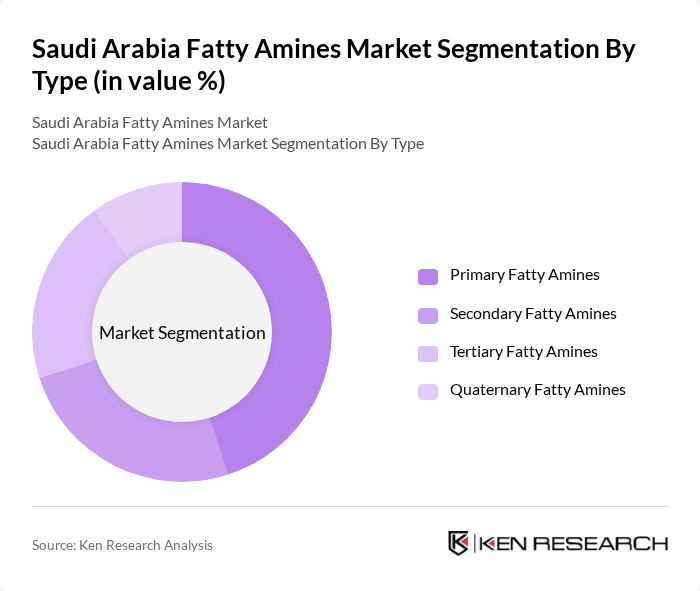
By Type:The market is segmented into four main types of fatty amines: Primary Fatty Amines, Secondary Fatty Amines, Tertiary Fatty Amines, and Quaternary Fatty Amines. Globally, tertiary fatty amines account for the largest revenue share due to their wide use in personal care, fabric softeners, and specialty chemicals, while primary fatty amines are experiencing the fastest growth as key intermediates for producing secondary and tertiary amines. Secondary and tertiary fatty amines are increasingly used in corrosion inhibitors and water treatment chemicals, while quaternary fatty amines remain niche, primarily in high-performance formulations.
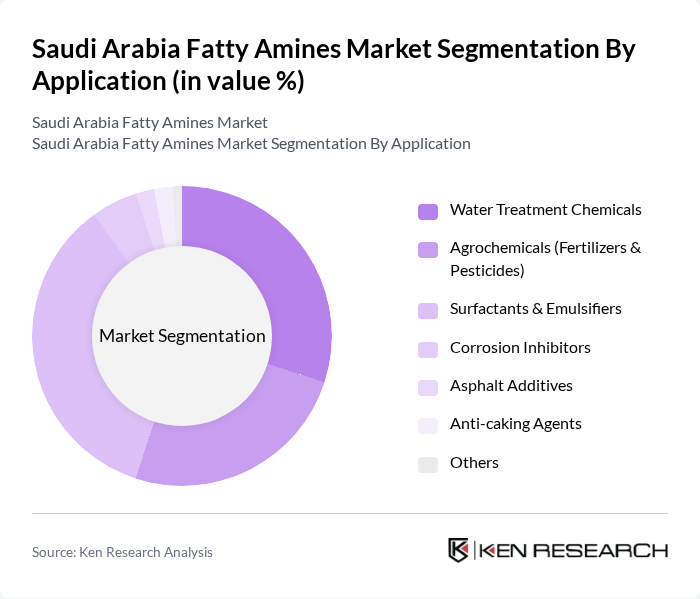
By Application:The applications of fatty amines are diverse, including Water Treatment Chemicals, Agrochemicals (Fertilizers & Pesticides), Surfactants & Emulsifiers, Corrosion Inhibitors, Asphalt Additives, Anti-caking Agents, and Others. The demand for surfactants and emulsifiers is particularly strong, driven by growth in personal care and household cleaning products, while water treatment chemicals represent a significant and expanding segment due to industrial and municipal needs. Agrochemicals remain a key application, especially in anti-caking agents for fertilizers, reflecting the region’s focus on agricultural productivity.
The Saudi Arabia Fatty Amines Market is characterized by a dynamic mix of regional and international players. Leading participants such as BASF SE, AkzoNobel N.V., Huntsman Corporation, Evonik Industries AG, Clariant AG, Solvay S.A., Kao Corporation, Stepan Company, Oxiteno S.A., Wilmar International Limited, Aarti Industries Limited, Galaxy Surfactants Limited, Nouryon, Arkema S.A., Global Amines Company Pte. Ltd., India Glycols Limited, Volant-Chem Corp., Lonza Group AG contribute to innovation, geographic expansion, and service delivery in this space.
The Saudi Arabia fatty amines market is poised for significant transformation, driven by a shift towards sustainable and biodegradable products. As consumer preferences evolve, manufacturers are likely to invest in innovative production technologies that enhance efficiency and reduce environmental impact. Additionally, the expansion of the agricultural sector and increasing demand for specialty chemicals will create new avenues for growth. Collaborations with local manufacturers will further strengthen market presence, ensuring a resilient supply chain and fostering innovation in product development.
| Segment | Sub-Segments |
|---|---|
| By Type | Primary Fatty Amines Secondary Fatty Amines Tertiary Fatty Amines Quaternary Fatty Amines |
| By Application | Water Treatment Chemicals Agrochemicals (Fertilizers & Pesticides) Surfactants & Emulsifiers Corrosion Inhibitors Asphalt Additives Anti-caking Agents Others |
| By End-User | Agriculture Water Treatment Oil & Gas Personal Care & Cosmetics Industrial Cleaning Others |
| By Distribution Channel | Direct Sales Distributors Online Sales Others |
| By Region | Central Region Eastern Region Western Region Southern Region |
| By Price Range | Low Price Mid Price High Price |
| By Policy Support | Subsidies Tax Exemptions Grants for R&D |
| Scope Item/Segment | Sample Size | Target Respondent Profiles |
|---|---|---|
| Agricultural Applications of Fatty Amines | 100 | Agronomists, Crop Protection Managers |
| Personal Care Product Manufacturers | 80 | Product Development Managers, R&D Specialists |
| Industrial Chemical Users | 70 | Procurement Managers, Operations Directors |
| Pharmaceutical Sector Insights | 60 | Regulatory Affairs Managers, Quality Control Analysts |
| Surfactant and Detergent Manufacturers | 90 | Production Managers, Supply Chain Coordinators |
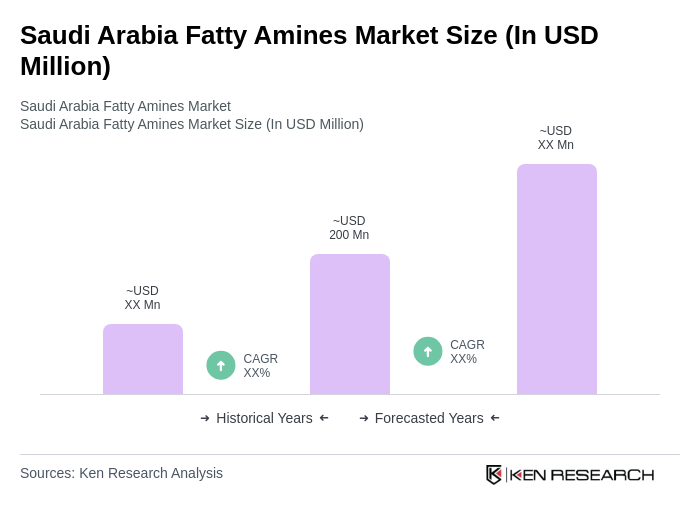
The Saudi Arabia Fatty Amines Market is valued at approximately USD 200 million, reflecting its share of the global fatty amines market, which is projected to reach USD 4.66 billion by 2024.

What makes us stand out is that our consultants follow Robust, Refine and Result (RRR) methodology. Robust for clear definitions, approaches and sanity checking, Refine for differentiating respondents' facts and opinions, and Result for presenting data with story.

We have set a benchmark in the industry by offering our clients with syndicated and customized market research reports featuring coverage of entire market as well as meticulous research and analyst insights.

While we don't replace traditional research, we flip the method upside down. Our dual approach of Top Bottom & Bottom Top ensures quality deliverable by not just verifying company fundamentals but also looking at the sector and macroeconomic factors.

With one step in the future, our research team constantly tries to show you the bigger picture. We help with some of the tough questions you may encounter along the way: How is the industry positioned? Best marketing channel? KPI's of competitors? By aligning every element, we help maximize success.

Our report gives you instant access to the answers and sources that other companies might choose to hide. We elaborate each steps of research methodology we have used and showcase you the sample size to earn your trust.

If you need any support, we are here! We pride ourselves on universe strength, data quality, and quick, friendly, and professional service.













