Saudi Arabia Health Check Up Market Report Size Share Growth Drivers Trends Opportunities & Forecast 2025–2030

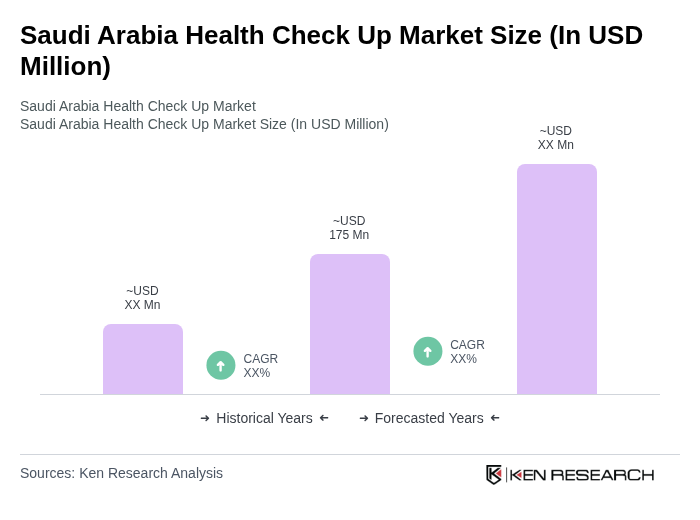
The Saudi Arabia health check up market, worth USD 175 million, grows due to preventive care demand, tech integration, and government programs in Riyadh and Jeddah.

Region:Middle East

Author(s):Rebecca

Product Code:KRAD2062

Pages:91

Published On:January 2026
About the Report

Base Year 2024

Saudi Arabia Health Check Up Market Overview

  • The Saudi Arabia Health Check Up Market is valued at USD 175 million, based on a five-year historical analysis. This growth is primarily driven by rising health awareness, increasing prevalence of chronic diseases such as diabetes and cardiovascular conditions, rapid urbanization, and expanding healthcare infrastructure, all of which encourage preventive care uptake. Technological advancements including AI-driven diagnostics, point-of-care testing, and telemedicine further enhance accessibility and efficiency in health screening services.
  • Key players in this market include Eurofins Ajal, Maersk Saudi Arabia, IQVIA Solutions Saudi Arabia Limited, Dr Lal PathLabs, and Abeer Medical Centers. These companies play a significant role in driving growth and maintaining high standards in health check-up services, particularly in Northern & Central regions such as Riyadh and Jeddah, where advanced healthcare infrastructure and economic activity foster robust demand.
  • In 2024, the Saudi Arabian government intensified regulations under the Health Sector Transformation Program, mandating the use of licensed personnel and equipment in health check-up services. This includes nationwide inspections of expatriate worker and food labor screening centers to ensure compliance with health laws, thereby enhancing the quality and reliability of health check-up services.
Saudi Arabia Health Check Up Market Size

Saudi Arabia Health Check Up Market Segmentation

By Type:The market is segmented into various types of health check-ups, including Comprehensive Health Check-Up, Basic Health Check-Up, Specialized Health Check-Up, Executive Health Check-Up, and Others. The Comprehensive Health Check-Up segment is currently dominating the market due to its extensive coverage of various health parameters, appealing to health-conscious individuals and corporates seeking thorough assessments. The demand for such comprehensive packages is driven by the increasing prevalence of chronic diseases and a growing emphasis on preventive healthcare.
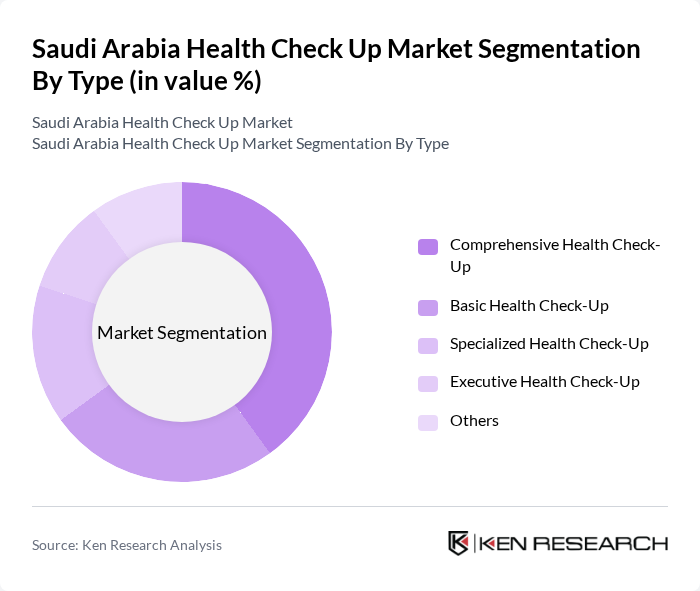
Saudi Arabia Health Check Up Market segmentation by Type.

By End-User:The end-user segmentation includes Individuals, Corporates, Government Employees, Insurance Companies, and Others. The Individuals segment is leading the market, driven by a growing awareness of health and wellness among the general population. This trend is further supported by the increasing availability of health check-up packages tailored to individual needs, making preventive healthcare more accessible and appealing.
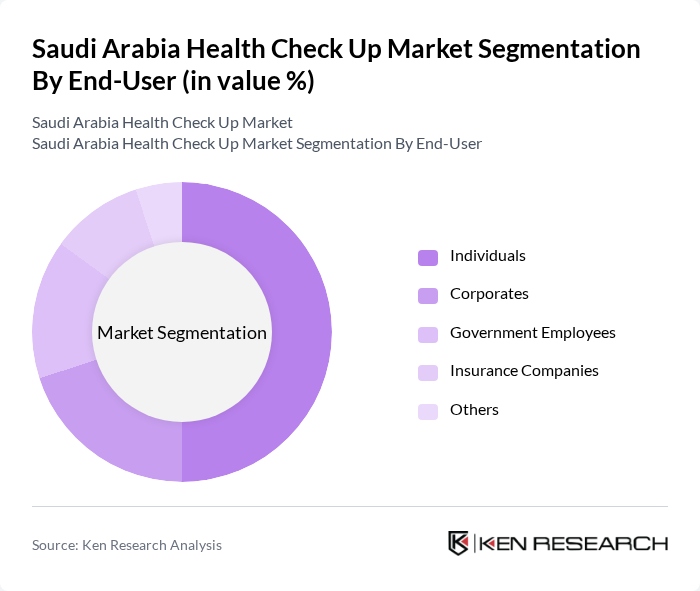
Saudi Arabia Health Check Up Market segmentation by End-User.

Saudi Arabia Health Check Up Market Competitive Landscape

The Saudi Arabia Health Check Up Market is characterized by a dynamic mix of regional and international players. Leading participants such as King Faisal Specialist Hospital & Research Centre, Saudi German Hospitals, Al Habib Medical Group, Dallah Hospital, Dr. Sulaiman Al Habib Medical Group, Al Noor Hospitals, Mouwasat Medical Services, National Guard Health Affairs, Al-Moosa Specialist Hospital, Al-Jazeera Hospital, Saudi Health Council, Al-Muhaidib Group, Al-Faisal Hospital, Al-Mawaddah Hospital, Al-Salam International Hospital contribute to innovation, geographic expansion, and service delivery in this space.

King Faisal Specialist Hospital & Research Centre

1975

Riyadh, Saudi Arabia

Saudi German Hospitals

1997

Jeddah, Saudi Arabia

Al Habib Medical Group

1993

Riyadh, Saudi Arabia

Dallah Hospital

1997

Riyadh, Saudi Arabia

Dr. Sulaiman Al Habib Medical Group

1995

Riyadh, Saudi Arabia

Company

Establishment Year

Headquarters

Group Size (Large, Medium, or Small as per industry convention)

Revenue Growth Rate

Customer Retention Rate

Market Penetration Rate

Pricing Strategy

Service Diversification

Saudi Arabia Health Check Up Market Industry Analysis

Growth Drivers

  • Expanding Digital Economy Infrastructure:The number of internet users in Saudi Arabia reached 35.0 million in future, while mobile connections surged to 50.0 million. This near-universal connectivity facilitates the delivery of telehealth and online health monitoring services, which are crucial for the growth of the health check-up market. Enhanced digital infrastructure supports the integration of innovative health solutions, making preventive healthcare more accessible to the population.
  • Robust ICT Sector Investment and Capabilities:In future, the operating revenue of the ICT sector in Saudi Arabia reached SAR 260.0 billion, with data center capacity growing by 45% to 300.0 megawatts. Additionally, fiber coverage expanded to over 4.0 million homes. This strong ICT infrastructure underpins the adoption of health technology, electronic records, and remote clinical assessments, driving the demand for comprehensive health check-up services across the nation.
  • Economic Diversification Driving Non-Oil Growth:Saudi Arabia's real GDP grew by 1.5% in future, with non-oil activities increasing by 5.0%. This robust performance in the non-oil sector indicates a rising demand for services, including preventive healthcare and wellness services. As the economy diversifies, the health check-up market is poised to benefit from increased consumer spending on health-related services, further enhancing market growth prospects.

Market Challenges

  • Regional Disparities in Infrastructure & Access:Consumer behavior and healthcare infrastructure remain heavily concentrated in urban areas like Riyadh, while rural regions such as Aseer lag significantly behind. This uneven development limits the outreach of health check-up services, creating a challenge for providers aiming to deliver comprehensive healthcare solutions across the entire country. Addressing these disparities is crucial for market expansion.
  • Fiscal Pressures and Limited Budgetary Room:Saudi Arabia is forecasted to face a fiscal deficit of SAR 250 billion (USD 66.0 billion) in future. Such large deficits may constrain public spending on healthcare infrastructure and services, limiting the government's ability to subsidize health check-ups or expand access to preventive care. This financial pressure poses a significant challenge to the growth of the health check-up market.

Saudi Arabia Health Check Up Market Future Outlook

The future of the Saudi Arabia health check-up market appears promising, driven by the integration of AI and cloud technologies in healthcare. With SAR 60 billion invested in AI and data centers in future, the adoption of AI diagnostics and cloud-based health data management is expected to accelerate. Additionally, the evolution of digital governance and telehealth services will enhance accessibility, particularly in underserved regions, fostering a more inclusive healthcare environment.

Market Opportunities

  • Expanded Telehealth Services for Underserved Regions:With 50.0 million mobile connections covering 145% of the population, there is significant potential for remote diagnostic check-ups and teleconsultations. Leveraging mobile technology can enhance healthcare access in rural areas, addressing the existing disparities in health service availability and improving overall public health outcomes.
  • AI-Powered Preventive Health Tools:The rising consumer engagement with AI for health applications opens pathways for innovative screening tools and mobile health check-up apps. As AI technology becomes more integrated into healthcare, it can facilitate personalized health assessments and proactive health management, creating new opportunities for service providers in the health check-up market.

Scope of the Report

SegmentSub-Segments
By Type

Comprehensive Health Check-Up

Basic Health Check-Up

Specialized Health Check-Up

Executive Health Check-Up

Others

By End-User

Individuals

Corporates

Government Employees

Insurance Companies

Others

By Age Group

Children

Adults

Seniors

Others

By Gender

Male

Female

Others

By Health Condition

Chronic Disease Management

Preventive Health Check-Ups

Wellness Check-Ups

Others

By Service Provider

Private Hospitals

Public Hospitals

Diagnostic Centers

Others

By Package Type

Standard Packages

Premium Packages

Customized Packages

Others

Key Target Audience

Investors and Venture Capitalist Firms

Government and Regulatory Bodies (e.g., Ministry of Health, Saudi Food and Drug Authority)

Healthcare Providers and Hospitals

Health Insurance Companies

Medical Equipment Manufacturers

Pharmaceutical Companies

Health Technology Startups

Corporate Wellness Program Managers

Players Mentioned in the Report:

King Faisal Specialist Hospital & Research Centre

Saudi German Hospitals

Al Habib Medical Group

Dallah Hospital

Dr. Sulaiman Al Habib Medical Group

Al Noor Hospitals

Mouwasat Medical Services

National Guard Health Affairs

Al-Moosa Specialist Hospital

Al-Jazeera Hospital

Saudi Health Council

Al-Muhaidib Group

Al-Faisal Hospital

Al-Mawaddah Hospital

Al-Salam International Hospital

Table of Contents

Market Assessment Phase

1. Executive Summary and Approach


2. Saudi Arabia Health Check Up Market Overview

2.1 Key Insights and Strategic Recommendations

2.2 Saudi Arabia Health Check Up Market Overview

2.3 Definition and Scope

2.4 Evolution of Market Ecosystem

2.5 Timeline of Key Regulatory Milestones

2.6 Value Chain & Stakeholder Mapping

2.7 Business Cycle Analysis

2.8 Policy & Incentive Landscape


3. Saudi Arabia Health Check Up Market Analysis

3.1 Growth Drivers

3.1.1 Increasing prevalence of chronic diseases
3.1.2 Rising health awareness among the population
3.1.3 Government initiatives promoting preventive healthcare
3.1.4 Expansion of healthcare infrastructure

3.2 Market Challenges

3.2.1 High cost of advanced health check-up packages
3.2.2 Limited access in rural areas
3.2.3 Lack of awareness about health check-ups
3.2.4 Regulatory hurdles in healthcare services

3.3 Market Opportunities

3.3.1 Growth in telemedicine and digital health solutions
3.3.2 Partnerships with corporate sectors for employee health check-ups
3.3.3 Development of customized health packages
3.3.4 Expansion of health check-up services to underserved regions

3.4 Market Trends

3.4.1 Increasing adoption of AI in health diagnostics
3.4.2 Shift towards personalized medicine
3.4.3 Integration of wellness programs with health check-ups
3.4.4 Growing demand for home-based health check-up services

3.5 Government Regulation

3.5.1 Mandatory health check-ups for certain professions
3.5.2 Regulations on health data privacy
3.5.3 Licensing requirements for health check-up centers
3.5.4 Guidelines for health check-up package pricing

4. SWOT Analysis


5. Stakeholder Analysis


6. Porter's Five Forces Analysis


7. Saudi Arabia Health Check Up Market Market Size, 2019-2024

7.1 By Value

7.2 By Volume

7.3 By Average Selling Price


8. Saudi Arabia Health Check Up Market Segmentation

8.1 By Type

8.1.1 Comprehensive Health Check-Up
8.1.2 Basic Health Check-Up
8.1.3 Specialized Health Check-Up
8.1.4 Executive Health Check-Up
8.1.5 Others

8.2 By End-User

8.2.1 Individuals
8.2.2 Corporates
8.2.3 Government Employees
8.2.4 Insurance Companies
8.2.5 Others

8.3 By Age Group

8.3.1 Children
8.3.2 Adults
8.3.3 Seniors
8.3.4 Others

8.4 By Gender

8.4.1 Male
8.4.2 Female
8.4.3 Others

8.5 By Health Condition

8.5.1 Chronic Disease Management
8.5.2 Preventive Health Check-Ups
8.5.3 Wellness Check-Ups
8.5.4 Others

8.6 By Service Provider

8.6.1 Private Hospitals
8.6.2 Public Hospitals
8.6.3 Diagnostic Centers
8.6.4 Others

8.7 By Package Type

8.7.1 Standard Packages
8.7.2 Premium Packages
8.7.3 Customized Packages
8.7.4 Others

9. Saudi Arabia Health Check Up Market Competitive Analysis

9.1 Market Share of Key Players

9.2 Cross Comparison of Key Players

9.2.1 Company Name
9.2.2 Group Size (Large, Medium, or Small as per industry convention)
9.2.3 Revenue Growth Rate
9.2.4 Customer Retention Rate
9.2.5 Market Penetration Rate
9.2.6 Pricing Strategy
9.2.7 Service Diversification
9.2.8 Brand Recognition
9.2.9 Operational Efficiency
9.2.10 Customer Satisfaction Score

9.3 SWOT Analysis of Top Players

9.4 Pricing Analysis

9.5 Detailed Profile of Major Companies

9.5.1 King Faisal Specialist Hospital & Research Centre
9.5.2 Saudi German Hospitals
9.5.3 Al Habib Medical Group
9.5.4 Dallah Hospital
9.5.5 Dr. Sulaiman Al Habib Medical Group
9.5.6 Al Noor Hospitals
9.5.7 Mouwasat Medical Services
9.5.8 National Guard Health Affairs
9.5.9 Al-Moosa Specialist Hospital
9.5.10 Al-Jazeera Hospital
9.5.11 Saudi Health Council
9.5.12 Al-Muhaidib Group
9.5.13 Al-Faisal Hospital
9.5.14 Al-Mawaddah Hospital
9.5.15 Al-Salam International Hospital

10. Saudi Arabia Health Check Up Market End-User Analysis

10.1 Procurement Behavior of Key Ministries

10.1.1 Health Ministry Procurement Policies
10.1.2 Budget Allocation for Health Check-Ups
10.1.3 Evaluation Criteria for Service Providers
10.1.4 Contracting Procedures

10.2 Corporate Spend on Infrastructure & Energy

10.2.1 Corporate Health Initiatives
10.2.2 Budgeting for Employee Health Check-Ups
10.2.3 Partnerships with Health Providers
10.2.4 ROI on Health Investments

10.3 Pain Point Analysis by End-User Category

10.3.1 Individual Patient Concerns
10.3.2 Corporate Health Management Issues
10.3.3 Government Health Program Challenges
10.3.4 Insurance Provider Limitations

10.4 User Readiness for Adoption

10.4.1 Awareness Levels
10.4.2 Accessibility of Services
10.4.3 Affordability of Packages
10.4.4 Trust in Service Providers

10.5 Post-Deployment ROI and Use Case Expansion

10.5.1 Measuring Health Outcomes
10.5.2 Cost Savings Analysis
10.5.3 Expansion of Services Offered
10.5.4 User Feedback and Improvement

11. Saudi Arabia Health Check Up Market Future Size, 2025-2030

11.1 By Value

11.2 By Volume

11.3 By Average Selling Price


Go-To-Market Strategy Phase

1. Whitespace Analysis + Business Model Canvas

1.1 Market Gaps Identification

1.2 Business Model Framework

1.3 Value Proposition Development

1.4 Revenue Streams Analysis

1.5 Cost Structure Evaluation

1.6 Key Partnerships Identification

1.7 Customer Segmentation


2. Marketing and Positioning Recommendations

2.1 Branding Strategies

2.2 Product USPs

2.3 Target Audience Identification

2.4 Communication Strategy

2.5 Digital Marketing Approach

2.6 Offline Marketing Tactics

2.7 Performance Metrics


3. Distribution Plan

3.1 Urban Retail Strategies

3.2 Rural NGO Tie-Ups

3.3 Online Distribution Channels

3.4 Partnerships with Health Providers

3.5 Logistics and Supply Chain Management

3.6 Customer Service Framework

3.7 Performance Evaluation


4. Channel & Pricing Gaps

4.1 Underserved Routes

4.2 Pricing Bands Analysis

4.3 Competitor Pricing Comparison

4.4 Customer Willingness to Pay

4.5 Pricing Strategy Recommendations

4.6 Value-Based Pricing Models

4.7 Performance Metrics


5. Unmet Demand & Latent Needs

5.1 Category Gaps Identification

5.2 Consumer Segments Analysis

5.3 Emerging Trends Exploration

5.4 Recommendations for New Offerings

5.5 Market Entry Strategies

5.6 Performance Metrics


6. Customer Relationship

6.1 Loyalty Programs Development

6.2 After-Sales Service Strategies

6.3 Customer Feedback Mechanisms

6.4 Relationship Management Tools

6.5 Performance Metrics


7. Value Proposition

7.1 Sustainability Initiatives

7.2 Integrated Supply Chains

7.3 Customer-Centric Approaches

7.4 Competitive Differentiation

7.5 Performance Metrics


8. Key Activities

8.1 Regulatory Compliance

8.2 Branding Strategies

8.3 Distribution Setup

8.4 Training and Development

8.5 Performance Metrics


9. Entry Strategy Evaluation

9.1 Domestic Market Entry Strategy

9.1.1 Product Mix
9.1.2 Pricing Band
9.1.3 Packaging

9.2 Export Entry Strategy

9.2.1 Target Countries
9.2.2 Compliance Roadmap

10. Entry Mode Assessment

10.1 Joint Ventures

10.2 Greenfield Investments

10.3 Mergers & Acquisitions

10.4 Distributor Model

10.5 Performance Metrics


11. Capital and Timeline Estimation

11.1 Capital Requirements

11.2 Timelines for Implementation

11.3 Financial Projections

11.4 Risk Assessment


12. Control vs Risk Trade-Off

12.1 Ownership vs Partnerships

12.2 Risk Mitigation Strategies

12.3 Performance Metrics


13. Profitability Outlook

13.1 Breakeven Analysis

13.2 Long-Term Sustainability

13.3 Financial Health Indicators


14. Potential Partner List

14.1 Distributors

14.2 Joint Ventures

14.3 Acquisition Targets


15. Execution Roadmap

15.1 Phased Plan for Market Entry

15.1.1 Market Setup
15.1.2 Market Entry
15.1.3 Growth Acceleration
15.1.4 Scale & Stabilize

15.2 Key Activities and Milestones

15.2.1 Milestone Planning
15.2.2 Performance Tracking

Research Methodology

ApproachModellingSample

Phase 1: Approach1

Desk Research

  • Analysis of health check-up service reports from the Ministry of Health in Saudi Arabia
  • Review of market studies and publications from healthcare associations and organizations
  • Examination of demographic and health statistics from the Saudi Arabian General Authority for Statistics

Primary Research

  • Interviews with healthcare providers and administrators in hospitals and clinics
  • Surveys conducted with patients who have undergone health check-ups
  • Focus group discussions with health professionals to understand market trends and consumer preferences

Validation & Triangulation

  • Cross-validation of findings through multiple data sources including government reports and industry publications
  • Triangulation of qualitative insights from interviews with quantitative data from surveys
  • Sanity checks through expert panel reviews comprising healthcare analysts and market experts

Phase 2: Market Size Estimation1

Top-down Assessment

  • Estimation of total healthcare expenditure in Saudi Arabia as a basis for market size
  • Segmentation of health check-up services by demographics and service types
  • Incorporation of government health initiatives and their impact on market growth

Bottom-up Modeling

  • Collection of service pricing data from leading health check-up providers
  • Volume estimates based on patient inflow data from hospitals and clinics
  • Calculation of revenue projections based on service uptake and pricing strategies

Forecasting & Scenario Analysis

  • Multi-factor regression analysis considering population growth, health awareness, and economic factors
  • Scenario modeling based on potential changes in healthcare policies and consumer behavior
  • Development of baseline, optimistic, and pessimistic forecasts through 2030

Phase 3: CATI Sample Composition1

Scope Item/SegmentSample SizeTarget Respondent Profiles
General Health Check-Up Services150Patients, Healthcare Administrators
Corporate Health Check-Up Programs100HR Managers, Corporate Wellness Coordinators
Preventive Health Screening Initiatives80Public Health Officials, Community Health Workers
Specialized Health Check-Ups (e.g., Cardiac, Diabetes)70Specialist Doctors, Clinic Managers
Health Check-Up Awareness Campaigns60Marketing Executives, Health Educators

Frequently Asked Questions

What is the current value of the Saudi Arabia Health Check Up Market?

The Saudi Arabia Health Check Up Market is valued at approximately USD 175 million, reflecting a significant growth trend driven by increased health awareness, chronic disease prevalence, and advancements in healthcare infrastructure and technology.

What factors are driving the growth of the health check-up market in Saudi Arabia?

Who are the major players in the Saudi Arabia Health Check Up Market?

What types of health check-ups are available in Saudi Arabia?

Other Regional/Country Reports

Middle East Health Check Up Market Report Size Share Growth Drivers Trends Opportunities & Forecast 2025–2030

Indonesia Health Check Up Market

Malaysia Health Check Up Market

KSA Health Check Up Market

APAC Health Check Up Market

SEA Health Check Up Market

Why Buy From Us?

Refine Robust Result (RRR) Framework

What makes us stand out is that our consultants follow Robust, Refine and Result (RRR) methodology. Robust for clear definitions, approaches and sanity checking, Refine for differentiating respondents' facts and opinions, and Result for presenting data with story.

Our Reach Is Unmatched

We have set a benchmark in the industry by offering our clients with syndicated and customized market research reports featuring coverage of entire market as well as meticulous research and analyst insights.

Shifting the Research Paradigm

While we don't replace traditional research, we flip the method upside down. Our dual approach of Top Bottom & Bottom Top ensures quality deliverable by not just verifying company fundamentals but also looking at the sector and macroeconomic factors.

More Insights-Better Decisions

With one step in the future, our research team constantly tries to show you the bigger picture. We help with some of the tough questions you may encounter along the way: How is the industry positioned? Best marketing channel? KPI's of competitors? By aligning every element, we help maximize success.

Transparency and Trust

Our report gives you instant access to the answers and sources that other companies might choose to hide. We elaborate each steps of research methodology we have used and showcase you the sample size to earn your trust.

Round the Clock Support

If you need any support, we are here! We pride ourselves on universe strength, data quality, and quick, friendly, and professional service.

Why Clients Choose Us?

400000+
Reports in repository
150+
Consulting projects a year
100+
Analysts
8000+
Client Queries in 2022








