About the Report
Base Year 2024Saudi Arabia Motorcycle Helmet Market Overview
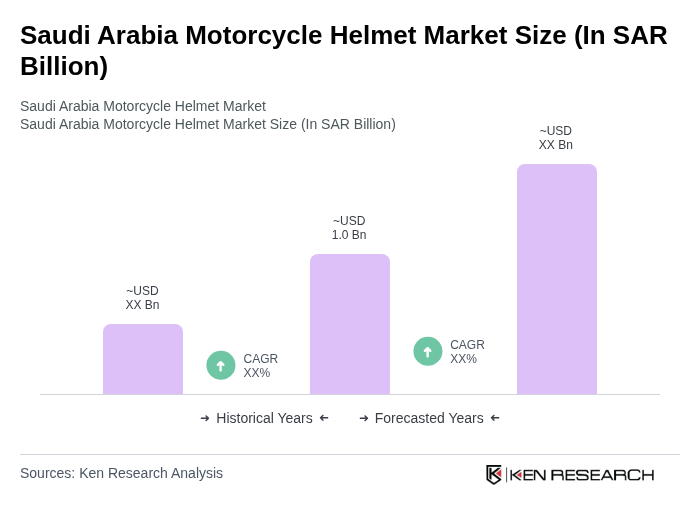
- The Saudi Arabia Motorcycle Helmet Market is valued at approximately SAR 1.0 billion, based on a five-year historical analysis and regional benchmarking against Middle East and Africa helmet market data. This growth is primarily driven by increasing motorcycle ownership, rising awareness of safety regulations, and a growing trend towards recreational riding. The market has seen a surge in demand for high-quality helmets as consumers become more conscious of safety standards and the importance of protective gear, supported by campaigns and enforcement focused on road safety.
- Key cities such as Riyadh, Jeddah, and Dammam dominate the market due to their high population density and significant motorcycle usage for both commuting and leisure, in line with broader regional trends where urbanization and traffic congestion encourage motorcycle adoption. The urban infrastructure in these cities supports a growing number of riders, contributing to the demand for various helmet types and styles that cater to different riding preferences, including full-face, open-face, and modular helmets.
- In 2023, the Saudi government implemented a regulation mandating that all motorcycle riders must wear helmets that comply with SASO standards, building on existing traffic law requirements for helmet use. The key binding framework is the Saudi Standard SASO 2913/2019 “Protective Helmets for Drivers and Passengers of Motorcycles and Mopeds,” issued by the Saudi Standards, Metrology and Quality Organization (SASO), which specifies performance, testing, and marking requirements for helmets placed on the market. This regulation aims to enhance road safety and reduce fatalities associated with motorcycle accidents, thereby driving the demand for certified helmets in the market.
Saudi Arabia Motorcycle Helmet Market Segmentation
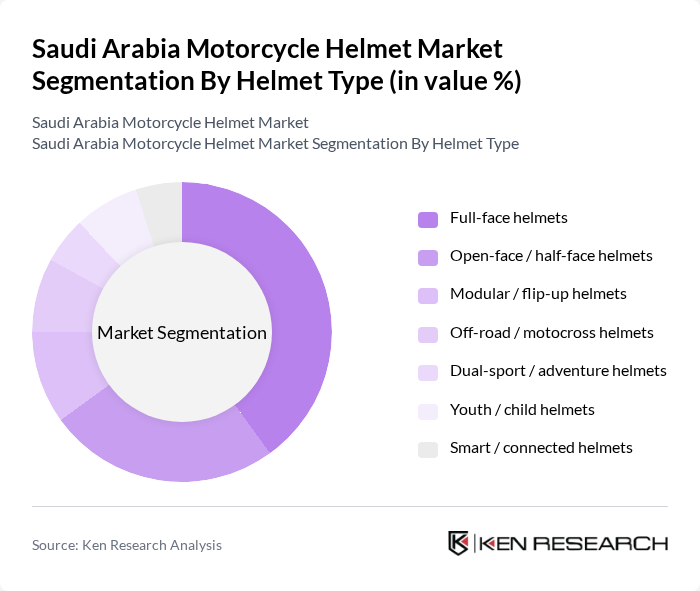
By Helmet Type:The market is segmented into various helmet types, including full-face helmets, open-face/half-face helmets, modular/flip-up helmets, off-road/motocross helmets, dual-sport/adventure helmets, youth/child helmets, and smart/connected helmets. Full-face helmets are currently the most popular choice among riders due to their comprehensive protection and aerodynamic design, making them ideal for both daily commuting and long-distance travel, consistent with regional and global patterns where full-face holds the largest share. Open-face helmets are also gaining traction, particularly among urban riders who prefer a more casual look and better ventilation for city riding. The demand for smart helmets is on the rise as technology integration—such as Bluetooth communication, navigation, and safety sensors—becomes a key factor in consumer purchasing decisions.
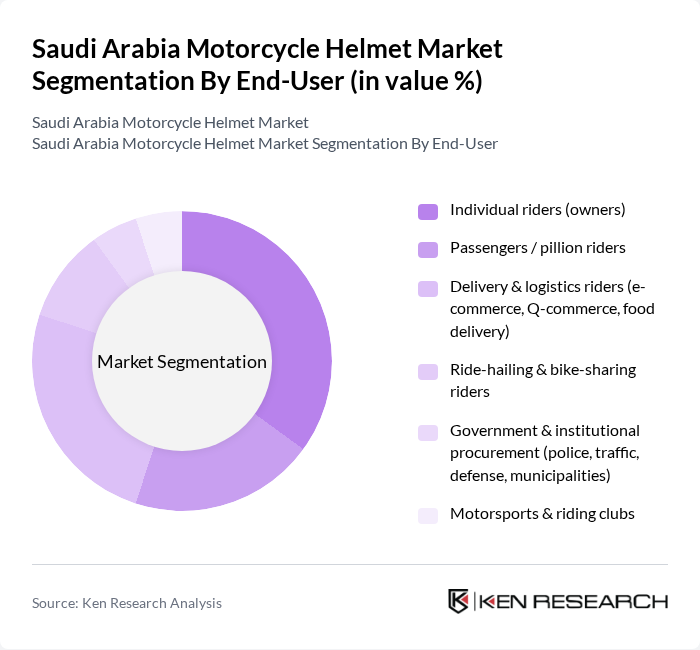
By End-User:The end-user segmentation includes individual riders (owners), passengers/pillion riders, delivery & logistics riders (e-commerce, Q-commerce, food delivery), ride-hailing & bike-sharing riders, government & institutional procurement (police, traffic, defense, municipalities), and motorsports & riding clubs. Individual riders represent the largest segment, driven by the increasing number of motorcycle owners in urban areas and rising disposable incomes. The rise of e-commerce and Q-commerce has also led to a significant increase in demand for helmets among delivery riders, as safety regulations and corporate policies for delivery platforms become more stringent. Additionally, government procurement for police and defense sectors, as well as municipal authorities responsible for traffic enforcement, contributes to the market's growth through bulk purchases of certified helmets.
Saudi Arabia Motorcycle Helmet Market Competitive Landscape
The Saudi Arabia Motorcycle Helmet Market is characterized by a dynamic mix of regional and international players. Leading participants such as HJC Helmets (HJC Corp.), Shoei Co., Ltd., AGV (a brand of Dainese S.p.A.), Arai Helmet, Ltd., LS2 Helmets (Xiamen LS2 Helmet Co., Ltd.), Shark Helmets (Shark SAS), Nolan Helmets (Nolangroup S.p.A.), Bell Powersports (Vista Outdoor Inc.), ScorpionExo (Kido Sports Co., Ltd.), SMK Helmets (Studds Accessories Ltd.), MT Helmets (Manufacturas Tomás, S.A.), NEXX Helmets (NEXXPRO S.A.), KYT Helmets, Caberg S.p.A., Royal Enfield (helmet & riding gear division) contribute to innovation, geographic expansion, and service delivery in this space.
Saudi Arabia Motorcycle Helmet Market Industry Analysis
Growth Drivers
- Increasing Motorcycle Ownership:The number of registered motorcycles in Saudi Arabia reached approximately 1.3 million in future, reflecting a growth rate of 10% from the previous year. This surge in ownership is driven by rising disposable incomes and a growing interest in motorcycling as a mode of transport. The Saudi government's Vision 2030 initiative aims to diversify the economy, further encouraging motorcycle use for both commuting and leisure, thereby boosting helmet demand significantly.
- Rising Awareness of Safety Regulations:In future, the Saudi government reported a 15% increase in road safety campaigns, emphasizing the importance of helmet use. This heightened awareness is leading to a cultural shift towards prioritizing safety among motorcyclists. As a result, the demand for high-quality helmets is expected to rise, with an estimated 30% of new motorcycle owners purchasing helmets within the first month of ownership, reflecting a growing commitment to safety standards.
- Growth in Adventure Tourism:The adventure tourism sector in Saudi Arabia is projected to grow by 20% annually, with motorcycle tours becoming increasingly popular. In future, the number of adventure tourism participants reached 600,000, significantly boosting the demand for specialized helmets. This trend is supported by government initiatives promoting tourism, which are expected to further enhance the market for motorcycle helmets designed for adventure riders, thus driving overall market growth.
Market Challenges
- High Import Tariffs on Helmets:Saudi Arabia imposes import tariffs of up to 20% on motorcycle helmets, significantly impacting the affordability and availability of international brands. This tariff structure discourages foreign manufacturers from entering the market, limiting consumer choices and potentially stifling innovation. As a result, local consumers may face higher prices, which could hinder overall market growth and limit access to advanced helmet technologies.
- Limited Local Manufacturing Capabilities:Currently, local production of motorcycle helmets in Saudi Arabia is minimal, with only 15% of the market supplied by domestic manufacturers. This lack of local manufacturing capabilities leads to reliance on imports, which are subject to tariffs and shipping delays. Consequently, the market faces challenges in meeting the growing demand for helmets, particularly as consumer preferences shift towards higher-quality and technologically advanced products.
Saudi Arabia Motorcycle Helmet Market Future Outlook
The Saudi Arabia motorcycle helmet market is poised for significant growth, driven by increasing motorcycle ownership and a cultural shift towards safety. As the government continues to promote road safety initiatives, consumer awareness will likely rise, leading to higher helmet adoption rates. Additionally, advancements in helmet technology, such as smart helmets, will attract tech-savvy consumers. The expansion of urban infrastructure will further facilitate motorcycle use, creating a favorable environment for market growth in the coming years.
Market Opportunities
- Development of Smart Helmets:The introduction of smart helmets, equipped with features like Bluetooth connectivity and navigation systems, presents a lucrative opportunity. With an estimated 25% of motorcyclists expressing interest in such technology, manufacturers can tap into this growing demand, enhancing safety and convenience for riders while differentiating their products in a competitive market.
- Collaborations with Ride-Sharing Services:Partnering with ride-sharing companies can create new distribution channels for helmet manufacturers. As ride-sharing services expand, the demand for helmets among riders is expected to increase. Collaborations can facilitate bulk purchases and promotional campaigns, potentially increasing market penetration and brand visibility in a rapidly evolving transportation landscape.
Scope of the Report
| Segment | Sub-Segments |
|---|---|
| By Helmet Type | Full-face helmets Open-face / half-face helmets Modular / flip-up helmets Off-road / motocross helmets Dual-sport / adventure helmets Youth / child helmets Smart / connected helmets |
| By End-User | Individual riders (owners) Passengers / pillion riders Delivery & logistics riders (e-commerce, Q-commerce, food delivery) Ride-hailing & bike-sharing riders Government & institutional procurement (police, traffic, defense, municipalities) Motorsports & riding clubs |
| By Distribution Channel | Offline retail – multi-brand dealers & motorcycle showrooms Offline retail – specialty helmet & riding-gear stores Offline retail – hypermarkets & sports/outdoor stores Online marketplaces (e.g., Amazon.sa, Noon) OEM / brand webstores & apps Government / institutional procurement channels |
| By Shell Material | Thermoplastic (ABS, polycarbonate) Fiberglass composites Carbon fiber & carbon-composite Advanced composites (Kevlar, multi-composite) Others |
| By Price Range (Retail) | Economy helmets (? SAR 250) Value / mid-range helmets (SAR 251–700) Premium helmets (SAR 701–1,500) Super-premium & luxury helmets (> SAR 1,500) |
| By Certification / Standard | SASO / Gulf standards compliant helmets ECE 22.05 / ECE 22.06 certified helmets DOT / Snell & other international standards Non-certified / informal segment |
| By Usage Type | Daily commuting Recreational / weekend riding Professional & amateur racing / track use Off-road / desert & adventure touring Delivery & last-mile logistics |
Key Target Audience
Investors and Venture Capitalist Firms
Government and Regulatory Bodies (e.g., Saudi Standards, Metrology and Quality Organization)
Manufacturers and Producers
Distributors and Retailers
Motorcycle Dealerships
Insurance Companies
Automotive Safety Organizations
Logistics and Supply Chain Companies
Players Mentioned in the Report:
HJC Helmets (HJC Corp.)
Shoei Co., Ltd.
AGV (a brand of Dainese S.p.A.)
Arai Helmet, Ltd.
LS2 Helmets (Xiamen LS2 Helmet Co., Ltd.)
Shark Helmets (Shark SAS)
Nolan Helmets (Nolangroup S.p.A.)
Bell Powersports (Vista Outdoor Inc.)
ScorpionExo (Kido Sports Co., Ltd.)
SMK Helmets (Studds Accessories Ltd.)
MT Helmets (Manufacturas Tomas, S.A.)
NEXX Helmets (NEXXPRO S.A.)
KYT Helmets
Caberg S.p.A.
Royal Enfield (helmet & riding gear division)
Table of Contents
Market Assessment Phase
1. Executive Summary and Approach
2. Saudi Arabia Motorcycle Helmet Market Overview
2.1 Key Insights and Strategic Recommendations
2.2 Saudi Arabia Motorcycle Helmet Market Overview
2.3 Definition and Scope
2.4 Evolution of Market Ecosystem
2.5 Timeline of Key Regulatory Milestones
2.6 Value Chain & Stakeholder Mapping
2.7 Business Cycle Analysis
2.8 Policy & Incentive Landscape
3. Saudi Arabia Motorcycle Helmet Market Analysis
3.1 Growth Drivers
3.1.1 Increasing motorcycle ownership
3.1.2 Rising awareness of safety regulations
3.1.3 Growth in adventure tourism
3.1.4 Expansion of urban infrastructure
3.2 Market Challenges
3.2.1 High import tariffs on helmets
3.2.2 Limited local manufacturing capabilities
3.2.3 Consumer price sensitivity
3.2.4 Lack of awareness regarding helmet standards
3.3 Market Opportunities
3.3.1 Development of smart helmets
3.3.2 Collaborations with ride-sharing services
3.3.3 Government initiatives for road safety
3.3.4 Expansion into rural markets
3.4 Market Trends
3.4.1 Increasing demand for lightweight materials
3.4.2 Customization and personalization of helmets
3.4.3 Integration of technology in helmet design
3.4.4 Growth of online sales channels
3.5 Government Regulation
3.5.1 Mandatory helmet use laws
3.5.2 Safety standards for helmet manufacturing
3.5.3 Regulations on helmet imports
3.5.4 Incentives for local production
4. SWOT Analysis
5. Stakeholder Analysis
6. Porter's Five Forces Analysis
7. Saudi Arabia Motorcycle Helmet Market Market Size, 2019-2024
7.1 By Value
7.2 By Volume
7.3 By Average Selling Price
8. Saudi Arabia Motorcycle Helmet Market Segmentation
8.1 By Helmet Type
8.1.1 Full-face helmets
8.1.2 Open-face / half-face helmets
8.1.3 Modular / flip-up helmets
8.1.4 Off-road / motocross helmets
8.1.5 Dual-sport / adventure helmets
8.1.6 Youth / child helmets
8.1.7 Smart / connected helmets
8.2 By End-User
8.2.1 Individual riders (owners)
8.2.2 Passengers / pillion riders
8.2.3 Delivery & logistics riders (e-commerce, Q-commerce, food delivery)
8.2.4 Ride-hailing & bike-sharing riders
8.2.5 Government & institutional procurement (police, traffic, defense, municipalities)
8.2.6 Motorsports & riding clubs
8.3 By Distribution Channel
8.3.1 Offline retail – multi-brand dealers & motorcycle showrooms
8.3.2 Offline retail – specialty helmet & riding-gear stores
8.3.3 Offline retail – hypermarkets & sports/outdoor stores
8.3.4 Online marketplaces (e.g., Amazon.sa, Noon)
8.3.5 OEM / brand webstores & apps
8.3.6 Government / institutional procurement channels
8.4 By Shell Material
8.4.1 Thermoplastic (ABS, polycarbonate)
8.4.2 Fiberglass composites
8.4.3 Carbon fiber & carbon-composite
8.4.4 Advanced composites (Kevlar, multi-composite)
8.4.5 Others
8.5 By Price Range (Retail)
8.5.1 Economy helmets (? SAR 250)
8.5.2 Value / mid-range helmets (SAR 251–700)
8.5.3 Premium helmets (SAR 701–1,500)
8.5.4 Super-premium & luxury helmets (> SAR 1,500)
8.6 By Certification / Standard
8.6.1 SASO / Gulf standards compliant helmets
8.6.2 ECE 22.05 / ECE 22.06 certified helmets
8.6.3 DOT / Snell & other international standards
8.6.4 Non-certified / informal segment
8.7 By Usage Type
8.7.1 Daily commuting
8.7.2 Recreational / weekend riding
8.7.3 Professional & amateur racing / track use
8.7.4 Off-road / desert & adventure touring
8.7.5 Delivery & last-mile logistics
9. Saudi Arabia Motorcycle Helmet Market Competitive Analysis
9.1 Market Share of Key Players
9.2 Cross Comparison of Key Players
9.2.1 Company name
9.2.2 Global motorcycle helmet revenue (latest FY)
9.2.3 Estimated Saudi Arabia revenue share (%)
9.2.4 CAGR of sales in Saudi Arabia (historical / forecast)
9.2.5 Average selling price (ASP) in Saudi Arabia
9.2.6 Product portfolio breadth (entry, mid, premium, smart)
9.2.7 Share of full-face vs. other helmet types in KSA mix
9.2.8 Share of certified helmets (SASO/ECE/DOT) in KSA portfolio
9.2.9 Number of active retail touchpoints in Saudi Arabia
9.2.10 Strength of online presence (own site + marketplaces)
9.2.11 Key local partners / distributors in Saudi Arabia
9.2.12 Marketing & sponsorship intensity (events, clubs, racing)
9.2.13 Customer ratings (average rating on leading KSA e-commerce)
9.2.14 Warranty & aftersales coverage in KSA
9.3 SWOT Analysis of Top Players
9.4 Pricing Analysis
9.5 Detailed Profile of Major Companies
9.5.1 HJC Helmets (HJC Corp.)
9.5.2 Shoei Co., Ltd.
9.5.3 AGV (a brand of Dainese S.p.A.)
9.5.4 Arai Helmet, Ltd.
9.5.5 LS2 Helmets (Xiamen LS2 Helmet Co., Ltd.)
9.5.6 Shark Helmets (Shark SAS)
9.5.7 Nolan Helmets (Nolangroup S.p.A.)
9.5.8 Bell Powersports (Vista Outdoor Inc.)
9.5.9 ScorpionExo (Kido Sports Co., Ltd.)
9.5.10 SMK Helmets (Studds Accessories Ltd.)
9.5.11 MT Helmets (Manufacturas Tomás, S.A.)
9.5.12 NEXX Helmets (NEXXPRO S.A.)
9.5.13 KYT Helmets
9.5.14 Caberg S.p.A.
9.5.15 Royal Enfield (helmet & riding gear division)
10. Saudi Arabia Motorcycle Helmet Market End-User Analysis
10.1 Procurement Behavior of Key Ministries
10.1.1 Government procurement policies
10.1.2 Budget allocation for safety equipment
10.1.3 Supplier selection criteria
10.1.4 Compliance with safety standards
10.2 Corporate Spend on Infrastructure & Energy
10.2.1 Investment in road safety initiatives
10.2.2 Corporate partnerships for helmet distribution
10.2.3 Funding for awareness campaigns
10.2.4 Budget for employee safety gear
10.3 Pain Point Analysis by End-User Category
10.3.1 Safety concerns among riders
10.3.2 Accessibility of quality helmets
10.3.3 Affordability issues
10.3.4 Lack of awareness about helmet benefits
10.4 User Readiness for Adoption
10.4.1 Awareness of helmet safety standards
10.4.2 Willingness to invest in quality helmets
10.4.3 Availability of information on helmet types
10.4.4 Influence of peer recommendations
10.5 Post-Deployment ROI and Use Case Expansion
10.5.1 Evaluation of helmet effectiveness
10.5.2 Long-term cost savings from injury prevention
10.5.3 Expansion of helmet use in new markets
10.5.4 Feedback mechanisms for continuous improvement
11. Saudi Arabia Motorcycle Helmet Market Future Size, 2025-2030
11.1 By Value
11.2 By Volume
11.3 By Average Selling Price
Go-To-Market Strategy Phase
1. Whitespace Analysis + Business Model Canvas
1.1 Market gaps identification
1.2 Value proposition development
1.3 Revenue model exploration
1.4 Customer segmentation analysis
1.5 Key partnerships identification
1.6 Cost structure analysis
1.7 Channels of distribution
2. Marketing and Positioning Recommendations
2.1 Branding strategies
2.2 Product USPs
2.3 Target audience identification
2.4 Communication strategies
2.5 Digital marketing initiatives
2.6 Event sponsorship opportunities
2.7 Customer engagement tactics
3. Distribution Plan
3.1 Urban retail strategies
3.2 Rural NGO tie-ups
3.3 E-commerce platform integration
3.4 Logistics and supply chain management
3.5 Retail partnerships
3.6 Inventory management solutions
3.7 Customer service enhancements
4. Channel & Pricing Gaps
4.1 Underserved routes
4.2 Pricing bands analysis
4.3 Competitor pricing strategies
4.4 Value-based pricing recommendations
4.5 Discount and promotion strategies
4.6 Price elasticity considerations
4.7 Bundling opportunities
5. Unmet Demand & Latent Needs
5.1 Category gaps identification
5.2 Consumer segments analysis
5.3 Product development opportunities
5.4 Market entry barriers
5.5 Customer feedback incorporation
5.6 Innovation in product offerings
5.7 Future trends anticipation
6. Customer Relationship
6.1 Loyalty programs design
6.2 After-sales service enhancements
6.3 Customer feedback mechanisms
6.4 Community engagement initiatives
6.5 Customer education programs
6.6 Relationship management tools
6.7 Personalization strategies
7. Value Proposition
7.1 Sustainability initiatives
7.2 Integrated supply chains
7.3 Unique selling propositions
7.4 Customer-centric approaches
7.5 Competitive advantages
7.6 Brand loyalty cultivation
7.7 Market differentiation strategies
8. Key Activities
8.1 Regulatory compliance measures
8.2 Branding strategies implementation
8.3 Distribution setup processes
8.4 Marketing campaign execution
8.5 Performance monitoring systems
8.6 Risk management strategies
8.7 Continuous improvement practices
9. Entry Strategy Evaluation
9.1 Domestic Market Entry Strategy
9.1.1 Product mix considerations
9.1.2 Pricing band analysis
9.1.3 Packaging strategies
9.2 Export Entry Strategy
9.2.1 Target countries identification
9.2.2 Compliance roadmap development
10. Entry Mode Assessment
10.1 Joint Ventures
10.2 Greenfield investments
10.3 Mergers & Acquisitions
10.4 Distributor Model evaluation
11. Capital and Timeline Estimation
11.1 Capital requirements analysis
11.2 Timelines for market entry
12. Control vs Risk Trade-Off
12.1 Ownership vs Partnerships considerations
13. Profitability Outlook
13.1 Breakeven analysis
13.2 Long-term sustainability strategies
14. Potential Partner List
14.1 Distributors identification
14.2 Joint Ventures opportunities
14.3 Acquisition targets
15. Execution Roadmap
15.1 Phased Plan for Market Entry
15.1.1 Market Setup
15.1.2 Market Entry
15.1.3 Growth Acceleration
15.1.4 Scale & Stabilize
15.2 Key Activitie
Research Methodology
Phase 1: Approach1
Desk Research
- Analysis of market reports from industry associations and government publications
- Review of academic journals and articles focusing on motorcycle safety and helmet regulations
- Examination of sales data and trends from leading motorcycle helmet manufacturers in Saudi Arabia
Primary Research
- Interviews with safety regulators and policy makers in the transportation sector
- Surveys conducted with motorcycle riders to understand helmet usage and preferences
- Focus group discussions with retailers and distributors of motorcycle helmets
Validation & Triangulation
- Cross-validation of findings through multiple data sources including sales, regulatory, and consumer data
- Triangulation of insights from expert interviews and market reports
- Sanity checks through feedback from industry experts and stakeholders
Phase 2: Market Size Estimation1
Top-down Assessment
- Estimation of total market size based on national motorcycle registration statistics
- Segmentation of the market by helmet types, including full-face, modular, and open-face helmets
- Incorporation of government regulations mandating helmet usage to project potential market growth
Bottom-up Modeling
- Collection of sales data from major retailers and online platforms selling motorcycle helmets
- Estimation of average selling prices across different helmet categories
- Volume estimates based on historical sales trends and projected growth rates
Forecasting & Scenario Analysis
- Utilization of time series analysis to forecast market growth over the next five years
- Scenario modeling based on potential changes in regulations and consumer behavior
- Development of best-case, worst-case, and most-likely market scenarios
Phase 3: CATI Sample Composition1
| Scope Item/Segment | Sample Size | Target Respondent Profiles |
|---|---|---|
| Motorcycle Riders | 150 | Casual Riders, Commuters, Enthusiasts |
| Helmet Retailers | 100 | Store Managers, Sales Representatives |
| Safety Regulators | 50 | Policy Makers, Safety Inspectors |
| Motorcycle Manufacturers | 75 | Product Development Managers, Marketing Executives |
| Consumer Safety Advocates | 40 | Non-profit Representatives, Community Leaders |
Frequently Asked Questions
What is the current value of the Saudi Arabia Motorcycle Helmet Market?
The Saudi Arabia Motorcycle Helmet Market is valued at approximately SAR 1.0 billion. This valuation is based on a five-year historical analysis and regional benchmarking against Middle East and Africa helmet market data, reflecting significant growth driven by increased motorcycle ownership and safety awareness.
What factors are driving the growth of the motorcycle helmet market in Saudi Arabia?
Which cities in Saudi Arabia dominate the motorcycle helmet market?
What recent regulations have impacted helmet usage in Saudi Arabia?
Other Regional/Country Reports
Malaysia Motorcycle Helmet Market
KSA Motorcycle Helmet Market
APAC Motorcycle Helmet Market
SEA Motorcycle Helmet Market
Other Adjacent Reports
Singapore Motorcycle Accessories Market
Brazil Protective Clothing Market
India Two-Wheeler Market Outlook to 2029Oman Road Safety Equipment Market
China Smart Wearables MarketUAE adventure tourism market report Size, Share, Growth Drivers, Trends, Opportunities & Forecast 2025–2030Brazil E-Commerce Delivery Market
Kuwait Ride-Sharing Services Market
Qatar Vehicle Insurance Market
Southeast Asia Personal Protective Equipment Market Outlook to 2030: Size, Share, Growth and TrendsWhy Buy From Us?

What makes us stand out is that our consultants follow Robust, Refine and Result (RRR) methodology. Robust for clear definitions, approaches and sanity checking, Refine for differentiating respondents' facts and opinions, and Result for presenting data with story.

We have set a benchmark in the industry by offering our clients with syndicated and customized market research reports featuring coverage of entire market as well as meticulous research and analyst insights.

While we don't replace traditional research, we flip the method upside down. Our dual approach of Top Bottom & Bottom Top ensures quality deliverable by not just verifying company fundamentals but also looking at the sector and macroeconomic factors.

With one step in the future, our research team constantly tries to show you the bigger picture. We help with some of the tough questions you may encounter along the way: How is the industry positioned? Best marketing channel? KPI's of competitors? By aligning every element, we help maximize success.

Our report gives you instant access to the answers and sources that other companies might choose to hide. We elaborate each steps of research methodology we have used and showcase you the sample size to earn your trust.

If you need any support, we are here! We pride ourselves on universe strength, data quality, and quick, friendly, and professional service.