About the Report
Base Year 2024Saudi Arabia Natural Insect Repellent Market Overview
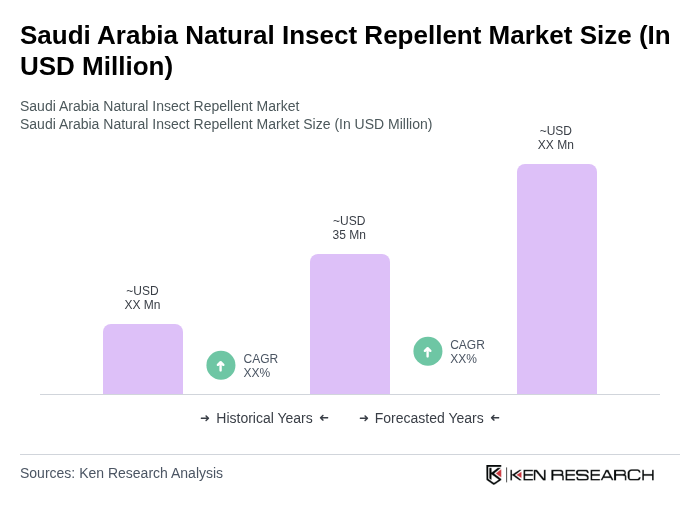
- The Saudi Arabia Natural Insect Repellent Market is valued at USD 35 million, based on a five-year historical analysis and benchmarking against the overall Saudi Arabia insect repellent market size and the share of natural-ingredient formats within Middle East markets. This growth is primarily driven by increasing consumer awareness regarding health and environmental sustainability, alongside a rising demand for organic and natural products. The market has seen a shift towards eco-friendly alternatives as consumers become more conscious of the harmful effects of synthetic chemicals such as DEET and pyrethroids found in traditional insect repellents.
- Key cities such as Riyadh, Jeddah, and Dammam dominate the market due to their high population density, concentration of higher-income consumers, and significant tourism and business travel flows. The hospitality sector in these cities, particularly during events like Hajj and Umrah centered around the holy cities and their travel corridors, drives the demand for insect repellents including natural and DEET?free formats in hotels, serviced apartments, pharmacies, and retail channels. Additionally, growing urbanization, rising outdoor recreational activities, and increased awareness of vector?borne diseases such as dengue and malaria further contribute to the market's expansion.
- Insect repellents, including those based on natural ingredients, are regulated in Saudi Arabia under biocide and cosmetic product frameworks overseen by the Saudi Food and Drug Authority (SFDA), which requires registration, safety assessment, and labeling compliance for products placed on the market. The Executive Regulation for Pesticides and Public Health Pest Control issued by the Saudi Food and Drug Authority in 2019, together with SFDA cosmetic regulations, sets requirements regarding active ingredients, product safety, permissible claims, and environmental and human health protection standards that apply to both synthetic and natural-ingredient insect repellent products. These instruments encourage manufacturers and importers to develop formulations that meet efficacy benchmarks while aligning with consumer preference for safer, eco?friendly alternatives.
Saudi Arabia Natural Insect Repellent Market Segmentation
By Product Type:The product type segmentation includes various forms of natural insect repellents that cater to different consumer preferences and usage scenarios. The subsegments are as follows:
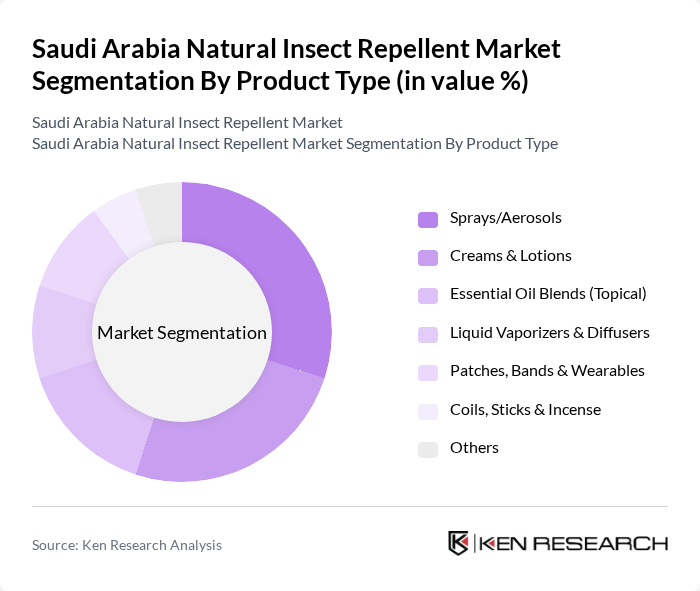
The product type segmentation reveals that sprays/aerosols dominate the market due to their convenience, quick coverage, and suitability for both households and travel use. Consumers prefer these formats for outdoor activities and travel, as they provide immediate protection against insects. Creams and lotions follow closely, appealing to those seeking longer-lasting effects, skin-conditioning benefits, and child-friendly options. Essential oil blends are gaining traction among health-conscious consumers looking for DEET?free and plant-based alternatives, while liquid vaporizers and diffusers are popular for indoor, overnight, and family environments. The market is witnessing a gradual increase in demand for innovative formats like patches and wearables, driven by consumer interest in hands-free, on-the-go solutions and by e?commerce visibility for imported brands.
By Ingredient Type:The ingredient type segmentation focuses on the natural components used in insect repellents, which are crucial for attracting health-conscious consumers. The subsegments are as follows:
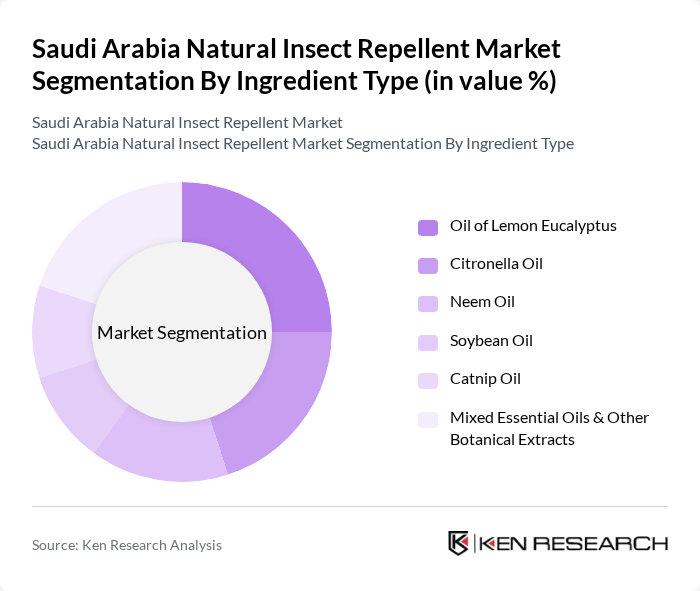
The ingredient type segmentation indicates that oil of lemon eucalyptus is the leading component due to its proven efficacy in repelling mosquitoes and ticks and its recognition in international public health guidance as a plant-based active, appealing to consumers looking for effective yet safe options. Citronella oil follows closely, known for its characteristic scent and effectiveness against mosquitoes in candles, sprays, and diffusers. Neem oil is gaining popularity for its multifunctional insecticidal and skincare properties, while mixed essential oils (such as eucalyptus, peppermint, lavender, and lemongrass) are favored for their versatility, aromatherapy value, and holistic appeal. The market is also seeing a rise in the use of soybean and catnip oils, reflecting consumer interest in diverse natural ingredients and in formulations perceived as gentler for children and sensitive skin.
Saudi Arabia Natural Insect Repellent Market Competitive Landscape
The Saudi Arabia Natural Insect Repellent Market is characterized by a dynamic mix of regional and international players. Leading participants such as SC Johnson & Son Inc. (OFF! & Other Natural Lines), Reckitt Benckiser Group plc (Mortein NaturGard & Related Lines), Godrej Consumer Products Ltd. (Goodknight Naturals), Dabur India Ltd. (Dabur Odomos Natural Range), Himalaya Wellness Company (Herbal Personal Care & Repellents), Pigeon Corporation, Johnson & Johnson (Inc. Natural Baby & Family Repellent Products), Beiersdorf AG (NIVEA & Related Personal Care with Natural Repellent Lines), Saudi Pharmaceutical Industries & Medical Appliances Corporation (SPIMACO), Jamjoom Pharma, Nahdi Medical Co. (Private Label & Distributed Natural Repellents), online pharmacies like Al-Dawaa Medical Services Co. (Private Label & Distributed Natural Repellents), Life Pharmacy (Gulf-based Chain Active in Saudi Arabia), Key Local Organic & Natural Personal Care Brands (e.g., Sukoon, Nature’s Gate Distributors, Others), Leading E-commerce Platforms for Natural Repellents (e.g., Noon, Amazon.sa, local specialty sites) contribute to innovation, geographic expansion, and service delivery in this space.
Saudi Arabia Natural Insect Repellent Market Industry Analysis
Growth Drivers
- Increasing Awareness of Health and Environmental Impacts:The Saudi Arabian population is becoming increasingly aware of the health risks associated with synthetic insect repellents. According to a report by the Saudi Ministry of Health, over 60% of consumers are concerned about chemical exposure. This awareness is driving demand for natural alternatives, as consumers seek products that are safer for both their health and the environment, contributing to a projected increase in natural repellent sales.
- Rising Demand for Organic and Natural Products:The organic product market in Saudi Arabia is expected to reach SAR 1.5 billion in future, reflecting a growing consumer preference for natural goods. This trend is particularly evident among younger demographics, with 70% of millennials indicating a preference for organic products. As consumers prioritize health and sustainability, the demand for natural insect repellents is anticipated to rise significantly, aligning with broader market trends.
- Government Initiatives Promoting Natural Alternatives:The Saudi government has launched several initiatives aimed at promoting natural products, including insect repellents. In the recent past, the Ministry of Environment allocated SAR 200 million to support local businesses producing eco-friendly products. These initiatives not only enhance consumer trust but also stimulate market growth by encouraging manufacturers to innovate and expand their natural product lines, thereby increasing availability and accessibility.
Market Challenges
- Competition from Synthetic Insect Repellents:The natural insect repellent market faces significant competition from established synthetic brands, which dominate approximately 75% of the market share. These products often offer longer-lasting effects and lower prices, making it challenging for natural alternatives to gain traction. As a result, many consumers remain loyal to synthetic options, hindering the growth potential of natural repellents in the market.
- Limited Consumer Awareness of Natural Options:Despite the growing interest in natural products, consumer awareness remains a barrier. A survey conducted in the recent past revealed that only 40% of consumers are familiar with natural insect repellent options. This lack of awareness limits market penetration and growth, as many potential customers are unaware of the benefits and availability of these products, necessitating increased marketing efforts from manufacturers.
Saudi Arabia Natural Insect Repellent Market Future Outlook
The future of the natural insect repellent market in Saudi Arabia appears promising, driven by increasing consumer demand for health-conscious and environmentally friendly products. As awareness grows, manufacturers are likely to invest in innovative formulations that cater to consumer preferences. Additionally, the expansion of e-commerce platforms will facilitate greater access to these products, allowing for increased market penetration and consumer engagement, ultimately fostering a more sustainable market landscape.
Market Opportunities
- Expansion into E-commerce Platforms:The rise of e-commerce in Saudi Arabia, projected to reach SAR 50 billion in future, presents a significant opportunity for natural insect repellent brands. By leveraging online sales channels, companies can enhance their visibility and accessibility, reaching a broader audience and driving sales growth in a competitive market.
- Development of Innovative Product Formulations:There is a growing opportunity for manufacturers to create innovative formulations that combine efficacy with natural ingredients. With 55% of consumers expressing interest in multifunctional products, brands that develop unique offerings, such as insect repellents with added skincare benefits, can capture market share and meet evolving consumer demands.
Scope of the Report
| Segment | Sub-Segments |
|---|---|
| By Product Type | Sprays/Aerosols Creams & Lotions Essential Oil Blends (Topical) Liquid Vaporizers & Diffusers Patches, Bands & Wearables Coils, Sticks & Incense Others |
| By Ingredient Type | Oil of Lemon Eucalyptus Citronella Oil Neem Oil Soybean Oil Catnip Oil Mixed Essential Oils & Other Botanical Extracts |
| By Application | Personal Care (Skin-Applied) Household Indoor Use Outdoor & Recreational Use Healthcare & Public Health Programs Others |
| By End-User | Residential Households Hospitality & Tourism (Hotels, Resorts, Camps, Hajj & Umrah Facilities) Commercial & Retail Establishments Healthcare Facilities & Clinics Government & Municipal Bodies Others |
| By Distribution Channel | Supermarkets/Hypermarkets Pharmacies & Drug Stores Specialty Organic & Health Stores Online Retail & E-commerce Platforms Convenience Stores & Grocery Stores Others |
| By Target Insect | Mosquitoes Flies Ticks Sandflies & Midges Others |
| By Region | Central Region (Including Riyadh) Western Region (Including Makkah, Madinah, Jeddah) Eastern Region (Including Dammam, Al Khobar) Southern Region (Including Asir, Jizan, Najran) Northern Region |
Key Target Audience
Investors and Venture Capitalist Firms
Government and Regulatory Bodies (e.g., Saudi Food and Drug Authority, Ministry of Environment, Water and Agriculture)
Manufacturers and Producers
Distributors and Retailers
Importers and Exporters
Natural Product Associations
Health and Wellness Organizations
Environmental NGOs
Players Mentioned in the Report:
SC Johnson & Son Inc. (OFF! & Other Natural Lines)
Reckitt Benckiser Group plc (Mortein NaturGard & Related Lines)
Godrej Consumer Products Ltd. (Goodknight Naturals)
Dabur India Ltd. (Dabur Odomos Natural Range)
Himalaya Wellness Company (Herbal Personal Care & Repellents)
Pigeon Corporation
Johnson & Johnson (Inc. Natural Baby & Family Repellent Products)
Beiersdorf AG (NIVEA & Related Personal Care with Natural Repellent Lines)
Saudi Pharmaceutical Industries & Medical Appliances Corporation (SPIMACO)
Jamjoom Pharma
Nahdi Medical Co. (Private Label & Distributed Natural Repellents)
online pharmacies like Al-Dawaa Medical Services Co. (Private Label & Distributed Natural Repellents)
Life Pharmacy (Gulf-based Chain Active in Saudi Arabia)
Key Local Organic & Natural Personal Care Brands (e.g., Sukoon, Natures Gate Distributors, Others)
Leading E-commerce Platforms for Natural Repellents (e.g., Noon, Amazon.sa, local specialty sites)
Table of Contents
Market Assessment Phase
1. Executive Summary and Approach
2. Saudi Arabia Natural Insect Repellent Market Overview
2.1 Key Insights and Strategic Recommendations
2.2 Saudi Arabia Natural Insect Repellent Market Overview
2.3 Definition and Scope
2.4 Evolution of Market Ecosystem
2.5 Timeline of Key Regulatory Milestones
2.6 Value Chain & Stakeholder Mapping
2.7 Business Cycle Analysis
2.8 Policy & Incentive Landscape
3. Saudi Arabia Natural Insect Repellent Market Analysis
3.1 Growth Drivers
3.1.1 Increasing awareness of health and environmental impacts
3.1.2 Rising demand for organic and natural products
3.1.3 Government initiatives promoting natural alternatives
3.1.4 Growth in outdoor activities and tourism
3.2 Market Challenges
3.2.1 Competition from synthetic insect repellents
3.2.2 Limited consumer awareness of natural options
3.2.3 Regulatory hurdles for product approvals
3.2.4 Price sensitivity among consumers
3.3 Market Opportunities
3.3.1 Expansion into e-commerce platforms
3.3.2 Development of innovative product formulations
3.3.3 Collaborations with health and wellness brands
3.3.4 Increasing export potential to neighboring regions
3.4 Market Trends
3.4.1 Shift towards eco-friendly packaging
3.4.2 Growth of DIY natural repellent solutions
3.4.3 Rising popularity of herbal and botanical ingredients
3.4.4 Increased focus on sustainability in production
3.5 Government Regulation
3.5.1 Standards for natural product labeling
3.5.2 Import regulations for natural ingredients
3.5.3 Safety assessments for consumer products
3.5.4 Incentives for local production of natural repellents
4. SWOT Analysis
5. Stakeholder Analysis
6. Porter's Five Forces Analysis
7. Saudi Arabia Natural Insect Repellent Market Market Size, 2019-2024
7.1 By Value
7.2 By Volume
7.3 By Average Selling Price
8. Saudi Arabia Natural Insect Repellent Market Segmentation
8.1 By Product Type
8.1.1 Sprays/Aerosols
8.1.2 Creams & Lotions
8.1.3 Essential Oil Blends (Topical)
8.1.4 Liquid Vaporizers & Diffusers
8.1.5 Patches, Bands & Wearables
8.1.6 Coils, Sticks & Incense
8.1.7 Others
8.2 By Ingredient Type
8.2.1 Oil of Lemon Eucalyptus
8.2.2 Citronella Oil
8.2.3 Neem Oil
8.2.4 Soybean Oil
8.2.5 Catnip Oil
8.2.6 Mixed Essential Oils & Other Botanical Extracts
8.3 By Application
8.3.1 Personal Care (Skin-Applied)
8.3.2 Household Indoor Use
8.3.3 Outdoor & Recreational Use
8.3.4 Healthcare & Public Health Programs
8.3.5 Others
8.4 By End-User
8.4.1 Residential Households
8.4.2 Hospitality & Tourism (Hotels, Resorts, Camps, Hajj & Umrah Facilities)
8.4.3 Commercial & Retail Establishments
8.4.4 Healthcare Facilities & Clinics
8.4.5 Government & Municipal Bodies
8.4.6 Others
8.5 By Distribution Channel
8.5.1 Supermarkets/Hypermarkets
8.5.2 Pharmacies & Drug Stores
8.5.3 Specialty Organic & Health Stores
8.5.4 Online Retail & E-commerce Platforms
8.5.5 Convenience Stores & Grocery Stores
8.5.6 Others
8.6 By Target Insect
8.6.1 Mosquitoes
8.6.2 Flies
8.6.3 Ticks
8.6.4 Sandflies & Midges
8.6.5 Others
8.7 By Region
8.7.1 Central Region (Including Riyadh)
8.7.2 Western Region (Including Makkah, Madinah, Jeddah)
8.7.3 Eastern Region (Including Dammam, Al Khobar)
8.7.4 Southern Region (Including Asir, Jizan, Najran)
8.7.5 Northern Region
9. Saudi Arabia Natural Insect Repellent Market Competitive Analysis
9.1 Market Share of Key Players
9.2 Cross Comparison of Key Players
9.2.1 Company Name
9.2.2 Group Size (Global Major, Regional Leader, Local/Niche Player)
9.2.3 Revenue from Natural Insect Repellents in Saudi Arabia
9.2.4 3-year Revenue CAGR in Saudi Arabia Natural Segment
9.2.5 Market Share in Saudi Arabia Natural Insect Repellent Market
9.2.6 Natural Product Portfolio Breadth (Formats & Ingredients)
9.2.7 Geographic Coverage within Saudi Arabia (No. of Cities/Regions Served)
9.2.8 Number of Active SKUs in Saudi Arabia
9.2.9 Share of E-commerce in Saudi Sales
9.2.10 Average Price Positioning vs Category (Premium/Mid/Value)
9.2.11 Halal/Organic/eco-certification Coverage
9.2.12 Marketing & Promotion Intensity (Estimated Ad/Promo Spend as % of Sales)
9.2.13 Key Retail & Pharmacy Listings (Coverage Index)
9.2.14 Customer Rating Score on Major Online Platforms
9.3 SWOT Analysis of Top Players
9.4 Pricing Analysis
9.5 Detailed Profile of Major Companies
9.5.1 SC Johnson & Son Inc. (OFF! & Other Natural Lines)
9.5.2 Reckitt Benckiser Group plc (Mortein NaturGard & Related Lines)
9.5.3 Godrej Consumer Products Ltd. (Goodknight Naturals)
9.5.4 Dabur India Ltd. (Dabur Odomos Natural Range)
9.5.5 Himalaya Wellness Company (Herbal Personal Care & Repellents)
9.5.6 Pigeon Corporation
9.5.7 Johnson & Johnson (Inc. Natural Baby & Family Repellent Products)
9.5.8 Beiersdorf AG (NIVEA & Related Personal Care with Natural Repellent Lines)
9.5.9 Saudi Pharmaceutical Industries & Medical Appliances Corporation (SPIMACO)
9.5.10 Jamjoom Pharma
9.5.11 Nahdi Medical Co. (Private Label & Distributed Natural Repellents)
9.5.12 online pharmacies like Al-Dawaa Medical Services Co. (Private Label & Distributed Natural Repellents)
9.5.13 Life Pharmacy (Gulf-based Chain Active in Saudi Arabia)
9.5.14 Key Local Organic & Natural Personal Care Brands (e.g., Sukoon, Nature’s Gate Distributors, Others)
9.5.15 Leading E-commerce Platforms for Natural Repellents (e.g., Noon, Amazon.sa, local specialty sites)
10. Saudi Arabia Natural Insect Repellent Market End-User Analysis
10.1 Procurement Behavior of Key Ministries
10.1.1 Ministry of Health
10.1.2 Ministry of Environment
10.1.3 Ministry of Tourism
10.1.4 Others
10.2 Corporate Spend on Infrastructure & Energy
10.2.1 Corporate Social Responsibility Initiatives
10.2.2 Sustainability Programs
10.2.3 Health and Safety Compliance
10.2.4 Others
10.3 Pain Point Analysis by End-User Category
10.3.1 Residential Users
10.3.2 Commercial Establishments
10.3.3 Industrial Users
10.3.4 Government Entities
10.4 User Readiness for Adoption
10.4.1 Awareness Levels
10.4.2 Accessibility of Products
10.4.3 Price Sensitivity
10.4.4 Others
10.5 Post-Deployment ROI and Use Case Expansion
10.5.1 Effectiveness of Products
10.5.2 User Feedback and Adaptation
10.5.3 Market Expansion Opportunities
10.5.4 Others
11. Saudi Arabia Natural Insect Repellent Market Future Size, 2025-2030
11.1 By Value
11.2 By Volume
11.3 By Average Selling Price
Go-To-Market Strategy Phase
1. Whitespace Analysis + Business Model Canvas
1.1 Market Gaps Identification
1.2 Business Model Framework
2. Marketing and Positioning Recommendations
2.1 Branding Strategies
2.2 Product USPs
3. Distribution Plan
3.1 Urban Retail Strategies
3.2 Rural NGO Tie-Ups
4. Channel & Pricing Gaps
4.1 Underserved Routes
4.2 Pricing Bands
5. Unmet Demand & Latent Needs
5.1 Category Gaps
5.2 Consumer Segments
6. Customer Relationship
6.1 Loyalty Programs
6.2 After-Sales Service
7. Value Proposition
7.1 Sustainability Initiatives
7.2 Integrated Supply Chains
8. Key Activities
8.1 Regulatory Compliance
8.2 Branding Efforts
8.3 Distribution Setup
9. Entry Strategy Evaluation
9.1 Domestic Market Entry Strategy
9.1.1 Product Mix
9.1.2 Pricing Band
9.1.3 Packaging Considerations
9.2 Export Entry Strategy
9.2.1 Target Countries
9.2.2 Compliance Roadmap
10. Entry Mode Assessment
10.1 Joint Ventures
10.2 Greenfield Investments
10.3 Mergers & Acquisitions
10.4 Distributor Model
11. Capital and Timeline Estimation
11.1 Capital Requirements
11.2 Timelines
12. Control vs Risk Trade-Off
12.1 Ownership vs Partnerships
13. Profitability Outlook
13.1 Breakeven Analysis
13.2 Long-Term Sustainability
14. Potential Partner List
14.1 Distributors
14.2 Joint Ventures
14.3 Acquisition Targets
15. Execution Roadmap
15.1 Phased Plan for Market Entry
15.1.1 Market Setup
15.1.2 Market Entry
15.1.3 Growth Acceleration
15.1.4 Scale & Stabilize
15.2 Key Activities and Milestones
15.2.1 Milestone Planning
15.2.2 Activity Tracking
Research Methodology
Phase 1: Approach1
Desk Research
- Analysis of market reports from agricultural and environmental agencies in Saudi Arabia
- Review of academic journals and publications on natural insect repellents and their efficacy
- Examination of consumer behavior studies related to organic and natural products in the region
Primary Research
- Interviews with manufacturers of natural insect repellents to understand production processes
- Surveys with retailers to gauge consumer preferences and purchasing trends
- Focus groups with end-users to collect qualitative insights on product usage and satisfaction
Validation & Triangulation
- Cross-validation of findings through multiple data sources including trade associations and market surveys
- Triangulation of qualitative insights from interviews with quantitative data from surveys
- Sanity checks through expert reviews from entomologists and market analysts
Phase 2: Market Size Estimation1
Top-down Assessment
- Estimation of market size based on national agricultural spending and pest control expenditures
- Segmentation of the market by product type, including sprays, oils, and lotions
- Incorporation of demographic data to assess potential market reach among different consumer groups
Bottom-up Modeling
- Collection of sales data from key retailers and e-commerce platforms selling natural insect repellents
- Estimation of average price points and volume sold across various distribution channels
- Analysis of production capacity and output from local manufacturers to determine supply-side constraints
Forecasting & Scenario Analysis
- Development of growth projections based on historical sales data and market trends
- Scenario analysis considering factors such as regulatory changes and shifts in consumer preferences towards natural products
- Creation of baseline, optimistic, and pessimistic forecasts through 2030
Phase 3: CATI Sample Composition1
| Scope Item/Segment | Sample Size | Target Respondent Profiles |
|---|---|---|
| Retail Market Insights | 100 | Store Managers, Category Buyers |
| Consumer Preferences Survey | 120 | Household Decision Makers, Eco-conscious Consumers |
| Manufacturer Feedback | 80 | Production Managers, R&D Heads |
| Distribution Channel Analysis | 70 | Logistics Coordinators, Supply Chain Managers |
| Market Trend Evaluation | 90 | Market Analysts, Industry Experts |
Frequently Asked Questions
What is the current value of the Saudi Arabia Natural Insect Repellent Market?
The Saudi Arabia Natural Insect Repellent Market is valued at approximately USD 35 million, reflecting a growing consumer preference for natural and organic products over synthetic alternatives.
What factors are driving the growth of the natural insect repellent market in Saudi Arabia?
Which cities in Saudi Arabia are the largest markets for natural insect repellents?
What types of products are available in the Saudi Arabia Natural Insect Repellent Market?
Other Regional/Country Reports
Indonesia Natural Insect Repellent Market
Malaysia Natural Insect Repellent Market
KSA Natural Insect Repellent Market
APAC Natural Insect Repellent Market
SEA Natural Insect Repellent Market
Other Adjacent Reports
Kuwait Eco-Friendly Household Cleaners Market
Japan Vector-Borne Disease Prevention Market
Indonesia Aromatherapy Products Market
Germany Natural Skincare Products Market
Brazil Biopesticides MarketKSA sustainable packaging market report Size, Share, Growth Drivers, Trends, Opportunities & Forecast 2025–2030Egypt Travel Health Products Market
Why Buy From Us?

What makes us stand out is that our consultants follow Robust, Refine and Result (RRR) methodology. Robust for clear definitions, approaches and sanity checking, Refine for differentiating respondents' facts and opinions, and Result for presenting data with story.

We have set a benchmark in the industry by offering our clients with syndicated and customized market research reports featuring coverage of entire market as well as meticulous research and analyst insights.

While we don't replace traditional research, we flip the method upside down. Our dual approach of Top Bottom & Bottom Top ensures quality deliverable by not just verifying company fundamentals but also looking at the sector and macroeconomic factors.

With one step in the future, our research team constantly tries to show you the bigger picture. We help with some of the tough questions you may encounter along the way: How is the industry positioned? Best marketing channel? KPI's of competitors? By aligning every element, we help maximize success.

Our report gives you instant access to the answers and sources that other companies might choose to hide. We elaborate each steps of research methodology we have used and showcase you the sample size to earn your trust.

If you need any support, we are here! We pride ourselves on universe strength, data quality, and quick, friendly, and professional service.