About the Report
Base Year 2024Middle East Natural Insect Repellent Market Overview
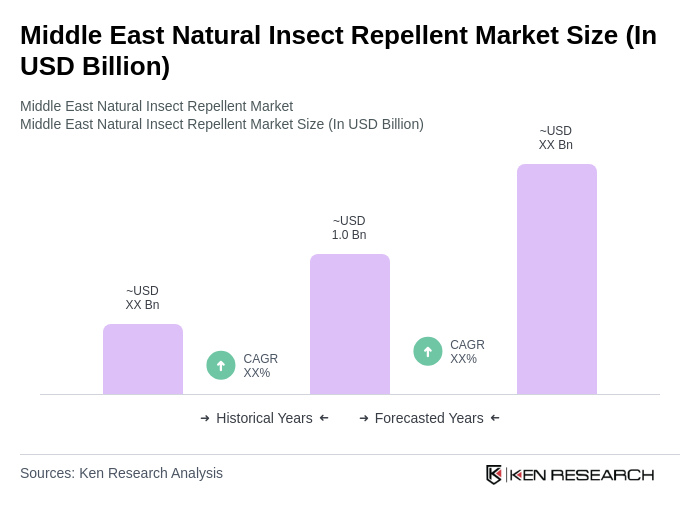
- The Middle East Natural Insect Repellent Market is valued at USD 1.0 billion, based on a five-year historical analysis. This growth is primarily driven by increasing consumer awareness regarding health and environmental concerns, leading to a shift from synthetic to natural products. The rising prevalence of insect-borne diseases has further fueled demand for effective and safe insect repellents. Recent trends include the adoption of DEET-free and essential oil-based formulations, along with advancements in microencapsulation technology and biodegradable packaging, which enhance product efficacy and sustainability .
- Countries such as the United Arab Emirates, Saudi Arabia, and Egypt dominate the market due to their high population density and tourism activities. Urbanization and lifestyle changes in these regions have led to a greater need for insect repellents, particularly in outdoor settings, making them key players in the natural insect repellent market. Saudi Arabia is expected to register the highest growth rate, driven by increased outdoor activities and public health initiatives .
- In 2023, the UAE government implemented regulations mandating the use of eco-friendly insect repellents in public spaces to combat the spread of diseases like dengue and malaria. The “UAE Public Health Pest Control Regulation, 2023” issued by the Ministry of Climate Change and Environment requires all public facilities to use certified natural or biodegradable insect repellent products, with compliance monitored through periodic inspections and product registration thresholds. This initiative aims to promote public health while ensuring environmental sustainability, thereby boosting the demand for natural insect repellents in the region .
Middle East Natural Insect Repellent Market Segmentation
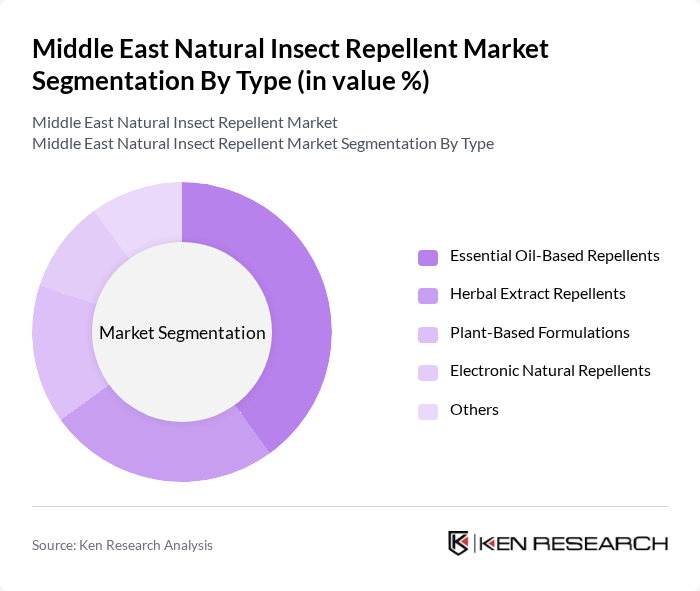
By Type:The market is segmented into various types of natural insect repellents, including essential oil-based repellents, herbal extract repellents, plant-based formulations, electronic natural repellents, and others. Among these, essential oil-based repellents are gaining significant traction due to their effectiveness and consumer preference for natural ingredients such as citronella, eucalyptus, peppermint, and neem. Herbal extract repellents remain popular in regions where traditional remedies are favored. The electronic natural repellents segment is emerging as a modern solution, appealing to tech-savvy consumers seeking non-chemical alternatives .
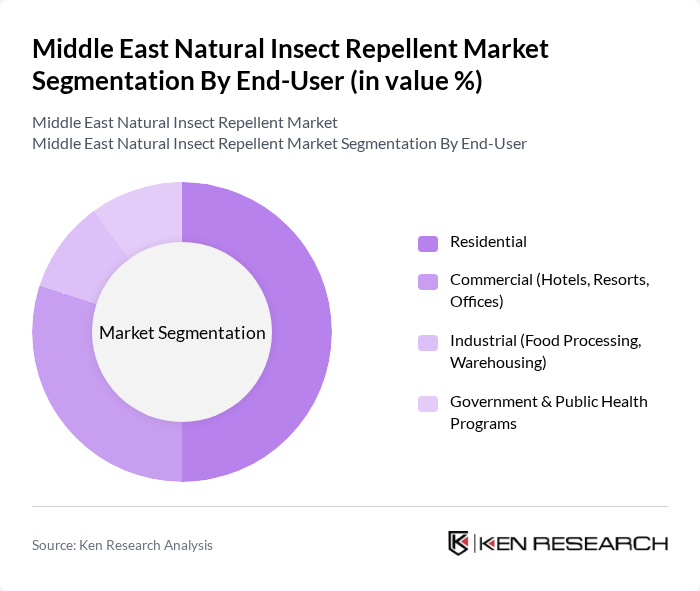
By End-User:The end-user segmentation includes residential, commercial (hotels, resorts, offices), industrial (food processing, warehousing), and government & public health programs. The residential segment is the largest, driven by increasing consumer awareness of health risks associated with insect bites and the convenience of home-use products. The commercial segment is significant, as hotels and resorts prioritize guest safety and comfort. Industrial users, such as food processing and warehousing, focus on compliance and hygiene standards. Government programs increasingly emphasize vector control and public health initiatives, further driving demand .
Middle East Natural Insect Repellent Market Competitive Landscape
The Middle East Natural Insect Repellent Market is characterized by a dynamic mix of regional and international players. Leading participants such as SC Johnson & Son (OFF! Botanicals), Godrej Consumer Products Ltd. (Goodknight Naturals), Reckitt Benckiser Group plc (Mortein NaturGard), Dabur International Ltd. (Odomos Natural), Spectrum Brands Holdings, Inc. (Repel Naturals), Herbal Armor (All Terrain Company), Murphy's Naturals, Green Cross Inc. (Green Cross Herbal), Quantum Health (Buzz Away Extreme), EcoSMART Technologies, Enesis Group (Soffell), Al Ain National Factory for Insecticides (UAE), Saudi Modern Factory Co. (Saudi Arabia), BASF SE (Mosquito Stop), Bayer AG (Baygon Natural Line) contribute to innovation, geographic expansion, and service delivery in this space .
Middle East Natural Insect Repellent Market Industry Analysis
Growth Drivers
- Increasing Consumer Preference for Natural Products:The Middle East has seen a significant shift towards natural products, with a reported 60% of consumers preferring organic options over synthetic ones. This trend is driven by a growing awareness of health and environmental issues, as evidenced by a recent survey indicating that 76% of consumers are concerned about the chemicals in traditional insect repellents. The demand for natural insect repellents is expected to rise as consumers prioritize health-conscious choices.
- Rising Awareness About Health Risks Associated with Chemical Repellents:Health concerns related to synthetic insect repellents have prompted a shift in consumer behavior. Reports indicate that 41% of users have experienced adverse effects from chemical repellents, leading to increased scrutiny and demand for safer alternatives. The World Health Organization has highlighted the potential risks of long-term exposure to these chemicals, further fueling the market for natural insect repellents as consumers seek safer options for their families.
- Growth in Outdoor Recreational Activities:The Middle East has witnessed a 31% increase in outdoor recreational activities, including camping and hiking, particularly post-pandemic. This surge has led to a heightened demand for effective insect repellents. According to the Middle East Tourism Report, outdoor tourism is projected to contribute $16 billion to the regional economy, driving the need for natural insect repellents that align with the eco-friendly preferences of outdoor enthusiasts.
Market Challenges
- High Competition from Synthetic Insect Repellents:The natural insect repellent market faces intense competition from established synthetic brands, which dominate approximately 69% of the market share. These brands benefit from extensive distribution networks and brand loyalty, making it challenging for natural alternatives to gain traction. The aggressive marketing strategies employed by synthetic manufacturers further complicate the landscape for new entrants in the natural segment.
- Limited Consumer Awareness About Natural Alternatives:Despite the growing interest in natural products, consumer awareness remains a significant barrier. A study revealed that only 36% of consumers are familiar with the benefits of natural insect repellents. This lack of knowledge hampers market growth, as many consumers continue to rely on familiar synthetic options. Educational initiatives are crucial to bridging this gap and promoting the advantages of natural alternatives.
Middle East Natural Insect Repellent Market Future Outlook
The future of the Middle East natural insect repellent market appears promising, driven by increasing consumer demand for health-conscious products and sustainable practices. As awareness of the adverse effects of synthetic chemicals grows, companies are likely to innovate and expand their product lines. Additionally, the rise of e-commerce platforms will facilitate greater access to natural products, enabling brands to reach a broader audience. Collaborations with eco-friendly organizations will further enhance market visibility and credibility.
Market Opportunities
- Development of Innovative Product Formulations:There is a significant opportunity for companies to create unique formulations that combine natural ingredients with enhanced efficacy. Research indicates that products incorporating essential oils can increase effectiveness by up to 51%, appealing to health-conscious consumers seeking reliable solutions.
- Expansion into Untapped Regional Markets:Emerging markets within the Middle East present lucrative opportunities for natural insect repellent brands. With a projected population growth of 2.6% annually in these regions, companies can capitalize on the increasing demand for natural products, particularly in areas with high outdoor activity rates.
Scope of the Report
| Segment | Sub-Segments |
|---|---|
| By Type | Essential Oil-Based Repellents Herbal Extract Repellents Plant-Based Formulations Electronic Natural Repellents Others |
| By End-User | Residential Commercial (Hotels, Resorts, Offices) Industrial (Food Processing, Warehousing) Government & Public Health Programs |
| By Distribution Channel | Online Retail Supermarkets/Hypermarkets Specialty Stores Pharmacies Direct Sales (B2B, Institutional) |
| By Packaging Type | Spray Bottles Roll-Ons Wipes Sachets & Pouches Others |
| By Price Range | Economy Mid-Range Premium |
| By Formulation | Liquid Gel Cream Solid (Sticks, Bars) |
| By Brand Positioning | Eco-Friendly Brands Luxury Brands Mass Market Brands Local/Regional Brands |
Key Target Audience
Investors and Venture Capitalist Firms
Government and Regulatory Bodies (e.g., Ministry of Health, Environmental Protection Agency)
Manufacturers and Producers
Distributors and Retailers
Importers and Exporters
Natural Product Certification Organizations
Industry Associations (e.g., Middle East Pest Control Association)
Financial Institutions
Players Mentioned in the Report:
SC Johnson & Son (OFF! Botanicals)
Godrej Consumer Products Ltd. (Goodknight Naturals)
Reckitt Benckiser Group plc (Mortein NaturGard)
Dabur International Ltd. (Odomos Natural)
Spectrum Brands Holdings, Inc. (Repel Naturals)
Herbal Armor (All Terrain Company)
Murphy's Naturals
Green Cross Inc. (Green Cross Herbal)
Quantum Health (Buzz Away Extreme)
EcoSMART Technologies
Enesis Group (Soffell)
Al Ain National Factory for Insecticides (UAE)
Saudi Modern Factory Co. (Saudi Arabia)
BASF SE (Mosquito Stop)
Bayer AG (Baygon Natural Line)
Table of Contents
Market Assessment Phase
1. Executive Summary and Approach
2. Middle East Natural Insect Repellent Market Overview
2.1 Key Insights and Strategic Recommendations
2.2 Middle East Natural Insect Repellent Market Overview
2.3 Definition and Scope
2.4 Evolution of Market Ecosystem
2.5 Timeline of Key Regulatory Milestones
2.6 Value Chain & Stakeholder Mapping
2.7 Business Cycle Analysis
2.8 Policy & Incentive Landscape
3. Middle East Natural Insect Repellent Market Analysis
3.1 Growth Drivers
3.1.1 Increasing consumer preference for natural products
3.1.2 Rising awareness about health risks associated with chemical repellents
3.1.3 Growth in outdoor recreational activities
3.1.4 Expansion of the tourism sector in the Middle East
3.2 Market Challenges
3.2.1 High competition from synthetic insect repellents
3.2.2 Limited consumer awareness about natural alternatives
3.2.3 Regulatory hurdles in product approvals
3.2.4 Variability in raw material availability
3.3 Market Opportunities
3.3.1 Development of innovative product formulations
3.3.2 Expansion into untapped regional markets
3.3.3 Collaborations with eco-friendly brands
3.3.4 Increasing demand for organic and sustainable products
3.4 Market Trends
3.4.1 Growing trend towards DIY natural repellents
3.4.2 Rise in e-commerce sales of natural products
3.4.3 Increased focus on sustainable packaging
3.4.4 Popularity of multi-functional insect repellents
3.5 Government Regulation
3.5.1 Stricter regulations on chemical insecticides
3.5.2 Incentives for organic farming practices
3.5.3 Guidelines for labeling and marketing natural products
3.5.4 Support for research and development in natural alternatives
4. SWOT Analysis
5. Stakeholder Analysis
6. Porter's Five Forces Analysis
7. Middle East Natural Insect Repellent Market Market Size, 2019-2024
7.1 By Value
7.2 By Volume
7.3 By Average Selling Price
8. Middle East Natural Insect Repellent Market Segmentation
8.1 By Type
8.1.1 Essential Oil-Based Repellents
8.1.2 Herbal Extract Repellents
8.1.3 Plant-Based Formulations
8.1.4 Electronic Natural Repellents
8.1.5 Others
8.2 By End-User
8.2.1 Residential
8.2.2 Commercial (Hotels, Resorts, Offices)
8.2.3 Industrial (Food Processing, Warehousing)
8.2.4 Government & Public Health Programs
8.3 By Distribution Channel
8.3.1 Online Retail
8.3.2 Supermarkets/Hypermarkets
8.3.3 Specialty Stores
8.3.4 Pharmacies
8.3.5 Direct Sales (B2B, Institutional)
8.4 By Packaging Type
8.4.1 Spray Bottles
8.4.2 Roll-Ons
8.4.3 Wipes
8.4.4 Sachets & Pouches
8.4.5 Others
8.5 By Price Range
8.5.1 Economy
8.5.2 Mid-Range
8.5.3 Premium
8.6 By Formulation
8.6.1 Liquid
8.6.2 Gel
8.6.3 Cream
8.6.4 Solid (Sticks, Bars)
8.7 By Brand Positioning
8.7.1 Eco-Friendly Brands
8.7.2 Luxury Brands
8.7.3 Mass Market Brands
8.7.4 Local/Regional Brands
9. Middle East Natural Insect Repellent Market Competitive Analysis
9.1 Market Share of Key Players
9.2 Cross Comparison of Key Players
9.2.1 Company Name
9.2.2 Group Size (Large, Medium, or Small as per industry convention)
9.2.3 Revenue Growth Rate (Regional)
9.2.4 Middle East Market Penetration Rate
9.2.5 Customer Retention Rate
9.2.6 Product Portfolio Diversification Index
9.2.7 Average Price per Unit (USD)
9.2.8 Distribution Network Coverage (No. of Countries/Channels)
9.2.9 Brand Recognition Score (Middle East)
9.2.10 Innovation Rate (New Product Launches per Year)
9.2.11 Regulatory Compliance Score (Local Certifications)
9.3 SWOT Analysis of Top Players
9.4 Pricing Analysis
9.5 Detailed Profile of Major Companies
9.5.1 SC Johnson & Son (OFF! Botanicals)
9.5.2 Godrej Consumer Products Ltd. (Goodknight Naturals)
9.5.3 Reckitt Benckiser Group plc (Mortein NaturGard)
9.5.4 Dabur International Ltd. (Odomos Natural)
9.5.5 Spectrum Brands Holdings, Inc. (Repel Naturals)
9.5.6 Herbal Armor (All Terrain Company)
9.5.7 Murphy's Naturals
9.5.8 Green Cross Inc. (Green Cross Herbal)
9.5.9 Quantum Health (Buzz Away Extreme)
9.5.10 EcoSMART Technologies
9.5.11 Enesis Group (Soffell)
9.5.12 Al Ain National Factory for Insecticides (UAE)
9.5.13 Saudi Modern Factory Co. (Saudi Arabia)
9.5.14 BASF SE (Mosquito Stop)
9.5.15 Bayer AG (Baygon Natural Line)
10. Middle East Natural Insect Repellent Market End-User Analysis
10.1 Procurement Behavior of Key Ministries
10.1.1 Government procurement policies
10.1.2 Budget allocation for natural products
10.1.3 Collaboration with local manufacturers
10.2 Corporate Spend on Infrastructure & Energy
10.2.1 Investment in sustainable products
10.2.2 Budget for employee health and safety
10.2.3 Corporate social responsibility initiatives
10.3 Pain Point Analysis by End-User Category
10.3.1 Effectiveness of natural repellents
10.3.2 Availability of products
10.3.3 Price sensitivity among consumers
10.4 User Readiness for Adoption
10.4.1 Awareness of natural alternatives
10.4.2 Willingness to switch from synthetic to natural
10.4.3 Accessibility of products in local markets
10.5 Post-Deployment ROI and Use Case Expansion
10.5.1 Measurement of effectiveness
10.5.2 Customer feedback and satisfaction
10.5.3 Opportunities for product line expansion
11. Middle East Natural Insect Repellent Market Future Size, 2025-2030
11.1 By Value
11.2 By Volume
11.3 By Average Selling Price
Go-To-Market Strategy Phase
1. Whitespace Analysis + Business Model Canvas
1.1 Market gaps and opportunities
1.2 Business model components
2. Marketing and Positioning Recommendations
2.1 Branding strategies
2.2 Product USPs
3. Distribution Plan
3.1 Urban retail vs rural NGO tie-ups
4. Channel & Pricing Gaps
4.1 Underserved routes
4.2 Pricing bands
5. Unmet Demand & Latent Needs
5.1 Category gaps
5.2 Consumer segments
6. Customer Relationship
6.1 Loyalty programs
6.2 After-sales service
7. Value Proposition
7.1 Sustainability
7.2 Integrated supply chains
8. Key Activities
8.1 Regulatory compliance
8.2 Branding
8.3 Distribution setup
9. Entry Strategy Evaluation
9.1 Domestic Market Entry Strategy
9.1.1 Product mix
9.1.2 Pricing band
9.1.3 Packaging
9.2 Export Entry Strategy
9.2.1 Target countries
9.2.2 Compliance roadmap
10. Entry Mode Assessment
10.1 JV
10.2 Greenfield
10.3 M&A
10.4 Distributor Model
11. Capital and Timeline Estimation
11.1 Capital requirements
11.2 Timelines
12. Control vs Risk Trade-Off
12.1 Ownership vs Partnerships
13. Profitability Outlook
13.1 Breakeven analysis
13.2 Long-term sustainability
14. Potential Partner List
14.1 Distributors
14.2 JVs
14.3 Acquisition targets
15. Execution Roadmap
15.1 Phased Plan for Market Entry
15.1.1 Market Setup
15.1.2 Market Entry
15.1.3 Growth Acceleration
15.1.4 Scale & Stabilize
15.2 Key Activities and Milestones
15.2.1 Milestone tracking
15.2.2 Activity scheduling
Research Methodology
Phase 1: Approach1
Desk Research
- Analysis of market reports from regional agricultural and environmental agencies
- Review of academic journals focusing on natural insect repellents and their efficacy
- Examination of consumer behavior studies related to insect repellent usage in the Middle East
Primary Research
- Interviews with product development managers at leading natural insect repellent manufacturers
- Surveys conducted with retailers specializing in organic and natural products
- Focus groups with consumers to understand preferences and purchasing behavior
Validation & Triangulation
- Cross-validation of findings through multiple data sources including sales data and consumer surveys
- Triangulation of insights from industry experts and market analysts
- Sanity checks through feedback from a panel of entomologists and environmental scientists
Phase 2: Market Size Estimation1
Top-down Assessment
- Estimation of market size based on regional agricultural spending on pest control
- Segmentation of the market by product type, including sprays, oils, and lotions
- Incorporation of demographic data to assess potential consumer base growth
Bottom-up Modeling
- Collection of sales data from key retailers and distributors of natural insect repellents
- Estimation of average price points across different product categories
- Volume estimates based on historical sales trends and market penetration rates
Forecasting & Scenario Analysis
- Utilization of time series analysis to project future market growth rates
- Scenario modeling based on potential regulatory changes affecting natural products
- Development of best-case, worst-case, and most-likely market scenarios through 2030
Phase 3: CATI Sample Composition1
| Scope Item/Segment | Sample Size | Target Respondent Profiles |
|---|---|---|
| Retail Market Insights | 100 | Store Managers, Category Buyers |
| Consumer Preferences Survey | 120 | End Consumers, Health-Conscious Shoppers |
| Manufacturer Feedback | 80 | Product Managers, R&D Specialists |
| Distribution Channel Analysis | 60 | Logistics Coordinators, Supply Chain Analysts |
| Environmental Impact Assessment | 40 | Environmental Scientists, Regulatory Affairs Experts |
Frequently Asked Questions
What is the current value of the Middle East Natural Insect Repellent Market?
The Middle East Natural Insect Repellent Market is valued at approximately USD 1.0 billion, reflecting a significant growth trend driven by consumer preferences for natural products and increasing awareness of health and environmental issues.
What factors are driving the growth of the natural insect repellent market in the Middle East?
Which countries are leading the Middle East Natural Insect Repellent Market?
What types of natural insect repellents are available in the market?
Other Regional/Country Reports
Indonesia Natural Insect Repellent Market
Malaysia Natural Insect Repellent Market
APAC Natural Insect Repellent Market
SEA Natural Insect Repellent Market
Vietnam Natural Insect Repellent Market
Other Adjacent Reports
Vietnam Outdoor Recreation Equipment Market
Vietnam Travel Health Products Market
Brazil Aromatherapy Products Market
Kuwait natural cosmetics market size, share, growth drivers, trends, opportunities & forecast 2025–2030Japan Eco-Friendly Household Products Market
Why Buy From Us?

What makes us stand out is that our consultants follow Robust, Refine and Result (RRR) methodology. Robust for clear definitions, approaches and sanity checking, Refine for differentiating respondents' facts and opinions, and Result for presenting data with story.

We have set a benchmark in the industry by offering our clients with syndicated and customized market research reports featuring coverage of entire market as well as meticulous research and analyst insights.

While we don't replace traditional research, we flip the method upside down. Our dual approach of Top Bottom & Bottom Top ensures quality deliverable by not just verifying company fundamentals but also looking at the sector and macroeconomic factors.

With one step in the future, our research team constantly tries to show you the bigger picture. We help with some of the tough questions you may encounter along the way: How is the industry positioned? Best marketing channel? KPI's of competitors? By aligning every element, we help maximize success.

Our report gives you instant access to the answers and sources that other companies might choose to hide. We elaborate each steps of research methodology we have used and showcase you the sample size to earn your trust.

If you need any support, we are here! We pride ourselves on universe strength, data quality, and quick, friendly, and professional service.