Ksa Next Generation Non Volatile Memory Market Size, Share, Growth Drivers, Trends, Opportunities & Forecast 2025–2030

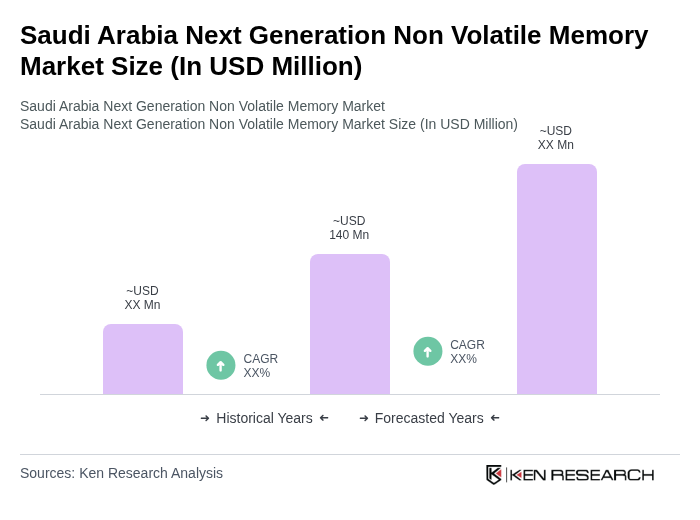
Saudi Arabia Next Generation Non Volatile Memory Market is worth USD 140 million, fueled by high-performance computing, IoT growth, and data center expansions under Vision 2030 initiatives.

Region:Middle East

Author(s):Geetanshi

Product Code:KRAD6036

Pages:90

Published On:December 2025
About the Report

Base Year 2024

Saudi Arabia Next Generation Non Volatile Memory Market Overview

  • The Saudi Arabia Next Generation Non Volatile Memory Market is valued at USD 140 million, based on a five-year historical analysis and its proportion within the global next generation non-volatile memory market, which was valued at around USD 6–7 billion at the global level. This growth is primarily driven by the increasing demand for high-performance computing, the proliferation of IoT devices, expanding hyperscale and colocation data center investments, and the rising need for advanced data storage solutions across various sectors, including automotive, industrial, and healthcare as part of Saudi Vision 2030 digitalization initiatives.
  • Key cities such as Riyadh, Jeddah, and Dammam dominate the market due to their strategic importance as economic and digital infrastructure hubs. Riyadh, being the capital, concentrates a large share of government digital transformation programs and hyperscale cloud investments, including data centers developed under national ICT and Vision 2030 initiatives. Jeddah serves as a major port city facilitating trade, logistics, and industrial activity on the Red Sea corridor, while Dammam is pivotal for the oil and gas industry in the Eastern Province, where upstream and downstream operations increasingly rely on advanced sensors, edge devices, and industrial automation systems that embed high?reliability non?volatile memory.
  • In 2023, the Saudi government implemented and reinforced data localization and residency requirements for public entities under the Personal Data Protection Law (PDPL) issued by Royal Decree M/19 and its Implementing Regulations, overseen by the Saudi Data and Artificial Intelligence Authority (SDAIA), which mandate that personal data processed by public sector entities and many regulated activities be stored and processed within the Kingdom except under approved transfer mechanisms. This framework aims to enhance data security, sovereignty, and compliance and is encouraging higher in?country investment in data centers, storage infrastructure, and associated next generation non?volatile memory solutions for public cloud, government workloads, and critical sectors.
Saudi Arabia Next Generation Non Volatile Memory Market Size

Saudi Arabia Next Generation Non Volatile Memory Market Segmentation

By Type:The market is segmented into various types of non-volatile memory technologies, including Flash Memory (NAND, NOR), Phase Change Memory (PCM/PRAM), Magnetoresistive RAM (MRAM, STT-MRAM), Ferroelectric RAM (FeRAM/FRAM), and Resistive RAM (ReRAM) & Other Emerging NVM. Among these, Flash Memory remains the most widely used due to its cost-effectiveness, maturity of the ecosystem, and high storage density, making it a preferred choice for consumer electronics, solid-state drives in data centers, and embedded storage in industrial and automotive applications.
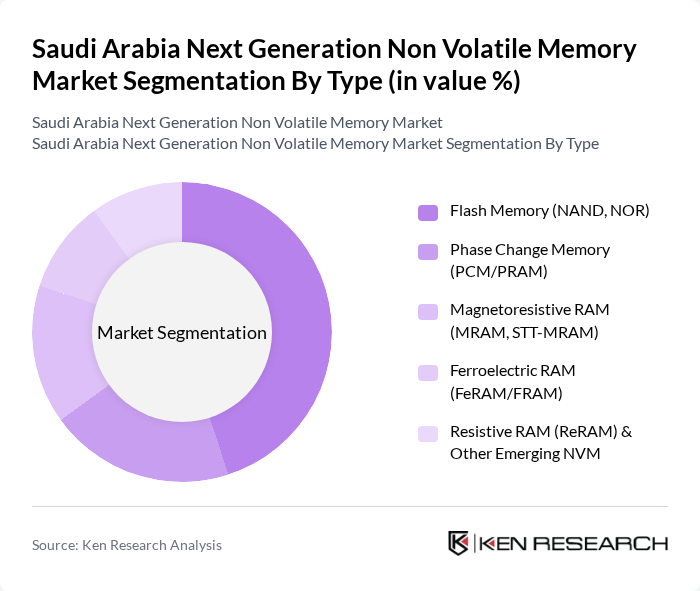
Saudi Arabia Next Generation Non Volatile Memory Market segmentation by Type.

By End-User:The end-user segmentation includes Consumer Electronics & Wearables, Automotive & Transportation (including EVs & ADAS), Industrial & Manufacturing (including automation & robotics), IT & Telecommunications (including data centers & cloud), Banking, Financial Services & Public Sector, Healthcare & Medical Devices, and Others. The Consumer Electronics segment leads the market, driven by the increasing adoption of smartphones, tablets, gaming devices, and wearables that require efficient, low?power, and high-capacity memory solutions, while rapid cloud, 5G, and smart manufacturing rollouts in Saudi Arabia are accelerating demand from IT, telecom, and industrial segments.
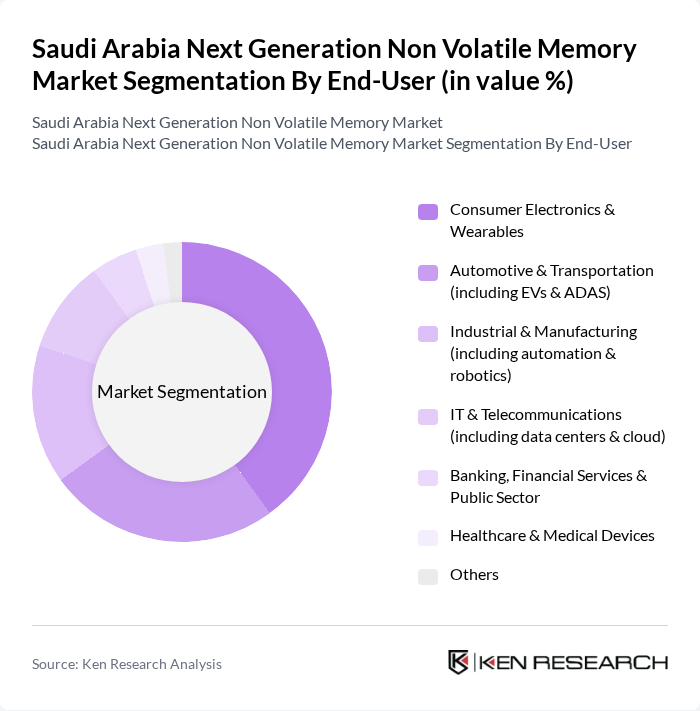
Saudi Arabia Next Generation Non Volatile Memory Market segmentation by End-User.

Saudi Arabia Next Generation Non Volatile Memory Market Competitive Landscape

The Saudi Arabia Next Generation Non Volatile Memory Market is characterized by a dynamic mix of regional and international players. Leading participants such as Samsung Electronics Co., Ltd., SK hynix Inc., Micron Technology, Inc., Kioxia Corporation, Western Digital Corporation, Intel Corporation (including legacy Optane/3D XPoint portfolio), Renesas Electronics Corporation, Infineon Technologies AG, STMicroelectronics N.V., NXP Semiconductors N.V., Texas Instruments Incorporated, Winbond Electronics Corporation, Macronix International Co., Ltd., Microchip Technology Inc., Fujitsu Semiconductor Memory Solution Limited contribute to innovation, geographic expansion, and service delivery in this space.

Samsung Electronics Co., Ltd.

1969

Seoul, South Korea

SK hynix Inc.

1983

Icheon, South Korea

Micron Technology, Inc.

1978

Boise, Idaho, USA

Kioxia Corporation

2017

Tokyo, Japan

Western Digital Corporation

1970

San Jose, California, USA

Company

Establishment Year

Headquarters

Global Revenue from NVM Business (USD Million)

Share of Revenue from Middle East / Saudi Arabia (%)

Installed Base with Saudi Data Centers & Cloud Providers (PB/TB)

Design Wins with Saudi OEMs / System Integrators (Number of Active Projects)

CAGR of NVM Sales in Saudi Arabia (Last 3–5 Years)

Average Selling Price Trend for Key NVM Products (Index)

Saudi Arabia Next Generation Non Volatile Memory Market Industry Analysis

Growth Drivers

  • Increasing Demand for High-Performance Computing:The demand for high-performance computing (HPC) in Saudi Arabia is projected to reach 1.5 million units in future, driven by sectors such as finance, healthcare, and research. The Kingdom's Vision 2030 initiative emphasizes technological advancement, leading to increased investments in HPC infrastructure. This growth is supported by a projected 4.5% annual increase in IT spending, which is expected to exceed SAR 60 billion, further fueling the need for advanced non-volatile memory solutions.
  • Expansion of Data Centers and Cloud Services:Saudi Arabia is witnessing a rapid expansion of data centers, with over 20 new facilities expected to be operational in future. This growth is driven by the increasing adoption of cloud services, projected to grow by 30% annually, reaching a market size of SAR 15 billion. The government's push for digital transformation and the establishment of the Saudi Data and Artificial Intelligence Authority (SDAIA) are key factors driving this expansion, necessitating advanced non-volatile memory technologies.
  • Growth in Consumer Electronics and IoT Devices:The consumer electronics market in Saudi Arabia is anticipated to grow to SAR 50 billion in future, with a significant rise in IoT device adoption. The number of connected devices is expected to reach 60 million, driven by smart home technologies and industrial IoT applications. This surge in demand for smart devices is creating a robust market for next-generation non-volatile memory, which is essential for enhancing performance and energy efficiency in these applications.

Market Challenges

  • High Initial Investment Costs:The high initial investment required for next-generation non-volatile memory technologies poses a significant barrier to entry for many companies in Saudi Arabia. The average cost of implementing advanced memory solutions can exceed SAR 1.2 million per facility, which may deter smaller enterprises from adopting these technologies. This challenge is compounded by the need for specialized infrastructure and skilled personnel, further increasing the financial burden on potential adopters.
  • Limited Awareness and Understanding of Technology:There is a notable lack of awareness and understanding of next-generation non-volatile memory technologies among businesses in Saudi Arabia. A recent survey indicated that over 65% of companies are unfamiliar with the benefits and applications of these technologies. This knowledge gap hinders adoption rates and slows down the overall market growth, as organizations may be hesitant to invest in unfamiliar solutions without clear evidence of their advantages.

Saudi Arabia Next Generation Non Volatile Memory Market Future Outlook

The future of the Saudi Arabia next-generation non-volatile memory market appears promising, driven by technological advancements and government support. As the Kingdom continues to invest in digital infrastructure, the integration of memory with processing units is expected to enhance performance across various sectors. Additionally, the focus on energy-efficient solutions will likely lead to innovations that address both performance and sustainability, positioning Saudi Arabia as a regional leader in memory technology in future.

Market Opportunities

  • Government Initiatives Promoting Technology Adoption:The Saudi government is actively promoting technology adoption through initiatives like the National Industrial Development and Logistics Program, which allocates SAR 2 billion for tech advancements. This funding is expected to stimulate the development and integration of next-generation non-volatile memory solutions across various sectors, creating significant growth opportunities for local and international companies.
  • Collaborations with Tech Startups:Collaborations between established companies and tech startups are emerging as a key opportunity in the Saudi market. With over 600 tech startups currently operating, partnerships can drive innovation in non-volatile memory applications. These collaborations can leverage local expertise and resources, fostering the development of tailored solutions that meet the specific needs of the Saudi market, thus enhancing competitive advantage.

Scope of the Report

SegmentSub-Segments
By Type

Flash Memory (NAND, NOR)

Phase Change Memory (PCM/PRAM)

Magnetoresistive RAM (MRAM, STT?MRAM)

Ferroelectric RAM (FeRAM/FRAM)

Resistive RAM (ReRAM) & Other Emerging NVM

By End-User

Consumer Electronics & Wearables

Automotive & Transportation (including EVs & ADAS)

Industrial & Manufacturing (including automation & robotics)

IT & Telecommunications (including data centers & cloud)

Banking, Financial Services & Public Sector

Healthcare & Medical Devices

Others

By Application

Enterprise & Cloud Data Storage

Embedded Systems & Microcontrollers

High-Performance Computing & AI Accelerators

IoT Devices & Edge Computing Nodes

Mobile & Client Computing (smartphones, tablets, PCs)

Others

By Technology

D NAND & 3D XPoint-Class Technologies

D/Planar NAND

Embedded NVM (eMMC, UFS, eMRAM, ePCM)

Other Emerging Memory Technologies

By Distribution Channel

Direct Sales to OEMs & Hyperscalers

Global & Regional Distributors

Online B2B Platforms

Retail & System Integrators

By Region

Central Region (including Riyadh)

Eastern Region (including Dammam, Dhahran, Khobar)

Western Region (including Jeddah, Makkah, Madinah, NEOM)

Southern Region

Northern Region

By Policy Support

Government Subsidies & Investment Funds (e.g., PIF, SIDF)

Tax Incentives & Customs Exemptions

Research Grants & Innovation Programs (e.g., Vision 2030, SDAIA, KAUST)

Local Content & Localization Programs (e.g., NIDLP, IKTVA)

Key Target Audience

Investors and Venture Capitalist Firms

Government and Regulatory Bodies (e.g., Saudi Arabian Standards Organization, Ministry of Communications and Information Technology)

Manufacturers and Producers

Distributors and Retailers

Technology Providers

Industry Associations

Financial Institutions

Telecommunications Companies

Players Mentioned in the Report:

Samsung Electronics Co., Ltd.

SK hynix Inc.

Micron Technology, Inc.

Kioxia Corporation

Western Digital Corporation

Intel Corporation (including legacy Optane/3D XPoint portfolio)

Renesas Electronics Corporation

Infineon Technologies AG

STMicroelectronics N.V.

NXP Semiconductors N.V.

Texas Instruments Incorporated

Winbond Electronics Corporation

Macronix International Co., Ltd.

Microchip Technology Inc.

Fujitsu Semiconductor Memory Solution Limited

Table of Contents

Market Assessment Phase

1. Executive Summary and Approach


2. Saudi Arabia Next Generation Non Volatile Memory Market Overview

2.1 Key Insights and Strategic Recommendations

2.2 Saudi Arabia Next Generation Non Volatile Memory Market Overview

2.3 Definition and Scope

2.4 Evolution of Market Ecosystem

2.5 Timeline of Key Regulatory Milestones

2.6 Value Chain & Stakeholder Mapping

2.7 Business Cycle Analysis

2.8 Policy & Incentive Landscape


3. Saudi Arabia Next Generation Non Volatile Memory Market Analysis

3.1 Growth Drivers

3.1.1 Increasing demand for high-performance computing
3.1.2 Expansion of data centers and cloud services
3.1.4 Growth in consumer electronics and IoT devices

3.2 Market Challenges

3.2.1 High initial investment costs
3.2.2 Limited awareness and understanding of technology
3.2.3 Supply chain disruptions
3.2.4 Competition from traditional memory technologies

3.3 Market Opportunities

3.3.1 Government initiatives promoting technology adoption
3.3.2 Collaborations with tech startups
3.3.3 Development of new applications in automotive and healthcare
3.3.4 Expansion into emerging markets

3.4 Market Trends

3.4.1 Shift towards energy-efficient memory solutions
3.4.2 Increasing integration of memory with processing units
3.4.3 Growth of hybrid memory systems
3.4.4 Rising focus on data security and privacy

3.5 Government Regulation

3.5.1 Standards for data protection and privacy
3.5.2 Incentives for R&D in memory technologies
3.5.3 Regulations on electronic waste management
3.5.4 Policies supporting local manufacturing

4. SWOT Analysis


5. Stakeholder Analysis


6. Porter's Five Forces Analysis


7. Saudi Arabia Next Generation Non Volatile Memory Market Market Size, 2019-2024

7.1 By Value

7.2 By Volume

7.3 By Average Selling Price


8. Saudi Arabia Next Generation Non Volatile Memory Market Segmentation

8.1 By Type

8.1.1 Flash Memory (NAND, NOR)
8.1.2 Phase Change Memory (PCM/PRAM)
8.1.3 Magnetoresistive RAM (MRAM, STT?MRAM)
8.1.4 Ferroelectric RAM (FeRAM/FRAM)
8.1.5 Resistive RAM (ReRAM) & Other Emerging NVM

8.2 By End-User

8.2.1 Consumer Electronics & Wearables
8.2.2 Automotive & Transportation (including EVs & ADAS)
8.2.3 Industrial & Manufacturing (including automation & robotics)
8.2.4 IT & Telecommunications (including data centers & cloud)
8.2.5 Banking, Financial Services & Public Sector
8.2.6 Healthcare & Medical Devices
8.2.7 Others

8.3 By Application

8.3.1 Enterprise & Cloud Data Storage
8.3.2 Embedded Systems & Microcontrollers
8.3.3 High-Performance Computing & AI Accelerators
8.3.4 IoT Devices & Edge Computing Nodes
8.3.5 Mobile & Client Computing (smartphones, tablets, PCs)
8.3.6 Others

8.4 By Technology

8.4.1 3D NAND & 3D XPoint-Class Technologies
8.4.2 2D/Planar NAND
8.4.3 Embedded NVM (eMMC, UFS, eMRAM, ePCM)
8.4.4 Other Emerging Memory Technologies

8.5 By Distribution Channel

8.5.1 Direct Sales to OEMs & Hyperscalers
8.5.2 Global & Regional Distributors
8.5.3 Online B2B Platforms
8.5.4 Retail & System Integrators

8.6 By Region

8.6.1 Central Region (including Riyadh)
8.6.2 Eastern Region (including Dammam, Dhahran, Khobar)
8.6.3 Western Region (including Jeddah, Makkah, Madinah, NEOM)
8.6.4 Southern Region
8.6.5 Northern Region

8.7 By Policy Support

8.7.1 Government Subsidies & Investment Funds (e.g., PIF, SIDF)
8.7.2 Tax Incentives & Customs Exemptions
8.7.3 Research Grants & Innovation Programs (e.g., Vision 2030, SDAIA, KAUST)
8.7.4 Local Content & Localization Programs (e.g., NIDLP, IKTVA)

9. Saudi Arabia Next Generation Non Volatile Memory Market Competitive Analysis

9.1 Market Share of Key Players

9.2 Cross Comparison of Key Players

9.2.1 Company Name
9.2.2 Global Revenue from NVM Business (USD Million)
9.2.3 Share of Revenue from Middle East / Saudi Arabia (%)
9.2.4 Installed Base with Saudi Data Centers & Cloud Providers (PB/TB)
9.2.5 Design Wins with Saudi OEMs / System Integrators (Number of Active Projects)
9.2.6 CAGR of NVM Sales in Saudi Arabia (Last 3–5 Years)
9.2.7 Average Selling Price Trend for Key NVM Products (Index)
9.2.8 Product Portfolio Breadth in Next-Generation NVM (Number of Product Families)
9.2.9 R&D Intensity in NVM (% of Revenue)
9.2.10 Local Presence (Offices, Local Partnerships, or Distribution Agreements in Saudi Arabia)
9.2.11 Compliance with Saudi Data Residency & Cybersecurity Regulations
9.2.12 Supply Reliability to Saudi Customers (Lead Time, Local Stock Availability)

9.3 SWOT Analysis of Top Players

9.4 Pricing Analysis

9.5 Detailed Profile of Major Companies

9.5.1 Samsung Electronics Co., Ltd.
9.5.2 SK hynix Inc.
9.5.3 Micron Technology, Inc.
9.5.4 Kioxia Corporation
9.5.5 Western Digital Corporation
9.5.6 Intel Corporation (including legacy Optane/3D XPoint portfolio)
9.5.7 Renesas Electronics Corporation
9.5.8 Infineon Technologies AG
9.5.9 STMicroelectronics N.V.
9.5.10 NXP Semiconductors N.V.
9.5.11 Texas Instruments Incorporated
9.5.12 Winbond Electronics Corporation
9.5.13 Macronix International Co., Ltd.
9.5.14 Microchip Technology Inc.
9.5.15 Fujitsu Semiconductor Memory Solution Limited

10. Saudi Arabia Next Generation Non Volatile Memory Market End-User Analysis

10.1 Procurement Behavior of Key Ministries

10.1.1 Budget Allocation Trends
10.1.2 Decision-Making Processes
10.1.3 Preferred Suppliers
10.1.4 Compliance Requirements

10.2 Corporate Spend on Infrastructure & Energy

10.2.1 Investment Priorities
10.2.2 Spending Patterns
10.2.3 Key Projects
10.2.4 Future Outlook

10.3 Pain Point Analysis by End-User Category

10.3.1 Challenges in Adoption
10.3.2 Performance Expectations
10.3.3 Cost Concerns
10.3.4 Support and Maintenance Issues

10.4 User Readiness for Adoption

10.4.1 Awareness Levels
10.4.2 Training Needs
10.4.3 Infrastructure Readiness
10.4.4 Adoption Barriers

10.5 Post-Deployment ROI and Use Case Expansion

10.5.1 Measurement of Success
10.5.2 Case Studies
10.5.3 Future Use Cases
10.5.4 Feedback Mechanisms

11. Saudi Arabia Next Generation Non Volatile Memory Market Future Size, 2025-2030

11.1 By Value

11.2 By Volume

11.3 By Average Selling Price


Go-To-Market Strategy Phase

1. Whitespace Analysis + Business Model Canvas

1.1 Market Gaps Identification

1.2 Business Model Framework


2. Marketing and Positioning Recommendations

2.1 Branding Strategies

2.2 Product USPs


3. Distribution Plan

3.1 Urban Retail Strategies

3.2 Rural NGO Tie-ups


4. Channel & Pricing Gaps

4.1 Underserved Routes

4.2 Pricing Bands


5. Unmet Demand & Latent Needs

5.1 Category Gaps

5.2 Consumer Segments


6. Customer Relationship

6.1 Loyalty Programs

6.2 After-sales Service


7. Value Proposition

7.1 Sustainability Initiatives

7.2 Integrated Supply Chains


8. Key Activities

8.1 Regulatory Compliance

8.2 Branding Efforts

8.3 Distribution Setup


9. Entry Strategy Evaluation

9.1 Domestic Market Entry Strategy

9.1.1 Product Mix
9.1.2 Pricing Band
9.1.3 Packaging

9.2 Export Entry Strategy

9.2.1 Target Countries
9.2.2 Compliance Roadmap

10. Entry Mode Assessment

10.1 Joint Ventures

10.2 Greenfield Investments

10.3 Mergers & Acquisitions

10.4 Distributor Model


11. Capital and Timeline Estimation

11.1 Capital Requirements

11.2 Timelines


12. Control vs Risk Trade-Off

12.1 Ownership vs Partnerships


13. Profitability Outlook

13.1 Breakeven Analysis

13.2 Long-term Sustainability


14. Potential Partner List

14.1 Distributors

14.2 Joint Ventures

14.3 Acquisition Targets


15. Execution Roadmap

15.1 Phased Plan for Market Entry

15.1.1 Market Setup
15.1.2 Market Entry
15.1.3 Growth Acceleration
15.1.4 Scale & Stabilize

15.2 Key Activities and Milestones

15.2.1 Milestone Planning
15.2.2 Activity Tracking

Research Methodology

ApproachModellingSample

Phase 1: Approach1

Desk Research

  • Industry reports from government agencies and market research firms focusing on non-volatile memory technologies
  • Academic publications and white papers detailing advancements in memory technology and applications
  • Market analysis from trade associations and technology forums specific to the semiconductor industry in Saudi Arabia

Primary Research

  • Interviews with R&D heads at leading semiconductor manufacturers in Saudi Arabia
  • Surveys with IT managers and decision-makers in sectors utilizing non-volatile memory solutions
  • Field interviews with engineers and product developers involved in memory technology projects

Validation & Triangulation

  • Cross-validation of data through multiple sources including industry reports and expert opinions
  • Triangulation of findings from primary interviews with secondary data trends
  • Sanity checks conducted through expert panel reviews to ensure data accuracy and relevance

Phase 2: Market Size Estimation1

Top-down Assessment

  • Analysis of the overall semiconductor market size in Saudi Arabia to estimate the share of non-volatile memory
  • Segmentation of the market by application areas such as automotive, consumer electronics, and industrial sectors
  • Incorporation of government initiatives promoting technology adoption and digital transformation

Bottom-up Modeling

  • Collection of sales data from key players in the non-volatile memory market
  • Estimation of market size based on production capacity and sales volume of memory products
  • Cost analysis of non-volatile memory components to derive pricing strategies and revenue potential

Forecasting & Scenario Analysis

  • Multi-factor regression analysis considering factors such as technological advancements and market demand
  • Scenario planning based on potential regulatory changes and shifts in consumer behavior
  • Development of baseline, optimistic, and pessimistic forecasts through 2030

Phase 3: CATI Sample Composition1

Scope Item/SegmentSample SizeTarget Respondent Profiles
Consumer Electronics Manufacturers120Product Managers, Technology Directors
Automotive Sector Suppliers100Supply Chain Managers, Engineering Leads
Industrial Automation Firms90Operations Managers, Technical Directors
Telecommunications Equipment Providers80Network Engineers, Product Development Managers
Research Institutions and Universities60Academic Researchers, Technology Analysts

Frequently Asked Questions

What is the current value of the Saudi Arabia Next Generation Non Volatile Memory Market?

The Saudi Arabia Next Generation Non Volatile Memory Market is valued at approximately USD 140 million, reflecting its share within the global market, which is estimated at around USD 67 billion. This growth is driven by various technological advancements and sector demands.

What factors are driving the growth of the non-volatile memory market in Saudi Arabia?

Which cities in Saudi Arabia are leading in the non-volatile memory market?

How is the Saudi government influencing the non-volatile memory market?

Other Regional/Country Reports

Indonesia Next Generation Non Volatile Memory Market

Malaysia Next Generation Non Volatile Memory Market

KSA Next Generation Non Volatile Memory Market

APAC Next Generation Non Volatile Memory Market

SEA Next Generation Non Volatile Memory Market

Vietnam Next Generation Non Volatile Memory Market

Why Buy From Us?

Refine Robust Result (RRR) Framework

What makes us stand out is that our consultants follow Robust, Refine and Result (RRR) methodology. Robust for clear definitions, approaches and sanity checking, Refine for differentiating respondents' facts and opinions, and Result for presenting data with story.

Our Reach Is Unmatched

We have set a benchmark in the industry by offering our clients with syndicated and customized market research reports featuring coverage of entire market as well as meticulous research and analyst insights.

Shifting the Research Paradigm

While we don't replace traditional research, we flip the method upside down. Our dual approach of Top Bottom & Bottom Top ensures quality deliverable by not just verifying company fundamentals but also looking at the sector and macroeconomic factors.

More Insights-Better Decisions

With one step in the future, our research team constantly tries to show you the bigger picture. We help with some of the tough questions you may encounter along the way: How is the industry positioned? Best marketing channel? KPI's of competitors? By aligning every element, we help maximize success.

Transparency and Trust

Our report gives you instant access to the answers and sources that other companies might choose to hide. We elaborate each steps of research methodology we have used and showcase you the sample size to earn your trust.

Round the Clock Support

If you need any support, we are here! We pride ourselves on universe strength, data quality, and quick, friendly, and professional service.

Why Clients Choose Us?

400000+
Reports in repository
150+
Consulting projects a year
100+
Analysts
8000+
Client Queries in 2022








