About the Report
Base Year 2024Saudi Arabia Oleochemicals Market Overview
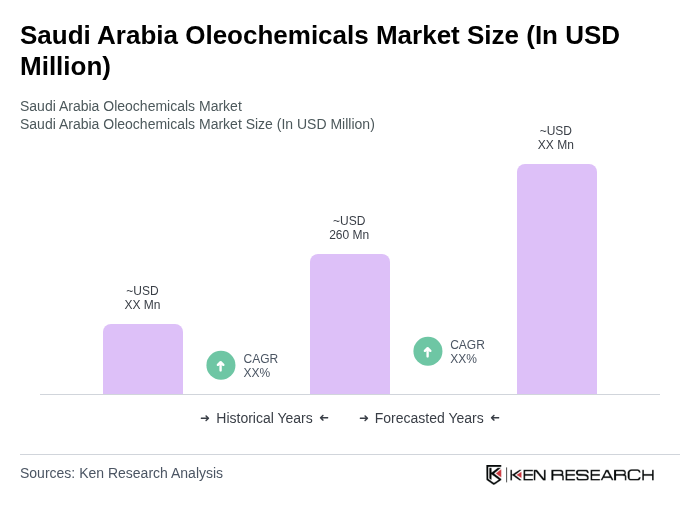
- The Saudi Arabia Oleochemicals Market is valued at USD 260 million, based on a five-year historical analysis. This growth is primarily driven by the increasing demand for bio-based and biodegradable products in home and personal care, lubricants, and specialty chemicals, as well as the rising awareness of sustainable alternatives across industrial users. The market is also supported by the government's initiatives to diversify the economy under Vision 2030, expand the downstream petrochemical and specialty chemicals base, and attract private investments into value-added chemicals production, which together are encouraging higher oleochemical production and consumption.
- Key clusters in this market are concentrated around major industrial and logistics hubs such as Riyadh, Jeddah, and Jubail, which dominate due to their strategic locations and robust industrial infrastructure. Riyadh serves as the political and economic hub and hosts corporate headquarters and downstream chemical demand centers, while Jubail Industrial City is known for its extensive petrochemical and chemical complexes, supporting feedstocks and infrastructure for oleochemical and related derivatives production and distribution. Jeddah, being a major Red Sea port and commercial center, enhances import–export flows, warehousing, and regional logistics for oleochemical-based products and raw materials.
- In 2023, the Saudi government strengthened environmental and industrial compliance requirements for chemical and related production facilities through instruments such as the Environmental Law issued by Royal Decree No. M/165 of 1441H and its implementing regulations, supervised by the National Center for Environmental Compliance, and the Saudi Green Initiative framework overseen by the Ministry of Energy and the Ministry of Environment, Water and Agriculture. These frameworks require new and expanded plants, including oleochemical and specialty chemical units, to implement environmental impact assessments, emissions and effluent controls, waste management plans, and continuous monitoring systems, thereby promoting cleaner production and alignment with Vision 2030 sustainability and economic diversification objectives.
Saudi Arabia Oleochemicals Market Segmentation
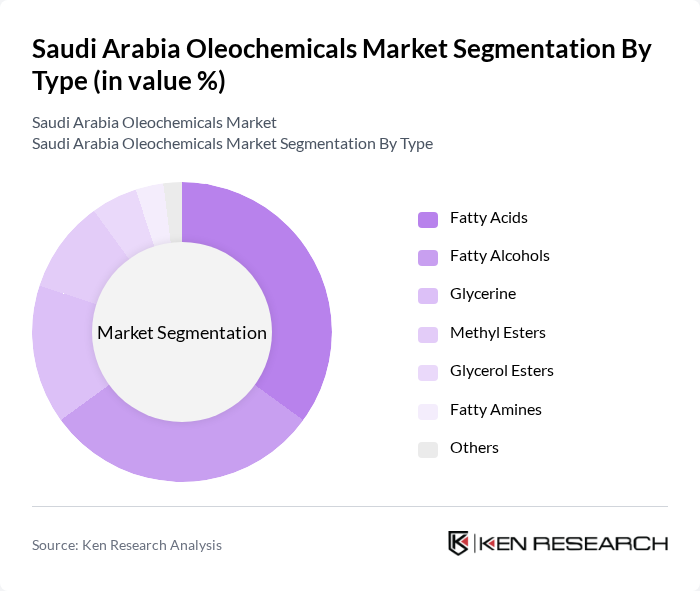
By Type:The oleochemicals market in Saudi Arabia is segmented into various types, including fatty acids, fatty alcohols, glycerine, methyl esters, glycerol esters, fatty amines, and others, in line with global product categorization for oleochemicals. Among these, fatty acids and fatty alcohols are the most prominent due to their extensive applications in soaps and detergents, personal care, cosmetics, surfactants, and a range of industrial formulations. The increasing demand for natural, plant-based, and biodegradable ingredients in home and personal care products, as well as in lubricants and plastic additives, is driving the growth of these segments.
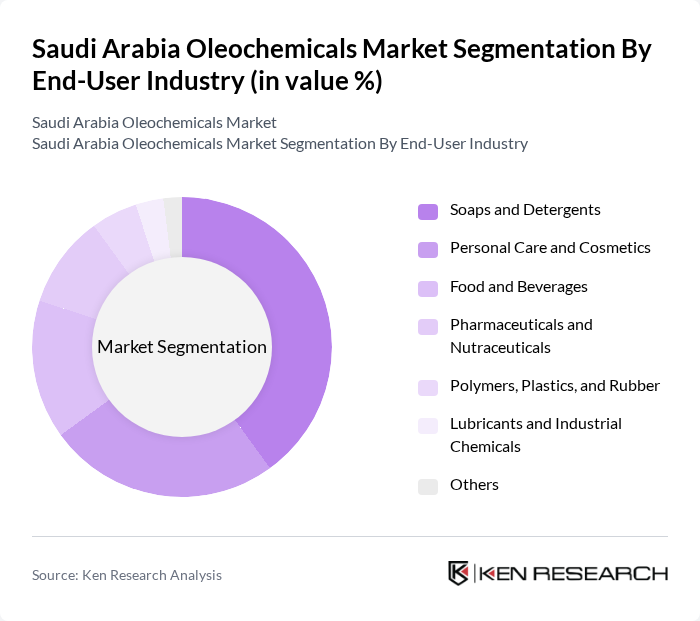
By End-User Industry:The end-user industries for oleochemicals in Saudi Arabia include soaps and detergents, personal care and cosmetics, food and beverages, pharmaceuticals and nutraceuticals, polymers, plastics, and rubber, lubricants and industrial chemicals, and others, consistent with global application patterns. The soaps and detergents segment is the largest due to the high demand for surfactants and cleaning products in both household and institutional cleaning, reinforced by heightened hygiene awareness and population growth in the region. Growing use of oleochemical-based emulsifiers, humectants, and texturizers in personal care, cosmetics, and food applications further supports downstream demand.
Saudi Arabia Oleochemicals Market Competitive Landscape
The Saudi Arabia Oleochemicals Market is characterized by a dynamic mix of regional and international players. Leading participants such as Saudi Basic Industries Corporation (SABIC), Saudi Kayan Petrochemical Company, Saudi Arabian Oil Company (Saudi Aramco), Saudi Industrial Investment Group (SIIG), Alujain Corporation, Tasnee – National Industrialization Company, Saudi Acrylic Acid Company (SAAC), Saudi Chevron Phillips Company, Rabigh Refining and Petrochemical Company (Petro Rabigh), Wilmar International Limited, Kuala Lumpur Kepong Berhad (KLK) – Oleochemicals Division, Emery Oleochemicals, BASF SE, Croda International Plc, Cargill, Incorporated contribute to innovation, geographic expansion, and service delivery in this space.
Saudi Arabia Oleochemicals Market Industry Analysis
Growth Drivers
- Increasing Demand for Biodegradable Products:The global market for biodegradable products is projected to reach $9.8 billion in future, driven by consumer preferences for sustainable options. In Saudi Arabia, the demand for biodegradable oleochemicals is expected to rise significantly, with the government aiming for a 30% reduction in plastic waste in future. This shift is supported by a growing population of approximately 36 million, increasingly aware of environmental impacts, thus propelling the oleochemicals market forward.
- Government Initiatives for Sustainable Development:Saudi Arabia's Vision 2030 emphasizes sustainability, with investments exceeding $700 billion in renewable energy and green technologies. The government has introduced incentives for companies adopting eco-friendly practices, including tax breaks and grants. This commitment is expected to boost the oleochemicals sector, as firms align their production processes with national sustainability goals, fostering a favorable environment for growth in renewable-based products.
- Expansion of the Food and Personal Care Industries:The food and personal care sectors in Saudi Arabia are projected to grow at a rate of 5.2% annually, reaching $25 billion in future. This growth is driving the demand for oleochemicals, which are essential in manufacturing natural ingredients for cosmetics and food additives. As consumer preferences shift towards organic and natural products, the oleochemicals market is positioned to benefit significantly from this trend.
Market Challenges
- Fluctuating Raw Material Prices:The prices of raw materials for oleochemicals, such as palm oil and fatty acids, have shown volatility, with palm oil prices fluctuating between $650 and $1,050 per metric ton in recent periods. This instability poses a significant challenge for manufacturers in Saudi Arabia, as it affects production costs and profit margins. Companies must develop strategies to mitigate these risks, such as diversifying suppliers or investing in alternative feedstocks.
- Competition from Petrochemical Products:The petrochemical industry in Saudi Arabia is well-established, with a market size of approximately $70 billion. This dominance presents a challenge for oleochemicals, as petrochemical products often offer lower prices and established supply chains. To compete effectively, oleochemical producers must emphasize the environmental benefits and sustainability of their products, which may require significant marketing and educational efforts to shift consumer perceptions.
Saudi Arabia Oleochemicals Market Future Outlook
The Saudi Arabia oleochemicals market is poised for significant transformation, driven by increasing consumer demand for sustainable products and government support for green initiatives. As the country invests in renewable energy and eco-friendly technologies, the oleochemicals sector will likely see innovations in product applications. Additionally, the rising popularity of natural ingredients in personal care and food industries will further enhance market growth, creating a robust landscape for future investments and developments.
Market Opportunities
- Growth in Renewable Energy Sector:The renewable energy sector in Saudi Arabia is expected to attract investments of $60 billion in future. This growth presents opportunities for oleochemical producers to develop bio-based products that align with renewable energy initiatives, enhancing their market presence and sustainability credentials.
- Development of New Oleochemical Applications:Emerging applications for oleochemicals in sectors such as bioplastics and biofuels are gaining traction. With the global bioplastics market projected to reach $30 billion in future, Saudi companies can capitalize on this trend by innovating and diversifying their product offerings, thus tapping into new revenue streams.
Scope of the Report
| Segment | Sub-Segments |
|---|---|
| By Type | Fatty Acids Fatty Alcohols Glycerine Methyl Esters Glycerol Esters Fatty Amines Others |
| By End-User Industry | Soaps and Detergents Personal Care and Cosmetics Food and Beverages Pharmaceuticals and Nutraceuticals Polymers, Plastics, and Rubber Lubricants and Industrial Chemicals Others |
| By Application | Soaps and Household Cleaning Products Industrial and Institutional Cleaners Personal Care Formulations (Emollients, Surfactants, Emulsifiers) Food Emulsifiers and Additives Lubricants, Greases, and Metalworking Fluids Plasticizers, Coatings, and Resins Biofuels and Biodiesel Others |
| By Feedstock Source | Imported Vegetable Oils (Palm, Palm Kernel, Coconut, Soy, Rapeseed, Sunflower) Local and Imported Animal Fats (Tallow and Others) Mixed / Blended Feedstock Others |
| By Sales Channel | Direct Sales to FMCG and Industrial Customers Distributors and Chemical Traders Trading Houses and Importers Online B2B Platforms Others |
| By Region | Central Region (including Riyadh) Eastern Region (including Jubail and Dammam) Western Region (including Jeddah, Makkah, and Madinah) Southern Region Northern Region |
| By Product Form | Liquid Solid / Flakes Powder / Granules Pastes and Gels Others |
Key Target Audience
Investors and Venture Capitalist Firms
Government and Regulatory Bodies (e.g., Saudi Arabian General Investment Authority, Ministry of Industry and Mineral Resources)
Manufacturers and Producers
Distributors and Retailers
Raw Material Suppliers
Industry Associations (e.g., Saudi Chemical Society)
Financial Institutions
Environmental Agencies (e.g., Saudi Arabian Environmental Protection Agency)
Players Mentioned in the Report:
Saudi Basic Industries Corporation (SABIC)
Saudi Kayan Petrochemical Company
Saudi Arabian Oil Company (Saudi Aramco)
Saudi Industrial Investment Group (SIIG)
Alujain Corporation
Tasnee National Industrialization Company
Saudi Acrylic Acid Company (SAAC)
Saudi Chevron Phillips Company
Rabigh Refining and Petrochemical Company (Petro Rabigh)
Wilmar International Limited
Kuala Lumpur Kepong Berhad (KLK) Oleochemicals Division
Emery Oleochemicals
BASF SE
Croda International Plc
Cargill, Incorporated
Table of Contents
Market Assessment Phase
1. Executive Summary and Approach
2. Saudi Arabia Oleochemicals Market Overview
2.1 Key Insights and Strategic Recommendations
2.2 Saudi Arabia Oleochemicals Market Overview
2.3 Definition and Scope
2.4 Evolution of Market Ecosystem
2.5 Timeline of Key Regulatory Milestones
2.6 Value Chain & Stakeholder Mapping
2.7 Business Cycle Analysis
2.8 Policy & Incentive Landscape
3. Saudi Arabia Oleochemicals Market Analysis
3.1 Growth Drivers
3.1.1 Increasing Demand for Biodegradable Products
3.1.2 Government Initiatives for Sustainable Development
3.1.3 Expansion of the Food and Personal Care Industries
3.1.4 Rising Awareness of Environmental Issues
3.2 Market Challenges
3.2.1 Fluctuating Raw Material Prices
3.2.2 Limited Technological Advancements
3.2.3 Regulatory Compliance Costs
3.2.4 Competition from Petrochemical Products
3.3 Market Opportunities
3.3.1 Growth in Renewable Energy Sector
3.3.2 Development of New Oleochemical Applications
3.3.3 Export Potential to Emerging Markets
3.3.4 Investment in R&D for Innovative Products
3.4 Market Trends
3.4.1 Shift Towards Sustainable and Green Chemistry
3.4.2 Increasing Use of Oleochemicals in Biofuels
3.4.3 Rising Popularity of Natural Surfactants
3.4.4 Growth of E-commerce in the Personal Care Sector
3.5 Government Regulation
3.5.1 Environmental Protection Laws
3.5.2 Safety Standards for Chemical Manufacturing
3.5.3 Incentives for Renewable Resource Utilization
3.5.4 Import Tariffs on Non-Biodegradable Products
4. SWOT Analysis
5. Stakeholder Analysis
6. Porter's Five Forces Analysis
7. Saudi Arabia Oleochemicals Market Market Size, 2019-2024
7.1 By Value
7.2 By Volume
7.3 By Average Selling Price
8. Saudi Arabia Oleochemicals Market Segmentation
8.1 By Type
8.1.1 Fatty Acids
8.1.2 Fatty Alcohols
8.1.3 Glycerine
8.1.4 Methyl Esters
8.1.5 Glycerol Esters
8.1.6 Fatty Amines
8.1.7 Others
8.2 By End-User Industry
8.2.1 Soaps and Detergents
8.2.2 Personal Care and Cosmetics
8.2.3 Food and Beverages
8.2.4 Pharmaceuticals and Nutraceuticals
8.2.5 Polymers, Plastics, and Rubber
8.2.6 Lubricants and Industrial Chemicals
8.2.7 Others
8.3 By Application
8.3.1 Soaps and Household Cleaning Products
8.3.2 Industrial and Institutional Cleaners
8.3.3 Personal Care Formulations (Emollients, Surfactants, Emulsifiers)
8.3.4 Food Emulsifiers and Additives
8.3.5 Lubricants, Greases, and Metalworking Fluids
8.3.6 Plasticizers, Coatings, and Resins
8.3.7 Biofuels and Biodiesel
8.3.8 Others
8.4 By Feedstock Source
8.4.1 Imported Vegetable Oils (Palm, Palm Kernel, Coconut, Soy, Rapeseed, Sunflower)
8.4.2 Local and Imported Animal Fats (Tallow and Others)
8.4.3 Mixed / Blended Feedstock
8.4.4 Others
8.5 By Sales Channel
8.5.1 Direct Sales to FMCG and Industrial Customers
8.5.2 Distributors and Chemical Traders
8.5.3 Trading Houses and Importers
8.5.4 Online B2B Platforms
8.5.5 Others
8.6 By Region
8.6.1 Central Region (including Riyadh)
8.6.2 Eastern Region (including Jubail and Dammam)
8.6.3 Western Region (including Jeddah, Makkah, and Madinah)
8.6.4 Southern Region
8.6.5 Northern Region
8.7 By Product Form
8.7.1 Liquid
8.7.2 Solid / Flakes
8.7.3 Powder / Granules
8.7.4 Pastes and Gels
8.7.5 Others
9. Saudi Arabia Oleochemicals Market Competitive Analysis
9.1 Market Share of Key Players
9.2 Cross Comparison of Key Players
9.2.1 Company Name
9.2.2 Global Group Size (Large, Medium, Small)
9.2.3 Revenue from Oleochemicals in Saudi Arabia
9.2.4 3-Year Revenue CAGR in Saudi Arabia Oleochemicals
9.2.5 Oleochemical Production Capacity in / for Saudi Arabia (KT per year)
9.2.6 Capacity Utilization Rate in Saudi Arabia (%)
9.2.7 Product Portfolio Breadth (Number of Oleochemical Product Families)
9.2.8 Share of Bio?based / RSPO?Certified Products (%)
9.2.9 R&D Intensity (R&D Spend as % of Oleochemical Sales)
9.2.10 Average Realized Price per Tonne in Saudi Arabia (USD/tonne)
9.2.11 Sales Mix by End?User Sector (Top 3 Sectors % of Revenue)
9.2.12 Distribution Reach in Saudi Arabia (Number of Key Accounts / Distributors)
9.2.13 Local Value Addition (Share of Local Processing vs Imports of Finished Oleochemicals)
9.2.14 ESG / Sustainability Scores and Certifications (RSPO, ISO 14001, etc.)
9.3 SWOT Analysis of Top Players
9.4 Pricing Analysis
9.5 Detailed Profile of Major Companies
9.5.1 Saudi Basic Industries Corporation (SABIC)
9.5.2 Saudi Kayan Petrochemical Company
9.5.3 Saudi Arabian Oil Company (Saudi Aramco)
9.5.4 Saudi Industrial Investment Group (SIIG)
9.5.5 Alujain Corporation
9.5.6 Tasnee – National Industrialization Company
9.5.7 Saudi Acrylic Acid Company (SAAC)
9.5.8 Saudi Chevron Phillips Company
9.5.9 Rabigh Refining and Petrochemical Company (Petro Rabigh)
9.5.10 Wilmar International Limited
9.5.11 Kuala Lumpur Kepong Berhad (KLK) – Oleochemicals Division
9.5.12 Emery Oleochemicals
9.5.13 BASF SE
9.5.14 Croda International Plc
9.5.15 Cargill, Incorporated
10. Saudi Arabia Oleochemicals Market End-User Analysis
10.1 Procurement Behavior of Key Ministries
10.1.1 Ministry of Environment
10.1.2 Ministry of Health
10.1.3 Ministry of Industry and Mineral Resources
10.1.4 Ministry of Commerce
10.2 Corporate Spend on Infrastructure & Energy
10.2.1 Investment in Sustainable Practices
10.2.2 Budget Allocation for R&D
10.2.3 Expenditure on Compliance and Safety
10.2.4 Spending on Technology Upgrades
10.3 Pain Point Analysis by End-User Category
10.3.1 Cost Management in Production
10.3.2 Quality Assurance Challenges
10.3.3 Supply Chain Disruptions
10.3.4 Regulatory Compliance Issues
10.4 User Readiness for Adoption
10.4.1 Awareness of Oleochemical Benefits
10.4.2 Training and Skill Development Needs
10.4.3 Infrastructure Readiness
10.4.4 Financial Readiness for Transition
10.5 Post-Deployment ROI and Use Case Expansion
10.5.1 Measurement of Performance Metrics
10.5.2 Case Studies of Successful Implementations
10.5.3 Feedback Mechanisms for Continuous Improvement
10.5.4 Expansion into New Applications
11. Saudi Arabia Oleochemicals Market Future Size, 2025-2030
11.1 By Value
11.2 By Volume
11.3 By Average Selling Price
Go-To-Market Strategy Phase
1. Whitespace Analysis + Business Model Canvas
1.1 Identification of Market Gaps
1.2 Business Model Framework
2. Marketing and Positioning Recommendations
2.1 Branding Strategies
2.2 Product USPs
3. Distribution Plan
3.1 Urban Retail Strategies
3.2 Rural NGO Tie-ups
4. Channel & Pricing Gaps
4.1 Underserved Routes
4.2 Pricing Bands
5. Unmet Demand & Latent Needs
5.1 Category Gaps
5.2 Consumer Segments
6. Customer Relationship
6.1 Loyalty Programs
6.2 After-sales Service
7. Value Proposition
7.1 Sustainability Initiatives
7.2 Integrated Supply Chains
8. Key Activities
8.1 Regulatory Compliance
8.2 Branding Efforts
8.3 Distribution Setup
9. Entry Strategy Evaluation
9.1 Domestic Market Entry Strategy
9.1.1 Product Mix Considerations
9.1.2 Pricing Band Analysis
9.1.3 Packaging Strategies
9.2 Export Entry Strategy
9.2.1 Target Countries
9.2.2 Compliance Roadmap
10. Entry Mode Assessment
10.1 Joint Ventures
10.2 Greenfield Investments
10.3 Mergers & Acquisitions
10.4 Distributor Model
11. Capital and Timeline Estimation
11.1 Capital Requirements
11.2 Timelines for Implementation
12. Control vs Risk Trade-Off
12.1 Ownership Considerations
12.2 Partnerships Evaluation
13. Profitability Outlook
13.1 Breakeven Analysis
13.2 Long-term Sustainability Strategies
14. Potential Partner List
14.1 Distributors
14.2 Joint Ventures
14.3 Acquisition Targets
15. Execution Roadmap
15.1 Phased Plan for Market Entry
15.1.1 Market Setup
15.1.2 Market Entry
15.1.3 Growth Acceleration
15.1.4 Scale & Stabilize
15.2 Key Activities and Milestones
15.2.1 Milestone Planning
15.2.2 Activity Tracking
Research Methodology
Phase 1: Approach1
Desk Research
- Analysis of industry reports from the Saudi Arabian Ministry of Industry and Mineral Resources
- Review of market studies published by local and international research firms
- Examination of trade statistics and import/export data from the Saudi Customs Authority
Primary Research
- Interviews with key stakeholders in the oleochemical supply chain, including manufacturers and distributors
- Surveys conducted with industry experts and consultants specializing in the chemical sector
- Field visits to production facilities to gather insights on operational practices and capacity
Validation & Triangulation
- Cross-verification of data from multiple sources to ensure accuracy and reliability
- Engagement with an expert panel for qualitative insights and validation of quantitative findings
- Sanity checks through comparison with historical market trends and growth patterns
Phase 2: Market Size Estimation1
Top-down Assessment
- Estimation of total market size based on national production and consumption statistics
- Segmentation of the market by product type, including fatty acids, glycerol, and surfactants
- Incorporation of government initiatives promoting the use of bio-based chemicals
Bottom-up Modeling
- Collection of production volume data from leading oleochemical manufacturers in Saudi Arabia
- Analysis of pricing trends for various oleochemical products across different sectors
- Calculation of market size based on production volume multiplied by average selling prices
Forecasting & Scenario Analysis
- Development of forecasting models using historical growth rates and market drivers
- Scenario analysis based on potential regulatory changes and shifts in consumer preferences
- Creation of multiple growth scenarios (baseline, optimistic, and pessimistic) through 2030
Phase 3: CATI Sample Composition1
| Scope Item/Segment | Sample Size | Target Respondent Profiles |
|---|---|---|
| Fatty Acids Production | 100 | Production Managers, Quality Control Supervisors |
| Glycerol Market Insights | 80 | Sales Directors, Product Managers |
| Surfactants Application in Personal Care | 70 | R&D Managers, Marketing Executives |
| Bio-based Chemicals Adoption | 60 | Sustainability Officers, Regulatory Affairs Managers |
| Oleochemical Supply Chain Dynamics | 90 | Logistics Coordinators, Procurement Specialists |
Frequently Asked Questions
What is the current value of the Saudi Arabia Oleochemicals Market?
The Saudi Arabia Oleochemicals Market is valued at approximately USD 260 million, reflecting a five-year historical analysis. This valuation highlights the market's growth driven by increasing demand for bio-based and biodegradable products across various industries.
What factors are driving the growth of the oleochemicals market in Saudi Arabia?
Which regions in Saudi Arabia are key clusters for oleochemical production?
What are the main types of oleochemicals produced in Saudi Arabia?
Other Regional/Country Reports
Malaysia Oleochemicals Market
KSA Oleochemicals Market
APAC Oleochemicals Market
SEA Oleochemicals Market
Other Adjacent Reports
Oman Soaps and Detergents Market
Qatar Food and Beverages Market
Oman Pharmaceuticals and Nutraceuticals Market
Belgium Polymers and Plastics Market
Saudi Arabia Lubricants Market Size, Share & Forecast, By Product Type, End-Use Industry & Technology, 2026–2032Bahrain Bioplastics Market Report Size Share Growth Drivers Trends Opportunities & Forecast 2025–2030Middle East Biofuels Market Report Size Share Growth Drivers Trends Opportunities & Forecast 2025–2030Why Buy From Us?

What makes us stand out is that our consultants follow Robust, Refine and Result (RRR) methodology. Robust for clear definitions, approaches and sanity checking, Refine for differentiating respondents' facts and opinions, and Result for presenting data with story.

We have set a benchmark in the industry by offering our clients with syndicated and customized market research reports featuring coverage of entire market as well as meticulous research and analyst insights.

While we don't replace traditional research, we flip the method upside down. Our dual approach of Top Bottom & Bottom Top ensures quality deliverable by not just verifying company fundamentals but also looking at the sector and macroeconomic factors.

With one step in the future, our research team constantly tries to show you the bigger picture. We help with some of the tough questions you may encounter along the way: How is the industry positioned? Best marketing channel? KPI's of competitors? By aligning every element, we help maximize success.

Our report gives you instant access to the answers and sources that other companies might choose to hide. We elaborate each steps of research methodology we have used and showcase you the sample size to earn your trust.

If you need any support, we are here! We pride ourselves on universe strength, data quality, and quick, friendly, and professional service.