Saudi Arabia Wearable Medical Devices Market Report Size Share Growth Drivers Trends Opportunities & Forecast 2025–2030

Saudi Arabia wearable medical devices market is valued at USD 310 million, growing due to rising chronic diseases, Vision 2030 initiatives, and innovations in diagnostic and therapeutic devices.

Region:Middle East

Author(s):Geetanshi

Product Code:KRAC7857

Pages:94

Published On:December 2025

About the Report

Base Year 2024

Saudi Arabia Wearable Medical Devices Market Overview

  • The Saudi Arabia Wearable Medical Devices Market is valued at USD 310 million, based on a five-year historical analysis. This growth is primarily driven by the increasing prevalence of chronic diseases such as diabetes and cardiovascular conditions, rising health awareness among consumers, and advancements in technology that enhance the functionality of wearable devices. The market is also supported by a growing demand for remote patient monitoring solutions, which proved particularly successful during the COVID-19 pandemic, and the integration of artificial intelligence and machine learning for better predictive analysis and personalized healthcare recommendations.
  • Key cities dominating the market include Riyadh, Jeddah, and Dammam. Riyadh, as the capital, serves as a hub for healthcare innovation and investment, while Jeddah and Dammam benefit from their strategic locations and access to a large population. The concentration of healthcare facilities and technology companies in these cities further drives market growth.
  • The Saudi Arabian government's Vision 2030 initiative emphasizes the integration of digital health technologies, including wearable medical devices, into the healthcare system. In 2021, the National Health Information Center under the Ministry of Health launched the Saudi Telehealth Network to bridge the gap between healthcare facilities and primary health centres and hospitals in remote areas via telemedicine, establishing Saudi Arabia as the first country in the Middle East to provide e-health via SEHA Virtual Hospital. Additionally, in August 2025, the Saudi Food and Drug Authority (SFDA) granted marketing authorization for a locally developed hand-worn medical device by King Saud University, reflecting the Kingdom's increasing regulatory support for domestic medical technology innovation and patent protection.
Saudi Arabia Wearable Medical Devices Market Report Size Share Growth Drivers Trends Opportunities & Forecast 2025–2030 Size

Saudi Arabia Wearable Medical Devices Market Segmentation

By Product Type:The product type segmentation includes various categories of wearable medical devices that cater to different health monitoring and management needs. The dominant sub-segment is Diagnostic Devices, which includes ECG monitors, blood pressure monitors, and glucose monitors. These devices are widely used due to the increasing prevalence of chronic diseases such as diabetes and hypertension. Following closely are Smartwatches with health monitoring features and Fitness trackers, which have gained popularity among health-conscious consumers for their convenience and multifunctionality. The market is also seeing growth in Therapeutic Devices and Smart clothing, driven by advancements in technology and consumer demand for integrated health solutions. The therapeutic device segment is expected to experience accelerated growth, with a strong pipeline of innovative solutions such as wearable pain relievers, insulin management devices, and intelligent asthma management products.
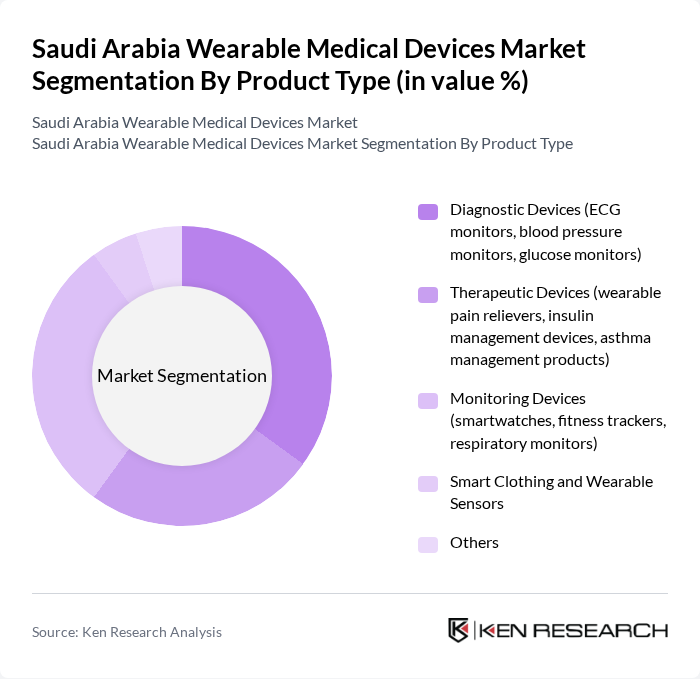
Saudi Arabia Wearable Medical Devices Market segmentation by Product Type.

By Form Factor/Site:The form factor segmentation categorizes wearable medical devices based on their design and how they are worn or used. The leading sub-segment is Strap/Clap/Bracelet devices, which accounted for 51% market share in 2023 due to their ease of use and comfort. Handheld devices are also gaining traction, particularly for diagnostic purposes, while Headband devices and Shoe sensors are emerging as innovative solutions for specific health monitoring needs. The market is witnessing a gradual shift towards more integrated and multifunctional devices, which is driving the growth of various form factors. Advancements in technology, including ECG tracking features along with pulse rate and respiratory monitoring featured with Bluetooth and cloud connectivity, are further expected to drive the market.
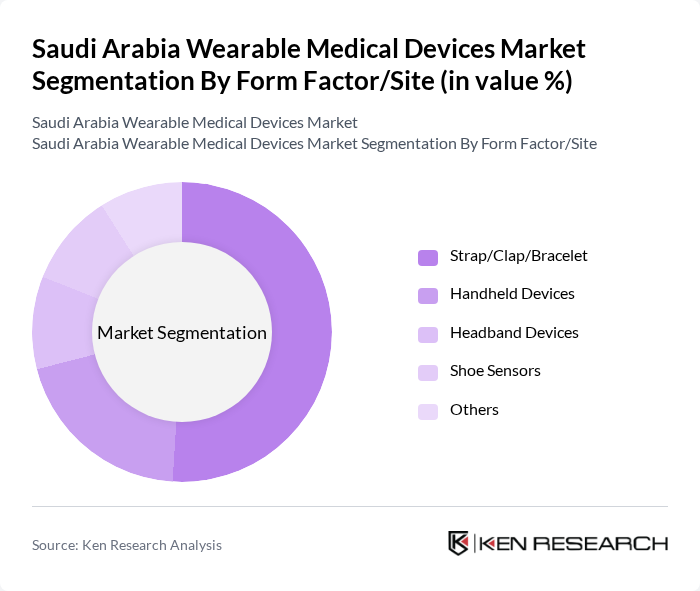
Saudi Arabia Wearable Medical Devices Market segmentation by Form Factor/Site.

Saudi Arabia Wearable Medical Devices Market Competitive Landscape

The Saudi Arabia Wearable Medical Devices Market is characterized by a dynamic mix of regional and international players. Leading participants such as Koninklijke Philips N.V. (Philips Healthcare), Garmin Ltd., Apple Inc., Covidien (Medtronic), Polar Electro, Sotera Wireless, Huawei Device Co., Ltd., Omron Healthcare Co., Ltd., Samsung Electronics, Xiaomi Corporation, Abbott Laboratories, AliveCor, Withings, Oura Health, and King Saud University (locally developed medical devices) contribute to innovation, geographic expansion, and service delivery in this space.

Koninklijke Philips N.V. (Philips Healthcare)

1891

Amsterdam, Netherlands

Garmin Ltd.

1989

Olathe, Kansas, USA

Apple Inc.

1976

Cupertino, California, USA

Covidien (Medtronic)

2000

Dublin, Ireland

Polar Electro

1977

Finland

Company

Establishment Year

Headquarters

Company Size Classification (Large, Medium, or Small)

Year-over-Year Revenue Growth Rate (%)

Market Penetration Rate in Saudi Arabia (%)

Customer Retention Rate (%)

Pricing Strategy (Premium, Mid-range, Budget)

Product Innovation Rate (New products/year)

Saudi Arabia Wearable Medical Devices Market Industry Analysis

Growth Drivers

  • Increasing Prevalence of Chronic Diseases:The rise in chronic diseases such as diabetes and cardiovascular conditions is a significant driver for the wearable medical devices market in Saudi Arabia. According to the Saudi Ministry of Health, approximately 8 million people are living with diabetes, and cardiovascular diseases account for 38% of all deaths in the country. This alarming trend necessitates innovative health monitoring solutions, propelling the demand for wearable devices that can track vital signs and manage health conditions effectively.
  • Rising Health Awareness Among Consumers:Health awareness in Saudi Arabia is on the rise, with a growing number of consumers seeking proactive health management solutions. The World Health Organization reported that 65% of the Saudi population is now aware of the benefits of preventive healthcare. This shift is driving the adoption of wearable medical devices, as individuals increasingly prioritize health monitoring and lifestyle management, leading to a surge in demand for fitness trackers and health monitoring wearables.
  • Technological Advancements in Wearable Devices:The rapid advancement in technology is significantly enhancing the capabilities of wearable medical devices. Innovations such as improved sensors, longer battery life, and enhanced connectivity features are making these devices more appealing. For instance, the introduction of 5G technology is expected to facilitate real-time health data transmission, which is crucial for remote patient monitoring. This technological evolution is expected to drive market growth as consumers seek more sophisticated health management tools.

Market Challenges

  • High Cost of Advanced Wearable Medical Devices:One of the primary challenges facing the wearable medical devices market in Saudi Arabia is the high cost associated with advanced devices. Many cutting-edge wearables can range from SAR 1,800 to SAR 5,500, which may be prohibitive for a significant portion of the population. This financial barrier limits accessibility and adoption, particularly among lower-income groups, hindering overall market growth despite increasing demand.
  • Data Privacy and Security Concerns:As wearable medical devices collect sensitive health data, concerns regarding data privacy and security are paramount. A survey by the Saudi Data and Artificial Intelligence Authority indicated that 75% of consumers are worried about how their health data is managed. This apprehension can deter potential users from adopting wearable technologies, posing a significant challenge to market expansion as companies must address these concerns to build consumer trust.

Saudi Arabia Wearable Medical Devices Market Future Outlook

The future of the wearable medical devices market in Saudi Arabia appears promising, driven by technological advancements and increasing health consciousness among the population. As the government continues to promote digital health initiatives, the integration of AI and machine learning into wearable devices will enhance their functionality. Furthermore, the expansion of telehealth services will facilitate remote patient monitoring, making healthcare more accessible. These trends indicate a robust growth trajectory for the market, with significant potential for innovation and collaboration in the healthcare sector.

Market Opportunities

  • Expansion of Telehealth Services:The growing acceptance of telehealth services presents a significant opportunity for wearable medical devices. With the Saudi government investing in telehealth infrastructure, the integration of wearables can enhance remote patient monitoring, allowing healthcare providers to offer timely interventions and improve patient outcomes, thereby increasing the demand for these devices.
  • Integration of AI and Machine Learning:The incorporation of AI and machine learning into wearable medical devices can revolutionize health monitoring. These technologies can analyze vast amounts of health data to provide personalized insights and predictive analytics, enhancing user engagement and adherence to health regimens. This innovation is likely to attract more consumers, driving market growth significantly.

Scope of the Report

SegmentSub-Segments
By Product Type

Diagnostic Devices (ECG monitors, blood pressure monitors, glucose monitors)

Therapeutic Devices (wearable pain relievers, insulin management devices, asthma management products)

Smartwatches with health monitoring features

Fitness trackers

Smart clothing and wearable sensors

Respiratory monitoring devices

Others

By Form Factor/Site

Strap/Clap/Bracelet (51.51% market share in 2023)

Handheld devices

Headband devices

Shoe sensors

Others

By Application

Home healthcare (largest revenue share in 2023)

Remote patient monitoring (fastest growing segment)

Sports and fitness

Chronic disease management

Others

By End-User

Hospitals and healthcare facilities

Home healthcare providers

Fitness and wellness centers

Research institutions and clinical trial centers

Individual consumers

By Distribution Channel

Online retail and e-commerce platforms

Offline retail (pharmacies, medical stores)

Direct sales through manufacturers

Healthcare provider partnerships

Distributors and wholesalers

By Technology

Bluetooth-enabled devices with cloud connectivity

Wi-Fi-enabled devices

Cellular-enabled devices

NFC-enabled devices

AI and machine learning-integrated devices

By Region

Central Region (Riyadh)

Eastern Region

Western Region (Jeddah, Mecca)

Southern Region

Northern Region

By User Demographics

Age group (Children, Adults, Seniors)

Gender (Male, Female)

Income level (Low, Middle, High)

Health status (Chronic disease patients, fitness enthusiasts, general wellness)

Key Target Audience

Investors and Venture Capitalist Firms

Government and Regulatory Bodies (e.g., Saudi Food and Drug Authority, Ministry of Health)

Manufacturers and Producers

Distributors and Retailers

Healthcare Providers and Hospitals

Insurance Companies and Payers

Technology Providers

Industry Associations and Trade Organizations

Players Mentioned in the Report:

Koninklijke Philips N.V. (Philips Healthcare)

Garmin Ltd.

Apple Inc.

Covidien (Medtronic)

Polar Electro

Sotera Wireless

Huawei Device Co., Ltd.

Omron Healthcare Co., Ltd.

Samsung Electronics

Xiaomi Corporation

Abbott Laboratories

AliveCor

Withings

Oura Health

King Saud University (locally developed medical devices)

Table of Contents

Market Assessment Phase

1. Executive Summary and Approach


2. Saudi Arabia Wearable Medical Devices Market Overview

2.1 Key Insights and Strategic Recommendations

2.2 Saudi Arabia Wearable Medical Devices Market Overview

2.3 Definition and Scope

2.4 Evolution of Market Ecosystem

2.5 Timeline of Key Regulatory Milestones

2.6 Value Chain & Stakeholder Mapping

2.7 Business Cycle Analysis

2.8 Policy & Incentive Landscape


3. Saudi Arabia Wearable Medical Devices Market Analysis

3.1 Growth Drivers

3.1.1 Increasing prevalence of chronic diseases
3.1.2 Rising health awareness among consumers
3.1.3 Technological advancements in wearable devices
3.1.4 Government initiatives promoting digital health

3.2 Market Challenges

3.2.1 High cost of advanced wearable medical devices
3.2.2 Data privacy and security concerns
3.2.3 Limited consumer awareness and education
3.2.4 Regulatory hurdles in device approval

3.3 Market Opportunities

3.3.1 Expansion of telehealth services
3.3.2 Integration of AI and machine learning
3.3.3 Growing demand for remote patient monitoring
3.3.4 Collaborations with healthcare providers

3.4 Market Trends

3.4.1 Increasing adoption of fitness trackers
3.4.2 Shift towards preventive healthcare
3.4.3 Rise in personalized healthcare solutions
3.4.4 Development of multi-functional wearable devices

3.5 Government Regulation

3.5.1 Implementation of health technology assessment
3.5.2 Standards for data interoperability
3.5.3 Guidelines for clinical validation of devices
3.5.4 Regulations on data protection and privacy

4. SWOT Analysis


5. Stakeholder Analysis


6. Porter's Five Forces Analysis


7. Saudi Arabia Wearable Medical Devices Market Market Size, 2019-2024

7.1 By Value

7.2 By Volume

7.3 By Average Selling Price


8. Saudi Arabia Wearable Medical Devices Market Segmentation

8.1 By Product Type

8.1.1 Diagnostic Devices (ECG monitors, blood pressure monitors, glucose monitors)
8.1.2 Therapeutic Devices (wearable pain relievers, insulin management devices, asthma management products)
8.1.3 Smartwatches with health monitoring features
8.1.4 Fitness trackers
8.1.5 Smart clothing and wearable sensors
8.1.6 Respiratory monitoring devices
8.1.7 Others

8.2 By Form Factor/Site

8.2.1 Strap/Clap/Bracelet (51.51% market share in 2023)
8.2.2 Handheld devices
8.2.3 Headband devices
8.2.4 Shoe sensors
8.2.5 Others

8.3 By Application

8.3.1 Home healthcare (largest revenue share in 2023)
8.3.2 Remote patient monitoring (fastest growing segment)
8.3.3 Sports and fitness
8.3.4 Chronic disease management
8.3.5 Others

8.4 By End-User

8.4.1 Hospitals and healthcare facilities
8.4.2 Home healthcare providers
8.4.3 Fitness and wellness centers
8.4.4 Research institutions and clinical trial centers
8.4.5 Individual consumers

8.5 By Distribution Channel

8.5.1 Online retail and e-commerce platforms
8.5.2 Offline retail (pharmacies, medical stores)
8.5.3 Direct sales through manufacturers
8.5.4 Healthcare provider partnerships
8.5.5 Distributors and wholesalers

8.6 By Technology

8.6.1 Bluetooth-enabled devices with cloud connectivity
8.6.2 Wi-Fi-enabled devices
8.6.3 Cellular-enabled devices
8.6.4 NFC-enabled devices
8.6.5 AI and machine learning-integrated devices

8.7 By Region

8.7.1 Central Region (Riyadh)
8.7.2 Eastern Region
8.7.3 Western Region (Jeddah, Mecca)
8.7.4 Southern Region
8.7.5 Northern Region

8.8 By User Demographics

8.8.1 Age group (Children, Adults, Seniors)
8.8.2 Gender (Male, Female)
8.8.3 Income level (Low, Middle, High)
8.8.4 Health status (Chronic disease patients, fitness enthusiasts, general wellness)

9. Saudi Arabia Wearable Medical Devices Market Competitive Analysis

9.1 Market Share of Key Players

9.2 Cross Comparison of Key Players

9.2.1 Company Name
9.2.2 Company Size Classification (Large, Medium, or Small)
9.2.3 Year-over-Year Revenue Growth Rate (%)
9.2.4 Market Penetration Rate in Saudi Arabia (%)
9.2.5 Customer Retention Rate (%)
9.2.6 Pricing Strategy (Premium, Mid-range, Budget)
9.2.7 Product Innovation Rate (New products/year)
9.2.8 Distribution Channel Efficiency Score
9.2.9 Brand Recognition Score (1-10)
9.2.10 Customer Satisfaction Index (NPS or CSAT score)

9.3 SWOT Analysis of Top Players

9.4 Pricing Analysis

9.5 Detailed Profile of Major Companies

9.5.1 Koninklijke Philips N.V. (Philips Healthcare)
9.5.2 Garmin Ltd.
9.5.3 Apple Inc.
9.5.4 Covidien (Medtronic)
9.5.5 Polar Electro
9.5.6 Sotera Wireless
9.5.7 Huawei Device Co., Ltd.
9.5.8 Omron Healthcare Co., Ltd.
9.5.9 Samsung Electronics
9.5.10 Xiaomi Corporation
9.5.11 Abbott Laboratories
9.5.12 AliveCor
9.5.13 Withings
9.5.14 Oura Health
9.5.15 King Saud University (locally developed medical devices)

10. Saudi Arabia Wearable Medical Devices Market End-User Analysis

10.1 Procurement Behavior of Key Ministries

10.1.1 Ministry of Health
10.1.2 Ministry of Education
10.1.3 Ministry of Defense
10.1.4 Ministry of Interior
10.1.5 Others

10.2 Corporate Spend on Infrastructure & Energy

10.2.1 Healthcare sector investments
10.2.2 Technology adoption in healthcare
10.2.3 Research and development funding
10.2.4 Others

10.3 Pain Point Analysis by End-User Category

10.3.1 Hospitals
10.3.2 Home healthcare providers
10.3.3 Fitness centers
10.3.4 Research institutions
10.3.5 Others

10.4 User Readiness for Adoption

10.4.1 Awareness levels
10.4.2 Training and support needs
10.4.3 Technology acceptance
10.4.4 Others

10.5 Post-Deployment ROI and Use Case Expansion

10.5.1 Cost savings analysis
10.5.2 User feedback and improvement
10.5.3 Expansion into new use cases
10.5.4 Others

11. Saudi Arabia Wearable Medical Devices Market Future Size, 2025-2030

11.1 By Value

11.2 By Volume

11.3 By Average Selling Price


Go-To-Market Strategy Phase

1. Whitespace Analysis + Business Model Canvas

1.1 Market gaps identification

1.2 Business model development

1.3 Value proposition analysis

1.4 Competitive landscape overview

1.5 Customer segmentation

1.6 Revenue stream identification

1.7 Cost structure analysis


2. Marketing and Positioning Recommendations

2.1 Branding strategies

2.2 Product USPs

2.3 Target audience identification

2.4 Marketing channels selection

2.5 Messaging and communication strategy

2.6 Performance metrics

2.7 Budget allocation


3. Distribution Plan

3.1 Urban retail strategy

3.2 Rural NGO tie-ups

3.3 E-commerce integration

3.4 Partnerships with healthcare providers

3.5 Logistics and supply chain management

3.6 Distribution channel optimization

3.7 Performance tracking


4. Channel & Pricing Gaps

4.1 Underserved routes

4.2 Pricing bands analysis

4.3 Competitor pricing comparison

4.4 Customer willingness to pay

4.5 Pricing strategy recommendations

4.6 Discount and promotion strategies

4.7 Monitoring and adjustment


5. Unmet Demand & Latent Needs

5.1 Category gaps identification

5.2 Consumer segments analysis

5.3 Product development opportunities

5.4 Market entry strategies

5.5 Customer feedback incorporation

5.6 Future trends forecasting

5.7 Strategic partnerships exploration


6. Customer Relationship

6.1 Loyalty programs design

6.2 After-sales service enhancement

6.3 Customer engagement strategies

6.4 Feedback loops establishment

6.5 Community building initiatives

6.6 Customer education programs


Research Methodology

ApproachModellingSample

Phase 1: Approach1

Desk Research

  • Analysis of market reports from healthcare authorities in Saudi Arabia
  • Review of industry publications and white papers on wearable medical devices
  • Examination of demographic and health statistics from the Saudi Ministry of Health

Primary Research

  • Interviews with healthcare professionals and specialists in wearable technology
  • Surveys conducted with patients using wearable medical devices
  • Focus groups with stakeholders in the healthcare and technology sectors

Validation & Triangulation

  • Cross-validation of findings through multiple data sources including government and industry reports
  • Triangulation of insights from primary interviews and secondary data analysis
  • Sanity checks through expert panels comprising industry veterans and analysts

Phase 2: Market Size Estimation1

Top-down Assessment

  • Estimation of market size based on national healthcare expenditure trends
  • Segmentation of the market by device type, application, and end-user demographics
  • Incorporation of government initiatives promoting digital health solutions

Bottom-up Modeling

  • Collection of sales data from leading manufacturers of wearable medical devices
  • Estimation of market penetration rates across different healthcare segments
  • Analysis of pricing strategies and revenue models of key players in the market

Forecasting & Scenario Analysis

  • Utilization of time-series analysis to project market growth through 2030
  • Scenario modeling based on technological advancements and regulatory changes
  • Development of best-case, worst-case, and most-likely market scenarios

Phase 3: CATI Sample Composition1

Scope Item/SegmentSample SizeTarget Respondent Profiles
Healthcare Providers120Doctors, Nurses, Healthcare Administrators
Patients Using Wearable Devices90Chronic Disease Patients, Fitness Enthusiasts
Technology Developers75Product Managers, R&D Engineers
Regulatory Bodies45Policy Makers, Compliance Officers
Insurance Companies60Underwriters, Claims Adjusters

Frequently Asked Questions

What is the current value of the Saudi Arabia Wearable Medical Devices Market?

The Saudi Arabia Wearable Medical Devices Market is valued at approximately USD 310 million, reflecting a significant growth driven by the increasing prevalence of chronic diseases, rising health awareness, and technological advancements in wearable devices.

What are the main drivers of growth in the Saudi Arabia Wearable Medical Devices Market?

Which cities are leading in the Saudi Arabia Wearable Medical Devices Market?

How does the Saudi government's Vision 2030 initiative impact the market?

Why Buy From Us?

Refine Robust Result (RRR) Framework

What makes us stand out is that our consultants follow Robust, Refine and Result (RRR) methodology. Robust for clear definitions, approaches and sanity checking, Refine for differentiating respondents' facts and opinions, and Result for presenting data with story.

Our Reach Is Unmatched

We have set a benchmark in the industry by offering our clients with syndicated and customized market research reports featuring coverage of entire market as well as meticulous research and analyst insights.

Shifting the Research Paradigm

While we don't replace traditional research, we flip the method upside down. Our dual approach of Top Bottom & Bottom Top ensures quality deliverable by not just verifying company fundamentals but also looking at the sector and macroeconomic factors.

More Insights-Better Decisions

With one step in the future, our research team constantly tries to show you the bigger picture. We help with some of the tough questions you may encounter along the way: How is the industry positioned? Best marketing channel? KPI's of competitors? By aligning every element, we help maximize success.

Transparency and Trust

Our report gives you instant access to the answers and sources that other companies might choose to hide. We elaborate each steps of research methodology we have used and showcase you the sample size to earn your trust.

Round the Clock Support

If you need any support, we are here! We pride ourselves on universe strength, data quality, and quick, friendly, and professional service.

Why Clients Choose Us?

400000+
Reports in repository
150+
Consulting projects a year
100+
Analysts
8000+
Client Queries in 2022








