About the Report
Base Year 2024Listen to the audio summary
UAE Health Sensors Market Overview
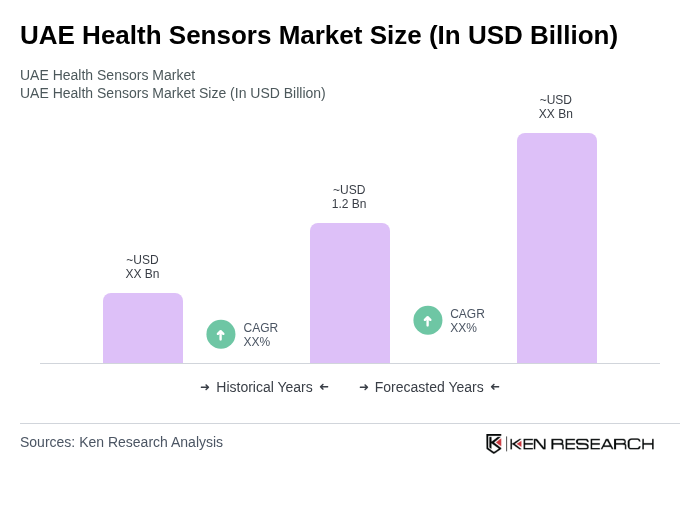
- The UAE Health Sensors Market is valued at USD 1.2 billion, based on a five-year historical analysis. This growth is primarily driven by the increasing prevalence of chronic diseases, rising health awareness among consumers, and advancements in sensor technology. The integration of health sensors in personal healthcare devices has also contributed significantly to market expansion. Recent trends highlight the rapid adoption of AI-enabled wearable devices, partnerships between technology firms and healthcare providers, and the growing focus on preventive healthcare and remote patient monitoring as key market drivers .
- Dubai and Abu Dhabi are the dominant cities in the UAE Health Sensors Market due to their advanced healthcare infrastructure, high disposable income, and a tech-savvy population. The government's focus on digital health initiatives and smart city projects further enhances the market's growth potential in these regions. Large-scale investments in digital health and smart infrastructure continue to position these cities as regional leaders in health technology adoption .
- In 2023, the UAE government implemented a regulation mandating the use of health sensors in telemedicine services. This regulation, under the "Telehealth Services Regulation, 2023" issued by the UAE Ministry of Health and Prevention, requires healthcare providers to integrate certified health sensor devices for remote patient monitoring in all telemedicine consultations. The regulation specifies operational standards for device interoperability, data security, and mandatory compliance audits for licensed telehealth providers .
UAE Health Sensors Market Segmentation
By Type:The market is segmented into various types of health sensors, including wearable sensors, implantable sensors, ingestible sensors, environmental sensors, remote patient monitoring devices, and others. Each type serves distinct purposes and caters to different consumer needs. Wearable sensors, such as fitness trackers and smartwatches, are the most widely adopted, offering real-time health monitoring and lifestyle management. Implantable and ingestible sensors are primarily used for clinical and diagnostic applications, while environmental sensors and remote patient monitoring devices support broader health and wellness management .
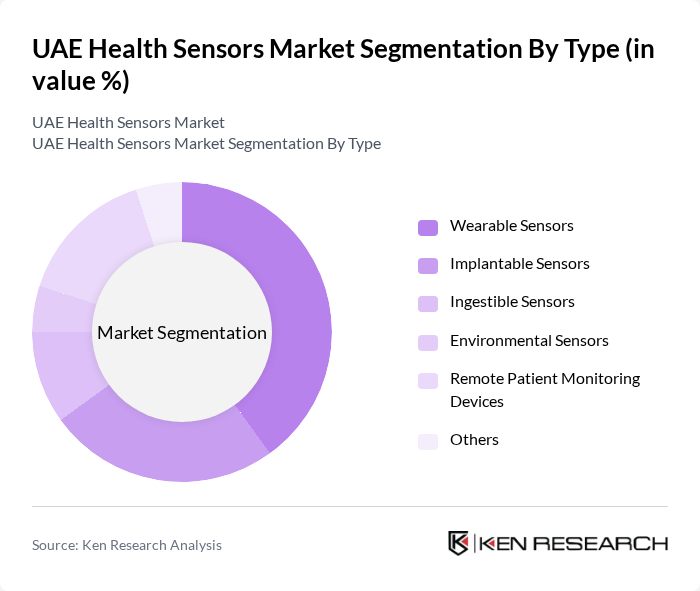
Wearable sensors dominate the market due to their increasing adoption among consumers for fitness tracking and health monitoring. Devices such as fitness trackers and smartwatches have gained popularity, driven by consumer demand for real-time health data and lifestyle management. The convenience and accessibility of these devices have made them a preferred choice for health monitoring, leading to significant market growth. Integration with AI and cloud analytics further enhances the value proposition of wearable sensors .
By End-User:The market is segmented based on end-users, including hospitals and clinics, home healthcare settings, rehabilitation centers, fitness centers, corporate wellness programs, insurance companies, and others. Each segment has unique requirements and applications for health sensors. Hospitals and clinics lead in adoption due to their need for continuous patient monitoring and chronic disease management, while home healthcare settings are rapidly growing as remote monitoring and telemedicine become more prevalent .
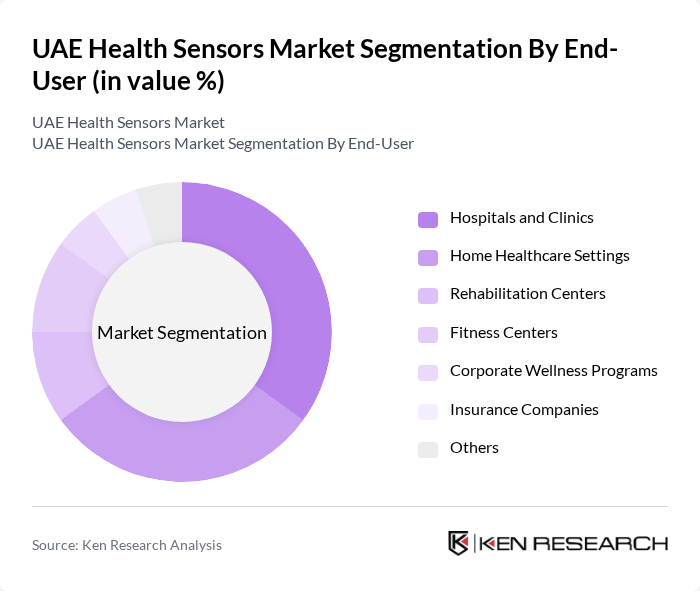
Hospitals and clinics are the leading end-users of health sensors, primarily due to the increasing need for patient monitoring and management in clinical settings. The integration of health sensors in hospital systems enhances patient care, improves operational efficiency, and supports chronic disease management, making them indispensable in modern healthcare. Home healthcare settings are also expanding rapidly, supported by telehealth adoption and patient demand for remote monitoring solutions .
UAE Health Sensors Market Competitive Landscape
The UAE Health Sensors Market is characterized by a dynamic mix of regional and international players. Leading participants such as Philips Healthcare, Siemens Healthineers, Medtronic, Abbott Laboratories, GE Healthcare, Honeywell, Fitbit Inc., Samsung Electronics Co., Ltd., Omron Healthcare, Withings, iHealth Labs, Garmin Ltd., Biotronik, AliveCor, Inc., DarioHealth, Apple Inc., Huawei Technologies Co., Ltd., Xiaomi Corporation, Oura Health Ltd., BioTelemetry, Inc., Zephyr Technology Corporation, Empatica Srl contribute to innovation, geographic expansion, and service delivery in this space .
UAE Health Sensors Market Industry Analysis
Growth Drivers
- Increasing Prevalence of Chronic Diseases:The UAE has witnessed a significant rise in chronic diseases, with diabetes affecting approximately 1.5 million people as of in future. The World Health Organization reported that 20% of the adult population is diabetic, leading to a growing demand for health sensors that monitor glucose levels and other vital signs. This trend is expected to drive the adoption of health sensors, as healthcare providers seek efficient solutions to manage chronic conditions effectively.
- Rising Demand for Remote Patient Monitoring:The COVID-19 pandemic accelerated the need for remote patient monitoring solutions, with a reported 70% increase in telehealth consultations in future. The UAE government aims to enhance healthcare accessibility, targeting a 40% increase in remote monitoring adoption in future. This shift is fostering the development of advanced health sensors that facilitate continuous monitoring, enabling healthcare professionals to provide timely interventions and improve patient outcomes.
- Technological Advancements in Health Sensors:The UAE health sensors market is benefiting from rapid technological advancements, with investments in R&D reaching AED 2 billion in future. Innovations such as IoT-enabled devices and AI-driven analytics are enhancing sensor capabilities, allowing for real-time health monitoring. This technological evolution is expected to attract more consumers and healthcare providers, as they seek to leverage these advancements for improved health management and patient care.
Market Challenges
- High Costs of Advanced Health Sensors:The high costs associated with advanced health sensors pose a significant barrier to market growth. For instance, premium wearable devices can range from AED 1,200 to AED 3,500, limiting accessibility for lower-income populations. This financial constraint is exacerbated by the fact that only 30% of the population is covered by health insurance that includes such technologies, hindering widespread adoption and utilization of health sensors.
- Data Privacy and Security Concerns:As health sensors collect sensitive personal data, concerns regarding data privacy and security are paramount. In future, 75% of consumers expressed apprehension about data breaches, which could lead to identity theft or misuse of health information. The lack of robust data protection regulations in the UAE further complicates this issue, creating hesitance among potential users to adopt health monitoring technologies, thereby stifling market growth.
UAE Health Sensors Market Future Outlook
The UAE health sensors market is poised for significant transformation, driven by the integration of advanced technologies and a focus on personalized healthcare solutions. As the government continues to promote digital health initiatives, the adoption of telehealth services is expected to rise, enhancing patient engagement. Furthermore, the increasing elderly population will necessitate innovative health monitoring solutions, creating a favorable environment for market expansion and collaboration between technology providers and healthcare institutions.
Market Opportunities
- Expansion of Telehealth Services:The UAE's telehealth services are projected to expand significantly, with an estimated 50% increase in usage in future. This growth presents an opportunity for health sensor manufacturers to develop compatible devices that enhance remote monitoring capabilities, ultimately improving patient care and reducing healthcare costs.
- Integration of AI in Health Monitoring:The integration of AI technologies in health monitoring is expected to revolutionize the sector, with investments in AI healthcare solutions projected to reach AED 1.5 billion in future. This trend offers opportunities for health sensor companies to innovate and create smarter devices that provide predictive analytics, improving health outcomes and operational efficiencies for healthcare providers.
Scope of the Report
| Segment | Sub-Segments |
|---|---|
| By Type | Wearable Sensors (Fitness Trackers, Smartwatches, Health Monitoring Bands, Smart Clothing, Wearable ECG Monitors, Wearable Blood Pressure Monitors) Implantable Sensors (Glucose Monitors, Cardiac Monitors, Neurostimulators) Ingestible Sensors (Capsule Endoscopy, Medication Adherence Sensors) Environmental Sensors (Air Quality, Temperature, Humidity Sensors for Healthcare Environments) Remote Patient Monitoring Devices Others (Biophysical Sensors, Multi-parameter Monitors) |
| By End-User | Hospitals and Clinics Home Healthcare Settings Rehabilitation Centers Fitness Centers Corporate Wellness Programs Insurance Companies Others |
| By Application | Chronic Disease Management Fitness and Wellness Monitoring Remote Patient Monitoring Emergency Health Alerts Clinical Trials Others |
| By Distribution Channel | Online Retail Offline Retail Direct Sales Distributors B2B Sales Others |
| By Technology | Bluetooth Enabled Devices Wi-Fi Enabled Devices NFC Technology Cellular Enabled Devices MEMS-based Sensors CMOS-based Sensors Others |
| By Region | Abu Dhabi Dubai Sharjah Ajman Others |
| By Policy Support | Government Subsidies Tax Incentives Grants for Research and Development Others |
Key Target Audience
Investors and Venture Capitalist Firms
Government and Regulatory Bodies (e.g., Ministry of Health and Prevention, Dubai Health Authority)
Manufacturers and Producers
Distributors and Retailers
Healthcare Providers and Hospitals
Technology Providers
Industry Associations (e.g., UAE Medical Device Manufacturers Association)
Health Insurance Companies
Players Mentioned in the Report:
Philips Healthcare
Siemens Healthineers
Medtronic
Abbott Laboratories
GE Healthcare
Honeywell
Fitbit Inc.
Samsung Electronics Co., Ltd.
Omron Healthcare
Withings
iHealth Labs
Garmin Ltd.
Biotronik
AliveCor, Inc.
DarioHealth
Apple Inc.
Huawei Technologies Co., Ltd.
Xiaomi Corporation
Oura Health Ltd.
BioTelemetry, Inc.
Zephyr Technology Corporation
Empatica Srl
Table of Contents
Market Assessment Phase
1. Executive Summary and Approach
2. UAE Health Sensors Market Overview
2.1 Key Insights and Strategic Recommendations
2.2 UAE Health Sensors Market Overview
2.3 Definition and Scope
2.4 Evolution of Market Ecosystem
2.5 Timeline of Key Regulatory Milestones
2.6 Value Chain & Stakeholder Mapping
2.7 Business Cycle Analysis
2.8 Policy & Incentive Landscape
3. UAE Health Sensors Market Analysis
3.1 Growth Drivers
3.1.1 Increasing prevalence of chronic diseases
3.1.2 Rising demand for remote patient monitoring
3.1.3 Technological advancements in health sensors
3.1.4 Government initiatives promoting digital health
3.2 Market Challenges
3.2.1 High costs of advanced health sensors
3.2.2 Data privacy and security concerns
3.2.3 Limited awareness among consumers
3.2.4 Regulatory hurdles in product approvals
3.3 Market Opportunities
3.3.1 Expansion of telehealth services
3.3.2 Integration of AI in health monitoring
3.3.3 Growing elderly population requiring health monitoring
3.3.4 Partnerships with healthcare providers
3.4 Market Trends
3.4.1 Shift towards personalized healthcare solutions
3.4.2 Increasing adoption of wearable health technology
3.4.3 Focus on preventive healthcare measures
3.4.4 Rise in health data analytics
3.5 Government Regulation
3.5.1 Implementation of health data protection laws
3.5.2 Standards for medical device safety and efficacy
3.5.3 Guidelines for telehealth practices
3.5.4 Incentives for local manufacturing of health sensors
4. SWOT Analysis
5. Stakeholder Analysis
6. Porter's Five Forces Analysis
7. UAE Health Sensors Market Market Size, 2019-2024
7.1 By Value
7.2 By Volume
7.3 By Average Selling Price
8. UAE Health Sensors Market Segmentation
8.1 By Type
8.1.1 Wearable Sensors (Fitness Trackers, Smartwatches, Health Monitoring Bands, Smart Clothing, Wearable ECG Monitors, Wearable Blood Pressure Monitors)
8.1.2 Implantable Sensors (Glucose Monitors, Cardiac Monitors, Neurostimulators)
8.1.3 Ingestible Sensors (Capsule Endoscopy, Medication Adherence Sensors)
8.1.4 Environmental Sensors (Air Quality, Temperature, Humidity Sensors for Healthcare Environments)
8.1.5 Remote Patient Monitoring Devices
8.1.6 Others (Biophysical Sensors, Multi-parameter Monitors)
8.2 By End-User
8.2.1 Hospitals and Clinics
8.2.2 Home Healthcare Settings
8.2.3 Rehabilitation Centers
8.2.4 Fitness Centers
8.2.5 Corporate Wellness Programs
8.2.6 Insurance Companies
8.2.7 Others
8.3 By Application
8.3.1 Chronic Disease Management
8.3.2 Fitness and Wellness Monitoring
8.3.3 Remote Patient Monitoring
8.3.4 Emergency Health Alerts
8.3.5 Clinical Trials
8.3.6 Others
8.4 By Distribution Channel
8.4.1 Online Retail
8.4.2 Offline Retail
8.4.3 Direct Sales
8.4.4 Distributors
8.4.5 B2B Sales
8.4.6 Others
8.5 By Technology
8.5.1 Bluetooth Enabled Devices
8.5.2 Wi-Fi Enabled Devices
8.5.3 NFC Technology
8.5.4 Cellular Enabled Devices
8.5.5 MEMS-based Sensors
8.5.6 CMOS-based Sensors
8.5.7 Others
8.6 By Region
8.6.1 Abu Dhabi
8.6.2 Dubai
8.6.3 Sharjah
8.6.4 Ajman
8.6.5 Others
8.7 By Policy Support
8.7.1 Government Subsidies
8.7.2 Tax Incentives
8.7.3 Grants for Research and Development
8.7.4 Others
9. UAE Health Sensors Market Competitive Analysis
9.1 Market Share of Key Players
9.2 Cross Comparison of Key Players
9.2.1 Company Name
9.2.2 Group Size (Large, Medium, or Small as per industry convention)
9.2.3 Revenue Growth Rate (Year-on-Year %)
9.2.4 Market Penetration Rate (Share of UAE Health Sensors Market)
9.2.5 Customer Retention Rate (% of repeat customers or contracts)
9.2.6 Product Innovation Rate (Number of new products/major upgrades launched annually)
9.2.7 Pricing Strategy (Premium, Mid-range, Budget)
9.2.8 Distribution Efficiency (Average delivery time, coverage of UAE regions)
9.2.9 Brand Recognition (Brand awareness score, awards, certifications)
9.2.10 Customer Satisfaction Score (Net Promoter Score, survey ratings)
9.2.11 Regulatory Compliance (Number of UAE/MOHAP approvals, certifications)
9.2.12 Local Partnership Activity (Number of UAE-based collaborations, joint ventures)
9.3 SWOT Analysis of Top Players
9.4 Pricing Analysis
9.5 Detailed Profile of Major Companies
9.5.1 Philips Healthcare
9.5.2 Siemens Healthineers
9.5.3 Medtronic
9.5.4 Abbott Laboratories
9.5.5 GE Healthcare
9.5.6 Honeywell
9.5.7 Fitbit Inc.
9.5.8 Samsung Electronics Co., Ltd.
9.5.9 Omron Healthcare
9.5.10 Withings
9.5.11 iHealth Labs
9.5.12 Garmin Ltd.
9.5.13 Biotronik
9.5.14 AliveCor, Inc.
9.5.15 DarioHealth
9.5.16 Apple Inc.
9.5.17 Huawei Technologies Co., Ltd.
9.5.18 Xiaomi Corporation
9.5.19 Oura Health Ltd.
9.5.20 BioTelemetry, Inc.
9.5.21 Zephyr Technology Corporation
9.5.22 Empatica Srl
10. UAE Health Sensors Market End-User Analysis
10.1 Procurement Behavior of Key Ministries
10.1.1 Health Ministry Procurement Trends
10.1.2 Budget Allocations for Health Sensors
10.1.3 Evaluation Criteria for Health Sensor Procurement
10.1.4 Collaboration with Private Sector
10.2 Corporate Spend on Infrastructure & Energy
10.2.1 Investment in Health Technology
10.2.2 Budgeting for Health Sensor Integration
10.2.3 Corporate Partnerships for Health Solutions
10.2.4 Trends in Corporate Health Spending
10.3 Pain Point Analysis by End-User Category
10.3.1 Challenges Faced by Hospitals
10.3.2 Issues in Home Care Settings
10.3.3 Rehabilitation Center Needs
10.3.4 Fitness Center Demands
10.4 User Readiness for Adoption
10.4.1 Awareness Levels Among Users
10.4.2 Training Needs for Health Sensors
10.4.3 User Experience Feedback
10.4.4 Adoption Barriers
10.5 Post-Deployment ROI and Use Case Expansion
10.5.1 Measuring ROI from Health Sensors
10.5.2 Use Case Expansion Opportunities
10.5.3 Long-term Benefits of Health Sensors
10.5.4 Case Studies of Successful Implementations
11. UAE Health Sensors Market Future Size, 2025-2030
11.1 By Value
11.2 By Volume
11.3 By Average Selling Price
Go-To-Market Strategy Phase
1. Whitespace Analysis + Business Model Canvas
1.1 Market Gaps Identification
1.2 Business Model Development
2. Marketing and Positioning Recommendations
2.1 Branding Strategies
2.2 Product USPs
3. Distribution Plan
3.1 Urban Retail vs Rural NGO Tie-ups
4. Channel & Pricing Gaps
4.1 Underserved Routes
4.2 Pricing Bands
5. Unmet Demand & Latent Needs
5.1 Category Gaps
5.2 Consumer Segments
6. Customer Relationship
6.1 Loyalty Programs
6.2 After-sales Service
7. Value Proposition
7.1 Sustainability
7.2 Integrated Supply Chains
8. Key Activities
8.1 Regulatory Compliance
8.2 Branding
8.3 Distribution Setup
9. Entry Strategy Evaluation
9.1 Domestic Market Entry Strategy
9.1.1 Product Mix
9.1.2 Pricing Band
9.1.3 Packaging
9.2 Export Entry Strategy
9.2.1 Target Countries
9.2.2 Compliance Roadmap
10. Entry Mode Assessment
10.1 JV
10.2 Greenfield
10.3 M&A
10.4 Distributor Model
11. Capital and Timeline Estimation
11.1 Capital Requirements
11.2 Timelines
12. Control vs Risk Trade-Off
12.1 Ownership vs Partnerships
13. Profitability Outlook
13.1 Breakeven Analysis
13.2 Long-term Sustainability
14. Potential Partner List
14.1 Distributors
14.2 JVs
14.3 Acquisition Targets
15. Execution Roadmap
15.1 Phased Plan for Market Entry
15.1.1 Market Setup
15.1.2 Market Entry
15.1.3 Growth Acceleration
15.1.4 Scale & Stabilize
15.2 Key Activities and Milestones
15.2.1 Milestone Planning
15.2.2 Activity Tracking
Research Methodology
Phase 1: Approach1
Desk Research
- Analysis of market reports from health technology associations and government health departments
- Review of published articles and white papers on health sensors and wearable technology trends
- Examination of statistical data from healthcare expenditure reports and demographic studies in the UAE
Primary Research
- Interviews with healthcare professionals and hospital administrators regarding sensor adoption
- Surveys targeting patients to understand their experiences and preferences with health sensors
- Focus groups with technology developers and manufacturers in the health sensor space
Validation & Triangulation
- Cross-validation of findings through multiple data sources including industry reports and expert opinions
- Triangulation of market trends with sales data from health sensor manufacturers
- Sanity checks conducted through expert panel reviews and feedback sessions
Phase 2: Market Size Estimation1
Top-down Assessment
- Estimation of the overall healthcare market size in the UAE and its growth rate
- Segmentation of the health sensors market by application areas such as fitness, chronic disease management, and remote monitoring
- Incorporation of government initiatives promoting digital health and telemedicine
Bottom-up Modeling
- Collection of sales data from leading health sensor manufacturers operating in the UAE
- Estimation of market penetration rates based on consumer adoption trends and healthcare provider feedback
- Volume and pricing analysis to derive revenue estimates for various sensor categories
Forecasting & Scenario Analysis
- Multi-variable forecasting using factors such as population health trends and technological advancements
- Scenario analysis based on potential regulatory changes and market entry of new technologies
- Development of baseline, optimistic, and pessimistic market projections through 2030
Phase 3: CATI Sample Composition1
| Scope Item/Segment | Sample Size | Target Respondent Profiles |
|---|---|---|
| Healthcare Providers | 100 | Doctors, Hospital Administrators |
| Patients Using Health Sensors | 80 | Chronic Disease Patients, Fitness Enthusiasts |
| Health Technology Developers | 60 | Product Managers, R&D Engineers |
| Insurance Companies | 50 | Underwriters, Health Policy Analysts |
| Regulatory Bodies | 40 | Health Regulators, Compliance Officers |
Frequently Asked Questions
What is the current value of the UAE Health Sensors Market?
The UAE Health Sensors Market is valued at approximately USD 1.2 billion, reflecting significant growth driven by the rising prevalence of chronic diseases, increased health awareness, and advancements in sensor technology.
What are the main drivers of growth in the UAE Health Sensors Market?
Which cities dominate the UAE Health Sensors Market?
What types of health sensors are available in the UAE market?
Other Regional/Country Reports
Indonesia Health Sensors Market
Malaysia Health Sensors Market
KSA Health Sensors Market
APAC Health Sensors Market
SEA Health Sensors Market
Other Adjacent Reports
Thailand IoT Healthcare Market
South Africa AI Healthcare Market
Vietnam Fitness Trackers Market Size, Share & Forecast, 2026-2031India Biosensors Market Outlook to 2030Qatar Digital Health Market Size, Share & Forecast, By Product Type, Care Setting & Technology, 2026-2032Global Mining Equipment Market 2030Philippines Medical Imaging Market Size, Share & Forecast, By Product Type, Technology & End User, 2025-2032Why Buy From Us?

What makes us stand out is that our consultants follow Robust, Refine and Result (RRR) methodology. Robust for clear definitions, approaches and sanity checking, Refine for differentiating respondents' facts and opinions, and Result for presenting data with story.

We have set a benchmark in the industry by offering our clients with syndicated and customized market research reports featuring coverage of entire market as well as meticulous research and analyst insights.

While we don't replace traditional research, we flip the method upside down. Our dual approach of Top Bottom & Bottom Top ensures quality deliverable by not just verifying company fundamentals but also looking at the sector and macroeconomic factors.

With one step in the future, our research team constantly tries to show you the bigger picture. We help with some of the tough questions you may encounter along the way: How is the industry positioned? Best marketing channel? KPI's of competitors? By aligning every element, we help maximize success.

Our report gives you instant access to the answers and sources that other companies might choose to hide. We elaborate each steps of research methodology we have used and showcase you the sample size to earn your trust.

If you need any support, we are here! We pride ourselves on universe strength, data quality, and quick, friendly, and professional service.